by
Tom Gurney
Tom Gurney BSc (Hons) is an art history expert with over 20 years experience
Email:
tomgurney1@gmail.com
/ Phone:
+44 7429 011000
Portrait of Anne of Cleves by Hans Holbein the Younger: Introduction
Anne of Cleves faces us with her hands folded at her waist, surrounded by red cloth, patterned gold borders and an intricate headdress. Her face occupies a small, quiet space within this display. The eyes meet ours; the lips rest together; the elaborate clothing leaves little of her body exposed. Holbein gives the viewer a remarkably direct encounter while keeping the sitter's expression difficult to read.
This is the Louvre's portrait of the German princess who became Henry VIII's fourth wife. Its catalogue date remains 1539, although recent research has reopened the possibility of a London painting associated with the marriage in 1540. The distinction matters: Holbein's documented journey to portray Anne does not by itself establish where this particular painting was completed. Its restored colours and newly legible details invite us to look beyond the familiar story of a disappointed king and a supposedly deceptive likeness. [1] [2] [3]
At a Glance
- Artist Hans Holbein the Younger, c.1497/98–1543.
- Subject Anne of Cleves, 1515–1557, fourth wife of Henry VIII.
- Date 1539 in the Louvre collection catalogue; 1539–1540 in the museum's 2025 reassessment.
- Medium Oil on vellum mounted on canvas; the Louvre records an earlier wooden support.
- Dimensions 65 × 48 cm, excluding the frame.
- Collection Musée du Louvre, Department of Paintings, Paris.
- Inventory INV 1348; MR 756.
- Marriage Celebrated on 6 January 1540; annulled that July.
- Key question Is this the portrait made during the Düren mission, or a painting produced in England from studies? [1] [2] [3] [4] [5] [6] [7]
This work across Hans Holbein the Younger’s career
Dead Christ in the Tomb
1521–22 [9]Sir Thomas More
1527 [10]Georg Giese
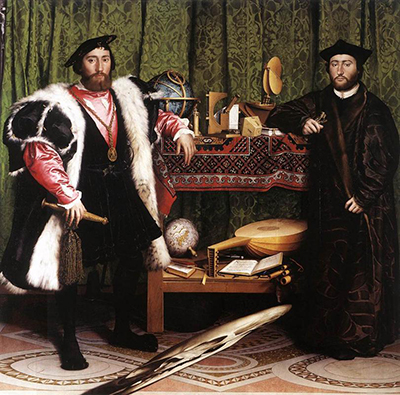
1532 [11]The Ambassadors
1533 [12]Portrait of Anne of Cleves by Hans Holbein the Younger (current article)
1539 in the Louvre collection catalogue; 1539–1540 in the museum's 2025 reassessmentContents
- Meeting Anne face to face
- Reading the costume
- A painter sent into a marriage negotiation
- Vellum, portability and a lost design
- What restoration changed
- Düren in 1539 or England in 1540?
- Henry's disappointment and the evidence for deception
- Copies, collectors and the image we inherit
Meeting Anne face to face
Begin with the line down the centre of the painting. The headdress rises over the forehead; the nose, mouth, pendant and belt buckle follow below; finally the hands gather near the same axis. Around this central line, Holbein spreads the costume into a broad, balanced shape. The upper sleeves expand outwards, while their long borders descend towards the lower corners. Anne seems firmly established within the rectangle, even though we see neither a chair nor the floor beneath her.
Small differences keep the symmetry alive. The fingers overlap unevenly. The folds of the sleeves pull in different directions. Chains fall in loose curves against the more rigid ornament of the neckline, and the headdress projects differently on either side. Looking closely, the portrait becomes less like an emblem and more like a person wearing a carefully arranged and physically substantial set of clothes.
The hands deserve time. Their pale surfaces emerge between soft white cuffs and the red sleeves, making a second area of exposed flesh below the face. Rings punctuate the fingers. The interlacing gesture closes the composition without becoming a tightly clenched grip. It can suggest composure to a viewer, but it does not tell us whether Anne felt calm, apprehensive or bored during a sitting. A formal portrait preserves a chosen presentation; the sitter's feelings remain beyond its reach.
The same caution helps with her face. Its slight asymmetries and gently modelled features resist the idea of a generic beauty. Yet visible specificity cannot prove that every feature is an exact measurement of Anne's appearance. There is no independent photograph against which to check it. What we can judge is how attentively Holbein distinguishes skin from fabric and how little the face depends on an expressive gesture to hold our attention.
Try covering the lower half of the image, then the upper half. The face and headdress create a compact portrait on their own; the hands and dress offer an almost equally absorbing arrangement of textures. Together they make two kinds of presence inseparable: the individual woman and her splendid public appearance.
Reading the costume
The red sleeves have broad areas of shadow and light, whereas the gold-coloured borders are filled with repeated shapes. This contrast gives the eye places to rest before it returns to the smaller ornaments. Along the neckline, round jewels and pale bead-like accents create a measured frame around the upper body. Below it, narrower chains introduce freer, overlapping rhythms. Holbein makes lavishness readable by changing the scale and spacing of the detail.
White fabric fills the opening above the bodice. Its bands of decoration run horizontally across the chest, beneath the necklaces, while the sleeve borders lead downwards. These crossing directions help hold the figure together. The clothing does much of the work that architecture or furniture performs in other portraits: it organises the space around the sitter and announces a social position without the need for a room full of possessions.
The headdress is particularly absorbing. Its outline encloses the cheeks while its ornaments spread beyond them, and a translucent-looking edge projects at the sides. A portrait seen quickly can turn all this complexity into one heavy shape. Slower looking reveals a succession of different surfaces, edges and attachments. The face is enclosed, but it is not swallowed by the ornament.
Two details have acquired particular significance in the Louvre's recent interpretation. The band across Anne's forehead carries the words “A BON FINE”, a motto the museum relates to bridal clothing in marriage portraits. A brooch on the headdress represents a couple facing one another. The Louvre reads these as references to Anne's marriage to Henry. They give the costume a more specific role than the general advertisement of wealth. [2]
Such details also change the scale at which the painting asks to be viewed. From a distance we register red, gold, pale skin and the direct gaze. Nearby, a few tiny letters or figures may bear on the portrait's occasion. Decorative precision and historical evidence meet in the same small painted forms.
A painter sent into a marriage negotiation
Holbein was already serving Henry as a royal painter when he was sent to portray Anne and her sister Amalia in 1539. The Royal Collection's account places his appointment by September 1536 and describes a job embracing jewellery and metalwork designs as well as likenesses. Sending such an artist abroad placed a trusted visual specialist inside a diplomatic undertaking. [2] [14]
Nicholas Wotton's letter to Henry, dated at Düren on 11 August 1539, gives the mission its clearest contemporary setting. Much of the letter concerns ambassadors, the proposed dowry and the documents needed to establish that Anne was free to marry. An earlier arrangement involving the house of Lorraine had to be addressed. Wotton was also trying to secure information about the marriage settlement of Anne's sister Sibylle. The portrait belonged among these practical enquiries, alongside questions about money, obligations and alliances. [3]
Wotton then turned to Anne herself. He described an upbringing closely supervised by her mother, needlework occupying much of her time, and a command of her own language without French or Latin. He expected that she could learn English. His account of her lack of musical training was accompanied by an explanation of local attitudes towards great ladies performing music. These observations tell us something about the cultural expectations through which an English envoy assessed a German princess. They should not be turned into proof that Anne lacked intelligence or education altogether. [3]
Near the end, Wotton reported that Holbein had portrayed both sisters and had rendered their images “verye lyvelye”. The phrase is short, but its position is revealing. It comes within a report intended to inform Henry, rather than in a later defence of the painter after the marriage failed. An observer involved in the negotiations was affirming the portraits' effectiveness before Anne travelled to England. [3]
The letter leaves an important gap. It confirms the making of likenesses, but supplies neither dimensions nor a detailed description that securely identifies the Louvre work. No phrase about its vellum, costume or hands ties that particular object to the report. We can therefore be confident about the mission while remaining open about the surviving painting's exact relationship to it.
The distance between the two courts explains why portraiture was useful. Written reports could enumerate accomplishments and describe a family; a painted likeness offered another form of encounter. Neither could reproduce the experience of meeting someone, speaking with her or sharing a household. The diplomatic use of portraits gave them considerable responsibilities without making them substitutes for every other kind of knowledge.
Vellum, portability and a lost design
The painting's support is unusual enough to have shaped its interpretation. Button identifies oil paint on parchment mounted on canvas. [15] Vellum is an animal-skin material rather than woven cloth. Describing the picture simply as an oil on canvas misses the surface on which Holbein actually painted.
A flexible support could travel more readily than a heavy panel, a practical advantage discussed in Victoria Button's study of Holbein's materials. [15] Portability nevertheless establishes neither where a brush touched the surface nor why this particular support was chosen. A portable painting could be produced in a studio for subsequent dispatch, just as studies brought home from a journey could be used to construct a finished likeness.
Victoria Button's research provides another reason to distinguish the surviving picture from an immediate record of a sitting. Discussing Anne's portrait in her 2013 thesis, she reports evidence of transfer by pouncing in its underdrawing. Pouncing carries a design through a pattern of small holes onto another surface. Her discussion, drawing on earlier technical scholarship, points to an intermediary design rather than a painting simply worked up over a drawing made directly before Anne. [15]
That observation has limits. A transferred design does not tell us the location of the transfer, and it cannot alone settle the date. It does, however, make room for stages of work that the familiar phrase “painted from life” tends to compress. A portrait may ultimately depend on observation of a sitter while passing through studies, patterns and a carefully prepared final image. Anne's direct gaze survives that elaborate process of making.
Watch: Holbein’s portraits and working methods
Explore museum films on Holbein’s drawings, painted portraits and close-looking details.
Hans Holbein at the court of Henry VIII
A Royal Collection Trust film exploring Holbein’s work at Henry VIII’s court.
Watch on YouTubeWhat restoration changed
Older reproductions can make the background appear almost black and give the entire portrait a brownish cast. This is especially misleading in a painting whose impact depends on distinctions between pale flesh, coloured fabric and fine ornament. It encourages us to treat the face as a light patch emerging from gloom, with the costume congealing around it.
The Louvre decided on restoration in 2021. The work took place at the Centre de recherche et de restauration des musées de France, with restorers Annie Hochart-Giacobbi and Jim Poncelet. [2]
The museum's report for 2024 describes problems affecting the support as well as the paint surface: irregularities in the parchment, tears and areas of detachment accompanied dirt and uneven layers of oxidised varnish. Treatment recovered a much brighter blue background and made the figure's modelling clearer. The report singles out the small mole beneath Anne's lip among the facial details that became visible. [16]
These changes affect interpretation as well as appearance. A clear blue field separates the silhouette from its surroundings; cleaner colour allows the sleeves, borders and skin to assert different textures. When a portrait has long circulated through dark reproductions, its supposed heaviness can become a judgement about the sitter instead of a response to the painting's condition.
Restoration does not remove the centuries between Anne and ourselves. It gives us a better opportunity to assess the surviving work. In this case, it has also made small features of the costume available for renewed historical scrutiny, bringing an apparently familiar portrait back into active debate.
Düren in 1539 or England in 1540?
The Louvre's collection catalogue continues to give 1539. Its more recent interpretation allows a broader account. The museum's announcement of Cécile Scailliérez's lecture on 5 June 2025 explicitly asked whether the painting was a betrothal portrait made in Düren or a marriage portrait made in England. The accompanying programme placed its approximate execution between July 1539 and July 1540. These are signs of a reassessment, rather than a universally settled new date. [1] [4] [5]
The possibilities imply different moments in Anne's public life. A betrothal portrait would present a prospective bride during negotiations. An English marriage portrait could mark the status she had attained after arriving in Henry's kingdom. The bridal references in her dress matter in either case, but their meaning would fall at a different point in the sequence.
It is easy to let a well-known story decide the answer in advance. If the Louvre picture is assumed to be the image Henry saw before agreeing to the match, every feature becomes part of a sales pitch. If it was made in England, perhaps from earlier studies, that assumption no longer holds. The picture could still depend on the Düren mission without being identical to its diplomatic product.
The sensible distinction is between a documented event and an object-specific identification. Wotton establishes Holbein's activity in 1539. The material examination and marriage details raise questions about this painting's making and use. They do not undo the letter, and the letter does not answer every question raised by the object. Holding both kinds of evidence together gives a more interesting history than forcing either to silence the other. [3] [15] [4] [5]
Henry's disappointment and the evidence for deception
Henry married Anne on 6 January 1540. By July, witnesses were being gathered for proceedings to end the union. The surviving depositions contain emphatic accounts of his dislike, but their occasion matters. They were assembled to support the dissolution of a royal marriage, after the relationship had broken down. We are reading testimony with a purpose, not unguarded comments collected at random. [2] [6]
Sir Anthony Browne recalled being sent to Anne at Rochester on New Year's Day and seeing Henry's dissatisfaction when the king met her. He also remembered Henry complaining that she did not match the reports he had received. Browne explained his own unease in terms of his brother, the Earl of Southampton, who had praised her. Anthony Denny likewise described having repeatedly praised Anne to the king and receiving an unfavourable response. Their accounts show a network of spoken and written recommendations under scrutiny. [6]
These passages do not establish that Holbein falsified a likeness. A disappointed husband could object to reports, find a meeting unsatisfactory or refuse affection without proving that a painter had altered a face. Nor does a modern viewer's judgement that the portrait looks attractive settle what Henry expected. The central historical question concerns the evidence for an accusation, not whether we agree with the king's taste.
Other testimony reveals the legal difficulties surrounding the match. Senior councillors recalled unresolved assurances about Anne's earlier Lorraine agreement, and the proceedings included evidence concerning non-consummation. The former issue was already present in Wotton's report of August 1539. It had a history before Henry met Anne. Reducing the annulment to the discovery of an inaccurate picture strips away questions that the negotiators and the later witnesses themselves treated seriously. [3] [6]
The claim that Holbein was punished or dismissed over the portrait also requires evidence. Royal payment entries transcribed by Nicholas Harris Nicolas continue to name him after the marriage ended, at Michaelmas and Christmas 1540 and Midsummer 1541. Their accounting abbreviations include references to earlier payment, so each entry should not be described as a fresh cash reward. They nevertheless contradict a simple story in which the failed match abruptly removed him from royal service. [17]
Anne's own correspondence changes the emphasis again. In a letter of 11 July 1540, preserved in contemporary copies, she accepted the judgement on the marriage and asked to remain among Henry's servants, with the prospect of being received as his sister. A notarial instrument recorded her consent at Richmond in the presence of royal officers and attendants. Her second letter, dated 16 July, reaffirmed the position of sister and servant. [7]
This language was shaped by royal power and the settlement being negotiated. It cannot give us unrestricted access to Anne's private feelings. It does show that her story continued through an active adjustment of status, rather than ending with Henry's first reaction. Looking back at the portrait after reading these letters, the composed figure need no longer appear merely as the unwitting subject of someone else's disappointment.
Copies, collectors and the image we inherit
Holbein's painted image had a long life beyond the Tudor court. Wenceslaus Hollar made an etching after it in 1648; the National Portrait Gallery holds an impression numbered D11254. The Latin inscription identifies Anne as Henry's fourth wife. That label fixes the identity for later viewers, while the translation into printed lines gives the portrait a different material presence. [18]
In a monochrome print, red cloth and blue background cannot do the same work as in oil paint. The organisation of the figure, the costume's pattern and the hands remain available, but colour relationships have to become variations of line and tone. A print can preserve and circulate a likeness while changing the terms on which it is seen. It also places a later maker between the viewer and Holbein's image.
The Louvre traces the painting through Thomas Howard, Earl of Arundel, who took it to the Netherlands in 1642. It passed through his family and the sale of Arundel pictures at Utrecht, then to Everhard Jabach. Louis XIV acquired it from Jabach in 1671. It was displayed at the opening of the Louvre museum in 1793, when the catalogue called the sitter “Jeanne de Clèves”. Even the title attached to a famous image has a history. [1]
Painting, etching and photograph consequently offer related but distinct encounters. Hollar's print records an early stage of its afterlife; a dark older photograph preserves the work through a different veil; the restored painting makes colour and fine detail newly accessible. Comparing them rewards attention to what has changed in the image itself before deciding what has changed in our opinion of Anne.
Artworks directory
Explore paintings, drawings, prints and designs, including works without a separate article. Related studies and versions have their own entries; workshop works and copies are labelled. Print designs and series are grouped rather than repeated for every impression.
Frequently Asked Questions
Oil paint on vellum, now mounted on canvas. The Louvre's record notes an earlier wooden support. Its measurements are 65 × 48 cm without the frame. [1]
The payment records continue to name him after the annulment. They do not support an abrupt dismissal over a deceptive portrait. [17]
Discussion
Look again at the images and ideas explored in Portrait of Anne of Cleves by Hans Holbein the Younger. These editorial prompts invite your observations.
Reader Insights
Spend a moment looking only at Anne's eyes and mouth, then at the great sweep of her sleeves. Which part most strongly shapes your impression of her presence?
Imagine receiving a likeness alongside Wotton's written report. What could each tell you about a person living at another court, and what would remain unknown?
Compare a dark reproduction with the restored painting. Notice whether the clearer background and separate textures alter the character you first imagined for the sitter.
Join the Conversation
Which detail makes you pause longest: the folded hands, the bridal motto, the headdress or Anne's direct gaze? Describe what you see before connecting it with the history of her marriage.
References
- Musée du Louvre , Portrait d'Anne de Clèves (1515–1557), reine d'Angleterre, quatrième épouse de Henri VIII , INV 1348; MR 756, collection record, updated 12 January 2026 (in French). View source .
- Musée du Louvre , Le portrait d'Anne de Clèves par Hans Holbein le Jeune , restoration and interpretation feature (in French). View source .
- Nicholas Wotton , letter to Henry VIII, Düren, 11 August 1539, calendared in James Gairdner and R. H. Brodie, eds, Letters and Papers, Foreign and Domestic, Henry VIII , vol. 14, part 2, 1895, no. 33, pp. 8–9, British History Online. View source .
- Musée du Louvre / Cécile Scailliérez , La restauration du Portrait d'Anne de Clèves par Hans Holbein le Jeune , announcement for the lecture of 5 June 2025 (in French). View source .
- Musée du Louvre / Cécile Scailliérez , La restauration du Portrait d'Anne de Clèves par Hans Holbein le Jeune , programme, 5 June 2025, p. 2 (in French). View source .
- James Gairdner and R. H. Brodie, editors , “The Divorce from Anne of Cleves”, contemporary depositions calendared in Letters and Papers, Foreign and Domestic, Henry VIII , vol. 15, 1896, no. 850, especially sections 3, 7 and 9, British History Online. View source .
- Anne of Cleves , letters to Henry VIII, 11 and 16 July 1540, and associated notarial instrument, calendared in James Gairdner and R. H. Brodie, eds, Letters and Papers, Foreign and Domestic, Henry VIII , vol. 15, 1896, nos. 872 and 891, British History Online. View source .
- Kunstmuseum Basel, Bildnis des Bonifacius Amerbach, 1519, inventory 314 (in German) . View source .
- Kunstmuseum Basel, Der tote Christus im Grab, 1521–22, inventory 318 (in German) . View source .
- The Frick Collection, Sir Thomas More, 1527, accession 1912.1.77, collection record . View source .
- Gemäldegalerie Berlin, Georg Gisze . View source .
- Susan Foister, The Ambassadors, The German Paintings before 1800 (2024) . View source .
- Susan Foister, Christina of Denmark, Duchess of Milan (2024) . View source .
- Royal Collection Trust , Holbein at the Tudor Court , large-print exhibition labels, Nash Gallery, opening “Artists at Court” labels. View source .
- Victoria Button , The Portrait Drawings of Hans Holbein the Younger: Function and Use Explored through Materials and Techniques , PhD thesis, Royal College of Art, 2013, p. 109, including discussion of earlier research by Élisabeth Foucart-Walter and Maryan Ainsworth. View source .
- Musée du Louvre , Bilan d'activité 2024 , “Le Portrait d'Anne de Clèves de Holbein dévoile toutes ses couleurs”, p. 12 (in French). View source .
- Nicholas Harris Nicolas, editor , The Privy Purse Expences of King Henry the Eighth , 1827, introduction, pp. xxvi–xxvii, transcription of royal payment entries, Project Gutenberg. View source .
- National Portrait Gallery , Anne of Cleves by Wenceslaus Hollar, based on a work by Hans Holbein the Younger , schools resource and record of etching, 1648, NPG D11254. View source .
- Würth Collection, Holbeins Schutzmantelmadonna, inventory 14910, current owner account (in German) . View source .
- Metropolitan Museum, Dance of Death series . View source .
- Kunstmuseum Basel, Bildnis der Frau des Künstlers mit den beiden ältesten Kindern, about 1528–29, inventory 325 (in German) . View source .
- Kunsthistorisches Museum Wien, Next Generation, Jane Seymour, about 1536–37, inventory 881 (in German) . View source .