by
Tom Gurney
Tom Gurney BSc (Hons) is an art history expert with over 20 years experience
Email:
tomgurney1@gmail.com
/ Phone:
+44 7429 011000
Anne Cresacre by Hans Holbein the Younger: Introduction
Anne Cresacre turns towards the right, her pale face held within the angular outline of a dark hood. A narrow yellow border catches the eye before it reaches the quiet features beneath. Holbein gives her dress, veil and chair very different degrees of attention, allowing us to follow the making of a portrait across the sheet. Drawn in 1526–27, Anne belonged to the household of Sir Thomas More as his ward; she later married his son John. This study prepared her appearance in Holbein’s portrait of Thomas More and his family , now lost. [1]
At a Glance
- Artist Hans Holbein the Younger.
- Title Anne Cresacre (c.1511–1577) .
- Date 1526–27.
- Medium Black and coloured chalks on paper.
- Dimensions 37.2 × 26.6 cm, sheet of paper.
- Collection Royal Collection, RCIN 912270.
- Sitter Thomas More’s ward and the future wife of his son John More.
- Purpose A study for the lost portrait of Thomas More and his family. [1]
This work across Hans Holbein the Younger’s career
Dead Christ in the Tomb
1521–22 [3]Sir Thomas More
1527 [4]Georg Giese
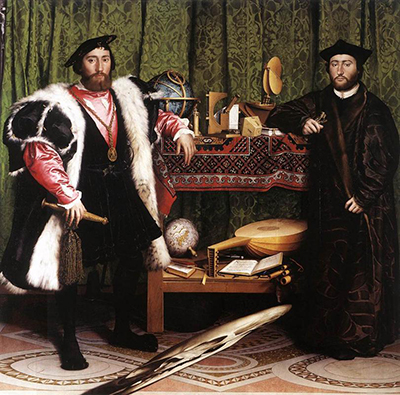
1532 [5]The Ambassadors
1533 [6]Contents
- Anne in the More household
- Chalk, colour and the framing hood
- A seated study for a standing figure
- The drawing and the lost painting
Anne in the More household
Anne’s place in the family is easy to misunderstand. She was More’s ward, rather than one of his daughters, and the Royal Collection describes her marriage to John as a later event. The drawing records a young woman already belonging to the household whose relationship to it would change through marriage. [1]
Her inclusion also gives the phrase “family portrait” a broader meaning. Holbein’s commission gathered a household around More, bringing individual likenesses into a shared composition. Anne’s head turns away from a frontal encounter with us, and her body follows the same direction. Seen alone, she seems to look towards someone beyond the edge of the paper. Within a group, that turn could become part of an exchange between figures.
Chalk, colour and the framing hood
Look first at the difference between Anne’s face and her sleeve. The dark fabric at the lower left is built from conspicuous strokes, its surface alive with changes in direction and pressure. Her face is much more continuous. The Royal Collection explains that Holbein wetted the chalks to establish its flesh tone. The drawing therefore combines the familiar grain of a dry drawing material with a softer, more unified area of colour. [1]
Small changes carry the likeness. A faint shadow beneath the chin separates the head from the neck; the lips are picked out with a short warm line; delicate marks describe the eyelids and the bridge of the nose. Little is needed to make these features legible against the light surrounding paper. The effect rewards close looking, since the strongest darks belong to the clothing rather than the face.
The hood supplies a firm framework. Its edge rises steeply beside the cheek, then changes direction above the forehead. Yellow follows that angular border, while a broad dark veil falls behind the neck towards the shoulder. Between hood and brow, a smooth area of brown hair softens the transition from cloth to skin.
Colour then leads downwards. A similar yellow accent follows the neckline, connecting the head with the torso. Fine lines indicate necklaces and the edge of the garment, while a lightly drawn pattern remains visible on the nearer shoulder. Holbein records enough of the dress to establish its structure without giving every area the density of the veil and sleeve. That uneven finish leaves the drawing open: some passages feel almost solid, others barely touch the paper.
Watch: Holbein’s portraits and working methods
Explore museum films on Holbein’s drawings, painted portraits and close-looking details.
Hans Holbein at the court of Henry VIII
A Royal Collection Trust film exploring Holbein’s work at Henry VIII’s court.
Watch on YouTubeA seated study for a standing figure
At the left edge, faint chair outlines survive beside the much darker silhouette of Anne’s clothing. They are easily overlooked. Yet the chair helps explain how Holbein could study a sitter comfortably while preparing a figure for a different arrangement.
The Royal Collection’s exhibition account draws attention to Anne’s position at the edge of the seat. It reads this pose in relation to the standing figure intended for the finished family portrait. The torso’s upright bearing becomes especially useful when seen that way: the support of the chair need not determine the eventual pose. [8]
The same account suggests that Holbein already had the group’s arrangement in mind when he made the individual studies. Anne’s drawing thus preserves two kinds of preparation at once: the careful description of a particular face and the positioning of a body within a larger design. [8]
The drawing and the lost painting
The finished More family painting was destroyed by fire in 1752. A composition drawing survives in Basel, and the Royal Collection holds individual studies of seven sitters. Its catalogue also points to Rowland Lockey’s early copy at Nostell as possible evidence for the final painting’s appearance. That copy, the Basel design and Anne’s chalk study each preserve a different part of the work’s history. [1]
The sheet itself has a long collecting history. The Royal Collection traces its ownership from Henry VIII through royal and aristocratic collections, including those of the earls of Arundel. Charles II had acquired it by 1675. [1]
Artworks directory
Explore paintings, drawings, prints and designs, including works without a separate article. Related studies and versions have their own entries; workshop works and copies are labelled. Print designs and series are grouped rather than repeated for every impression.
Frequently Asked Questions
She was Sir Thomas More’s ward and later married his son John More. She should not be confused with one of More’s daughters. The Royal Collection gives her lifespan as about 1511–1577. [1]
It is a drawing in black and coloured chalks. Holbein wetted the chalks to create the flesh tone of the face, which helps explain its softly blended appearance. [1]
The Royal Collection’s exhibition text interprets her position at the edge of a chair as preparation for the standing pose in the larger composition. The seated study allowed Holbein to record her likeness and upright bearing together. [8]
The original painting was destroyed by fire in 1752. Surviving drawings and later copies provide evidence of the composition, but they are separate works. Anne’s study is in the Royal Collection. [1]
Discussion
Look again at the images and ideas explored in Anne Cresacre by Hans Holbein the Younger. These editorial prompts invite your observations.
Reader Insights
Trace the yellow edging from the hood to the neckline. How does this small amount of colour connect the face with the rest of the figure?
Look from the cheek to the dark sleeve. Which marks remain visible, and where does the chalk seem to merge into a continuous tone?
Notice the faint lines beside Anne’s shoulder. How does recognising the chair change your understanding of her posture?
Join the Conversation
Which detail first draws you towards Anne: the yellow border, the eyes, or the contrast between face and clothing? Share how your impression changes when you imagine her among the other members of More’s household.
References
- Royal Collection Trust , Hans Holbein the Younger, Anne Cresacre (c.1511–1577) , 1526–27, RCIN 912270, collection description, physical properties and provenance. View source .
- Kunstmuseum Basel, Bildnis des Bonifacius Amerbach, 1519, inventory 314 (in German) . View source .
- Kunstmuseum Basel, Der tote Christus im Grab, 1521–22, inventory 318 (in German) . View source .
- The Frick Collection, Sir Thomas More, 1527, accession 1912.1.77, collection record . View source .
- Gemäldegalerie Berlin, Georg Gisze . View source .
- Susan Foister, The Ambassadors, The German Paintings before 1800 (2024) . View source .
- Susan Foister, Christina of Denmark, Duchess of Milan (2024) . View source .
- Royal Collection Trust , Holbein at the Tudor Court / Holbein am Hof der Tudors , exhibition text, “Die Familie von Thomas More, 1526–27”, PDF page 11 (in German). View source .
- Würth Collection, Holbeins Schutzmantelmadonna, inventory 14910, current owner account (in German) . View source .
- Metropolitan Museum, Dance of Death series . View source .
- Kunstmuseum Basel, Bildnis der Frau des Künstlers mit den beiden ältesten Kindern, about 1528–29, inventory 325 (in German) . View source .
- Kunsthistorisches Museum Wien, Next Generation, Jane Seymour, about 1536–37, inventory 881 (in German) . View source .