by
Tom Gurney
Tom Gurney BSc (Hons) is an art history expert with over 20 years experience
Email:
tomgurney1@gmail.com
/ Phone:
+44 7429 011000
Hans Holbein's Designs for Objects, Glass and Decoration: Introduction
Two children stand beneath a clock, each reaching towards a curved sundial. Lower down, crouching figures brace the base of an enormous hourglass. In Hans Holbein the Younger's design for Anthony Denny's clocksalt, bodies become supports and gestures become parts of an instrument. The separate compass at the left makes the sheet feel like an invention still being discussed: one view supplies information that the main structure cannot show. The drawing, made about 1543, belongs to the British Museum. [1]
This is a useful entrance to Holbein's art beyond portraiture. His designs could surround a printed text, shape a pendant, organise a window or help transform a room. Each required a different relationship between an image and the surface carrying it. A jewel moves with its wearer; a window admits light; a mural confronts people in an actual building. Following these changes brings other makers into view too. Holbein's invention often reached its audience through somebody else's skilled work.
At a Glance
- Artist Hans Holbein the Younger, about 1497–98 to 1543. [2]
- Fields of design Precious metalwork, jewellery, lettering and books, stained glass, murals and festival decoration. [3] [4] [5]
- Drawing illustrated Design for a clock-salt , about 1543, pen and black ink with grey and some red wash, 41 × 21.3 cm; British Museum, 1850,0713.14. [1]
- A related vessel design Table ornament with caryatids , 1533–36; Kunstmuseum Basel, inventory 1662.165.89, traditionally associated with an Anne Boleyn fountain. [6] [7]
- Collaboration Named collaborators include instrument maker Nicholas Kratzer, glass painter Antoni Glaser and blockcutter Hans Lützelburger. Their roles differed between projects. [1] [4] [2]
- Survival Designs, completed works, fragments and later copies provide different kinds of evidence. A surviving drawing alone does not prove that its proposed object was made.
Contents
- Paper between an idea and its making
- Metalwork: giving ornament weight
- Jewels and the shape of a letter
- Books to read, carry and wear
- Stained glass and an image made with light
- Designing the walls of a room
- Decoration for a passing occasion
- Timekeeping and the meeting of skills
- Following designs through portraits and collections
Paper between an idea and its making
A design drawing has several possible audiences. A patron may need to see the effect of a proposed commission. A craftsperson may need an outline, a repeated pattern or a view of a difficult component. The artist may need to test how its parts fit together. Those purposes can coexist on one sheet, although we cannot assign each surviving mark to a particular conversation.
The clocksalt gives this exchange a visible form. Dark contours hold its tower clear against the paper, while wash makes ledges project and bodies turn. The large empty circle near the foot provides a pause below the hourglass. Up above, the clock's face is legible within an open crown. The whole outline remains comparatively simple even where the decoration becomes crowded.
Its frontal view is persuasive, yet it leaves the back and internal construction largely unseen. To imagine the object in use, we must give it depth. A projecting ledge needs thickness; an upright needs a connection to the base; the timekeeping apparatus needs access. The drawing establishes relationships that would matter to manufacture without supplying every answer on its surface.
Other kinds of design needed other information. Basel explains that full-size glass designs could serve presentation or manufacture; a glass painter could complete repeated decoration from a partial pattern. [4] An unfinished-looking passage can therefore be intelligible within a working relationship. Completeness on paper and usefulness to a maker are separate qualities.
This helps us look at Holbein's drawings more attentively. Before judging a sheet by its finish, ask what another person could do with it. A sharply stated silhouette, a written note and an isolated detail may each carry a different part of the proposal.
Designs for objects and larger compositions


Metalwork: giving ornament weight
Holbein's vessel designs make ornament participate in structure. In the Basel Table ornament with caryatids , small bodies gather around the stem and bend beneath projecting edges. The museum dates the pen drawing to 1533–36. Its current descriptive title sits beside the traditional identification as a fountain associated with Anne Boleyn. The sheet does not establish a completed fountain, its patron or its water mechanism. [6] [7]
The figures make the object feel heavy. Bent knees, raised arms and curving backs turn the practical idea of support into bodily effort. Around them, the vessel expands and contracts: narrow foot, stem, swelling body, broad rim, crown. The eye reads the larger balance before separating the small forms packed into it.
That balance is easier to appreciate if we temporarily ignore the crown. Follow the rim's widest projection down to the narrow stem, then towards the foot. The design has to make the broad upper mass seem supported by a much smaller lower one. Shading helps, but the changes of width do much of the work. Decoration gives those transitions extra energy.
The clocksalt uses a related vocabulary in a different arrangement. Its base spreads in curled feet, while a rectangular frame holds the hourglass. Here the centre is open and tall. The Basel vessel appears compact and swelling. Their resemblance lies in the movement between body, foliage and support, rather than in a single repeated silhouette.
The term caryatid identifies a human figure serving as a support. Once recognised, it offers a way through intricate decoration: look for where a shoulder meets a ledge, or where a limb turns into a scroll. These crossings let Holbein give small objects an architectural presence. They also keep the imagined architecture lively, as though every rigid junction could briefly become animate.
Jewels and the shape of a letter
A pendant offers another problem. Its outline must remain convincing against clothing, while its interior can invite much closer inspection. Holbein's design for an RE monogram in the British Museum, about 1536–37, sets stones around entwined letters and suspends three pearls below them. The museum considers it probably a companion to another design associated with Jane Seymour. That proposed pairing should remain qualified. [8]
Look first at the gaps between the letters. They are generous enough for the forms to remain open, even as little curls and settings thicken the edges. At the top, a ring gathers the design towards a point of suspension. Beneath it, the body of the jewel broadens; the hanging pearls extend the outline downwards. The drawing imagines how a letter can become something with weight and a place on the body.
Colour makes the settings distinct without filling the whole surface. Red accents appear across the design from one another, with a green stone lower left and a dark one above right. These small areas punctuate a framework otherwise described by pen. The pearls are pale and rounded, offering a quieter ending below the restless curves.
Lettering here has two simultaneous pleasures. We try to read the monogram, but we also follow it as an arrangement of bars, loops and crossings. Its identity is carried by shape. At the scale of a jewel, the relation between recognisable letter and ornamental complexity becomes especially close.
Such a drawing is also different from a painted record of jewellery someone already owned. The pendant proposes a form. A portrait places an accessory within the appearance of a person. Moving between the two can sharpen our looking, provided we keep the evidence for invention distinct from the evidence for possession.
Books to read, carry and wear
Holbein's book design ranges from the printed opening to the metalwork surrounding a very small volume. In each case the designer must work around something whose purpose extends beyond decoration: words to be read, leaves to be turned or a binding to be handled.
The British Museum's 1518 Basel volume of More's Utopia and epigrams by More and Erasmus brings together borders by Hans Holbein and Urs Graf, illustrations by Ambrosius Holbein, devices after Hans and initials by both brothers. Johann Froben printed it. Hans's title border places the text beneath an architectural arch; the island illustration belongs to Ambrosius. [5]
In the title border, the central field is comparatively calm. Lines of type stand within a broad rectangle, while bodies, foliage and architectural ornament occupy its surroundings. The boundary makes room for two kinds of attention. We can read steadily down the centre or wander through the smaller incidents at its edges. The black marks change density as our attention crosses from lettering to ornament.
A book-jewel reverses that relationship between inside and outside. The Morgan Library's exhibition identifies Holbein's designs for metalwork book covers with intended gold and black enamel, suspension rings and the initials TW and IW, associated with Thomas Wyatt the Younger and his wife Joan. The names become part of flowing ornamental patterns. [9]
Here the cover could be encountered as a personal object before its text was opened. Suspension turns the small volume into something carried on the body; initials connect its exterior with particular people. The scale of reading and the scale of adornment approach one another.
Across these examples, a border or cover gives a text a physical entrance. The printed volume also makes collaboration unusually tangible: several artists' contributions occupy one bound object. For the separate processes of designing, cutting and printing its images, Holbein's prints and woodcuts provide a fuller introduction. Both paper leaf and precious cover make the beginning of reading something to look at and handle.
Watch: Holbein’s portraits and working methods
Explore museum films on Holbein’s drawings, painted portraits and close-looking details.
Hans Holbein at the court of Henry VIII
A Royal Collection Trust film exploring Holbein’s work at Henry VIII’s court.
Watch on YouTubeStained glass and an image made with light
Small glass paintings furnished churches, council chambers and guild houses in sixteenth-century Switzerland and southern Germany. Basel's Lichtgestalten exhibition links their heraldry with office and alliances, and identifies Holbein's architectural settings and low viewpoints as means of giving figures monumentality. [4]
That viewpoint changes the relation between the imagined building and the spectator. Looking up towards a figure can enlarge its presence without requiring an enormous window. An arch or column becomes a measure of the body within it. The frame supplies a place from which the figure seems to address the room.
Glass also changes how we think about a drawn dark area. On paper, wash can suggest a shadow falling across a solid form. In a window, the finished effect depends on light passing through pieces of glass as well as on painted marks. The surrounding room and the brightness outside belong to the encounter. A reproduction of a design cannot restore those changing conditions.
Basel documents Glaser's execution of Holbein's Terminus design and proposes their wider collaboration. It also distinguishes autograph sheets from drawings influenced by Holbein. [4] Designer, glass painter and later imitator therefore deserve individual attention. A familiar architectural vocabulary can connect works while leaving their authorship distinct.
Designing the walls of a room
At monumental scale, design had to organise an encounter with a building. In Basel, Holbein received the commission to paint the Great Council Chamber in 1521. The canton records the destruction of the mural ensemble during later alterations, but also the preservation of original fragments now in the Kunstmuseum Basel. [10] Loss here is incomplete: the room, the whole decoration and the remaining painted pieces have different histories.
A wall painting surrounds or faces people who are already using an interior. Its figures must negotiate doors, corners, sightlines and the distance at which a viewer can stand. This makes the architectural setting more than a background. Even in a surviving design, it is useful to imagine the spectator occupying the floor before it.
The Whitehall cartoon showing Henry VIII and Henry VII carries that question into Holbein's English work. More than two and a half metres high, it consists of joined sheets, with the figures and faces attached as cut-outs. The National Portrait Gallery's recent labels suggest that this sheet was retained as a record and another cartoon used to transfer the design. [11]
Its construction makes rearrangement conceivable. A figure could be positioned against an architectural field before the whole was fixed in its final relation. The king's apparent solidity emerges through pieces of paper, connections and decisions. The finished Whitehall mural, completed in 1537, was destroyed in 1698; a later copy records the full group. [11]
Seen beside the small metalwork designs, the cartoon reveals a striking continuity. Both have to make a body occupy a structured setting. Their scales differ enormously, yet an outline, a support and the spacing between figures can determine how much authority the arrangement carries.
Decoration for a passing occasion
Some commissions had a much shorter intended life than a mural or a jewel. For the French embassy's entertainment at Greenwich in 1527, Holbein worked within a large group of painters and craftspeople on a banqueting house and theatre. Susan Foister describes the surviving accounts, which record his participation and payments. The work included a battle painting and collaboration with Kratzer and others on a painted ceiling. [3]
An entertainment gives decoration a sequence. Guests enter, eat, pass through an opening and encounter another space. An image revealed at one point can have an effect unavailable to a picture continuously visible on a wall. Painting participates in the movement of people and the timing of a ceremony.
The distinction matters when we imagine the finished appearance. A festival structure could combine painted surfaces with construction, gilding and sculpture supplied by different workers. Holbein's involvement does not make every part of the ensemble his individual design. Nor can a related surviving drawing automatically be treated as an exact record of what the guests saw.
Accounts and images preserve different aspects of the occasion. They can place an artist among a team and connect work with a particular occasion. They rarely allow every decorative detail to be restored. The temporary character of such commissions helps explain why portrait panels give us only a partial view of Holbein's activity: an event could demand substantial invention and skilled labour, then leave comparatively little to look at afterwards.
Timekeeping and the meeting of skills
The clocksalt brings several trades into a single proposed object. Its mechanical clock, hourglass, sundial and compass offer different ways of measuring or orienting time. The British Museum identifies technical annotations as Kratzer's handwriting. It assigns the early inscription recording Denny's gift to another hand. [1]
This difference gives the sheet two kinds of witness. Technical writing belongs beside the parts whose relationship needs explaining. A presentation inscription connects the design with a later royal gift. Reading all the handwriting as one contribution would collapse those separate moments.
The museum dates the drawing to about 1543 and reads the gift inscription as the beginning of 1544; Foister also gives 1544. Timothy Schroder's illustration list gives 1545 for the gift while retaining 1543 for the design. The accessible preview does not explain that disagreement. In either account, Holbein's drawing precedes the presentation; it is not a posthumous invention. [1] [3] [12]
Foister notes that the maker's identity is unknown. [3] The missing name is a reminder of how much expertise the finished object required beyond its drawn appearance. Clear proportions and lively supports had to meet the practical demands of functioning instruments.
At the summit, the children's arms make this meeting especially vivid. Their fingers indicate the sundial's hours, according to the museum's account. [1] A gesture that animates the ornament also helps the apparatus communicate. The design becomes most engaging where those two purposes occupy the same tiny form.
Following designs through portraits and collections
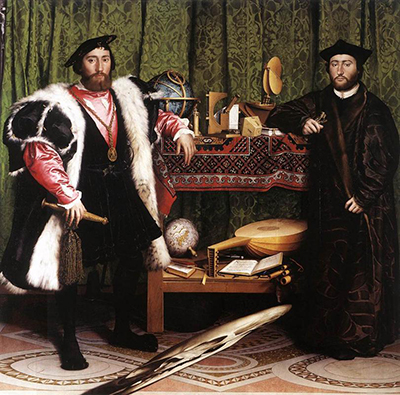
Designs can sharpen the way we read Holbein's painted objects, although the relationship needs care. In her catalogue of The Ambassadors , Susan Foister compares the ornament of Dinteville's dagger sheath with several decorative drawings. She identifies related caryatids and leaf forms, while warning against assuming that accessories in the portraits reproduce exactly what the sitters wore. [7]
Try following the edge of the painted sheath before naming its motifs. Its narrow outline has to remain readable beside a hand and richly patterned clothing. The decoration is contained within that long shape. A supporting body or scrolling leaf adapted to it performs a different visual task from one spread across a vessel's broad bowl.
These comparisons reward patience because they involve degrees of resemblance. A shared motif can reveal a vocabulary without identifying a particular surviving drawing as the pattern for the painted accessory. Precision of representation and certainty about an object's manufacture are different achievements.
Collections have also changed our encounter with these works. The British Museum's account of its former Jewellery Book describes drawings once brought together in a volume and later removed. It distinguishes their range from the ornamental drawings preserved in Basel and records later prints after designs no longer surviving on paper. [13] An individual framed sheet now appears more self-contained than a group of patterns consulted together would have done.
When browsing, keep the drawing's proposed use beside its present identity. The sheet is a real object, with its own marks, colour and edges. The cup, pendant, window or interior it proposes belongs to another stage. Moving between those two presences lets us enjoy the invention while recognising the other hands, materials and circumstances through which it could enter the world.
Artworks directory
Explore paintings, drawings, prints and designs, including works without a separate article. Related studies and versions have their own entries; workshop works and copies are labelled. Print designs and series are grouped rather than repeated for every impression.
Frequently Asked Questions
The design is on paper. A glass painter translated such designs into another material. Basel documents Glaser's execution of Holbein's Terminus design, while treating his wider collaboration with Holbein as probable. [4]
Discussion
Look again at the images and ideas explored in Hans Holbein's Designs for Objects, Glass and Decoration. These editorial prompts invite your observations.
Reader Insights
Compare a caryatid beneath the Basel vessel with a figure at the clocksalt's base. Which pose gives the stronger impression of bearing weight?
Look between the monogram's letters, then at the open centre of a book border. How does the unfilled area help each design work?
Choose a drawn detail and imagine it in glass, enamel or metal. Which part of its appearance would depend most on the maker's contribution?
Join the Conversation
Which design changes your understanding of Holbein most: an instrument, a jewel, a book, a window or a room? Describe a detail that makes you imagine how the finished work could have been used.
References
- British Museum , Design for a clock-salt , about 1543, 1850,0713.14; description, inscriptions and commentary edited from John Rowlands, German Drawings in the British Museum , 1993, no. 328. View source .
- The Metropolitan Museum of Art , The Dance of Death , about 1526, published 1538, 19.57.1–.42; Hans Holbein the Younger and printmaker Hans Lützelburger. View source .
- Susan Foister / Gresham College , “Hans Holbein the Younger: ‘A man very excellent in taking of physionamies’”, lecture transcript, 6 June 2016, sections on Greenwich, design and Kratzer. View source .
- Kunstmuseum Basel , Lichtgestalten , exhibition room text, 2020, sections “Von der Zeichnung zum Glasgemälde”, “Hans Holbein” and “Werkstattpraxis” (in German). View source .
- British Museum , De Optimo Reip. Statu, Deque noua insula Vtopia and accompanying epigrams, Basel: Johann Froben, 1518, 1904,0206.53; collection description and image. View source .
- Kunstmuseum Basel , Tafelaufsatz mit Karyatiden ( Table ornament with caryatids ), 1533/36, inventory 1662.165.89; collection record (in German). View source .
- Susan Foister / National Gallery , The Ambassadors , in The German Paintings before 1800 , 2024, discussion of Dinteville's dagger sheath and related ornamental drawings. View source .
- British Museum , Design for a pendant in the form of a monogram RE , about 1536–37, SL,5308.117; collection description, commentary and image. View source .
- The Morgan Library & Museum , Designs for Metalwork , about 1532–43, British Museum SL,5308.8, SL,5308.10, SL,5308.1 and SL,5308.5; online exhibition, Holbein: Capturing Character . View source .
- Kanton Basel-Stadt , Das Basler Rathaus , sections on the building's history and Holbein's lost paintings, updated 31 August 2026 (in German). View source .
- National Portrait Gallery , King Henry VIII; King Henry VII , about 1536–37, NPG 4027; collection description and 2023 display labels. View source .
- Timothy Schroder , A Marvel to Behold: Gold and Silver at the Court of Henry VIII , Boydell Press, 2020, illustration list p. xiv, figure 10.17; publisher preview. View source .
- British Museum , Design for the end of a jewellery casket , SL,5308.1; acquisition notes, “History and Contents of Sloane 5308”, edited from Rowlands 1993, pp. 152–55. View source .