 by
Tom Gurney
Tom Gurney BSc (Hons) is an art history expert with over 20 years experience
Email:
tomgurney1@gmail.com
/ Phone:
+44 7429 011000
Dance of Death by Hans Holbein the Younger: Introduction
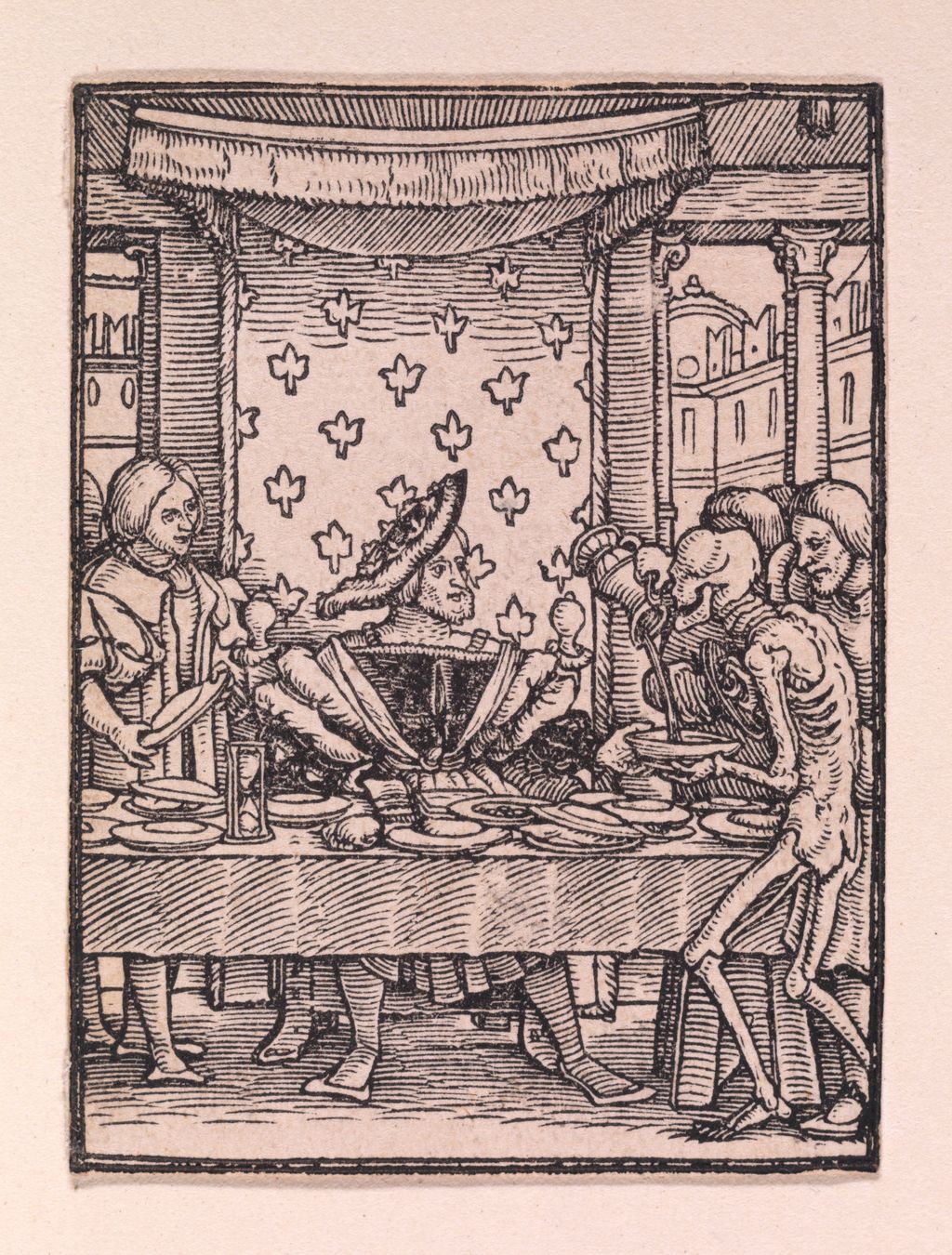
Death has found a place at the king’s table. The dishes are set, the canopy hangs overhead and a servant waits beside the seated ruler. At the right, a skeletal attendant tips a vessel towards a cup. The king turns in that direction, still surrounded by the arrangements that make him important. The room’s formal hospitality makes the skeletal visitor all the more unsettling. In another image, Death reaches over a judge’s shoulder as money passes before the throne of justice. Elsewhere, an elderly woman walks slowly between two animated corpses. Each encounter belongs to the same series, yet each has its own pace, setting and emotional temperature.
Holbein’s Dance of Death brings mortality into the business of living. Its tiny woodcuts contain crowded rooms, roads, fields, possessions and gestures of startling specificity. Their collective subject is universal, but their force comes from particular situations: a meal interrupted, an office compromised, a journey brought to an end. The Metropolitan Museum of Art dates the series to about 1526, with publication in 1538, and names Hans Holbein the Younger alongside the blockcutter Hans Lützelburger. Those two names, and those different dates, are essential to understanding what we see. [1]
The familiar title can suggest a continuous procession of dancing skeletons. Holbein gives us something more varied: a sequence of encounters between Death and people distinguished by occupation, rank and circumstances. Read together with the texts of the first published book, the scenes become a searching examination of worldly authority, human vulnerability and preparation for death. [2]
At a Glance
- Designer Hans Holbein the Younger.
- Principal blockcutter Hans Lützelburger. [1] [3]
- Medium Woodcut; the book editions combine the images with letterpress text.
- Design and cutting The British Museum places the designs in 1524–25 and the cutting before Lützelburger’s death in 1526; the Met uses about 1526. [1] [3]
- First book edition Les simulachres & historiees faces de la mort , Lyon, 1538; 41 woodcuts, printed by Melchior and Gaspar Trechsel for Jean and François Frellon. [4]
- Scale The Met gives an approximate image size of 6.5 × 5 centimetres for its series. Individual sheets and book pages vary. [1]
- Textual arrangement in 1538 Latin biblical passages above the pictures and French quatrains below. [2]
- Later development Further editions and additional designs followed; the British Museum’s 1549 volume contains 53 woodcuts in the series. [5]
- Important distinction A design, a carved block, an impression printed from it and a later copy are different objects with different dates.
This work across Hans Holbein the Younger’s career
Dead Christ in the Tomb
1521–22 [7]Dance of Death by Hans Holbein the Younger (current article)
c.1524–26; first book edition1538Sir Thomas More
1527 [8]Georg Giese
1532 [9]The Ambassadors
1533 [10]Contents
- Small pictures made by two artists
- From the creation of humanity to a world of occupations
- Power at the table and in the court
- Clergy, devotion and divided attention
- Age, labour and the child taken from home
- The 1538 book: pictures between two kinds of words
- Christian warning and the freedom to look closely
- More editions, new blocks and a long life in reproduction
Small pictures made by two artists
A room scarcely larger than a matchbox can accommodate a king, a table full of vessels, a canopy, a view of buildings and Death. Holbein’s handling of space allows that density to remain legible. The table anchors the foreground; the canopy identifies the seat of honour; heads and hands carry the action. Fine lines describe cloth and architecture without swallowing the principal encounter. The eye can recognise a royal feast almost immediately and then spend much longer discovering the disturbance within it. [12]
These effects depended on collaboration. Holbein devised the compositions; Lützelburger translated designs into printable relief on wood. The surface left standing takes the ink; cut-away spaces remain light. Every narrow contour and white interval therefore depends on decisions in the block. The cutter preserved an extraordinary amount of information in a small area, making the series a meeting of invention and skilled workmanship. [13]
It is therefore misleading to describe Holbein as having personally carved every image. Equally, treating Lützelburger as an anonymous mechanism between drawing and print obscures what makes the series so effective. Look at the distinction between the king’s heavy clothing and the skeletal attendant’s limbs. Both occupy the same shallow rectangle, yet the printed lines give one volume and weight, the other a brittle, exposed agility. The smallest open spaces help keep the two bodies distinct. [12]
The British Museum’s account places Holbein’s designs in 1524–25 and Lützelburger’s work before his death in 1526. It also records early impressions with German titles, dated around 1526. These are often called proofs, although the museum cautions that their use as actual working proofs is uncertain. They establish a life for the images before the illustrated book of 1538. The full reasons for the interval before publication remain unclear. [3]
That history changes how the date beneath a reproduction should be read. “1538” may identify the first book edition; it does not necessarily date the invention of its scene. Nor does a reproduction of a particular design prove that the sheet reproduced was printed in that year. Blocks could be reused, books reissued and compositions copied onto new matrices. The distinction matters especially when looking at editions published after Holbein’s lifetime.
Lützelburger’s initials appear within The Duchess , incorporated into the bedstead rather than isolated in a large signature panel. The first book thus contains a small acknowledgement of the person who made these densely imagined worlds printable. Its discretion suits the scale of the whole undertaking: close looking reveals both the craftsmanship and the human action it sustains. [2] [14]
From the creation of humanity to a world of occupations
The 1538 sequence opens before kings, judges and merchants enter it. The creation of Eve is followed by the temptation of Adam and Eve, their expulsion from Eden and the life of labour that follows. These scenes give the encounters with Death a biblical history. Mortality belongs within an account of the human condition beginning with Creation and the Fall. The series then passes into the social world of its contemporary readers. [2]
In the first images, events unfold within elaborate landscapes. The creation scene sets the human figures among animals and a richly populated natural world. In the expulsion, the movement away from paradise already has a macabre accompaniment. The following scene brings Death into agricultural work. This is an early indication of the flexibility that will govern the series: the skeletal figure can participate in an activity as well as terminate it. The relationship between human labour and death returns near the end, in The Ploughman . [2]
Skeletons Making Music , also called The Cemetery , announces the company that will populate the later episodes. The Met’s impression shows bodies crowded before an arched building and beneath its openings. Wind instruments overlap, while a figure bends towards two large drums in the foreground. Loose bones lie along the lower edge. Several skeletons seem to press forward at once; the tightly packed bodies make a kind of visual noise. [15]
The musicians have an energy that fleshly bodies elsewhere in the series often lack. Their raised instruments, open jaws and angular limbs prepare us for an unwelcome interruption. Yet the scene also rewards ordinary curiosity about performance: how the instruments are held, how the figures overlap, how the drummer reaches down. Death becomes active through recognisable human behaviour.
The subsequent encounters move through people described by office and estate: pope and emperor, king and cardinal, legal and religious professionals, wealthy people and workers. This is a social ordering rather than a collection of modern individual portraits. Clothes, implements, attendants and settings tell us what each person does or possesses. The series makes status highly visible in order to show its limits. [2]
Its sequence also has an ending beyond the last individual death. The Last Judgement places humanity before divine judgement, while the concluding heraldic image turns mortality into an emblem. The surviving social distinctions have been carried through a larger Christian history. A reader who stops at the king or corrupt judge misses the frame that holds these local dramas together. [2]
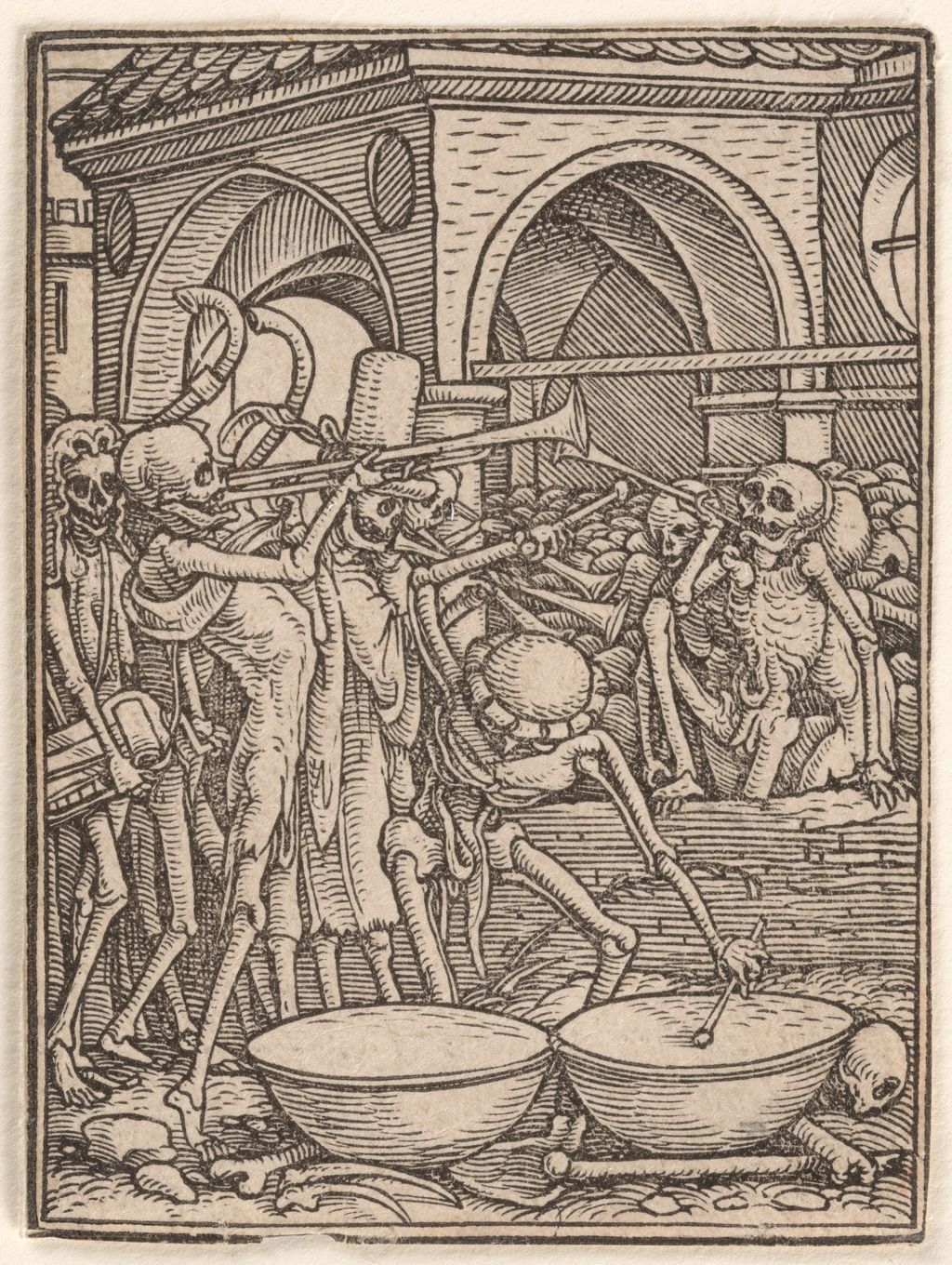
Skeletons Making Music, also called The Cemetery, from the Dance of Death, designed by Hans Holbein the Younger and cut by Hans Lützelburger. The Metropolitan Museum of Art, Rogers Fund, 1919, 19.57.5.
Image source
.
Public domain
.
Power at the table and in the court
The king’s room stages privilege through careful organisation. He sits centrally under an elaborate canopy, with a cloth of estate patterned with fleurs-de-lis behind him. Tableware divides the foreground into small areas of attention. A sword-bearing attendant stands to the left. At the right, Death takes up an action appropriate to the room: pouring a drink. The composition draws its humour and menace from that apparent fitness. The invader behaves like someone entitled to be there. [12]
Look at the difference between the king’s seated body and Death’s forward movement. The ruler’s arms, sleeves and fur help fill the space beneath the canopy. Death leans into the service of the meal, its exposed legs crossing the lower right of the picture. The action can be recognised before its consequence is understood. A daily ceremony of sustaining life has become an encounter with its ending.
The canopy promises an ordered world centred on one person. Death enters across that hierarchy. It does not need to overthrow the furniture, expel the servants or dress the king in rags. His position remains splendid while its inability to protect him becomes visible. This is one reason the picture works so well at small scale: the central idea depends upon a few clear relationships, while the details make the scene convincing enough to inhabit.
The Judge addresses a different failure of authority. The seated official occupies an ornate chair within a panelled interior. A well-dressed man at the right reaches towards his purse, while the judge extends a hand in his direction. On the other side, a more poorly dressed figure stands close to the seat. Death rises behind that figure and over the judge, reaching towards the staff that marks his office. A vessel lies tipped on the ground. [16]
The French quatrain beneath the image in the 1538 book explicitly condemns judges corrupted by gifts. The accompanying passage is taken from Amos. The transaction is therefore more than an ambiguous arrangement of hands: the printed text directs the reader towards bribery and corrupt judgement. Death’s presence links the official’s present conduct with the end of his authority. [2]
The contrast between the two standing men matters. Their clothing and positions create unequal access to the seated figure. Holbein compresses a social complaint into a bodily exchange: the hand stretched towards money, the neglected person waiting nearby, the official who appears to control the room. Death brings a competing claim upon him from behind. The exercise of power and its loss occupy the same instant.
The powerful commit different offences. Royal luxury, judicial corruption and a nobleman’s disregard for the poor create different moral situations. In The Duke , a woman kneels close to the richly dressed figure while Death approaches amid the surrounding company. The human appeal and the skeletal intervention meet around the same body. Seen alongside The Judge , the scene asks how a person responds to others while he still has the means to do so. [2]
These images can feel gleeful when they expose the pretensions of authority. But that pleasure does not provide a secure position for the reader. Death continues through occupations, ages and circumstances that carry much less power. The satire against the mighty is one movement within a sequence that will eventually reach the vulnerable.
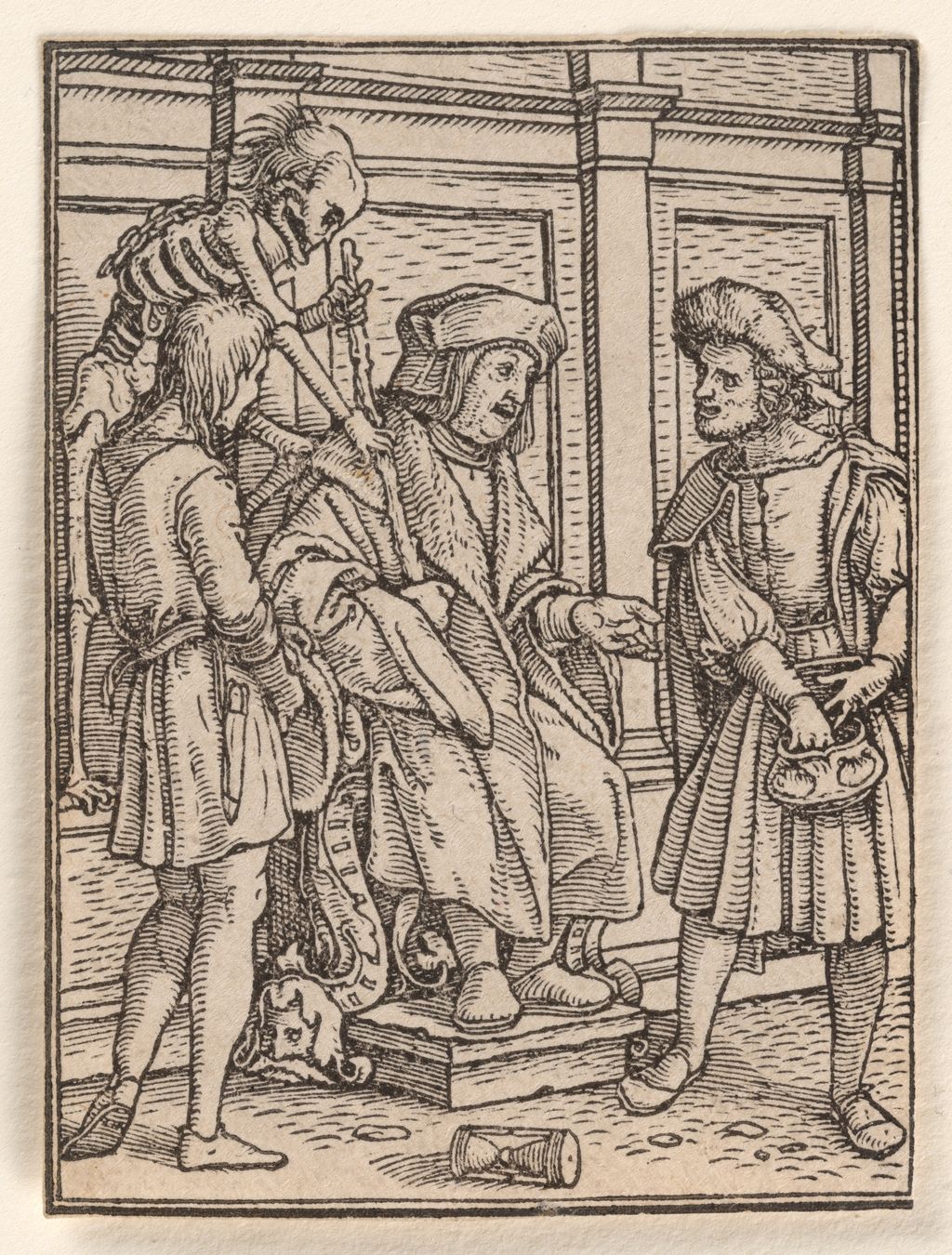
Death reaches over the judge while the living figures seek access to his authority. The Judge, designed by Hans Holbein the Younger and cut by Hans Lützelburger. The Metropolitan Museum of Art, Rogers Fund, 1919, 19.57.18.
Image source
.
Public domain
.
Clergy, devotion and divided attention
Religious office provides no exemption. The series includes a pope, cardinal, bishop, abbot, abbess, preacher, priest, friar and nun, giving clerical life considerable variety. It offers repeated opportunities to compare a public role with the conduct of the person occupying it. The distinctions between those episodes are more revealing than a general statement that Holbein attacked the Church. [2]
In The Abbot , Death wears the mitre and carries the crozier associated with the office. The living abbot, enveloped in heavy cloth, is drawn forward while his book remains in his hand. The transfer of attributes makes a sharp visual joke. What ordinarily distinguishes the religious superior has become part of his captor’s costume. His authority can be detached from his body. [2]
Other episodes concern attention. A person may be surrounded by religious objects and still be absorbed elsewhere. The nun turns towards a lute-playing companion while Death attends to the candles near the altar. Sacred setting, earthly attraction and mortality occupy one small enclosure. The picture encourages the eye to follow the direction of the nun’s head before taking in the action beside her. [2]
There is also a priest carrying the sacrament to a dying person. Death goes before him, adopting a role within the religious procession. Here the presence of Death need not turn the priest’s action into evidence of hypocrisy. The text beneath the image speaks in the priest’s voice: he carries the sacrament to help the dying, while remaining mortal himself. The series can place sincere service under the same condition as corrupt authority. [2]
This range guards against an overly simple account of its religious meaning. Clerical luxury and misconduct are exposed, yet the book’s own language remains deeply concerned with Christian preparation, salvation and judgement. Death may unmask an abuse; it may also remind a person engaged in a proper duty that the duty cannot make its bearer immortal.
The clothes and objects deserve close attention here. A crozier, mitre, book or liturgical vessel can identify an office in seconds. Holbein then allows Death to handle the signs of human distinction. The action brings an abstract argument about worldly status down to the level of touch: something is carried off, seized, extinguished or put on another body. The symbolic force stays attached to an event that can be seen.
Watch: Holbein’s portraits and working methods
Explore museum films on Holbein’s drawings, painted portraits and close-looking details.
Hans Holbein at the court of Henry VIII
A Royal Collection Trust film exploring Holbein’s work at Henry VIII’s court.
Watch on YouTubeAge, labour and the child taken from home
The elderly woman’s scene slows the sequence. In the Met’s impression she bends forward, her cloak falling in a long, heavy curve almost to the ground. She uses a staff, and beads hang from her hand. One skeletal figure moves before her with a small percussion instrument, while another appears behind her, its skull crowned with foliage. The front figure’s lifted arm and extended leg make her measured progress feel even slower. [17]
Several kinds of movement share the space. The cloak barely seems to move; the front skeleton strides; the figure behind reaches close to her head. Holbein gives the elderly body a different rhythm from the bodies accompanying it. The image allows us to feel the labour of walking before asking what the journey means.
The book’s words make the encounter more complicated. The Latin passage states that death is better than life, and the French verse describes a long life of suffering and the wish for death. That language supplies a possible reading of release. It does not make the woman’s bodily difficulty disappear, nor does it oblige every viewer to find the scene comforting. The printed page holds exhaustion, movement and the promise of an ending together. [2]
Labour receives similarly varied treatment. The pedlar bends beneath a basket of goods, caught on the road with his burden still attached to him. His merchandise gives him a livelihood and also a visible weight. The biblical invitation above the image addresses those who are burdened; the French verse turns that invitation towards the trader and the prospect of being relieved of his load. The reader connects a spiritual phrase with a very material basket. [2]
The Ploughman opens out into a landscape. The ploughman follows his team across worked ground while Death moves at the animals’ side. Beyond them, the land rises towards buildings and a distant horizon. The scene has a breadth that contrasts with the interiors of king and judge, although its printed frame is hardly larger. The worker’s bent body and the lines of the ploughing keep effort at the centre. [2]
Its text invokes the earning of bread by the sweat of the face. This returns the reader to the labour following the Fall near the beginning of the book. The ploughman’s encounter consequently belongs both to one person’s working day and to the larger history of humanity laid out by the sequence. A social type becomes part of a recurring condition.
The young child unsettles any comfortable equation between death and punishment for adult misconduct. In the domestic scene, Death takes a small child by the hand within the family’s modest dwelling. Household life continues around the intrusion. The child has no royal canopy, purse of bribe money or insignia of office to surrender. The loss falls within intimate relationships rather than public rank. [2]
The accompanying words, drawn from Job, compare human life with a flower and a passing shadow. Their scope is larger than the single household; their placement beside it makes that general truth painful. After so many pictures in which Death’s timing can appear pointed or satirical, the child’s vulnerability refuses an easy satisfaction. Equality before death includes people whom the viewer has no wish to see humbled.
That change of feeling is fundamental to reading the series. One can laugh at Death appropriating an office or entering a banquet. One can also hesitate before the ageing woman, exhausted labourer or child. The skeletal figure’s return allows a fresh emotional response. Holbein’s settings and gestures continually adjust our distance from the person being taken.
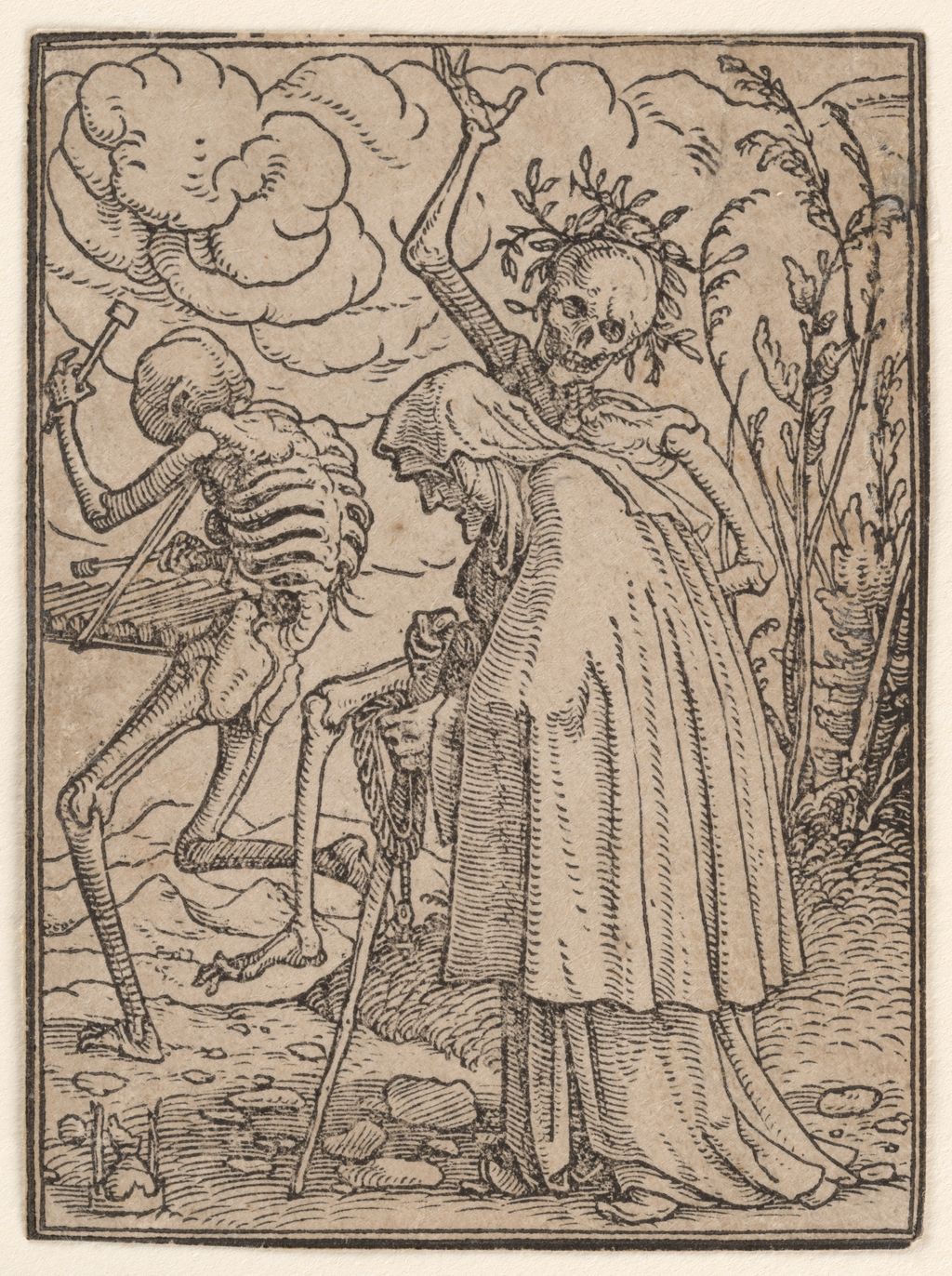
The heavy fall of the woman’s cloak contrasts with the skeletons’ movements. The Old Woman, from the Dance of Death, designed by Hans Holbein the Younger and cut by Hans Lützelburger. The Metropolitan Museum of Art, Rogers Fund, 1919, 19.57.25.
Image source
.
Public domain
.
The 1538 book: pictures between two kinds of words
The first book appeared in Lyon in 1538 under a title usually shortened to Les simulachres & historiees faces de la mort . The Morgan Library’s copy is catalogued as the first edition, with 41 woodcuts after Holbein’s designs, cut by Lützelburger. Its colophon names the brothers Melchior and Gaspar Trechsel. The publication brought the small scenes into a reading experience shaped by other contributors as well as the two artists. [4]
Each illustrated page has a recognisable arrangement: a Latin biblical passage at the top, the woodcut beneath it and a French quatrain below. The generous surrounding paper makes the picture’s smallness apparent. Turning the pages creates pauses between encounters. Within each page, the eye moves between a familiar human action and words that place it within scriptural and moral instruction. [2]
The words do more than describe the pictures. The judge’s verse names corruption; the ploughman’s words connect work with Genesis; the child’s passage describes the brevity of life. Their relationship to the visible scene changes. A reader may begin with the picture and move to its lesson, or begin with the biblical words and discover how the image gives them an unexpected contemporary setting.
The authorship of the French material needs care. The Morgan catalogue associates Nicolas Bourbon with the French text, while recording Jean de Vauzelles or Gilles Corrozet as alternative attributions for the quatrains. It would be misleading to treat every sentence surrounding the pictures as Holbein’s own explanation. The edition presents a meeting of visual invention, literary contributions and publishing decisions. [4]
The opening dedication addresses Jeanne de Touszele, abbess of the convent of Saint-Pierre in Lyon. It offers the images as aids to religious reflection. Its language of mirrors asks readers to contemplate their condition and correct their conduct. The same preface also admires the artistic force of the figures. Moral instruction and pleasure in skilful representation coexist within the book’s own introduction. [2]
Patricia Eichel-Lojkine, writing about the volume as an emblem book, draws attention to the differing contributions of image and text and to the reader’s work in connecting them. Her discussion helps explain why a verse need not describe every action in a woodcut. The page invites an active comparison between its parts. [13]
Something is lost when the images are reproduced as an uncaptioned row of skeletons. Their visual wit survives, but the original reader also encountered a sequence of biblical references, vernacular poems and devotional prose. Conversely, reading the text alone misses the way an extended hand, familiar object or sudden movement can complicate a moral statement. The book makes room for both kinds of attention.
Christian warning and the freedom to look closely
The Dance of Death has an obvious relevance to religious conflict: it exposes failings among ecclesiastical authorities and insists that status cannot secure a privileged relation to death. But a picture of a bad churchman does not, by itself, settle the doctrinal allegiance of its maker or every reader. The religious frame of the 1538 edition deserves to be read in its own words. [2]
Its dedication defends the value of religious images and attacks their opponents. It argues that visible forms can help the mind contemplate what cannot be directly represented. The reader is asked to remember death, avoid sin and prepare for the Christian hope of life beyond death. These are the arguments of the book’s prefatory voice; they should not be silently converted into a personal declaration by Holbein. [2]
The skeletons themselves raise a question that the preface recognises: how can death, an invisible condition or event, be pictured? The answer offered is to use the bodies through which death has passed. The dead body provides a visible figure for something beyond direct sight. Holbein’s moving corpses make that solution memorable, then stretch it through play, disguise and participation in ordinary tasks. [2]
This helps explain their unstable character. Death is sometimes an enemy, sometimes an attendant, sometimes almost a fellow worker. These roles do not amount to a single consistent personality. They are ways of making a different encounter visible. The same skeletal body can make a king’s service ominous and a labourer’s burden seem close to being lifted.
The sequence asks ethical questions without resolving every feeling it provokes. The judge is condemned for accepting gifts; the child’s death requires another response. The priest can serve the dying while remaining vulnerable himself. The viewer has to distinguish misconduct, ordinary occupation, physical suffering and innocence even as the images insist on a shared destination.
Their small scale encourages that discrimination. From a distance, a viewer might see only living figures paired with skeletons. Close looking reveals who notices whom, which hand reaches for what, where an interruption begins and how the surrounding space helps us understand it. The series’ general proposition becomes richer, and less comfortable, as its individual actions come into focus.
More editions, new blocks and a long life in reproduction
The 1538 book began an extended publishing history. Later editions changed titles, languages and accompanying material, and enlarged the body of images. The British Museum’s 1549 volume contains 53 woodcuts in the series, twelve more than the first book. Those additions include further adult encounters and groups of children. The museum associates some of the children’s blocks with Veit Specklin, using a qualified attribution. The expanded series therefore cannot be described as Lützelburger’s work throughout. [5]
There is a revealing anticipation of this growth in the 1538 preface. It describes a scene involving an overturned cart that does not appear among that edition’s 41 images. Eichel-Lojkine examines the discrepancy between the prefatory description and the later published Waggoner . The passage allows us to glimpse a project larger than the first edition, while warning against assuming that its text simply records the image eventually printed. [2] [13]
Successive editions also created different routes into the pictures. Latin verses could place them before a different readership from the first French quatrains; translations and altered titles changed the surrounding literary experience. The images were stable enough to remain recognisable while the books containing them changed. The title Dance of Death now conveniently gathers together a history that includes several distinct printed forms. [14]
Later artists reproduced the compositions through other processes. Wenceslaus Hollar made etched versions in the seventeenth century. Centuries later, wood engravers and publishers helped circulate them again. Austin Dobson’s introduction to the 1903 Dance of Death explains that its pictures were printed from the copy blocks made by Bonner and John Byfield for Francis Douce’s publication of 1833. A reader opening that attractive volume encounters a later interpretation in wood, rather than impressions from the original sixteenth-century blocks. [14]
The distinction does not deprive those later versions of interest. They show what successive makers valued and what their own techniques could preserve. But the line can change, a composition can be reversed or a new border can alter the encounter. A familiar design is a starting point for identification, not enough to establish the date or maker of every printed object bearing it.
The series also has an international collecting and exhibition history. The National Museum of Western Art in Tokyo holds an impression of The Cardinal , acquired in 1996. Its record distinguishes the image, 6.4 × 5 centimetres, from the larger sheet, and lists its appearance in the museum’s 2000 exhibition devoted to the Dance of Death tradition. It provides a concrete example of the images’ continuing life beyond the European books in which they first circulated. [18]
For anyone looking at the series today, the most useful habit is to hold two scales of attention together. Follow the whole sequence, from its biblical opening through the social encounters to judgement. Then return to one print and watch a hand, an instrument, a cup or the turn of a head. The broad idea of mortality is immediately grasped; the living situations through which Holbein and his collaborators made it visible take longer to exhaust.
Artworks directory
Explore paintings, drawings, prints and designs, including works without a separate article. Related studies and versions have their own entries; workshop works and copies are labelled. Print designs and series are grouped rather than repeated for every impression.
Frequently Asked Questions
It contains sharp criticism of clerical failings, but the 1538 book places its images within Christian reflection on sin, mortality and salvation. Its preface also defends religious images. Individual scenes and the book’s texts need to be read together, without assuming that every contributor expressed an identical position. [2]
No. Later makers copied the designs in wood engraving, etching and other forms. Dobson’s 1903 edition, for example, uses nineteenth-century copy blocks. The design can be Holbein’s while the physical print is the work of a much later maker. [14]
Discussion
Look again at the images and ideas explored in Dance of Death by Hans Holbein the Younger. These editorial prompts invite your observations.
Reader Insights
Compare the cupbearer in The King with the reaching hands in The Judge . Each scene lets a small exchange carry an argument about authority.
The young child invites a different response from the corrupt official. Which image most alters your sense of Death’s role in the sequence?
Choose one illustrated page from the 1538 book. Consider what the biblical passage and French verse add to the action, and what remains most powerfully expressed by the picture.
Join the Conversation
Which encounter stays with you: the royal feast, the elderly woman’s walk, the working ploughman or the child at home? Share a detail that changed your response when you looked again.
References
- The Metropolitan Museum of Art , The Dance of Death , Hans Holbein the Younger and Hans Lützelburger, about 1526, published 1538, object 19.57.1–.42. View source .
- Hans Holbein the Younger, Hans Lützelburger and collaborators , Les simulachres & historiees faces de la mort , Lyon: Melchior and Gaspar Trechsel, 1538; digitised copy, Francis A. Countway Library of Medicine, Internet Archive (in Middle French and Latin). Preface, illustrated sequence and accompanying verses. View source .
- The British Museum , The Creation of Eve , from the Dance of Death , about 1525–26, object 1895,0122.796; collection record and curatorial comments on the early series. View source .
- The Morgan Library & Museum , Les simulachres & historiees faces de la mort , Lyon, 1538, PML 2112; Printed Books catalogue record. View source .
- The British Museum , Simolachri, Historie e figure de la Morte , Lyon: Jean Frellon, 1549, object 1904,0206.83; collection record and curatorial comments on additional blocks. View source .
- Kunstmuseum Basel, Bildnis des Bonifacius Amerbach, 1519, inventory 314 (in German) . View source .
- Kunstmuseum Basel, Der tote Christus im Grab, 1521–22, inventory 318 (in German) . View source .
- The Frick Collection, Sir Thomas More, 1527, accession 1912.1.77, collection record . View source .
- Gemäldegalerie Berlin, Georg Gisze . View source .
- Susan Foister, The Ambassadors, The German Paintings before 1800 (2024) . View source .
- Susan Foister, Christina of Denmark, Duchess of Milan (2024) . View source .
- The Metropolitan Museum of Art , The King, from “The Dance of Death” , about 1526, published 1538, object 19.57.8; record and image. View source .
- Patricia Eichel-Lojkine , “Le livre d’emblèmes moraux comme terrain d’expérimentation au temps d’Holbein (1530–1540)”, CIELAM, Malice (in French), sections on the Simulachres , image and text, and the Charretier . View source .
- Austin Dobson , introduction to The Dance of Death by Hans Holbein , New York: Scott-Thaw Company, 1903; especially “Other Reproductions” and “The Present Issue”, public-domain text at Project Gutenberg. View source .
- The Metropolitan Museum of Art , Skeletons Making Music (or the Cemetery), from “The Dance of Death” , about 1526, published 1538, object 19.57.5; record and image. View source .
- The Metropolitan Museum of Art , The Judge, from “The Dance of Death” , about 1526, published 1538, object 19.57.18; record and image. View source .
- The Metropolitan Museum of Art , The Old Woman, from “The Dance of Death” , about 1526, published 1538, object 19.57.25; record and image. View source .
- The National Museum of Western Art, Tokyo , The Dance of Death: The Cardinal , G.1995-0006; collection, dimensions, acquisition and exhibition record (in Japanese, with English). View source .
- Würth Collection, Holbeins Schutzmantelmadonna, inventory 14910, current owner account (in German) . View source .
- Kunstmuseum Basel, Bildnis der Frau des Künstlers mit den beiden ältesten Kindern, about 1528–29, inventory 325 (in German) . View source .
- Kunsthistorisches Museum Wien, Next Generation, Jane Seymour, about 1536–37, inventory 881 (in German) . View source .
- Splash image , The King, from the Dance of Death. Design by Hans Holbein the Younger; block cut by Hans Lützelburger, about 1526. The series was first published as a book in 1538. The Metropolitan Museum of Art, Rogers Fund, 1919, 19.57.8. Image source . Public domain .