 by
Tom Gurney
Tom Gurney BSc (Hons) is an art history expert with over 20 years experience
Email:
tomgurney1@gmail.com
/ Phone:
+44 7429 011000
Portrait of Mary, Lady Guildford by Hans Holbein the Younger: Introduction
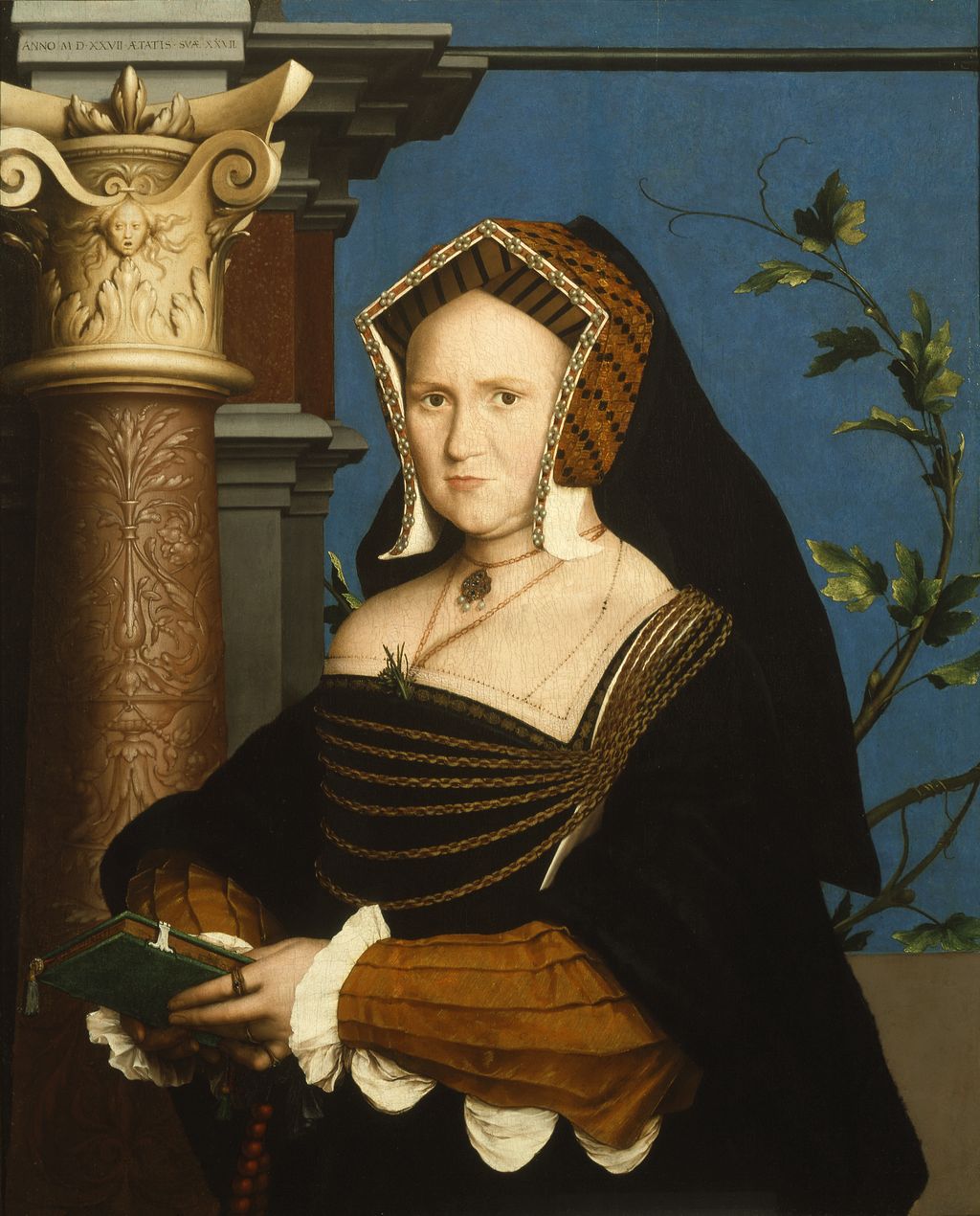
Mary Guildford looks out from a setting crowded with beautiful things. A richly carved column rises beside her, a vine climbs behind her, and gold chains fall in shallow loops across her black dress. Yet her hands bring the eye to something quieter: a small green book and the beads hanging beneath it. Holbein holds the splendour of an expensive portrait together with the suggestion of interrupted prayer.
Painted in England in 1527, Mary, Lady Guildford belongs to the Saint Louis Art Museum. It was conceived as the companion to the portrait of her husband, Sir Henry Guildford , now in the Royal Collection. The surviving drawing of Mary reveals how much could change between a sitting and a finished image. Her clothes, surroundings and direct gaze make the painting a carefully shaped public presence, while the study preserves a more informal encounter. [1] [2] [3]
At a Glance
- Artist Hans Holbein the Younger, 1497/98–1543. [1]
- Title Mary, Lady Guildford . [1]
- Date and place 1527, made in England. [1]
- Medium oil on panel. [1]
- Dimensions 87 × 70.6 cm, unframed. [1]
- Sitter Mary Wotton, Lady Guildford; the Saint Louis record uses the spelling Wotten and gives her dates as 1499–1558. [1]
- Collection Saint Louis Art Museum, Museum Purchase, object number 1:1943. [1]
- Companion painting Sir Henry Guildford , 1527, Royal Collection, RCIN 400046. [2]
- Surviving study portrait drawing in the Kunstmuseum Basel, Kupferstichkabinett, inventory 1662.35. [3]
- Version to distinguish the Metropolitan Museum of Art owns a sixteenth-century copy after Holbein, object 20.155.4. [4]
This work across Hans Holbein the Younger’s career
Dead Christ in the Tomb
1521–22 [6]Sir Thomas More
1527 [7]Portrait of Mary, Lady Guildford by Hans Holbein the Younger (current article)
1527, made in EnglandGeorg Giese
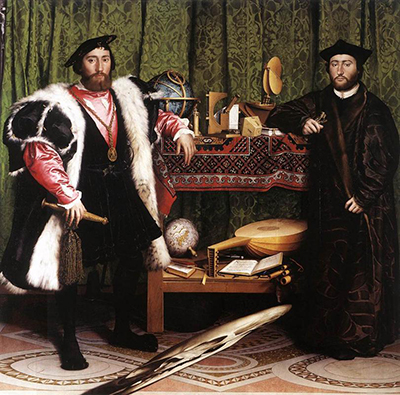
1532 [8]The Ambassadors
1533 [9]Contents
- A Face Framed by Gold
- Dress, Jewellery and the Weight of Detail
- A Book, a Rosary and a Sprig of Rosemary
- The Column and the Climbing Vine
- Two Portraits Sharing One Setting
- What the Drawing Preserves
- A Portrait Rediscovered
- The Saint Louis Original and the New York Copy
- Annotated details
A Face Framed by Gold
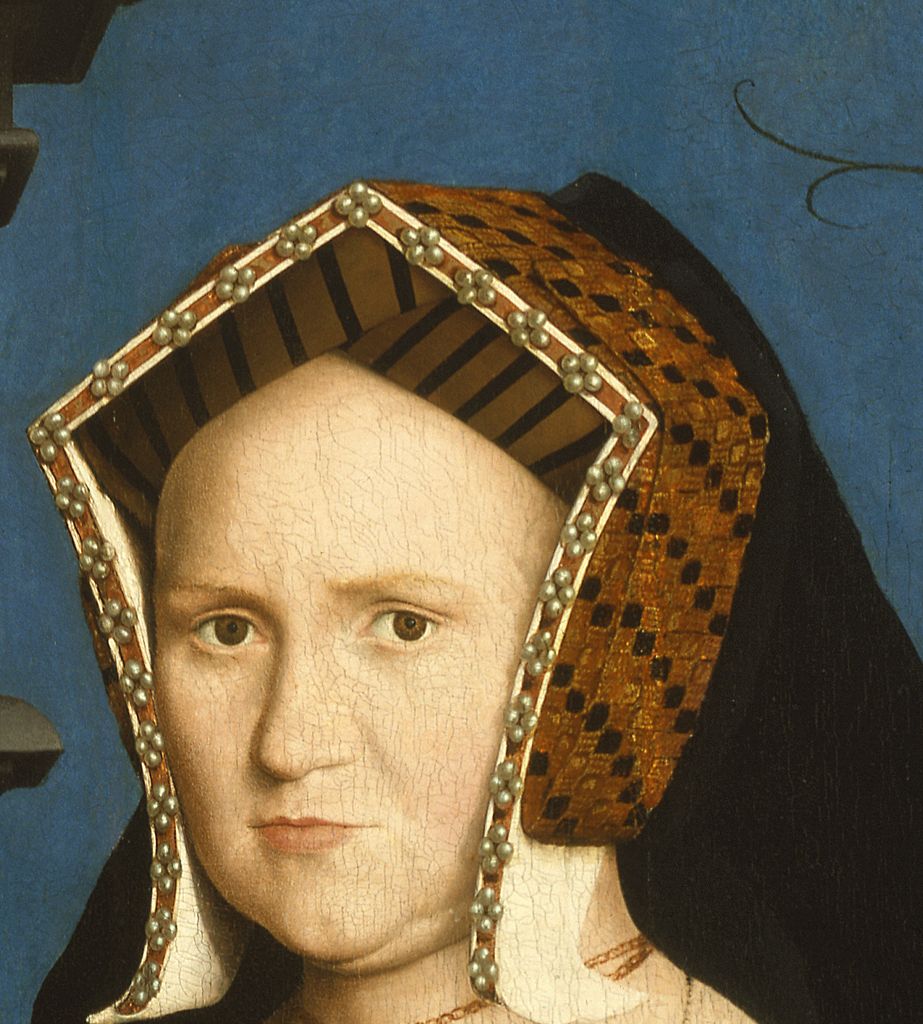
The headdress makes an angular frame around Mary's face. Its pointed top rises like a small roof, while the decorated sides descend towards her shoulders. Black fabric spreads behind it and joins the dark mass of the gown. Against these surroundings, the pale forehead, cheeks and neck form a continuous area of light. The effect is striking even before the individual ornaments become legible.
Holbein does not give the face a grand gesture to match the architecture. Mary's lips are closed. Her brows and eyes carry the expression, and the slight turn of the head allows one side of the face to fall more fully into shadow. She seems attentive without appearing caught in a sudden movement. The hands are occupied; the eyes meet an audience.
This directness matters because it differs from the surviving study. The Saint Louis museum describes a change from a sideways glance in the drawing to the more serious presentation of the finished portrait. Its suggestion that Henry probably requested the alteration is an interpretation, rather than a recorded conversation between patron and painter. [1] The distinction keeps the comparison useful: we can see that Holbein changed the encounter, even though we cannot recover everyone’s part in that decision.
Looking closely also checks the temptation to give Mary a fixed personality. Severity, patience or reserve may be impressions produced by the image, but they are not biographical discoveries. The portrait shows how a woman was represented at a particular moment. Its precision makes her vivid without giving us unrestricted access to her thoughts.
Dress, Jewellery and the Weight of Detail
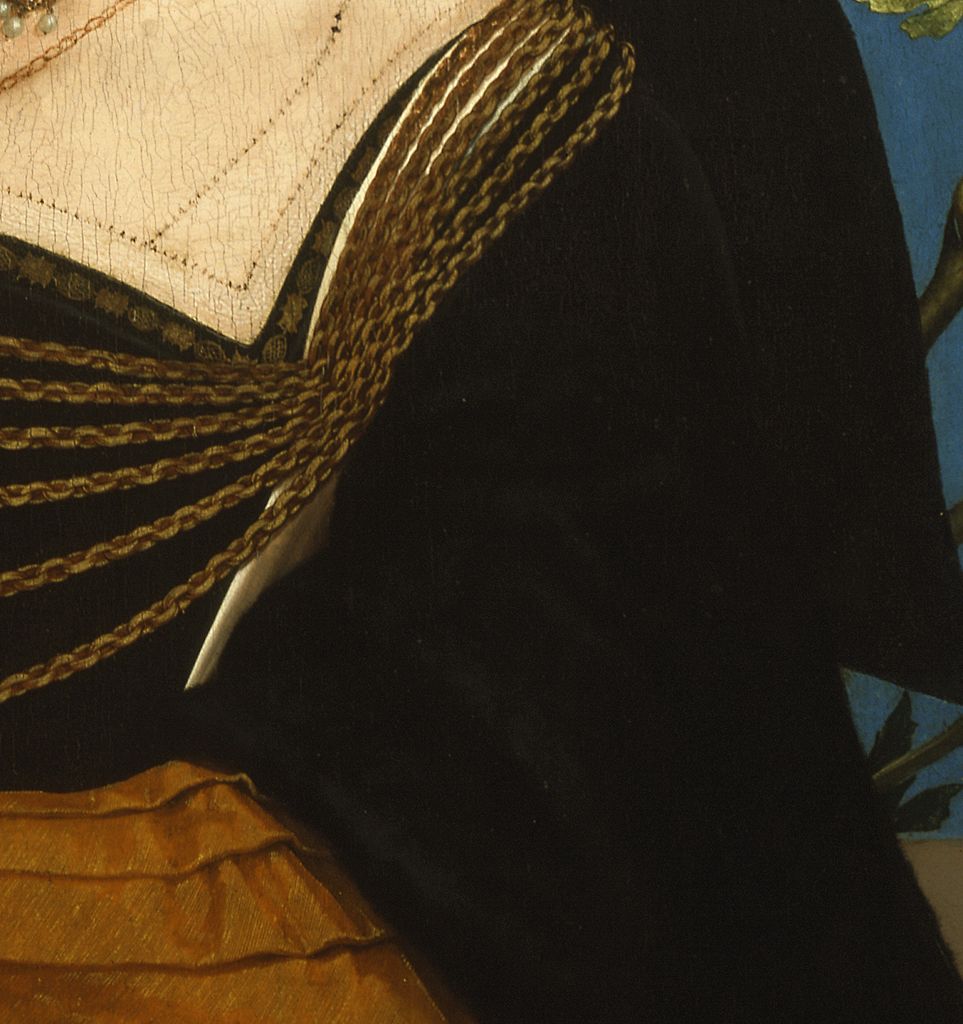
The black gown provides a broad, relatively quiet surface on which the gold chains can register. Their loops move across the bodice in a measured sequence, rising towards the shoulder. A finer necklace and jewelled pendant occupy the space above them. At the edges of the headdress, small bright ornaments make a broken line against the darker fabric. Holbein varies the scale of the decoration so that the eye moves between large curves and minute points of light.
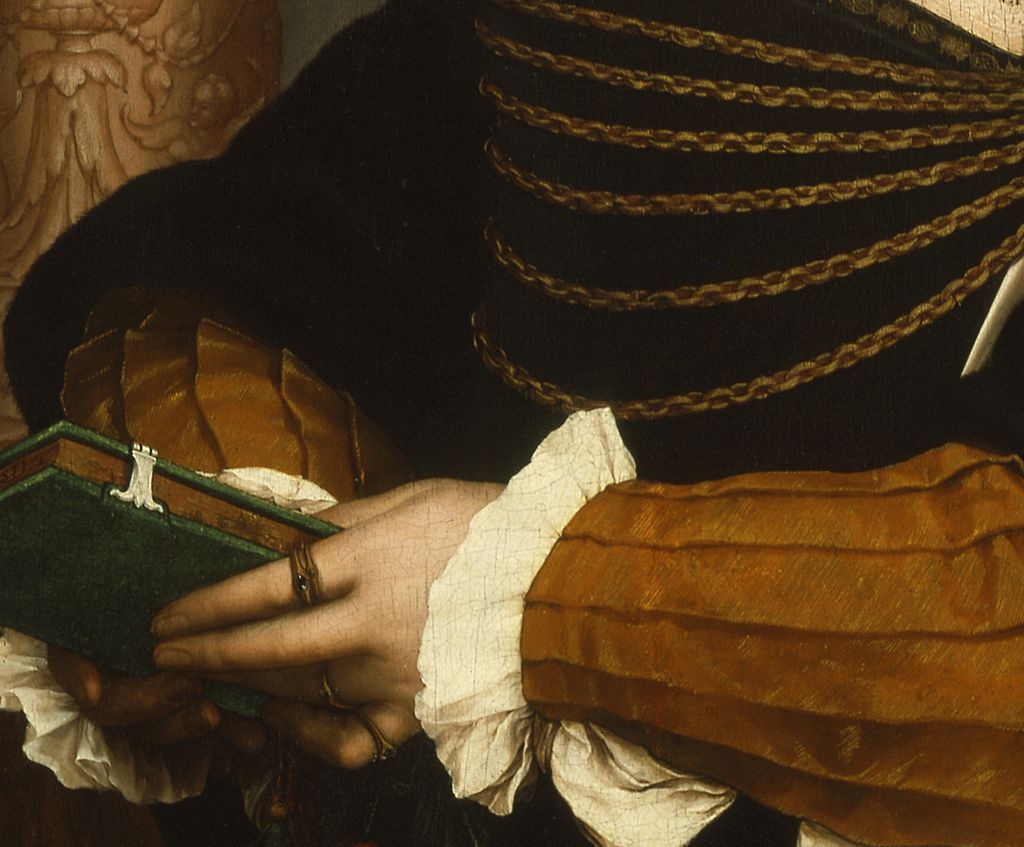
The sleeves introduce a different rhythm. Their warm golden-brown folds spread horizontally towards the hands, while white fabric emerges beneath them and at the wrists. The crisp white edges sharpen the meeting of skin, book and dress. Mary's fingers do not dissolve into this abundance: their separate positions remain readable, and the rings add small accents within the larger display.
The Morgan Library & Museum interprets the fashionable clothes, jewellery and elaborate setting as signs of Mary's social position. Its exhibition account also stresses the lavish use of gold in the painting. [11] This is a material as well as a pictorial richness. We should nevertheless keep the evidence for each portrait distinct: the Royal Collection's detailed account of shell-gold paint and gold leaf in Henry's clothes cannot automatically supply the technical recipe for Mary's. [2]
The chains sit against a deep black, the headdress alternates light and dark, and the sleeves gather into broad folds. The portrait rewards both a distant view of the silhouette and a close examination of its smaller ornaments.
Annotated Details from Mary, Lady Guildford
The numbered points identify visible features discussed in this article. Return from each detail to the whole composition. Hans Holbein the Younger, Mary, Lady Guildford, 1527. Oil on panel, 87 × 70.6 cm. Saint Louis Art Museum, Museum Purchase, 1:1943. Saint Louis Art Museum, Museum Purchase1:1943; Wikimedia Commons. Image source . Public domain .
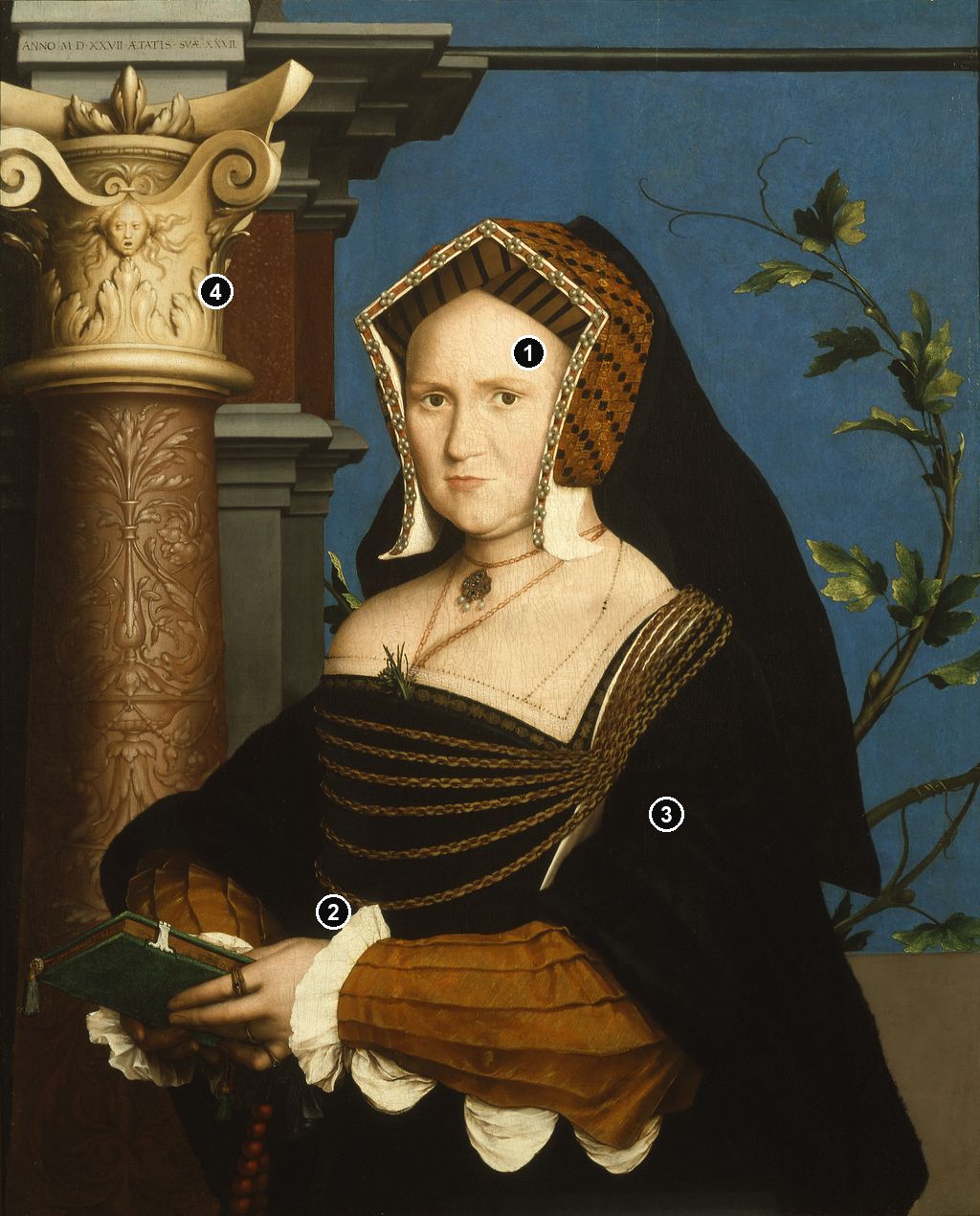
Details from MARY, LADY GUILDFORD
Compare the cropped details with the complete images above. Notice how their colours, shapes and positions contribute to the larger compositions.
Face and jewelled hood
The hood encloses Mary’s face within a succession of angular bands. The small differences between eyes and cheeks keep the likeness from becoming symmetrical.
The book held before the body
Mary’s hands gather around the book. Look at the contrast between the page edges, the dark cover, the jewellery and the pale fingertips.
Sleeves and surface pattern
The sleeve folds spread beneath an intricate upper garment. The cropped view makes it easier to compare broad areas of cloth with small repeated ornaments.
The column beside the sitter
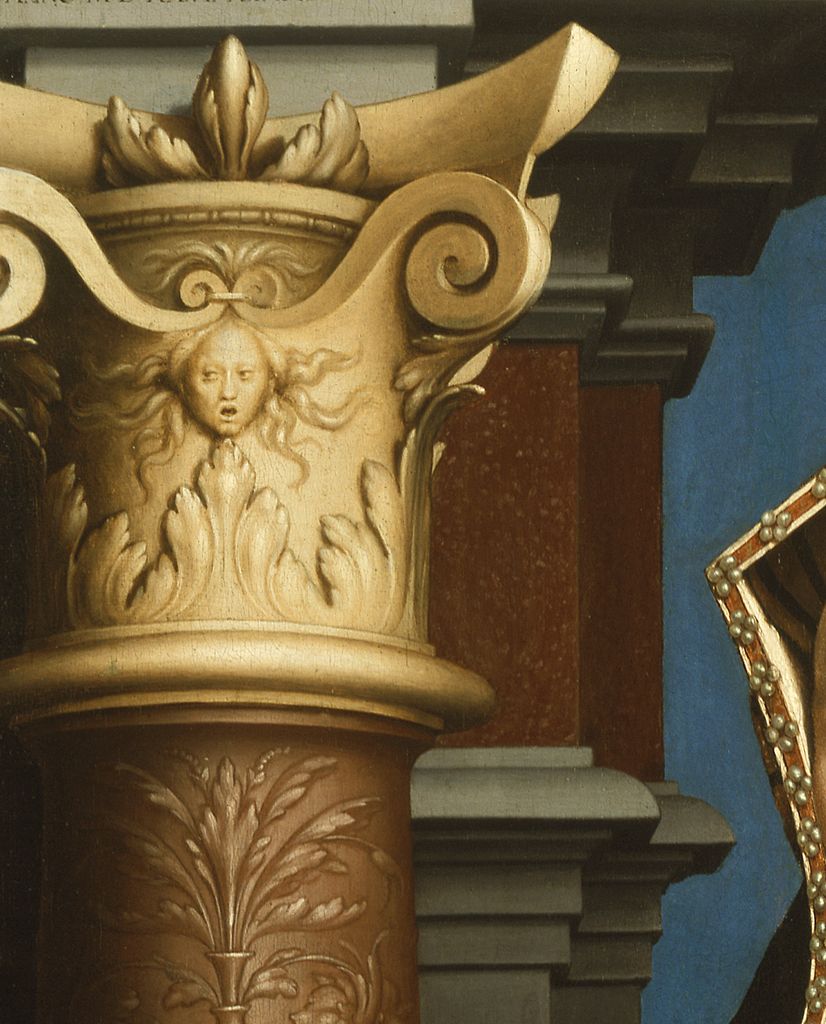
Carved-looking ornament rises beside Mary’s head. Compare its pale projecting forms with the flatter blue and green passages around it.
A Book, a Rosary and a Sprig of Rosemary
Mary holds the book at an angle, with its green cover visible and the pale edges of the pages appearing above it. The fingers cross its surface instead of opening it towards us. Below, a string of large beads descends into the dark lower part of the painting. These objects give the hands a purpose and establish a devotional context for the richly dressed figure.
The Saint Louis museum calls the volume a prayer book. The Morgan identifies a religious book and rosary and reads them as expressions of piety and virtue. [1] [11] The pose allows the viewer to imagine a pause in reading or prayer, but the painting does not document an actual interruption. Holbein has arranged an intelligible action: Mary possesses the book, holds the beads and looks up.
A much smaller detail lies at the neckline, where a narrow green sprig interrupts the dark edge of the bodice. The Morgan identifies it as rosemary and connects it with remembrance. [11] It is easy to overlook beside the pendant and chains. Once noticed, however, its irregular leaves add a living, fragile form among objects shaped and polished by human hands.
These signs work on different scales. The book occupies the foreground; the rosary draws the eye down; the rosemary asks for a closer look. Together they give the portrait a vocabulary beyond expensive dress. They also reveal how little can safely be inferred about private belief from a painted attribute. Devotional objects communicate an appropriate religious identity, but they do not tell us the words Mary prayed or the character of her inner life.
The Column and the Climbing Vine
The column almost competes with Mary for attention. It rises along the left side of the painting, with its surface covered in scrolling ornament. A carved face appears high above her hands; further forms gather around the capital. Behind it, projecting architectural edges step back towards the blue field. The setting gives her presence an architectural scale without opening into a broad, navigable room.
The Morgan describes the column as marble and its decoration as Italianate. [11] That term identifies a visual language associated with Italian Renaissance ornament. It need not mean that the portrait records a particular English interior, or that every element was copied from a building Holbein had personally visited. Here the architecture performs a clear pictorial task: it supports, frames and magnifies the sitter.
The vine creates a looser movement on the opposite side. Its stem branches upwards, its leaves turn at different angles, and a thin tendril curls across the blue. In contrast with the column's dense carving, these forms leave open intervals through which the background remains visible. The two sides balance each other through different kinds of detail.
Saint Louis interprets the grape vines and leaves as symbols of wealth. [1] That reading fits the surrounding display, but it should remain attached to the museum's account rather than become a claim about Mary's personal love of gardening or the planting of her household. What the image itself makes clear is the contrast between carved ornament and growing form. The column is heavy and upright; the vine is slender and irregular. Mary occupies the space between them, held steady by the broad shape of her dark clothing.
Watch: Holbein’s portraits and working methods
Explore museum films on Holbein’s drawings, painted portraits and close-looking details.
Hans Holbein at the court of Henry VIII
A Royal Collection Trust film exploring Holbein’s work at Henry VIII’s court.
Watch on YouTubeTwo Portraits Sharing One Setting
Seen alone, Mary's picture can feel like a self-contained arrangement of figure, column and vine. The portrait of Henry restores another part of its space. A curtain rail runs above him, and the corner of the pillar appears at the upper right of his panel. The rail continues into Mary's portrait, where the pillar becomes a major feature. The Royal Collection identifies these connections as evidence that the paintings originally hung together. [2]
The arrangement places Henry on the viewer's left and Mary on the right. A pendant is a companion picture designed to be understood with another. In this pair the relationship is built into the setting, so that the space between the panels becomes part of the experience. The architectural continuation invites the eye to travel from one sitter to the other.
Henry's green curtain, blue background and twisting vine belong to the same visual world. His staff of office and richly worked clothing present his court standing; Mary's book, rosary and jewellery give her portrait a different set of emphases. [11] [2] Their likenesses are linked, while each remains individually organised. The pair offers two presences within a coordinated display.
Separation has changed that experience. Henry is in the Royal Collection and Mary in Saint Louis. [1] [2] Reproductions can bring them together again, though they should preserve the distinction between the original objects and later copies. They also need to account for the paintings' different present dimensions: Mary's panel measures 87 × 70.6 cm, while Henry's is 82.7 × 66.4 cm. [1] [2] A neat digital pairing can otherwise make two objects appear more mechanically identical than they are.
What the Drawing Preserves
The study of Mary in Basel is a substantial sheet, measuring 552 × 385 mm. Victoria Button's examination identifies creamy-white, unprepared laid paper and describes a combination of chalks with touches of liquid media. Black chalk establishes and reinforces contours, while red, yellow and black contribute to the flesh. Golden-yellow chalk records elements of the costume. The paper itself supplies the whites of the eyes. [3]
These details make the drawing more than an outline awaiting paint. Holbein was gathering relationships of colour, shape and expression. Broad areas of black and finer lines could coexist on the same sheet; a shoulder or necklace required a different touch from the main body of the headdress. Button notes some erosion of the chalks and cautions that their layered application makes the exact sequence difficult to determine. [3]
The differences from the painting are equally revealing. Button describes the drawing as informal beside the more formal painted likeness and connects that difference with the works' functions: a record made in a live sitting could become the basis for an image intended to convey status. [3] This does not make the drawing a transparent record of the “real Mary”. A sitting is also an encounter shaped by pose, attention and the artist's choices. It does, however, preserve another way in which she appeared to Holbein.
Button found no signs of transfer on this sheet. [3] That is a useful limit on any easy account in which the surviving drawing was simply traced straight onto the panel. The relationship between study and painting is secure; the exact physical route between them is less fully recoverable. In Holbein's portrait drawings , looking, recording and preparing an image could overlap without leaving every step visible to us.
A Portrait Rediscovered
The painting's later history includes periods in which attribution and identity became uncertain. The Saint Louis provenance account links it, with qualification, to a portrait of Lady Guildford in the 1590 inventory of John Lumley's collection. The inventory identifies her through her marriage to Sir Henry and names Holbein as the painter. The museum considers its picture the most likely match. [1]
By the time the painting appeared at Sotheby's on 14 May 1930, it was being offered under a different identity and school: Dame Elizabeth Bullen, attributed to the Flemish School. Its recognition as the Holbein original transformed the understanding of another familiar version, the painting now in the Metropolitan Museum of Art. Before the Saint Louis picture's reappearance, the New York version had been regarded as an original. [1]
The Saint Louis museum acquired its portrait in 1943. [1] Those two moments—rediscovery and public acquisition—are especially useful for understanding why reproductions and older references can be confusing. A work's present attribution may rest on comparisons that were impossible when only a copy was widely known.
Holbein constructed a firm, recognisable identity through a face, costume and devotional objects. Later owners could still lose the sitter's name and the painter's authorship. Recovering that knowledge required comparisons and documentary records, as well as confidence in what could be seen.
The Saint Louis Original and the New York Copy
The Metropolitan Museum now explicitly catalogues its painting as a copy after Hans Holbein the Younger. Its object number is 20.155.4, and it measures 81.6 × 66.4 cm. The museum describes its medium as oil and gold on oak. These are the facts of the New York object, not alternative measurements or materials for the Saint Louis original. [4]
The resemblance explains why the distinction matters. Both images convey the same sitter through the familiar headdress, jewellery, book and architectural setting. A caption giving only “Holbein, Lady Guildford” can therefore conceal a significant difference in authorship. The Saint Louis painting is Holbein's 1527 original; the Met work preserves the composition through another painter's hand. [1] [4]
The copy has a place in the portrait's history, especially because it helped carry the image during the original's long obscurity. It should not be made to stand in for the original when discussing the handling of Mary's face, fabric or hands. Keeping the two works distinct allows comparison to become more revealing: the shared design shows what travelled, while differences in execution belong to the individual objects.
Return, finally, to Mary's hands in the Saint Louis picture. The book is turned across the body, the pale fingers overlap its cover, and the beads lead down towards the edge. Above this small concentration of touch and weight, the gold chains spread and the face looks out. The portrait's many details remain legible because Holbein gives each a place within that larger, steady arrangement.
Artworks directory
Explore paintings, drawings, prints and designs, including works without a separate article. Related studies and versions have their own entries; workshop works and copies are labelled. Print designs and series are grouped rather than repeated for every impression.
Frequently Asked Questions
Yes. Its companion is Holbein's Sir Henry Guildford in the Royal Collection. The continuation of a curtain rail and pillar across the pictures links their settings and establishes their intended relationship. [2]
Discussion
Look again at the images and ideas explored in Portrait of Mary, Lady Guildford by Hans Holbein the Younger. These editorial prompts invite your observations.
Reader Insights
The rosemary sprig is easy to miss beside the gold jewellery. Does noticing it change where you look next, or how you understand Mary's presentation?
Compare the sideways glance of the study with the painting's outward gaze. Consider how much a small alteration to the eyes can change the social distance between sitter and viewer.
Imagine Henry's portrait hanging to Mary's left, with the rail continuing across both. Which details in her picture begin to feel different when the pair shares a setting?
Join the Conversation
Which holds your attention longest in Mary's portrait: the face, the hands, the clothing or the carved column? Share the detail that first drew you in and what you noticed after looking longer.
References
- Saint Louis Art Museum , Mary, Lady Guildford , 1527, object 1:1943, collection record, interpretive notes and provenance. View source .
- Royal Collection Trust , Sir Henry Guildford (1489–1532) , dated 1527, RCIN 400046, collection entry adapted from The Northern Renaissance: Dürer to Holbein , 2011. View source .
- Victoria Button , The Portrait Drawings of Hans Holbein the Younger: Function and Use Explored through Materials and Techniques , PhD thesis, Royal College of Art, 2013, p. 154 and table 15, p. 287. View source .
- The Metropolitan Museum of Art , Lady Guildford (Mary Wotton, 1499–1558) , copy after Hans Holbein the Younger, object 20.155.4, collection record. View source .
- Kunstmuseum Basel, Bildnis des Bonifacius Amerbach, 1519, inventory 314 (in German) . View source .
- Kunstmuseum Basel, Der tote Christus im Grab, 1521–22, inventory 318 (in German) . View source .
- The Frick Collection, Sir Thomas More, 1527, accession 1912.1.77, collection record . View source .
- Gemäldegalerie Berlin, Georg Gisze . View source .
- Susan Foister, The Ambassadors, The German Paintings before 1800 (2024) . View source .
- Susan Foister, Christina of Denmark, Duchess of Milan (2024) . View source .
- The Morgan Library & Museum , “Mary, Lady Guildford”, entry 014 in the online exhibition Holbein: Capturing Character . View source .
- Würth Collection, Holbeins Schutzmantelmadonna, inventory 14910, current owner account (in German) . View source .
- Metropolitan Museum, Dance of Death series . View source .
- Kunstmuseum Basel, Bildnis der Frau des Künstlers mit den beiden ältesten Kindern, about 1528–29, inventory 325 (in German) . View source .
- Kunsthistorisches Museum Wien, Next Generation, Jane Seymour, about 1536–37, inventory 881 (in German) . View source .
- Splash image , Hans Holbein the Younger, Mary, Lady Guildford, 1527. Oil on panel, 87 × 70.6 cm. Saint Louis Art Museum, Museum Purchase, 1:1943. Saint Louis Art Museum, Museum Purchase1:1943; Wikimedia Commons. Image source . Public domain .