by
Tom Gurney
Tom Gurney BSc (Hons) is an art history expert with over 20 years experience
Email:
tomgurney1@gmail.com
/ Phone:
+44 7429 011000
Nicholas Bourbon: Introduction
A face in profile occupies the upper half of this sheet; a hand holding a pen is barely gathered together below. Between them, Hans Holbein makes the poet Nicholas Bourbon recognisable through two different kinds of attention. The head receives colour, shadow and a firm outline. The writing hand remains a tangle of searching lines. We can read the man's features closely while still watching his portrait take shape.
Made in 1535, the drawing belongs to Bourbon's English visit and to the history of his published writing. A related woodcut appeared in his Paedagogeion in 1536. The sheet therefore brings a particular encounter between artist and sitter into contact with a wider readership. [1]
At a Glance
- Artist Hans Holbein the Younger (1497/8–1543).
- Title Nicholas Bourbon (c.1503–1549/50) .
- Date 1535.
- Medium Black and coloured chalks and black ink on pink prepared paper.
- Dimensions 30.8 × 25.9 cm, sheet of paper.
- Collection Royal Collection.
- Collection number RCIN 912192. [2]
- Sitter French poet and humanist, also known as Nicolas Bourbon. [1] [3]
- Related publication Paedagogeion , 1536; the Met catalogues its copy as Paidagogeion . [2] [3]
This work across Hans Holbein the Younger’s career
Dead Christ in the Tomb
1521–22 [5]Sir Thomas More
1527 [6]Georg Giese
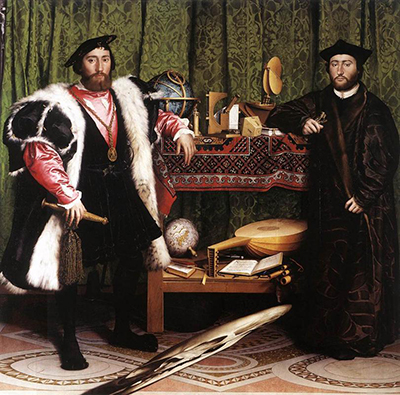
1532 [7]The Ambassadors
1533 [8]Contents
- A Profile Built from Different Marks
- A French Poet Among English Craftsmen and Courtiers
- A Writer Shown at Work
- From a Drawing to a Book Portrait
A Profile Built from Different Marks
Bourbon looks left, across a broad stretch of nearly empty paper. His cap spreads horizontally above the face, its soft dark mass balancing the rounded fall of hair behind his neck. The nose projects decisively into the open ground. Under it, the moustache, lips and beard form a sequence of small changes in direction. Nothing in this outline needs a setting or an accompanying figure to hold our attention.
The eye is particularly economical. A dark upper lid and a small patch of shadow establish its position beneath the brow. The cheek remains much lighter, so that the eye seems to sit within the head rather than on its surface. Look lower and the beard resolves into separate strokes around the chin; look back at the hair and broader passages of brown give the impression of a heavier, continuous mass. Holbein varies the marks to describe different textures.
At the shoulder, the drawing loosens. Long lines suggest the garment's seams and folds without giving every piece of cloth a complete boundary. The sleeve curves towards the hand at the lower left, carrying the eye away from the head. This change in finish creates a useful route through the sheet: the face first, then the turning body, then the much lighter indications of an activity.
The pink ground runs through all these passages. It is visible around the figure and within areas of the face and clothing, keeping the most worked parts connected to the open sheet. The Royal Collection identifies a prepared surface and several drawing materials; their visual effect is an image in which colour, tone and contour can each do a different job. [2] A dark boundary can be exact while the neighbouring area stays almost untouched.
Watch: Holbein’s portraits and working methods
Explore museum films on Holbein’s drawings, painted portraits and close-looking details.
Hans Holbein at the court of Henry VIII
A Royal Collection Trust film exploring Holbein’s work at Henry VIII’s court.
Watch on YouTubeA French Poet Among English Craftsmen and Courtiers
Bourbon's English connections crossed several kinds of work. After imprisonment in France for his reforming views, he found support among Anne Boleyn and William Butts . His London lodging was with Cornelis Hayes, the king's goldsmith and a close contact of Holbein. [2] The portrait belongs within this small network of hospitality, religious sympathy and artistic acquaintance.
Hayes also appears among the royal craftsmen with whom Holbein collaborated in the Royal Collection's exhibition account. That account places book illustration beside jewellery and metalwork in the artist's activities. [10] A poet staying with a goldsmith is a helpful reminder that the people around a portrait did not necessarily belong to separate literary and artistic worlds. Their personal connections could bring different skills into the same circle.
The Morgan Library calls Bourbon Holbein's friend and admirer, links his Paidagogeion to Erasmus, and compares the profile to an ancient coin, reflecting the poet's classical interests. [1] This interpretation gives the pose a historical resonance without requiring every feature to be symbolic. The cap, beard and sharply observed nose still belong to an individual man.
A Writer Shown at Work
The pen is a small detail with a large effect. It gives the lightly drawn hand a purpose and makes the lower part of the sheet worth a second look. Without it, the loosely indicated fingers might pass as an incidental fragment of the pose. With it, they identify writing as part of the portrait's subject.
The Morgan reads Bourbon as if engaged in composing, connecting the image with Holbein's portraits of scholars at work. [1] Yet no legible verse appears here. We are shown the means of writing, while its particular words remain outside the picture. That restraint allows the face and the hand to carry different information: one records a likeness, the other introduces an occupation.
Bourbon's own writing also preserves evidence about the artist. The Royal Collection's exhibition labels cite a letter by him as evidence that Holbein was King's Painter by September 1536. [10] The sitter thus enters Holbein's history twice, through the surviving image and through a written record. The pen draws attention to the activity through which we also know something about the painter.
From a Drawing to a Book Portrait
The relationship to print is secure, although an intervening painting remains uncertain. The Royal Collection proposes a lost panel portrait between this sheet and the woodcut, while allowing that the print could follow the drawing directly. The woodcut is dated 1535. [2] The Morgan emphasises the sheet's role in the first edition's portrait. [1]
These accounts leave room for a painting without making its existence essential to understanding the surviving likeness. They also separate two dates that are easily confused: the date associated with the portrait image and the publication of the volume. The Metropolitan Museum of Art records its Paidagogeion as dated 10 October 1536, with Nicolas Bourbon as author, Philipp Romain as publisher and Johannes Barbous as printer. [3]
Publication gave the likeness a different setting. On this sheet, the face is surrounded by open space, and the degree of finish changes as our eye moves downwards. In a book, a portrait encounters readers alongside an author's words. Holbein's image could help those readers put a face to the poet whose writing they held. Its connection to the book explains why this modestly sized drawing reaches beyond the encounter between artist and sitter.
Artworks directory
Explore paintings, drawings, prints and designs, including works without a separate article. Related studies and versions have their own entries; workshop works and copies are labelled. Print designs and series are grouped rather than repeated for every impression.
Frequently Asked Questions
It is a drawing, now in the Royal Collection. A related panel painting has been proposed, but does not survive. [2]
The pen identifies his occupation as a poet. The Morgan reads the pose as suggesting composition; no particular poem is identified. [1]
Discussion
Look again at the images and ideas explored in Nicholas Bourbon. These editorial prompts invite your observations.
Reader Insights
Follow the profile from the cap to the chin. Which small change in the outline makes the face feel most particular?
Compare the head with the pen hand. Does the hand's lightness make the act of writing seem more immediate, or harder to grasp?
Imagine encountering this likeness beside Bourbon's poems. What would the profile and pen tell you before you began to read?
Join the Conversation
Which part of Holbein's portrait stays with you: the precisely drawn face, the broad cap or the faint writing hand? Share the detail that first drew you in and what you noticed on a second look.
References
- The Morgan Library & Museum , “077. Nicholas Bourbon”, Holbein: Capturing Character in the Renaissance , online exhibition entry and accompanying transcription. View source .
- Royal Collection Trust , Hans Holbein the Younger, Nicholas Bourbon (c.1503–1549/50) , 1535, RCIN 912192, collection record. View source .
- The Metropolitan Museum of Art , Paidagogeion , 10 October 1536, object 45.86.1, collection record. View source .
- Kunstmuseum Basel, Bildnis des Bonifacius Amerbach, 1519, inventory 314 (in German) . View source .
- Kunstmuseum Basel, Der tote Christus im Grab, 1521–22, inventory 318 (in German) . View source .
- The Frick Collection, Sir Thomas More, 1527, accession 1912.1.77, collection record . View source .
- Gemäldegalerie Berlin, Georg Gisze . View source .
- Susan Foister, The Ambassadors, The German Paintings before 1800 (2024) . View source .
- Susan Foister, Christina of Denmark, Duchess of Milan (2024) . View source .
- Royal Collection Trust , Holbein at the Tudor Court , Nash Gallery large-text labels, “Artists at Court” and “Holbein the Designer”, PDF pages 2–3 and 13. View source .
- Würth Collection, Holbeins Schutzmantelmadonna, inventory 14910, current owner account (in German) . View source .
- Metropolitan Museum, Dance of Death series . View source .
- Kunstmuseum Basel, Bildnis der Frau des Künstlers mit den beiden ältesten Kindern, about 1528–29, inventory 325 (in German) . View source .
- Kunsthistorisches Museum Wien, Next Generation, Jane Seymour, about 1536–37, inventory 881 (in German) . View source .