by
Tom Gurney
Tom Gurney BSc (Hons) is an art history expert with over 20 years experience
Email:
tomgurney1@gmail.com
/ Phone:
+44 7429 011000
George Brooke, Lord Cobham: Introduction
George Brooke faces us beneath a broad, low cap. His shoulders spread towards the edges of the sheet, but his face holds the centre with quiet steadiness. The eyes are lightly drawn; the beard grows darker as it descends. Below it, the clothing opens into a few loose lines and a large expanse of warm paper. Looking down the drawing, we seem to move from a person into the marks through which Holbein has made him visible.
That change in finish gives the portrait much of its interest. The face, cap and dress each have a different density. Follow their edges and the drawing begins to reveal several ways of describing a surface within the same small sheet.
At a Glance
- Artist Hans Holbein the Younger.
- Sitter George Brooke, 9th Baron Cobham, c.1497–1558.
- Date c.1538–39.
- Medium Black and coloured chalks with a touch of black ink on pink prepared paper.
- Dimensions 28.9 × 20.3 cm, sheet.
- Collection Royal Collection, RCIN 912195. [1]
This work across Hans Holbein the Younger’s career
Dead Christ in the Tomb
1521–22 [3]Sir Thomas More
1527 [4]Georg Giese
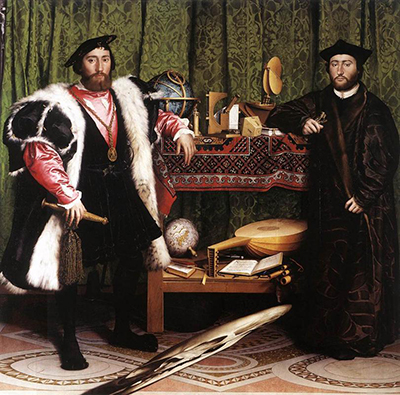
1532 [5]The Ambassadors
1533 [6]Contents
- A face built from small differences
- The dark cap and the open clothing
- What the pink paper contributes
- A likeness that could be used again
A face built from small differences
Start with the nose. Its bridge emerges through delicate changes of tone, while the nostrils and lower edge receive firmer marks. On either side, the cheek changes gradually from light to shadow. The far more emphatic beard makes these slight transitions easier to appreciate: a few dark areas can give weight to the whole face without surrounding every feature with an equally strong line.
The eyes reward a closer look. The lids are more definite than the skin around them, and the eyebrows are quiet enough to leave the gaze unobstructed. Beneath each eye, a shallow passage of shadow helps the cheek turn. The mouth, partly enclosed by the moustache, stays small within the larger shape of the beard. Its closed line contributes to the portrait's stillness.
Brooke's head is presented almost squarely, yet the two sides are not mirror images. The differing cheek shadows and the uneven outline of the facial hair keep the frontal arrangement from becoming rigid. His gaze seems to meet ours even as these small variations draw our eyes across the face.
The name at the upper left identifies Brooke as Lord Cobham. It is an eighteenth-century copy of an earlier inscription. Brooke inherited the barony in 1529; his cultural interests included patronage of Italian craftsmen and the education of his sons in Padua. [1] The informally dressed sitter had a place in the Tudor court's wider artistic connections.
The dark cap and the open clothing
The cap cuts across the rounded skull as a long, irregular band. Its brim projects on both sides, while broken dark strokes describe folds and overlaps. The compressed shape gives a firm upper boundary to a face modelled much more gently below. The little badge interrupts the cap's dark surface without competing with the features.
The Royal Collection suggests that a damp brush may have been used on the hat's chalk to evoke velvet. [1] Dark material gathers into broader passages here, making the cap appear soft and substantial despite its relatively narrow area on the sheet.
At the shoulders, the handling loosens. Several lines search along the upper edges of the clothing; below, two long contours descend into an open V. Much of the interior receives very little additional description. The viewer supplies the continuation of the garment from this small amount of information.
Try covering the lower half of the sheet, then uncovering it. The head initially seems self-contained. With the shoulders restored, its stillness gains a bodily setting, and the lightly indicated dress gives the densely worked beard room to stand out. The broad outline is enough to establish a bust without asking every part of it to carry the same detail.
Watch: Holbein’s portraits and working methods
Explore museum films on Holbein’s drawings, painted portraits and close-looking details.
Hans Holbein at the court of Henry VIII
A Royal Collection Trust film exploring Holbein’s work at Henry VIII’s court.
Watch on YouTubeWhat the pink paper contributes
The warm surface participates throughout the portrait. It lies between the dark cap and the paler forehead, shows through the cheeks, and spreads almost uninterrupted across the lower half. Along the shoulders, where little drawing material has accumulated, the ground becomes especially apparent. The face therefore feels connected to the surrounding sheet even where its contours are clearly defined.
Royal Collection conservators explain that Holbein frequently prepared paper with a pink coating before drawing. This supplied a middle tone from which he could develop both light and shadow, reducing the material needed to establish flesh. They also describe how chalk could be blended to soften facial modelling. [8] These observations help explain why so much can happen here within a restrained range of tones.
Brooke's sheet is recorded as using the same paper as Holbein's drawing of Charles Wingfield, a connection that may indicate a similar date. [1] Shared paper offers a material link between portraits; it does not establish that the two men sat together or commissioned their likenesses as a pair.
The uneven distribution of marks also makes the portrait enjoyable at different distances. From farther away, the cap, beard and shoulders read as a coherent arrangement. Up close, their substance separates into strokes, shading and exposed ground. The paper never quite disappears behind the person.
A likeness that could be used again
Holbein's portrait drawings often served as preparations for paintings or miniatures. [8] Brooke's sheet also carries evidence relevant to that working purpose. In her technical survey, Victoria Button records very faint indentations around the eyes and ear, following the drawn contours. She places these in her survey of signs of transfer. [9]
Such marks differ from the coloured lines we readily see in a reproduction: they are impressions in the surface. Button's wider discussion explains how tracing could leave indentations, while also warning that their extent varies and that some transfer methods leave little visible evidence. [9] The observation adds another kind of looking to our response to the portrait, attentive to the physical sheet as well as the depicted man.
The faint marks support a history of use, but do not identify a particular finished painting. They allow us to imagine the drawing being consulted and its contours followed, alongside the information held in its colours and shading. The loose clothing and carefully established face then acquire a practical relationship: Holbein has preserved a likeness with a very selective investment of detail.
Artworks directory
Explore paintings, drawings, prints and designs, including works without a separate article. Related studies and versions have their own entries; workshop works and copies are labelled. Print designs and series are grouped rather than repeated for every impression.
Frequently Asked Questions
It belongs to the Royal Collection, numbered RCIN 912195. [1]
The prepared ground provides a middle tone for modelling skin with lighter and darker marks. Holbein used this approach in many of his portrait drawings. [8]
Button records faint contour indentations as signs of transfer. These suggest practical use of the likeness, but do not establish the identity or survival of a particular painting. [9]
The difference directs attention towards the likeness. Royal Collection conservators explain that Holbein often recorded clothing economically, preserving enough information for further work without drawing every detail. [8]
Discussion
Look again at the images and ideas explored in George Brooke, Lord Cobham. These editorial prompts invite your observations.
Reader Insights
Compare the cap's dark boundary, the cheek's softer turn and the open lines of the clothing. Which seems most substantial, and why?
Find a passage where the paper itself supplies most of the visible colour. How does that area connect the head with the shoulders?
Notice the small differences between the two sides of Brooke's face. How do they affect the stillness of the portrait?
Join the Conversation
What caught your attention first: Brooke's gaze, his cap or the sparse outline of his dress? Share a detail that changed as you looked more closely.
References
- Royal Collection Trust , George Brooke, 9th Baron Cobham (c.1497–1558) , Hans Holbein the Younger, c.1538–39, RCIN 912195, collection record. View source .
- Kunstmuseum Basel, Bildnis des Bonifacius Amerbach, 1519, inventory 314 (in German) . View source .
- Kunstmuseum Basel, Der tote Christus im Grab, 1521–22, inventory 318 (in German) . View source .
- The Frick Collection, Sir Thomas More, 1527, accession 1912.1.77, collection record . View source .
- Gemäldegalerie Berlin, Georg Gisze . View source .
- Susan Foister, The Ambassadors, The German Paintings before 1800 (2024) . View source .
- Susan Foister, Christina of Denmark, Duchess of Milan (2024) . View source .
- Rachael Smith and Victoria Button, Royal Collection Trust , Holbein's portrait drawings , sections on prepared papers, chalk and clothing. View source .
- Victoria Button , The portrait drawings of Hans Holbein the Younger: function and use explored through materials and techniques , doctoral thesis, Royal College of Art/Victoria and Albert Museum, 2013, pp.203–206 and Table 4, p.261. View source .
- Würth Collection, Holbeins Schutzmantelmadonna, inventory 14910, current owner account (in German) . View source .
- Metropolitan Museum, Dance of Death series . View source .
- Kunstmuseum Basel, Bildnis der Frau des Künstlers mit den beiden ältesten Kindern, about 1528–29, inventory 325 (in German) . View source .
- Kunsthistorisches Museum Wien, Next Generation, Jane Seymour, about 1536–37, inventory 881 (in German) . View source .