 by
Tom Gurney
Tom Gurney BSc (Hons) is an art history expert with over 20 years experience
Email:
tomgurney1@gmail.com
/ Phone:
+44 7429 011000
Portrait of Derich Born by Hans Holbein the Younger: Introduction
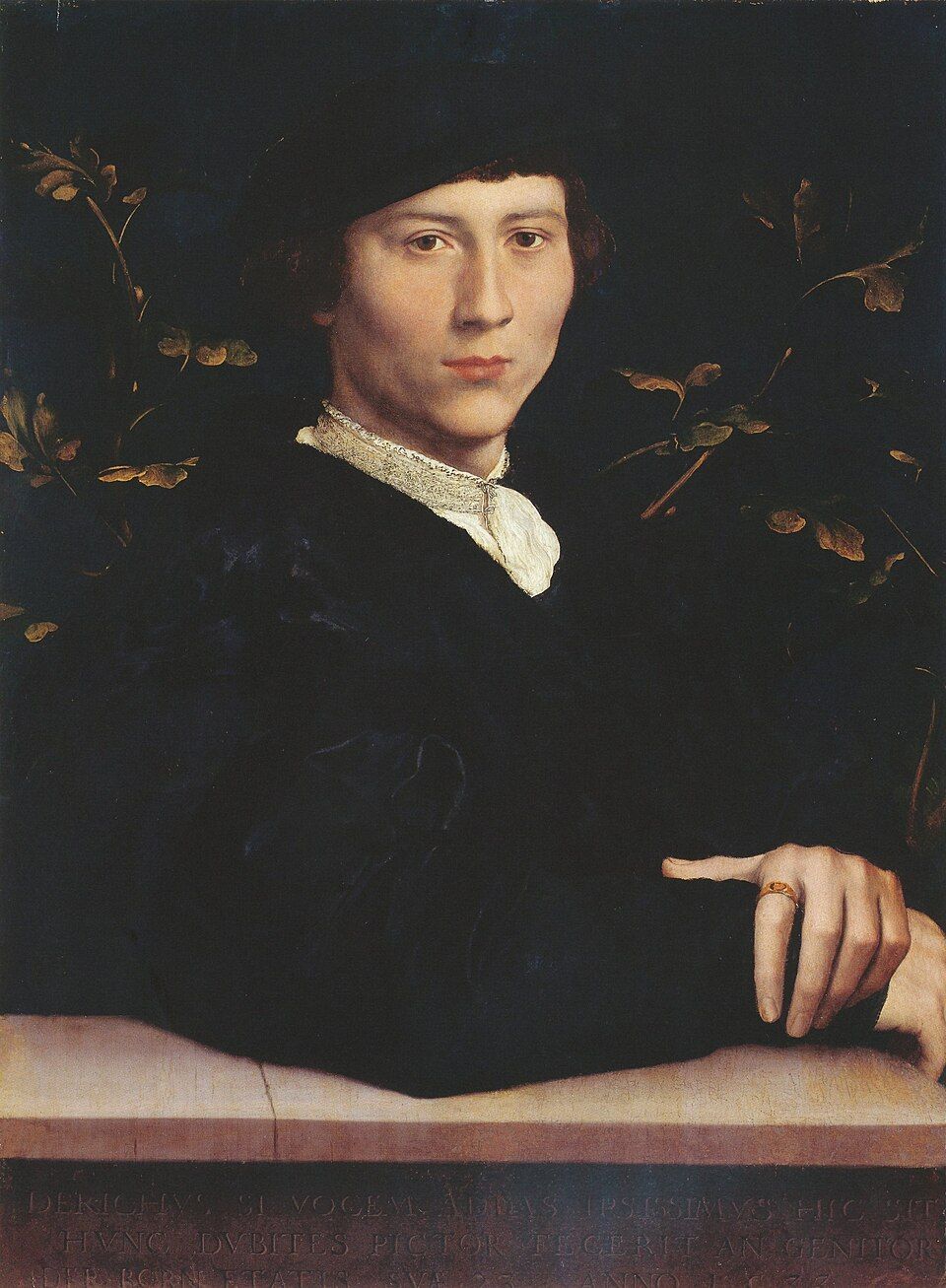
Derich Born rests his forearm on a stone ledge and looks straight at us. His body turns away, but his pale face brings the encounter back to the centre. A white collar interrupts the black of his clothes; branches spread through the blue background; a gold ring catches the light on the hand laid over his other wrist. He seems comfortably within reach, although the ledge keeps us on our side of the picture.
Holbein painted the twenty-three-year-old German merchant in 1533. Across the ledge, a Latin inscription invites an extraordinary comparison: give this image a voice, and the distinction between the painted Born and the living man would become uncertain. The portrait makes that claim through satin, fur, skin and stone, each apparently responding to light in its own way. Examination beneath the surface reveals how patiently Holbein adjusted those effects, including repeated changes to the outline of the face. [1] [2]
At a Glance
- Artist Hans Holbein the Younger, 1497/98–1543.
- Title Derich Born (1509/10–after 1549) , also described as Portrait of Derich Born .
- Date 1533; catalogued as signed and dated.
- Sitter Derich Born, a merchant from Cologne associated with London's Steelyard; aged twenty-three in the inscription.
- Medium and support Oil on panel, formed from two boards of Baltic oak.
- Dimensions 60.3 × 44.9 cm, support measurements.
- Collection Royal Collection, RCIN 405681.
- Location recorded by the collection King's Closet, Windsor Castle.
- Distinctive features Latin inscription praising the likeness; black satin and fur; revisions visible through infrared examination; a thumb impression described as probably Holbein's. [1] [2]
This work across Hans Holbein the Younger’s career
Dead Christ in the Tomb
1521–22 [4]Sir Thomas More
1527 [5]Georg Giese
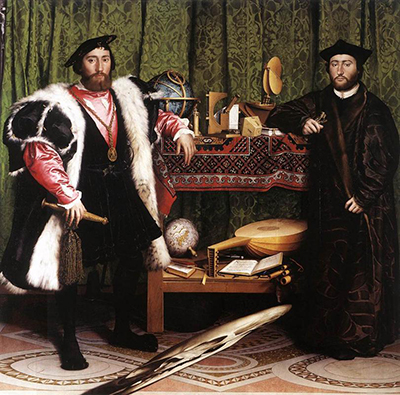
1532 [6]The Ambassadors
1533 [7]Portrait of Derich Born by Hans Holbein the Younger (current article)
1533; catalogued as signed and datedContents
- A Turn Held in Balance
- A Cologne Merchant in London
- Wealth in Black
- The Likeness That Needs a Voice
- Beneath the Face: Panel, Ground and Drawing
- Blue Paint and a Thumb Impression
- Stone and Letters Made with a Brush
- The Portrait Enters Royal Collections
- Annotated details
A Turn Held in Balance
The pose has two movements. Born's shoulders and arms carry the body towards the right of the picture, while the face turns back towards the viewer. The large sleeve on our left swells forward, then narrows towards the hands at the opposite edge. Above this diagonal movement, the head remains remarkably still. His eyes meet ours without a smile or an emphatic gesture.
The elbow gives the composition its balance. It lies beneath the face, close to the vertical centre of the panel, anchoring a body whose mass extends sideways. The Royal Collection's catalogue draws attention to this precise relationship between the centrally placed face and elbow. The arrangement is exact without looking rigid. [1]
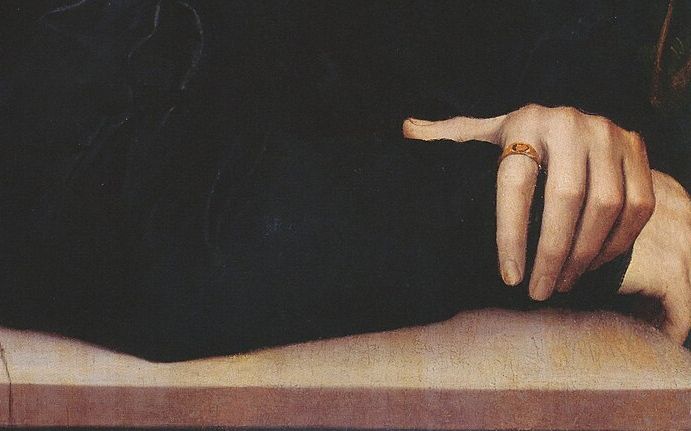
The hands make the position feel sustainable. One lies over the other wrist, with long fingers dropping towards the ledge. Their relaxed overlap provides a quieter counterpart to the turn of the head. The near sleeve almost touches the lower boundary of the image, giving the figure weight and proximity. We see enough of the body to understand how Born occupies his space, while the lower edge leaves his full position outside our view.
Behind him, thin branches introduce a different rhythm. They fork, cross and carry scattered leaves around the silhouette, breaking up the dark field without competing with the face. Their irregular lines make the broad clothing feel more solid. No particular symbolic meaning is needed to notice their compositional work: they fill the space around the head and shoulders while allowing the direct gaze to remain the strongest point of contact.
A Cologne Merchant in London
Born belonged to the community of German merchants living and trading at the Steelyard in the City of London. This was a walled commercial enclave used by Hanseatic merchants, and it offered Holbein a circle of potential sitters during his second period in England, which began in 1532. Seven portraits of German merchants from about 1532–33 survive. The Royal Collection suggests that some may have been intended for the sitters' families at home, although their shared circumstances do not establish a single collective commission. [1]
Born's business extended across very different sorts of goods. Nicola Christie's conservation account describes trade ranging from weapons to towels. In 1536 he supplied military equipment to Henry VIII's armourer, Erasmus Kyrkener, for the suppression of the Northern Rebellion. These later records place the young sitter within Tudor England's supply networks. They do not identify the transaction that paid for his portrait or explain its commission. [1] [2]
His London career eventually ended in conflict. In 1541, Born and his elder brother were expelled from the Steelyard after a dispute with the Duke of Suffolk over payment for a consignment of lead. He appears in Antwerp records in 1542 and 1543. The last record cited by the Royal Collection places him in Cologne in 1549, submitting a formal complaint about his expulsion. His death date remains unknown. [1]
Those events belong to the years after the painting. Reading the face as a prediction of trouble would give the portrait knowledge it could not possess. What it preserves is a particular presentation at twenty-three: composed, expensively dressed and able to occupy the foreground with assurance. The documents recover a mobile working life beyond that carefully held moment.
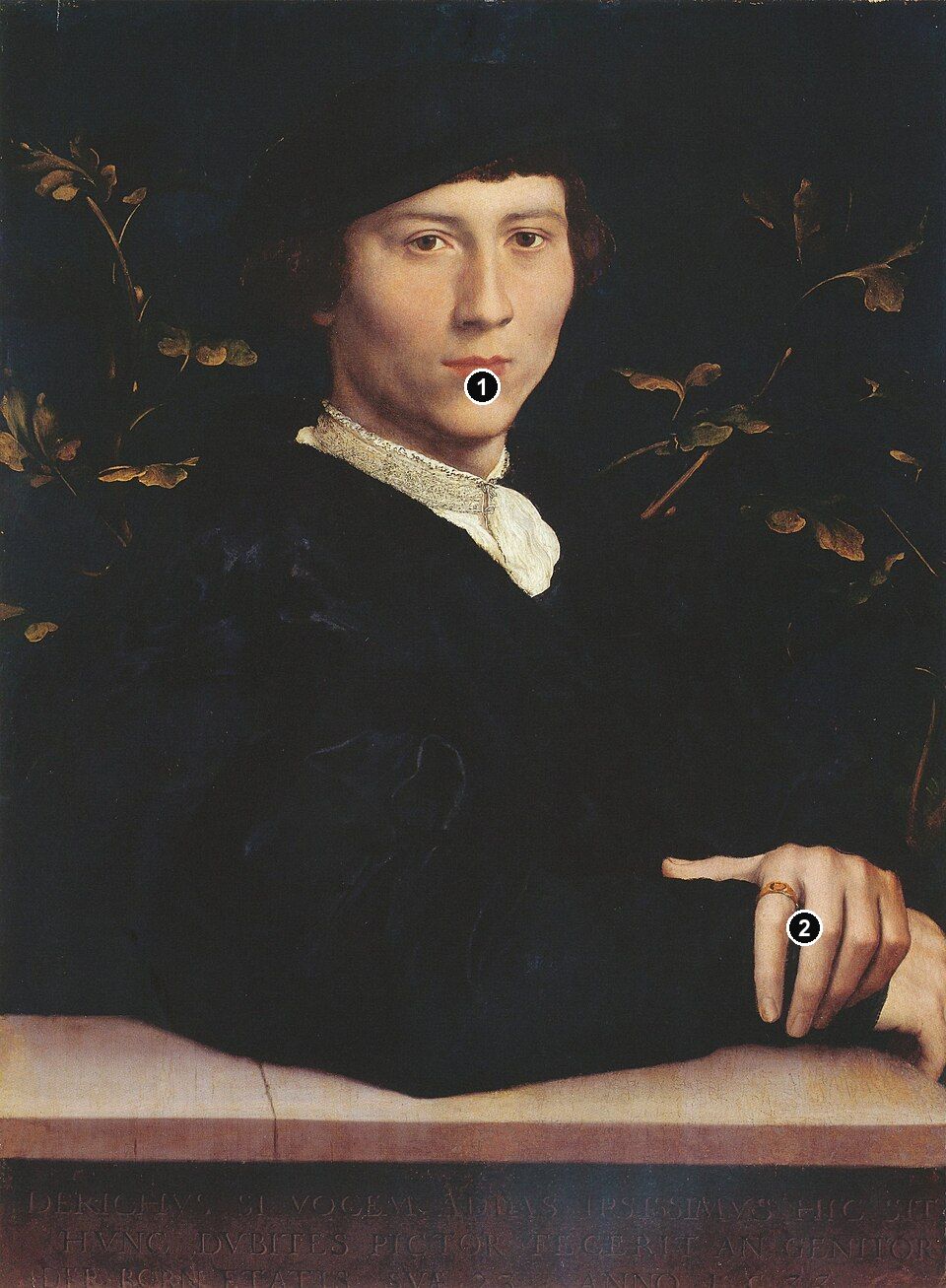
Annotated Details from Portrait of Derich Born
The numbered points identify visible features discussed in this article. Return from each detail to the whole composition. Hans Holbein the Younger, Derich Born, 1533. Oil on panel, 60.3 × 44.9 cm. Royal Collection, RCIN 405681. Royal Collection; reproduction from Stephanie Buck1999 via Wikimedia Commons. Image source . Public domain .
Details from PORTRAIT OF DERICH BORN
Compare the cropped details with the complete images above. Notice how their colours, shapes and positions contribute to the larger compositions.
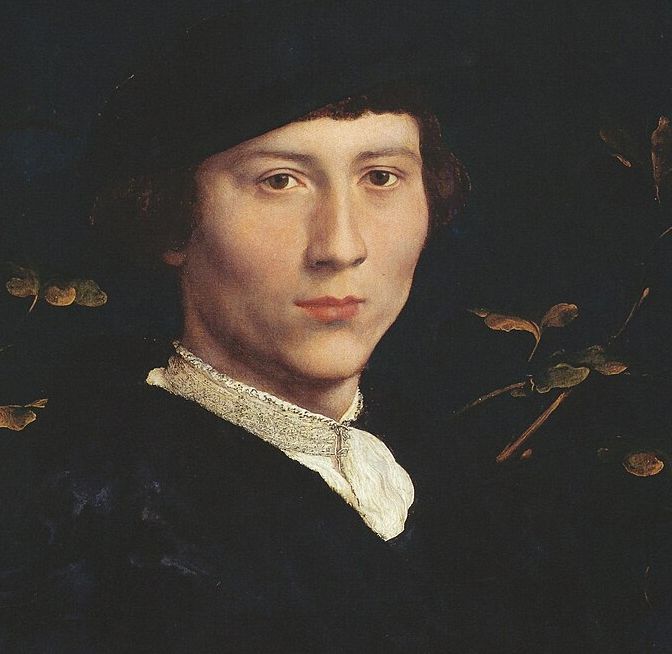
The face, cap and pale collar
The black cap and coat gather around the face. Small changes in light distinguish the mouth, nose and cheeks from the much broader surrounding shapes.
The hand over the stone ledge
The extended finger and ringed hand rest against the stone. Compare the pale skin, dark sleeve and long curve of the ledge.
Wealth in Black
Born's clothes reward a slower look than their restrained colour initially encourages. The small white collar draws attention to the neck, where its fine pattern meets the smooth skin. Around it, black extends across almost the whole body. Yet this darkness contains several distinct surfaces: the broad, gleaming sleeve, the softer fur and the folds that change direction around the arm.
The catalogue identifies an expensive satin doublet and a black fur-lined gown, describing their restrained elegance as characteristic of Cologne fashion. Born's wealth is therefore communicated through the quality of his clothing as well as through the ring. The portrait offers no inventory of merchandise and no conspicuous scene of business. Its most extensive evidence of prosperity is something he wears. [1]
Holbein's handling makes these dark materials legible. According to Christie, both the silk and the short-haired fur contain lamp black and lead white in linseed oil. Their different appearances arise from the application of paint. In the sleeve, fine, smooth strokes create the changing sheen of silk. For the fur, stiffer paint and a square-tipped brush allowed highlights to be dragged into the dark paint while it was still wet. [2]
Look at the sharp, looping highlights gathered around the bent arm, then at the more broken marks across the fur. The sleeve reflects light in folds; the fur scatters it across a surface. With much the same ingredients, Holbein gives us two different expectations of touch. Understanding the recipe makes the distinction more striking: pigment alone does not produce the illusion. The direction, thickness and finish of each stroke help tell the eye what kind of material it is seeing.
The Likeness That Needs a Voice
The Latin inscription turns looking into a test. Its first two lines say, in effect, that if this image could speak it would be Derich himself, leaving the viewer uncertain whether a painter or a father had brought him into being. Beneath them, the inscription records Born's age as twenty-three and the year as 1533. [1]
The comparison depends on two kinds of making. A father produces a living child; a painter produces a likeness. Here, the painted likeness is praised so strongly that the difference seems to narrow to a missing voice. The words encourage us to search for signs of life in the eyes, closed lips and turned head. That is an invitation made by the inscription, rather than proof that the image reproduces Born exactly as every contemporary would have recognised him.
Its placement gives the claim particular force. The words occupy the front of the stone ledge, below the arm that appears to rest on its upper surface. The same structure both supports the figure and presents the argument for his lifelike presence. We encounter a convincing body above a statement about its convincingness.
The inscription does not identify who composed the Latin. It is evidence of the portrait's presentation, rather than a transcript of Holbein speaking. The Royal Collection reads the text as praise of the extraordinary likeness. [1]
There is also a productive distance between text and face. The verse makes an extravagant claim; Born maintains his reserve. His mouth does not open to enact the promised speech. We are left to imagine the missing sound, while the stillness of the painted surface remains before us.
Watch: Holbein’s portraits and working methods
Explore museum films on Holbein’s drawings, painted portraits and close-looking details.
Hans Holbein at the court of Henry VIII
A Royal Collection Trust film exploring Holbein’s work at Henry VIII’s court.
Watch on YouTubeBeneath the Face: Panel, Ground and Drawing
The apparent solidity of the stone and softness of the clothes were built on wood. The support consists of two Baltic oak boards joined down the middle. Christie explains that Baltic oak was common in English painting of this period, and a panel of this size could readily require a join. Its central position is less usual. The boards were covered with a chalk ground, followed by a thin grey priming layer spread in broad strokes running in several directions. [2]
This preparation matters to the whole image. The grey helps establish the cool tonality that unites the pale flesh, dark clothing, blue background and plum-coloured ledge. Christie contrasts it with the pink priming beneath Holbein's portrait of William Reskimer . Even before the final colours were applied, the two paintings had different foundations for their effects. [2]
On Born's prepared panel, Holbein drew with a carbon-containing material, probably using a brush. Infrared reflectography makes parts of that underdrawing visible through the paint above. The published infrared detail reveals several lines searching along the cheek and jaw. The catalogue records adjustments to the shoulders, head and cap, with the right-hand contour of the face redrawn three times. Changes continued during painting. [1] [2]
These lines are particularly revealing beside the finished face. A narrow alteration to the cheek changes how broad the head seems and how it turns towards us. The smooth final boundary conceals a sequence of decisions. Holbein's style and technique emerge here through the correction of small relationships as much as through a recognisable manner of painting.
No preparatory drawing for Born survives. That absence leaves the earlier stages uncertain; it cannot establish that Holbein began without a separate study. Christie considers it probable that a drawing helped transfer the principal elements to the panel. The catalogue leaves more than one possibility open for the merchant portraits, including the loss or dispersal of drawings. [1] [2]
Blue Paint and a Thumb Impression
The background may initially appear to be a quiet interval between the figure and the frame. Technically, it is one of the portrait's most substantial passages. Christie identifies two thick layers of high-quality azurite, a blue mineral pigment. Between those applications Holbein adjusted the figure's right contour. The background therefore participated in the shaping of the sitter rather than simply filling an untouched space around him. [2]
The paint has its own physical relief. Its thickness created a raised edge beside the figure, and a slight dribble developed as it dried. Such details bring a flat reproduction into a different register: the picture has ridges, accumulated material and a sequence of wet applications. The clean silhouette seen from a normal viewing distance was made through this less tidy material activity. [2]
Conservation undertaken with the Getty Conservation Institute also revealed a thumb impression at the left edge of the panel. The published detail shows curved ridges pressed into the surface. Christie describes it as probably Holbein's and suggests that the paint may have dried more slowly than he expected. Both qualifications matter. The impression is a physical trace; its attribution to the artist and the explanation of the contact remain interpretations. [2]
It is tempting to turn such a mark into an intimate scene of Holbein lifting or steadying the panel. The evidence does not recover the precise gesture. What it does provide is an encounter with the paint as a workable substance, vulnerable to contact before it hardened. Beside the deliberate brushwork and carefully revised outlines, a small impression records a different kind of touch.
Stone and Letters Made with a Brush
The ledge changes character as our eyes move across it. Its pale upper surface receives the weight of the forearm. Below, a darker plum face carries the inscription. A thin apparent crack on our left and the shadow beneath the sleeve help persuade us that this is a solid, imperfect piece of stone.
Christie's account identifies iron-red oxide in the plum tones. The softer edge of the ledge was made by blending lighter and darker strokes, while a fine dark-red line marks the deepest transition between the stone and silk. Deep plum paint also forms the curving cast shadow beneath the sleeve. These small variations join the body to its support: the arm seems to interrupt light falling onto a surface that extends behind and below it. [2]
The letters offer another illusion of depth. They appear cut into the stone, but their preparation and finish belong to the painted surface. Extremely fine guidelines were lightly scored into the ledge's paint. Within these, Holbein formed the lettering freehand, using two colours and drawing one over the other to create intermediate tones. This is not an inscription carved into the wooden support. [2]
In the enlarged detail, light and dark edges give the letters their apparent recess. At points where the brush lifted, a little rounded deposit of paint remains. The effect combines measured spacing with minute signs of freehand execution. It also gives the verse a material presence: words praising the painter's imitation of life are themselves embedded in an imitation of carved stone.
The Portrait Enters Royal Collections
The portrait's early movements are not fully known. A portrait of a Born family member by Barthel Bruyn has prompted the suggestion that Holbein's painting, a copy or a preparatory drawing reached Germany. The Royal Collection finds the relationship between the pictures insufficiently close to settle the matter and considers it more likely that Holbein's panel remained in England. Its presence in Charles I's collection in the seventeenth century supports that possibility without filling every intervening year. [1]
The recorded later history is clearer. Charles I acquired the painting and may have given it to the Earl of Arundel. It appears in the Arundel inventory made in Amsterdam in 1655, was acquired by Charles II, and was recorded in the King's Closet at Whitehall in 1666. The Royal Collection now records it at Windsor Castle. [1]
Born's painted identity thus survived changes in country, owner and setting that are only partly recoverable. The Latin retained his name and age while the physical object entered new collections. Today, the commercial records help restore a life around the likeness, and conservation makes the painter's decisions newly visible. Returning to the face after examining those details, we can see its calm as something achieved: a sequence of revisions, textures and edges brought into balance around a young man's steady gaze.
Artworks directory
Explore paintings, drawings, prints and designs, including works without a separate article. Related studies and versions have their own entries; workshop works and copies are labelled. Print designs and series are grouped rather than repeated for every impression.
Frequently Asked Questions
He was a merchant from Cologne who lived and traded in London's Steelyard. He supplied military equipment to Henry VIII's armourer in 1536 and was later expelled from the Steelyard following a dispute over a lead payment. He is last documented in Cologne in 1549. [1]
It praises the likeness by suggesting that speech alone would turn the image into Born himself, so that a viewer might confuse the painter's creation with the father's child. It also records that Born was twenty-three in 1533. The words are part of the portrait's presentation; their presence does not identify the author of the Latin. [1]
Conservation revealed a thumb impression at the left edge. Nicola Christie describes it as probably Holbein's. This is a qualified attribution, not a forensic identification of the artist. [2]
Discussion
Look again at the images and ideas explored in Portrait of Derich Born by Hans Holbein the Younger. These editorial prompts invite your observations.
Reader Insights
Compare the position of the face with the elbow directly below it. How does that alignment steady the turning body?
Look from the silk sleeve to the fur. Which highlights make each surface recognisable before you know how it was painted?
First see it as stone supporting an arm, then as paint carrying words. Does the inscription change how closely you examine the face?
Join the Conversation
Which detail most strongly gives Born a living presence for you: the gaze, the overlapping hands, the sheen of his sleeve or the shadow on the ledge? Describe where your eye settles and how that detail works within the portrait.
References
- Royal Collection Trust , Derich Born (1509/10–after 1549) , Hans Holbein the Younger, signed and dated 1533, RCIN 405681. Current collection record, including catalogue text adapted from The Northern Renaissance: Dürer to Holbein (London, 2011), and provenance; accessed 18 October 2026. View source .
- Nicola Christie, Royal Collection Trust , “Derich Born”, Holbein in the Royal Collection , conservation feature with infrared, paint, inscription and thumb-impression details; accessed 18 October 2026. View source .
- Kunstmuseum Basel, Bildnis des Bonifacius Amerbach, 1519, inventory 314 (in German) . View source .
- Kunstmuseum Basel, Der tote Christus im Grab, 1521–22, inventory 318 (in German) . View source .
- The Frick Collection, Sir Thomas More, 1527, accession 1912.1.77, collection record . View source .
- Gemäldegalerie Berlin, Georg Gisze . View source .
- Susan Foister, The Ambassadors, The German Paintings before 1800 (2024) . View source .
- Susan Foister, Christina of Denmark, Duchess of Milan (2024) . View source .
- Würth Collection, Holbeins Schutzmantelmadonna, inventory 14910, current owner account (in German) . View source .
- Metropolitan Museum, Dance of Death series . View source .
- Kunstmuseum Basel, Bildnis der Frau des Künstlers mit den beiden ältesten Kindern, about 1528–29, inventory 325 (in German) . View source .
- Kunsthistorisches Museum Wien, Next Generation, Jane Seymour, about 1536–37, inventory 881 (in German) . View source .
- Splash image , Hans Holbein the Younger, Derich Born, 1533. Oil on panel, 60.3 × 44.9 cm. Royal Collection, RCIN 405681. Royal Collection; reproduction from Stephanie Buck1999 via Wikimedia Commons. Image source . Public domain .