 by
Tom Gurney
Tom Gurney BSc (Hons) is an art history expert with over 20 years experience
Email:
tomgurney1@gmail.com
/ Phone:
+44 7429 011000
Design for a Table Ornament by Hans Holbein the Younger: Introduction
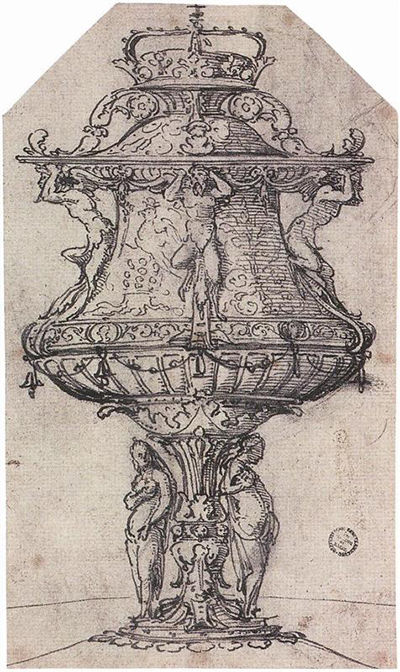
A crown balances above a swelling, densely ornamented vessel. Small figures bend beneath its projecting edges, while others stand around the narrow stem. Almost every surface curls, folds or bulges. Holbein makes the object feel substantial through a drawing that fits comfortably within a hand.
This sheet in the Kunstmuseum Basel is often encountered under the longer title Design for a Table Fountain with the Badge of Anne Boleyn . The museum currently calls it Table ornament with caryatids and dates it to 1533–1536. That title invites a close look at the surviving design before the royal association takes over its story. [1]
At a Glance
- Artist Hans Holbein the Younger.
- Current museum title Tafelaufsatz mit Karyatiden ( Table ornament with caryatids ).
- Date 1533–1536, given by Basel as 1533/36.
- Medium Pen in black over a preliminary chalk drawing; black chalk on the reverse.
- Sheet Upper corners cut diagonally; no inscription recorded.
- Collection Kunstmuseum Basel, Kupferstichkabinett, Amerbach-Kabinett.
- Inventory number 1662.165.89. [1]
- Traditional association A table fountain associated with Anne Boleyn; the surviving drawing does not establish a completed object or its patron's intentions. [1] [2]
This work across Hans Holbein the Younger’s career
Dead Christ in the Tomb
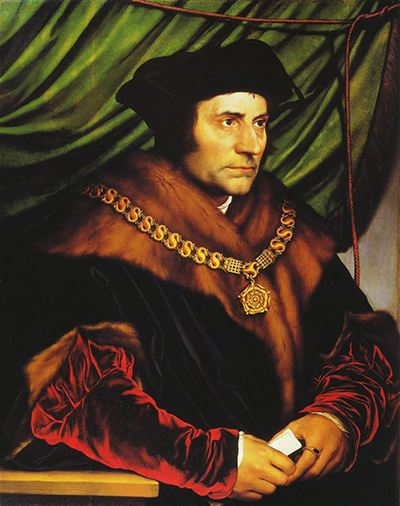
1521–22 [4]Sir Thomas More
1527 [5]Georg Giese
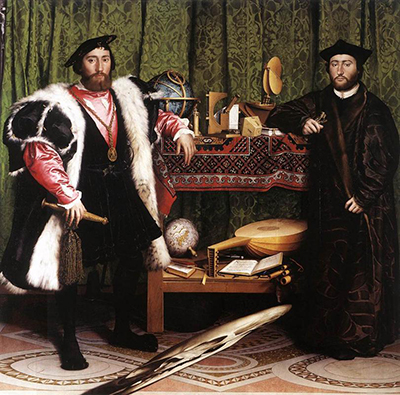
1532 [6]The Ambassadors
1533 [2]Design for a Table Ornament by Hans Holbein the Younger (current article)
1533–1536, given by Basel as 1533/36Contents
- A Small Sheet with an Architectural Presence
- The Figures That Carry the Ornament
- Drawing Volume with Black Lines
- Why the Anne Boleyn Title Needs Care
- A Design and the Object It Imagines
- Ornament Across Holbein's Work
A Small Sheet with an Architectural Presence
The drawing rises in stages. A low foot supports a narrow stem; the stem opens into the rounded underside of the vessel; the main body expands and then draws inward beneath a broad upper rim. Above this comes a curved, lid-like structure surmounted by a crown. The repeated changes of width give the silhouette a distinctive pulse.
Try following just the outside edge. At the bottom it is compact and comparatively stable. Higher up, it pushes outward into a broad bowl, retreats, and spreads again at the rim. Curled projections catch the eye at either side. The crown supplies a light, open ending to a form that otherwise seems packed with weight.
The result resembles a miniature building as much as a vessel. Its parts suggest base, supports, wall, cornice and roof. This is a way of reading the visible arrangement: the sheet itself supplies no architectural specification. What holds the design together is the clear vertical sequence beneath its abundant detail.
The Figures That Carry the Ornament
Caryatids are human figures used as architectural supports. Basel's title places them at the centre of this design's identity. [1] Here the word offers a useful starting point for looking: the figures seem caught between living bodies and components of an object.
Around the stem, elongated bodies flank the central support. Above them, at the sides of the main vessel, other figures curve beneath the overhanging rim. Their bent limbs and raised arms make the projection appear to bear down upon them. A narrower figure runs along the front, cutting across the surrounding bands of decoration.
These bodies create a sense of effort, though no literal burden is being carried on the paper. The eye supplies weight because it recognises the poses. That is part of the drawing's visual ingenuity: a practical relationship between support and supported mass becomes a small drama of bodies bracing, turning and extending.
Look also at the transitions. A torso gives way to an elongated lower form; the curves around a figure merge with the neighbouring scrolls. It is sometimes difficult to decide exactly where anatomy ends and ornament begins. That uncertainty animates the surface without disrupting the overall silhouette.
Drawing Volume with Black Lines
The most immediately striking contrast is between the pale open area on the left of the vessel and the denser shading on the right. Across the right-hand surface, close horizontal strokes accumulate into darkness. On the left, a few contours and scattered motifs allow the paper to remain visible. Together they make the central body appear to turn away from the light.
Holbein changes the work his line performs as the eye moves downward. Beneath the broad bowl, curved divisions suggest ribs or flutes. At the stem, tighter marks gather into deep recesses. Along the outer edges, firmer contours keep the whole form legible against the unworked background.
The drawing's recorded medium is black pen over a chalk preparation. [1] Even without separating each stage by eye, it is possible to appreciate the economy of the finished marks. A thin dark arc can describe an edge, establish an overlap and suggest the thickness of a projecting band. The design acquires depth through these small distinctions.
Watch: Holbein’s portraits and working methods
Explore museum films on Holbein’s drawings, painted portraits and close-looking details.
Hans Holbein at the court of Henry VIII
A Royal Collection Trust film exploring Holbein’s work at Henry VIII’s court.
Watch on YouTubeWhy the Anne Boleyn Title Needs Care
The familiar fountain title belongs to the work's history of interpretation. Susan Foister's National Gallery catalogue still refers to an Anne Boleyn fountain among Holbein's decorative designs, whereas Basel's current title describes the object and its supporting figures. [1] [2]
Those names direct attention differently. The longer one encourages a search for a royal emblem and a particular use; the museum's title keeps the form in view. Neither makes every small motif easy to identify. A crown is plainly visible at the summit, but a crown alone cannot identify a patron.
For this sheet, the Anne Boleyn connection is best retained as a qualified association. It should not become an account of a commission, a particular gift ceremony or a functioning fountain without further evidence. The figures, broad curves and intricate edges reward attention even where the historical explanation is incomplete.
A Design and the Object It Imagines
A drawing of an elaborate vessel can make an imagined object seem almost present. Here the rounded underside invites us to picture a hollow form; the projecting rim suggests thickness; the narrow stem seems to gather the whole weight into a small foot. Yet the physical evidence before us is a sheet of paper.
The drawing does not show a section through the vessel, a measured assembly or an exposed water mechanism. It therefore cannot tell us how a fountain based upon it would have worked. Nor should the shaded areas be treated as a record of a particular metal, finish or colour. They describe form in black line.
The scale of the drawing gives no secure basis for calculating the intended size of a completed ornament. A hand-sized design can propose an object of quite different dimensions.
This distinction helps us recognise what the sheet does convey. It makes an exterior coherent enough to imagine in three dimensions, while leaving questions of manufacture and use open. We can trace how a figure meets a rim or how the bowl joins its stem without claiming that a craftsman ever made those connections in metal.
Ornament Across Holbein's Work
The caryatids connect this sheet to a wider decorative vocabulary. In her discussion of the dagger sheath in The Ambassadors , Foister compares its figure and leaf forms with Holbein's ornamental drawings, including the design known as the Anne Boleyn fountain. She also cautions that the relationship between objects in the portraits and surviving designs is not always straightforward. [2]
The comparison suggests a rewarding way to look across Holbein's work: follow a motif as it changes setting. A supporting body can help organise a vessel or a narrow sheath. Its scale, neighbours and apparent task alter, while the interplay between anatomy and ornament remains recognisable.
The design for Anthony Denny's clocksalt offers another route into Holbein's designs for objects. The broader range is explored in his designs for objects, glass and decoration . With the Basel sheet, begin again at the foot and move upward: the larger outline makes sense of the details, and the details make that outline unexpectedly lively.
Artworks directory
Explore paintings, drawings, prints and designs, including works without a separate article. Related studies and versions have their own entries; workshop works and copies are labelled. Print designs and series are grouped rather than repeated for every impression.
Frequently Asked Questions
Kunstmuseum Basel calls it Tafelaufsatz mit Karyatiden , translated in its record as Table ornament with caryatids . Its inventory number is 1662.165.89. [1]
The evidence discussed here establishes the surviving design. A completed object corresponding to this exact sheet has not been established; it would be misleading to describe its manufacture or later destruction as known events.
They are human figures used as supports. In this drawing, the bodies around the stem and beneath the upper rim help turn the structure of the imagined vessel into ornament. Basel identifies them in the work's title. [1]
Discussion
Look again at the images and ideas explored in Design for a Table Ornament by Hans Holbein the Younger. These editorial prompts invite your observations.
Reader Insights
Trace the outside edge before studying the decoration. Which change of width gives the object its strongest sense of balance?
Compare the figures around the stem with those beneath the upper rim. Where does a pose most convincingly suggest effort?
Look between the marks on the lighter side of the vessel. How much of its apparent volume depends on an area Holbein leaves open?
Join the Conversation
Which detail first drew you into this design: the crown, the supporting figures or the sweep of the bowl? Describe how it changes your sense of the whole object.
References
- Kunstmuseum Basel , Tafelaufsatz mit Karyatiden ( Table ornament with caryatids ), Hans Holbein the Younger, 1533/36, inventory 1662.165.89, collection record (in German). View source .
- Susan Foister / National Gallery , The Ambassadors , in The German Paintings before 1800 , 2024, especially the discussion of Jean de Dinteville's ornaments, dagger sheath and related designs. View source .
- Kunstmuseum Basel, Bildnis des Bonifacius Amerbach, 1519, inventory 314 (in German) . View source .
- Kunstmuseum Basel, Der tote Christus im Grab, 1521–22, inventory 318 (in German) . View source .
- The Frick Collection, Sir Thomas More, 1527, accession 1912.1.77, collection record . View source .
- Gemäldegalerie Berlin, Georg Gisze . View source .
- Susan Foister, Christina of Denmark, Duchess of Milan (2024) . View source .
- Würth Collection, Holbeins Schutzmantelmadonna, inventory 14910, current owner account (in German) . View source .
- Metropolitan Museum, Dance of Death series . View source .
- Kunstmuseum Basel, Bildnis der Frau des Künstlers mit den beiden ältesten Kindern, about 1528–29, inventory 325 (in German) . View source .
- Kunsthistorisches Museum Wien, Next Generation, Jane Seymour, about 1536–37, inventory 881 (in German) . View source .