 by
Tom Gurney
Tom Gurney BSc (Hons) is an art history expert with over 20 years experience
Email:
tomgurney1@gmail.com
/ Phone:
+44 7429 011000
John Colet by Hans Holbein the Younger: Introduction
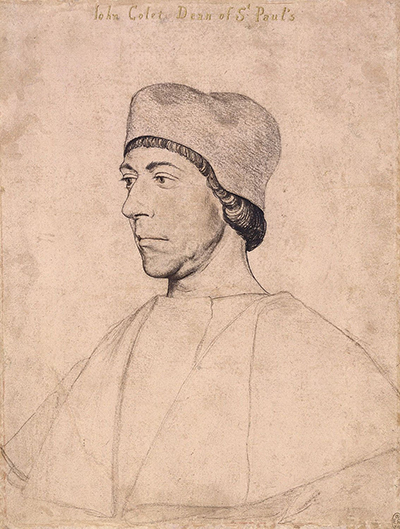
John Colet looks alert: the eyes are open, the lips firmly closed, the head held above a lightly sketched cape. Yet this is a posthumous portrait. Colet died in 1519; Holbein made the drawing around 1535, using a sculpted likeness. [1] The sheet invites a closer look at how a portrait can give someone a convincing presence without recording an encounter between artist and sitter.
At a Glance
- Artist Hans Holbein the Younger.
- Title John Colet, Dean of St Paul's (1467–1519) .
- Date c.1535.
- Materials Black and coloured chalks, pen and ink, brush and ink, and metalpoint on pale pink prepared paper.
- Dimensions 26.8 × 20.5 cm.
- Collection Royal Collection, RCIN 912199. [1]
This work across Hans Holbein the Younger’s career
Dead Christ in the Tomb
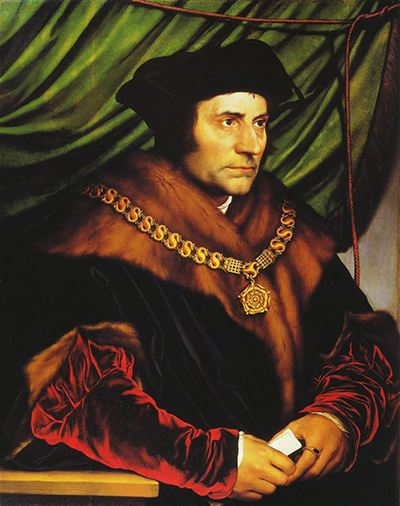
1521–22 [3]Sir Thomas More
1527 [4]Georg Giese
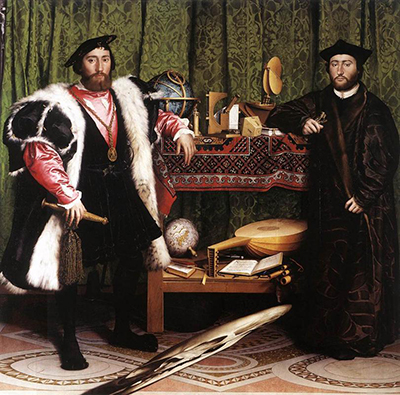
1532 [5]The Ambassadors
1533 [6]Contents
- A Likeness Through Sculpture
- Following the Face
- Chalk, Ink and the Strength of a Contour
- Colet's Humanist World
- A Portrait Preserved by Collectors
A Likeness Through Sculpture
Holbein worked after a bust attributed to Pietro Torrigiano. The sculptor's authorship remains qualified. [1] There are therefore two acts of portraiture behind this face: the modelling of Colet's features in three dimensions, then Holbein's selection and translation of them onto paper.
Drawing a sculpture involves choices that are easy to overlook when the result resembles a living person. The draughtsman selects a viewpoint; the projecting nose and the far side of the face fall into a particular relationship; light and shadow become marks. The drawing fixes one view of a form that could otherwise be seen from several directions.
Conservator Victoria Button groups Colet with Holbein's drawings after sculptures of the Duke and Duchess of Berry, observing that these figures are represented with the appearance of flesh. [8] That is the striking achievement here. There is no pedestal, sculptural surround or conspicuous surface texture to draw attention to an intervening object. We encounter a head, clothing and the space around them. Knowing the source changes the history of the image without cancelling its human immediacy.
Following the Face
Although the nose gives the drawing a strong profile edge, enough of the far eye remains visible to turn the head in space. The two eyes do different work: the nearer one opens clearly beneath its eyebrow, while the farther one is compressed towards the bridge of the nose. Small differences in width establish the angle of the face.
Follow the outer line downwards. The forehead gives way to the projecting nose, then to the shorter steps of the lips and chin. Against the empty paper, these changes of direction carry much of the likeness. Inside that boundary, the cheek is quieter. Shading gathers beneath the cheekbone and along the jaw, giving breadth to a face whose outline could otherwise look flat.
The hair supplies a different rhythm. Short dark strokes fringe the forehead, then curl into a denser mass behind the ear. Above them, the cap forms a broad, softly shaded volume. Its rounded top and sloping side frame the head without competing with the precise features below.
The shoulders expand almost to the edges of the sheet, but the clothing receives far less attention. Long lines describe the cape and its divisions; much of the paper remains open between them. This difference in finish directs the eye back towards the head. It also makes the portrait feel poised between a fully articulated face and the economical notation of a body.
Watch: Holbein’s portraits and working methods
Explore museum films on Holbein’s drawings, painted portraits and close-looking details.
Hans Holbein at the court of Henry VIII
A Royal Collection Trust film exploring Holbein’s work at Henry VIII’s court.
Watch on YouTubeChalk, Ink and the Strength of a Contour
Around the eyelids, mouth and hair, dark lines concentrate the drawing's sharpest information. Softer passages across the cap and cheek allow these accents to remain distinct. Try looking first at the shaded areas alone, then at the dark edges: volume and recognition depend on different kinds of mark working together.
Button's technical survey identifies this sheet by its older Royal Library number, RL 12199, and describes its contours as predominantly aqueous black over chalk. Her survey records no signs of transfer on it. [8] The distinction matters: an emphatic outline does not by itself demonstrate that a drawing was traced onto a painting support.
Holbein varied his materials across his portrait drawings. Rachael Smith and Button explain how sharpened chalk could produce detailed lines, while broader or blended strokes built shadows; stronger black watercolour could reinforce contours. [9] Those broader working habits help us understand his range, while the examination of Colet's sheet supplies the more specific evidence for its dark outlines.
Colet's Humanist World
Colet's clerical dress gives a visible starting point for his identity. His educational work adds another dimension. He founded St Paul's School in 1509 and used his inherited wealth to endow it. The school's history describes an education combining Christian teaching with humanist learning. Erasmus advised him, supplied textbooks and helped recruit staff. [10]
That practical collaboration gives substance to the word “humanist”: it involved what pupils would learn, the books available to them and the people who would teach them. Colet also placed the school's governance with the Mercers' Company. [10] His influence continued through an institution as well as through images.
None of this can be read directly from the set of his mouth. The drawing offers no classroom, book or writing desk. Its concentration on the head leaves biography outside the picture, to be supplied by knowledge of the person represented.
A Portrait Preserved by Collectors
The name above the head was added in the eighteenth century. [1] Its neat lettering belongs to the sheet's later life, making identification explicit for viewers who could no longer recognise the face unaided.
The recorded ownership runs from Henry VIII through royal and aristocratic collections, with an uncertain bequest from Lord Lumley to Prince Henry in 1609. Charles II had acquired the drawing by 1675. [1] Its survival extends the chain of mediation: a sculpted likeness became a drawing, and the drawing became something collected, labelled and preserved.
Artworks directory
Explore paintings, drawings, prints and designs, including works without a separate article. Related studies and versions have their own entries; workshop works and copies are labelled. Print designs and series are grouped rather than repeated for every impression.
Frequently Asked Questions
No. The drawing follows a bust and dates from after Colet's death. [1]
Button's technical survey records no signs of transfer on RL 12199. That finding should not be expanded into a claim about every possible later use of the likeness. [8]
He founded St Paul's School. His plans joined Christian and humanist education, with help from Erasmus. [10]
Discussion
Look again at the images and ideas explored in John Colet by Hans Holbein the Younger. These editorial prompts invite your observations.
Reader Insights
Look at the small amount of the farther eye that remains visible. How much does it change your sense of the head's angle?
The clothing is much more lightly described than the face. Does that difference make the head feel closer?
Knowing that Holbein worked from sculpture changes the encounter behind the portrait. Does it alter how alive the face seems?
Join the Conversation
Which detail most convinces you of Colet's presence: the eyes, the mouth, the hair or the shape of the head? Share what you notice and how the portrait's posthumous origin affects your response.
References
- Royal Collection Trust , John Colet, Dean of St Paul's (1467–1519) , c.1535, RCIN 912199; object description, materials and provenance. View source .
- Kunstmuseum Basel, Bildnis des Bonifacius Amerbach, 1519, inventory 314 (in German) . View source .
- Kunstmuseum Basel, Der tote Christus im Grab, 1521–22, inventory 318 (in German) . View source .
- The Frick Collection, Sir Thomas More, 1527, accession 1912.1.77, collection record . View source .
- Gemäldegalerie Berlin, Georg Gisze . View source .
- Susan Foister, The Ambassadors, The German Paintings before 1800 (2024) . View source .
- Susan Foister, Christina of Denmark, Duchess of Milan (2024) . View source .
- Victoria Button , The portrait drawings of Hans Holbein the Younger: function and use explored through materials and techniques , PhD thesis, Royal College of Art, 2013, p.114, note 107, and Appendix Four, Table 4, p.261, entry Parker 59/RL 12199. View source .
- Rachael Smith and Victoria Button, Royal Collection Trust , “Holbein's portrait drawings”, sections on chalk and watercolour. View source .
- St Paul's School , “History and Archives”, account of Colet's foundation, educational aims, governance and collaboration with Erasmus. View source .
- Würth Collection, Holbeins Schutzmantelmadonna, inventory 14910, current owner account (in German) . View source .
- Metropolitan Museum, Dance of Death series . View source .
- Kunstmuseum Basel, Bildnis der Frau des Künstlers mit den beiden ältesten Kindern, about 1528–29, inventory 325 (in German) . View source .
- Kunsthistorisches Museum Wien, Next Generation, Jane Seymour, about 1536–37, inventory 881 (in German) . View source .