by
Tom Gurney
Tom Gurney BSc (Hons) is an art history expert with over 20 years experience
Email:
tomgurney1@gmail.com
/ Phone:
+44 7429 011000
Sir Richard Southwell: the Portrait Drawing: Introduction
The face is already compellingly present; the clothes remain a web of lines. In Hans Holbein the Younger’s drawing of Sir Richard Southwell, a softly shaded cheek meets the firm edge of a nose, the mouth closes in a fine dark stroke, and a broad cap settles over closely described hair. Below the neck, open outlines carry the coat, shirt and buttons across the pink surface. The change in finish lets us follow the artist’s attention from the particularities of a face to the information needed for a larger portrait.
Made in 1536, this sheet in the Royal Collection prepared the painted portrait of Southwell now in the Uffizi . It also preserves a small German note about his eyes: a reminder that colour, as well as contour, had to travel from the drawing into paint. [1]
At a Glance
- Artist Hans Holbein the Younger.
- Collection title Sir Richard Southwell (1502/3–1564) .
- Date 1536.
- Medium Black and coloured chalks and black ink on pink prepared paper.
- Dimensions 36.6 × 27.7 cm, sheet of paper.
- Collection Royal Collection, RCIN 912242.
- Purpose Preparatory study for the Uffizi painting.
- Sitter’s age 33, recorded on the sheet. [1]
This work across Hans Holbein the Younger’s career
Dead Christ in the Tomb
1521–22 [3]Sir Thomas More
1527 [4]Georg Giese
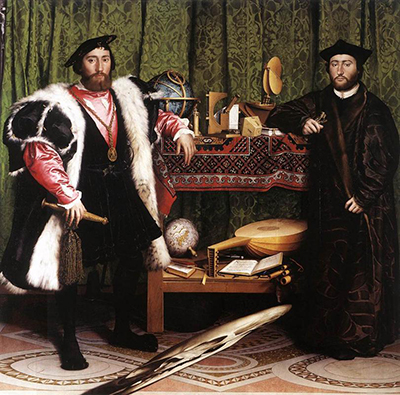
1532 [5]The Ambassadors
1533 [6]Contents
- A portrait at two speeds
- Pink paper, chalk and ink
- The reminder beside the eyes
- Scars without a diagnosis
- Contours that carried information
- From the sheet to the Uffizi painting
A portrait at two speeds
Southwell turns three-quarters towards the right, his gaze continuing beyond the edge of the sheet. The cap spreads sideways across the upper part of the drawing, while the long front of the coat opens the composition below. Between these broad shapes, the head is closely observed. Holbein distinguishes the small projection of the lower lip, the weight beneath the chin and the turn from the cheek towards the ear.
Look at the two eyes. Their unequal apparent widths establish the head’s angle, and the thin lines of the lids give them a presence quite out of proportion to their size. Much of the cheek, meanwhile, is held by gentle changes of tone. The eye moves easily between a sharply fixed feature and a softer passage where the pink beneath remains visible. These differences in density give the drawing its distinctive rhythm.
Pink paper, chalk and ink
The pink is part of the portrait’s construction. Holbein worked on prepared paper, so a warm underlying colour was available before he added the face. In her technical study of the sheet, Victoria Button describes this preparation as thin and streaked, with visible brush marks. It behaves more like a wash than a thick, concealing ground. [8]
That foundation helps explain how little additional colour some passages appear to need. Across the face, warm touches and grey shading build on a surface that already suggests flesh. The small yellow accent by the shoulder introduces another colour without filling the costume. Button identifies yellow chalk there as the indication of Southwell’s gold chain. [8]
The current collection record’s combination of chalks and ink is worth keeping in mind when looking closely. A soft band of shading and a narrow black edge do different jobs. Treating every mark as a single kind of pencil line would lose much of the variety through which Holbein brings the head into focus. [1] [8]
The reminder beside the eyes
At the right, a slender line of handwriting runs down beside Southwell’s head. Holbein wrote Die augen ein wenig gelbatt , translated by the Royal Collection as “the eyes a little yellowish”. The note belongs to the artist’s practical record of the sitter. The more prominent name at the upper left was added in the eighteenth century. [1]
Words and drawn colour could work together. Button’s examination distinguishes red chalk, black chalk and liquid black in the construction of the eyes, with brown watercolour in the irises. She suggests that the pink preparation may have complicated the recording of a yellowish eye colour, making the written reminder useful. This remains a proposed explanation for the note, rather than a documented statement of Holbein’s reasoning. [8]
After taking in the face, we notice this tiny piece of working language alongside it. A colour that might escape a quick glance receives its own brief instruction.
Watch: Holbein’s portraits and working methods
Explore museum films on Holbein’s drawings, painted portraits and close-looking details.
Hans Holbein at the court of Henry VIII
A Royal Collection Trust film exploring Holbein’s work at Henry VIII’s court.
Watch on YouTubeScars without a diagnosis
The skin receives the same attention as the outlines of the features. The Royal Collection identifies scars on Southwell’s forehead and neck; their delicacy can make them look at first like marks on the paper. [1] In the drawing, these irregularities sit within the modelling of the head, alongside the shading under the jaw and the warmer colouring around the nose.
Such details make a likeness specific. They also call for restraint. A visible scar does not establish its cause, and the drawn expression cannot tell us how Southwell behaved in a conversation, a household or a council chamber. The slight downturn of a mouth may feel severe to one viewer and merely still to another. Looking carefully means noticing both the detail Holbein recorded and the limits of what that detail can explain.
Contours that carried information
Below the head, the shirt opening, buttons and coat are sufficiently clear to guide further work. Their lines describe edges and overlaps without recreating the full weight or colour of cloth. Some are doubled or accompanied by parallel strokes, making this area feel more openly provisional than the face.
Button found physical evidence of use here: indentations following most of the costume outlines, including the buttons. Parts of the ear, nape and fringe also carry indented lines. She interprets these as signs of tracing. Her examination leaves uncertainty about the precise material or tool responsible for some marks. [8]
This is a useful distinction when considering the darker contours. Their appearance can reflect drawing, reinforcement and pressure on the paper. A reproduction shows their visible strength, but technical examination helps separate a deposited mark from a groove. The sheet therefore preserves more than the arrangement of Southwell’s features: it bears traces of the practical work of carrying a design forward.
From the sheet to the Uffizi painting
The Uffizi identifies its painted Southwell as a work of 1536. [9] Beside it, the drawing makes the continuities easy to recognise: the sideways spread of the cap, the turn of the nose, the curve beneath the chin and the opening of the garments. Button also notes the close correspondence between Southwell’s drawn and painted attire. [8]
The painting gives these outlines substantial surroundings. Dark clothing fills much of its lower half, a chain crosses the chest, the white shirt stands out at the neck, and the hands complete the half-length figure. The face occupies a firmer setting of fabric, background and inscription. On paper, the head emerges from an open field, with the unfilled costume letting us see through to the surface beneath.
Comparing the two rewards a return to the drawing’s smallest marks. A button can serve as a point of alignment; a short change of direction at the neck can determine how the head sits above the collar. The surviving sheet shows how much a portrait could depend on concise observations made before its painted surfaces were complete.
Artworks directory
Explore paintings, drawings, prints and designs, including works without a separate article. Related studies and versions have their own entries; workshop works and copies are labelled. Print designs and series are grouped rather than repeated for every impression.
Frequently Asked Questions
Holbein’s German note records that Southwell’s eyes were “a little yellowish”. It appears vertically beside the head. [1]
Button identified indentations along much of the costume and parts of the head, which she interpreted as tracing evidence. Some details of the tools and materials remain uncertain. [8]
Discussion
Look again at the images and ideas explored in Sir Richard Southwell: the Portrait Drawing. These editorial prompts invite your observations.
Reader Insights
Follow the transition from the shaded cheek to the open coat. Which few lines let you understand the clothing without its painted colour?
Find the vertical note beside the face, then look back at the eyes. Does the written reminder draw your attention to something you initially missed?
Compare the shirt buttons in the drawing and painting. Small details can reveal the relationship between two portraits as clearly as the overall pose.
Join the Conversation
Which part of Southwell’s drawing holds your attention longest: the face, the loose costume lines or the handwritten note? Describe a detail that changes when you compare it with the Uffizi painting.
References
- Royal Collection Trust , Sir Richard Southwell (1502/3–1564) , 1536, RCIN 912242; collection record and catalogue commentary adapted from The Northern Renaissance: Dürer to Holbein (2011). View source .
- Kunstmuseum Basel, Bildnis des Bonifacius Amerbach, 1519, inventory 314 (in German) . View source .
- Kunstmuseum Basel, Der tote Christus im Grab, 1521–22, inventory 318 (in German) . View source .
- The Frick Collection, Sir Thomas More, 1527, accession 1912.1.77, collection record . View source .
- Gemäldegalerie Berlin, Georg Gisze . View source .
- Susan Foister, The Ambassadors, The German Paintings before 1800 (2024) . View source .
- Susan Foister, Christina of Denmark, Duchess of Milan (2024) . View source .
- Victoria Button , The Portrait Drawings of Hans Holbein the Younger: Function and Use Explored through Materials and Techniques , PhD thesis, Royal College of Art, 2013, pp. 105, 134–135, 188, 197–204 and 296–297, Table 20. View source .
- Gallerie degli Uffizi , Uffizi, futuro nell’Antico. Le cornici dei maestri d’Oltralpe , 25 March 2025 (in Italian). View source .
- Würth Collection, Holbeins Schutzmantelmadonna, inventory 14910, current owner account (in German) . View source .
- Metropolitan Museum, Dance of Death series . View source .
- Kunstmuseum Basel, Bildnis der Frau des Künstlers mit den beiden ältesten Kindern, about 1528–29, inventory 325 (in German) . View source .
- Kunsthistorisches Museum Wien, Next Generation, Jane Seymour, about 1536–37, inventory 881 (in German) . View source .