 by
Tom Gurney
Tom Gurney BSc (Hons) is an art history expert with over 20 years experience
Email:
tomgurney1@gmail.com
/ Phone:
+44 7429 011000
The Artist's Family by Hans Holbein the Younger: Introduction
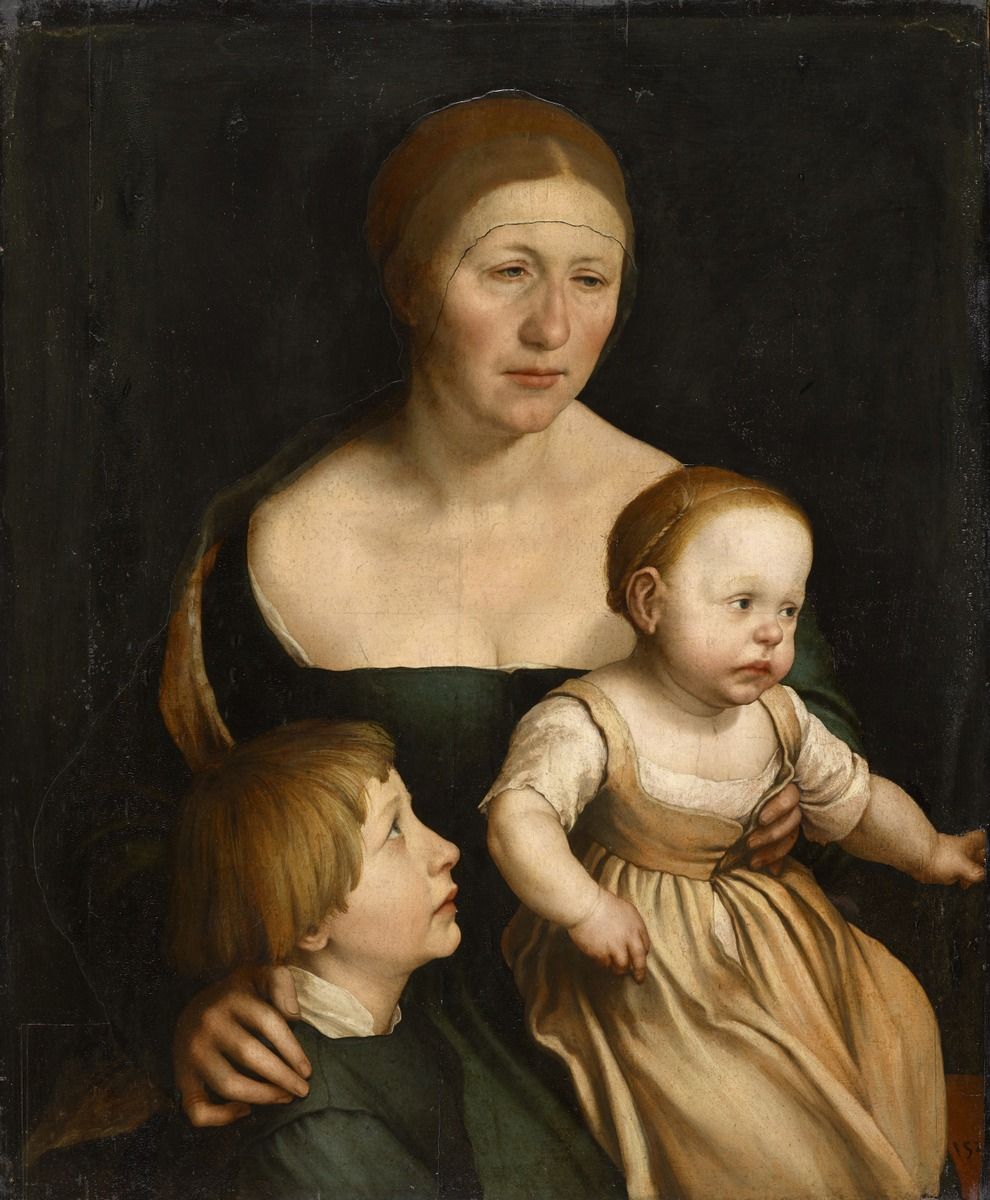
The little girl reaches towards the edge of the picture. Her brother looks up past her, while their mother sits behind them with a hand on each child. Hans Holbein the Younger's The Artist's Family brings three people close together without gathering their attention into a single place. The hands hold the group together; the eyes carry us beyond it.
Painted around 1528–29, the portrait shows Holbein's wife Elsbeth and their two eldest children, Philipp and Katharina. It belongs to the Kunstmuseum Basel, which calls it Portrait of the Artist's Wife with the Two Elder Children . That fuller title is useful: the family here consists of particular, named people, and the painter himself does not appear in the surviving image. Whether he once occupied a larger composition remains an open question. [1]
The picture's intimacy can make it feel unusually direct. Yet its present appearance has a complicated physical history. Holbein painted on paper; the figures were subsequently cut out along their contours and mounted on wood. Looking at the portrait means attending both to the people he represented and to a composition whose original extent can no longer be taken for granted. [1]
At a Glance
- Artist Hans Holbein the Younger. [1]
- Common title The Artist's Family . [1]
- Collection title Portrait of the Artist's Wife with the Two Elder Children ( Bildnis der Frau des Künstlers mit den beiden ältesten Kindern ). [1]
- Date Around 1528–29, following Holbein's return from his first visit to England. [1]
- Sitters Elsbeth, née Binzenstock, with Philipp and Katharina, the couple's two elder children. [1]
- Medium and support Mixed technique on paper, cut along the figures' contours and mounted on limewood. [1]
- Dimensions 79.4 × 64.7 cm. [1]
- Collection Kunstmuseum Basel, Amerbach-Kabinett, inventory number 325. [1]
- Inscription Unsigned; a fragmentary date, recorded as “152[]”, survives on the bench at the right. [1]
This work across Hans Holbein the Younger’s career
Dead Christ in the Tomb
1521–22 [3]Sir Thomas More
1527 [4]The Artist's Family by Hans Holbein the Younger (current article)
Around 1528–29, following Holbein's return from his first visit to EnglandGeorg Giese
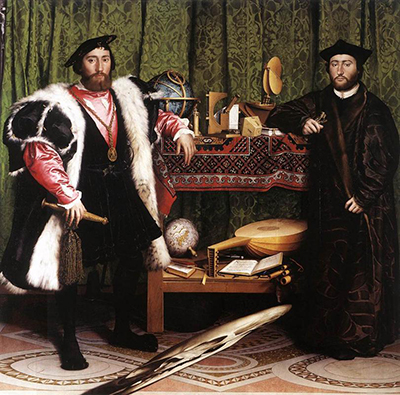
1532 [5]The Ambassadors
1533 [6]Contents
- Elsbeth and the children
- A family connected by touch
- The shape of a sacred group
- Painted on paper, preserved on wood
- Did Holbein once stand at the right?
- Expressions without a private diary
- From a family portrait to a public collection
- Annotated details
Elsbeth and the children
Elsbeth occupies the upper centre of the portrait, her brown head covering rising above the children's uncovered heads. Her dark dress and pale neckline establish a broad, quiet shape behind them. Philipp, at the lower left, turns his face upwards. Katharina sits higher on the right, supported against her mother's body, with a light-coloured dress spreading into long folds. Their different positions give each child a separate presence.
The museum identifies these three sitters as Elsbeth, née Binzenstock, and the two elder children of her marriage to Holbein. Philipp is the boy at the left; Katharina is the smaller child at the right. The fuller title identifies the people represented in this surviving group, while making no claim to show Holbein's entire household. [1]
The dating places the work at a return home. According to Basel's catalogue, it was made after Holbein's first English stay, in 1528 or by 1529 at the latest. That is a more useful starting point than reading the portrait backwards from the painter's later career in England. Here, the documented situation is a painter back in Basel making an image of his wife and children. [1]
This was also a return to a city where Holbein had already worked across several forms of art. Basel's account of his years there brings religious paintings, portraits, drawings and printed work into the same career. The Artist's Family belongs within that varied practice. Its treatment of a mother and children can draw upon forms familiar from religious art while giving sustained attention to the appearances of living people. [8]
For the broader sequence of journeys and commissions, Holbein's biography and the account of his Basel years provide the surrounding story. Within this picture, the essential point is simpler: the names allow us to recognise family relationships, while the painting asks us to spend time with three distinct faces.
A family connected by touch
Start with Elsbeth's hands. At the left, her fingers rest over Philipp's shoulder. At the right, her other hand supports Katharina's upper body. These contacts make the group intelligible before we look closely at any face. The children occupy different heights and turn in different ways, but both remain physically connected to their mother.
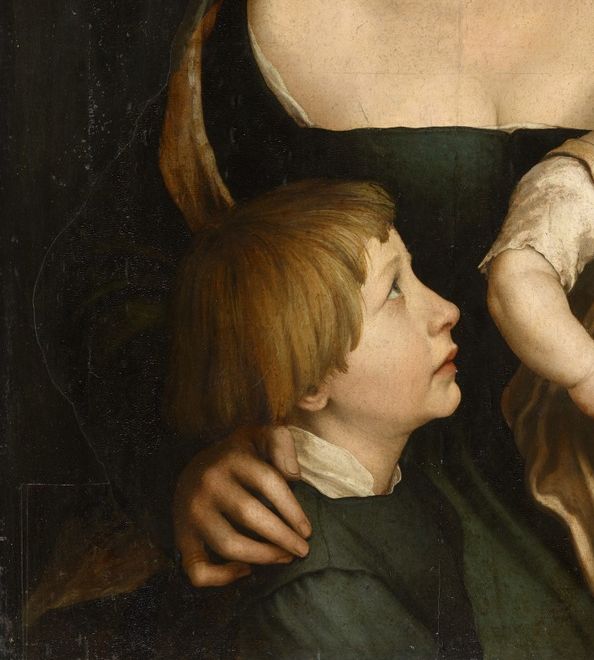
Philipp's head is presented almost in profile. His light hair falls around his face and neck; the narrow strip of pale fabric at his throat stands out against his darker clothing. The upward turn of his face creates a diagonal movement across the lower part of the group. Following it, our eye arrives near Katharina, then continues towards the space beyond the right edge.
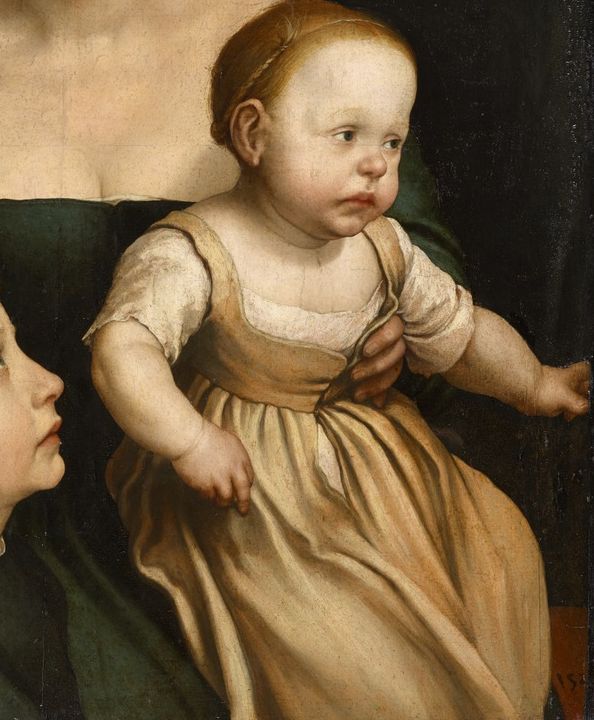
Katharina supplies a second, more outward movement. One arm reaches to the right, meeting the boundary of the surviving image. Her head turns in that direction too. Her light sleeves, rounded arms and gathered dress make her figure particularly easy to distinguish against the darkness. The folds below her waist spread and descend, giving the small body a substantial place within the picture.
Elsbeth's head turns less emphatically. Her face is nearer to a frontal view, though her attention does not meet ours. Her mouth is closed, and small changes of light around the eyes, cheeks and lips make the expression difficult to reduce to a single word. The brown head covering frames the face closely. Below, the large pale area of her neckline opens between the darker shapes of her clothes and the background.
The arrangement rewards a change in the way we look. If we follow the gazes, the picture feels open and unfinished at the right. If we follow the hands and overlapping bodies, it becomes compact and secure. A family group can be held together by touch even when its members are absorbed in different things.
There is little surrounding scenery to compete with those relationships in the work as it survives. The dark field makes the light of faces, necklines and hands especially prominent. However, that setting belongs to the picture's history of cutting and mounting. It should not automatically be imagined as the entire background Holbein first painted. The museum describes the figures as having been attached to a wooden panel whose dark ground now stands behind them. [1]
Annotated Details from The Artist’s Family
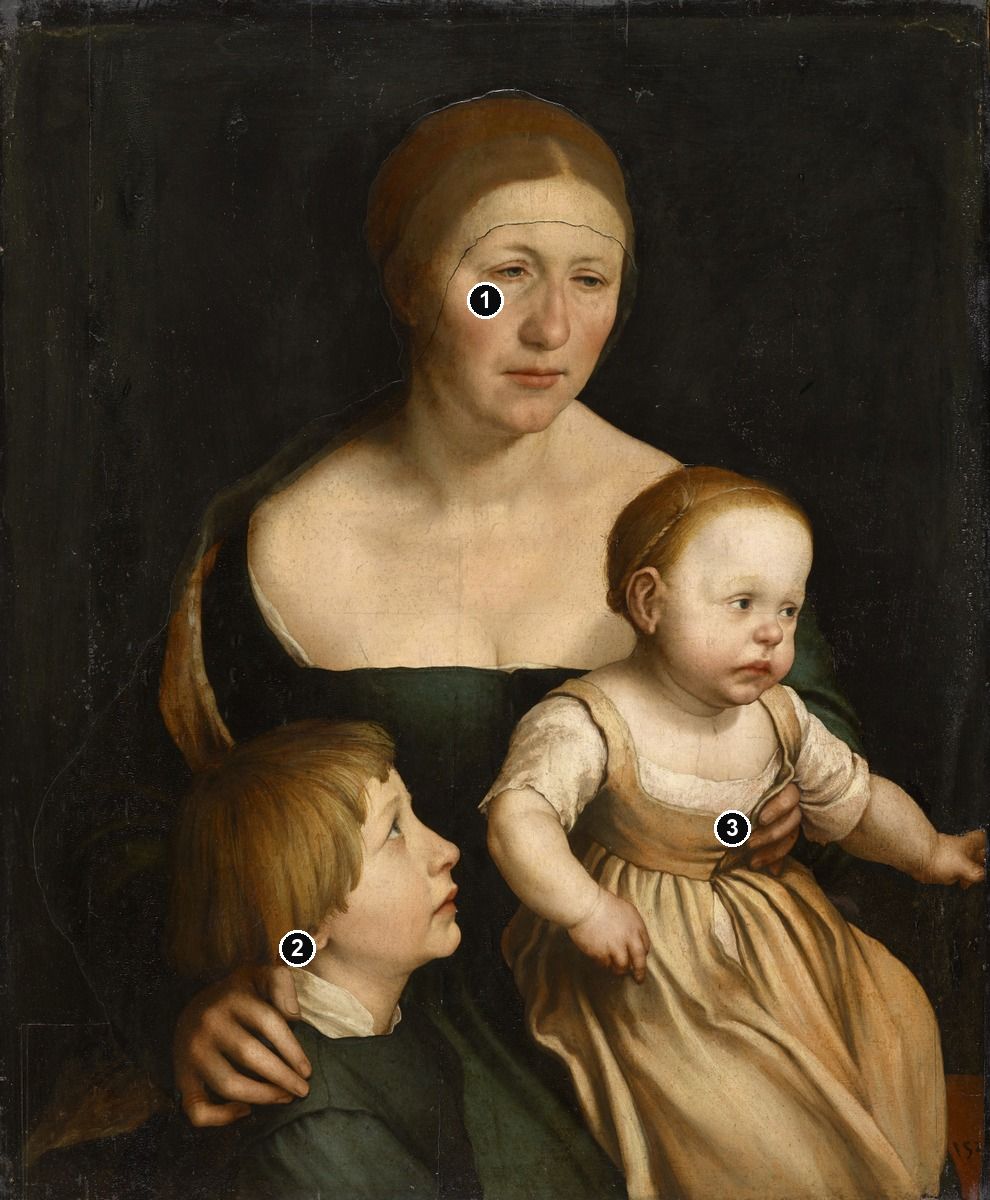
The numbered points identify visible features discussed in this article. Return from each detail to the whole composition. Hans Holbein the Younger, Portrait of the Artist's Wife with the Two Elder Children, around 1528–29. Mixed technique on paper, cut along the figures' contours and mounted on limewood, 79.4 × 64.7 cm. Kunstmuseum Basel, Amerbach-Kabinett, inv. 325. Image source . Public domain .
Details from THE ARTIST’S FAMILY
Compare the cropped details with the complete images above. Notice how their colours, shapes and positions contribute to the larger compositions.
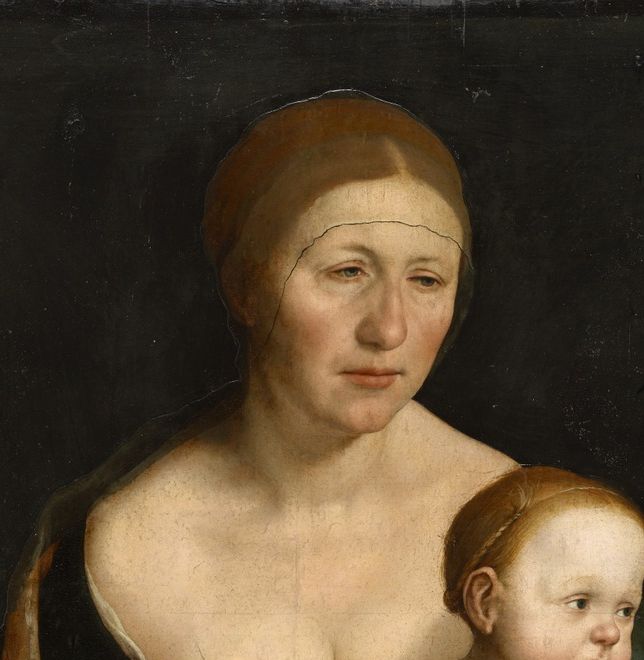
The mother’s face and cap
The lightly modelled face is enclosed by the cap and the dark background. Follow the unequal eyelids and the small changes of tone around the mouth.
The boy and the supporting hand
The boy looks upwards while a hand rests around his shoulder. The visible contact links the two figures without telling us what either was thinking.
The younger child and pale clothing
Pale fabric folds around the child’s body as the arms extend in different directions. Compare the soft clothing with the firmer fingers supporting the figure.
The shape of a sacred group
The three figures form a broad pyramid: Elsbeth's head makes its highest point, and the children widen the group below. Basel's catalogue compares this arrangement with Christian images of Saint Anne, the Virgin and Child, and with Madonnas accompanied by the infant Jesus and John the Baptist. These are comparisons of pictorial structure, helping us recognise how familiar forms can organise an image of a family. [1]
The comparison is easy to feel in the stability of the mother's central position. She provides the space against which both children are seen. Their smaller bodies extend across her, and the pattern of hands turns physical care into a clear compositional relationship. The broad triangular shape allows three differently placed figures to be read together.
There is also a revealing difference. As the museum observes, this group lacks the inward completeness of a self-contained sacred arrangement. The children's attention moves towards the right. A triangular outline is present, but it does not contain every direction of movement. The image seems to continue beyond the people we can see. [1]
Recognising a sacred compositional echo does not change the sitters' identities. Elsbeth remains Elsbeth; Philipp and Katharina remain her children. Nor does it establish that the portrait was intended for devotion. What the comparison offers is a way of seeing Holbein's construction: a familiar arrangement gives the family coherence, while the individual turns and gestures prevent it from settling into a wholly closed pattern.
That balance is part of the portrait's interest within Holbein's paintings . The mother and children possess the weight and clarity of a carefully organised group. At the same time, the children's different movements make the scene feel particular. A small reaching arm can disturb a stable triangle without destroying it.
Watch: Holbein’s portraits and working methods
Explore museum films on Holbein’s drawings, painted portraits and close-looking details.
Hans Holbein at the court of Henry VIII
A Royal Collection Trust film exploring Holbein’s work at Henry VIII’s court.
Watch on YouTubePainted on paper, preserved on wood
The material description changes how we understand the object. This is a painting on paper attached to a wooden panel, rather than paint applied directly to the wood. Basel records mixed technique on paper, cut along the contours of the figures and mounted on limewood. The support is therefore part of the work's history, with the painted paper and the panel performing different roles. [1]
The distinction can be difficult to appreciate in a reproduction. On a screen, the whole image forms one rectangle, and its surface may seem continuous. The catalogue asks us to imagine a more complicated structure: the painted group was separated from its earlier surroundings, then placed against the dark field that now gives the figures their setting. It also reports apparently substantial cutting at the right and below. [1]
Those changes affect more than the edges. A background helps establish where bodies are, how far apart they stand and what they may be attending to. When figures are cut out and remounted, their new setting can encourage a new reading. Here, the dark surround concentrates attention on Elsbeth and the children, while offering few clues about the space towards which the children turn.
Paper itself need not imply that a work was merely a sketch. In her study of Holbein's materials and techniques, Victoria Button examines his use of paper and parchment as painting supports. She includes The Artist's Family among a small group of surviving paintings on paper and stresses how difficult it can be to establish their original functions and the sequence in which they were attached to more solid supports. [9]
Button's discussion is valuable because it keeps practical possibilities separate from certainty about a particular object. Paper could serve as a painting surface within a developed artistic practice. In some circumstances, flexible supports also had advantages for moving pictures. Those broader observations do not establish why Holbein chose paper for his family portrait. No account of its manufacture cited here gives us his reason. [9]
For this painting, the clearest sequence is the one described by Basel: a paper painting was cut, then glued to a wooden panel. The museum's account does not identify the person who made the alteration or give its date. It would be misleading to turn that later intervention into a documented decision by Holbein himself. [1]
Nor does the medium justify inventing a detailed painting recipe from the colours we see. “Mixed technique” is the museum's description. The warmth of the faces and the lightness of Katharina's dress can be discussed as visible effects without assigning particular pigments or binders. Readers interested in the wider relationship between surface, drawing and finish can continue with Holbein's style and technique .
Did Holbein once stand at the right?
Katharina's reaching arm and the children's attention make the right edge unusually suggestive. Since the work appears to have been cut back there, it is reasonable to ask what has disappeared. Basel proposes that another person might once have occupied that space: Holbein himself, standing at an easel. This is an interpretation of a damaged composition, not an identification of a surviving figure. [1]
The proposal joins two kinds of evidence. One is visual and physical: the outward attention and the apparent loss of painted paper. The other is an early description associated with Hans Asper, the Zurich painter who owned the work before it entered the Amerbach collection. As quoted in Basel's catalogue, Asper described a work showing how Holbein portrayed his wife and both children. The museum considers that wording compatible with the possibility of the painter's inclusion. [1]
The possibility would change the relationship between the family and the act of painting. The children might then be attending to a person represented within their own picture. An artist at an easel would make the family portrait also an image of its making. Its evidential status, however, remains uncertain.
The description does not supply an unambiguous inventory of four visible figures. A statement that Holbein portrayed his family can describe his authorship as readily as his presence inside the scene. The cut support establishes that the present arrangement may be incomplete; it cannot, by itself, tell us exactly what the missing portions contained. [1]
The most responsible way to look is to retain both the question and its limits. Let the children's attention draw the eye towards the right. Notice how abruptly the surviving rectangle stops the reaching movement. Then return to what remains: three figures whose gestures make sense as relationships, even though their full original surroundings are uncertain. A reconstruction can illuminate the problem without becoming a substitute for the painting.
Expressions without a private diary
Elsbeth's face has encouraged viewers to attach a story to the picture. The children are unsmiling too, and the subdued colour and dark background make the group easy to describe as melancholy. Basel notes the range of speculation this appearance has generated, including accounts of an abandoned wife and even suggestions of an eye condition. These belong to the portrait's interpretive history; they are not established by its expressions. [1]
An unsmiling face is a visible feature. Abandonment is a claim about events and relationships. An eye disease is a medical claim. Moving from the first to either of the others requires evidence beyond the appearance of the painted face. The portrait offers no spoken explanation from Elsbeth, and no words from Holbein here tell us what he wanted her expression to communicate.
This need not make the encounter emotionally empty. Elsbeth's steady support of the children is moving in its own right. So is the difference between the boy's upward attention and the little girl's outward reach. The faces invite prolonged looking because they remain individual and difficult to summarise. Their reserve leaves room for a viewer's response without confirming the viewer's chosen story.
The altered format adds another reason for care. We meet these faces in a setting created partly through later cutting and mounting. If the earlier composition supplied more space, objects or another person, its emotional rhythm may have differed from the concentrated group we know. That possibility does not invalidate our response; it reminds us how closely a response can depend on what survives around a face. [1]
There is a useful freedom in leaving the feelings unresolved. We can notice the delicate modelling around Elsbeth's eyes, the firmness of her hands and the children's separate directions of attention without making them evidence in a verdict on the marriage. The painting's human detail is richer than any single domestic explanation.
From a family portrait to a public collection
The portrait's early ownership takes it beyond the household it depicts. Hans Asper of Zurich possessed it before it passed into the Amerbach collection in 1579. That is the date of its entry into a private collection, distinct from the later civic acquisition through which the Amerbach holdings became the foundation of Basel's public collection. [1]
Basel purchased the Amerbach cabinet in 1661. The museum's collection history describes a broad humanist collection that included paintings, drawings, prints, books and other kinds of objects. At Basilius Amerbach's death in 1591, it contained about fifty paintings, including fifteen by Holbein. This collecting history helped preserve a substantial body of the artist's work together. [10]
The city's purchase and public access were separate stages. The same institutional history records that the art cabinet opened to the public in the Haus zur Mücke in 1671. The Artist's Family thus belongs to a long history in which private ownership, civic preservation and public looking gradually changed the audience for the picture. Its present credit line, Kunstmuseum Basel, Amerbach-Kabinett, carries that history in a few words. [1] [10]
Copies show that the group attracted attention early. Basel cites several, predominantly from the sixteenth century, including examples associated with Lille, Saint-Omer and the former Trümpy collection in Glarus. Its account names the Lille version Caritas , or Charity. These copies are witnesses to the image's circulation and reception; their dates and authorship need to be considered individually rather than treating every version as another Holbein original. [1]
The title Caritas is particularly suggestive beside the museum's comparison with sacred mother-and-child groups. It shows how a familiar arrangement of a woman caring for children could be encountered under a different description. It does not prove that Holbein originally intended an allegory of Charity. The distinction allows the copies to add something to the picture's history without replacing the identities preserved in Basel's title. [1]
Today those identities remain the anchor for looking. A work once owned and copied by others still presents the particular turn of Philipp's head, Katharina's reaching arm and Elsbeth's supporting hands. The history explains how their image reached us; the surviving gestures keep drawing us back to the three people within it.
Artworks directory
Explore paintings, drawings, prints and designs, including works without a separate article. Related studies and versions have their own entries; workshop works and copies are labelled. Print designs and series are grouped rather than repeated for every impression.
Frequently Asked Questions
The painting shows Holbein's wife Elsbeth, née Binzenstock, and their two elder children, Philipp and Katharina. Philipp is at the lower left, and Katharina is supported at the right. The Kunstmuseum Basel's fuller title is Portrait of the Artist's Wife with the Two Elder Children . [1]
The museum dates it to around 1528–29, after his return from his first stay in England. A damaged date on the bench at the right is recorded as “152[]”; it does not preserve a complete year. [1]
The painted surface is paper. The figures were cut out along their contours and mounted on limewood. Basel describes the medium as mixed technique and records the work's dimensions as 79.4 × 64.7 cm. [1]
Possibly, but this is unproved. The museum suggests that the children's attention towards the right might have been directed at Holbein standing at an easel in a larger composition. The painting's cut state and an early description support asking the question without establishing the missing content. [1]
Discussion
Look again at the images and ideas explored in The Artist's Family by Hans Holbein the Younger. These editorial prompts invite your observations.
Reader Insights
Trace Elsbeth's contact with each child. How does the group change when you concentrate on touch rather than expressions?
The figures form a stable pyramid, yet the children's attention moves outwards. Which movement first draws your eye towards the right edge?
Spend a moment with Elsbeth's face before choosing a word for its mood. Does the expression seem different after looking at her hands and the children?
Join the Conversation
What holds this family group together most strongly for you: its shape, its gestures or the differences between the three faces? Share a detail that changed how you looked at the portrait, and consider how its cut edges affect your response.
References
- Kunstmuseum Basel , Bildnis der Frau des Künstlers mit den beiden ältesten Kindern , collection catalogue, inventory 325; object data, description, image and bibliography (in German). View source .
- Kunstmuseum Basel, Bildnis des Bonifacius Amerbach, 1519, inventory 314 (in German) . View source .
- Kunstmuseum Basel, Der tote Christus im Grab, 1521–22, inventory 318 (in German) . View source .
- The Frick Collection, Sir Thomas More, 1527, accession 1912.1.77, collection record . View source .
- Gemäldegalerie Berlin, Georg Gisze . View source .
- Susan Foister, The Ambassadors, The German Paintings before 1800 (2024) . View source .
- Susan Foister, Christina of Denmark, Duchess of Milan (2024) . View source .
- Kunstmuseum Basel , Hans Holbein d. J.: Die Basler Jahre 1515 bis 1532 , institutional account of the 2006 exhibition (in German). View source .
- Victoria Button , The Portrait Drawings of Hans Holbein the Younger: Function and Use Explored through Materials and Techniques , PhD thesis, Royal College of Art, 2013, section 3.5, printed pp. 106–110. View source .
- Kunstmuseum Basel , Geschichte der Öffentlichen Kunstsammlung Basel , especially “Das Amerbach-Kabinett” (in German). View source .
- Würth Collection, Holbeins Schutzmantelmadonna, inventory 14910, current owner account (in German) . View source .
- Metropolitan Museum, Dance of Death series . View source .
- Kunsthistorisches Museum Wien, Next Generation, Jane Seymour, about 1536–37, inventory 881 (in German) . View source .
- Splash image , Hans Holbein the Younger, Portrait of the Artist's Wife with the Two Elder Children, around 1528–29. Mixed technique on paper, cut along the figures' contours and mounted on limewood, 79.4 × 64.7 cm. Kunstmuseum Basel, Amerbach-Kabinett, inv. 325. Image source . Public domain .