 by
Tom Gurney
Tom Gurney BSc (Hons) is an art history expert with over 20 years experience
Email:
tomgurney1@gmail.com
/ Phone:
+44 7429 011000
Portrait of Erasmus of Rotterdam: Introduction
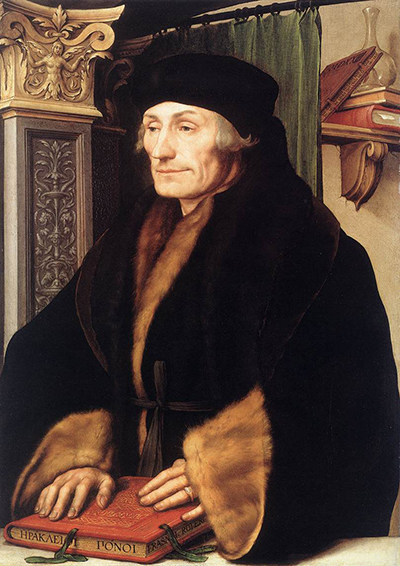
Erasmus rests both hands on a closed red book. He has no pen, and his eyes remain raised above the page, looking towards the left of the picture. A green curtain hangs behind him; beside it, a narrow shelf supports more books and a glass vessel. His broad black gown fills the space between these small objects and the pale stone ledge below. The face, framed by cap and fur, seems remarkably close.
Holbein painted this portrait in 1523. Erasmus was a Dutch scholar and Christian writer, closely associated with the Renaissance study of ancient texts. Known as the Longford Castle Erasmus , the painting is on loan from that collection to the National Gallery in London. It differs from the smaller portraits in Basel and Paris in which Erasmus writes with his head inclined. Here the scholar offers a more expansive presence, surrounded by objects that connect his likeness with the work for which he was known. [1]
At a Glance
- Artist Hans Holbein the Younger.
- Subject Desiderius Erasmus of Rotterdam.
- National Gallery title Erasmus .
- Date 1523.
- Medium Oil on wood.
- Dimensions 73.6 × 51.4 cm.
- Collection Longford Castle collection; on loan to the National Gallery, London.
- National Gallery inventory number L658. [1]
- Distinct related paintings Erasmus Writing , Kunstmuseum Basel, inventory 319; Portrait d'Érasme écrivant , Musée du Louvre, INV 1345. [2] [3]
This work across Hans Holbein the Younger’s career
Dead Christ in the Tomb
1521–22 [5]Sir Thomas More
1527 [6]Georg Giese
1532 [7]The Ambassadors
1533 [8]Contents
- The face within the black gown
- Hands, fur and the closed book
- A room arranged around learning
- The inscriptions and Erasmus's Herculean labour
- A portrait sent across a distance
- The writing portraits in Basel and Paris
- What the hand studies reveal
- Erasmus in print and in later collections
The face within the black gown
Begin with the figure's outline. Erasmus's shoulders spread widely, and the sleeves continue their curve almost to the lower corners. Above this broad base, the head appears relatively small. The cap extends horizontally, balancing the spread of the body below, while the pale face narrows towards the chin. Holbein brings these different proportions together through the open collar, whose long dark sides lead from shoulders to throat.
The face is turned enough to give the nose a clear projecting edge, while leaving both eyes visible. Light catches the forehead, upper cheek and ridge of the nose. Around the mouth it becomes gentler, allowing the lips to register without a hard outline. The farther cheek withdraws into shadow beside the fur. These changes make the head seem solid and irregular: a particular face turning within the space available to it.
The eyes are especially restrained. They do not widen to meet the spectator, and the upper lids partly cover them. A small area of brightness brings each eye forward under the cap's shadow. The mouth has a slight upward inflection, though the surrounding lines prevent that movement settling into an uncomplicated smile. We can recognise something like amusement without knowing what has prompted it.
Erasmus could appear reserved, attentive or quietly pleased, depending on which feature first holds us. Holbein has made the folds around the eyes and mouth available to scrutiny, while leaving the sitter's immediate thoughts unspoken.
The cap and collar intensify this effect by placing darkness immediately beside the skin. Along the forehead, the cap's edge is comparatively smooth; beside the cheek, the fur is broken and soft. Two very different boundaries frame the same face. The grey hair escaping near the ear supplies a third texture, lighter and more delicate than either.
Try covering the books at the right with your hand. The likeness remains compelling without its learned setting: the turn of the head and the modelling of the cheek are enough to establish a person. Restore the background and the experience changes. We become aware that this person is being presented within a carefully equipped space, where objects and words can make claims that a face alone cannot convey.
Hands, fur and the closed book
The hands occupy a narrow strip near the bottom of the portrait, yet their light colour draws the eye across the gown. Erasmus's right hand appears at the viewer's left, its fingers bending down towards the red binding. His left hand lies farther across the book, with a ring visible on one finger. The hands remain separate, distributed over its surface. Their quiet contact provides a physical connection between the sitter and the volume.
Notice how differently they emerge from the sleeves. One cuff spreads into a broad, softly lit patch of fur; the other rises more steeply beside the book. The fur's small hairs interrupt its outline, while the fingers have clearer edges and more continuous surfaces. The contrast makes the exposed skin feel thin and vulnerable beside the thick material enclosing it.
Light describes the hands through tiny changes around the joints. A knuckle catches it; a shallow crease interrupts it; the side of a finger turns away. The fingernails introduce pale, firmer shapes within the flesh. None of these details needs to be emphatic. Their relationship to one another gives the fingers their varying lengths and pressures, and makes their placement on the book convincing.
The binding introduces a different kind of precision. Its red surface carries patterns of fine lines, while green ties fall over the fore-edge and onto the ledge. The ties have their own slight twists and shadows. They bring a loose, flexible movement into an arrangement dominated by the weight of the book and the steadiness of the hands.
One tie passes close to the front of the picture, where the stone sill meets our space. It is a modest detail, but it changes the distance we feel from the sitter. The figure may seem ceremonious in its broad gown; this small dangling strip belongs to the familiar business of opening, closing and handling a volume.
The book is closed, leaving its contents inaccessible. That choice gives the hands a different role from those in the writing portraits. Here they display contact, rest and possession. We meet Erasmus in an interval whose duration we cannot measure: the painted ties and fingers suggest a world of use, but supply no certain account of what happened immediately before the pose.
A room arranged around learning
At the left, an ornamented architectural support rises beside Erasmus. Its lower panel contains a fine vegetal pattern; above it, carved forms spread into a richly decorated capital. The upright divides the picture sharply, presenting a succession of small, hard edges beside the cap and soft collar. At the right, a wooden bracket curves under the shelf. Between them, the green curtain supplies long folds and a relatively quiet field behind the head.
These objects make the setting feel furnished without revealing much of a room. We cannot see a floor or locate the far wall with confidence. The curtain closes off part of the background, and the shelf occupies only a shallow strip. Holbein gives each feature a persuasive surface while limiting our ability to reconstruct the whole interior.
The National Gallery connects the architecture with classical learning and the curtain, books and vessel with images of the evangelist Mark and the biblical translator Jerome. [1] These associations place Erasmus within traditions of Christian scholarship. They do not turn him into either saint, or make the picture an inventory of his actual study.
The distinction is useful when looking at the glass vessel. Its narrow neck stands out against the pale wall, while its broader lower part is partly hidden by a leaning book. We can see enough to recognise glass and its delicate contour, but the portrait does not invite us to identify its contents. Its visual role is immediately clear: a fragile, transparent form balances the heavier bindings nearby.
The shelf also changes the scale at which we look. After the broad sweep of Erasmus's sleeve, its thin horizontal edge and small objects require close attention. The bracket's curling shape echoes some of the ornamental movement across the capital on the opposite side. Decoration therefore frames the sitter from two directions, while the curtain allows the face to remain readable between them.
There is pleasure in these shifts between large forms and minute description. The gown can be understood at a distance; the book edges ask us to approach. The painted room makes space for both kinds of attention, keeping its most concentrated details around a sitter whose body is comparatively still.
The inscriptions and Erasmus's Herculean labour
The large red book carries an unexpected title along its fore-edge. Its lettering combines Greek with Latin characters to identify the Herculean labours of Erasmus of Rotterdam. The phrase compares literary work with the feats of the ancient hero. Arthur B. Chamberlain transcribes the inscription in his 1913 account of the portrait, observing that the last part disappears beneath the fur cuff. [10]
That partial concealment matters visually. The words occupy the book's thickness, the very area where a reader would normally see compressed pages. Erasmus's name becomes part of the object under his hands. We are offered a monument to his work in the form of something he can touch, use and close.
The heroic comparison gains force from the sitter's stillness. His hands perform no strenuous action, and the broad gown conceals most of the body. Labour is represented through the book and its words. The inscription invites us to imagine the time and effort behind a finished volume, even though the picture shows only a quiet pause.
A second inscription appears on a much smaller book above his shoulder. Chamberlain records the date in Roman numerals on its cover and a damaged Latin couplet associated with Holbein's name. Its point is that criticism comes more easily than successful imitation of the painter. [10] The boast directs attention towards the skill needed to produce the likeness we are studying.
The two inscriptions occupy opposite ends of the composition. The lower one belongs to the sitter's achievement; the upper one introduces the artist. Between them, Holbein demonstrates what the second claim requires: distinctions between fur and skin, the turn of the face, the sheen of a binding and the translucency of glass. Words and painted surfaces reinforce one another without doing the same job.
The small inscription has suffered, and its historical reconstruction should not be mistaken for an uninterrupted text that every viewer can now read unaided. Nor does its presence identify who devised its wording. What remains clear is the portrait's willingness to accommodate praise of both scholar and painter. Erasmus's accumulated writing and Holbein's concentrated act of representation share the same small interior.
Watch: Holbein’s portraits and working methods
Explore museum films on Holbein’s drawings, painted portraits and close-looking details.
Hans Holbein at the court of Henry VIII
A Royal Collection Trust film exploring Holbein’s work at Henry VIII’s court.
Watch on YouTubeA portrait sent across a distance
The portrait belonged to a culture in which a likeness could sustain relationships between people living far apart. Its early journey has unusually direct documentary support. Writing to Willibald Pirckheimer on 3 June 1524, Erasmus reported sending two portraits of himself to England. In a letter to William Warham dated 4 September, he expressed the hope that his likeness had arrived, so that the archbishop would retain something of him after his death. Both letters are quoted in Chamberlain's account. [10]
The National Gallery identifies the Longford Castle painting as the portrait sent to Warham, Archbishop of Canterbury. [1] The gift makes particular sense of its sustained, composed presence. A recipient could return to this face long after a visit or a letter, encountering the hands, clothes and familiar features of someone absent. The book's claim for Erasmus's enduring work sits beside the much more personal wish to be remembered.
Portrait exchange was already familiar within his circle. In 1517, Quinten Massys had painted Erasmus and Peter Giles in a paired gift for Thomas More. More responded with verses which give the picture a voice. The poem assigns different tasks to the two forms of exchange: a loving letter conveys the friends' minds, and the painting provides their bodily appearance. The surviving text accompanies More's letter to Giles of 7 October 1517. [11]
That concise distinction helps explain the value of a portrait without treating it as a complete revelation of character. A letter could argue, joke or explain; a painting could preserve the shape of a face and the feeling of physical company. Each answered a different part of separation. In Holbein's portrait, the small fluctuations around Erasmus's mouth offer more than a name on a page, while the inscriptions place that bodily likeness beside his written achievement.
The connection also had practical consequences for Holbein. When he travelled to England in 1526, Erasmus's acquaintances offered a network through which his abilities could become known. More's letter to Erasmus of 18 December that year calls the painter a mirus artifex , a remarkable artist, and promises assistance in finding opportunities. [12] Its few lines about Holbein show friendship becoming practical patronage.
More's earlier Massys portrait, Warham's gift and Holbein's later English employment are separate episodes. A portrait could establish a painter's reputation before the painter himself arrived; the correspondence does not establish More as the recipient of this particular Holbein.
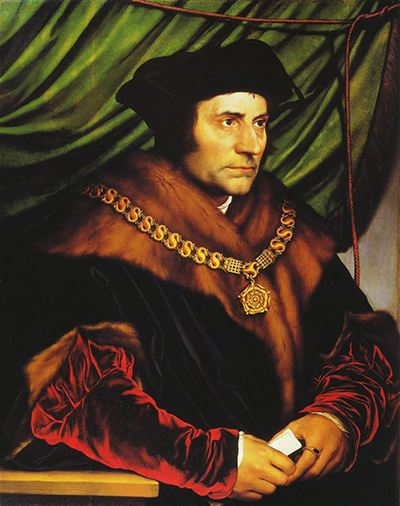
Holbein's later portrait of Thomas More offers a useful continuation. Both men sit within encompassing dark clothes, with their hands near the picture's lower edge. Yet Erasmus's books make writing visibly central, while More's folded paper remains unreadable. The comparison shows how much the choice of a single object can change the presentation of a sitter.
The writing portraits in Basel and Paris
Erasmus also appears in a more closely observed activity: his head bent, one hand holding a pen, the other steadying the paper. Two surviving paintings use this arrangement. Their resemblance has often encouraged accounts that treat them as interchangeable, but their materials, scale, backgrounds and current dates need to be kept separate.
| Work | Current collection identification |
|---|---|
| Longford Castle Erasmus | 1523; oil on wood; 73.6 × 51.4 cm; National Gallery loan L658. [1] |
| Erasmus Writing , Basel | 1523; mixed media on paper mounted on fir; 37.1 × 30.8 cm; Kunstmuseum Basel, inventory 319. [2] |
| Portrait d'Érasme écrivant , Paris | Currently dated 1528; limewood support; 43 × 33 cm; Musée du Louvre, INV 1345. [3] |
In the Basel painting, a green background throws the profile into relief. Erasmus's nose, lips and chin form a continuous projecting outline above the paper. His gaze descends towards the working hands. The pen creates a slender diagonal, and the other hand lies over the sheet. Books below it provide a raised surface on which to write. Compared with the Longford Castle figure, he occupies a much narrower space, with the activity gathered close to his body.
The writing identifies the beginning of his paraphrase of Mark's Gospel, which he completed in 1523. Basel's collection account relates the portrait to his work with the printer Johannes Froben, whose publications he could supervise while living in the city. It also records that Bonifacius Amerbach bought this painting from Holbein's wife in 1542. [2] These details connect the image of writing with a particular text, a publishing environment and a later act of collecting.
The Louvre painting has a more elaborate background. Patterned fabric fills much of the space before the profile, while wooden panelling appears behind the sitter. Small coloured motifs on the hanging draw the eye close to the surface; the dark gown gathers into a large, quieter form below. Erasmus's attention remains directed towards the page, so that our looking takes place beside an activity which does not acknowledge us.
Its date requires care. Older accounts, including Chamberlain's, place it in 1523 beside the Basel picture. The Louvre's current record gives 1528. That same record retains a proposed identification with one of the portraits sent to England in 1524, leaving a chronological inconsistency within its account. [10] [3] We can compare the pictures' shared pose while recognising that their exact sequence is unsettled.
The difference in address remains clear whatever the dating. In the writing portraits, the bent head and moving hand give us an action to follow. In the Longford Castle picture, the closed book directs attention back towards Erasmus himself. We encounter the author both at work and as the person whose work is being honoured.
What the hand studies reveal
A small Louvre sheet brings us closer to the making of these arrangements. Catalogued as Three Studies of Hands for the Portrait of Erasmus , INV 18697 recto, it contains two studies of a resting left hand and a separate hand holding a pen. The museum connects the resting hands with the Longford Castle picture. [13]
The differences across the sheet are immediately visible. At the top, a lightly drawn hand remains largely an outline, with shading concentrated near the thumb. Below, another hand is more fully modelled. Parallel marks describe the fingers' rounded surfaces, and a warmer tone enters the flesh. Between them, the writing hand has a darker, quicker-looking line. Its pen makes a strong upright within the page.
Victoria Button's technical discussion explains how silverpoint outlines and shading interact with red chalk in the resting-hand studies. She observes that some outlines have been strengthened, and that red chalk crosses parts of their edges. Her account makes the sequence of marks legible: the contours were investigated and reinforced, then given further bodily presence through colour. [14]
The central writing hand carries a separate attribution problem. The Louvre summarises Paul Ganz's older judgement that it was a later, non-autograph addition after Dürer's 1526 engraving. It also records Christian Müller's proposal for a later study connected with an older Erasmus. [13] The whole sheet therefore cannot safely be described as three unquestioned autograph studies made together in 1523.
For the finished portrait, the securely related hands are especially revealing. What seems a simple resting pose required decisions about the bending fingers, their spread and the small shadows between them. The studies isolate these relationships from gown and background. Returning to the painting, we can recognise how much observation lies within an action so quiet that it almost escapes notice. The broader subject of Holbein's drawings includes many such exchanges between a recorded detail and its place in a larger likeness.
Erasmus in print and in later collections
The painted portraits were only one form in which Erasmus's likeness travelled. A small woodcut catalogued by the Rijksmuseum is associated with 1533. Its block was used in the March 1533 Basel edition of the Adagia , issued by Froben's heirs; the museum cautions that its particular impression probably comes from another edition. [15] The distinction separates a design's publication history from the date of a surviving sheet.
This is a different kind of circulation from Warham's gift. A painting could travel to one recipient and remain in a household or collection. A printed portrait could appear beside an author's words in multiple books. The likeness accompanied the writing into further hands, joining recognition of the face with recognition of the name. The history of Holbein's prints and woodcuts belongs to the same world of publishers and readers that supported Erasmus's literary work.
Painted repetition continued too. The Mauritshuis catalogues its small Portrait of Desiderius Erasmus , inventory 279, as after Holbein. [16] That description credits the earlier artist's model while distinguishing the surviving object from a painting executed by him. A familiar face can be transmitted successfully even when its maker, scale and setting change.
Visitors need no prior acquaintance with Erasmus's letters to respond to the Longford Castle picture. The projecting nose, soft fur and hands touching a red binding offer an encounter before we begin to read the inscriptions. Learning what those words mean adds a second experience: the quiet seated figure becomes the author of Herculean labours, and the small book behind him introduces the painter's own claim to distinction.
Below these claims to distinction, a narrow green tie falls across the stone, bringing the picture back to the scale of the hand.
Artworks directory
Explore paintings, drawings, prints and designs, including works without a separate article. Related studies and versions have their own entries; workshop works and copies are labelled. Print designs and series are grouped rather than repeated for every impression.
Frequently Asked Questions
It is the 1523 portrait with Erasmus's hands resting on a closed red book, green curtains behind him and a shelf at the upper right. The National Gallery lists it as loan L658 from the Longford Castle collection. [1]
It identifies the Herculean labours of Erasmus of Rotterdam, comparing his literary achievement with the ancient hero's feats. The inscription runs along the book's fore-edge and is partly concealed by a cuff. [10]
His connections helped bring Holbein into contact with English patrons. More's letter to Erasmus of 18 December 1526 praises the painter and promises practical assistance. It gives direct evidence of this support, without describing the arrangements for a particular portrait. [12]
Discussion
Look again at the images and ideas explored in Portrait of Erasmus of Rotterdam. These editorial prompts invite your observations.
Reader Insights
Trace the small gaps between the fingers, then compare them with the much softer edges of the fur. Which detail most strongly suggests touch?
The red volume honours Erasmus's labour; the little book above his shoulder introduces Holbein's skill. Consider how their positions alter the way you move through the portrait.
In the writing portraits, the pen and lowered eyes establish an activity. In the Longford Castle picture, the book is closed and the gaze is raised. Notice how that changes your own position as a viewer.
Join the Conversation
Does Erasmus seem more present to you while writing or while resting his hands on the closed book? Share the visible detail that shapes your response, whether it is a finger, a fold of fur or the slight movement at the corner of his mouth.
References
- National Gallery , Hans Holbein the Younger, Erasmus , 1523, L658; collection details and interpretation. View source .
- Kunstmuseum Basel , Bildnis des schreibenden Erasmus von Rotterdam , 1523, inventory 319, Amerbach-Kabinett; collection record (in German). View source .
- Musée du Louvre , Portrait d'Érasme (1467–1536) écrivant , currently dated 1528, INV 1345; collection record (in French). View source .
- Kunstmuseum Basel, Bildnis des Bonifacius Amerbach, 1519, inventory 314 (in German) . View source .
- Kunstmuseum Basel, Der tote Christus im Grab, 1521–22, inventory 318 (in German) . View source .
- The Frick Collection, Sir Thomas More, 1527, accession 1912.1.77, collection record . View source .
- Gemäldegalerie Berlin, Georg Gisze . View source .
- Susan Foister, The Ambassadors, The German Paintings before 1800 (2024) . View source .
- Susan Foister, Christina of Denmark, Duchess of Milan (2024) . View source .
- Arthur B. Chamberlain , Hans Holbein the Younger , vol. I, 1913, chapter VIII, especially pp. 168–174; portrait inscriptions and transcribed Erasmus correspondence. View source .
- Thomas More , letter to Peter Giles, 7 October 1517, with verses on Quinten Massys's paired portrait, letter 684 in P. S. Allen's edition of Erasmus's correspondence (in Latin); digitised by the Center for Thomas More Studies. View source .
- Thomas More , letter to Erasmus, Greenwich, 18 December 1526, letter 1770 in P. S. Allen's edition, especially p. 443, lines 71–74 (in Latin); digitised by the Center for Thomas More Studies. View source .
- Musée du Louvre , Trois études de mains pour le portrait d'Erasme , INV 18697 recto; collection commentary including Paul Ganz's and Christian Müller's interpretations (in French). View source .
- Victoria Button , The Portrait Drawings of Hans Holbein the Younger: Function and Use Explored through Materials and Techniques , doctoral thesis, Royal College of Art, 2013, section 3.6.8, pp. 122–124. View source .
- Rijksmuseum , Portret van Erasmus , woodcut, 1533; catalogue note on use in Froben's Adagia and the separate dating of the impression (in Dutch). View source .
- Mauritshuis , Portrait of Desiderius Erasmus (1466/69–1536) , after Hans Holbein the Younger, inventory 279; collection record. View source .
- Würth Collection, Holbeins Schutzmantelmadonna, inventory 14910, current owner account (in German) . View source .
- Metropolitan Museum, Dance of Death series . View source .
- Kunstmuseum Basel, Bildnis der Frau des Künstlers mit den beiden ältesten Kindern, about 1528–29, inventory 325 (in German) . View source .
- Kunsthistorisches Museum Wien, Next Generation, Jane Seymour, about 1536–37, inventory 881 (in German) . View source .