by
Tom Gurney
Tom Gurney BSc (Hons) is an art history expert with over 20 years experience
Email:
tomgurney1@gmail.com
/ Phone:
+44 7429 011000
Mary Shelton, later Lady Heveningham by Hans Holbein the Younger: Introduction
A black headdress spreads behind Mary Shelton’s face like a dark wing. Above her forehead, a narrow band changes direction sharply; below it, the eyebrows and eyelids are drawn with extraordinary delicacy. Her shoulders occupy the width of the sheet, yet the eye keeps returning to the small, firmly placed features. Holbein gives the face room to breathe inside an elaborate structure of dress.
The drawing rewards two distances. From across a room, the head and black fabric hold together as a clear shape. Close up, there are necklaces that break into scattered dots, a pale pendant and a tiny bright drop beneath it. Some passages seem complete enough to belong to a painting; others leave the artist’s searching lines exposed. The pleasure lies in moving between these different degrees of attention.
At a Glance
- Artist Hans Holbein the Younger
- Title Mary Shelton, later Lady Heveningham (1510/15–1570/71)
- Date c. 1543?; the question mark forms part of the Royal Collection’s current dating
- Medium black and coloured chalks with black and brown inks and white heightening on pink prepared paper
- Dimensions 30.3 × 21.1 cm, sheet of paper
- Collection Royal Collection
- Object number RCIN 912227. [1]
This work across Hans Holbein the Younger’s career
Dead Christ in the Tomb
1521–22 [3]Sir Thomas More
1527 [4]Georg Giese
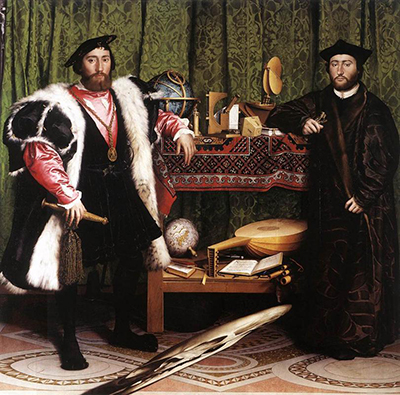
1532 [5]The Ambassadors
1533 [6]Mary Shelton, later Lady Heveningham by Hans Holbein the Younger (current article)
c. 1543?; the question mark forms part of the Royal Collection’s current datingContents
- Looking at the Face
- A Name Added Later
- The Pink Beneath the Marks
- Dress Built from Contrasts of Surface
- The Eyes and the Painter’s Brush
- Shelton and the Devonshire Manuscript
- A Preparatory Drawing with an Open Ending
Looking at the Face
Shelton turns towards the right, showing enough of the far cheek for her face to have breadth without losing the clarity of its profile. Follow the outer edge from the forehead down the nose. The line pauses and changes character as it reaches the nostril, the lips and the round of the chin. The slight projection of the mouth prevents the profile from becoming a single smooth curve.
The two eyes occupy different amounts of space. The nearer one opens more fully, while the farther eye is compressed by the turn. Their relation makes the direction of the face convincing even before we attend to shading. A small difference of angle between the brow and upper lid gives each eye its own shape.
There is little dramatic shadow across the cheek. Instead, the face gathers volume through small shifts in tone and the disposition of its edges. The jaw becomes clearest where it meets the darker fabric. Towards the neck, its boundary is gentler. Holbein varies the pressure of attention across the head, keeping the features distinct without enclosing every part equally strongly.
Her closed mouth and level gaze may appear composed, even reserved. Those are responses to the image, however, rather than evidence of Shelton’s temperament. Nothing visible tells us what she was thinking during a sitting. Her expression remains particular without supplying a story for it.
A Name Added Later
The woman is Mary Shelton, daughter of Sir John Shelton and a cousin of Anne Boleyn. The current collection record places the drawing tentatively near the end of Holbein’s career. At that time Shelton may have been engaged to Thomas Clere; her marriage to Sir Anthony Heveningham came later. Calling her “Lady Heveningham” at the moment of the sitting would therefore assume too much. [1]
The lettering at the upper left belongs to the drawing’s later history. According to the Royal Collection, its eighteenth-century inscription copies a mid-sixteenth-century original. The married name preserved there identifies a person across time; it does not date her clothing or establish her marital status when Holbein drew her. [1]
Look back at the sheet with this distinction in mind. The inscription occupies its own strip above the head. It sits close enough to guide recognition, but the image does not depend on the letters for its visual coherence. We encounter the face before we have settled the name. Historical knowledge then brings that face into a wider life, with relationships and activities that the likeness alone cannot reveal.
The Pink Beneath the Marks
The coloured surface is part of the drawing’s construction. Holbein worked on paper prepared with a pink coating, so that exposed areas could contribute to the complexion. In her study of his portrait drawings, conservator Victoria Button explains that this preparation supplied a foundation for flesh tones and accepted both dry drawing materials and liquid colour. Further marks could individualise a face without requiring the whole sheet to be covered. [8]
That helps explain the economy of Shelton’s cheek and neck. Their relative openness does not make them empty. They belong to the same coloured field as the surrounding sheet, while the darker contours tell us where a human form begins and ends. Alongside the black headdress, the pale face appears luminous despite the restrained modelling.
Button’s broader technical findings also caution against imagining a “chalk drawing” as a work made with one tool in one uninterrupted sitting. Holbein combined materials and adjusted the firmness of a line as he developed the likeness. Her examination distinguishes friable chalk from the more fixed liquid contours that could follow it. [8]
On Shelton’s sheet, the result remains visibly varied. The shoulders retain fine, tentative outlines; the large black shapes seem much more decisive. One passage establishes where an edge might lie, another fixes a strong boundary, and another supplies the light or colour needed to distinguish a surface.
Watch: Holbein’s portraits and working methods
Explore museum films on Holbein’s drawings, painted portraits and close-looking details.
Hans Holbein at the court of Henry VIII
A Royal Collection Trust film exploring Holbein’s work at Henry VIII’s court.
Watch on YouTubeDress Built from Contrasts of Surface
Shelton’s hood makes the strongest frame within the drawing. Its pale, angular front presses close to the head, while the black fabric falls away behind it. The arrangement widens towards the left edge of the sheet, balancing the face as it turns right. A thin white border separates adjacent areas that might otherwise merge.
Holbein varies his treatment of the clothing. The dark upper edge of the bodice forms a nearly continuous horizontal bar. Below it, a large ornament is lightly indicated, with little of the definition given to the face. Across the sleeves and shoulders, lines accumulate into loose folds rather than a fully described fabric. These differences create a useful path for the eye: broad shape first, then chosen details, then the returning face.
Kate Heard’s curatorial account identifies yellow and red chalk in the jewellery and headdress, with white applied by brush to selected trimmings and the pearl. She also notes that Holbein records only part of the bead pattern. [9] That observation makes the small interrupted necklace especially revealing. The drawing contains enough information to carry a pattern forward, even where it does not repeat that pattern throughout.
The ornaments do not all compete for equal prominence. The small pendant sits high against the open neck, while the larger medallion below is almost ghostlike. Their different levels of completion keep the chest from becoming a dense catalogue of possessions. Looking from one to the other makes us aware of how selectively Holbein distributes detail.
The Eyes and the Painter’s Brush
The eyes are a good place to slow down. Their dark pupils and carefully shaped lids create a concentrated point of contact, even though Shelton looks past us. The tiny light areas make them appear moist and rounded. At ordinary viewing distance these marks merge into an impression of sight; closer inspection reveals how little material is needed to produce it.
Heard identifies blue watercolour in the irises and fine brushwork in the lashes and brows. [9] Button’s wider examination of Holbein’s portrait drawings explains why the brush was so useful here: liquid colour could be placed accurately in a small area, where a thicker, crumbling chalk would be harder to control. Many of the eyes she examined combine drawn and painted elements. [8]
This shifts attention from the apparent immediacy of a likeness to its patient construction. An eye can feel observed in an instant while depending on several kinds of mark. A surrounding chalk tone, a firm lid and a minute change in colour each contribute something different. Their effects meet only when we stand back.
Compare those compact passages with the broad darkness behind the head. Both can involve liquid material, yet their scale and handling differ completely. The drawing moves between an almost calligraphic precision and expansive areas of tone. Its liveliness comes partly from keeping those different kinds of touch visible together.
Shelton and the Devonshire Manuscript
Shelton’s literary activity survives in a different kind of object. The British Library identifies her, Mary Fitzroy and Lady Margaret Douglas as compilers of the Devonshire Manuscript , an anthology of Tudor courtly poetry from the 1530s. Its contents are largely attributed to Thomas Wyatt, alongside verse by Henry Howard, Earl of Surrey, and others. The catalogue records Shelton’s name on the first leaf and identifies her among at least nineteen contributing hands. [10]
This evidence gives the sitter an active place in literary culture. Compiling a book involves choosing, copying and preserving words, and the manuscript joins her handwriting to that of other people. Heard also describes the compilers’ marginal comments. [9] The portrait shows none of that activity directly: Shelton holds no pen or book, and no poem appears beside her.
The two objects nevertheless make a revealing pair. One preserves the appearance of a woman seen by another person; the other preserves traces of people reading and writing within a shared volume. Together they enlarge what we can know about Shelton without turning facial expression into proof of literary intelligence.
Readers can also explore Holbein’s portrait of Henry Howard, Earl of Surrey . The connection helps restore a social world around these otherwise isolated likenesses. Each portrait remains a separate encounter, but the names belong to overlapping networks of friendship, family and writing.
A Preparatory Drawing with an Open Ending
Heard treats the sheet as preparation for a painted portrait. No corresponding painting is known, and the purpose of the commission remains uncertain. An association with Shelton’s engagement to Clere is a possibility; he died in 1545 before they could marry. [9] The proposed occasion should remain a question, even with the collection’s tentative date of about 1543.
A missing painting leaves us unable to compare Holbein’s choices across two stages. We cannot see whether he would have completed the large medallion, retained the same neckline or adjusted the space around the head. Nor can the absence of a known painting establish that one was never made.
The drawing offers enough of its own evidence to hold our attention. Its lightly recorded clothing sits beside features developed with exceptional care. In the broader group of Holbein’s drawings , this combination makes the boundary between study and finished likeness especially interesting. Detail can serve future work and still give a surviving sheet great visual richness.
Return finally to the space around Shelton’s cheek. The headdress spreads behind her, the neckline anchors the lower part of the figure, and the eyes carry our attention beyond the paper. The differences between a broad dark area, a tentative outline and a minute brushstroke sustain a long look.
Artworks directory
Explore paintings, drawings, prints and designs, including works without a separate article. Related studies and versions have their own entries; workshop works and copies are labelled. Print designs and series are grouped rather than repeated for every impression.
Frequently Asked Questions
Yes. The Royal Collection identifies the sitter as Mary Shelton, later Lady Heveningham. The married name in the inscription refers to a later stage of her life. [1]
It is a drawing combining chalks, inks and white heightening on pink prepared paper. [1] Its use of several materials helps explain the unusually developed appearance.
She helped compile the Devonshire Manuscript , now British Library Add MS 17492, alongside Mary Fitzroy and Margaret Douglas. [10]
Discussion
Look again at the images and ideas explored in Mary Shelton, later Lady Heveningham by Hans Holbein the Younger. These editorial prompts invite your observations.
Reader Insights
Follow the pale edge of the hood. Where does it make the face feel most distinct from the surrounding darkness?
Compare the eyes with the large ornament on the bodice. What does each passage ask you to supply through imagination?
Consider Shelton’s handwriting alongside her portrait. How does each preserve something different about a person?
Join the Conversation
Which detail first held your attention: the angular hood, the interrupted necklace or Shelton’s eyes? Share how that detail changed as you looked more closely.
References
- Royal Collection Trust , Mary Shelton, later Lady Heveningham (1510/15–1570/71) , RCIN 912227, current collection record, accessed 18 October 2026. View source .
- Kunstmuseum Basel, Bildnis des Bonifacius Amerbach, 1519, inventory 314 (in German) . View source .
- Kunstmuseum Basel, Der tote Christus im Grab, 1521–22, inventory 318 (in German) . View source .
- The Frick Collection, Sir Thomas More, 1527, accession 1912.1.77, collection record . View source .
- Gemäldegalerie Berlin, Georg Gisze . View source .
- Susan Foister, The Ambassadors, The German Paintings before 1800 (2024) . View source .
- Susan Foister, Christina of Denmark, Duchess of Milan (2024) . View source .
- Victoria Button , The Portrait Drawings of Hans Holbein the Younger: Function and Use Explored through Materials and Techniques , PhD thesis, Royal College of Art, 2013, especially pp. 38–39, 134–140 and 216–218. View source .
- Kate Heard, Royal Collection Trust , “Mary Shelton”, Holbein in the Royal Collection , curatorial account. View source .
- British Library , Anthology of Tudor courtly verse … (‘The Devonshire Manuscript’) , Add MS 17492, Archives and Manuscripts Catalogue, scope, physical description and provenance. View source .
- Würth Collection, Holbeins Schutzmantelmadonna, inventory 14910, current owner account (in German) . View source .
- Metropolitan Museum, Dance of Death series . View source .
- Kunstmuseum Basel, Bildnis der Frau des Künstlers mit den beiden ältesten Kindern, about 1528–29, inventory 325 (in German) . View source .
- Kunsthistorisches Museum Wien, Next Generation, Jane Seymour, about 1536–37, inventory 881 (in German) . View source .