by
Tom Gurney
Tom Gurney BSc (Hons) is an art history expert with over 20 years experience
Email:
tomgurney1@gmail.com
/ Phone:
+44 7429 011000
Sir Philip Hoby by Hans Holbein the Younger: Introduction
The face in Holbein’s Sir Philip Hoby is much more fully described than the body beneath it. A broad cap crosses the upper part of the sheet; below, the shoulders almost dissolve into the pink surface. Between them, a few dark accents hold the eyes, nose and mouth in place. The drawing makes a likeness feel remarkably present while leaving much of the figure barely stated.
Hoby also knew portraiture from the other side of the sitting. In 1538 he accompanied Holbein to Brussels for the portrait of Christina of Denmark, a possible bride for Henry VIII. This portrait of Hoby himself has a much broader date, about 1532–43. It cannot securely be attached to that journey. [1] [2]
At a Glance
- Artist Hans Holbein the Younger, 1497/8–1543. [1]
- Title Sir Philip Hoby (1504/5–1558) . [1]
- Date About 1532–43. [1]
- Medium Black and coloured chalks, and grey bodycolour on pale pink prepared paper. [1]
- Dimensions 30.1 × 22.3 cm, sheet of paper. [1]
- Collection Royal Collection, RCIN 912210. [1]
- Format Head and shoulders, turned three-quarters to the right. [1]
- Inscription The identifying words at the bottom were added in the eighteenth century. [1]
This work across Hans Holbein the Younger’s career
Dead Christ in the Tomb
1521–22 [4]Sir Thomas More
1527 [5]Georg Giese
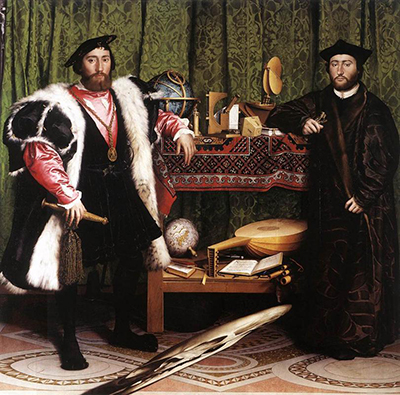
1532 [6]The Ambassadors
1533 [7]Contents
- A face beneath a broad cap
- Pink paper and grey bodycolour
- Hoby and the business of likeness
- A drawing passed between collections
A face beneath a broad cap
The cap gives the composition its widest, most assertive shape. Its brim reaches towards the right edge, while its soft crown rises in a shallow mound above Hoby’s head. Lines describing its folds remain visible as lines: the fabric has volume without becoming a solid block of dark colour. Beneath the brim, the forehead is comparatively quiet, allowing the eyes to attract attention.
Look at the difference between the two sides of the face. On the left of the image, the ear and cheek emerge from a shaded strip beneath the cap. On the right, the cheek is held by a much lighter boundary. That unequal emphasis helps turn the head. The nose projects into the clearer space to the right, and the eyes look in the same general direction, beyond the viewer.
The moustache is narrow and carefully placed; a small tuft of beard darkens the chin. Neither needs to be drawn hair by hair across its whole extent. A few concentrated strokes establish the texture, just as the line of the mouth gives the lips their firmness. The expression can seem watchful, but the sheet offers no reliable diagnosis of Hoby’s character. Its particularity lies in the arrangement of visible features.
Pink paper and grey bodycolour
The warm colour spreads across both the face and the unworked space around it. Grey bodycolour adds opaque paint to the chalk drawing. [1] The pink ground remains visible through much of the image, joining the face to the surrounding space.
Royal Collection conservators Rachael Smith and Victoria Button explain that a prepared pink mid-tone allowed Holbein to model faces through highlights and shadows while applying less material during a sitting. Their account also stresses the variety of his methods from sheet to sheet. [9] Here, the ground remains especially conspicuous around the lightly indicated clothing. You can follow the neck down towards the collar and then watch the description thin out across the chest.
The dark contours should not automatically be read as evidence of tracing. In her technical survey, Button records chalk and touches of aqueous black in Hoby’s contours, but no signs of transfer. [10] That finding leaves the drawing’s possible subsequent use open. It does not prove that a painting was made from it, or that one particular method carried the likeness to another surface. The sheet’s concentrated face and abbreviated costume are rewarding enough to examine on their own.
Watch: Holbein’s portraits and working methods
Explore museum films on Holbein’s drawings, painted portraits and close-looking details.
Hans Holbein at the court of Henry VIII
A Royal Collection Trust film exploring Holbein’s work at Henry VIII’s court.
Watch on YouTubeHoby and the business of likeness
Philip Hoby was a diplomat whose career extended beyond Holbein’s lifetime. His familiar title can obscure the chronology: he received his knighthood in 1544, after the date range assigned to this drawing. The later inscription beneath the figure therefore names him by a status acquired afterwards. [1] [11]
His connection with Holbein gives the portrait an unusually apt context. In a letter to Thomas Cromwell dated 14 March 1538, the English diplomat John Hutton reported Christina’s three-hour sitting with Holbein in Brussels. [2] No preparatory drawing of Christina survives, so the report cannot tell us precisely how much Holbein completed on paper during those hours. [10] Nor does it establish the duration of Hoby’s own sitting.
It does, however, place the man before us within the practical world in which likenesses were commissioned, assessed and carried between courts. Hoby was involved in obtaining a portrait for the king. In this sheet, he becomes the person whose features the artist must preserve. The separate portrait of Christina of Denmark belongs to that documented commission.

Hans Holbein the Younger, Christina of Denmark, Duchess of Milan, 1538. Oil on oak. National Gallery, London, NG2475.
A drawing passed between collections
The sheet passed from Tudor royal ownership through the Arundel and Lumley collections. Its bequest to Henry, Prince of Wales, in 1609 is uncertain. It later belonged to Charles I, left his collection in 1627/8, and returned to royal ownership under Charles II by 1675. [1]
Later admirers encountered the face through reproductions. The Metropolitan Museum of Art holds John Smart Jr.’s Philip Hobby Knight, after Holbein , dated 1798. Smart worked from Francesco Bartolozzi’s 1796 stipple engraving, rather than from Holbein’s sheet. The print belonged to a series reproducing the royal drawings on pink paper. [12]
That chain of copying helps explain how a working portrait study became a historical image of a Tudor courtier. It also makes returning to Holbein’s surface worthwhile. The uneven degrees of finish, the spacious pink field and the faint lower outlines belong to the encounter preserved by this particular drawing. The face retains its clarity while the figure around it remains open and lightly drawn.
Artworks directory
Explore paintings, drawings, prints and designs, including works without a separate article. Related studies and versions have their own entries; workshop works and copies are labelled. Print designs and series are grouped rather than repeated for every impression.
Frequently Asked Questions
It is a portrait drawing on prepared paper, made with black and coloured chalks and grey bodycolour. The opaque paint is one component of its mixed technique. [1]
Yes. He accompanied Holbein to Brussels in March 1538 for the portrait of Christina of Denmark. John Hutton’s letter records a three-hour sitting; it does not date Hoby’s own portrait. [2]
Button’s survey found no signs of transfer on the Hoby drawing. That observation does not establish whether a painted portrait was ever produced. [10]
Discussion
Look again at the images and ideas explored in Sir Philip Hoby by Hans Holbein the Younger. These editorial prompts invite your observations.
Reader Insights
Trace the brim from left to right. How much of the head’s position is established before your eye reaches the face?
Look for the point where the neck and clothing become difficult to distinguish from the pink ground. Does that change where you linger?
The small inscription belongs to a later century. How differently do the drawn features and the written identification introduce the sitter? [1]
Join the Conversation
Which detail makes Hoby most recognisable to you: the eyes, the narrow moustache, the cap or the turn of his head? Share the passage that holds your attention and explain what you see there.
References
- Royal Collection Trust , Sir Philip Hoby (1504/5–1558) , c.1532–43, RCIN 912210, collection record. View source .
- John Hutton , letter to Thomas Cromwell, 14 March 1538, transcribed in Arthur B. Chamberlain, Hans Holbein the Younger , 1913, vol. 2, chapter XX, pp. 121–124; Letters and Papers, Henry VIII , XIII, part 1, no. 507; State Papers , VIII, p. 17. View source .
- Kunstmuseum Basel, Bildnis des Bonifacius Amerbach, 1519, inventory 314 (in German) . View source .
- Kunstmuseum Basel, Der tote Christus im Grab, 1521–22, inventory 318 (in German) . View source .
- The Frick Collection, Sir Thomas More, 1527, accession 1912.1.77, collection record . View source .
- Gemäldegalerie Berlin, Georg Gisze . View source .
- Susan Foister, The Ambassadors, The German Paintings before 1800 (2024) . View source .
- Susan Foister, Christina of Denmark, Duchess of Milan (2024) . View source .
- Rachael Smith and Victoria Button, Royal Collection Trust , “Holbein’s portrait drawings”, especially “Creating a skin tone”. View source .
- Victoria Button , The Portrait Drawings of Hans Holbein the Younger: Function and Use Explored through Materials and Techniques , PhD thesis, Royal College of Art/Victoria & Albert Museum, 2013, p. 112 and Table 4, p. 260. View source .
- Gordon Goodwin , “Hoby, Philip”, Dictionary of National Biography , 1885–1900, vol. 27, historical biographical entry, transcribed at Wikisource. View source .
- The Metropolitan Museum of Art , John Smart Jr., Philip Hobby Knight, after Holbein , 1798, graphite, accession 2022.25.1, collection record. View source .
- Würth Collection, Holbeins Schutzmantelmadonna, inventory 14910, current owner account (in German) . View source .
- Metropolitan Museum, Dance of Death series . View source .
- Kunstmuseum Basel, Bildnis der Frau des Künstlers mit den beiden ältesten Kindern, about 1528–29, inventory 325 (in German) . View source .
- Kunsthistorisches Museum Wien, Next Generation, Jane Seymour, about 1536–37, inventory 881 (in German) . View source .