by
Tom Gurney
Tom Gurney BSc (Hons) is an art history expert with over 20 years experience
Email:
tomgurney1@gmail.com
/ Phone:
+44 7429 011000
Jakob Meyer zum Hasen: the Portrait Studies: Introduction
A broad hat tilts above a face drawn with extraordinary economy. Curls gather around the ears, the lips press together, and a little shadow under the chin gives weight to the head. Below, the coat is barely more than an arrangement of lines. Holbein has given Jakob Meyer zum Hasen a convincing presence without finishing every part of his appearance.
This drawing dates from 1516. Made chiefly in silverpoint on white prepared paper, it belongs to the preparations for Holbein’s paired painted portraits of Meyer and his wife, Dorothea Kannengiesser. Meyer’s name appears as Jacob in the Kunstmuseum Basel’s catalogue; the early sheet is inventory number 1823.137. The drawing and painting survive in Basel. [1] [2]
Holbein drew Meyer again around 1525/26, in a larger sheet associated with the family’s commission of the Darmstadt Madonna . That later portrait uses different materials and shows the sitter bareheaded. Looking between the two drawings brings an unusually clear reward: the same recognisable face appears at different moments in Holbein’s working life, first in preparation for a married couple’s portrait, then for a place within a religious painting. [3] [4]
At a Glance
- Artist Hans Holbein the Younger.
- Principal work Portrait of Jacob Meyer zum Hasen ( Bildnis des Jacob Meyer zum Hasen ).
- Date 1516.
- Materials silverpoint on white prepared paper, with red chalk in the face and traces of black drawing material at the hat, nose and chin; mounted on thick paper.
- Dimensions 28.1 × 19 cm.
- Collection Kunstmuseum Basel, Kupferstichkabinett, Museum Faesch.
- Inventory number 1823.137. [1]
- Related painting the 1516 double portrait of Meyer and Dorothea Kannengiesser, oil on limewood, Kunstmuseum Basel, inventory number 312. [2]
- Separate later study Portrait of Jacob Meyer zum Hasen , around 1525/26; black and coloured chalk, with lead stylus and incised contour lines, a light green tint to the ground, lined with Japanese paper; 38.3 × 27.5 cm; Kunstmuseum Basel, inventory number 1823.140. [4]
This work across Hans Holbein the Younger’s career
Dead Christ in the Tomb
1521–22 [6]Sir Thomas More
1527 [7]Georg Giese
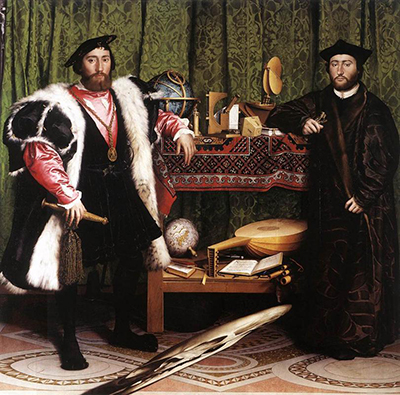
1532 [8]The Ambassadors
1533 [9]Contents
- The Face beneath the Hat
- Silverpoint and a Prepared Surface
- Colour Remembered in Words
- Meyer and Dorothea in 1516
- How Closely Does the Drawing Follow the Painting?
- The Bareheaded Meyer, around 1525/26
- A Likeness for the Darmstadt Madonna
- Reading the Two Sheets Together
The Face beneath the Hat
The hat occupies almost as much attention as the face. Its broad, soft shape slopes across the upper part of the sheet, pressing down towards one eyebrow and lifting away on the opposite side. Beneath it, the rounded curls form a more restless edge. Their different rhythms make the head feel substantial before we examine the features.
Meyer turns towards the right. We see enough of the farther eye to understand the width of the face, while the nearer cheek, nose and chin establish its projecting form. The mouth is small and firm within the broader flesh of the lower face. Tiny changes around the eyes carry more expression than the long outlines of the coat.
It is tempting to turn this compressed expression into a judgement about Meyer’s character. The drawing offers no secure basis for deciding whether he was impatient, suspicious or severe during the sitting. What we can see is Holbein’s control of emphasis: a few carefully placed marks make the face seem attentive, while the lightly indicated torso allows the eye to return to it.
The horizontal disturbance crossing the sheet also deserves notice. Conservator Victoria Button identifies damage from a fold, with loss of preparation along it. This is part of the drawing’s physical history, separate from the lines with which Holbein described the sitter. The sheet has survived as a handled object as well as an image. [3]
Silverpoint and a Prepared Surface
Silverpoint is a form of metalpoint drawing: a silver tip leaves a fine deposit on a suitably prepared surface. The preparation supplies the slight abrasion needed to receive the mark. In this early portrait, the pale ground supports an intricate network of delicate lines, readily visible in the curls and along the hat’s edge. [3]
Button’s examination describes silverpoint establishing most contours and building darker passages through repeated strokes. Red chalk adds warmth to the face; small accents of black strengthen selected features. Holbein could vary the density of his marks while keeping the overall surface light. [3]
Look at the difference between hair and cheek. The curls depend on many small turns of line, each contributing to a clustered mass. The cheek is quieter. Its volume emerges through faint shading and the relation between the facial features, leaving broad areas relatively open. This is an efficient use of the sheet’s lightness: the unworked or lightly worked surface participates in the face.
Button associates these early materials and methods with Holbein’s training in his father’s Augsburg workshop. She also emphasises the larger scale of the Meyer studies compared with many of Hans Holbein the Elder’s small portrait drawings. The Younger was developing an inherited practice for his own portrait commissions. [3]
Colour Remembered in Words
Above and to the left of Meyer’s hat are small written notes. They are easy to overlook because the face commands attention, yet they reveal another kind of observation. The museum transcribes instructions about the sitter’s eyes, hat and eyebrows. Button’s discussion identifies black eyes, a red beret, and eyebrows yellower than the hair among the information recorded. [1] [3]
The notes help explain the drawing’s selective finish. A lightly outlined hat could carry a written colour reminder; it did not need to become a fully coloured image to preserve useful information. The marks describing a face and the words describing a colour serve related purposes, each recording something that might be needed later.
In the painting, Meyer’s hat becomes a striking red shape against blue sky and ornamental architecture. Its colour transforms the balance of the portrait, giving the upper part of the figure an immediate visual force. Comparing sheet and panel makes the written reminder tangible: a small notation belongs to the practical bridge between an observed sitter and a richly coloured painting.
This combination of careful faces, economical costume outlines and occasional annotations also appears elsewhere in Holbein’s drawings . Royal Collection conservators Rachael Smith and Victoria Button describe how written information could supplement abbreviated passages of clothing, allowing details to be reconstructed later. That broader practice helps us recognise the early Meyer sheet as a purposeful working document. [11]
Meyer and Dorothea in 1516
The completed double portrait places husband and wife on adjoining panels. Meyer turns towards the right, while Dorothea faces back towards him from the other side. Architectural ornament continues across their surroundings, creating a shared setting even though the sitters occupy separate pieces of wood.
Meyer’s dark clothing gives his figure a broad, almost continuous mass. The red hat and pale shirt emerge strongly from it. Dorothea’s striped headdress creates a different pattern above her face, and the colour divisions of her dress produce a more articulated silhouette. Holbein makes the two figures distinct while bringing their gazes, bodies and surroundings into a carefully measured relationship.
The Kunstmuseum Basel links the commission to Meyer’s election as mayor on 24 June 1516. He was the first mayor drawn from the city’s guilds. The museum presents this occasion as more likely than a marriage celebration: Meyer and Dorothea had married by 1513. Calling the pictures wedding portraits therefore obscures their civic setting. [2]
The painted architecture contributes to that sense of public presentation. It frames the sitters with columns, decorated surfaces and an arch, giving a compact portrait the scale of a more ceremonial encounter. In the drawing there is only Meyer, his hat and his coat. The panel builds an environment around the likeness, turning the closely observed head into one element of a larger social image.
Watch: Holbein’s portraits and working methods
Explore museum films on Holbein’s drawings, painted portraits and close-looking details.
Hans Holbein at the court of Henry VIII
A Royal Collection Trust film exploring Holbein’s work at Henry VIII’s court.
Watch on YouTubeHow Closely Does the Drawing Follow the Painting?
The relationship is easiest to see by comparing the outline from the hat to the nose, mouth and chin. These features provide stable points of recognition even as painting introduces stronger colour, deeper shadow and a more elaborate setting. The drawing contains much of what makes the painted face recognisably Meyer’s.
Button notes that the early studies and painted heads have a one-to-one proportional relationship, suggesting that the sheets may have served as patterns for the faces. Her wording matters: correspondence in scale supports a practical connection without proving every step of the transfer. [3]
On the 1516 Meyer drawing, she could not decide whether sporadic indentations came from the original drawing process or from tracing for transfer. It would therefore go too far to describe a particular tracing procedure as established for this sheet. A preparatory relationship can be secure while the exact mechanics remain uncertain. [3]
There is a further visible difference in completeness. The painting gives Meyer hands, a setting and a fully described costume; the sheet concentrates on his head and the upper body’s main divisions. Those omissions are useful evidence of priorities. A study need not contain a miniature version of the entire painting to contribute decisively to it. Here, the most intensely observed area is the part through which we recognise the sitter.
The Bareheaded Meyer, around 1525/26
Nearly a decade later, Holbein returned to the same face. In the second drawing, Meyer’s hair forms a dark cap around his head. The hat has disappeared, and his gaze lifts more noticeably. The projecting nose, closed lips and weight beneath the chin allow us to recognise the earlier sitter, although the new pose changes the encounter.
This is a different sheet, larger than the 1516 study and catalogued by Basel as inventory number 1823.140. Its present dimensions are 38.3 × 27.5 cm. The museum records black and coloured chalk, lead stylus at the contours and incised lines, together with a light green tint and a Japanese-paper lining. [4]
Button’s close examination supplies a helpful qualification about the colour surrounding the figure. She describes a green wash applied around the sitter after the drawing, rather than a coloured preparation underneath the whole image. Her technical distinction cautions against assuming that every tint in a Holbein drawing served as the starting tone for his face. [3]
The dark hair gives this later portrait a stronger tonal anchor. Below it, the clothing again remains lightly outlined. Across the two sheets, Holbein changes his materials and the angle of the head while retaining the concentration on the sitter’s particular features. Their differences are more revealing when we resist treating one as a repetition of the other.
A Likeness for the Darmstadt Madonna
The later study belongs with the family portraits prepared for the Darmstadt Madonna . The Würth Collection dates the painting to 1525/26 and 1528, acknowledging its successive stages. It shows the Virgin and Child above a group of kneeling figures, bringing Meyer’s likeness into a setting of devotion and protection. [3] [12]
That change of setting alters how the head is read. In the 1516 panels, husband and wife occupy a portrait space organised around their worldly presence. In the religious painting, Meyer becomes a donor: a recognisable person placed in relation to holy figures. The lifted face of the later drawing can be understood in connection with that larger arrangement without inventing a private thought for him.
The surviving studies also have a place in the painting’s later history. Kunstmuseum Basel’s account of the Madonna describes how twentieth-century X-ray and infrared examination revealed changes in the painted composition and correspondence with the Basel chalk studies. The drawings helped illuminate the making of a much larger work. [13]
The two Meyer drawings and the 1516 double portrait belong to Kunstmuseum Basel; the original Madonna belongs to the Würth Collection. “Darmstadt” is the painting’s familiar historical name, rather than the present collection of the portrait sheets. [1] [2] [4] [12]
Reading the Two Sheets Together
Begin with the areas Holbein chose to strengthen. In 1516, curls, hat contours and the small marks around the eyes establish a face within an expansive pale sheet. Around 1525/26, the dark hair becomes a much more solid shape, surrounding a face whose upward turn changes its relation to the empty space above.
Then compare what remains spare. Both drawings give relatively little attention to the lower costume. Their unequal finish directs our looking, but it also reflects a practical division within portrait making: some information required close description, while other parts could remain abbreviated.
The surviving marks do not all have the same certainty of purpose. Button found the later sheet’s heavy contour indentations persuasive evidence of transfer; she remained cautious about the sporadic indentations on the early one. The contrast lets us see why technical examination matters without making every scratch answer the same question. [3]
Finally, return to the expression. Holbein offers enough specificity for us to recognise Meyer across time and across commissions. The same familiar features can belong to a man facing his wife, a donor looking upwards, or a head studied alone on paper. The drawings hold those larger possibilities in a remarkably small area: the turn of a cheek, the distance between eye and brow, and the line where the lips meet.
Artworks directory
Explore paintings, drawings, prints and designs, including works without a separate article. Related studies and versions have their own entries; workshop works and copies are labelled. Print designs and series are grouped rather than repeated for every impression.
Frequently Asked Questions
The sheet showing Meyer in a broad hat is the 1516 study, Kunstmuseum Basel inventory number 1823.137. It measures 28.1 × 19 cm and is chiefly silverpoint on white prepared paper, with red chalk and traces of black drawing material. [1]
The Kunstmuseum Basel considers his election as mayor on 24 June 1516 the likely occasion. His marriage to Dorothea Kannengiesser had taken place by 1513. The painting is a portrait of a married couple, but that does not make its date their wedding date. [2]
Transfer evidence must be assessed sheet by sheet. Victoria Button identifies heavy contour indentations on the later Meyer drawing as evidence of transfer. She could not establish whether sporadic indentations on the 1516 sheet resulted from tracing or from drawing. [3]
Discussion
Look again at the images and ideas explored in Jakob Meyer zum Hasen: the Portrait Studies. These editorial prompts invite your observations.
Reader Insights
Compare Meyer’s hat in 1516 with the dark mass of hair in the later sheet. How does each shape affect the prominence of the face?
The early drawing preserves colour information in words. Consider what the writing records that the delicate lines alone cannot convey.
Notice how lightly the clothing is drawn in both studies. Does this make the likeness feel more immediate to you?
Join the Conversation
Which Meyer portrait gives you the strongest sense of an encounter: the early drawing, the paired painted portraits or the later donor study? Share a detail that shaped your response.
References
- Kunstmuseum Basel , Bildnis des Jacob Meyer zum Hasen , 1516, inventory 1823.137, collection record (in German). View source .
- Kunstmuseum Basel , Doppelbildnis des Jacob Meyer zum Hasen und seiner Frau Dorothea Kannengiesser , 1516, inventory 312, collection record and commentary (in German). View source .
- Victoria Button , The Portrait Drawings of Hans Holbein the Younger: Function and Use Explored through Materials and Techniques , PhD thesis, Royal College of Art, 2013, pp. 12, 91–98, 274–275 and 278. View source .
- Kunstmuseum Basel , Bildnis des Jacob Meyer zum Hasen , around 1525/26, inventory 1823.140, collection record (in German). View source .
- Kunstmuseum Basel, Bildnis des Bonifacius Amerbach, 1519, inventory 314 (in German) . View source .
- Kunstmuseum Basel, Der tote Christus im Grab, 1521–22, inventory 318 (in German) . View source .
- The Frick Collection, Sir Thomas More, 1527, accession 1912.1.77, collection record . View source .
- Gemäldegalerie Berlin, Georg Gisze . View source .
- Susan Foister, The Ambassadors, The German Paintings before 1800 (2024) . View source .
- Susan Foister, Christina of Denmark, Duchess of Milan (2024) . View source .
- Rachael Smith and Victoria Button, Royal Collection Trust , “Holbein’s portrait drawings”, conservation account, especially “Clothing and jewellery”. View source .
- Würth Collection , Alte Meister in der Sammlung Würth / Old Masters in the Würth Collection , Johanniterkirche leaflet, Madonna of Mayor Jacob Meyer zum Hasen , inventory 14910 (in German and English). View source .
- Kunstmuseum Basel , Madonnenkinder , 2020 exhibition text, especially “Kunstwissenschaftliche und restauratorische Forschung während der Ausleihe in Basel” (in German). View source .
- Würth Collection, Holbeins Schutzmantelmadonna, inventory 14910, current owner account (in German) . View source .
- Metropolitan Museum, Dance of Death series . View source .
- Kunstmuseum Basel, Bildnis der Frau des Künstlers mit den beiden ältesten Kindern, about 1528–29, inventory 325 (in German) . View source .
- Kunsthistorisches Museum Wien, Next Generation, Jane Seymour, about 1536–37, inventory 881 (in German) . View source .