 by
Tom Gurney
Tom Gurney BSc (Hons) is an art history expert with over 20 years experience
Email:
tomgurney1@gmail.com
/ Phone:
+44 7429 011000
Portrait of Sir Henry Guildford: Introduction
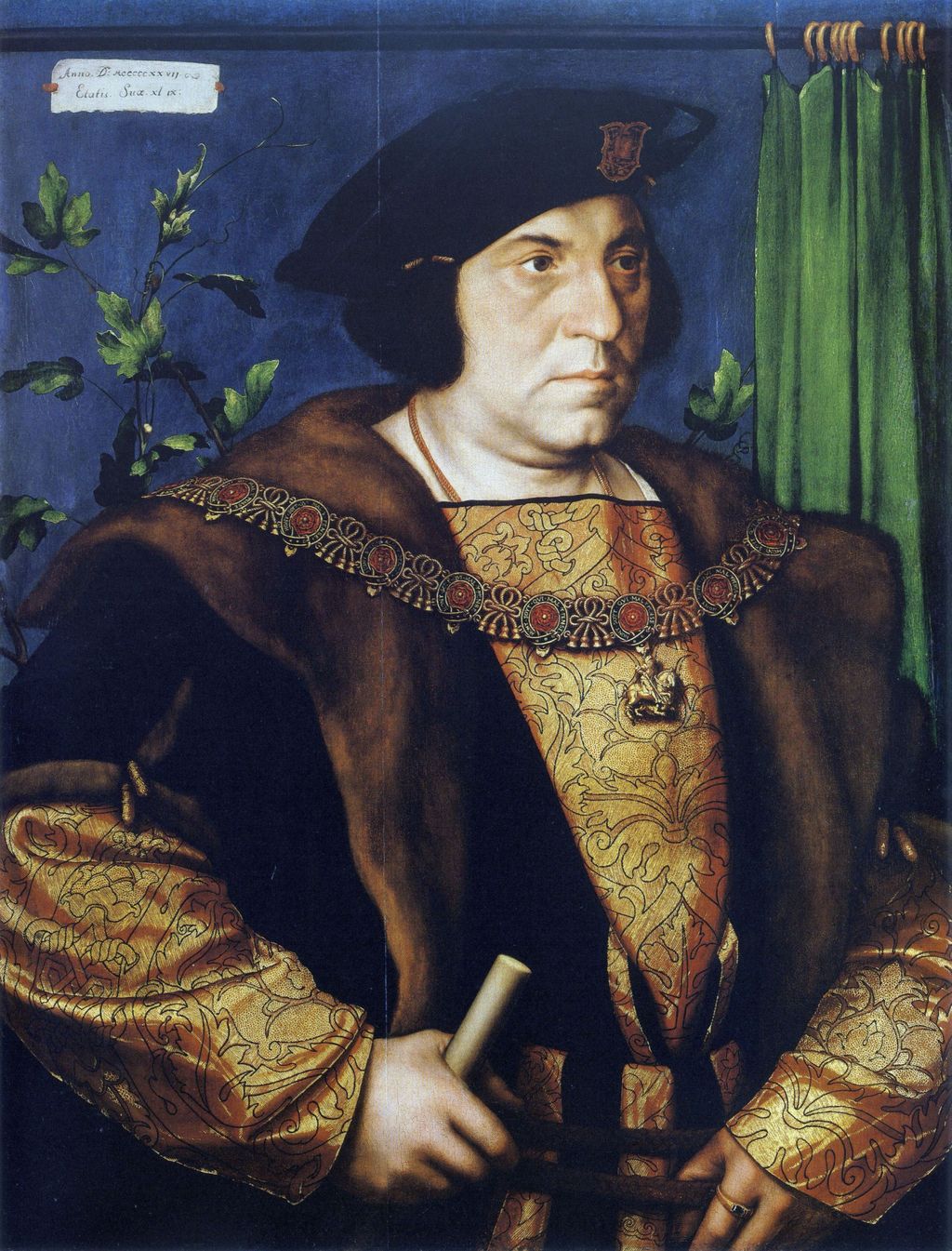
Sir Henry Guildford fills his portrait with the weight of a court appointment. His shoulders spread beneath fur, his gold-patterned sleeves bend towards the lower corners, and a white staff rests in his right hand. Holbein gives each material its own behaviour: light catches the satin, sinks into the velvet and breaks into small bright accents across the woven gold. Above this abundance, Guildford’s face remains still, turned slightly towards the right. The painting dates from 1527, during Holbein’s first stay in England. [1]
There is more to the setting than this single panel reveals. The curtain rail continues into the companion portrait of Guildford’s wife, Mary, now in Saint Louis. A scrap of architecture at the upper right belongs to that shared space. Seen together, the portraits place two people within a coordinated interior; seen separately, each preserves part of a larger design. [1]
At a Glance
- Artist Hans Holbein the Younger.
- Title Sir Henry Guildford (1489–1532) .
- Date 1527.
- Medium Oil on oak panel.
- Dimensions 82.7 × 66.4 cm.
- Collection Royal Collection, RCIN 400046; the collection record lists Windsor Castle.
- Sitter A courtier who served Henry VIII as Comptroller of the Household.
- Companion Mary, Lady Guildford , 1527, Saint Louis Art Museum, object 1:1943.
- Important detail The later inscription gives his age as 49; he was actually 38. [1] [2]
This work across Hans Holbein the Younger’s career
Dead Christ in the Tomb
1521–22 [4]Sir Thomas More
1527 [5]Georg Giese
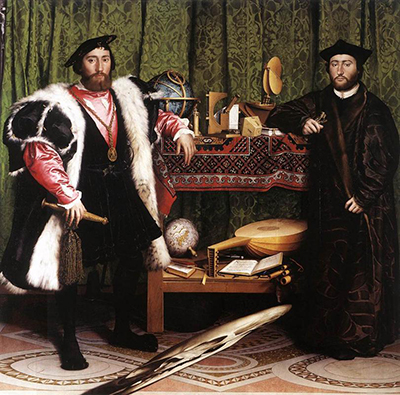
1532 [6]The Ambassadors
1533 [7]Contents
- A figure who occupies the whole picture
- How Holbein makes gold look woven
- The courtier behind the white staff
- The badge and the painted curtain
- Mary’s portrait completes the setting
- From a chalk study to the painted portrait
- Why the inscription gives the wrong age
- The original and its later company
- Annotated details
A figure who occupies the whole picture
The broad body makes an immediate impression. Guildford’s head sits relatively high within the panel, leaving room for a large expanse of dress and for both hands. The turn of his face carries the eye towards the adjoining portrait’s side, while the bent arms bring attention back to the body. His presence depends on these large, simple relationships before the individual ornaments begin to register.
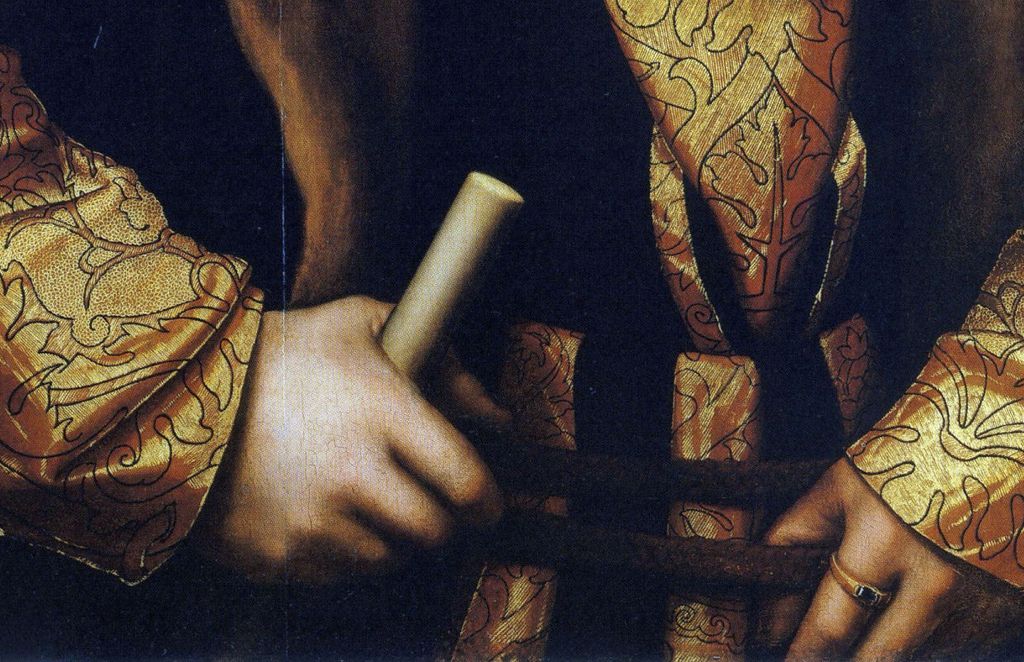
Look at the narrow pale line of the staff against the complicated folds below it. Once its function is known, it provides an unusually economical identification: this is the white staff of the Comptroller of the Household. Its plainness makes it legible among the patterned sleeves, fur, chain and belt. [1] Holbein allows an office to be understood through an object that the sitter can hold.
The background is just as carefully organised. Blue opens around Guildford’s head, and a vine interrupts its flat colour with stems and leaves. The green curtain gathers along the right edge. Across the top, its rail establishes a firm horizontal line above the soft slope of the hat. The small hanging label occupies another pocket of blue at the upper left. These details keep the setting active without weakening the large outline of the man.
His closed mouth and steady gaze make a striking counterweight to clothing that invites prolonged, restless looking. The face holds its position while the eye travels through the wealth surrounding it.
How Holbein makes gold look woven
The gold clothing rewards a second, slower look. Its pomegranate pattern spreads across the doublet and sleeves, bending as the material folds. Holbein distinguishes different kinds of weave and the loops of gold thread. This is a fabric with structure, rather than a continuous metallic surface: the pattern, the underlying cloth and the changing light all have to remain readable together. [1]
The painting also contains actual gold. The Royal Collection identifies both shell-gold paint and gold leaf, with the leaf helping imitate the brightest reflections from the woven threads. [1] This matters when looking at a reproduction. A screen translates everything into coloured light, but the original combines painted illusion with materials that have their own reflective properties. Some of the brilliance belongs to the substances on the panel as well as to Holbein’s representation of the garment.
Beside the gold, the dark clothing becomes more varied than it first appears. A band of black satin runs down the arm against the deeper black of the velvet sleeve. The satin reads through sharper changes of light, while the velvet holds a denser darkness. Fur frames the chest with a softer, irregular edge. The portrait asks the painter to show three different kinds of dark surface alongside a fabric full of small metallic highlights. [1]
These distinctions also organise the body. Dark areas separate the brighter sleeves from the gold at the centre, and the fur directs attention upwards towards the chain and face. The eye can enjoy the minute workmanship without losing the figure beneath it. Clothing carries information about rank, but its arrangement is equally important to the picture’s balance.
Holbein later returned to a simplified form of this cloth-of-gold pattern in his portrait of the infant Edward, now in the National Gallery of Art, Washington. The Royal Collection notes that the design was reused at the same scale, making it appear unusually large on the child’s garment. [1] That comparison offers a glimpse of the painter’s stock of useful designs. A textile could be studied closely, retained and adapted for another sitter, with a different result on a much smaller body.
Annotated Details from Sir Henry Guildford
The numbered points identify visible features discussed in this article. Return from each detail to the whole composition. Hans Holbein the Younger, Sir Henry Guildford, 1527. Oil on oak panel, 82.7 × 66.4 cm. Royal Collection, RCIN 400046. Royal Collection; reproduction from Stephanie Buck1999 via Wikimedia Commons. Image source . Public domain .
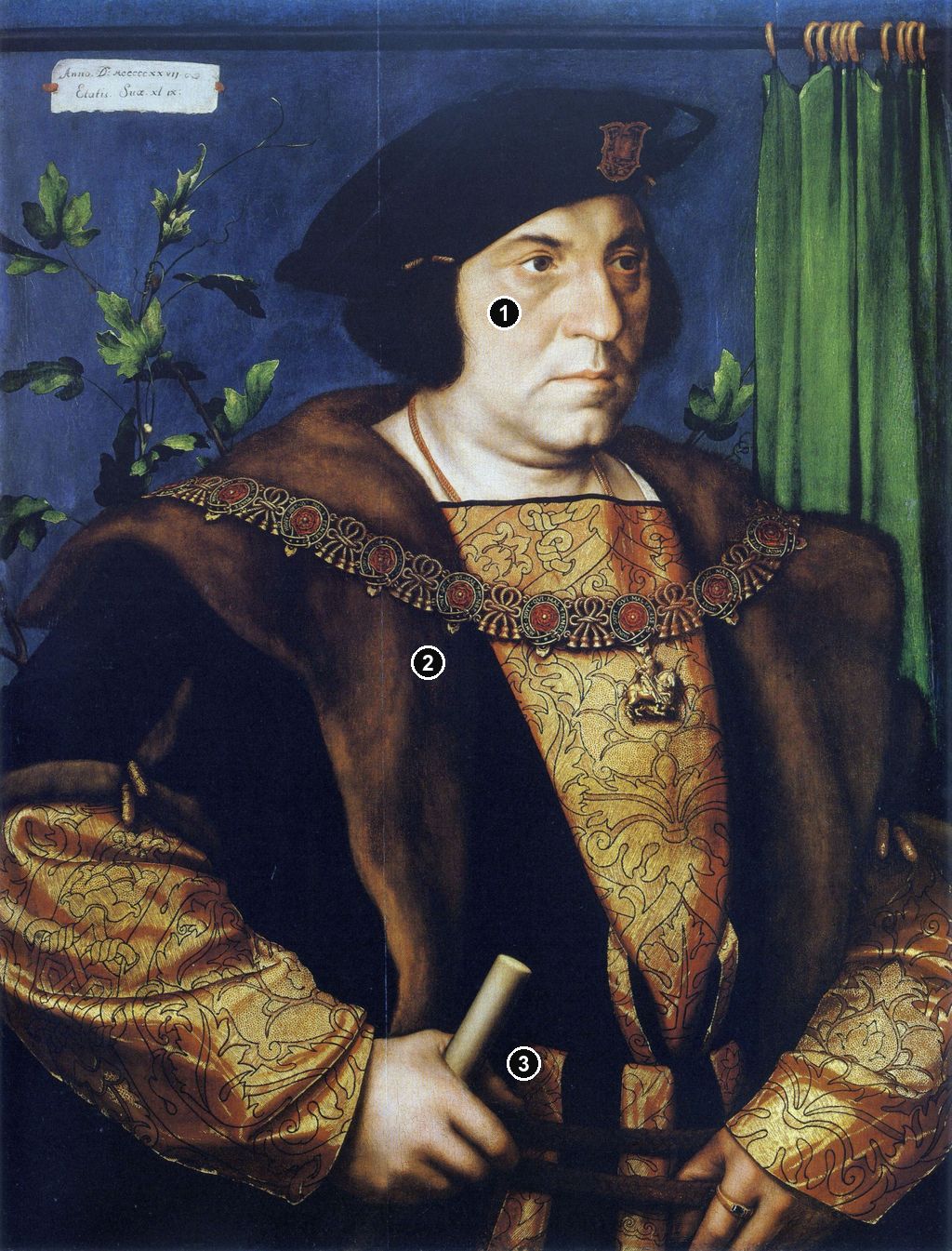
Details from SIR HENRY GUILDFORD
Compare the cropped details with the complete images above. Notice how their colours, shapes and positions contribute to the larger compositions.
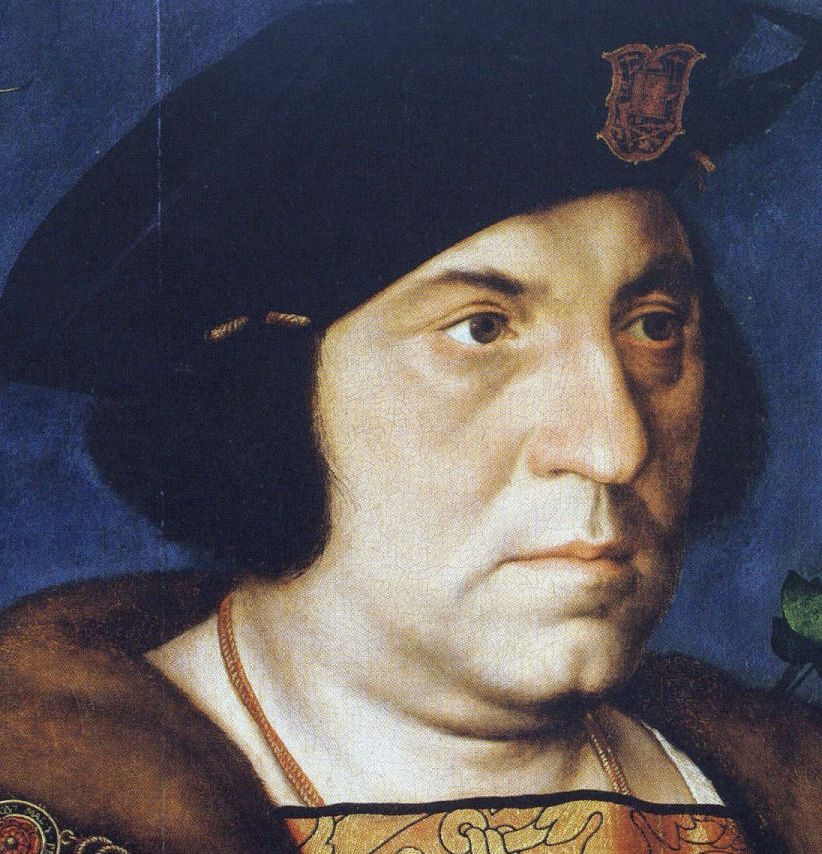
The head beneath the cap
The broad black cap surrounds a face modelled with small changes of light. Compare the crisp eyelids with the softer cheek and jaw.
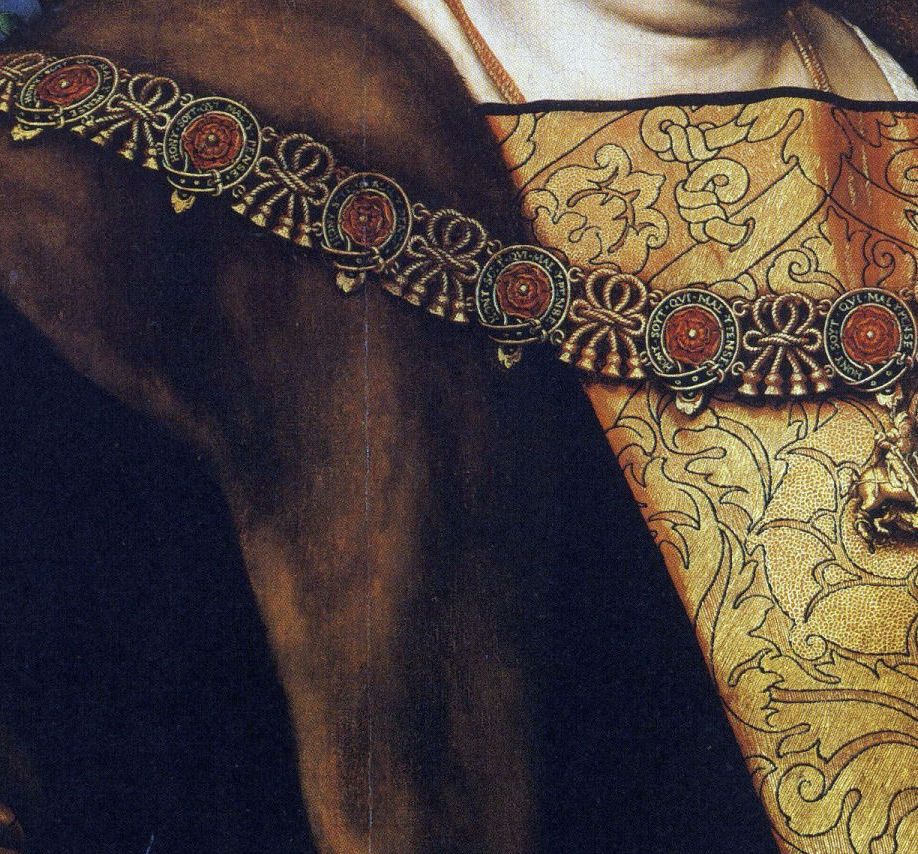
The chain and patterned cloth
The chain crosses the patterned doublet. Notice how separate bright links remain legible against an already elaborate surface.
The hands and staff
The hands and the pale staff give the lower portrait its structure. Their clear edges interrupt the dense ornament of the sleeves.
The courtier behind the white staff
Guildford’s career helps explain the mixture of conspicuous splendour and official restraint. He was born in 1489 and became one of Henry VIII’s close companions. At the king’s accession in 1509, he was appointed Esquire of the Body, a position involving personal attendance on the monarch, and Master of Revels. [1]
The latter title meant practical responsibility for elaborate entertainment. Guildford organised costumes, morris dancers and moving stages for the young king’s court. Such occasions depended on visual invention as well as administration: people had to be clothed, structures built and performances coordinated. The lavish garment in his portrait belongs to a world in which dress and spectacle were familiar instruments of court life. [1]
Royal favour had its interruptions. In 1519, the removal of a group of young courtiers, often called the purge of the “minions”, curtailed Guildford’s influence. He returned to court and built a substantial career in the royal household. [1] The portrait catches him after that recovery. Its staff gives a particular position to the richly dressed figure, rather than leaving his authority dependent on an expensive costume alone.
The chain crossing his chest adds another distinction. The Museum of Fine Arts, Houston’s catalogue identifies it as the chain of the Order of the Garter, an honour Guildford received in 1526. [9] In a painting made the following year, it was a recent mark of status.
Guildford continued to support Katherine of Aragon as the king’s relationship with Anne Boleyn developed. The Royal Collection describes the hostility this created with Anne, while noting that he remained in office until his death in 1532. [1] That later political tension gives context to his career. It does not turn the painted expression into a prediction of events or a confession of allegiance.
The badge and the painted curtain
A small badge on the hat introduces another kind of detail. It represents a clock and geometrical instruments. The Royal Collection observes that it is absent from the surviving preparatory drawing and offers two possibilities: Holbein may have studied it separately, or it may have been added to the design later at the suggestion of painter or sitter. [1]
The difference is revealing even without a definite explanation. A portrait could grow beyond the first study of a face. A badge needed particular information about a small, intricate object, and its inclusion could be decided independently of the principal likeness. Its subject is also suggestive beside the museum’s account of Guildford as a scholar with humanist interests. Those interests may have helped bring him into contact with Holbein, who arrived in England with Erasmus’s recommendation. [1] The badge itself supplies no written account of that encounter.
The curtain has prompted a more specific interpretation. The Royal Collection suggests a possible allusion to the ancient contest between Zeuxis and Parrhasius: Parrhasius painted a curtain so convincingly that his fellow painter was deceived by it. [1] Read in that way, Holbein’s hanging fabric becomes a quiet demonstration of what painting can do.
This remains a possibility, not a recorded explanation from either Holbein or Guildford. The curtain already has a clear pictorial function, defining the edge of the space and helping connect the two portraits. A learned association can enrich that function without replacing it.
Watch: Holbein’s portraits and working methods
Explore museum films on Holbein’s drawings, painted portraits and close-looking details.
Hans Holbein at the court of Henry VIII
A Royal Collection Trust film exploring Holbein’s work at Henry VIII’s court.
Watch on YouTubeMary’s portrait completes the setting
The companion Portrait of Mary, Lady Guildford was also painted in 1527. Its original is in the Saint Louis Art Museum, where it bears the object number 1:1943. Mary occupies a more elaborately articulated architectural setting, with a column beside her. The rail above her head continues the line in Henry’s picture, and the corner visible at his upper right belongs to the connecting architecture. [1] [2]
This is why the pairing matters beyond the fact that the sitters were married. Holbein coordinated the space around them. Each panel contains a complete figure, but the backgrounds encourage the viewer to imagine the pictures side by side. The architecture supplies continuity while the curtain and vine vary the areas around Henry’s head and shoulders.
The Morgan Library & Museum’s account of Mary’s portrait draws attention to her religious book and rosary, which place piety alongside the status expressed by her clothes and jewellery. [10] Henry’s white staff has a different kind of identifying work to do. Across the pair, possessions and gestures give each sitter a distinct presence within a common environment.
Their association with Holbein also extended beyond easel painting. The Royal Collection considers it almost certain that Guildford and the artist worked together on the Greenwich revels of 1527, for which a painter recorded as “Master Hans” undertook much decorative work. [1] The identification is persuasive, but the surviving name should retain its qualification. It offers a likely point of contact between the organiser of royal entertainment and a painter capable of supplying large decorative schemes.
The shared setting preserves their visual companionship even though the panels now belong to collections on opposite sides of the Atlantic.
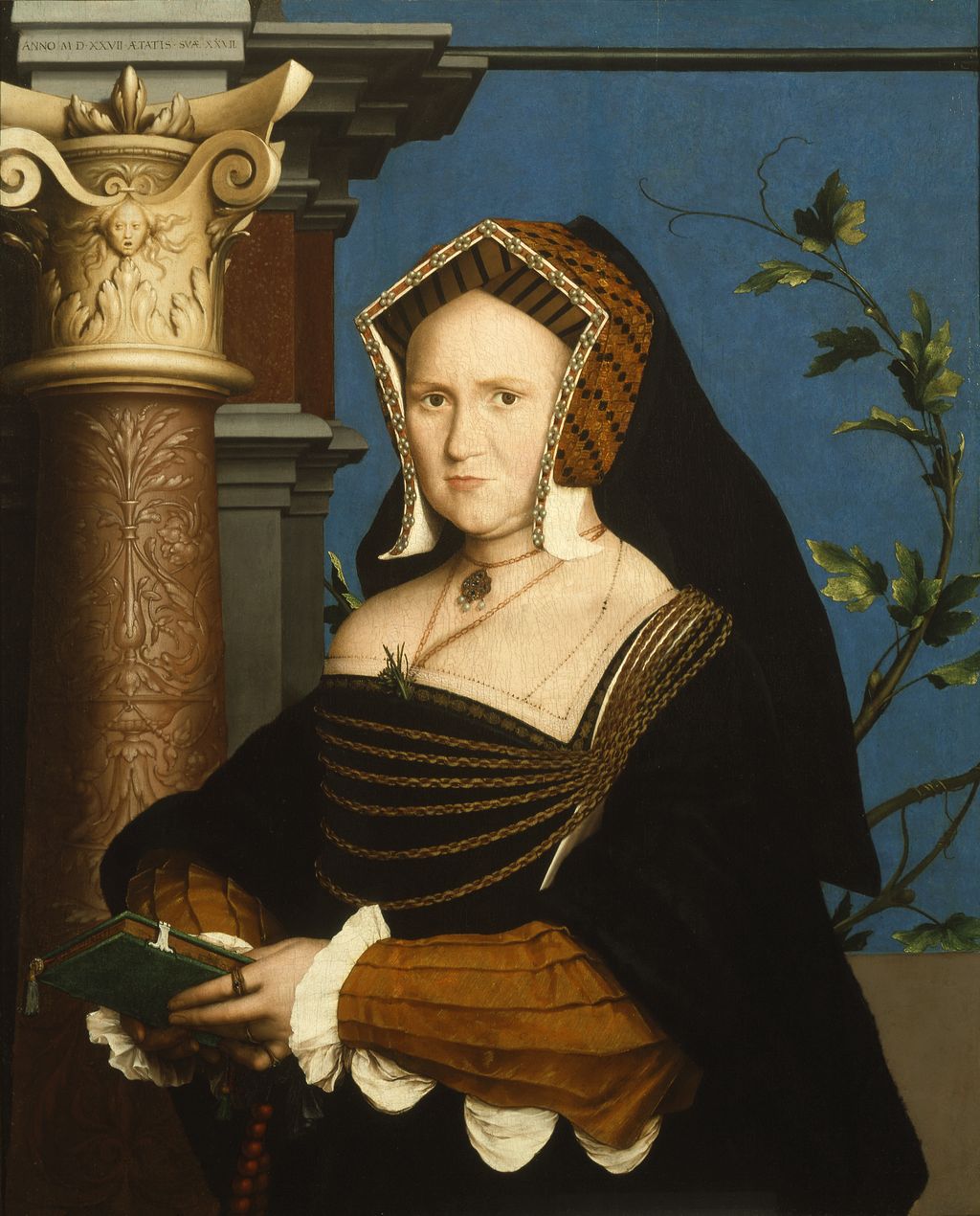
Hans Holbein the Younger, Mary, Lady Guildford, 1527. Oil on panel, 87 × 70.6 cm. Saint Louis Art Museum, Museum Purchase, 1:1943. Saint Louis Art Museum, Museum Purchase1:1943; Wikimedia Commons.
Image source
.
Public domain
.
From a chalk study to the painted portrait
Henry’s preparatory drawing also survives in the Royal Collection, as RCIN 912266. The current catalogue dates it to 1527 and describes black and coloured chalks with touches of brown ink on a sheet measuring 38.3 × 29.4 cm. [11] The medium gives it a very different character from the oil painting. Much of the clothing is abbreviated, and the face carries the concentration of the study.
Holbein used chalk in several ways. Sharpened points establish firm lines, broader strokes indicate the hat, and smudged black suggests the hair. Dampened material helps build the flesh colour. The museum also identifies a fine pen-and-ink line sharpening the lower right edge of the soft hat. [11] The drawing’s apparent economy depends on this variety of handling: a single medium can move between contour, shadow and a more continuous tone.
Conservator Victoria Button describes the hair in particular as built through blending and wetting black chalk, followed by finer strands drawn over it. Her examination records cream-coloured, unprepared paper and relates that light support to the creamy preparatory layer beneath the painting. [12] The comparison makes the move from drawing to panel more tangible. Both works begin from a pale surface, but each requires a different sequence of marks and layers.
The sheet has been cut down. According to the Royal Collection, it may originally have included more of the staff and may have approached the size of Mary’s much larger surviving study in Basel. [11] Its present edges therefore should not be taken as certain evidence of Holbein’s original composition. Nor is the name written above the head his own label: the museum dates that inscription to the eighteenth century. [11]
The exact method of transfer deserves care. The Royal Collection’s account proposes tracing the contours, while Button’s later examination lists no surviving signs of transfer on Henry’s sheet. [11] [12] These statements leave the physical procedure less secure than the relationship between the two works. We can recognise the study’s role without imagining every intermediate step as established.
The finished likeness also involved adjustment. Helga Kessler Aurisch’s Houston catalogue essay notes that Henry’s face becomes slimmer in the painting, with the features spaced more widely. It reports infrared evidence suggesting that changes were settled before the panel underdrawing was transferred, rather than corrected within it. [9] The portrait’s convincing presence thus incorporates decisions made between study and finished picture.
Why the inscription gives the wrong age
The little label at the upper left is a cartellino , a painted representation of a small piece of paper. Its inscription supplies the year 1527 and an age of 49. The Royal Collection identifies it as a later addition and states that Guildford was actually shown aged 38. [1]
That correction changes how the label should be read. A conspicuous inscription can look like the most authoritative part of an old portrait, particularly when it appears neatly isolated from the figure. Here, it belongs to the painting’s subsequent history. The accepted date remains 1527, but the label’s age is inaccurate.
The error also cautions against dating a sitter by appearance. Guildford’s substantial face, dark clothes and air of established authority might make either number seem plausible to a modern viewer. His documented identity and chronology provide a firmer basis. Holbein painted an experienced courtier in his late thirties, with a career already extending back to the beginning of Henry VIII’s reign. [1]
The original and its later company
The original painting is the rectangular oak panel in the Royal Collection, RCIN 400046. Its recorded provenance includes Thomas Howard, Earl of Arundel; purchase from his heirs by George II or Queen Caroline; and a documented place in the Privy Chamber at Kensington Palace in 1732. [1] That account leaves the royal purchaser as an alternative and gives a secure early eighteenth-century location without requiring an exact date of separation from Mary’s portrait.
A small circular version in Houston is a separate work. The museum currently attributes it to Holbein’s workshop, while Aurisch describes an unidentified painter in his circle. It combines the fuller face of the drawing with costume details from the painting. This copy must be distinguished from Holbein’s large original. [9]
Mary’s portrait has its own history of confusion. The Saint Louis museum explains that a version in the Metropolitan Museum of Art was once accepted as the original, before the Saint Louis painting reappeared in 1930. The latter entered the museum in 1943. [2] Keeping the two versions distinct restores the correct companion to Henry’s picture.
The drawing, painted pair and copies offer different encounters with the same people. Returning to the Royal panel, the broad sleeves, plain staff and tiny badge become easier to see as separate decisions within a portrait that holds them firmly together.
Artworks directory
Explore paintings, drawings, prints and designs, including works without a separate article. Related studies and versions have their own entries; workshop works and copies are labelled. Print designs and series are grouped rather than repeated for every impression.
Frequently Asked Questions
He was a courtier and close associate of Henry VIII who served as Esquire of the Body, Master of Revels and Comptroller of the Household. His white staff identifies the last of these offices in the portrait. [1]
The painting dates to 1527, when Guildford was 38. A later inscription incorrectly gives his age as 49. [1]
Yes. The Royal Collection records shell-gold paint and gold leaf, including leaf used to imitate bright reflections from the gold threads in the clothing. [1]
Yes. It is in the Royal Collection, RCIN 912266, and dates to 1527. Its surviving materials include black and coloured chalks with touches of brown ink. The sheet has been cut down. [11]
Discussion
Look again at the images and ideas explored in Portrait of Sir Henry Guildford. These editorial prompts invite your observations.
Reader Insights
Compare the satin band, velvet sleeve and dark hair. Which edges and highlights make them feel different?
Set Henry’s portrait beside Mary’s and follow the curtain rail. How does the architecture change your sense of each sitter’s space?
Look from the preparatory drawing to the painting. What changes when the concentrated head study becomes a figure surrounded by gold, fur and official objects?
Join the Conversation
Which detail first made you pause: the white staff, the clock badge, the woven gold or the later age label? Describe where it leads your eye within the portrait.
References
- Royal Collection Trust , Sir Henry Guildford (1489–1532) , dated 1527, RCIN 400046; collection record and catalogue entry adapted from The Northern Renaissance: Dürer to Holbein (London, 2011). In English. View source .
- Saint Louis Art Museum , Mary, Lady Guildford , 1527, object 1:1943; collection and provenance record. In English. View source .
- Kunstmuseum Basel, Bildnis des Bonifacius Amerbach, 1519, inventory 314 (in German) . View source .
- Kunstmuseum Basel, Der tote Christus im Grab, 1521–22, inventory 318 (in German) . View source .
- The Frick Collection, Sir Thomas More, 1527, accession 1912.1.77, collection record . View source .
- Gemäldegalerie Berlin, Georg Gisze . View source .
- Susan Foister, The Ambassadors, The German Paintings before 1800 (2024) . View source .
- Susan Foister, Christina of Denmark, Duchess of Milan (2024) . View source .
- Helga Kessler Aurisch / Museum of Fine Arts, Houston , Sir Henry Guildford , cat. 30, The Straus Collection , online catalogue, object 44.549; workshop/circle version and comparisons with Holbein’s original and drawing. In English. View source .
- The Morgan Library & Museum , Mary, Lady Guildford , no. 014, online exhibition Holbein: Capturing Character . In English. View source .
- Royal Collection Trust , Sir Henry Guildford (1489–1532) , 1527, preparatory drawing, RCIN 912266; collection record and catalogue entry adapted from The Northern Renaissance: Dürer to Holbein (London, 2011). In English. View source .
- Victoria Button , The Portrait Drawings of Hans Holbein the Younger: Function and Use Explored through Materials and Techniques , PhD thesis, Royal College of Art, 2013, pp. 103, 130, 182 and 286 (table 14). In English. View source .
- Würth Collection, Holbeins Schutzmantelmadonna, inventory 14910, current owner account (in German) . View source .
- Metropolitan Museum, Dance of Death series . View source .
- Kunstmuseum Basel, Bildnis der Frau des Künstlers mit den beiden ältesten Kindern, about 1528–29, inventory 325 (in German) . View source .
- Kunsthistorisches Museum Wien, Next Generation, Jane Seymour, about 1536–37, inventory 881 (in German) . View source .
- Splash image , Hans Holbein the Younger, Sir Henry Guildford, 1527. Oil on oak panel, 82.7 × 66.4 cm. Royal Collection, RCIN 400046. Royal Collection; reproduction from Stephanie Buck1999 via Wikimedia Commons. Image source . Public domain .