by
Tom Gurney
Tom Gurney BSc (Hons) is an art history expert with over 20 years experience
Email:
tomgurney1@gmail.com
/ Phone:
+44 7429 011000
Hans Holbein’s Style and Technique: Introduction
In Holbein’s chalk portrait of Thomas More, the hat is broad and dark, the fur collar loosely described and the face astonishingly particular. The eyes occupy unequal spaces beneath the turning brow. A small shadow beside the nose helps establish the cheek; the mouth is held together by a delicate division between the lips. Much of the surrounding paper remains lightly worked. The likeness depends on knowing where to insist and where to stop.
This is the Royal Collection’s study of 1527, RCIN 912268, made in black and coloured chalks, with outlines pricked for transfer. It belongs beside the finished portrait in the Frick Collection, but its physical marks preserve a history of use that the painted image alone cannot explain. [1]
Holbein’s technique becomes most interesting at these points of movement: from a person to a drawing, from a drawing to a painted surface, from a flat design to a printed page or a precious object. Careful description accompanies substantial invention. A likeness can retain its individuality while its surrounding clothes, architecture and objects are arranged to create a different encounter.
At a Glance
- Artist Hans Holbein the Younger, c.1497/98–1543. [1]
- Drawing materials metalpoint, black and coloured chalks, liquid black media, watercolour and white heightening, in combinations that vary between sheets. [2]
- Drawing supports white paper and paper given a coloured preparation; pink preparations often supplied a starting flesh tone. [2]
- Painting supports examples discussed here include oak, limewood and painted paper mounted on wood. [3] [4] [5]
- Working evidence pricking, tracing, underdrawing and revisions; these do not establish one identical procedure for every portrait. [1] [6] [3]
- Other activities woodcut design, mural preparation and designs for metalwork. [7] [8] [9]
- Featured image Sir Thomas More , 1527, black and coloured chalks, Royal Collection, RCIN 912268. [1]
Contents
- Observation and Invention
- Paper, Colour and the Selected Mark
- Carrying a Likeness into Paint
- Building a Painted Surface
- When the Support Changes the Picture
- Making Space Around a Sitter
- Scale, Selection and the Printed Line
- Designs, Collaboration and Surviving Copies
Observation and Invention
The More study makes a useful distinction between completeness and accuracy. The fur does not need an individually counted hair at every point. Its broad, uneven edge and changing density already distinguish it from the smooth skin above. The hat’s dark mass encloses the head without competing with the small adjustments around the eyes. What matters is the relationship between areas of attention.
Even the face is not equally emphatic throughout. The bridge of the nose can be read through a change of tone; the nostril needs a more definite mark. The nearer eye presents a longer, more open shape than the farther one. Their different angles establish the turn of the head, and the mouth follows that same turning surface. A recognisable person emerges through a small number of carefully related differences.
That persuasiveness can make Holbein’s portraits seem like direct records of an encounter. Jeanne Nuechterlein offers a helpful qualification. In the introduction to Translating Nature into Art , she argues that his descriptive manner encourages us to experience appearance as a person’s enduring identity. She places this alongside a more overtly inventive manner, especially evident in his allegorical and decorative work. These are interpretative categories within her argument, rather than two sealed compartments into which every work must fit. [10]
The distinction gives us a question to bring to individual pictures: how does the image ask to be believed? More’s face invites recognition. The extraordinary vessel in a metalwork design asks us to imagine something that might be made. Both depend on visual decisions, although they place those decisions differently before us.
A portrait’s restraint also leaves expression open. A closed mouth and steady eyes can suggest intelligence, caution or reserve to a modern viewer. They cannot supply a dependable report of temperament. Holbein’s precisely observed surface gives us much to attend to while withholding the certainty of a spoken explanation.
This combination helps explain why detail matters without becoming an end in itself. A line of hair, a fold at the neck or a tiny highlight changes how a larger form is understood. We can admire the small mark and still ask what work it performs within the image.
Paper, Colour and the Selected Mark
Paper participates in the likeness before every part of it is covered. Rachael Smith and Victoria Button explain that Holbein used both white paper and sheets prepared with a pink coating. The coloured preparation supplied a middle tone for modelling a face. Chalk could be sharpened or blended; liquid additions extended its colour and tonal range. [2]
These possibilities help us understand the different kinds of mark visible in the More study. The hat’s repeated dark strokes remain legible as strokes. Across the cheek, smaller changes merge into an impression of rounded skin. The collar, by comparison, stays open and broken. Moving from one passage to another is like changing the distance from which we look, although everything occupies the same sheet.
A practical drawing need not give every material the finish it will receive in paint. A few lines may preserve the direction of a garment, while a repeated ornament can be recorded through a small representative passage. The Royal Collection’s account also describes written reminders about colour and fabric, and enlarged details of particular jewels. Such notes carried information that a shaded face could not supply. [2]
This separation of information is worth following through the portrait drawings . Shape, colour, pattern and texture can be recorded in different ways. Their unequal development does not necessarily represent an abandoned attempt to finish the whole sheet. It can reflect a judgement about what needed to be retained for further work.
It also changes our sense of colour. A blue or green iris might occupy a minute area, yet determine how the eyes sit within a face. A broad dark garment might be described with much less differentiation. Area and importance do not coincide: the smallest addition can be crucial to recognition.
Carrying a Likeness into Paint
The practical value of a portrait study lies partly in preserving relationships: the distance between the eyes, the length of the nose, the turn from cheek to chin. Once established, these could guide another image without requiring the sitter to remain present throughout its making.
Marks left by use need careful discrimination. A drawn line deposits material; a stylus can press a groove into paper; pricking makes a succession of holes. Pouncing carries an outline onward by passing powder through those holes. The marks may occupy the same contour, but they record different actions. [11]
The More drawings show why the distinction matters. The featured sheet is pricked; a second Royal Collection study, RCIN 912225, has traced contours. Button’s comparison found that the pricked sheet did not align throughout with the Frick painting’s underdrawing, while the second study gave a closer fit. She considers an intermediate pattern among the possible explanations. The pricking itself cannot securely be assigned to a particular moment. [1] [6]
A transfer preserves a relationship while also allowing small departures. Choosing which edge of a chalk line to follow already involves a decision. Strengthening a transferred outline provides another opportunity to alter it. The finished painting consequently need not be a mechanically enlarged or coloured version of the surviving sheet.
Nor must every useful study precede the whole painting. The Louvre’s studies of Erasmus’s hands include two resting hands connected with the Longford Castle portrait. Its commentary reports Christian Müller’s proposal that these were drawn after painting had begun. The central writing hand has a separate history: Paul Ganz rejected its autograph status, while Müller proposed a later study for an older Erasmus. Those positions concern particular passages within one sheet. [12]
Drawing, in this view, remains available when a new problem arises. A face may be established while a hand still needs closer attention. A contour can be carried forward while costume changes around it. The surviving evidence makes the relationship between paper and painting more active than a simple succession of finished stages.
Building a Painted Surface
A painted portrait begins below what the eye first recognises. In Derich Born , Nicola Christie describes two joined oak boards with a chalk ground and a thin grey priming layer. Carbon-containing underdrawing lies above that preparation. Infrared examination reveals revisions around the cheek and jaw, made during drawing and painting. These findings belong to this particular portrait. [3]
The preparation supplies a useful way to think about the painted object. Wood carries the structure; the ground and priming provide the surface on which the image develops. The face we meet at the end belongs to an accumulation of decisions and materials. A reproduction makes those stages appear to occupy a single flat plane.
Born’s clothing offers a more visible lesson. Christie identifies lamp black and lead white in linseed oil in both silk and fur. Their different appearance comes from handling: smooth application gives the sleeve its sheen, while stiffer paint and dragged highlights articulate the short fur. The blue background contains two thick azurite layers. [3]
Look from the sleeve to the darker chest. The sleeve’s narrow highlights curve and break, suggesting cloth that changes direction sharply. Around the shoulder and neck, the softer interruptions feel less continuous. The eye recognises surfaces through the behaviour of their light, before it knows anything about their ingredients. Identical pigments can contribute to quite different impressions.
Sir Henry Guildford brings another material into the argument. The Royal Collection records shell-gold paint and gold leaf in his portrait of 1527, including leaf used to imitate bright gold threads in his clothing. The satin strip along the arm is also differentiated from the adjacent velvet. [13]
Here the image of richness includes actual precious metal. A yellow appearance alone would never establish that fact; the collection’s material account does. Once we know it, the patterned doublet becomes especially absorbing. Dark winding contours separate small areas of brightness, while larger folds give the cloth a substantial body beneath the ornament.
The pattern must remain legible as decoration while also belonging to a garment wrapped around a person. Follow it across the chest, then towards the sleeves. Its visual density changes as it meets the broader dark shapes of the fur. The head, by comparison, is less patterned and more continuous. The arrangement allows material splendour to frame the face without dispersing our attention across every shining point.
Watch: Holbein’s portraits and working methods
Explore museum films on Holbein’s drawings, painted portraits and close-looking details.
Hans Holbein at the court of Henry VIII
A Royal Collection Trust film exploring Holbein’s work at Henry VIII’s court.
Watch on YouTubeWhen the Support Changes the Picture
The distinction between a drawing and a painting does not rest simply on paper versus wood. A catalogue description can identify several physical layers within one object: a painting surface, something to which it was attached and a later mounting. Each may contribute differently to the image’s appearance.
The Artist’s Family makes the consequences tangible. Kunstmuseum Basel dates the portrait of Elsbeth, Philipp and Katharina to about 1528/29. It records mixed technique on paper, cut around the figures and mounted on limewood. The museum considers the surviving picture a fragment, apparently reduced substantially at the right and below. [4]
In the present arrangement, the figures stand out against a dark field. Elsbeth’s broad pale neckline and the little girl’s dress establish large areas of light. The boy rises from below, looking towards the same side to which his sister reaches. Hands connect the three bodies even as their attention moves beyond the group.
Knowing that the painted paper was cut changes the question we ask of that darkness. It cannot automatically be taken as the complete setting Holbein originally devised. The children’s outward attention may once have met something now missing. Basel’s suggestion that the painter himself might have appeared there remains a reconstruction, not a surviving fourth portrait. [4]
Alteration can also belong to the artist’s own work. In The Dead Christ in the Tomb , dated 1521–22, Basel describes a change from a vaulted niche to the angular enclosure now visible. The position of the date changed too: Holbein wrote 1522, then painted over its final numeral to leave 1521. [5]
That history gives a physical dimension to the painting’s severity. The long upper boundary and the upright end wall enclose the body within a conspicuously angular space. The cloth and flesh retain their irregular folds and contours against those straight limits. The apparent directness of the encounter is inseparable from a setting that was worked upon and revised.
These two paintings demand different questions. One survives through later cutting and mounting; the other contains a documented change during execution. The finished rectangle conceals neither history completely, but each history needs to be recovered from its own object.
Making Space Around a Sitter
Holbein’s accuracy in a small object does not oblige the whole room to behave like a measured interior. Georg Giese’s portrait , painted in 1532, is a revealing example. Berlin curator Stephan Kemperdick describes changes to the shelf, room corner and direction of the head. He also draws attention to the compressed, irregular space around the merchant, while leaving open who initiated the alterations. [14]
The glass vase provides one kind of certainty. Its slender stem and delicate handles remain clear against the darker clothing. Inside it, stems continue through the water; around it, the patterned carpet spreads across the foreground. Each small junction tells us what overlaps what.
The room as a whole is harder to assemble. At the left, a shelf crosses a large area of wall; at the right, the furnishings rise in a denser stack. Slanting papers project into the narrow space beside the sitter. The table brings a patterned surface towards us, while Giese’s sleeves occupy much of the interval between table and wall.
Those arrangements direct attention effectively even when they resist a neat architectural reconstruction. The surroundings hold the figure close. The flowers interrupt one sleeve, the letters answer the document in his hands, and the shelves provide smaller horizontal lines against the breadth of his hat. Holbein gives individual things persuasive edges while adjusting the space that contains them.
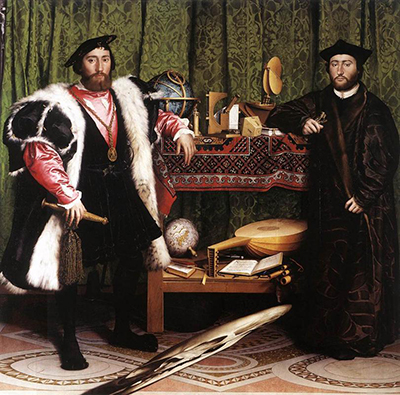
The Ambassadors extends the question through its much larger arrangement of two men, shelves and objects. Susan Foister’s technical account identifies underdrawing and revisions, including changes to the lute’s tuning pegs. Her discussion of making the portrait also notes that no pouncing dots establish the use of a cartoon for this work. A hypothetical full-size design should therefore remain hypothetical. [7]
The contrast within the painting is immediately visible. The shelves run steadily across the centre; the men stand upright; the pale shape of the skull cuts diagonally across the foreground. Recognising that shape requires a different angle of view. The painting permits both a sustained frontal inspection of material detail and a more disruptive experience of changing position. [7]
That viewing effect demonstrates an interest in optical transformation. It does not establish a single hidden device used to produce Holbein’s portraits. The important distinction is between a visible pictorial effect and a claim about the equipment or procedure behind it. Here the evidence rewards attention to how a particular image changes as we move.
Scale, Selection and the Printed Line
The scale of an object changes the task of looking. The broad figures in The Ambassadors invite an encounter across a room; a small woodcut asks us to come close. Enlarging both to the same size on a screen can conceal how differently they address the body of the viewer.
The Metropolitan Museum’s impression of The King , from the Dance of Death , measures only 6.5 × 4.9 centimetres as a sheet. Its record names Holbein alongside Hans Lützelburger and separates the approximate making date, about 1526, from publication in 1538. [8]
At this tiny scale, the image must establish an action before its finest marks have been inspected. The king sits beneath a canopy. A table divides the scene horizontally. Death enters beside him with a vessel, bringing a skeletal body into the ceremony of service. The principal shapes make the encounter readable; smaller lines distinguish clothes, furniture, vessels and flesh.
Look at the patterned hanging behind the king. Its repeated signs occupy a relatively open field. Around it, hatching darkens the canopy and columns; across the table, diagonal lines distinguish the cloth. Different directions and densities of mark prevent adjoining surfaces from merging. The white intervals matter as much as the black ones.
Woodcut is a relief process: the raised parts of a prepared block receive ink, while cut-away areas leave the paper unprinted. The catalogue’s distinction between Holbein and Lützelburger consequently matters to the visible result. Design and cutting are related contributions, each requiring decisions about how a line and the space beside it will survive in print. [8]
This is also a different use of abbreviation from the portrait study. More’s loosely indicated clothing can preserve information for a later painted image. The woodcut’s concentrated marks have to carry the encounter in the printed object itself. The little scene needs to remain coherent through its contours, gestures and patterned intervals.
The prints reveal how description can serve an invented event. The king’s recognisable furnishings make the skeletal visitor more startling. Small scale does not diminish the conception; it requires a particularly clear distribution of what the reader sees first and discovers next.
Designs, Collaboration and Surviving Copies
A design for metalwork moves in another direction: from marks on paper towards an object with weight, depth and separate components. Basel’s Table Ornament with Caryatids , dated 1533/36, uses black pen over a chalk preparation. Its traditional association with an Anne Boleyn fountain is more specific than the museum’s current title. The drawing alone does not establish the construction or appearance of an executed fountain. [9]
The broad vessel swells above a narrow supporting stem. Small figures occupy the transition between foot and bowl. Ornament curls across the surface, while shading suggests the rounded sides turning away. The sheet offers several pleasures at once: an intelligible silhouette, a play of supporting bodies and a succession of smaller decorative inventions.
The figures are especially effective because they make structure something we can imagine physically. Their bodies appear to bear the vessel’s weight. Yet a persuasive drawn support is only part of the problem of making metalwork. Depth, joints, balance and access would have to become practical decisions in a finished object.
Susan Foister’s Gresham College lecture places such invention within Holbein’s relationships with court craftspeople. Discussing Anthony Denny’s clocksalt, she distinguishes Holbein’s design, Nicholas Kratzer’s involvement and the unknown maker of the finished object. [15] A celebrated designer’s name does not make the metalworker disappear. The designs preserve exchanges between kinds of expertise as well as inventions by an individual hand.
Copies require a related distinction between the conception and the surviving object. Holbein’s Whitehall mural was destroyed in 1698. The National Portrait Gallery’s surviving cartoon represents its left half; a later copy by Remigius van Leemput records the full composition. The cartoon joins sheets and pasted cut-outs, and the Gallery suggests that an intermediate copy was used for transfer. Henry VIII’s head differs between the cartoon and the painted composition preserved by Leemput. [11]
The copy therefore gives access to a lost design while retaining its own maker and date. It can help us understand the arrangement of figures; it cannot place Holbein’s original painted surface before us. The cartoon supplies another kind of evidence, including the material assembly of a large image before painting.
Return from those monumental preparations to the small marks around More’s eyes. The change of scale is enormous, but the practical questions remain engagingly concrete. Which relationships must be preserved? What can be altered? What does the next material require? Holbein’s surviving works make those questions visible in a sharpened contour, a revised room, a patch of gold or an interval of unprinted paper.
Artworks directory
Explore paintings, drawings, prints and designs, including works without a separate article. Related studies and versions have their own entries; workshop works and copies are labelled. Print designs and series are grouped rather than repeated for every impression.
Frequently Asked Questions
Yes. The Artist’s Family is painted in mixed technique on paper, later cut around the figures and mounted on limewood. Paper identifies its painting surface; wood identifies its present rigid support. [4]
Some works contain actual gold. The Royal Collection records shell-gold paint and gold leaf in Sir Henry Guildford . That object-specific finding does not identify every golden-looking area in another portrait. [13]
Discussion
Look again at the images and ideas explored in Hans Holbein’s Style and Technique. These editorial prompts invite your observations.
Reader Insights
Move from More’s face to his hat and collar. Which small differences in mark make skin, fabric and fur distinguishable?
Consider the cut paper of The Artist’s Family . How does knowing about its support change your reading of the children’s outward attention?
Imagine The King at its small printed size. Which gesture or large shape would you notice before its finer detail?
Join the Conversation
Which Holbein work most changes when you learn how it was made? Share a particular contour, surface, revision or material that draws your attention back to the image.
References
- Royal Collection Trust , Sir Thomas More (1478–1535) , 1527, RCIN 912268, collection record. View source .
- Rachael Smith and Victoria Button, Royal Collection Trust , “Holbein’s portrait drawings”, sections on papers, preparation, chalk, watercolour and costume. View source .
- Nicola Christie, Royal Collection Trust , “Derich Born”, Holbein in the Royal Collection , conservation feature, sections on construction, underdrawing and materials. View source .
- Kunstmuseum Basel , Bildnis der Frau des Künstlers mit den beiden ältesten Kindern , around 1528/29, inventory 325, collection record (in German). View source .
- Kunstmuseum Basel , Der tote Christus im Grab , 1521–22, inventory 318, collection record, discussion of niche and date revisions (in German). View source .
- Victoria Button , The portrait drawings of Hans Holbein the Younger: function and use explored through materials and techniques , PhD thesis, Royal College of Art, 2013, pp.208–210 and 216–219. View source .
- Susan Foister, National Gallery , “The Ambassadors”, The German Paintings before 1800 , 2024, “Technical Notes”, “The Making of the Portrait” and discussion of the skull. View source .
- Metropolitan Museum of Art , The King, from The Dance of Death , about 1526, published 1538, design by Hans Holbein the Younger, blockcutting by Hans Lützelburger, object 19.57.8. View source .
- Kunstmuseum Basel , Tafelaufsatz mit Karyatiden ( Table Ornament with Caryatids ), 1533/36, inventory 1662.165.89, collection record (in German). View source .
- Jeanne Nuechterlein , Translating Nature into Art: Holbein, the Reformation, and Renaissance Rhetoric , Pennsylvania State University Press, 2011, introduction, supplied publisher extract. View source .
- National Portrait Gallery , King Henry VIII; King Henry VII , c.1536–37, NPG 4027, collection record and display labels. View source .
- Musée du Louvre , Trois études de mains pour le portrait d’Erasme , INV 18697 recto, collection record and commentary on Ganz and Müller (in French). View source .
- Royal Collection Trust , Sir Henry Guildford (1489–1532) , 1527, RCIN 400046, collection record, material discussion adapted from The Northern Renaissance: Dürer to Holbein (2011). View source .
- Gemäldegalerie, Staatliche Museen zu Berlin , Der Kaufmann Georg Gisze , 1532, inventory 586; Stephan Kemperdick’s commentary from 200 Meisterwerke der europäischen Malerei – Gemäldegalerie Berlin (2019) (in German). View source .
- Susan Foister / Gresham College , “Hans Holbein the Younger: ‘A man very excellent in taking of physionamies’”, lecture transcript, 6 June 2016, discussion of Holbein, Kratzer and Denny’s clocksalt. View source .