 by
Tom Gurney
Tom Gurney BSc (Hons) is an art history expert with over 20 years experience
Email:
tomgurney1@gmail.com
/ Phone:
+44 7429 011000
William Fitzwilliam, Earl of Southampton by Hans Holbein the Younger: Introduction
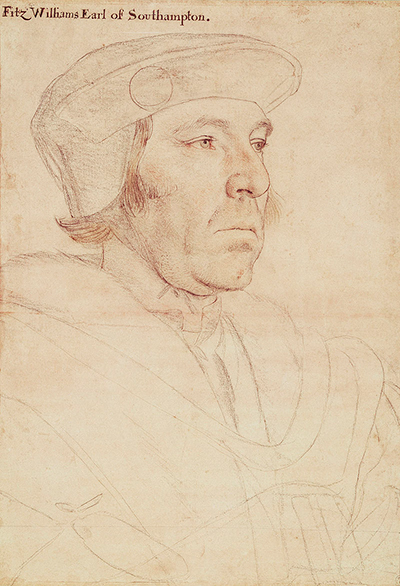
William Fitzwilliam's face seems to emerge from a costume still being worked out. Holbein gives the eyes, nose and closed mouth a concentrated precision, while the broad shoulders below them remain a network of pale lines. A large hat frames the head; beneath it, strands of hair turn outwards at the neck. The contrast draws us towards the small marks that make this face recognisable.
The Royal Collection dates the drawing to about 1536–40. Fitzwilliam, a longstanding servant of Henry VIII, appears in the insignia of the Order of the Garter. A painted version survives in Cambridge as a work after Holbein; the drawing itself preserves the artist's much more immediate attention to the sitter. [1] [2]
At a Glance
- Artist Hans Holbein the Younger
- Title William Fitzwilliam, Earl of Southampton (c.1490–1542)
- Date about 1536–40
- Medium black and coloured chalks, and metalpoint on pale pink prepared paper
- Dimensions 38.3 × 27 cm, sheet
- Collection Royal Collection
- Object number RCIN 912206
- Related work a painted portrait after Holbein, Fitzwilliam Museum, Cambridge, accession 164. [1] [2]
This work across Hans Holbein the Younger’s career
Dead Christ in the Tomb
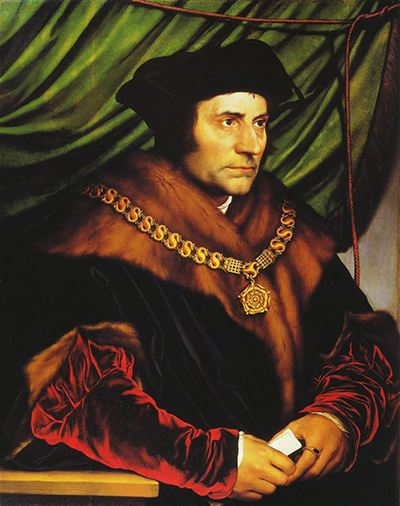
1521–22 [4]Sir Thomas More
1527 [5]Georg Giese
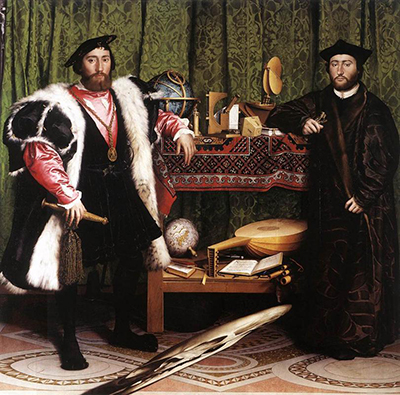
1532 [6]The Ambassadors
1533 [7]Contents
- A Face Built from Small Decisions
- Chalk, Metalpoint and the Pink Surface
- Dress That Frames the Head
- A Courtier's Name and the Drawing's Date
- The Painted Counterpart in Cambridge
- The Sheet's Journey through Collections
A Face Built from Small Decisions
Fitzwilliam turns towards the right, presenting both eyes while allowing the projecting nose to establish a clear side contour. The nearer eye receives particular emphasis: its upper lid, iris and surrounding wrinkles hold the attention within an otherwise lightly coloured face. A few short lines at the mouth give the lips firmness without making them heavily outlined.
Look lower and the drawing changes pace. Marks around the cheek, jaw and chin suggest the uneven surface of skin and the beginnings of a beard. These small interruptions keep the face from becoming a smooth mask. The line beneath the chin is more decisive, separating the head from the neck and clothing.
The expression can look guarded, even severe. The downturned mouth and steady gaze are visible; a judgement about Fitzwilliam's temperament would require different evidence. Holbein supplies enough individuality to encourage that judgement while leaving us no certain account of what the sitter was thinking.
Chalk, Metalpoint and the Pink Surface
The sheet's warm tone is part of its construction. The Royal Collection identifies pale pink prepared paper beneath black and coloured chalks and metalpoint. Preparation means that the artist worked over a coloured surface, rather than having to supply every trace of flesh colour through subsequent marks. [1]
Rachael Smith and Victoria Button, the Royal Collection's paper conservators, explain that prepared pink papers could speed the recording of a likeness and provide a middle tone for modelling. They also stress the variety of Holbein's drawing methods. Their account offers a useful setting for this sheet without establishing the exact sequence of every stroke here. [9]
In the face, soft shading sits beside narrow, distinct lines. Around the hat, a much lighter touch allows one contour to remain visible beside another. The medium list does not tell us which individual mark is metalpoint. Looking at a reproduction can reveal differences in emphasis, but identifying a tool stroke by stroke requires examination beyond what the image alone supplies.
Watch: Holbein’s portraits and working methods
Explore museum films on Holbein’s drawings, painted portraits and close-looking details.
Hans Holbein at the court of Henry VIII
A Royal Collection Trust film exploring Holbein’s work at Henry VIII’s court.
Watch on YouTubeDress That Frames the Head
The hat spreads above the forehead in a broad, flattened curve. Its circular medallion is outlined with economical simplicity. Darker passages at the side of the head lead the eye down to the outward-sweeping hair, where individual strokes are more pronounced than much of the costume below.
Across the shoulders, the fur collar forms a broad enclosing shape. Beneath it, the Garter collar is faintly indicated. These different collars have distinct purposes: one is part of the clothing, while the other identifies an honour. The Royal Collection records Fitzwilliam's appointment as a Knight of the Garter in 1526. [1]
A few sweeping lines establish a substantial upper body. They give the carefully articulated head enough support without competing with it. Following these lines down the sheet, the viewer passes from a highly particular likeness into a much more open description of dress.
A Courtier's Name and the Drawing's Date
Fitzwilliam had belonged to Prince Henry's early circle. His subsequent offices included ambassador to France, Treasurer of the Household and Lord High Admiral. The portrait therefore represents someone whose career extended through several forms of royal service. [1]
Two dates in the title need separating. The years about 1490–1542 describe Fitzwilliam's lifetime; about 1536–40 is the Royal Collection's date for the drawing. Neither provides an exact sitting day. Nor does the identifying inscription above the hat come from the original encounter: the collection assigns that writing to the eighteenth century. Its prominent lettering belongs to the sheet's later history. [1]
The Painted Counterpart in Cambridge
The Royal Collection connects the study with a lost painting by Holbein, known through a surviving version in the Fitzwilliam Museum. Cambridge catalogues its portrait as after Holbein , in oil on panel, measuring 187.1 × 100 cm. It is a separate work from the autograph drawing and the lost painted original. [1] [2]
The painting's chronology also needs care. Its record gives a production date no earlier than 1539 and transcribes an inscription ending in 1542. That inscribed year does not change the Royal Collection's dating of the sheet. These objects preserve different stages in the history of Fitzwilliam's likeness. [2]
The Sheet's Journey through Collections
The drawing has a history quite separate from the Cambridge panel. The Royal Collection traces it from Henry VIII and Edward VI through the Arundel and Lumley collections. A probable bequest to Henry, Prince of Wales, brought it towards royal ownership again; later exchanges and gifts took it through further aristocratic hands. Charles II had acquired it by 1675. [1]
Those changes help explain why an intimate working sheet also carries the marks of later collecting. The name above the hat identifies a historical person for subsequent viewers. Below it, Holbein's much smaller marks keep drawing our attention back to the face. For more on the different purposes these sheets served, see Holbein's drawings .
Artworks directory
Explore paintings, drawings, prints and designs, including works without a separate article. Related studies and versions have their own entries; workshop works and copies are labelled. Print designs and series are grouped rather than repeated for every impression.
Frequently Asked Questions
The Royal Collection dates the identifying inscription to the eighteenth century, long after Holbein's death. [1]
Discussion
Look again at the images and ideas explored in William Fitzwilliam, Earl of Southampton by Hans Holbein the Younger. These editorial prompts invite your observations.
Reader Insights
Compare the emphasis on the nearer eye with the lighter description of the farther one. How does this guide your attention?
Trace a shoulder contour towards the lower edge. Where does a clear shape give way to a suggestion?
Compare the large identifying inscription with the small marks of the face. They belong to different moments in the sheet's history. [1]
Join the Conversation
Which detail makes Fitzwilliam most recognisable to you: the gaze, the mouth, the hair or the shape of the hat?
References
- Royal Collection Trust , Hans Holbein the Younger, William Fitzwilliam, Earl of Southampton (c.1490–1542) , c.1536–40, RCIN 912206; object description, materials and provenance. View source .
- The Fitzwilliam Museum, University of Cambridge , William Fitzwilliam, Earl of Southampton , after Hans Holbein the Younger, accession 164; collection record. View source .
- Kunstmuseum Basel, Bildnis des Bonifacius Amerbach, 1519, inventory 314 (in German) . View source .
- Kunstmuseum Basel, Der tote Christus im Grab, 1521–22, inventory 318 (in German) . View source .
- The Frick Collection, Sir Thomas More, 1527, accession 1912.1.77, collection record . View source .
- Gemäldegalerie Berlin, Georg Gisze . View source .
- Susan Foister, The Ambassadors, The German Paintings before 1800 (2024) . View source .
- Susan Foister, Christina of Denmark, Duchess of Milan (2024) . View source .
- Rachael Smith and Victoria Button, Royal Collection Trust , Holbein's portrait drawings , conservation account. View source .
- Würth Collection, Holbeins Schutzmantelmadonna, inventory 14910, current owner account (in German) . View source .
- Metropolitan Museum, Dance of Death series . View source .
- Kunstmuseum Basel, Bildnis der Frau des Künstlers mit den beiden ältesten Kindern, about 1528–29, inventory 325 (in German) . View source .
- Kunsthistorisches Museum Wien, Next Generation, Jane Seymour, about 1536–37, inventory 881 (in German) . View source .