by
Tom Gurney
Tom Gurney BSc (Hons) is an art history expert with over 20 years experience
Email:
tomgurney1@gmail.com
/ Phone:
+44 7429 011000
Anne Boleyn: the Portrait Drawing: Introduction
A linen cap curves around a woman's head, its folds gathered behind her ear. Beneath it, a narrow strip of hair catches the light. Holbein has made the eyes, nose and closed mouth remarkably clear, while the broad garment below dissolves into pale lines. The distinction gives this small drawing its immediacy: we meet a face before we begin to read the clothes.
The name at the upper left makes that encounter more charged. It identifies the woman as Anne Boleyn, Henry VIII's second wife and the mother of Elizabeth I. The Royal Collection considers the identification persuasive, although it has been disputed. The inscription itself is later than Holbein's drawing. This may preserve a rare likeness of Anne made during her lifetime; it does not give us an uncontested image of her. [1] [2]
At a Glance
- Artist Hans Holbein the Younger.
- Collection title Anne Boleyn (c.1500–1536) .
- Date 1532–36.
- Medium black chalk and coloured chalks on pink prepared paper.
- Dimensions 28.2 × 19.3 cm, sheet of paper.
- Collection Royal Collection.
- Object number RCIN 912189.
- Sitter probably Anne Boleyn; the identification remains debated.
- Inscription an eighteenth-century copy of a mid-sixteenth-century identification.
- Reverse a sketch of the Wyatt arms and supporters, with no established connection to the portrait. [1] [2]
This work across Hans Holbein the Younger’s career
Dead Christ in the Tomb
1521–22 [4]Sir Thomas More
1527 [5]Georg Giese
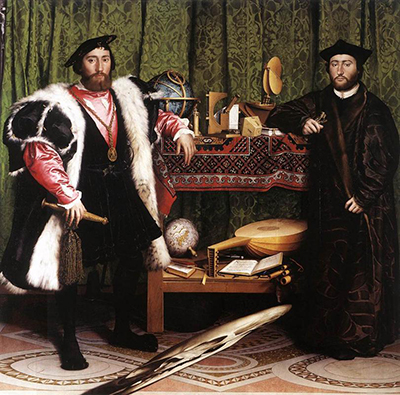
1532 [6]The Ambassadors
1533 [7]Contents
- Looking at the Face
- Chalk on Pink Paper
- What the Name Inscription Establishes
- Hair, Colour and the Question of Likeness
- Informal Dress and a Missing Finished Portrait
- The Wyatt Arms on the Reverse
- A Different Drawing and a Later Anne Boleyn
Looking at the Face
The sitter turns towards the left edge of the sheet. Her eyes look ahead rather than towards us, and the far eye remains just visible beside the bridge of the nose. The mouth is closed without looking tightly pressed. A delicate shadow beneath the lower lip gives substance to the chin, while small dark marks define the nostril and the corner of the eye. These are modest interventions, yet they make the face feel fully present.
Follow the outer contour from forehead to throat. Holbein moves between the long projection of the nose, the slight recess above the mouth and the rounded chin. The line changes direction repeatedly without becoming emphatic. Within that boundary, much of the cheek remains quiet. The portrait's force comes partly from this balance between a precise edge and a lightly worked interior.
The cap gives the head a second outline. Its broad dome rises above the forehead, then folds back towards the knot at the rear. Near the ear, overlapping edges become sharper and more complicated. Those folded planes frame the face without the symmetry of an elaborate ceremonial headdress. Below, a narrow collar and its small ties introduce a different rhythm of gathered cloth.
There is little here to support a confident account of the sitter's mood. A lowered gaze can look thoughtful, reserved or tired depending on what we bring to the image. The drawing records eyelids and mouth; it leaves the thoughts behind them inaccessible. Knowing Anne's fate makes that restraint especially valuable. Nothing in the marks requires us to read the face as a premonition.
Chalk on Pink Paper
This is a drawing in black and coloured chalks, without the pen-and-ink additions found in some other Holbein portrait studies. Its support is paper prepared with a pink ground. The Royal Collection's record identifies both the medium and the preparation, details that help explain the softness of the image. [1]
The ground supplies a warm middle tone across the face and its surroundings. Holbein can establish a feature with a darker touch and allow the surface around it to remain comparatively open. The paper therefore participates in the likeness. Much of what we read as flesh is the relationship between its underlying colour and the artist's limited additions.
Look down from the face and the degree of finish changes markedly. The broad collar is indicated by sweeps of line and patches of shading; the body has far less definition than the head. Holbein has selected the information he needs to retain most precisely. The contrast also lets us see the drawing as work in progress, in which one passage could be closely resolved while another remained an economical indication.
That uneven finish is one reason to spend time with the original scale. At just over twenty-eight centimetres high, the sheet does not overwhelm us. It asks for attention to small differences: a strengthened edge, a faint fold, a darker eye. Enlargements can make every trace seem equally assertive, although the effect of the whole depends on differences in weight and clarity. [1]
What the Name Inscription Establishes
The words at the upper left read “Anna Bollein Queen.” They are not Holbein's signature or a name written by the sitter. According to the Royal Collection, the visible inscription was added in the eighteenth century and copies a mid-sixteenth-century original. The collection connects the earlier identification with Sir John Cheke. [1]
This gives the name a history more substantial than a much later guess. It also separates two things easily confused in a reproduction: the date of the portrait and the date of the writing we can see. The person who formed these letters did not necessarily witness the sitting. Their value lies in the older identification they transmit.
The Royal Collection cites the argument made by John Rowlands and David Starkey in 1983 in support of Anne's identity. It also notes Maria Hayward's suggestion that the sitter's garment might be a nightgown given to Anne by Henry VIII. These are scholarly reasons for taking the name seriously, rather than proof supplied by the woman's features alone. The proposed identification of the garment remains a possibility. [1]
A reader can therefore accept that Anne is the most persuasive identification without treating the question as closed. The collection's title preserves her name; its accompanying account explains the debate. Holbein's authorship and the uncertainty over the sitter are separate matters.
Watch: Holbein’s portraits and working methods
Explore museum films on Holbein’s drawings, painted portraits and close-looking details.
Hans Holbein at the court of Henry VIII
A Royal Collection Trust film exploring Holbein’s work at Henry VIII’s court.
Watch on YouTubeHair, Colour and the Question of Likeness
The light-coloured hair visible beside the forehead has been an objection to the identification, since Anne was brunette. The sheet's condition changes the terms of that comparison. The Royal Collection reports abrasion and loss of pigment in the hair, which may have made it appear lighter. Its exhibition labels explain that Holbein built hair with layers of differently coloured chalk and that traces of this construction survive near the forehead. The sitter's eyes are brown. [1] [2]
The present image is consequently an imperfect guide to its original colour relationships. A pale passage in a reproduction need not represent a deliberate statement that the sitter was fair-haired. Nor does evidence of lost colour by itself settle whose portrait this is. It removes some of the force from one objection.
This is a useful distinction whenever we compare historical likenesses. We are looking at a surviving material object, with a particular state of preservation, rather than an untouched record. Before matching hair, eyes or complexion to a written description, we need to ask how reliably those features have reached us.
Informal Dress and a Missing Finished Portrait
The woman wears a linen cap and a fur collar. Those details create an impression of relative informality, particularly beside the rich, structured costume associated with royal portraiture. They have also contributed to the discussion of her identity and the purpose of the sitting. [1] [2]
The Royal Collection's exhibition labels offer more than one explanation. Holbein might have changed the clothes in the finished portrait; alternatively, the informality might have suited a private image for the king. The eventual work could even have been a miniature. These are possibilities, and no finished portrait securely corresponding to this drawing survives. [2]
It would be tempting to fill the blank with an imagined jewel, a different hood or a richly painted gown. The drawing does not authorise that reconstruction. Its light indications of clothing leave considerable room between the surviving sheet and any later work that may have followed it. Even the intimacy we feel when looking at the cap and unadorned face cannot establish the intended audience.
A comparison with Holbein's portrait of Jane Seymour shows how different the surviving evidence can be. Jane's drawing can be related to a known painted likeness and to the Whitehall mural. Anne's sheet offers no equivalent secure sequence. The contrast helps explain why it deserves to be understood in its own right, with its unfinished passages intact. [2]
The Wyatt Arms on the Reverse
Turn the sheet over and the subject changes entirely. A lightly drawn heraldic design occupies the reverse: the arms and supporters of the Wyatt family. The Royal Collection identifies this as the only Holbein drawing in its collection with work on the verso. It finds no evidence of a connection between the heraldry and the portrait on the other side. [1]
The collection raises the possibility that the paper was reused after Anne's fall. It also points to the death of Henry Wyatt in November 1536 and asks whether the design could have served his funeral or the chantry chapel he had founded at Milton in Kent. These suggestions place the sketch in a plausible setting, but neither its precise purpose nor the circumstances of the paper's reuse are established. [1]
Keeping those qualifications matters. The reverse cannot tell us that Holbein deliberately rejected the portrait, or that someone tried to erase Anne from memory. Nor does the Wyatt name establish a personal story linking the sitter to the heraldry. Two drawings can share a support without sharing a subject or a commission.
The physical sheet nevertheless enlarges our view of Holbein's practice. The front concentrates on an individual face; the back arranges the identifying signs of a family. One relies on observed features, the other on a heraldic language. Their coexistence is tangible even where the reason for it remains uncertain.
A Different Drawing and a Later Anne Boleyn
Another Holbein drawing has often been reproduced under Anne's name. It is in the British Museum, numbered 1975,0621.22, and shows a woman in a structured headdress, necklace and square-necked bodice. It is a separate portrait from the Royal Collection's capped sitter. The British Museum now describes its subject as a woman formerly thought to be Anne Boleyn. [9]
The museum traces that identification no earlier than Wenceslaus Hollar's etching of 1649. Hollar's print, made more than a century after Anne's death, helped spread the likeness through subsequent paintings and engravings. A repeated image could thus become familiar as Anne without providing independent confirmation of her appearance. The British Museum's account distinguishes this rejected identification from the stronger, though disputed, case for the Royal Collection sheet. [9]
These two histories explain why an image labelled simply “Anne Boleyn by Holbein” can be misleading. We need to know which woman, which drawing and which inscription are involved. The capped sitter's claim rests on an earlier naming tradition and the evidence examined by her present custodians.
Artworks directory
Explore paintings, drawings, prints and designs, including works without a separate article. Related studies and versions have their own entries; workshop works and copies are labelled. Print designs and series are grouped rather than repeated for every impression.
Frequently Asked Questions
The Royal Collection dates the sheet to 1532–36. This is a date range, not a recorded day of sitting. The later name inscription should not be mistaken for contemporary documentation of when the drawing was made. [1]
No securely corresponding finished portrait survives. The Royal Collection's exhibition labels suggest that the drawing might have led to a panel portrait or a miniature, and that the clothes could have been changed. The finished work's appearance and format remain uncertain. [2]
No. The British Museum associates Hollar's 1649 etching with its own separate drawing, 1975,0621.22. That museum no longer accepts the identification of its sitter as Anne Boleyn. [9]
Discussion
Look again at the images and ideas explored in Anne Boleyn: the Portrait Drawing. These editorial prompts invite your observations.
Reader Insights
Look at how little chalk Holbein needs to make the eye and mouth legible. Which detail first makes the sitter feel present to you?
The inscription preserves an older identification but belongs to another century. How much does knowing that change your encounter with the face?
The portrait and the Wyatt heraldry have no established connection. Consider how seeing the reverse changes your sense of the drawing as a physical object.
Join the Conversation
What holds your attention most: the closely observed face, the folded cap or the faintly indicated clothing? Share the detail you would choose to show someone looking at this drawing for the first time.
References
- Royal Collection Trust , Hans Holbein the Younger, Anne Boleyn (c.1500–1536) , 1532–36, RCIN 912189, collection record, including description and provenance. View source .
- Royal Collection Trust , Holbein at the Tudor Court , large-print exhibition labels, especially PDF pages 48–50, Anne Boleyn and Jane Seymour. View source .
- Kunstmuseum Basel, Bildnis des Bonifacius Amerbach, 1519, inventory 314 (in German) . View source .
- Kunstmuseum Basel, Der tote Christus im Grab, 1521–22, inventory 318 (in German) . View source .
- The Frick Collection, Sir Thomas More, 1527, accession 1912.1.77, collection record . View source .
- Gemäldegalerie Berlin, Georg Gisze . View source .
- Susan Foister, The Ambassadors, The German Paintings before 1800 (2024) . View source .
- Susan Foister, Christina of Denmark, Duchess of Milan (2024) . View source .
- British Museum , Hans Holbein the Younger, portrait drawing of a woman formerly thought to be Anne Boleyn, c.1532–35, museum number 1975,0621.22, collection record and curator's comments. View source .
- Würth Collection, Holbeins Schutzmantelmadonna, inventory 14910, current owner account (in German) . View source .
- Metropolitan Museum, Dance of Death series . View source .
- Kunstmuseum Basel, Bildnis der Frau des Künstlers mit den beiden ältesten Kindern, about 1528–29, inventory 325 (in German) . View source .
- Kunsthistorisches Museum Wien, Next Generation, Jane Seymour, about 1536–37, inventory 881 (in German) . View source .