by
Tom Gurney
Tom Gurney BSc (Hons) is an art history expert with over 20 years experience
Email:
tomgurney1@gmail.com
/ Phone:
+44 7429 011000
Design for Anthony Denny's Clocksalt: Introduction
A crown rests above a clock, two small figures support its dial, and an enormous hourglass fills the centre of a richly ornamented stand. Beside the main structure floats a separate circular compass. Hans Holbein the Younger's Design for Anthony Denny's Clocksalt asks us to imagine several kinds of timekeeping assembled into one extraordinary table object. Its little bodies, curling feet and carefully divided scales belong to the same invention: ornament gives the instruments their setting, while the instruments give the ornament a purpose.
The surviving work is a drawing, made about 1543 and now in the British Museum. An early inscription records that Anthony Denny gave the resulting object to Henry VIII at the beginning of 1544. Holbein died in 1543, so the design and the royal presentation belong to different moments. The sheet preserves his contribution to a commission whose manufacture required other hands. [1]
At a Glance
- Artist Hans Holbein the Younger.
- Title Design for Anthony Denny's Clocksalt ; the British Museum describes it as a design for a clock-salt.
- Date about 1543.
- Medium pen and black ink with grey wash and some red wash, on paper.
- Dimensions 41 × 21.3 cm.
- Collection British Museum, Department of Prints and Drawings, London.
- Museum number 1850,0713.14.
- Intended recipient Henry VIII, through a gift from Anthony Denny.
- Gift date New Year's Day 1544 according to the British Museum's catalogue and its transcription of the inscription; a later publication's illustration list gives 1545. [1] [2]
This work across Hans Holbein the Younger’s career
Dead Christ in the Tomb
1521–22 [4]Sir Thomas More
1527 [5]Georg Giese
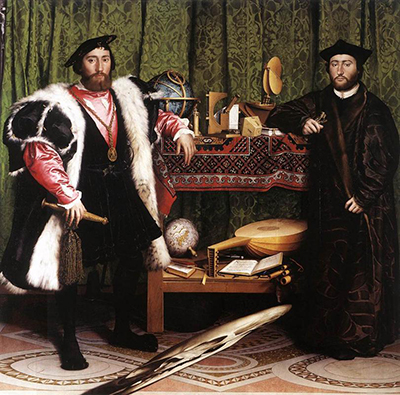
1532 [6]The Ambassadors
1533 [7]Contents
- A Small Architecture of Instruments
- Clock, Hourglass, Sundial and Compass
- Kratzer's Writing on Holbein's Sheet
- Anthony Denny and a Royal Gift
- Why 1543, 1544 and 1545 Appear
- A Design Rather Than a Surviving Machine
A Small Architecture of Instruments
The design rises in distinct stages. Broad, curling feet steady the base. Above them, a large empty roundel sits between two crouching, partly human figures. Their bodies lean into the structure as though physically helping to carry its weight. Foliage and scrolls pack the surrounding surfaces, but the circular opening remains clear. That contrast between a busy border and an uncluttered centre reappears throughout the drawing.
The hourglass occupies the tallest compartment. Two straight uprights enclose its swelling chambers, their narrow meeting point placed near the middle of the whole composition. An elongated figure runs up the central axis, bringing another human presence into the instrument's frame. Above, a spreading cornice makes a platform for two putti, the small childlike figures who stand back to back beneath the clock.
From a distance, the object resembles a narrow tower. Close up, its outline keeps changing character: a taut vertical frame gives way to a swelling ledge, a figure's shoulder becomes a support, and an arc of numbered metal projects into open space. Holbein makes the structure legible without simplifying its richness. The eye can climb it in a single movement, then return to inspect each stage.
The compass at the left interrupts this upward rhythm. Seen from above, it offers a different view of a component whose place in the finished assembly is less immediately obvious. The British Museum's catalogue proposes that it fitted into the top of the hourglass case. It also suggests that the upper section could lift off or be hinged. These are reconstructions of how the parts might have worked together, rather than surviving features of an intact object. [1]
Clock, Hourglass, Sundial and Compass
The four instruments ask different questions. The mechanical clock displays the hour on a dial. The hourglass measures an interval through the movement of sand. A sundial makes the sun's position readable through a shadow, while a compass establishes direction. Their combination brings together mechanical motion, gravity, sunlight and magnetic orientation.
Holbein gives each system a recognisable visual character. The upper clock is a compact circle enclosed by a crown and supported by bodies. The hourglass is tall and transparent in conception, allowing its two chambers to dominate the central opening. The sundial spreads outward in curved, numbered wings. The compass is treated as a separate circular study, its radiating lines sharpened with red wash. [1]
The putti are particularly ingenious. Each extends an arm towards one of the curved scales. The British Museum explains that their fingers indicate the hour on the sundial arcs. Their gestures therefore join the figure sculpture to the timekeeping apparatus. What first looks like a lively flourish has a technical role. [1]
Looking between the large hourglass and the little clock changes the pace of the drawing. The hourglass makes duration tangible: its form implies something passing from one chamber to another. The dial compresses the same broad subject into a pointer and a ring of numbers. These differences make the design more engaging than a single display would be. It offers several ways of attending to time within one elaborate object.
The familiar word clocksalt can make the arrangement sound easier to reconstruct than it is. It associates a timepiece with the tradition of an elaborate table salt. Yet the surviving sheet gives far more explicit information about instruments than about the storage or dispensing of salt. Its title should not encourage us to identify an uncertain compartment as a salt cellar with complete confidence. The mechanical and ornamental structure is clearer than every detail of its intended use. [1]
Watch: Holbein’s portraits and working methods
Explore museum films on Holbein’s drawings, painted portraits and close-looking details.
Hans Holbein at the court of Henry VIII
A Royal Collection Trust film exploring Holbein’s work at Henry VIII’s court.
Watch on YouTubeKratzer's Writing on Holbein's Sheet
Handwritten notes turn the drawing into a record of exchange. The British Museum distinguishes annotations in a contemporary hand identified as that of Nicholas Kratzer, Henry VIII's astronomer and horologer, from the early inscription recording the gift. The identification of Kratzer's writing was made by Otto Pächt through comparison with manuscripts. The museum explicitly assigns the gift inscription to a different early hand. [1]
That distinction matters. A written record of a royal presentation is evidence about the object's history; a technical annotation beside a component belongs to the discussion of its construction or functions. They need not have been written by the same person or at the same stage. The sheet accumulated information as well as carrying a design.
Kratzer was well placed to advise on such an invention. In Holbein's portrait of him , dated 1528, he is shown working on a many-sided sundial. The Louvre identifies the object as a ten-faced polyhedral dial and describes the instruments and tools around him. The portrait establishes the practical world in which his later annotations make sense. [9]
The two works also offer different views of expertise. The portrait shows an individual handling instruments. The clocksalt drawing shows the meeting of skills through a proposed object and the writing around it. Kratzer's contribution is visible as handwriting rather than a face. His participation supports the understanding of the design as a collaboration, although the division of responsibility for every technical detail cannot be recovered. [1] [9]
Anthony Denny and a Royal Gift
Anthony Denny supplied the link between this intricate design and the king. The British Museum describes him as a gentleman of the bedchamber and states that he was knighted in September of the year in which Henry received the gift. The conventional name Sir Anthony Denny is therefore later than the New Year's presentation recorded on the sheet. [1]
A present to the king offered opportunities for ingenuity as well as material display. Here the crown at the summit announces the royal destination visually, while the succession of devices provides repeated occasions for inspection. A viewer might notice the dial first, then discover the hourglass, the pointing children and the compass.
Susan Foister places the design within Holbein's long association with Kratzer and the broader world of court craftsmanship. Her Gresham College lecture identifies the finished clocksalt as Denny's New Year's gift in 1544. She also stresses that the maker's name is unknown. Transforming Holbein's proposal into metal required skills beyond drawing, including the ability to combine intricate ornament with functioning instruments. [10]
The distinction between those contributions enlarges our view of Holbein's court work. The drawing presents an invention in a form that could be discussed and made by others. Its authority lies in the coordination of the whole: proportions, figures, supports and displays. The object's royal destination depended on a chain of expertise and patronage, of which this sheet is the surviving visual witness.
Why 1543, 1544 and 1545 Appear
Three dates have become attached to the design's story. About 1543 is the British Museum's date for the drawing. The early gift inscription includes the words “in initio novi anni 1544”, placing Denny's presentation at the beginning of 1544. The museum's catalogue accordingly identifies New Year's Day 1544 as the occasion. Foister gives the same year. [1] [10]
The illustration list in Timothy Schroder's A Marvel to Behold: Gold and Silver at the Court of Henry VIII instead describes the object as Denny's New Year's gift to the king in 1545, while dating Holbein's design to 1543. That is a real disagreement over the presentation year. The accessible list does not explain the basis for the later date. [2]
The inscription transcribed by the owning museum provides a particularly direct reason to retain 1544, while acknowledging that 1545 appears in the literature. Neither presentation date should be used to move the act of drawing beyond Holbein's lifetime. The secure distinction is between a design made around 1543 and a finished object presented subsequently. A later gift could embody an artist's earlier invention.
Nor does the inscription tell us exactly when each stage of manufacture occurred. The clock might have been developed while Holbein was alive, with work continuing afterwards; the surviving evidence does not allow that sequence to be described in detail. A date for the presentation is not automatically a completion date for every component.
A Design Rather Than a Surviving Machine
The paper offers a persuasive vision of a solid, costly object. Grey wash creates shadows under ledges and around limbs, while dark contours make thin components seem firm enough to support what rests above them. Yet its frontal clarity leaves many practical questions unanswered. We do not see a complete set of views, the internal clock movement or all the connections between parts.
This is part of the drawing's interest. Holbein establishes how the object should appear and how its major elements relate. The maker still had to solve problems of depth, access, stability and assembly. The neat rectangle around the hourglass cannot by itself explain how the glass was turned, and an elegant outline cannot specify the whole movement behind the dial.
Even the companion compass view suggests a conversation across the sheet. It supplies information that the main elevation cannot show, while remaining visually detached from the tower. The eye has to assemble the proposal mentally. The annotations occupy a similar position between image and explanation.
The drawing survives as a work by Holbein; the executed gift is lost, as Christian Kiening notes in his study of sixteenth-century time. We cannot set it beside the sheet to test every correspondence. [11] Calling the metalwork a Holbein design acknowledges his invention without making him its documented manufacturer. The unknown maker belongs to the history too. [1] [10]
Artworks directory
Explore paintings, drawings, prints and designs, including works without a separate article. Related studies and versions have their own entries; workshop works and copies are labelled. Print designs and series are grouped rather than repeated for every impression.
Frequently Asked Questions
The term joins a clock with the tradition of an elaborate table salt. Holbein's drawing combines a mechanical clock, hourglass, sundial and compass. The precise arrangement of every compartment should remain qualified because the finished gift is not available for inspection. [1]
The British Museum dates it to about 1543. This is the date of the design on paper, distinct from the subsequent gift to Henry VIII. [1]
It belongs to the British Museum's Department of Prints and Drawings, under museum number 1850,0713.14. [1]
Discussion
Look again at the images and ideas explored in Design for Anthony Denny's Clocksalt. These editorial prompts invite your observations.
Reader Insights
Look at the putti's pointing hands. How does knowing their relationship to the sundial change the way you see their poses?
Compare the hourglass with the clock dial. Which makes you more conscious of duration, and which seems to make time easier to read?
The main view and the separate compass show different aspects of the proposal. What would you still need to know before making it in three dimensions?
Join the Conversation
Which element draws you into Holbein's design first: the crowned dial, the hourglass or the figures supporting them? Share the detail that changes your understanding when you look again.
References
- British Museum , Design for a clock-salt , museum number 1850,0713.14, collection record, inscriptions and curator's commentary edited from John Rowlands, German Drawings in the British Museum , 1993, no. 328. View source .
- Timothy Schroder , A Marvel to Behold: Gold and Silver at the Court of Henry VIII , Woodbridge: Boydell Press, 2020, publisher preview, illustration list, fig. 10.17, p. xiv. View source .
- Kunstmuseum Basel, Bildnis des Bonifacius Amerbach, 1519, inventory 314 (in German) . View source .
- Kunstmuseum Basel, Der tote Christus im Grab, 1521–22, inventory 318 (in German) . View source .
- The Frick Collection, Sir Thomas More, 1527, accession 1912.1.77, collection record . View source .
- Gemäldegalerie Berlin, Georg Gisze . View source .
- Susan Foister, The Ambassadors, The German Paintings before 1800 (2024) . View source .
- Susan Foister, Christina of Denmark, Duchess of Milan (2024) . View source .
- Musée du Louvre , Portrait de Nicolas Kratzer (vers 1486–après 1550), astronome du roi d'Angleterre Henri VIII , 1528, INV 1343, collection record (in French). View source .
- Susan Foister / Gresham College , Hans Holbein the Younger: “A man very excellent in taking of physionamies” , lecture transcript, 6 June 2016, section on Holbein and Nicholas Kratzer. View source .
- Christian Kiening , Ästhetik und Pragmatik der Zeit im 16. Jahrhundert , Tübingen University Press, 2023, pp. 9–10, discussion and illustration of the clocksalt (in German). View source .
- Würth Collection, Holbeins Schutzmantelmadonna, inventory 14910, current owner account (in German) . View source .
- Metropolitan Museum, Dance of Death series . View source .
- Kunstmuseum Basel, Bildnis der Frau des Künstlers mit den beiden ältesten Kindern, about 1528–29, inventory 325 (in German) . View source .
- Kunsthistorisches Museum Wien, Next Generation, Jane Seymour, about 1536–37, inventory 881 (in German) . View source .