 by
Tom Gurney
Tom Gurney BSc (Hons) is an art history expert with over 20 years experience
Email:
tomgurney1@gmail.com
/ Phone:
+44 7429 011000
Head of a Woman by Hans Holbein the Younger: Introduction
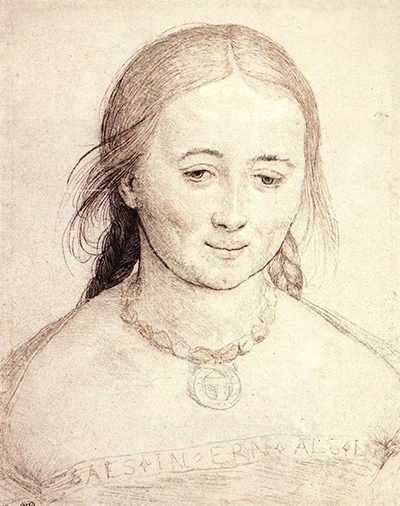
A young woman looks down, her mouth beginning to smile. Loose strands escape beside her face, while the plait behind her shoulder is drawn much more darkly. A chain and round pendant occupy the open space below her chin. Holbein gives us enough detail to imagine a particular person, yet her name remains uncertain. The small drawing known as Head of a Woman holds our attention through that meeting of precise observation and an expression we cannot quite pin down.
At a Glance
- Artist Hans Holbein the Younger.
- Louvre title Portrait de jeune femme en buste, souriant (Portrait of a young woman in bust, smiling).
- Date About 1520–1522?, retaining the Louvre’s uncertainty.
- Medium Silverpoint, pen and black ink, brown and grey washes, red chalk and white chalk on paper prepared pink on both sides.
- Size 19.2 × 15.5 cm.
- Collection Musée du Louvre, Department of Prints and Drawings, Paris.
- Inventory INV 20737, recto. [1]
This work across Hans Holbein the Younger’s career
Head of a Woman by Hans Holbein the Younger (current article)
About 1520–1522?, retaining the Louvre’s uncertaintyDead Christ in the Tomb
1521–22 [3]Sir Thomas More
1527 [4]Georg Giese
1532 [5]The Ambassadors
1533 [6]Contents
- A smile carried by small differences
- Hair, jewellery and the edge of the garment
- Drawing on a prepared surface
- An early sheet and a family tradition
- A possible connection with the Solothurn Madonna
- Why the sitter remains unnamed
A smile carried by small differences
The mouth is tiny within the composition. Its closed line bends gently upwards, but the lips alone do not account for the expression. Shadows beneath the lower lip and beside the nose give the face softness; the broad, lightly worked forehead keeps it open. The result changes as the eye moves between mouth and eyes. Look only at the mouth and the woman appears quietly amused. Look at the lowered eyes and she seems more absorbed in something beyond our view.
Her gaze gives the portrait an unusual intimacy. She does not meet our eyes or turn dramatically away. The two eyes are unequal in shape and emphasis, and the shadow beneath one is stronger. Such differences keep the face from becoming a symmetrical pattern. They also discourage a single emotional label. A smile is visible; happiness, shyness or affection would be interpretations of a moment whose circumstances we do not know.
Try following the contour from the temple to the chin. It passes through a rounded cheek into the small curve beneath the mouth, then returns towards the darker hair. That enclosing shape makes the head feel solid even where the marks within it are faint.
Hair, jewellery and the edge of the garment
The hair begins with an orderly centre parting. Closely laid strokes describe its fall over the crown, then loosen into individual strands beside the ears. On the left of the image, curved lines spring away from the head and return towards the dark plait. The eye can follow their movement more easily than it can count the separate locks.
This contrast between tidy crown and escaping hair gives the portrait much of its animation. The face is still; the lines around it are restless. Compact shading sits beside open loops, a dense dark passage beside a lightly indicated edge.
Below, the chain forms an irregular sequence of links around the neck. Its pendant contains overlapping circular shapes whose interior is less immediately legible than the face. The broad neckline curves across the bottom of the drawing and carries lettering. These details place the head within a clothed body without requiring a fully described torso. They also make a useful route back to the expression: from the pendant up the neck, through the chin, to the slight rise at the corners of the mouth.
Watch: Holbein’s portraits and working methods
Explore museum films on Holbein’s drawings, painted portraits and close-looking details.
Hans Holbein at the court of Henry VIII
A Royal Collection Trust film exploring Holbein’s work at Henry VIII’s court.
Watch on YouTubeDrawing on a prepared surface
Fine lines, coloured marks and liquid media come together on a surface prepared before the face was drawn. Victoria Button’s technical study examines this particular sheet as an early example of Holbein’s use of pink prepared paper. She describes an opaque, pale pink coating and observes orange-red vermilion particles in the preparation under magnification. [8]
A preparation is an added surface layer, distinct from colour inherent in the paper. Button explains its double value: a sufficiently abrasive ground allows the metal stylus of silverpoint to leave a deposit, while a coloured surface supplies a middle tone from which an artist can work towards shadow and light. [8]
In this portrait, the different densities of the marks are especially rewarding. The plait is almost a continuous dark shape, while the forehead remains spacious and pale. Across the cheeks, smaller marks allow the surface to remain visible. A reproduction cannot settle the sequence of every stroke, but it makes clear how much of the face depends on restraint. The light areas do not need to be filled with detail to appear rounded.
An early sheet and a family tradition
The drawing belongs to an earlier moment than the English court portraits for which Holbein is widely known. Button discusses its small format and materials alongside the practices of his father, Hans Holbein the Elder. Both qualities support its early dating. She also uses the sheet to challenge the idea that the younger Holbein first adopted pink prepared paper only during his later career. [8]
Within Holbein’s drawings , prepared paper is a material with a history. Here it participates in the face itself. The exposed surface between the marks is part of what we see as skin and light; the pale ground also binds the different treatments of hair, clothing and features together.
A possible connection with the Solothurn Madonna
The woman’s features have been compared with those of the Virgin in Holbein’s Solothurn Madonna . Button notes the resemblance and the suggestion that the same model was involved. The painting is dated 1522 by its owner, Kunstmuseum Solothurn. [8] [9]
Seen together, the works make a useful comparison. In the painting, Mary’s head is a small, luminous point within a large arrangement of drapery, figures and architecture. The drawing brings a young woman’s face close and surrounds it with very little. A lowered gaze and gently rounded features can belong to both images, while their effect changes with the setting.
The Louvre records Christian Müller’s suggestion that added washes, ink and white highlights may have adapted the portrait into a model. That remains an interpretation of the sheet’s development. [1] It leaves room for an observed face to have acquired a further purpose, although the precise sequence of work is uncertain.
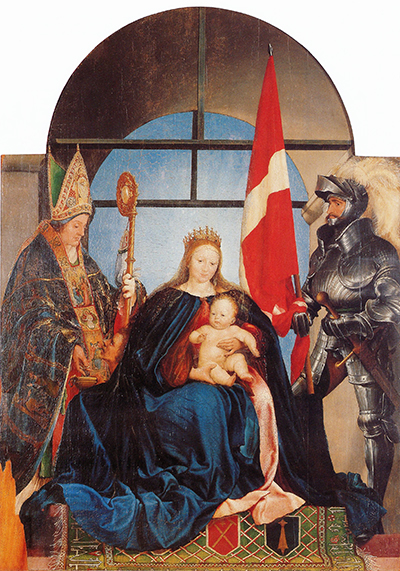
Hans Holbein the Younger, Solothurn Madonna, 1522. Oil on limewood, Kunstmuseum Solothurn, A I 134. St Martin stands on the viewer’s left and St Ursus on the right.
Why the sitter remains unnamed
The identification with Holbein’s wife, Elsbeth Binzenstock, is disputed; the Louvre notes that it has been widely challenged since 1954. [1] The drawing’s warmth cannot establish a family relationship. Nor does a proposed connection with a Virgin and Child painting tell us the model’s name.
The uncertainty changes how we look. Freed from the expectation of recognising a famous artist’s wife, we can attend to the particular shape of the eyes, the uneven fall of the hair and the almost imperceptible smile. These are substantial things to know about an image, even when the person remains beyond identification.
Artworks directory
Explore paintings, drawings, prints and designs, including works without a separate article. Related studies and versions have their own entries; workshop works and copies are labelled. Print designs and series are grouped rather than repeated for every impression.
Frequently Asked Questions
That identification is disputed. The Louvre does not treat Elsbeth Binzenstock as a securely established sitter. [1]
A connection has been proposed, partly through the resemblance of the faces. It is safest to describe it as a possible relationship, rather than a fully documented sequence from drawing to painting. [8]
It has an added coating. This changes the surface on which the artist draws and supplies a coloured middle tone; an abrasive preparation also enables silverpoint to leave a mark. [8]
Discussion
Look again at the images and ideas explored in Head of a Woman by Hans Holbein the Younger. These editorial prompts invite your observations.
Reader Insights
Cover the mouth, then the eyes. How much does each contribute to the expression you read?
Look from the dense plait to the loose strands. How does the change in line affect the stillness of the face?
Compare the head with Mary in the Solothurn Madonna . Which similarities seem persuasive, and which differences come from the surrounding composition?
Join the Conversation
What first holds your attention here: the lowered gaze, the slight smile or the freely drawn hair? Describe the detail that shapes your response to this unnamed woman.
References
- Musée du Louvre , Portrait de jeune femme en buste, souriant , INV 20737, recto; collection record, updated 25 April 2025 (in French). View source .
- Kunstmuseum Basel, Bildnis des Bonifacius Amerbach, 1519, inventory 314 (in German) . View source .
- Kunstmuseum Basel, Der tote Christus im Grab, 1521–22, inventory 318 (in German) . View source .
- The Frick Collection, Sir Thomas More, 1527, accession 1912.1.77, collection record . View source .
- Gemäldegalerie Berlin, Georg Gisze . View source .
- Susan Foister, The Ambassadors, The German Paintings before 1800 (2024) . View source .
- Susan Foister, Christina of Denmark, Duchess of Milan (2024) . View source .
- Victoria Button , The Portrait Drawings of Hans Holbein the Younger: Function and Use Explored through Materials and Techniques , Royal College of Art PhD thesis, 2013, especially pp. 92–101 and 116–117. View source .
- Kunstmuseum Solothurn , Solothurner Madonna , 1522, inventory A I 134; collection record (in German). View source .
- Würth Collection, Holbeins Schutzmantelmadonna, inventory 14910, current owner account (in German) . View source .
- Metropolitan Museum, Dance of Death series . View source .
- Kunstmuseum Basel, Bildnis der Frau des Künstlers mit den beiden ältesten Kindern, about 1528–29, inventory 325 (in German) . View source .
- Kunsthistorisches Museum Wien, Next Generation, Jane Seymour, about 1536–37, inventory 881 (in German) . View source .