by
Tom Gurney
Tom Gurney BSc (Hons) is an art history expert with over 20 years experience
Email:
tomgurney1@gmail.com
/ Phone:
+44 7429 011000
Frances, Countess of Surrey: Introduction
Frances looks almost straight out of the sheet, her pale face held within the angular folds of a Tudor hood. Her eyes and mouth are carefully placed, while much of the dress remains a framework of lines. Near the bottom, a handwritten note supplies something the chalk barely shows: the gown was pink velvet. Holbein’s drawing lets us see a portrait taking shape through several kinds of attention, from the soft modelling of a cheek to a few words recording a textile. The Royal Collection dates it to about 1535–36. [1]
At a Glance
- Artist Hans Holbein the Younger.
- Title Frances, Countess of Surrey (1517–1577) .
- Date c.1535–36.
- Medium Black and coloured chalks with white heightening and touches of black ink on pink prepared paper.
- Dimensions 31 × 21 cm, sheet of paper.
- Collection Royal Collection, RCIN 912214. [1]
- Related work Probably conceived as a pair with Holbein’s drawing of her husband, Henry Howard, Earl of Surrey, RCIN 912215. [2]
This work across Hans Holbein the Younger’s career
Dead Christ in the Tomb
1521–22 [4]Sir Thomas More
1527 [5]Georg Giese
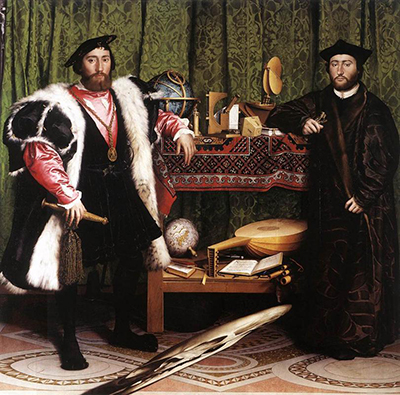
1532 [6]The Ambassadors
1533 [7]Contents
- A Face within an Angular Hood
- Who Was Frances?
- Reading the Dress
- Pink Paper and Small Dark Marks
- The Companion Study
- A Household beyond the Sitting
A Face within an Angular Hood
The hood gives this small drawing a broad, irregular silhouette. Its dark fabric spreads to either side of the head, with one fold lifted high above the forehead and another descending towards the shoulder. Pale and yellow bands frame the face inside this darker shape. The contrast anchors the head above the lightly described shoulders and sleeves.
Look from the edge of the hood towards the eyes and the scale of the marks changes. Broad dark passages give way to small lines and delicate shadows. The bridge of the nose is scarcely outlined; its shape emerges from the surrounding tone. The closed mouth is a narrow, level accent above the softly rounded chin. These small differences keep the frontal pose from becoming a rigid diagram. We can recognise the arrangement at a glance, then spend much longer following its nuances.
Who Was Frances?
Frances de Vere was the daughter of John de Vere, 15th Earl of Oxford, and the wife of Henry Howard, Earl of Surrey. The drawing therefore brings together two prominent noble families. Its inscription, “The Lady Surry”, is later: the Royal Collection identifies the lettering as an eighteenth-century copy of a mid-sixteenth-century identification. It should be distinguished from the artist’s working notes on the dress. [1] [9]
Frances and Henry were still in their late teens at the date now assigned to their drawings. Henry was the son and heir of Thomas Howard, Duke of Norfolk, and had been educated alongside Henry Fitzroy, Henry VIII’s son. [2] That family setting helps explain the portrait’s social reach. Frances appears alone on the sheet, yet her likeness belonged within a closely connected circle of marriages, households and court relationships.
Reading the Dress
The costume contains information in several forms. Lines establish the wide neckline and the fall of the sleeves; pale yellow strokes suggest the necklace and ornament at her chest. The garment is much less densely worked than the hood. Looking down the torso, the eye encounters open areas of paper between the contours.
Holbein filled some of those spaces with words. The Royal Collection transcribes rosa felbet as pink velvet, another note as velvet, and schwarz as black; a further word may read rot , red. That last reading remains uncertain. [1]
These notes change how we look at the apparently spare dress. A colour could be remembered in writing without being spread across the whole garment. The word velvet also supplies a material quality that an outline alone cannot convey. The image records both the shape before Holbein’s eyes and practical information that could be used after the sitting. In their account of his portrait drawings , Royal Collection conservators Rachael Smith and Victoria Button explain that abbreviated patterns and textile annotations helped preserve details for later reconstruction. [10]
Watch: Holbein’s portraits and working methods
Explore museum films on Holbein’s drawings, painted portraits and close-looking details.
Hans Holbein at the court of Henry VIII
A Royal Collection Trust film exploring Holbein’s work at Henry VIII’s court.
Watch on YouTubePink Paper and Small Dark Marks
The pink surface is part of the drawing’s construction. Smith and Button explain that Holbein often coated paper in advance to provide a middle tone for flesh. Shadows could deepen that starting colour, while white highlights brought selected areas forward. This reduced the amount of material needed to establish a face during a sitting. [10]
Here, the face seems to grow out of the surrounding sheet. Its edges are quiet beside the black hood, and the shaded areas remain thin enough to retain the paper’s presence. White touches sharpen the eyes. Tiny strokes of black ink mark the eyelashes, according to the collection record. [1]
The difference between these marks matters more than any single spectacular flourish. The dark hood gives weight; the chalk models; a small firm line makes an eye suddenly precise. Although the materials recur across Holbein’s drawings, the conservators emphasise that his technique varied from sitter to sitter. [10] This sheet rewards looking at where he concentrated each kind of mark.
The Companion Study
The likely companion is a drawing of Henry Howard in the Royal Collection, also dated about 1535–36. It shows him facing forward beneath a feathered hat. An earlier sheet, with his head turned, appears to have been abandoned in favour of that frontal version. The collection describes the portraits of husband and wife as a probable pair. [2]
The surviving studies establish a persuasive relationship without supplying every detail of the intended paintings or their arrangement.
The painted portrait of Henry Howard in São Paulo is a separate object. MASP dates it to about 1542 and records oil and tempera on wood. [9] It should not be treated as the direct companion to Frances’s earlier drawing simply because it represents her husband. Keeping the two moments apart lets us see the young couple’s studies on their own terms.

Hans Holbein the Younger, Henry Howard, Earl of Surrey, about 1542. Oil and tempera on wood, 55.5 × 44.5 × 0.5 cm. MASP, São Paulo, MASP.00182. MASP, Purchase1958; The Yorck Project/Wikimedia Commons.
Image source
.
Public domain
.
A Household beyond the Sitting
The Royal Collection’s Tudor exhibition placed Frances alongside Henry and his sister Mary Fitzroy, Duchess of Richmond and Somerset. Its account connects these likenesses with a wider group of Howard family portraits made around 1535; Mary’s study was probably intended for a portrait to match those of her brother and sister-in-law. [11]
The family’s later history was severe. Henry was executed in January 1547. Frances and their five children continued to live at Kenninghall with Mary Fitzroy. [2] [11] Knowing this changes our historical understanding of the household, but it cannot tell us what Frances was thinking as she sat. The drawing gives us something more immediate and more limited: the particular face, the elaborate hood, and the artist’s economical record of a pink velvet gown.
Artworks directory
Explore paintings, drawings, prints and designs, including works without a separate article. Related studies and versions have their own entries; workshop works and copies are labelled. Print designs and series are grouped rather than repeated for every impression.
Frequently Asked Questions
It is a portrait drawing. Holbein’s studies recorded sitters in person and could provide the basis for paintings or miniatures developed over longer periods. [10]
The notes record colours and fabrics. The exhibition label translates rosa felbet as pink velvet, identifying the material of Frances’s gown. [11]
She married Henry Howard, Earl of Surrey, the poet and soldier. Holbein’s frontal drawing of him, RCIN 912215, was probably conceived as a pair with hers. [2]
It belongs to the Royal Collection and is catalogued as RCIN 912214. [1]
Discussion
Look again at the images and ideas explored in Frances, Countess of Surrey. These editorial prompts invite your observations.
Reader Insights
Compare the dense black hood with the lightly outlined dress. Where does your eye slow down?
Look first at the garment’s lines, then at the colour notes. How much does knowing it was pink velvet change the image?
Frances faces almost directly towards us. Does that make the encounter feel formal, intimate, or a mixture of the two?
Join the Conversation
Which detail makes Frances most present to you: her eyes, the shape of the hood, or the small record of what she wore? Share what you noticed when looking closely.
References
- Royal Collection Trust , Frances, Countess of Surrey (1517–1577) , c.1535–36, RCIN 912214, collection record. View source .
- Royal Collection Trust , Henry Howard, Earl of Surrey (1516/17–1547) , c.1535–36, RCIN 912215, collection record. View source .
- Kunstmuseum Basel, Bildnis des Bonifacius Amerbach, 1519, inventory 314 (in German) . View source .
- Kunstmuseum Basel, Der tote Christus im Grab, 1521–22, inventory 318 (in German) . View source .
- The Frick Collection, Sir Thomas More, 1527, accession 1912.1.77, collection record . View source .
- Gemäldegalerie Berlin, Georg Gisze . View source .
- Susan Foister, The Ambassadors, The German Paintings before 1800 (2024) . View source .
- Susan Foister, Christina of Denmark, Duchess of Milan (2024) . View source .
- Museu de Arte de São Paulo Assis Chateaubriand , O poeta Henry Howard, conde de Surrey , c.1542, MASP.00182, collection record and catalogue text (in Portuguese). View source .
- Rachael Smith and Victoria Button, Royal Collection Trust , Holbein’s portrait drawings , conservation account. View source .
- Royal Collection Trust , Holbein at the Tudor Court , Nash Gallery large-text labels, sections “Dynasties”, “Frances, Countess of Surrey” and “Mary Fitzroy, Duchess of Richmond and Somerset”, PDF pp.57–64. View source .
- Würth Collection, Holbeins Schutzmantelmadonna, inventory 14910, current owner account (in German) . View source .
- Metropolitan Museum, Dance of Death series . View source .
- Kunstmuseum Basel, Bildnis der Frau des Künstlers mit den beiden ältesten Kindern, about 1528–29, inventory 325 (in German) . View source .
- Kunsthistorisches Museum Wien, Next Generation, Jane Seymour, about 1536–37, inventory 881 (in German) . View source .