by
Tom Gurney
Tom Gurney BSc (Hons) is an art history expert with over 20 years experience
Email:
tomgurney1@gmail.com
/ Phone:
+44 7429 011000
William Reskimer: Introduction
A long reddish beard draws the eye down Hans Holbein the Younger’s portrait of William Reskimer. Above it, a small cap sits at an angle; below it, the coat spreads into broad, lightly drawn shapes. The face receives a different degree of attention. Its eye, projecting nose and sharply observed ear make the head feel solid against the warm paper.
This drawing also offers something unusually practical: a surviving painted portrait against which to compare it. Both belong to the Royal Collection, which currently dates them to about 1536–39. Following Reskimer from paper to panel reveals how closely Holbein preserved a likeness while building a fuller composition around it. The face has a documented connection across the two objects; the hands introduce a separate problem. [1] [2]
At a Glance
- Artist Hans Holbein the Younger.
- Drawing William Reskimer (d.1552) , about 1536–39; black and coloured chalks with watercolour on pink prepared paper; 29 × 21 cm; Royal Collection, RCIN 912237. [1]
- Related painting William Reskimer (?-1552) , about 1536–39; oil on panel; 46 × 33.5 cm; Royal Collection, RCIN 404422. [2]
- Sitter A Cornish court servant who held several positions under Henry VIII; identified as William rather than his brother John through the painting’s provenance. [1] [2]
- Relationship The drawing is preparatory for the painting. It records the head and upper body without the painted hands. [1] [2]
This work across Hans Holbein the Younger’s career
Dead Christ in the Tomb
1521–22 [4]Sir Thomas More
1527 [5]Georg Giese
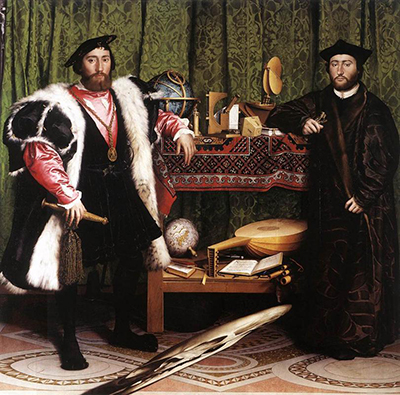
1532 [6]The Ambassadors
1533 [7]William Reskimer (current article)
c.1536–39Contents
- Who was William Reskimer?
- Looking closely at the head
- Chalk, watercolour and a pink foundation
- How the likeness reached the panel
- The painting’s hands and setting
- Surfaces that have changed
- Two objects with separate histories
Who was William Reskimer?
Reskimer came from Cornwall and served at Henry VIII’s court. His appointments included Page of the Chamber; later he became keeper of the ports of the Duchy of Cornwall in 1543 and Gentleman Usher in 1546. Those later offices help place the man in a continuing court career, but they do not date this portrait. [1]
The distinction between William and his brother John matters because both held court positions. The Royal Collection bases its identification on the history of the painting: Sir Robert Killigrew, a direct descendant of William, presented it to Charles I. The ownership record therefore supplies evidence that appearance alone cannot provide. [2]
A later inscription across the drawing’s upper edge describes Reskimer as a Cornish gentleman. It belongs to the eighteenth century, long after the sitter’s death in 1552. Its lettering is part of the sheet’s history, rather than Holbein’s own written introduction to his subject. Read together, the inscription and the painting’s provenance explain both the regional description and the more precise personal identification. [1]
Looking closely at the head
The head turns towards the left, bringing the nose and the downward sweep of the beard into a strong profile. Holbein nevertheless gives us enough of the near cheek and eye to avoid reducing the face to an outline. The small changes of tone around the eye socket, temple and cheek make the flesh turn away from the light. The ear sits within a particularly clear boundary between closely cropped hair and exposed skin.
The cap’s sloping brim crosses the upper part of this otherwise upright arrangement. Its dark marks answer the dark lines of the collar, while the beard links head and torso through a much larger field of colour. Beneath the carefully worked face, the coat remains open and economical: a few long lines establish its collar, shoulder and folds.
That difference in finish guides attention. We can read the dress sufficiently to understand how the head sits above it, yet the face holds us through smaller, more varied marks. The distinction becomes still clearer beside the painting, where the clothing acquires a continuous dark surface and occupies much more of the composition. [2]
Chalk, watercolour and a pink foundation
The pink tone is a preparation applied to the paper. As the Royal Collection explains, this smaller, coloured support belongs to the type Holbein favoured after his return to England in 1532. It provides a warm starting point for the flesh, allowing additional marks to shape a complexion without covering the whole face. [1]
Conservator Victoria Button’s examination of this particular sheet identifies black chalk as the principal means of establishing its contours. Red chalk defines the eyes; red and black develop the face over the existing pink. In the beard, broader applications of red, brown and yellow are combined with finer strokes that separate strands. These observations help explain why the beard reads both as a mass and as individual hairs. [9]
Button also records blue-green irises with lighter areas left for highlights. She is cautious about distinguishing dry from liquid material in the eyes, although the pupils and lashes appear to use a black liquid medium. That caution is useful when looking at a reproduction: a dense dark stroke does not reveal its material simply by looking sharp. The owner’s medium description includes watercolour, while close examination is needed to discuss its placement. [1] [9]
Watch: Holbein’s portraits and working methods
Explore museum films on Holbein’s drawings, painted portraits and close-looking details.
Hans Holbein at the court of Henry VIII
A Royal Collection Trust film exploring Holbein’s work at Henry VIII’s court.
Watch on YouTubeHow the likeness reached the panel
Comparison gives the drawing a clear practical role. The Royal Collection notes the close correspondence between the drawn and painted faces, extending to fine marks near the eyes and the shading of the cheeks. It identifies a small difference inside the earlobe and suggests that Holbein transferred the design by following its outlines with a stylus. [2]
Button’s examination supplies physical evidence on the sheet itself. She found indentations along parts of the ear, the back of the head and the clothing, where pressure had compressed the drawing material into a narrower contour. She did not find such indentations on the nose outline or the eyes. The surviving marks thus support tracing in particular places without demonstrating that every feature was pressed through in the same way. [9]
This distinction keeps the comparison interesting. A transferred boundary could help maintain the size and placement of a head, but the drawing also preserved colour, shading and fine observation. The painter had more information available than an outline alone. Looking from one face to the other, we can follow an accumulation of small decisions carried into another medium. [2] [9]
The painting’s hands and setting
The panel extends the portrait downwards. Reskimer’s hands appear low in front of his body, one turning into a cupped position above the other. Against the dark clothing they form a second focus beneath the face. Leafy vines occupy the background, introducing irregular curves around the sitter’s compact silhouette. [2]
None of these hands appears in the surviving portrait drawing. Infrared examination of the painting reveals freehand underdrawing and hatched shading in them. The Royal Collection allows for a separate hand study, now lost, whose outlines might have been transferred and then strengthened freehand. It remains a possibility; the visible technical evidence does not establish an additional surviving sheet. [2]
The hands alter the experience of the figure even without an elaborate gesture or identifying object. In the drawing, the long beard leads into loosely indicated clothing. In the painting, that downward movement ends in interlocking fingers and cuffs. The panel therefore asks us to look through a more extended arrangement of head, body and gesture, while retaining the recognisable shape of the drawn face.
Surfaces that have changed
The sheet’s present appearance also reflects its condition. Button describes a rectangular stain whose upper edge crosses the forehead, and a damaged area beside the eye. Citing conservation reports from the 1970s, she explains that the latter was a flap of paper that had folded backwards and was subsequently repositioned. Such interruptions need to be distinguished from marks that describe the sitter. [9]
The painting has a complicated foundation too. Button reports technical examination indicating that its panel had been reused, with earlier red and grey layers beneath the thick pink preparation supporting the visible portrait. The evidence does not identify a lost earlier subject. It explains why a pink layer in this painting cannot be treated simply as the painted equivalent of the drawing’s pink paper. [9]
Button’s thesis uses an earlier date of about 1533 for Reskimer; the Royal Collection now dates both objects to about 1536–39. Her technical observations concern the same surviving works despite this difference in dating. [1] [2] [9]
Two objects with separate histories
The drawing and painting reached the Royal Collection through different histories. The sheet’s recorded provenance begins with Henry VIII and Edward VI, then follows changes of ownership involving the earls of Arundel and Lord Lumley. It was back in royal ownership under Charles II by 1675. [1]
The painting’s history centres on Killigrew’s gift to Charles I. Recorded at Whitehall in 1639, it was sold during the dispersal of the royal collection in 1653 and recovered at the Restoration. [2]
Artworks directory
Explore paintings, drawings, prints and designs, including works without a separate article. Related studies and versions have their own entries; workshop works and copies are labelled. Print designs and series are grouped rather than repeated for every impression.
Frequently Asked Questions
Tracing is supported by indentations along some contours, including the ear and back of the head. Button found no indentations on the nose outline or eyes, so the evidence should not be extended to every feature. [9]
The surviving sheet concentrates on the head and upper body. The painting includes hands with freehand underdrawing visible through infrared examination. A separate hand study may once have existed, but it has not survived as an identified companion to this drawing. [2]
Discussion
Look again at the images and ideas explored in William Reskimer. These editorial prompts invite your observations.
Reader Insights
Notice how the broad warm colour holds together even as fine strokes divide it into strands.
Look for the small change inside the earlobe when moving from the drawing to the painted face.
Consider how their addition changes the balance and pace of the portrait.
Join the Conversation
Which detail makes Reskimer most present to you: the closely observed eye, the sweep of his beard, or the painted hands? Share what you notice when comparing paper and panel.
References
- Royal Collection Trust , William Reskimer (d.1552) , c.1536–9, RCIN 912237; collection record, description and provenance, including catalogue text adapted from The Northern Renaissance: Dürer to Holbein (London, 2011). View source .
- Royal Collection Trust , William Reskimer (?-1552) , c.1536–9, RCIN 404422; collection record, technical discussion and provenance, including catalogue text adapted from The Northern Renaissance: Dürer to Holbein (London, 2011). View source .
- Kunstmuseum Basel, Bildnis des Bonifacius Amerbach, 1519, inventory 314 (in German) . View source .
- Kunstmuseum Basel, Der tote Christus im Grab, 1521–22, inventory 318 (in German) . View source .
- The Frick Collection, Sir Thomas More, 1527, accession 1912.1.77, collection record . View source .
- Gemäldegalerie Berlin, Georg Gisze . View source .
- Susan Foister, The Ambassadors, The German Paintings before 1800 (2024) . View source .
- Susan Foister, Christina of Denmark, Duchess of Milan (2024) . View source .
- Victoria Button , The Portrait Drawings of Hans Holbein the Younger: Function and Use Explored through Materials and Techniques , PhD thesis, Royal College of Art (2013), pp. 133–134, 181–183 and Table 16, pp. 288–289. View source .
- Würth Collection, Holbeins Schutzmantelmadonna, inventory 14910, current owner account (in German) . View source .
- Metropolitan Museum, Dance of Death series . View source .
- Kunstmuseum Basel, Bildnis der Frau des Künstlers mit den beiden ältesten Kindern, about 1528–29, inventory 325 (in German) . View source .
- Kunsthistorisches Museum Wien, Next Generation, Jane Seymour, about 1536–37, inventory 881 (in German) . View source .