by
Tom Gurney
Tom Gurney BSc (Hons) is an art history expert with over 20 years experience
Email:
tomgurney1@gmail.com
/ Phone:
+44 7429 011000
Portrait of Bonifacius Amerbach: Introduction
Bonifacius Amerbach looks past the little tablet hanging beside him. His black hat spreads above his face, reddish hair curls beneath its brim, and a pale collar catches the light at his throat. The Latin inscription occupies much of the space left by his turned head. Face and words ask for different kinds of attention: we can look at the young man immediately, while reading his account of the likeness takes time.
Hans Holbein the Younger painted this portrait in 1519, when Amerbach was preparing to continue his legal education in Avignon. Amerbach supplied the verse himself. More than twenty drafts survive, according to the Kunstmuseum Basel, which owns the painting. Even the wording on the panel was revised. The apparent ease of the portrait conceals a particularly thoughtful exchange between a painter and a sitter who cared about the language in which he would be remembered. [1]
The work is small, just under thirty centimetres high. Its nearly square shape brings a broad stretch of sky into close company with the head, dark clothing and hanging text. Holbein gives Amerbach a substantial presence. The inscription claims fidelity to life; the painted face invites us to test that claim for ourselves. [1]
At a Glance
- Artist Hans Holbein the Younger. [1]
- Title Portrait of Bonifacius Amerbach ; the museum's German title is Bildnis des Bonifacius Amerbach . [1]
- Date 1519. The precise date in the inscription refers to Amerbach's birthday. [1]
- Sitter Bonifacius Amerbach, 1495–1562, a Basel humanist and legal scholar. [1]
- Materials Mixed technique on fir wood. [1]
- Dimensions 29.9 × 28.3 cm. [1]
- Collection Kunstmuseum Basel, Amerbach-Kabinett, inventory 314. [1]
- Inscription Latin verse composed by Amerbach, with the sitter's and painter's names below. [1]
This work across Hans Holbein the Younger’s career
Dead Christ in the Tomb
1521–22 [2]Sir Thomas More
1527 [3]Georg Giese
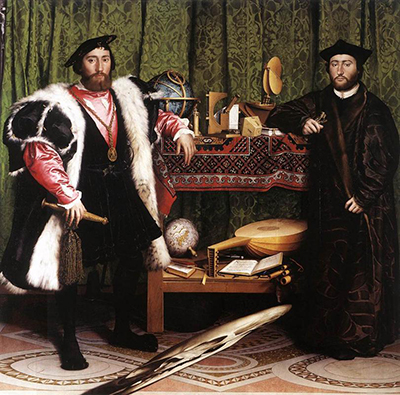
1532 [4]The Ambassadors
1533 [5]Contents
- The Face Beneath the Black Hat
- Sky, Tree and the Space Around Him
- A Young Scholar Preparing to Travel
- The Portrait Speaks in Latin
- A Sheet of Drafts and a Changed Emphasis
- The Beard and the Planned Second Image
- Writing and Friendship: Looking Towards Erasmus
- From a Family Likeness to a Public Collection
- Annotated details
The Face Beneath the Black Hat
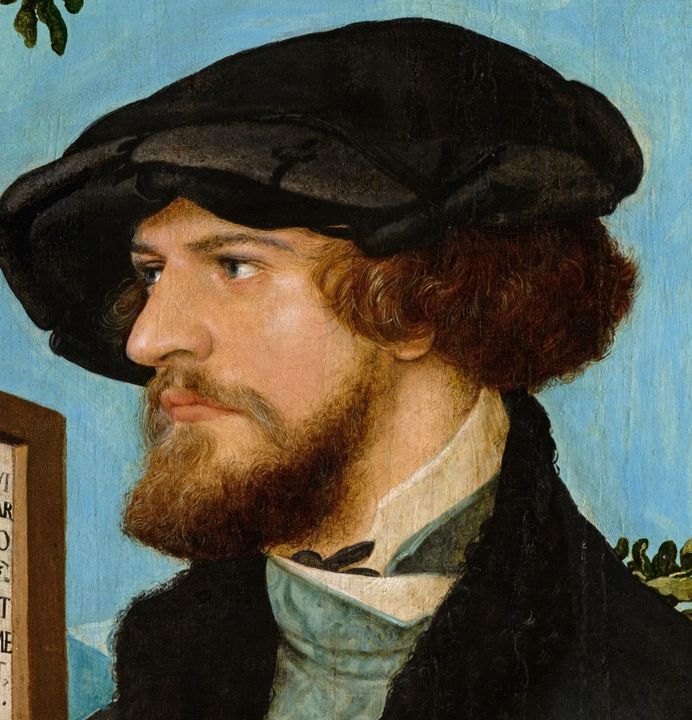
Amerbach's body fills the lower part of the panel, while his head turns towards our left. We see enough of the farther side of his face to register its volume. The nose projects against the blue background, the nearer eye looks out beneath a slightly lowered brow, and the mouth remains closed. His gaze continues beyond the picture rather than meeting ours. The effect is alert and self-contained, although the portrait gives us no certain account of what he was thinking.
The hat makes that concentration more noticeable. Its soft, irregular folds form a broad dark shape, with a low brim over the forehead and a fuller crown towards the right. Below it, the face is comparatively narrow. Holbein gives the small changes around the eye, nose and lips the force that a more demonstrative portrait might obtain from an elaborate gesture.
Look especially at the meeting of cheek and beard. The beard gathers into a pointed mass below the chin, but its edges remain softer and less uniform than the outline of the nose. The reddish hair beside the ear curls and spreads into shadow. These differences keep the head from becoming a single crisp silhouette. Flesh, hair and cloth each have their own way of holding the light.
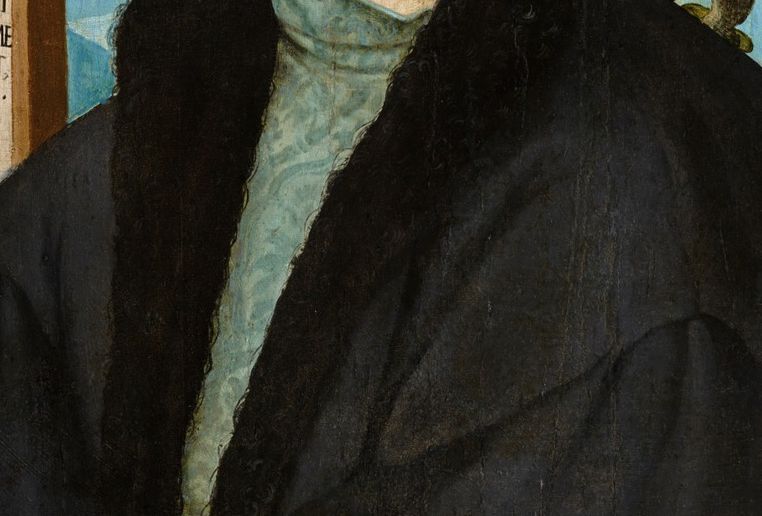
The clothing provides a second, quieter sequence of textures. The dark outer garment opens around a pale blue-green front; a white collar folds outward at the neck. Black against black is still legible through the different tones of sleeve, shoulder and edging. The lightest cloth gives the eye a resting place beneath the face. No hands appear, so the encounter is concentrated on the head and the way it rises from the shoulders.
Amerbach's later reputation as a scholar need not determine every feature we see. The crease of an eyelid or set of a mouth can establish a convincing likeness without serving as a certificate of wisdom.
Sky, Tree and the Space Around Him
A thick tree trunk rises along the left edge. A short projecting branch carries the inscription tablet, whose brown frame and pale surface stand out against the trunk. Across the picture, thinner branches and clusters of leaves reach in from the right. Between them lies the broad blue field behind Amerbach's head. A small glimpse of pale distant terrain appears beside his shoulder.
These elements have different spatial jobs. The trunk places something solid close to us; the sky opens the view; the distant landscape extends it beyond the figure. Amerbach remains close and substantial because the air around his hat and face is so uncluttered. His dark shoulders spread across the panel's base, giving this open setting a firm lower boundary.
The tablet complicates the space in an engaging way. Its frame recedes at an angle, while the letters belong to a flat surface turned towards the reader. It seems like an object that could hang beside a person, yet it also resembles a label supplied for our benefit. Holbein makes the explanation of the picture part of the picture's scenery.
The leaves and distant forms invite slow looking without yielding a secure symbolic code. A tree species or mountain range, even if identified, would not by itself prove a meaning about poetry, character or destiny. Here the setting's most immediate achievement is visible: the living face is surrounded by air and irregular growing forms, while its verbal description is held within a measured rectangle.
The balance changes when we concentrate on different areas. Follow the branches and the composition feels expansive; follow the tablet's edges and it becomes more orderly. Amerbach's profile sits between those rhythms. The painting lets a carefully described individual occupy a world that extends beyond the words naming him.
Annotated Details from Bonifacius Amerbach
The numbered points identify visible features discussed in this article. Return from each detail to the whole composition. Hans Holbein the Younger, Portrait of Bonifacius Amerbach, 1519. Mixed technique on fir wood, 29.9 × 28.3 cm. Kunstmuseum Basel, Amerbach-Kabinett, inventory 314. Image source . Public domain .
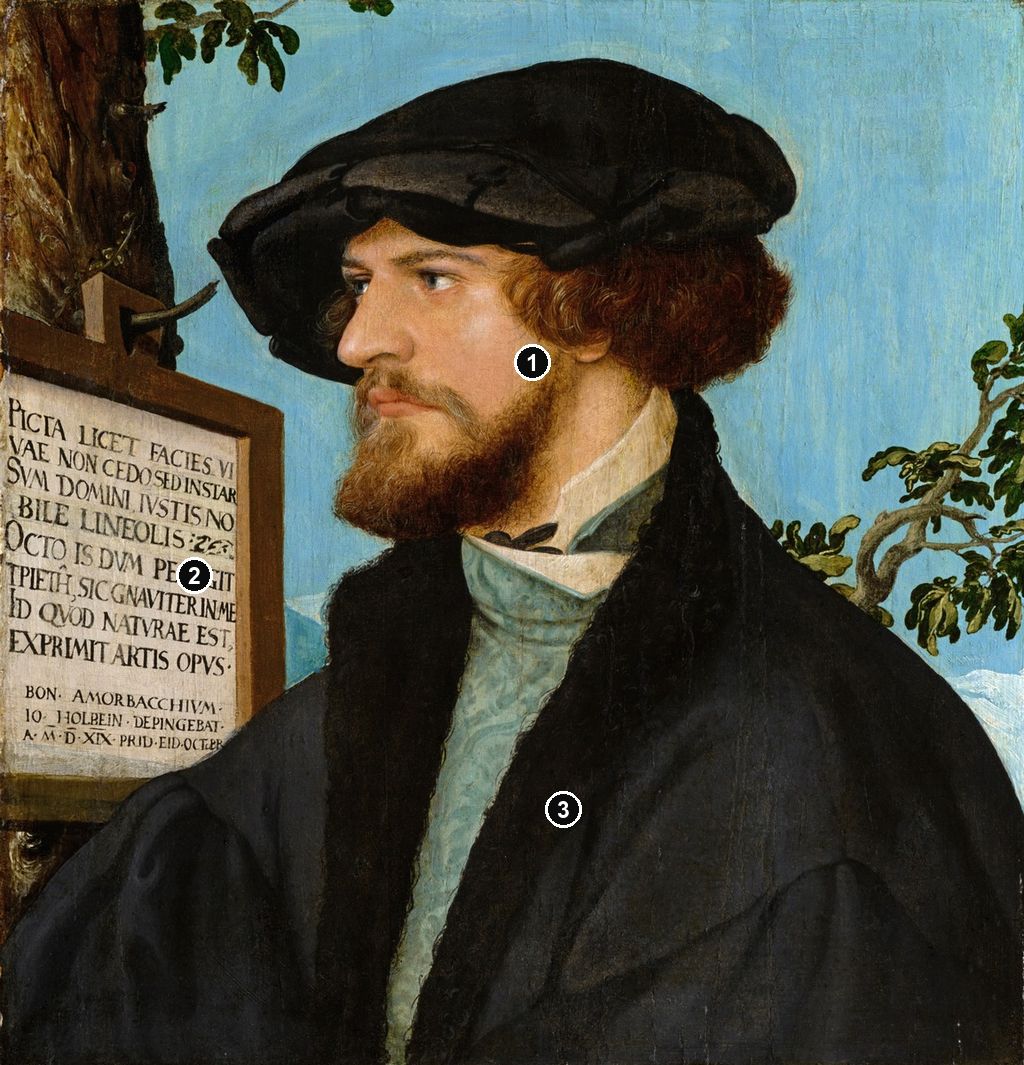
Details from BONIFACIUS AMERBACH
Compare the cropped details with the complete images above. Notice how their colours, shapes and positions contribute to the larger compositions.
Face, cap and turning gaze
The broad cap shades the upper face. Small shifts around the nose, cheek and beard establish the turn towards the inscription.
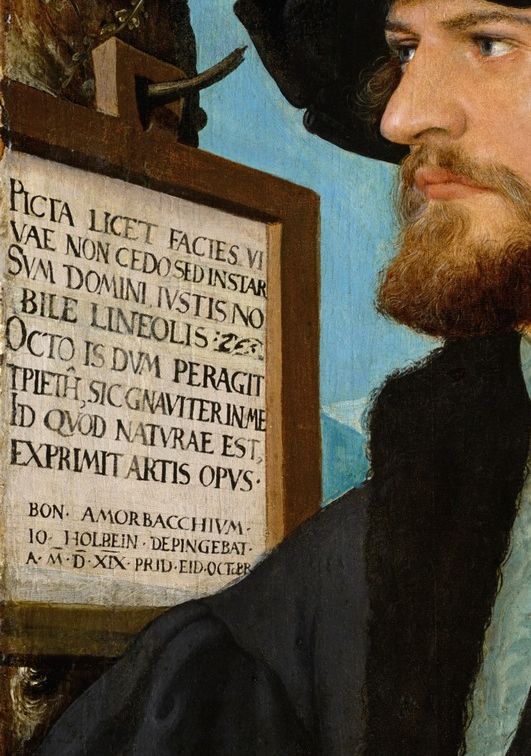
The painted epigram
The framed text sits beside the sitter like a voice within the portrait. Compare the regular capitals with the irregular bark and branches around it.
Fur and patterned blue-green cloth
The dark fur borders a narrow passage of patterned cloth. Different edges and small changes of colour distinguish the two materials.
A Young Scholar Preparing to Travel
Amerbach was the son of the Basel printer Johannes Amerbach and became closely associated with Erasmus of Rotterdam. His family's connection with books helps us understand why a Latin poem could play such a conspicuous part in a portrait. Writing was one of the sitter's own resources for presenting himself. In this painting, the words are an active contribution from the man whose face Holbein represents. [1]
In 1519, Amerbach was preparing to continue in Avignon the legal studies he had begun in Freiburg im Breisgau. The Kunstmuseum Basel connects the portrait with this departure. It points to the hazards of a long journey and to plague in southern France as circumstances in which preserving one's appearance could acquire particular urgency. This is the museum's explanation of the commission's setting; it need not make the young man's expression a visible record of fear. [1]
Travel gives a practical edge to the inscription's insistence on likeness. A portrait could remain with people from whom its subject was separated. The young man might go elsewhere, while his familiar features stayed available to be looked at. The panel's modest size makes that possibility easy to imagine, although its exact first placement and viewing arrangements are not established by the picture.
The date also needs care. The inscription includes 14 October 1519, which the museum identifies with Amerbach's birthday. It should therefore be understood as a statement about the sitter's life rather than the day on which Holbein necessarily finished painting. The year dates the portrait securely; the more precise wording gives the image a personal anniversary. [1]
This distinction is particularly apt in a work so concerned with representation. A painted likeness can fix a person's age and appearance without preserving one literal instant. The outdoor setting likewise need not record a specific sitting beneath a specific tree. We see the finished arrangement through which Amerbach was presented at this point in his life.
Watch: Holbein’s portraits and working methods
Explore museum films on Holbein’s drawings, painted portraits and close-looking details.
Hans Holbein at the court of Henry VIII
A Royal Collection Trust film exploring Holbein’s work at Henry VIII’s court.
Watch on YouTubeThe Portrait Speaks in Latin
The tablet gives the image a voice. Its short Latin poem speaks from the position of the painted likeness, praising its resemblance to the living Amerbach and the artist's ability to reproduce what nature has made. The sitter's name, Holbein's name and the date follow beneath. The Kunstmuseum Basel places this praise within a familiar humanist tradition of celebrating the apparent lifelikeness of portraits. [1]
That convention becomes unusually interesting here because Amerbach wrote the poem. He could look at Holbein's work and compose the terms in which others would be asked to understand it. The likeness presents his physical appearance, while the verse demonstrates his command of literary self-presentation. The portrait accommodates both kinds of authorship without making them visually identical: Holbein's modelling shapes the face; Amerbach's measured language occupies the tablet.
Even before the Latin is deciphered, its lettering affects the picture. The capital letters make repeated dark marks across the pale field. Their close spacing contrasts with the larger, more open shapes of the head and hat. The small text below the poem establishes a further change of scale. Looking at the face from a little distance and moving closer to read the names are two distinct experiences of the same small object.
The text's position also matters. It accompanies the face at roughly head height, and the direction of Amerbach's turn brings the two into a single visual neighbourhood. Yet he is not shown reading it. The poem addresses the viewer across the space of the painting, while the sitter attends to something beyond us. That separation prevents the scene from becoming an illustration of a man consulting a document.
The claim to lifelikeness is therefore more than a piece of praise attached afterwards. Holbein gives it a conspicuous physical home. Once we have read what the picture says about itself, the line of the nose, the colour of the beard and the slight shadows around the eye become evidence to examine again.
A Sheet of Drafts and a Changed Emphasis
The survival of Amerbach's preparatory writing allows an unusually close view of that literary contribution. The Kunstmuseum Basel reports more than twenty drafts on a sheet in Basel University Library, manuscript C VIa 73, folio 407. The Getty's 2021 exhibition checklist independently identifies the sheet as Page with Drafts of the Epigram for His Portrait , dating it to 1519 and recording pen and ink on paper. It lists the portrait and draft sheet within the same exhibition. [1] [7]
Repeated drafting gives a different sense of the poem from the neat lettering on the tablet. The painted text looks settled; the surviving sheet records the effort that preceded it. This evidence supports a picture of Amerbach as a participating author who worked over his language. It cannot tell us every conversation between sitter and painter, or establish the order of every visual decision.
One change continued after the words had reached the painting. According to the museum, the second verse originally ended with SCRIPTA COLORIBVS , where NOBILE LINEOLIS now appears. The earlier wording emphasised colour; the revision shifted attention towards line. This is a finding reported by the owning museum, and it is especially suggestive beside a face whose silhouette and small internal contours are so precisely controlled. [1]
The alteration does not require us to choose between colour and drawing as rival explanations of Holbein's achievement. The warm skin and reddish hair remain essential to the head's presence, as do the darker boundary of the eyelid and the profile against the sky. What changed was the poem's emphasis. A literary statement about the picture could be adjusted even when much of the painted image was already there.
Art historian Jeanne Nuechterlein offers a useful broader way of thinking about such apparent fidelity. In the introduction to Translating Nature into Art , she argues that Holbein's descriptive portraits persuade us that an observed appearance conveys the person represented. She also stresses the artifice involved in creating that impression. [8] Amerbach's tablet makes this negotiation unusually explicit: the image offers a convincing likeness and supplies carefully composed words encouraging us to trust it.
The Beard and the Planned Second Image
Amerbach's beard is one of the portrait's most prominent features. It also enters a more complicated story preserved in another poem. The Kunstmuseum Basel, drawing on Ueli Dill's 1998 study, reports an epigram referring to two portraits by Holbein from 1519, one bearded and one clean-shaven. The museum interprets it as evidence that Amerbach planned a companion to this panel after shaving. Whether the second painting was actually carried out remains unknown. [1]
The proposed pair belonged to a humanist discussion about the difference between the outward signs of philosophy and intellectual achievement itself. A beard might make someone look like a philosopher; it could not establish the quality of his thought. In the museum's reading, the clean-shaven image would have looked back at the earlier bearded self with a newly critical understanding. The idea gives the surviving beard a possible role in a larger act of self-examination. [1]
There is a particular wit in choosing portraiture for this purpose. A painter is exceptionally well equipped to distinguish a bearded from an unbearded face. The deeper change claimed by the proposed pairing would be harder to demonstrate. A viewer would have needed the relationship between the images and their words to grasp that a change in appearance was being presented as a change in self-understanding.
The museum suggests that the death of Amerbach's brother Bruno, a few weeks after the birthday recorded here, may have prompted this reconsideration. That remains a hypothesis. It should not turn the surviving portrait into a mourning picture, nor supply a confident story about a missing companion. [1] The evidence leaves us with a documented literary project whose full material outcome is uncertain.
Seen with this possibility in mind, the face becomes less final. The likeness that seems to preserve Amerbach so securely could itself have become an earlier self against which he measured a later one.
Writing and Friendship: Looking Towards Erasmus
A useful comparison survives in Basel's Portrait of Erasmus of Rotterdam Writing , dated 1523. Erasmus looks down towards his work, his hands and manuscript giving visible form to scholarly activity. The museum identifies the text as the beginning of his paraphrase of Mark's Gospel. Amerbach later bought this painting directly from Holbein's wife in 1542, while the artist was in England. [9]
Amerbach possessed a likeness of the scholar with whom he was closely connected, but the images present learning differently. Erasmus is occupied with writing inside the scene. Amerbach's own composition has already been transferred to the tablet beside him; we encounter its finished public form.
This comparison rewards attention to the location of words. A working manuscript gives Erasmus an activity and directs our eyes down towards his hands. The suspended epigram directs attention back towards Amerbach's likeness. In each case, writing gives a scholar a particular presence, and the placement of the text helps establish how we approach him. The different versions of Holbein's portraits of Erasmus should be kept distinct: the Basel writing portrait is a separate object from the portrait associated with Longford Castle. [9]
From a Family Likeness to a Public Collection
The portrait now belongs to the Amerbach-Kabinett at the Kunstmuseum Basel. The museum traces the core of its collection to the interests and friendships of Bonifacius and to the collecting of his son Basilius. By Basilius's death in 1591, the cabinet contained approximately fifty paintings, including fifteen by Holbein, alongside a large body of drawings and prints, books and other kinds of objects. [10]
In 1661, with the collection facing removal to Amsterdam, Basel's civic authorities and university secured it for the city. The Kunstkabinett opened to the public in the Haus zur Mücke in 1671. Acquisition and public display thus have different dates in the collection's history. [10]
Amerbach's portrait makes that history unusually tangible. A man who helped preserve Holbein's work is himself preserved within it, with the poem he composed still hanging beside his face. The tablet records a moment of deliberate self-presentation; the collection around the panel carries the consequences of a family's continuing attention to art. For a wider view of the city in which these relationships developed, see Holbein's Basel years .
Artworks directory
Explore paintings, drawings, prints and designs, including works without a separate article. Related studies and versions have their own entries; workshop works and copies are labelled. Print designs and series are grouped rather than repeated for every impression.
Frequently Asked Questions
Bonifacius Amerbach (1495–1562) was a Basel humanist and legal scholar, the son of printer Johannes Amerbach and a close associate of Erasmus of Rotterdam. In 1519, when Holbein painted him, he was preparing to continue his legal studies in Avignon. [1]
No. The Kunstmuseum Basel records mixed technique on fir wood, measuring 29.9 × 28.3 cm. It is a panel painting . [1]
In essence, the painted likeness claims to resemble the living Amerbach and praises the painter's ability to render nature through art. Amerbach composed the poem himself. More than twenty preparatory drafts survive, according to the museum. [1]
The date in the inscription refers to Amerbach's birthday. It does not establish the exact day when Holbein completed the painting. The museum dates the work to 1519. [1]
No second painting is established by the evidence discussed in the Basel catalogue. Another epigram refers to bearded and unbearded portraits, which the museum interprets as a plan for a companion image. It remains uncertain whether that second painting was executed. [1]
Discussion
Look again at the images and ideas explored in Portrait of Bonifacius Amerbach. These editorial prompts invite your observations.
Reader Insights
Look at Amerbach before reading the tablet. Which visible detail gives the strongest impression of a particular person: the eye, the profile, the hair or the fit of the hat?
The inscription praises the portrait's likeness. Does knowing that Amerbach wrote it make the image feel more intimate, more carefully staged, or both?
Imagine the proposed clean-shaven companion beside this panel. How might a second version of the same face change the way you read the first?
Join the Conversation
Which relationship draws you back to this portrait: the face against the sky, the sitter beside his own words, or the possibility of a later image looking back at this younger self? Share a detail that shaped your response.
References
- Kunstmuseum Basel , Bildnis des Bonifacius Amerbach , Hans Holbein the Younger, 1519, inventory 314; current collection record, description, inscription and bibliography (in German). Accessed 18 October 2026. View source .
- Kunstmuseum Basel, Der tote Christus im Grab, 1521–22, inventory 318 (in German) . View source .
- The Frick Collection, Sir Thomas More, 1527, accession 1912.1.77, collection record . View source .
- Gemäldegalerie Berlin, Georg Gisze . View source .
- Susan Foister, The Ambassadors, The German Paintings before 1800 (2024) . View source .
- Susan Foister, Christina of Denmark, Duchess of Milan (2024) . View source .
- J. Paul Getty Museum , Holbein: Capturing Character in the Renaissance , exhibition checklist, 2021, p. 7, entries 34 and 36: Bonifacius Amerbach and Page with Drafts of the Epigram for His Portrait . View source .
- Jeanne Nuechterlein , “Introduction: Holbein's Reformation of Art”, in Translating Nature into Art: Holbein, the Reformation, and Renaissance Rhetoric , Pennsylvania State University Press, 2011; introduction supplied on the publisher's website. View source .
- Kunstmuseum Basel , Bildnis des schreibenden Erasmus von Rotterdam , Hans Holbein the Younger, 1523, inventory 319; current collection record (in German). Accessed 18 October 2026. View source .
- Kunstmuseum Basel , Geschichte der Öffentlichen Kunstsammlung Basel , especially “Das Amerbach-Kabinett” (in German). Accessed 18 October 2026. View source .
- Würth Collection, Holbeins Schutzmantelmadonna, inventory 14910, current owner account (in German) . View source .
- Metropolitan Museum, Dance of Death series . View source .
- Kunstmuseum Basel, Bildnis der Frau des Künstlers mit den beiden ältesten Kindern, about 1528–29, inventory 325 (in German) . View source .
- Kunsthistorisches Museum Wien, Next Generation, Jane Seymour, about 1536–37, inventory 881 (in German) . View source .
- Splash image , Hans Holbein the Younger, Portrait of Bonifacius Amerbach, 1519. Mixed technique on fir wood, 29.9 × 28.3 cm. Kunstmuseum Basel, Amerbach-Kabinett, inventory 314. Image source . Public domain .