by
Tom Gurney
Tom Gurney BSc (Hons) is an art history expert with over 20 years experience
Email:
tomgurney1@gmail.com
/ Phone:
+44 7429 011000
Studies of the Hands of Erasmus of Rotterdam: Introduction
At the top of this small sheet, a hand opens towards the right, its fingers almost transparent. At the bottom, another hand reaches left, solidly shaded and wearing a ring. Between them, a much darker hand grips a pen. The three studies ask us to look at the same part of the body in different ways: as an outline, a rounded form and an instrument of action.
The sheet belongs to the Louvre, where it is catalogued under Hans Holbein the Younger. Its title links it with Erasmus, the Renaissance scholar whose portraits made books and writing central to his public image. Yet these hands do not form one continuous episode. The two resting studies and the writing hand require different explanations. [1] [2]
At a Glance
- Title Three Studies of Hands for the Portrait of Erasmus .
- Artist Hans Holbein the Younger; the central writing hand has a separate attribution history.
- Date Resting studies associated with the 1523 portrait; central study disputed.
- Materials Silverpoint, black chalk and red chalk on white-prepared paper.
- Dimensions 20.6 × 15.5 cm.
- Collection Musée du Louvre, Département des Arts graphiques, Paris.
- Inventory INV 18697 recto. [1]
This work across Hans Holbein the Younger’s career
Dead Christ in the Tomb
1521–22 [4]Studies of the Hands of Erasmus of Rotterdam (current article)
Resting studies associated with the 1523 portrait; central study disputedSir Thomas More
1527 [5]Georg Giese
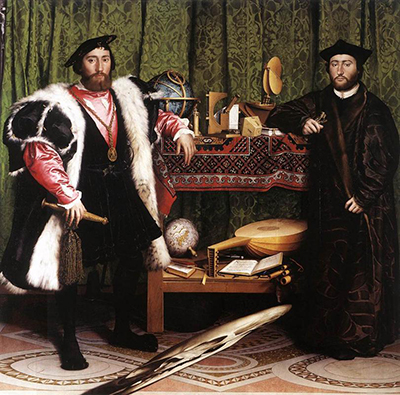
1532 [6]The Ambassadors
1533 [7]Contents
- The upper hand: a body emerging from an outline
- The lower hand: weight, skin and a ring
- Silverpoint and chalk at close quarters
- From a studied hand to the Longford portrait
- The writing hand and its disputed history
- Comparing the two portraits of Erasmus writing
The upper hand: a body emerging from an outline
The upper study begins at the left edge of the sheet and spreads into the space above the pen. Its upturned thumb is the most firmly shaded part. A dark patch at its base gives way to a lit upper surface and a small, clearly enclosed nail. From there, the eye follows the folded skin into the longer fingers, where the drawing becomes much fainter.
That change in emphasis is striking. One finger has enough shading to appear rounded; its neighbours survive largely as paired lines. Their nails are marked with a few light curves, while the broad back of the hand remains nearly empty. The drawing holds together because the fingers meet at plausible angles and their tips occupy convincing positions relative to one another. Very little tone is needed to make the rest intelligible.
Around the thumb, short curved strokes gather where the skin bends. These small interruptions prevent the hand from becoming a smooth diagram. The fingers are long, but their lengths are broken by joints, folds and the changes of direction at each knuckle. At the same time, there is no surrounding sleeve to explain whose arm this is, or where the body sits beyond the paper's edge.
The effect is unusually intimate. We are close enough to see a nail and a crease, yet denied the familiar information supplied by a face. Try following only the outside boundary, then return to the darker interior marks. The boundary locates the hand; the shading gives weight to particular parts of it. The contrast makes the decisions within the drawing unusually easy to see.
The lower hand: weight, skin and a ring
The lower study reverses the direction of our attention. Its fingers point left, carrying the eye back across the sheet. The wrist and arm disappear at the right edge, leaving the hand to occupy a much broader band of the paper. Shading extends through the fingers and across the knuckles, making this study feel fuller and more settled than the one above.
The fingers do not end along a straight line. Each nail projects a little differently, and the gaps between the fingers change in width and darkness. At the far left, the fingertips almost touch an oblique drawn line. That line introduces a surface against which the hand's downward pressure can be imagined, even though the supporting object has scarcely been described.
A ring encircles one finger. Its narrow bands follow the finger's curve, briefly interrupting the softer modelling of skin. The ring offers a useful test of the drawing's precision: a few curved marks must explain an object passing around a rounded form. Too flat a line would turn it into a stripe; too emphatic a band would detach it from the hand. Here it remains small and convincing.
Look also at the back of the hand, where the knuckles rise before the fingers begin to bend. Fine strokes describe both the raised areas and the shallower spaces between them. Ridges and folds give the skin a particular texture. Each finger has its own contour, and each joint slightly changes the direction of the light.
Silverpoint and chalk at close quarters
Silverpoint uses a silver tip to draw on a prepared surface. Victoria Button explains that the preparation provides the abrasive texture needed to receive a deposit from the metal. [2]
The warmer, finely worked resting hands and the dark central study have markedly different surfaces. Button examines these differences in her study of Holbein's portrait drawings. She identifies silverpoint contours and modelling in the resting hands, with repeated lines strengthening parts of their outline. She reads red chalk overlapping some edges as evidence that the colour followed the underlying drawing. [2]
Her account gives a sequence to marks that a reproduction can make seem simultaneous. First an edge is sought, then reinforced; shading makes a finger round; colour adds another quality to the skin. These are technical observations about how the studies were built, rather than proof that every mark across the sheet belongs to one sitting.
Button also distinguishes the fine contours from broader strokes made with the metalpoint held differently. Around the fingertips she observes damage to the preparation, which she relates to repeated drawing rather than a continuous tracing of the whole hand. [2] That distinction matters when asking how the studies were used. A marked contour does not by itself establish that the outline was mechanically transferred into a painting.
In the upper hand, the thin line has room to remain visible against the pale ground. In the lower one, denser strokes gather into shadows, and individual lines begin to merge at ordinary viewing distance. Moving closer restores their separate directions. The drawing alternates between an image of skin and a record of many small movements across the paper.
Watch: Holbein’s portraits and working methods
Explore museum films on Holbein’s drawings, painted portraits and close-looking details.
Hans Holbein at the court of Henry VIII
A Royal Collection Trust film exploring Holbein’s work at Henry VIII’s court.
Watch on YouTubeFrom a studied hand to the Longford portrait
The resting hands are connected with the Longford Castle portrait of Erasmus, painted in 1523 and on loan to the National Gallery. In that painting, both hands rest on a large red book. [2] [9] The relationship becomes clearer if we look first at Erasmus's left hand, appearing at the viewer's right.
The fingers extend across the binding, and a ring catches the light. A broad fur cuff rises beside them, hiding the wrist and much of the hand's connection with the arm. The studied fingers have acquired a place within an elaborate arrangement of materials: skin meets leather, leather rests above stone, and fur presses close to the exposed flesh.
The painting also changes the scale of our attention. Its black gown occupies a great deal of space, while the hands remain comparatively small. The red book brings them forward and gives their pale surfaces something warm to lie against. In the drawing, the fingers can command the entire encounter; in the painting, they contribute to the sitter's overall presence.
Christian Müller, as summarised by the Louvre, argues that the resting studies were made after work on the painting had begun. He connects their book-supported positions and abbreviated wrists with the painted arrangement. [1] This is a proposed sequence, not a dated record of a sitting.
It is nevertheless a helpful way to approach the sheet. The portrait's composition may have created a need for further observation of a particular detail. Drawing could remain useful while a painting was under way, allowing the artist to return closely to the fingers without reworking every element of the likeness. The separate studies make that concentration imaginable; they do not reconstruct the order of every stage.
The larger portrait of Erasmus surrounds the hands with inscriptions, books and furnishings. Here those associations fall away, leaving the practical problem on which their effect depends: making a hand seem to touch a surface.
The writing hand and its disputed history
The central hand occupies a smaller area but makes a forceful interruption. Its pen rises into the space below the upper fingers. Dark strokes gather near the grip and underneath the bent digits; other lines run lightly towards a sketch of the cuff. The drawing has little of the lower hand's continuous shading. Its emphasis falls on direction and the meeting of finger, thumb and pen.
Follow the pen downwards. It passes through a knot of lines around the fingertips and reaches towards the suggested writing surface. This slender diagonal helps the more loosely described hand hold together. The fingers are intelligible through their relation to something they grasp, while the cuff extends the gesture back towards an absent arm.
The Louvre records Paul Ganz's 1939 view that this was a later, non-autograph copy after Dürer's engraving of Erasmus from 1526. It also summarises Müller's 2006 proposal for a later study of an older Erasmus, around the early 1530s. [1] These accounts make different claims about the central sketch's origin and purpose.
The disputed passage therefore needs to remain distinct from the resting hands. A change in line or apparent speed can prompt a question about authorship, date or function, but visual difference alone cannot decide among them. Button discusses the contrast between the chalk sketch and the silverpoint studies as a difference in handling. [2] Her technical discussion should not be taken as a resolution of the attribution debate.
We can appreciate the grip's economy while leaving open who drew it and when. The whole sheet can be studied together without assigning every part the same degree of certainty.
Comparing the two portraits of Erasmus writing
A writing hand naturally brings to mind the smaller Erasmus portraits in Basel and Paris. Both place the scholar in profile, his attention lowered towards his work. In the Basel painting, the pen-holding hand sits above the other hand, which steadies the page. The two gestures gather close together, giving writing a compact physical centre beneath the descending face.
Kunstmuseum Basel dates its picture to 1523. Its support is paper mounted on fir, and its inventory number is 319. The museum identifies the text on the sheet as the beginning of Erasmus's paraphrase of Mark's Gospel, completed that year. [10] The action therefore belongs to a specific learned activity, as well as providing a recognisable image of an author at work.
The Louvre's painted Erasmus Writing , INV 1345, is a separate object on limewood, currently dated 1528. [11] Older comparisons, including Button's, call it a work of 1523. [2] This difference should remain visible when comparing the drawing with the paintings: similarity of pose does not make their dates interchangeable.
Nor does a shared pen establish an exact preparatory match. The central study gives the grip an isolated prominence that the portraits distribute among face, shoulders, writing surface and sleeves. Looking from sheet to painting helps us recognise the problem being explored, while leaving the disputed connection open.
The three studies also show why Holbein's drawings reward attention beyond the search for a finished counterpart. On this sheet, a nearly empty outline can feel bodily, a ring can explain a finger's roundness, and a few darker strokes can suggest an action. Each asks for a different pace of looking. The faint upper fingers invite us to slow down; the lower hand holds us through accumulated detail; the central grip sends the eye along the pen.
Artworks directory
Explore paintings, drawings, prints and designs, including works without a separate article. Related studies and versions have their own entries; workshop works and copies are labelled. Print designs and series are grouped rather than repeated for every impression.
Frequently Asked Questions
The central writing hand remains disputed. The sheet's general attribution does not give every study equal certainty. [1]
The Longford Castle Erasmus of 1523, on loan to the National Gallery. The hands in that painting rest on a closed red book. [9]
It combines materials. Button describes silverpoint and red chalk in the resting hands and black chalk in the central writing hand. Her technical observations do not settle the latter's attribution. [2]
Discussion
Look again at the images and ideas explored in Studies of the Hands of Erasmus of Rotterdam. These editorial prompts invite your observations.
Reader Insights
Follow the upper study from the shaded thumb towards the faint fingertips. Notice how little information is needed before you recognise their position.
Look at the small curves describing the ring in the lower study. How much do they contribute to the sense of the finger beneath it?
Compare the lower hand's many fine strokes with the central grip's darker lines. Which invites you to look longest?
Join the Conversation
Which of the three studies gives you the strongest sense of touch: the lightly outlined upper hand, the shaded lower one, or the hand holding the pen? Share the small detail that makes it convincing.
References
- Musée du Louvre , Trois études de mains pour le portrait d'Erasme , INV 18697 recto, current collection record and commentary, including its summaries of Paul Ganz (1939) and Christian Müller (2006) (in French). View source .
- Victoria Button , The Portrait Drawings of Hans Holbein the Younger: Function and Use Explored through Materials and Techniques , PhD thesis, Royal College of Art, 2013, section 3.4, pp. 92–93, and section 3.6.8, pp. 122–124. View source .
- Kunstmuseum Basel, Bildnis des Bonifacius Amerbach, 1519, inventory 314 (in German) . View source .
- Kunstmuseum Basel, Der tote Christus im Grab, 1521–22, inventory 318 (in German) . View source .
- The Frick Collection, Sir Thomas More, 1527, accession 1912.1.77, collection record . View source .
- Gemäldegalerie Berlin, Georg Gisze . View source .
- Susan Foister, The Ambassadors, The German Paintings before 1800 (2024) . View source .
- Susan Foister, Christina of Denmark, Duchess of Milan (2024) . View source .
- National Gallery , Hans Holbein the Younger, Erasmus , 1523, Longford Castle collection, on loan, L658, collection record. View source .
- Kunstmuseum Basel , Bildnis des schreibenden Erasmus von Rotterdam , 1523, inventory 319, collection record (in German). View source .
- Musée du Louvre , Portrait d'Érasme (1467–1536) écrivant , INV 1345, current collection record, dated 1528 (in French). View source .
- Würth Collection, Holbeins Schutzmantelmadonna, inventory 14910, current owner account (in German) . View source .
- Metropolitan Museum, Dance of Death series . View source .
- Kunstmuseum Basel, Bildnis der Frau des Künstlers mit den beiden ältesten Kindern, about 1528–29, inventory 325 (in German) . View source .
- Kunsthistorisches Museum Wien, Next Generation, Jane Seymour, about 1536–37, inventory 881 (in German) . View source .