 by
Tom Gurney
Tom Gurney BSc (Hons) is an art history expert with over 20 years experience
Email:
tomgurney1@gmail.com
/ Phone:
+44 7429 011000
Sir Thomas More and His Family: Introduction
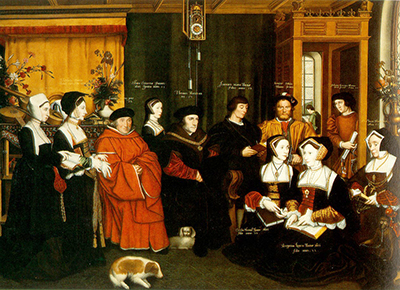
A dog curls on the floor while books rest in hands and a whole household fills the room. At the centre, Thomas More sits beside his elderly father; women stand to the left and sit across the foreground, and a doorway opens into another space behind them. The scene offers the pleasures of a family portrait on an unusually generous scale: differences of age, dress, attention and position become part of a shared life.
The painting reproduced here is a later copy, at Nostell in Yorkshire. Hans Holbein the Younger’s original group portrait, made during his first English visit in about 1527–28, is lost. The National Trust catalogues the Nostell canvas as a work after Holbein, traditionally associated with Rowland Lockey, and dates it about 1592–1620. Its inscription naming Lockey and the year 1592 is later. That distinction matters whenever we look closely: this is evidence for Holbein’s composition, carried through another painter’s work. [1] [2]
Holbein’s own drawings supply a more immediate encounter. A design in Basel and individual studies in the Royal Collection allow us to move between the plan of a household and the particular faces from which it was built. [3] [4] [5]
At a Glance
- Original artist Hans Holbein the Younger.
- Original work Sir Thomas More and His Family , about 1527–28; lost. [1] [2]
- Painting illustrated Sir Thomas More and his Family , after Holbein; traditionally associated with Rowland Lockey, about 1592–1620. The inscription naming Lockey and 1592 is later. [1]
- Medium and dimensions of the illustrated copy oil on canvas, 249 × 343 cm.
- Collection of the illustrated copy National Trust, Nostell, West Yorkshire, NT 960059. [1]
- Holbein’s surviving composition study Kunstmuseum Basel, Kupferstichkabinett, inventory 1662.31, dated about 1527. [4]
- Individual preparatory studies seven survive in the Royal Collection, including Thomas More, Sir John More and Anne Cresacre. [5] [6] [7]
- A different later version Rowland Lockey’s painting of 1593 in the National Portrait Gallery, NPG 2765, adds descendants to create an imagined gathering across five generations. [8]
This work across Hans Holbein the Younger’s career
Dead Christ in the Tomb
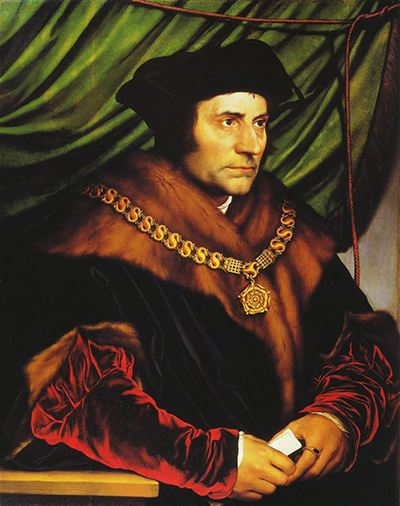
1521–22 [10]Sir Thomas More
1527 [11]Sir Thomas More and His Family (current article)
c.1527–28 (lost original; illustrated copy c.1592–1620)Georg Giese
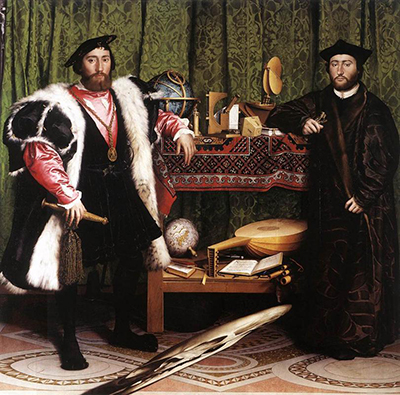
1532 [12]The Ambassadors
1533 [13]Contents
- More’s Support for a Newly Arrived Painter
- Who Belongs to the Household?
- A Room That Holds Many Kinds of Attention
- The Basel Design and a Composition Still Being Made
- Individual Faces Before the Large Group
- Books, Hands and the Life of the House
- Later Copies and the Family’s Memory
- Loss, Collection and the Surviving Encounter
More’s Support for a Newly Arrived Painter
The commission belongs to the beginning of Holbein’s English career. He came from Basel in 1526, entering a country where introductions could connect a painter with influential patrons. More was already linked to Erasmus, the scholar whose writings and portraits had helped establish Holbein’s reputation. The household picture grew from that network of personal trust and learned exchange. [3]
More’s letter to Erasmus of 18 December 1526 provides a small, unusually direct piece of evidence. Near the end of a longer discussion of religious controversy, he praised the painter and promised to do what he could to help him find opportunities in England. The passage expresses both admiration and practical concern: England might prove less fertile in work than the newcomer had hoped. [15]
A large family commission gave substantial form to that promise. The Royal Collection’s exhibition account places the group alongside More’s separate portrait as part of his support for the artist. [3] A portrait of More alone could concentrate attention on his face and public bearing. A household group required Holbein to coordinate people whose relationships mattered as much as their individual appearance.
This was a demanding way for a patron to introduce a painter’s abilities. A successful likeness had to remain recognisable when placed among many others; the separate figures also had to belong to one room and one composition. More could be presented through the company he kept at home, with his father, children, wife and other members of the household helping to define that company.
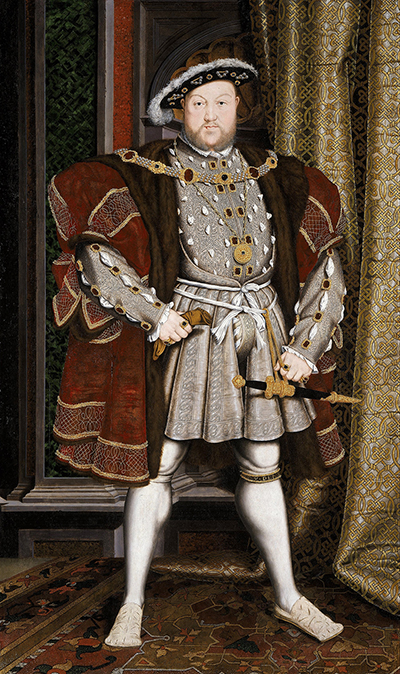
Dating the group to this first English visit keeps it distinct from Holbein’s later royal portraits. The picture arose from More’s circle before the painter’s mature career at Henry VIII’s court. Its surviving evidence concerns an early English commission whose scale already reached well beyond an isolated head and shoulders. [3]
Who Belongs to the Household?
The Nostell picture rewards a slow reading from left to right. The National Trust identifies the two women at the left as Margaret Clement, née Giggs, and More’s daughter Elizabeth Dauncey. Beside them sits Sir John More in his red judicial robes. Anne Cresacre stands behind the principal seated figures. Thomas More occupies the dark central position, with his son John reading to his right. [1]
Father and son share the name John, but they have different places in the family and in the composition. The elderly Sir John More was Thomas’s father and a judge. The younger John was Thomas’s son; Anne Cresacre, More’s ward, would become his wife. Their individual drawings preserve these identities independently of the later canvas. [6] [7] [16]
The remaining people extend the group beyond a simple arrangement of parents and children. The household fool Henry Patenson stands behind the seated women, and More’s clerk John Harris appears near the doorway. Cicely Heron and Margaret Roper, two more of More’s daughters, sit in the foreground. His second wife, Alice, closes the group at the right. A further young reader can be glimpsed in the room beyond; the National Trust leaves him unidentified. [1]
These names change the experience of the scene. A clerk and a household fool do not occupy the same social position as a judge, yet both belong within the pictured company. The word family needs its wider household sense here. Looking only for a pedigree would miss some of the people through whom More’s domestic world is represented.
The distribution is equally revealing. The men are not arranged in an uninterrupted row of authority, with the women reduced to a distant background. The women on the left frame the approach towards the central seats; the two daughters in front extend the group towards us. Alice’s position at the opposite edge provides a seated presence that answers the seated patriarchs across the room.
At the same time, inclusion does not remove hierarchy. Clothes, chairs, height and distance give people different degrees of prominence. More’s central placement remains unmistakable, even though Sir John’s red robe is the strongest block of colour. The picture allows the household to be varied without making its relationships look accidental.
A Room That Holds Many Kinds of Attention
In the Nostell copy, the figures form several small groups within the larger one. At the left, heads and shoulders overlap closely. Near the centre, the two older men have more space around their seated bodies. At the right, standing figures rise behind a lower cluster of women. These changes of height prevent the gathering from becoming a line of separate portraits pasted against a wall.
The large areas of dark clothing have a binding effect. Sleeves and skirts run together into a broad pattern, from which pale hands, faces, collars and open pages emerge. Sir John’s red clothing interrupts this field decisively. Its brightness draws the eye left of centre before attention returns towards More’s face and the people around him.
There is no single action to which everyone responds. One person reads; another looks across the room; hands close around a book or rest near the body. The lack of a shared dramatic incident gives the gathering its peculiar stillness. We can pass from face to face without feeling that we have arrived halfway through an event whose explanation lies elsewhere.
The foreground dog strengthens that effect. Its low, rounded shape sits apart from the upright human figures, occupying a piece of floor that no person needs for a pose. It makes the room seem inhabited beyond the formal business of portraiture. That is a visual effect of its placement, without requiring the animal to stand for a particular moral quality.
Behind the family, the architecture offers both enclosure and escape. The dark vertical wall divisions steady the central group, while the opening at the right leads towards a small, brightly lit background space. The reader there is remote enough to be overlooked at first. Once noticed, he gives the room a life beyond the principal company.
The flowers at the left and the clock high above the centre add different scales of detail. The flowers spread irregularly, their stems reaching away from the orderly bodies. The narrow clock hangs on the room’s strong vertical axis. Neither object needs an imposed story to matter: together they make the interior more specific and give the eye somewhere to rest between the faces.
All these effects can be appreciated in the surviving canvas. Their precise painted execution belongs to the later object. Holbein’s lost picture cannot be inspected for the same transitions of colour, the same sharpness of an outline or the same handling of a hand. The copy preserves a composition while keeping its own material character.
Watch: Holbein’s portraits and working methods
Explore museum films on Holbein’s drawings, painted portraits and close-looking details.
Hans Holbein at the court of Henry VIII
A Royal Collection Trust film exploring Holbein’s work at Henry VIII’s court.
Watch on YouTubeThe Basel Design and a Composition Still Being Made
Holbein’s composition drawing in Basel, inventory 1662.31, is a separate work, made around 1527 in pen and black ink over a chalk preparation. The scholarly Sandrart.net catalogue records annotations as well as the drawing’s relationship to the lost painting. It also traces the sheet’s passage to Erasmus in Basel in 1528, as a gift from More. [4]
The annotations are valuable because they reveal a composition still open to adjustment. Sandrart.net records a note at the right concerning whether a figure should sit, and another at the upper left concerning a clavichord and other stringed instruments on a cupboard. It attributes the names and ages accompanying the figures probably to Nicolaus Kratzer. The qualifications about handwriting should remain part of the account: every inscription on a working drawing need not come from the artist. [4]
A drawn plan and a completed painting answer different questions. The plan gives space to arrangements, changes and written reminders. The later copy presents a room in which those decisions appear resolved. Setting them beside one another makes the distance between conception and finished appearance part of the picture’s interest.
That distance also discourages an overly literal reading of the setting. A detailed domestic interior can feel like a record of everything that stood in a particular room on a particular day. A working design reminds us that chairs, objects and bodies were being arranged for a picture. Recognisable people could be brought into a coherent setting through a sequence of decisions.
The sheet’s association with Erasmus gives it another role. A composition with named figures could communicate the household to someone who was absent. The design thus belonged to the friendship connecting Basel and England as well as to the practical making of a painting. It had become a meaningful object beyond its immediate usefulness in the studio. [4]
Individual Faces Before the Large Group
Seven individual studies connected with the family painting survive in the Royal Collection. Their existence does not establish that the household assembled for one collective sitting. Each sheet allowed Holbein to attend to a particular sitter, retaining information that could subsequently be brought into the larger design. [5]
The study of Thomas More, RCIN 912225, is in black and coloured chalks with brown wash. At 37.6 × 25.5 cm, it presents the head and upper body with a concentrated attention to modelling. Its contours were traced with a stylus for transfer. The Royal Collection observes that it differs from the other family studies although the paper is the same, and suggests that it may represent another stage of the artist’s work. [5]
This is not interchangeable with the separate drawing of More dated 1527 . The 1527 sheet, RCIN 912268, has outlines pricked for transfer. The Royal Collection proposes that both large More studies may first have served his individual portrait; their precise sequence remains open. [5] [17]
Anne Cresacre’s study , RCIN 912270, shows her seated, whereas she appears standing in the family composition. The Royal Collection’s exhibition account explains that the lightly indicated chair supports her at its edge, anticipating the upright figure. It treats the poses of these studies as evidence that the larger arrangement was already being considered. This is a curatorial interpretation of the working material, rather than a surviving instruction from Holbein. [7] [3]
Sir John’s sheet offers a different kind of attention. The exhibition describes dry chalk mottled over a dampened area to render the broken veins in his cheeks. The elder man’s face could therefore receive minute observation even within an undertaking destined to become a large and crowded picture. [3] [6]
The younger John’s study, RCIN 912226, includes the book he holds and reads. Its inscription preserves a brief note by Holbein about lip colour. Such a reminder joins the practical needs of painting to the close observation of a person. Reading, facial likeness and a small colour decision could all be gathered on the same sheet. [16]
Books, Hands and the Life of the House
Books make attention visible throughout the Nostell picture. A lowered face and an open volume establish an activity that can be understood at once. Elsewhere, a book rests in hands without absorbing the holder’s whole attention. These differences give the figures distinct rhythms: some appear occupied, while others remain available to the surrounding company.
The pages also help organise the surface. Against dark clothes, their pale rectangles lead the eye towards fingers and wrists. A book can join two hands into one compact shape or turn an arm towards a neighbour. It supplies something definite for a person to do, helping a posed gathering feel less mechanically arranged.
The women’s books deserve particular attention. They give reading a place within their representation, allowing the domestic group to communicate an intellectual life extending beyond its central man. Margaret Roper’s historical identity as a writer and translator makes that aspect especially resonant. [1] The particular texts cannot all be named simply because a volume is present, and a closed or indistinct book should not acquire an invented title.
More’s own writing offers a useful companion to this room. In the prefatory letter to Peter Giles accompanying Utopia , he describes public business, legal work and the demands of home as competing claims on his time. Conversation with his wife, children and servants belongs among his necessary duties, leaving writing to be fitted into the remaining hours. This is a carefully shaped literary self-presentation, yet its attention to domestic conversation gives the household more substance than an inventory of learned possessions would do. [18]
The picture and the text do not illustrate one another exactly. The preface predates the portrait, and it cannot tell us what the sitters were saying or reading. Their affinity lies in the importance each gives to a life shared with other people. In the copy, books coexist with glances, proximity and the small movements of hands. Learning is represented within company.
This also explains why the dog, doorway and flowers matter alongside the volumes. They keep the room varied. Our attention moves between people and the setting they occupy, encountering reading as one activity within a broader domestic world.
Later Copies and the Family’s Memory
The Nostell canvas and the National Portrait Gallery’s painting should be distinguished carefully. The latter is securely catalogued as Rowland Lockey after Holbein, dated 1593. It brings five generations together by adding More’s grandson Thomas More II and his family to the earlier composition. The Gallery describes it as a genealogical memorial, probably commissioned by the grandson, in which descent and continued Catholic allegiance are closely joined. [8]
Those additions alter the nature of the gathering. People separated by decades can share the same represented room. The later family appears beside its ancestors, making an argument about continuity that an ordinary record of one sitting could never supply. The National Portrait Gallery’s expanded group is therefore an adaptation with its own historical purpose.
The Nostell painting preserves a different configuration, including Alice and members of the household beyond More’s direct descendants. Its full catalogue uses a cautious attribution to a painter after Holbein, with a traditional association with Lockey. A later inscription is evidence about the canvas’s history of attribution; it does not carry the same authority as a securely contemporary signature. [1]
These distinctions make the copies more interesting. Each can preserve something of an earlier composition while also speaking for people who commissioned, inherited or displayed it later. A copied likeness could continue to identify an ancestor long after the original sitter’s death. Changes in membership could express what a later generation wanted the household to mean.
The viewer therefore needs two dates in mind: the period represented by Holbein’s original commission and the period when a surviving version was painted. The faces may refer back to the 1520s even when the canvas belongs to the end of the century or beyond. The historical distance is built into the object we see.
Loss, Collection and the Surviving Encounter
Holbein’s original was destroyed by fire in 1752, according to the National Trust’s account. [1] That loss has given the drawings and copies a burden they were not all originally made to carry. A compositional study now helps establish the shape of a vanished painting; a later family possession has become an essential witness to an earlier artist’s work.
The Nostell picture reached Yorkshire through a family connection. Susannah Henshaw, descended from Margaret Roper, married into the Winn family; the painting was shipped to Nostell in 1742. The National Trust records a striking episode in its early life there: in 1761, a visitor found the enormous picture still in its packing case in the Lower Hall. [19]
That awkwardness of scale is easy to forget when the image is reduced to a screen. At more than three metres wide, the copy occupies a substantial part of a wall. Its crowded room is itself an object requiring a room. The difficulty of finding a place for it belongs to the history of how an image of family life was preserved and encountered. [1] [19]
Today the surviving works offer several kinds of closeness. The individual studies preserve Holbein’s concentrated work on particular faces. The Basel design records the larger arrangement and its capacity for revision. The Nostell canvas gives colour, costume and architectural breadth to a version of the group, while the National Portrait Gallery’s adaptation shows how descendants reshaped it.
Artworks directory
Explore paintings, drawings, prints and designs, including works without a separate article. Related studies and versions have their own entries; workshop works and copies are labelled. Print designs and series are grouped rather than repeated for every impression.
Frequently Asked Questions
It is the Nostell copy, NT 960059, catalogued after Holbein and traditionally associated with Rowland Lockey. The National Trust dates it about 1592–1620 and identifies the inscription naming Lockey and 1592 as later. Holbein’s original is lost. [1]
Discussion
Look again at the images and ideas explored in Sir Thomas More and His Family. These editorial prompts invite your observations.
Reader Insights
Compare the ways books are held. Which figure seems most absorbed in reading, and which seems ready to rejoin the company?
The curled dog and distant reader occupy very different parts of the room. Notice how each broadens the scene beyond the main seated figures.
Consider how adding descendants changes a household portrait into a statement about inheritance and family memory.
Join the Conversation
Which detail makes this formal gathering feel most like an inhabited home? Share what you notice in the Nostell copy, or describe how a surviving study changes your understanding of one sitter.
References
- National Trust Collections , Sir Thomas More and his Family , after Hans Holbein the Younger, about 1592–1620, Nostell, NT 960059; current object catalogue, attribution, dimensions and full description. View source .
- Sandrart.net , Bildnis der Familie des Thomas More , lost painting dated about 1528; scholarly catalogue record and commentary by Christina Posselt, 2 September 2009 (in German). View source .
- Royal Collection Trust , Holbein at the Tudor Court , Chambers Gallery large-print exhibition labels, especially PDF pp. 27–28 and 40–45, “Basel to London” and “The More Family”. View source .
- Sandrart.net , Entwurf für das Familienbildnis des Thomas More , Kunstmuseum Basel, inventory 1662.31; scholarly catalogue record and commentary by Christina Posselt, 2 September 2009 (in German). View source .
- Royal Collection Trust , Sir Thomas More , about 1526–27, black and coloured chalks with brown wash, RCIN 912225; object record. View source .
- Royal Collection Trust , Sir John More , about 1526–27, RCIN 912224; object record. View source .
- Royal Collection Trust , Anne Cresacre , 1526–27, RCIN 912270; object record. View source .
- National Portrait Gallery , Rowland Lockey after Hans Holbein the Younger, Sir Thomas More, his father, his household and his descendants , 1593, NPG 2765; current collection account and Charlotte Bolland’s 2018 catalogue extract. View source .
- Kunstmuseum Basel, Bildnis des Bonifacius Amerbach, 1519, inventory 314 (in German) . View source .
- Kunstmuseum Basel, Der tote Christus im Grab, 1521–22, inventory 318 (in German) . View source .
- The Frick Collection, Sir Thomas More, 1527, accession 1912.1.77, collection record . View source .
- Gemäldegalerie Berlin, Georg Gisze . View source .
- Susan Foister, The Ambassadors, The German Paintings before 1800 (2024) . View source .
- Susan Foister, Christina of Denmark, Duchess of Milan (2024) . View source .
- Thomas More , letter to Erasmus, Greenwich, 18 December 1526, P. S. Allen edition, letter 1770, p. 443, lines 71–74; scan supplied by the Center for Thomas More Studies (in Latin). View source .
- Royal Collection Trust , John More , about 1526–27, RCIN 912226; object record. View source .
- Royal Collection Trust , Sir Thomas More , 1527, RCIN 912268; object record, including text adapted from Holbein to Hockney: Drawings from the Royal Collection . View source .
- Thomas More , prefatory letter to Peter Giles in Utopia , Center for Thomas More Studies edition, 2023, pp. 13–14, paratext translated by Bradley Ritter. View source .
- National Trust , “Nostell’s collection”, section on Sir Thomas More and his Family ; the painting’s arrival and early display history. View source .
- Würth Collection, Holbeins Schutzmantelmadonna, inventory 14910, current owner account (in German) . View source .
- Metropolitan Museum, Dance of Death series . View source .
- Kunstmuseum Basel, Bildnis der Frau des Künstlers mit den beiden ältesten Kindern, about 1528–29, inventory 325 (in German) . View source .
- Kunsthistorisches Museum Wien, Next Generation, Jane Seymour, about 1536–37, inventory 881 (in German) . View source .