by
Tom Gurney
Tom Gurney BSc (Hons) is an art history expert with over 20 years experience
Email:
tomgurney1@gmail.com
/ Phone:
+44 7429 011000
Portrait of Sir William Butts by Hans Holbein the Younger: Introduction
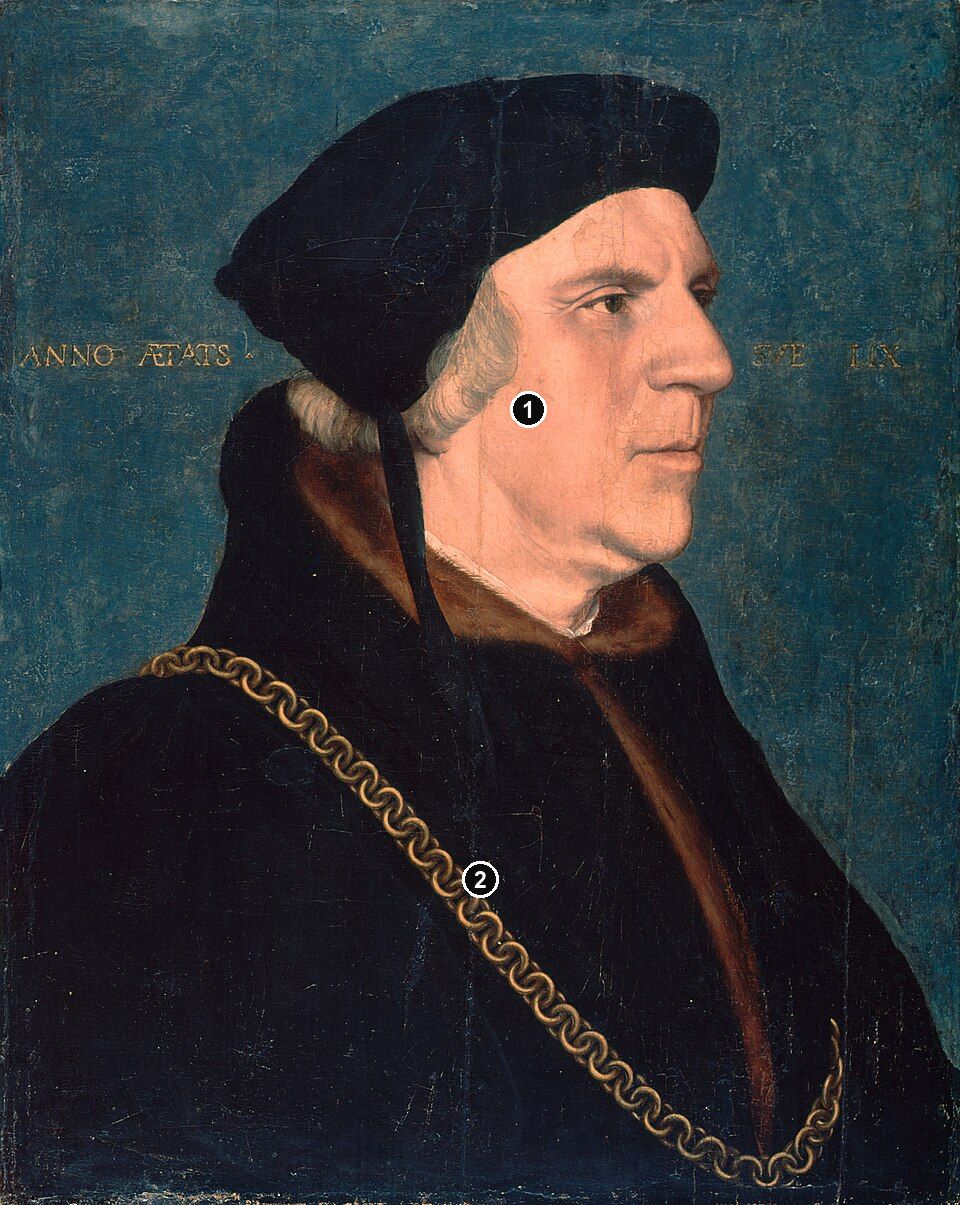
A gold chain travels across a great expanse of black cloth. Above it, a pale face turns towards the edge of the picture, its watchful eye, long nose and firmly closed mouth given unusual clarity by the blue-green background. Holbein leaves the hands outside the frame. Everything depends on the relationship between the head and the weight of the clothing beneath it.
The sitter was a physician to Henry VIII. His portrait belongs with that of his wife, Margaret Bacon, Lady Butts, and both are in the Isabella Stewart Gardner Museum in Boston. The museum currently dates the panels to about 1541–43, although a conflicting passage in its commentary needs care. [1] [2] Together they offer a close view of two people whose lives touched the Tudor court, without the architecture, ceremony or crowded company that might ordinarily make that world visible.
At a Glance
- Artist Hans Holbein the Younger
- Title Sir William Butts
- Date about 1541–43, provisionally following the current collection record
- Medium oil on panel
- Dimensions 46.8 × 37 cm
- Collection Isabella Stewart Gardner Museum, Boston
- Object number P21e1
- Companion Lady Margaret (Bacon) Butts , P21e5. [1] [2]
This work across Hans Holbein the Younger’s career
Dead Christ in the Tomb
1521–22 [4]Sir Thomas More
1527 [5]Georg Giese
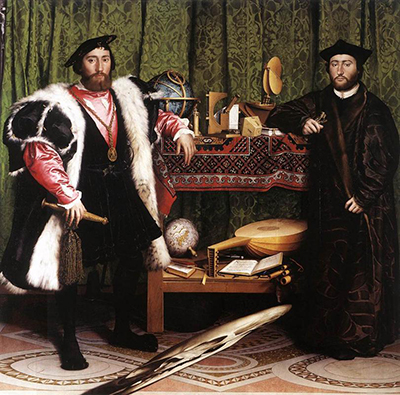
1532 [6]The Ambassadors
1533 [7]Portrait of Sir William Butts by Hans Holbein the Younger (current article)
about 1541–43, provisionally following the current collection recordContents
- The Face and Its Quiet Concentration
- Black Cloth, Brown Fur and Gold
- A Physician Within the Court
- Margaret Butts and the Meaning of a Pair
- From a Drawing to a Painted Portrait
- The Date and the Restored Inscription
- From Cornwall to Boston
- Annotated details
The Face and Its Quiet Concentration
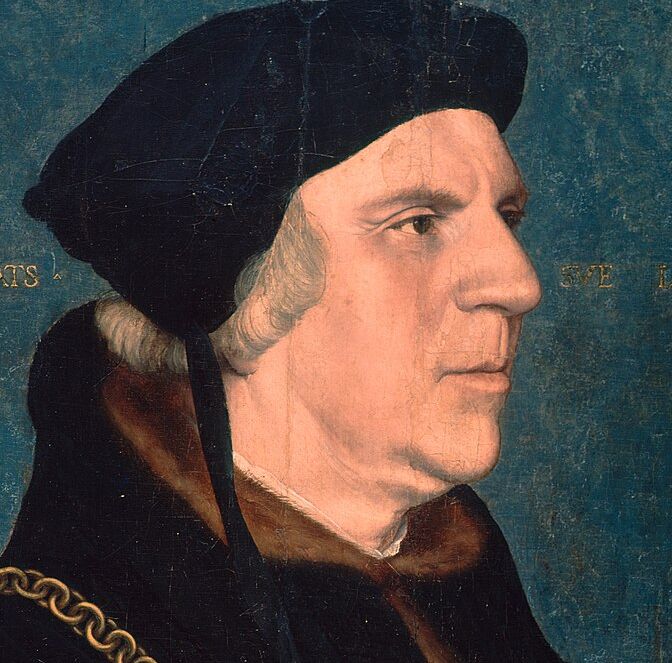
Butts looks towards our right. We see the broad nearer cheek and a sliver of the farther eye, so that the head remains a three-quarter view even though its outer contour is strongly emphasised. The nose reaches into the surrounding colour. Beneath it, a narrow shadow separates the upper lip from the mouth; the lower lip catches a little light before the chin turns back into shadow.
The outline alone would make him recognisable, but the face gains its presence from smaller changes within it. The skin over the cheek is warmer than the greyish area beside the ear. A crease passes down from the nose towards the mouth. The lower eyelid has weight, and the eyebrow lifts slightly above the nearer eye. These features give the head a particular structure without requiring a gesture or an exaggerated expression.
The pale hair is easy to overlook because the cap dominates the top of the picture. It emerges in small locks around the ear and at the nape, breaking the boundary between skin, headdress and fur. Against so much dark cloth, these fine strands become a second, quieter register of detail. The modelling of the face is broad enough to read from a distance; the hair rewards coming closer.
It is tempting to call such a sitter stern, weary or wise. His closed mouth certainly gives the portrait reserve, yet a painted expression cannot establish his temperament. More securely, we can see how Holbein makes attention itself compelling. The head is held upright, the gaze passes beyond us, and the mouth is still. Butts appears occupied with something to which we have no access. The lack of an explanatory action keeps our attention on the visible person.
Black Cloth, Brown Fur and Gold
The costume builds the portrait from large, simple forms. The cap spreads backwards in a broad dark curve, while the gown fills almost the whole lower half. Between them lies the illuminated face. The fur collar provides a warm intermediate colour, preventing the transition from skin to black clothing from becoming abrupt.
Within the darkness, the cap has a comparatively smooth surface and a definite outer edge. Across the gown, faint changes in tone suggest folds and the turn of the shoulder. The narrow strap descending beside the face is another kind of black: a linear element that joins the cap to the area of the collar. Looking for these distinctions makes the apparently plain costume more intricate.
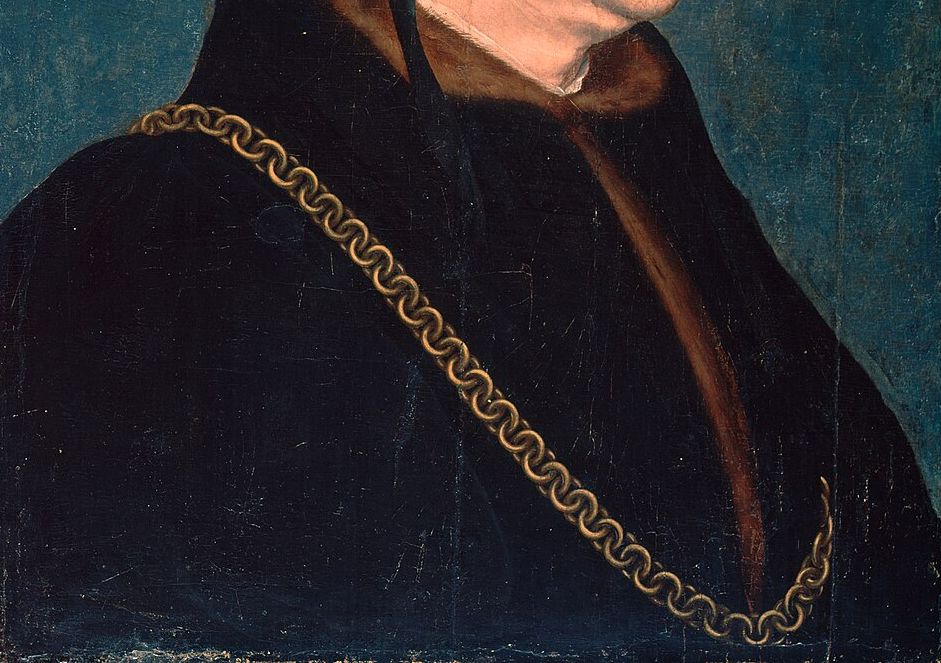
The gold chain supplies an entirely different rhythm. Its repeated links form a long curve that descends from the shoulder and returns towards the lower edge. Small bright touches separate one link from the next. The chain therefore reads both as an object with weight and as a pattern laid over the broad fabric. Its diagonal movement also carries the eye through an area that would otherwise be comparatively still.
This is an economical form of display. There is no array of jewels, embroidered sleeves or richly furnished interior. Yet the substantial garment, fur and conspicuous gold give Butts a commanding appearance. We need not identify the chain as a particular royal gift or order to recognise its visual role. It enlarges the sitter's presence, making the small upright panel feel ample and deliberate.
The dark shoulder occupies the lower left corner, while the face is displaced towards the right. This uneven balance matters. The figure feels turned rather than pinned flat against the background, and the sweep of the chain helps hold its different parts together. The arrangement gives movement to a motionless sitter.
Annotated Details from Portrait of Sir William Butts
The numbered points identify visible features discussed in this article. Return from each detail to the whole composition. Hans Holbein the Younger, Sir William Butts, about 1541–43, oil on panel, 46.8 × 37 cm. Isabella Stewart Gardner Museum, Boston, P21e1. Isabella Stewart Gardner Museum; Wikimedia Commons historical2012 reproduction. Image source . Public domain .
Details from PORTRAIT OF SIR WILLIAM BUTTS
Compare the cropped details with the complete images above. Notice how their colours, shapes and positions contribute to the larger compositions.
The turned head and broad cap
The broad black cap and warm fur frame the turned head. Compare the firm edge of the nose with the quieter changes along the cheek and mouth.
Gold links across black cloth
The chain makes a long curve across the dark gown. Each small link catches light differently, while broader changes of tone suggest the shoulder and folds beneath.
A Physician Within the Court
Butts's service to Henry VIII supplies the essential context for the portrait. [1] It also raises an interesting question: how does a physician become visible as a physician when there are no instruments, books or patients in the picture?
In this case, his profession is information we bring to the image. The painting presents a man in formal dress whose face and bearing have been carefully considered. It does not show him practising medicine. His identity can therefore change our reading of the same visible details. Once we know his occupation, the steady gaze may suggest observation, and the self-contained pose may seem appropriate to a trusted professional. Those are responses to the portrait, rather than evidence of his bedside manner.
Holbein's larger court world included portraits made for quite different purposes. Royal Collection Trust's exhibition account explains that his likenesses of potential royal brides were valued as trustworthy information in marriage negotiations. [9] Such commissions help us understand the importance of recognition at court. A likeness could carry practical and social weight as well as preserve appearance.
Butts's small panel brings that concern with a recognisable individual into a more concentrated setting. There is no need for an expansive court scene to establish that he belonged to this world. The portrait's authority rests in its combination of a distinctive head and an ordered public appearance. Its focus is personal, while its clothing allows the sitter to occupy a wider social position.
Watch: Holbein’s portraits and working methods
Explore museum films on Holbein’s drawings, painted portraits and close-looking details.
Hans Holbein at the court of Henry VIII
A Royal Collection Trust film exploring Holbein’s work at Henry VIII’s court.
Watch on YouTubeMargaret Butts and the Meaning of a Pair
The companion picture changes the scale of the encounter. Instead of one isolated court sitter, we have a married couple represented through two separate likenesses. A pendant portrait is a work conceived as a companion to another: the relationship between the pictures becomes part of the experience of looking.
Margaret's panel is almost the same size as William's. Her angular headdress and white collar give her image a different silhouette, with small details of embroidery and jewellery within the dark costume. The Gardner identifies her as Margaret Bacon, Lady Butts. [2] The pair share a measured dignity while allowing clothing and facial structure to distinguish each person.
The Royal Collection's related drawing adds to her identity. Its record describes Margaret as a daughter of John Bacon, a lady-in-waiting to Princess Mary and a member of Katherine Parr's circle. [10] She therefore had connections to the royal household in her own right. Reading the pictures together should make room for these parallel lives, rather than treating hers merely as an accessory to her husband's profession.
Pairing also offers a different kind of intimacy from an anecdotal scene of married life. The sitters do not embrace or share a domestic setting. Each occupies an individual panel, yet the similar scale encourages us to move between them, comparing a line of the mouth, the treatment of an eye or the framing of a face by dark clothing. The relationship is made through sustained attention to both people.
There is no need to invent a particular room in their home or an occasion for the commission. The pictures themselves give us enough to begin with: two distinct likenesses, comparable formats and a continuing association. Their survival together allows a marriage to remain visible through the arrangement of the objects as well as through the sitters' names.
From a Drawing to a Painted Portrait
Margaret's surviving portrait drawing, RCIN 912264, belongs to the Royal Collection and is dated about 1541–43. Its materials include black and coloured chalks, pen and brush work, and metalpoint on pale pink prepared paper. [10] It provides a useful companion to the painted pair because it brings the act of recording a face closer to view.
The Gardner describes the drawing as made from life and subsequently traced onto the panel for the painting. [2] The moment of observation preceded the longer work of making a finished portrait. A sitter did not have to remain before the painter through every stage of the painted costume and background.
Drawing and painting nevertheless offer different experiences. On paper, the worked head can be read against a comparatively open field. A finished panel places the face within a settled arrangement of dress, colour and edges. The likeness has to function within the whole object: it must sit convincingly beneath a headdress and above the dark mass of clothing, while retaining the specificity recorded in the study.
The surviving sheet concerns Margaret. It should not be silently turned into evidence for a surviving study of William. Holbein's portrait drawings reveal much about his working practice, but the history of each likeness still matters. Here, the drawing enriches our understanding of one half of the pair and invites us to look afresh at the carefully bounded forms of the other.
The Date and the Restored Inscription
The current Gardner record gives about 1541–43. Its commentary, however, proposes that William's portrait followed his knighthood in 1544. [1] These statements cannot both supply a straightforward date for an original painted by Holbein: he died in 1543, between 7 October and 29 November according to Royal Collection Trust's account. [9]
The museum's present object date is therefore the sensible provisional date to retain. The contradictory comment should remain a caution, without turning into a claim that Holbein painted the work after his death or that an otherwise undocumented later painter completed it. The discrepancy does not by itself establish a different attribution.
The gold lettering across the background adds another qualification. It gives the sitter's age as fifty-nine, but the Gardner explicitly records the inscription as restored. [1] It is useful evidence about how the portrait identifies its subject, while its present lettering must be distinguished from an untouched original inscription. An age is also different from a calendar date: combining it with a biographical birth year does not automatically produce an exact year of execution.
For the viewer, the lettering has a visual function as well. Its small gold capitals stretch across the open colour around the head, echoing the brighter chain below. The inscription gives the surrounding space a measured horizontal accent. The paint surface now carries both the image of a Tudor sitter and the history of how that image has been preserved.
From Cornwall to Boston
The published provenance places the pair with William Henry Pole-Carew at Antony House in Cornwall by 1880. After inheritance by Sir Reginald Pole-Carew, they passed through Colnaghi in 1899. Isabella Stewart Gardner bought them that June through Bernard Berenson. [1] [2]
This later history preserves the association between the portraits. Their movement into a museum was also a movement between settings and audiences. A likeness originally connected with particular people and their household became part of a collection encountered by visitors who might know neither name before seeing the pictures.
The pair rewards that unfamiliar viewer. The chain may attract attention first, followed by the clear contour of William's face. Margaret's picture then asks for an adjustment: a different headdress, a differently framed face, another set of small particulars. Together they slow the easy habit of seeing Tudor portraiture as an array of famous rulers and their ministers. Here the court comes into focus through a physician and a woman with her own place in its household networks.
Artworks directory
Explore paintings, drawings, prints and designs, including works without a separate article. Related studies and versions have their own entries; workshop works and copies are labelled. Print designs and series are grouped rather than repeated for every impression.
Frequently Asked Questions
He was a physician to Henry VIII, portrayed by Holbein in the painting now in Boston. [1]
No medical emblem is clearly displayed. The chain is a conspicuous element of dress, but his occupation is established by the sitter's documented identity. [1]
Discussion
Look again at the images and ideas explored in Portrait of Sir William Butts by Hans Holbein the Younger. These editorial prompts invite your observations.
Reader Insights
Trace the curve of the gold links. How does their movement affect the balance between the broad shoulder and the turned head?
Compare the cap, strap and gown. Which changes of edge and tone make these dark forms feel different?
How does knowing that Margaret has a separate, matching portrait change your response to William's self-contained appearance?
Join the Conversation
What holds your attention longest in this portrait: the face, the clothing or the relationship with Margaret's panel? Share a detail that makes the sitter feel particular to you.
References
- Isabella Stewart Gardner Museum , Sir William Butts , about 1541–43, oil on panel, P21e1; object details, inscription, provenance and commentary. View source .
- Isabella Stewart Gardner Museum , Lady Margaret (Bacon) Butts , about 1541–43, oil on panel, P21e5; object details, provenance and commentary. View source .
- Kunstmuseum Basel, Bildnis des Bonifacius Amerbach, 1519, inventory 314 (in German) . View source .
- Kunstmuseum Basel, Der tote Christus im Grab, 1521–22, inventory 318 (in German) . View source .
- The Frick Collection, Sir Thomas More, 1527, accession 1912.1.77, collection record . View source .
- Gemäldegalerie Berlin, Georg Gisze . View source .
- Susan Foister, The Ambassadors, The German Paintings before 1800 (2024) . View source .
- Susan Foister, Christina of Denmark, Duchess of Milan (2024) . View source .
- Royal Collection Trust , Holbein at the Tudor Court , large-print exhibition labels, 2023; sections on painting the royal family and Holbein's death. View source .
- Royal Collection Trust , Margaret, Lady Butts (c.1485–1545) , about 1541–43, RCIN 912264; collection record. View source .
- Würth Collection, Holbeins Schutzmantelmadonna, inventory 14910, current owner account (in German) . View source .
- Metropolitan Museum, Dance of Death series . View source .
- Kunstmuseum Basel, Bildnis der Frau des Künstlers mit den beiden ältesten Kindern, about 1528–29, inventory 325 (in German) . View source .
- Kunsthistorisches Museum Wien, Next Generation, Jane Seymour, about 1536–37, inventory 881 (in German) . View source .
- Splash image , Hans Holbein the Younger, Sir William Butts, about 1541–43, oil on panel, 46.8 × 37 cm. Isabella Stewart Gardner Museum, Boston, P21e1. Isabella Stewart Gardner Museum; Wikimedia Commons historical2012 reproduction. Image source . Public domain .