by
Tom Gurney
Tom Gurney BSc (Hons) is an art history expert with over 20 years experience
Email:
tomgurney1@gmail.com
/ Phone:
+44 7429 011000
Portrait of Sir Richard Southwell by Hans Holbein the Younger: Introduction
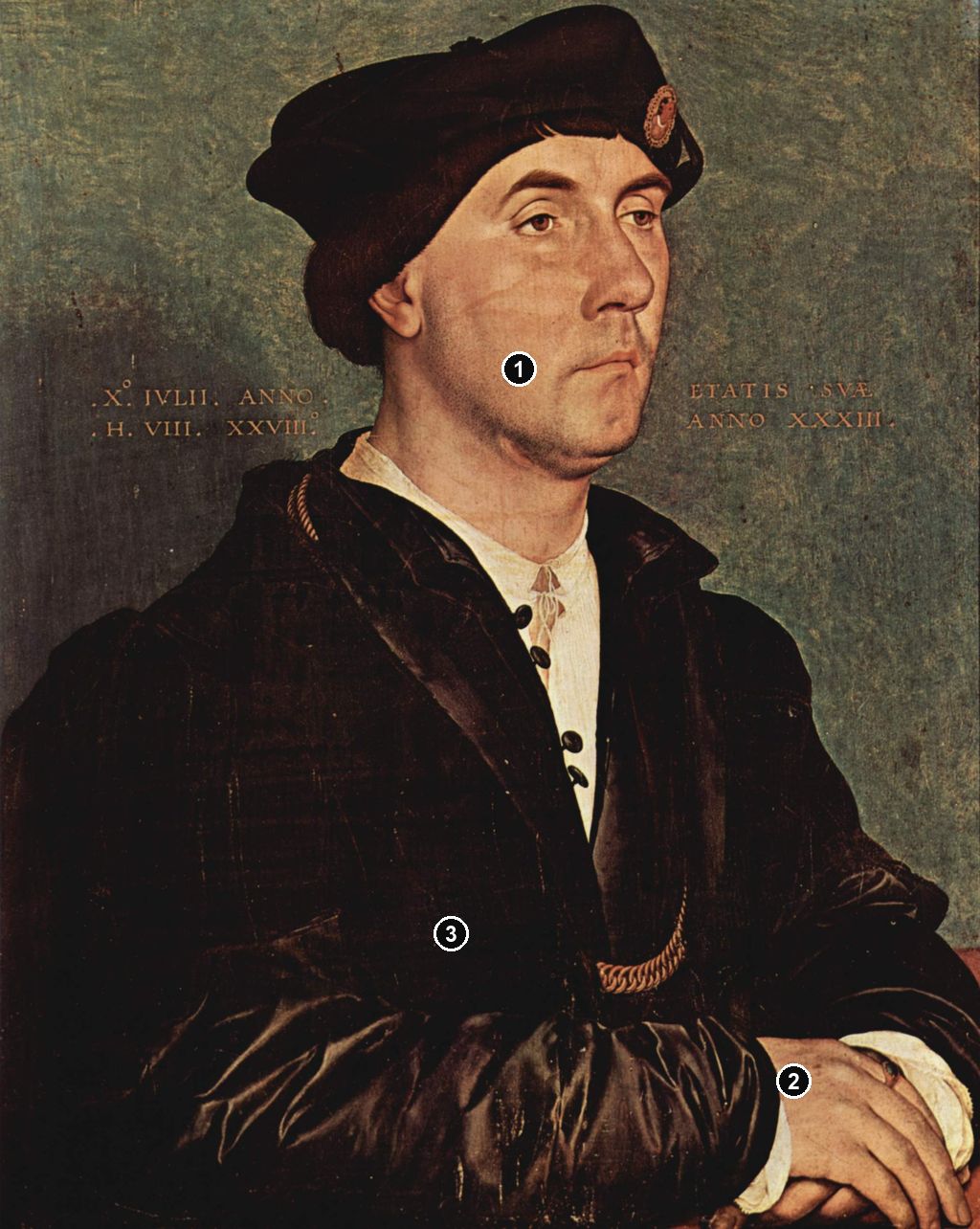
A narrow strip of white shirt divides the dark clothing; a gold chain drops towards the folded arms. Above them, Richard Southwell’s face turns into the light, its contours held between a broad black cap and a grey-green background. Hans Holbein the Younger gives weight to each part of the figure while leaving the space around him almost empty. We encounter the man through the particular shapes of his features, the textures he wears and the small objects that catch the light.
Painted in 1536, the portrait is now in the Uffizi Galleries in Florence. At 47.5 × 38 cm, it concentrates a substantial presence within a relatively modest panel. [1] A surviving preparatory drawing in the Royal Collection allows us to follow some of the decisions that preceded its painted surface. [2] The two works let us follow a turn of the head, a shirt opening and a few strokes of colour becoming a chain.
At a Glance
- Artist Hans Holbein the Younger.
- Title Portrait of Sir Richard Southwell , also catalogued as Richard Southwell .
- Date 1536.
- Medium Oil on panel.
- Dimensions 47.5 × 38 cm, unframed.
- Collection Gallerie degli Uffizi, Florence. [1]
- Related work Preparatory drawing, 1536, Royal Collection, RCIN 912242. [2]
- Distinguishing details Gold chain, decorated hat badge, folded hands and inscriptions flanking the head.
This work across Hans Holbein the Younger’s career
Dead Christ in the Tomb
1521–22 [4]Sir Thomas More
1527 [5]Georg Giese
1532 [6]The Ambassadors
1533 [7]Contents
- A figure held within a small panel
- The face and the limits of expression
- Dark clothes, bright edges
- The small image on the hat
- A date in the king’s reign
- From the surviving drawing to paint
- Southwell in Florence
- Annotated details
A figure held within a small panel
Southwell occupies nearly the entire picture. The cap approaches the top edge, the arms spread towards the lower corners, and the hands meet the boundary below. His body seems broad and stable, but the head turns towards the viewer’s right. That turn makes the composition more active than the arrangement of the arms initially suggests. The eyes continue in the direction of the face, towards a point beyond the picture.
The upper and lower halves have different rhythms. Across the top, the cap establishes a long, irregular horizontal shape. Its soft folds broaden the head without following its outline exactly. Below, the opening of the coat descends in a narrow wedge, drawing the eye towards the chain and the crossed forearms. The pale hands then lead us sideways again. These changes of direction prevent the large areas of dark clothing from settling into a single inert mass.
The background supplies no room, window or landscape. It leaves the outline of the head exceptionally clear. Around the far cheek and nose, the space opens up; behind the nearer side, the cap and shoulder press more closely towards the edge. Southwell therefore feels slightly displaced from the centre even though his torso fills the panel. We see both the breadth of his body and the direction of his attention.
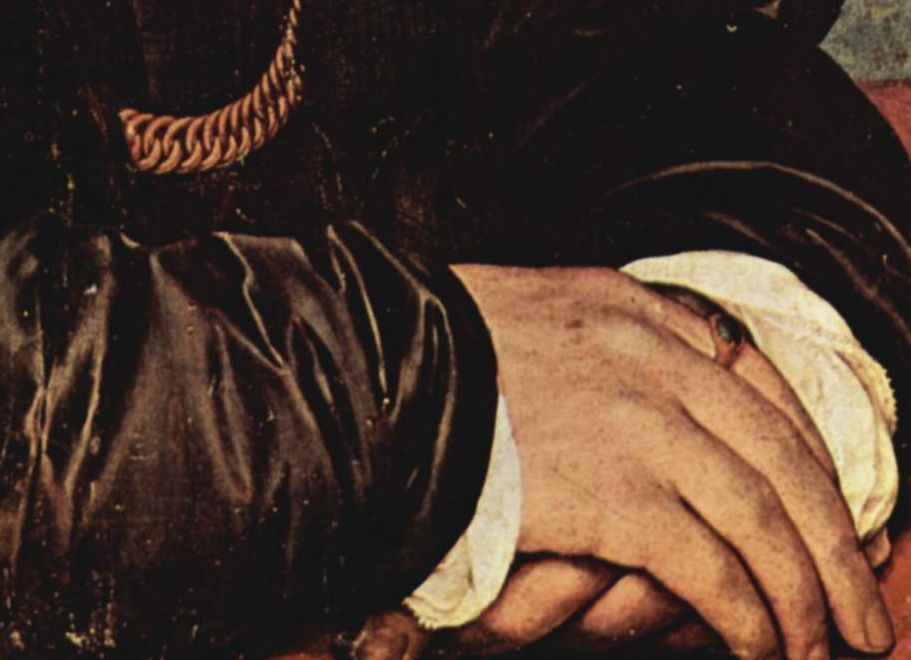
Nothing held in the hands explains his occupation. There is no document to read, no seal being pressed, no object offered to the viewer. The hands rest together, with a small ring adding a glint near the white cuff. This restrained arrangement gives the face a larger share of our attention. It also leaves the portrait’s social information to the dress, jewellery and lettering.
The face and the limits of expression
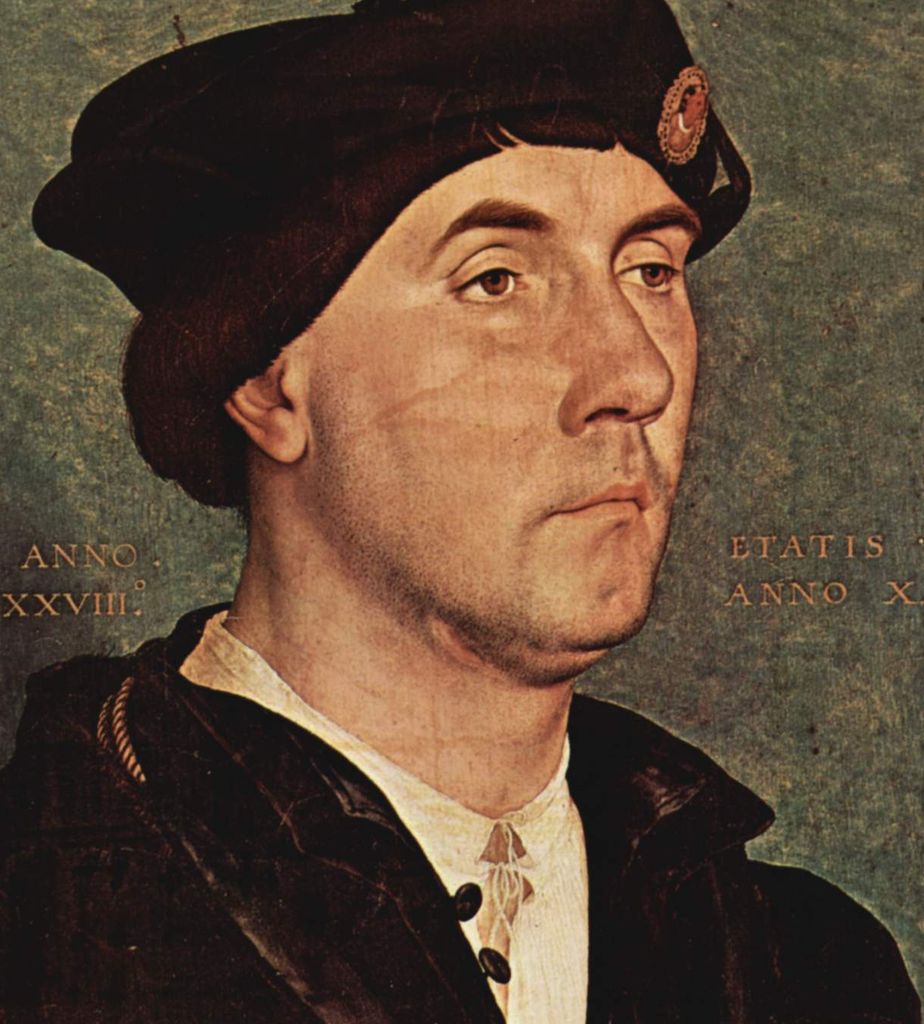
Holbein describes a face through differences that are easy to overlook: the narrower appearance of the farther eye, the projection of the lower lip, the shadow beneath the chin and the short fringe emerging from under the cap. The nose is strongly defined against the background, yet the passage across the cheek is much softer. A crisp edge and a gradual change of tone cooperate to make the head feel solid.
The eyes deserve a closer look. Pale areas around the irises keep them distinct from the surrounding flesh, while fine dark lines articulate the lids. The nearer eyebrow has a fuller sweep than the farther one, following the turn of the brow. Small shifts like these keep the head from becoming a symmetrical mask. Its angle is worked out through unequal shapes, rather than through an exaggerated twist of the neck.
The mouth is closed, with the lips meeting in a fine, uneven line. Above it, the flesh is lightly shaded; below, a small shadow marks the projecting lower lip before the chin rounds out. These modest transitions carry much of the likeness. The longer we look, the more the face depends on relationships between adjacent forms rather than on a single striking feature.
Southwell’s appearance has often tempted viewers to read a political personality into the portrait. The Royal Collection cautions against that approach. [2] Stillness can seem reserved, self-possessed or uncomfortable according to the expectations we bring to it. The image cannot settle those judgements. It can show how Holbein shaped the mouth and eyes, and how their position within a steady composition affects our encounter with the sitter.
Annotated Details from Portrait of Sir Richard Southwell
The numbered points identify visible features discussed in this article. Return from each detail to the whole composition. Hans Holbein the Younger, Portrait of Sir Richard Southwell, 1536, oil on panel, 47.5 × 38 cm. Gallerie degli Uffizi, Florence. Uffizi Galleries; The Yorck Project/Wikimedia Commons. Image source . Public domain .
Details from PORTRAIT OF SIR RICHARD SOUTHWELL
Compare the cropped details with the complete images above. Notice how their colours, shapes and positions contribute to the larger compositions.
The face below the broad cap
The cap’s long curve encloses the brow and cheek. Follow the small changes around the eyes, nose and mouth before returning to the wider silhouette.
Overlapping hands and white cuffs
The hands lie across one another near the lower edge. The small opening of the white cuff separates skin from the dark sleeve.
Light along the velvet sleeves
Narrow, warm highlights follow the sleeve’s raised folds. Broad dark areas and sharp ridges together describe the weight of the fabric.
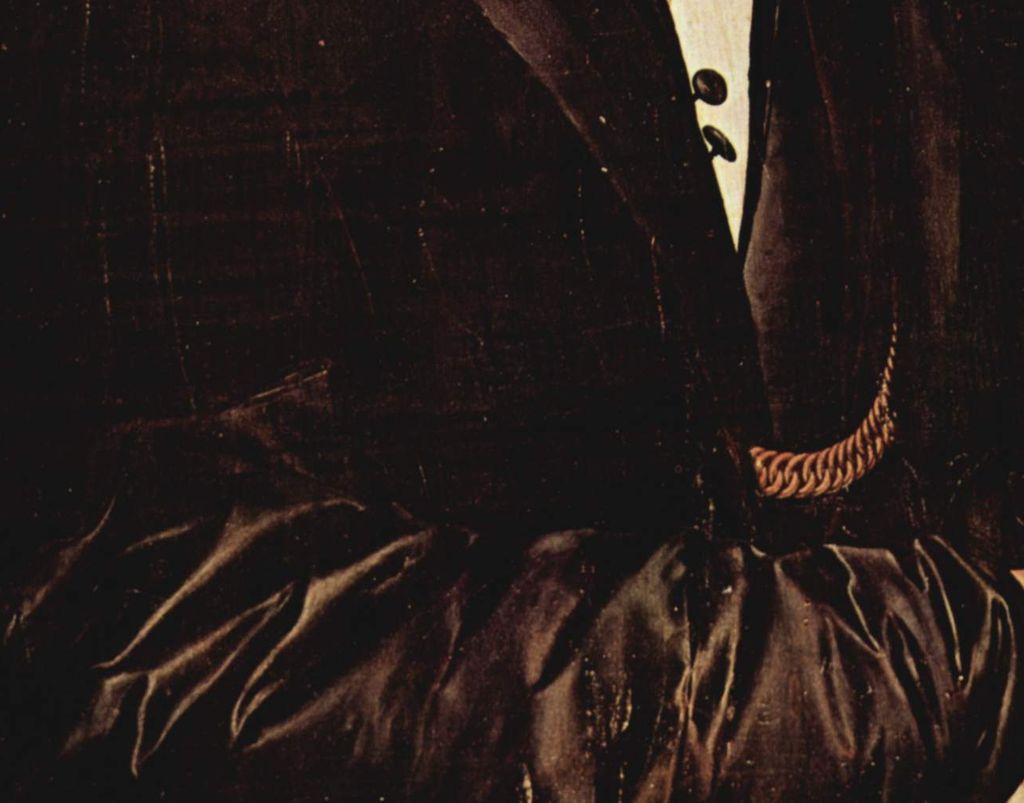
Dark clothes, bright edges
The costume is far from an undifferentiated black. Near the shoulders, the fabric is comparatively subdued; across the sleeves, narrow highlights open into long folds. Some are sharp and bright, others spread into softer brownish reflections. These changes suggest surfaces catching the light at different angles, giving volume to arms that might otherwise disappear into the coat.
The sleeve nearest us is especially expansive. Its gathered fabric moves down towards the wrist through a sequence of ridges and hollows. Beside it, the white cuff makes the hand appear warmer and more substantial. The transition from dark sleeve to light cuff and then to skin is one of the clearest demonstrations of Holbein’s control of neighbouring textures. Cloth can look smooth, rumpled or heavy without being described everywhere at the same level of detail.
At the neck, the shirt appears in a slender opening. Fine ties and small dark fastenings break up its pale surface. The opening narrows as it descends, so the shirt becomes a strong compositional line as well as a garment. Its brightness connects the head to the lower part of the body, drawing us through the darkest region of the picture.
The gold chain follows a different path. It is visible near one shoulder before reappearing more fully across the chest. Individual links gather into a bright curve above the forearms. The Uffizi identifies it as a curb-link chain, accompanying the hat ornament in Southwell’s presentation as a royal official. [9] Even at a distance, its colour gives it a clear identity; closer up, the interlocking shapes give that colour weight and structure.
The clothing also helps us judge the scale of the face. Broad sleeves, a wide cap and a substantial torso surround the more delicately described features. The few bright objects never overwhelm the head. They establish a person equipped for public appearance, while Holbein keeps our attention returning to the living surface above the collar.
Watch: Holbein’s portraits and working methods
Explore museum films on Holbein’s drawings, painted portraits and close-looking details.
Hans Holbein at the court of Henry VIII
A Royal Collection Trust film exploring Holbein’s work at Henry VIII’s court.
Watch on YouTubeThe small image on the hat
A round ornament sits near the cap’s edge above Southwell’s forehead. In the full portrait it is a small reddish and gold accent. Its position makes it conspicuous: it interrupts a dark silhouette close to the eyes, where a viewer is already likely to linger. The chain lies within the body’s larger shape; the badge projects into the boundary between head and background.
The Uffizi’s jewellery study describes the ornament as a composite jewel combining carved hardstone with gold and enamel, depicting a dark-skinned woman in an elaborate headdress. The museum proposes that the figure carries a pun on Thomas More’s surname, linking the badge to Southwell’s involvement in the events surrounding More’s fall. This is an interpretation of the painted object, rather than a documented explanation left by Southwell or Holbein. [9]
The distinction matters because a recognisable type of jewel and its proposed private meaning are different kinds of evidence. The badge plainly contributes to the sitter’s dress. Its placement is also visually effective, answering the warm tones of the face and the gold farther down the picture. A specific political message requires a further step of interpretation.
Look again at its scale. Holbein has placed a miniature human image beside the much larger portrait of Southwell. The difference encourages a change in viewing distance: the overall figure can be taken in at once, while the ornament asks for a closer approach. Whatever associations its original viewers might have recognised, the badge rewards attention as a small worked object represented within a larger painted one.
A date in the king’s reign
Lettering appears on either side of the head. On the left, the inscription gives 10 July in the twenty-eighth year of Henry VIII’s reign; on the right, it records Southwell’s age as thirty-three. The dated painting belongs to 1536. [1] [9] The words establish two measures of time around the same face: the sitter’s life and the reign under which he served.
Their position helps make them part of the composition. They occupy the open spaces beside the neck without spreading across the face or cap. Their warm colour sits between the muted background and the gold of the jewellery. Short rows of upright letters offer another kind of precision alongside the softer modelling of the skin.
Southwell was a Norfolk landowner and Justice of the Peace. In the year of the portrait, he became a Receiver in the Court of Augmentations, a court established to handle the transfer of monastic lands to the Crown. [2] [10] His presence belongs within the administrative as well as the ceremonial world of Henry VIII’s court.
This context gives the plain background particular interest. The picture offers no setting in which official business takes place. Public identity is carried on the body, through costly appearance, the contained arrangement of the hands and the inscription’s reference to the king. We can recognise that presentation without imagining an otherwise undocumented meeting, commission ceremony or intended room.
Lettering also appears on the preparatory drawing. [2] In the painting, it has become part of a balanced surface. The words remain readable, yet their spacing lets the head retain its primacy: the record of a person is organised around the person’s painted presence.
From the surviving drawing to paint
In the Royal Collection sheet, Southwell’s head is closely described above an open network of costume lines. The 1536 drawing combines chalks and ink on pink prepared paper. [2] Its light surface changes the whole encounter. We see the face emerging from a field of warm paper, with the body indicated through boundaries rather than filled with dark material.
Compare the outline of the cap, the turn of the nose and the opening of the shirt. The relationship is immediately recognisable. The painting expands the likeness downwards into sleeves, hands and overlapping fabrics, but the drawn arrangement already holds much of the information that makes the finished figure convincing. A small turn in a collar line can be as useful a point of comparison as the larger contour of a cheek.
Victoria Button’s technical study observes the close correspondence between Southwell’s drawn and painted attire. She also identifies indentations along much of the costume, including the buttons, and in limited areas around the ear, nape and fringe. These are evidence of tracing, although the precise tools and materials remain uncertain. [11] The surviving sheet was a working object, with physical traces of use alongside the marks that describe the sitter.
The comparison becomes especially rewarding around the chain. On paper, a touch of yellow indicates gold near the shoulder; in the painting, the links become a substantial feature crossing the dark clothes. [11] Colour has developed from a brief indication into an object with volume, reflected light and a clear place in the figure’s dress.
There is written information too. Beside the drawn head, Holbein noted that Southwell’s eyes were “a little yellowish”, in the Royal Collection’s translation of his German. [2] The reminder singles out a particular shade within the broader relationship between study and painting. A tiny written observation sits beside the closely worked eyes.
The two works give different pleasures. In the drawing, the changes in finish reveal the distribution of attention across the sheet. In the painting, the varied passages are brought into a more continuous surface. The darker costume makes the face appear more luminous, and the arms provide a substantial base for the head. Seeing them together lets us appreciate how much the finished portrait gained from decisions that remain economical and legible on paper.
Southwell in Florence
Today, the painting belongs to the Uffizi’s collection of northern European art. It was listed in the Getty’s 2021 Holbein: Capturing Character exhibition checklist, with Florence’s Gallerie degli Uffizi named as the collection. [1] That modern exhibition context brought its concentrated likeness into a broader examination of Holbein’s portraits and the objects through which people presented themselves.
The Uffizi has also considered how a frame changes the encounter. In March 2025, the museum included Southwell’s portrait among northern European paintings provided with newly made black frames based on historical Flemish types. [12] This is a modern act of presentation, rather than the recovery of a documented original frame for the portrait.
A dark surround has a particular resonance here because the painting already moves between dark dress, pale flesh and a muted background. It can make us more conscious of the edges that Holbein uses within the image: the cap against the space above, the white shirt against the coat, the hands against the sleeves. A frame does more than mark where a painting ends; it affects the first visual step we take towards it.
Return to the hands. Their pale shapes draw the eye across the lower edge, then the chain and shirt lead it back towards the face. The portrait allows this circuit to repeat without becoming predictable. A fold, a fastening or the tiny image on the cap can interrupt it, bringing a different part of Southwell’s painted presence into view.
Artworks directory
Explore paintings, drawings, prints and designs, including works without a separate article. Related studies and versions have their own entries; workshop works and copies are labelled. Print designs and series are grouped rather than repeated for every impression.
Frequently Asked Questions
The painting is in the Gallerie degli Uffizi in Florence. [1]
It dates to 1536 and measures 47.5 × 38 cm without its frame. The medium is oil on panel. [1]
The Uffizi proposes a wordplay connecting its depicted figure with Thomas More’s surname. That reading remains an attributed interpretation of the jewel. [9]
Yes. RCIN 912242 in the Royal Collection is the study for this painting. [2]
Discussion
Look again at the images and ideas explored in Portrait of Sir Richard Southwell by Hans Holbein the Younger. These editorial prompts invite your observations.
Reader Insights
Trace the white shirt from the neck towards the chain. Notice how this small area connects the upper and lower parts of the portrait.
Look from Southwell’s face to the tiny figure on his cap. How does the change in scale affect the attention each image receives?
Choose a fastening visible in the drawing and painting. Follow how an economical outline becomes part of a complete garment.
Join the Conversation
Which detail most changes your impression of Southwell’s portrait when you look closely: the hands, the dark sleeves, the lettering or the hat badge? Describe what you see and how it contributes to the whole figure.
References
- J. Paul Getty Museum , Holbein: Capturing Character , exhibition checklist, 2021, entry 31, printed p. 6, Richard Southwell , 1536. View source .
- Royal Collection Trust , Hans Holbein the Younger, Sir Richard Southwell (1502/3–1564) , 1536, RCIN 912242; collection record and commentary adapted from The Northern Renaissance: Dürer to Holbein , 2011. View source .
- Kunstmuseum Basel, Bildnis des Bonifacius Amerbach, 1519, inventory 314 (in German) . View source .
- Kunstmuseum Basel, Der tote Christus im Grab, 1521–22, inventory 318 (in German) . View source .
- The Frick Collection, Sir Thomas More, 1527, accession 1912.1.77, collection record . View source .
- Gemäldegalerie Berlin, Georg Gisze . View source .
- Susan Foister, The Ambassadors, The German Paintings before 1800 (2024) . View source .
- Susan Foister, Christina of Denmark, Duchess of Milan (2024) . View source .
- Gallerie degli Uffizi , Gioielli agli Uffizi , sections 67–68, Ritratto di Sir Richard Southwell (in Italian). View source .
- The National Archives , Political history in the Early Modern era: an overview , section on government departments and law courts. View source .
- Victoria Button , The Portrait Drawings of Hans Holbein the Younger: Function and Use Explored through Materials and Techniques , PhD thesis, Royal College of Art, 2013, printed pp. 188, 203–204 and Table 20, pp. 296–297. View source .
- Gallerie degli Uffizi , Uffizi, futuro nell’Antico. Le cornici dei maestri d’Oltralpe , 25 March 2025 (in Italian). View source .
- Würth Collection, Holbeins Schutzmantelmadonna, inventory 14910, current owner account (in German) . View source .
- Metropolitan Museum, Dance of Death series . View source .
- Kunstmuseum Basel, Bildnis der Frau des Künstlers mit den beiden ältesten Kindern, about 1528–29, inventory 325 (in German) . View source .
- Kunsthistorisches Museum Wien, Next Generation, Jane Seymour, about 1536–37, inventory 881 (in German) . View source .
- Splash image , Hans Holbein the Younger, Portrait of Sir Richard Southwell, 1536, oil on panel, 47.5 × 38 cm. Gallerie degli Uffizi, Florence. Uffizi Galleries; The Yorck Project/Wikimedia Commons. Image source . Public domain .