by
Tom Gurney
Tom Gurney BSc (Hons) is an art history expert with over 20 years experience
Email:
tomgurney1@gmail.com
/ Phone:
+44 7429 011000
Unidentified Man, perhaps George Cornwall, by Hans Holbein the Younger: Introduction
A young man's profile emerges from a sheet whose lower half is almost empty. His cap is a dense sweep of black; his hair is described strand by strand. Below the sharply outlined nose, a curling moustache gives way to a lightly shaded chin. The neck and clothing dissolve into faint lines. That uneven distribution of attention brings us close to Holbein's work of recording a face.
The Royal Collection now titles this drawing Unidentified man, perhaps George Cornwall , with the tentative date c.1543?. The familiar name Simon George of Cornwall is an older identification. [1]
At a Glance
- Artist Hans Holbein the Younger.
- Current title Unidentified man, perhaps George Cornwall .
- Traditional identification Simon George of Cornwall.
- Date c.1543?.
- Medium Black and coloured chalks with black and brown inks on pink prepared paper.
- Dimensions 27.9 × 19.1 cm, sheet.
- Collection Royal Collection, RCIN 912208. [1]
This work across Hans Holbein the Younger’s career
Dead Christ in the Tomb
1521–22 [3]Sir Thomas More
1527 [4]Georg Giese
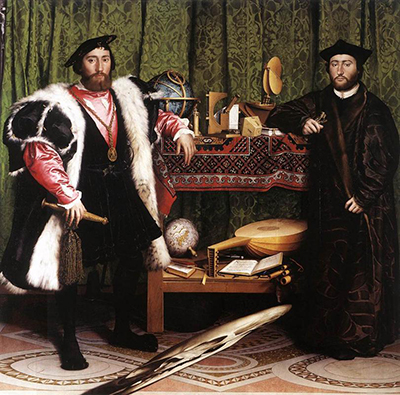
1532 [5]The Ambassadors
1533 [6]Contents
- Following the profile
- What happened to Simon George?
- Chalk, ink and the colour of the paper
- From a working sheet to a painted roundel
- Tracing the likeness
- Carnation, costume and a possible marriage
Following the profile
Start at the cap and follow its curve towards the forehead. The solid black shape establishes the head's tilt, while a few pale marks within it preserve the sense of a worked surface. Beneath its projecting brim, the forehead, nose and upper lip make a sequence of small changes in direction. Those turns are so clearly drawn that the face reads immediately against the bare paper.
The eye occupies a much smaller area, yet it anchors the whole likeness. A dark upper lid gives weight to the gaze; lighter shading below prevents the eye from becoming an isolated mark. Behind it, the ear is carefully articulated inside the rounded mass of hair. Individual strands change direction as they move over the crown and down towards the nape. They describe the shape of the skull as well as the texture of the hair.
The moustache introduces another kind of line: thicker, warmer and curled at the end. Look further down and the drawing becomes less definite. The neck remains legible through a few contours and shadows, but the shoulder and collar are barely established. The differences in finish let the eye travel between concentrated description and suggestion.
What happened to Simon George?
The inscription beneath the portrait reads “S. George of Cornwall”. It is an eighteenth-century copy of an earlier label. The Royal Collection questions the traditional expansion to Simon, for whom no contemporary record has been found. George Vertue recorded “Sir George Cornwall” in 1743. A naval commander of that name, knighted in 1544, is a possible candidate. [1]
A name written beneath a portrait looks reassuringly definite. Here, however, the small initial carries a great deal of historical weight. Reading it as the beginning of a forename produces one identity; reading the inscription through Vertue's record allows another. The face cannot adjudicate between them. Holbein's precision preserves a particular appearance, but appearance alone cannot supply a missing biography.
This distinction helps when encountering older reproductions or books. The familiar title remains useful for recognising the drawing, provided it is understood as a traditional identification.
Chalk, ink and the colour of the paper
The sheet's pink preparation supplies a starting flesh tone. In their account of Holbein's portrait drawings , Royal Collection conservators Rachael Smith and Victoria Button explain how a coloured surface reduced the amount of material needed to model a face. Chalk could establish a likeness quickly; darker or lighter additions developed its form. Their broader study also stresses the variety of Holbein's methods. Each portrait needs to be examined individually. [8]
Button's technical examination of this particular drawing explains how its different textures were made. Red chalk helps define the nose, lips, ear and cheek. Yellow and red chalk contribute to the facial hair, with fine black brushwork laid over them. The hat contains a much denser application of black, while the eye includes watercolour. These observations show why the sheet resists the impression of a single, uniform drawing material. [9]
Compare the softness of the cheek with the crisp edge of the nose. Both describe flesh, but they do so through different marks. Across the face, faint transitions suggest rounded volume; along its boundary, a narrow dark line makes the profile exact. In the hair, repeated strokes perform both tasks at once. They establish a contour and fill it with an active pattern. Looking at these passages in turn reveals how much variety Holbein could gather within a small head.
Watch: Holbein’s portraits and working methods
Explore museum films on Holbein’s drawings, painted portraits and close-looking details.
Hans Holbein at the court of Henry VIII
A Royal Collection Trust film exploring Holbein’s work at Henry VIII’s court.
Watch on YouTubeFrom a working sheet to a painted roundel
The related painting is in Frankfurt's Städel Museum, inventory 1065. Its current title retains a question mark: Portrait of Simon George of Cornwall (?) . The museum dates it broadly to c.1535–1543 and records mixed technique on oak, with a painted surface 31 cm in diameter. These are the details of the painting, distinct from those of the Royal Collection drawing. [10]
The comparison transforms the encounter. Against a blue background, the man wears an ornamented cap and richly described clothing. A full beard extends below his chin. His raised hand holds a red flower near his chest. The circular boundary gathers these details around the profile, making the head part of a complete, enclosed design.
In the drawing, the cap, hair and face dominate because so much around them remains faint. In the painting, the white feather, decorated collar and hand provide competing points of attention. The profile is still the organising feature, but its surroundings now tell a fuller story about dress and presentation. The distance between the two images is useful: a preparatory likeness could remain a point of reference while other elements developed.
Tracing the likeness
The physical sheet contains evidence of that further work. Button identified intermittent indentations at the ear, the back of the neck and parts of the clothing. She found that the tracing followed the application of the black liquid medium. Yet the principal facial contours, including the nose and lips, do not carry the same incised marks. The evidence is selective, and it does not support imagining every visible line mechanically retraced. [9]
Button also compared the drawing with the painting's underdrawing, the preparatory lines beneath its coloured surface. Some features align closely, including passages of the costume that were subsequently altered in paint. Other proportions differ. Her analysis makes the relationship between the two works tangible while allowing for adjustment during painting. She further notes that the underdrawing shows stubble, closer to the drawing than to the finished beard. [9]
This evidence gives the lightly indicated clothing a further interest. Button found that its black chalk lines have suffered abrasion, so their present faintness also reflects wear. [9] Lines that seem incidental to a modern viewer could supply practical information when a painting was begun. The drawing preserves several kinds of attention together: close observation of the face, summary indications elsewhere, and marks associated with its subsequent use.
Carnation, costume and a possible marriage
The Städel interprets the painting as a courtship portrait. It connects the carnation with the cap's clasp, which represents Leda and Jupiter in the form of a swan, and relates the circular profile format to antique coins. These are readings of the painted portrait and its accessories; the drawing contains no flower-bearing hand. [10]
The proposed identity also affects the date. If the man is George Cornwall, his marriage to Mary Brydges in 1543 would support a connection with Holbein's final year. That remains conditional. [1]
Returning to the drawing after seeing the roundel, the absence of those accessories becomes more noticeable. Here the eye has little to distract it from the measured profile, the close-cut hair and the transition from moustache to chin. The painting offers a possible occasion for the likeness. The sheet allows us to study the face with far fewer distractions.
Artworks directory
Explore paintings, drawings, prints and designs, including works without a separate article. Related studies and versions have their own entries; workshop works and copies are labelled. Print designs and series are grouped rather than repeated for every impression.
Frequently Asked Questions
No. The Royal Collection now calls him an unidentified man, perhaps George Cornwall. “Simon George” is the traditional identification. [1]
Button found that the black chalk costume lines are abraded. Their present appearance therefore reflects condition as well as the summary way they were drawn. [9]
The current Royal Collection record attributes the drawing to Hans Holbein the Younger. Its caution concerns the sitter's identity. [1]
Discussion
Look again at the images and ideas explored in Unidentified Man, perhaps George Cornwall, by Hans Holbein the Younger. These editorial prompts invite your observations.
Reader Insights
Trace the profile with your eye from forehead to chin. Where does a small change in the line contribute most to the likeness?
The hair is densely worked, the clothing faint. Consider how that difference guides the order in which you look.
Compare the moustache, beard and collar across the two works. Which change most affects your impression of the sitter?
Join the Conversation
Does the drawing's spare setting make the man feel closer than he does in the richly dressed painted portrait? Share the visible detail that shapes your response.
References
- Royal Collection Trust , Hans Holbein the Younger, Unidentified man, perhaps George Cornwall , c.1543?, RCIN 912208, current collection record. View source .
- Kunstmuseum Basel, Bildnis des Bonifacius Amerbach, 1519, inventory 314 (in German) . View source .
- Kunstmuseum Basel, Der tote Christus im Grab, 1521–22, inventory 318 (in German) . View source .
- The Frick Collection, Sir Thomas More, 1527, accession 1912.1.77, collection record . View source .
- Gemäldegalerie Berlin, Georg Gisze . View source .
- Susan Foister, The Ambassadors, The German Paintings before 1800 (2024) . View source .
- Susan Foister, Christina of Denmark, Duchess of Milan (2024) . View source .
- Rachael Smith and Victoria Button, Royal Collection Trust , “Holbein's portrait drawings”, sections on paper, preparation and drawing materials. View source .
- Victoria Button , The Portrait Drawings of Hans Holbein the Younger: Function and Use Explored through Materials and Techniques , PhD thesis, Royal College of Art, 2013, pp.188, 211–212 and Table 19, pp.294–295; the drawing is catalogued there under its earlier identification and date. View source .
- Städel Museum , Hans Holbein the Younger, Portrait of Simon George of Cornwall (?) , c.1535–1543, inventory 1065, Digital Collection, work data and “About the Work”. View source .
- Würth Collection, Holbeins Schutzmantelmadonna, inventory 14910, current owner account (in German) . View source .
- Metropolitan Museum, Dance of Death series . View source .
- Kunstmuseum Basel, Bildnis der Frau des Künstlers mit den beiden ältesten Kindern, about 1528–29, inventory 325 (in German) . View source .
- Kunsthistorisches Museum Wien, Next Generation, Jane Seymour, about 1536–37, inventory 881 (in German) . View source .