by
Tom Gurney
Tom Gurney BSc (Hons) is an art history expert with over 20 years experience
Email:
tomgurney1@gmail.com
/ Phone:
+44 7429 011000
Edward, Prince of Wales: the Portrait Drawings: Introduction
The boy looks straight towards us. His eyes and small, closed mouth remain clear, while his clothes almost disappear into the paper. A faint outline gives him shoulders and a collar; delicate strokes describe the hair beneath his cap. Holbein's drawing of the older Edward, Prince of Wales, now in the Royal Collection, has the directness of an encounter interrupted. Its rubbed surface also asks us to look carefully: some of the apparent simplicity belongs to the drawing's later history. The sheet dates from about 1540–43, several years after Holbein drew Edward as an infant. [1]
The earlier study belongs with the richly dressed baby in the National Gallery of Art, Washington. A circular profile painting in New York belongs to another stage of Edward's image and is now attributed to Holbein's workshop. Keeping these works apart reveals how a child's likeness could become a royal portrait, survive in a working collection and continue to circulate after its designer's death. [2] [3] [4]
At a Glance
- Principal work Edward, Prince of Wales (1537–1553) , RCIN 912201.
- Artist Hans Holbein the Younger.
- Date About 1540–43.
- Medium Black and coloured chalks, and pen and ink on pale pink prepared paper.
- Dimensions 27.3 × 22.7 cm, sheet of paper.
- Collection Royal Collection.
- Subject Edward, son of Henry VIII and Jane Seymour, later Edward VI.
- Condition The Royal Collection describes the drawing as much rubbed. [1]
- Earlier drawing RCIN 912200, dated 1538; black and red chalks with blue watercolour and black ink on pink prepared paper, 26.4 × 22.4 cm. [2]
This work across Hans Holbein the Younger’s career
Dead Christ in the Tomb
1521–22 [6]Sir Thomas More
1527 [7]Georg Giese
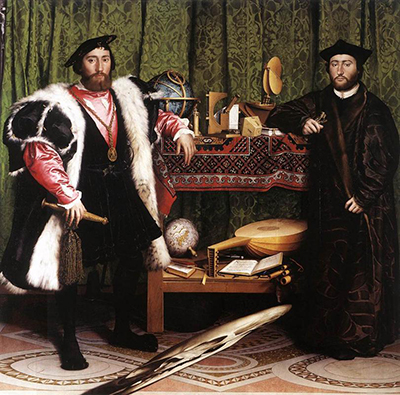
1532 [8]The Ambassadors
1533 [9]Contents
- The older prince meets our eye
- A coloured ground beneath the lines
- The infant study of 1538
- From a face study to a royal gift
- What the drawings reveal about making portraits
- A profile that outlived Holbein
- The sitter who inherited the drawings
The older prince meets our eye
The frontal pose gives the later drawing its unusual stillness. The head sits almost squarely above the neck, and the two eyes address the viewer across a broad, lightly modelled face. The small nose and mouth occupy little space beneath them. The upper body is suggested below the head, with no surrounding scene to direct our response.
Look at the changing strength of the marks. The eyelids, pupils, nostrils and division between the lips are readily legible. The cheeks are much harder to follow. Along the jaw, a contour establishes the lower face without enclosing it in a heavy border. Around the forehead, fine strokes and pale areas make hair, skin and cap more difficult to disentangle than the sharper features at the centre. Our attention repeatedly returns to the eyes because those small dark accents survive so distinctly.
The shoulders extend across the lower portion of the sheet, but the costume supplies little of the visual weight that clothing carries in Holbein's painted court portraits. A viewer familiar with his portraits of Henry VIII may expect jewels, rich fabrics and a commanding silhouette. Here the emphasis falls on a young face. That difference makes the drawing feel intimate, although intimacy is our response to the surviving image, not proof that the sitting was private or informal.
Edward's expression is similarly open to different readings. The slight irregularities around his mouth may suggest seriousness, curiosity or a moment of patience. They cannot tell us what he thought about being drawn. Nor should the faint complexion be used to diagnose his health. The condition of the sheet matters: the Royal Collection explicitly records extensive rubbing. Its present delicacy cannot reliably convey the strength of the original modelling. [1]
A coloured ground beneath the lines
Both Edward drawings were made on paper prepared with a pink coating. The colour is part of the drawing's construction. It supplies a middle tone from which darker marks can describe shadow and lighter touches can suggest illumination. Rachael Smith and Victoria Button, the Royal Collection's paper conservators, explain that such preparation reduced the amount of drawing needed to establish a sitter's complexion. Holbein varied his materials and handling between portraits; there was no single formula applied without adjustment. [11]
In the older Edward, the remaining pale field makes the face appear to emerge from its support. The cheek does not need to be filled with densely packed lines to be read as flesh. A few surviving accents give the nose a projection, separate the lips and set the eyes within the head. The viewer assembles a solid head from very little information.
The medium descriptions help distinguish the two studies. The later one is catalogued with coloured chalks and pen and ink; the infant sheet specifies black and red chalk, blue watercolour and black ink. These are drawings built from several kinds of mark, with differences of colour and density contributing to the likeness. A pale passage in a reproduction should not automatically be called untouched paper, or every dark accent assumed to be pencil. [1] [2]
For a wider view of this combination of materials, Holbein's portrait drawings offer a useful comparison. In Edward's case, however, the worn surface makes restraint especially necessary. The visible remnants support close looking more securely than an imagined reconstruction of every lost stroke.
The infant study of 1538
The earlier drawing, RCIN 912200, catches Edward at a younger age. His head is broader and rounder, with a high forehead, full cheeks and a tiny mouth. The face has a different angle and balance from the squarely confronting older child. Across the top, the outline of his headwear extends around the skull. The small features occupy a comparatively limited part of that large, rounded form.
This sheet is also faint. In her technical study, Victoria Button reports that little drawing material remains. She identifies surviving black chalk around the face and cap, red chalk at the eyes and lips, dark liquid accents in the features, and faint blue watercolour in the irises. Her examination gives a material basis for appreciating how selective the surviving image has become. [12]
The coloured ground can now seem more conspicuous than the modelling. That balance should not be mistaken for an intact record of Holbein's original priorities. Button distinguishes the survival of the paper from the considerable loss of the drawn image. The small amount of visible material is evidence of present condition as well as a reminder of economical handling. [12]
The name above the head belongs to a later stage too. The Royal Collection dates the inscription to the eighteenth century and identifies it as a copy of a mid-sixteenth-century original. It helps preserve the sitter's identity, but it is not Holbein's signature or a written record of the sitting made in 1538. [2]
Watch: Holbein’s portraits and working methods
Explore museum films on Holbein’s drawings, painted portraits and close-looking details.
Hans Holbein at the court of Henry VIII
A Royal Collection Trust film exploring Holbein’s work at Henry VIII’s court.
Watch on YouTubeFrom a face study to a royal gift
The infant drawing prepares for Edward VI as a Child in Washington. The National Gallery of Art dates the oil painting to probably 1538 and gives its dimensions as 56.8 × 44 cm. The relationship belongs to this earlier sheet; the later frontal drawing should not be presented as the study for the infant painting. [2] [3]
In the painted composition, the head is embedded in an elaborate arrangement of clothing and gesture. The broad red cap extends to one side, while a pale feather curves in the opposite direction. Gold patterning spreads over the sleeves. A white frill separates flesh from fabric at the neck and wrists. Below, a green cloth and an inscribed paper establish a horizontal base. These changes make the face part of a much fuller public presentation.
The hands are especially important to the effect. One opens towards us; the other rests close to a small golden sceptre. The infant's upright body, heavy costume and controlled gestures lend him an authority at odds with the smallness of his features. The National Gallery reads the raised hand as a blessing gesture and connects the portrait's form with royal and sacred imagery. The Latin verse by Richard Morison praises the father through the son and directs attention to succession. [3]
Edward was born on 12 October 1537 to Henry VIII and Jane Seymour . The painting is associated with Holbein's New Year's gift to Henry in 1539. The Gallery cites the surviving gift roll, which records a picture of the prince given by the artist. Its catalogue describes the Washington panel as apparently the portrait concerned. The connection is strong, but the surviving entry should not be made to say more about the painting's appearance than it records. [3]
Comparing drawing and painting brings the scale of the transformation into focus. A lightly recorded face could be developed within an image dense with dynastic meaning. The painted richness does not make the study incidental. The particular shape of the infant's cheeks, eyes and mouth anchors the ceremonial image in an individual child.
What the drawings reveal about making portraits
The Edward pair invites a distinction between likeness, design and transfer. A study can preserve the appearance of a sitter, inform a painted composition and provide a means of carrying contours to another support. Those functions can overlap without leaving the same evidence on every sheet.
Smith and Button describe Holbein's portrait studies as comparatively rapid work made before the sitter, available for the slower construction of paintings or miniatures. Such a division of labour explains the uneven attention visible in many drawings: a face might require sustained observation, while a garment could be recorded more briefly. It does not establish the duration or circumstances of either Edward sitting. [11]
The infant study has a documented relationship to a surviving painting, but Button found no signs of transfer on it. This is a useful limit. We can identify its preparatory purpose without claiming that Holbein pricked its outlines or pressed a stylus along them to make the Washington panel. Absence of visible transfer marks does not undo the relationship between the works; it leaves the precise means of moving from one to the other uncertain. [2] [12]
With the older sheet, it is particularly tempting to fill gaps by imagination. The faint clothing could seem to await a splendid completion, and the strong frontal face could suggest a finished portrait now lost. Neither observation identifies a particular painting. The drawing can be understood within Holbein's portrait practice without assigning it an undocumented destination.
Its incompleteness also changes our experience of the child. In the Washington painting, fabrics, hands and inscription guide attention towards inheritance and authority. Before the older drawing, the viewer spends longer with the spacing of the features and the fragile boundary of the face. The difference concerns what the surviving objects let us see, rather than a recoverable change in Holbein's feelings towards Edward.
A profile that outlived Holbein
Another frequently reproduced Edward is the circular painting in the Metropolitan Museum of Art, Edward VI (1537–1553), When Duke of Cornwall . It shows the prince in profile and is attributed to the workshop of Hans Holbein the Younger. The Met dates it to about 1545, reworked in 1547 or later. Its medium is oil and gold on oak, and its diameter is 32.4 cm. Its profile and circular format distinguish it immediately from the other works. [4]
The Met explains that technical evidence supports execution after Holbein's death by an assistant using an earlier design. It also identifies later changes to the costume. The boy's represented age and the panel's manufacture therefore need not coincide. An image can preserve a younger likeness while its materials and alterations belong to subsequent years. The museum connects the circular format and profile with the example of classical coinage. [4]
This is a revealing companion to the frontal study because it gives the head a different kind of presence. A profile makes the outer contour carry much of the identity; a frontal face distributes recognition across paired eyes, brows and cheeks. The distinction is immediately useful when sorting reproductions. A common sitter and the name Holbein do not make these images interchangeable.
The sitter who inherited the drawings
Edward's relationship to the sheets extended beyond posing. The Royal Collection records that he owned the book of Holbein portrait drawings, which included the infant study and a drawing of his mother. That association gives the collection a particular poignancy: images made through encounters with the artist became part of the young king's possessions. [2]
The drawings subsequently travelled through several collections. The Royal Collection's provenance links them with Henry FitzAlan, Earl of Arundel, and John, Lord Lumley, before their return to royal ownership. One important step remains qualified: Lumley's bequest to Henry, Prince of Wales, in 1609 is described as probable. Later exchanges and transfers brought the drawings through the collections of Pembroke and Thomas Howard, Earl of Arundel; Charles II had acquired them by 1675. [1] [2]
That history and the later inscriptions remind us that these are preserved, handled objects. Their present appearance joins Holbein's marks to wear and subsequent acts of identification. Looking back at the older prince's face, the rubbed passages become part of the encounter. The clear eyes remain surrounded by areas where information has thinned or disappeared. We see an individual likeness with remarkable immediacy, while the paper keeps the longer history of its survival.
Artworks directory
Explore paintings, drawings, prints and designs, including works without a separate article. Related studies and versions have their own entries; workshop works and copies are labelled. Print designs and series are grouped rather than repeated for every impression.
Frequently Asked Questions
It is RCIN 912201 in the Royal Collection, dated about 1540–43. Holbein used black and coloured chalks, and pen and ink on pale pink prepared paper. The sheet measures 27.3 × 22.7 cm. [1]
The Met currently attributes it to Holbein's workshop and dates it to about 1545, with reworking in 1547 or later. Its technical evidence supports execution after the artist's death, using an earlier design. [4]
Discussion
Look again at the images and ideas explored in Edward, Prince of Wales: the Portrait Drawings. These editorial prompts invite your observations.
Reader Insights
Notice how a few darker marks make the older prince's eyes seem present even where the surrounding modelling is faint.
Look at the frontal drawing beside the Met's profile: which features carry recognition in each view?
In the Washington painting, consider how the hands change the meaning of the infant's likeness.
Join the Conversation
Which Edward holds your attention longest: the faint infant study, the older boy looking forward, or the richly dressed child in the Washington painting? Describe one detail that shapes your response.
References
- Royal Collection Trust , Hans Holbein the Younger, Edward, Prince of Wales (1537–1553) , about 1540–43, RCIN 912201; object details, description and provenance. View source .
- Royal Collection Trust , Hans Holbein the Younger, Edward, Prince of Wales (1537–1553) , 1538, RCIN 912200; object details, description and provenance. View source .
- National Gallery of Art, Washington , Hans Holbein the Younger, Edward VI as a Child , probably 1538, Andrew W. Mellon Collection, 1937.1.64; object record, interpretation and provenance note 1. View source .
- The Metropolitan Museum of Art , workshop of Hans Holbein the Younger, Edward VI (1537–1553), When Duke of Cornwall , about 1545; reworked 1547 or later, The Jules Bache Collection, 1949, 49.7.31; current object record. View source .
- Kunstmuseum Basel, Bildnis des Bonifacius Amerbach, 1519, inventory 314 (in German) . View source .
- Kunstmuseum Basel, Der tote Christus im Grab, 1521–22, inventory 318 (in German) . View source .
- The Frick Collection, Sir Thomas More, 1527, accession 1912.1.77, collection record . View source .
- Gemäldegalerie Berlin, Georg Gisze . View source .
- Susan Foister, The Ambassadors, The German Paintings before 1800 (2024) . View source .
- Susan Foister, Christina of Denmark, Duchess of Milan (2024) . View source .
- Rachael Smith and Victoria Button, Royal Collection Trust , “Holbein's portrait drawings”; sections on portrait studies, prepared paper and drawing materials. View source .
- Victoria Button , The Portrait Drawings of Hans Holbein the Younger: Function and Use Explored through Materials and Techniques , PhD thesis, Royal College of Art, 2013, pp. 174–175 and 302, table 23, infant drawing RL12200. View source .
- Würth Collection, Holbeins Schutzmantelmadonna, inventory 14910, current owner account (in German) . View source .
- Metropolitan Museum, Dance of Death series . View source .
- Kunstmuseum Basel, Bildnis der Frau des Künstlers mit den beiden ältesten Kindern, about 1528–29, inventory 325 (in German) . View source .
- Kunsthistorisches Museum Wien, Next Generation, Jane Seymour, about 1536–37, inventory 881 (in German) . View source .