 by
Tom Gurney
Tom Gurney BSc (Hons) is an art history expert with over 20 years experience
Email:
tomgurney1@gmail.com
/ Phone:
+44 7429 011000
The Passion Altarpiece: Introduction
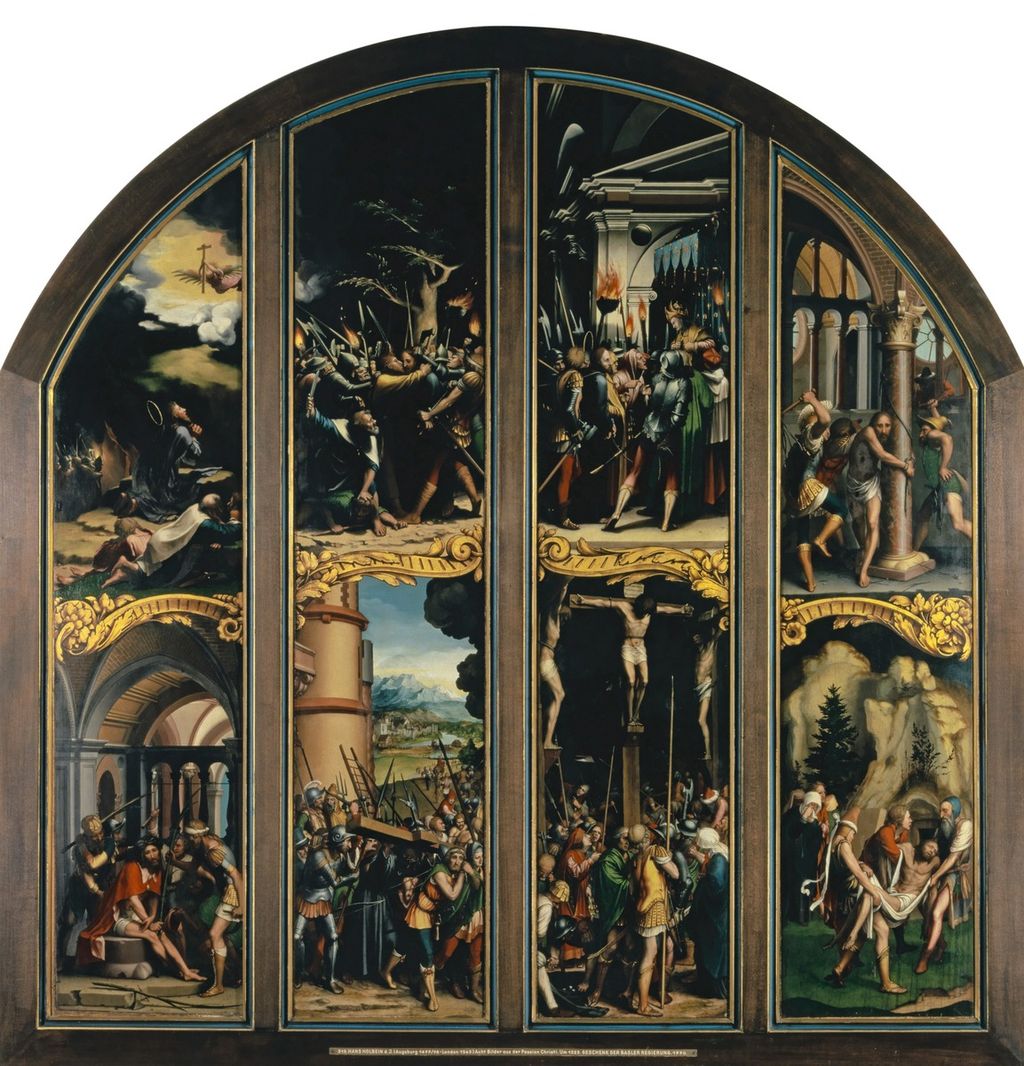
A pale body hangs high above a crowd, arms extended almost across the width of a narrow panel. Beside it, another crowd pushes beneath a cross; farther right, men carefully carry a body towards a rocky tomb. Holbein's Passion Altarpiece repeatedly changes the relationship between Christ and the people surrounding him. Hands seize, strike, mock, support and mourn. The same human body holds the eight episodes together.
Seen from a distance, the ensemble resembles a single arched window. Come closer and its divisions become insistent: four slender compartments, each containing two scenes, with curling golden ornaments separating the upper and lower stories. Figures seem both confined by these boundaries and eager to cross them. Spears, arms and architectural edges carry the eye upwards; landscape and clouds encourage it sideways.
The painting belongs to Holbein's religious work in Basel . It survives at the Kunstmuseum Basel as The Passion of Christ . [1] Its painted scenes once formed the outside of a folding altarpiece. The pictures reward attention before any reconstruction begins.
At a Glance
- Artist Hans Holbein the Younger
- Title The Passion of Christ , also called the Passion Altarpiece
- Date about 1524–26
- Medium oil on limewood
- Dimensions 149.5 × 124 cm
- Collection Kunstmuseum Basel
- Inventory 315
- Credit gift of the Basel government. [1]
This work across Hans Holbein the Younger’s career
Dead Christ in the Tomb
1521–22 [3]The Passion Altarpiece (current article)
about 1524–26Sir Thomas More
1527 [4]Georg Giese
1532 [5]The Ambassadors
1533 [6]Contents
- How to Read the Eight Scenes
- Night in the Garden
- Accusation, Punishment and Mock Kingship
- The Road Opens into Landscape
- The Crucifixion and the Weight of the Body
- What the Folding Altarpiece Has Lost
- Dating the Painting and Considering the Workshop
- From an Altar to a Civic Possession
How to Read the Eight Scenes
Begin at the upper left and move across the top row: the Agony in the Garden, the Arrest, Christ before Caiaphas and the Flagellation. Then return to the lower left for the Crowning with Thorns, Carrying the Cross, the Crucifixion and the Entombment. These are eight episodes within four panels, rather than eight separate paintings hung together by chance.
The narrative concerns the Passion: Christ's suffering, death and burial. The Gospel of Mark provides a useful introduction to its movement from prayer and betrayal to interrogation, punishment and the tomb. The painting selects recognisable moments rather than illustrating every intervening event. [8] [9] Its first and last scenes are especially revealing. At the beginning Christ can kneel and pray; at the end other people must bear his weight.
Reading across the rows gives the chronological sequence. Looking down each narrow compartment produces other relationships. Prayer stands above mockery; capture above the burden of the cross. In the third panel, an earthly tribunal occupies the space above the Crucifixion. At the right, the upright body bound to a column gives way below to a body held in a sheet. These vertical pairings are worth noticing even without assigning each a separate symbolic programme.
The arched outline also distributes attention unevenly. The central upper scenes have more height, while the outer scenes must accommodate the descending curve. Holbein uses the irregular spaces actively. Open sky fills the tapering upper left; architecture occupies the upper right. The outer compartments therefore introduce different kinds of enclosure before the eye reaches the crowds at the centre.
Night in the Garden
The first scene offers the most open interval in the upper row. Christ kneels apart from the sleeping disciples, with his face and hands directed upwards. His dark clothing merges with the ground around him, while the pale fabric of a sleeper in the foreground catches the eye. The gap between them makes their separation immediately intelligible.
Mark describes Christ asking his companions to remain awake while he prays, then returning to find them asleep. Judas subsequently arrives with an armed group and identifies him with a kiss. [8] Holbein turns these successive situations into sharply different patterns of movement. The first picture is organised around a solitary upward appeal; the next is a knot of bodies pressed together.
Look at the small heavenly figure near the upper edge of the garden scene. Light opens around it in the clouds. Below, the disciples' bodies spread across the ground in low, relaxed shapes. Between the bright height and the sleeping foreground, the kneeling Christ occupies a precarious middle position. The eye travels vertically through different states of awareness.
In the Arrest, weapons make a jagged canopy over the crowd. A bare tree rises through the gathering, and points of flame break into the darkness. Faces become small islands of illumination. Christ is difficult to separate from the people gripping and surrounding him: recognition takes a moment, as though the viewer must search through the confusion.
The difference between the scenes reaches beyond the number of figures. The garden gives Christ room to turn his body; the Arrest takes that room away. Arms overlap his shoulders and torso. The men's spread legs brace them against one another, making the crowd appear physically forceful even where individual actions are hard to disentangle. Torchlight reveals fragments without clearing the darkness behind them.
The eye has barely settled into the first scene's solitude before the next presses close. The narrow panels make isolation feel exposed and the armed group feel overcrowded.
Accusation, Punishment and Mock Kingship
In Christ before Caiaphas , the figures gather before a raised seat beneath a substantial architectural canopy. Christ's dark robe remains low among standing men, while the seated authority appears higher and farther back. Soldiers' legs and weapons create a barrier between the foreground and the tribunal. The scene is legible through differences of height before its individual faces can be examined.
The architecture promises order, but the crowd complicates it. Columns and horizontal mouldings describe a stable structure; the people beneath them turn, point and lean in conflicting directions. A flame flares beside the building, continuing the restless illumination of the Arrest. Christ passes from an outdoor seizure into a setting where power has furniture, attendants and a formal place.
The Flagellation changes the visual problem. Christ is stripped and tied to a column. His pale torso now stands out with a clarity that the dark robe denied him in the preceding crowds. One tormentor raises his arm; another bends into the action. Their poses form opposing diagonals around the vertical support.
The column is more than background scenery. Christ's arms close around it, and his body bends against its rigid surface. Behind him, a succession of arches opens into a larger building. The depth is visible, yet offers him no exit. The eye can travel through the architecture more freely than the bound figure can move within it.
At the lower left, the Crowning with Thorns places Christ beneath another imposing arcade. He sits on a low support, wrapped in a red cloak, while men crowd around his head. Long rods converge towards the crown. The soldiers' activity produces a ring of pressure around a figure whose hands remain close together.
Mark's account describes the soldiers clothing Christ in purple, crowning him with thorns and parodying royal homage. [9] In Holbein's scene the cloak gives him a conspicuous patch of colour, but his seat is low and his bare legs stretch awkwardly forwards. The mock ceremony is enacted through practical contact: rods, hands, fabric and a cramped position.
Compare this seated figure with Caiaphas above and to the right. Both scenes contain a seated centre surrounded by standing men, but the distribution of control is different. The high priest receives the prisoner; the seated Christ is subjected to the actions around him. Holbein can convey authority and humiliation using related arrangements of bodies.
The punishment scenes resist an easy equation between beautiful architecture and humane conduct. Their columns, vaults and arches retain their elegance while violence takes place beneath them.
Watch: Holbein’s portraits and working methods
Explore museum films on Holbein’s drawings, painted portraits and close-looking details.
Hans Holbein at the court of Henry VIII
A Royal Collection Trust film exploring Holbein’s work at Henry VIII’s court.
Watch on YouTubeThe Road Opens into Landscape
Carrying the Cross exchanges the interiors for a road beside a great round tower. Above the tightly packed procession, the view opens towards fields, buildings and distant mountains. This is the lower row's broadest prospect. Its recession briefly offers the eye a route out of the foreground congestion.
The crossbeam cuts across the crowd at shoulder height. Around it, metal helmets catch light and long weapons rise at different angles. The procession feels difficult to move through. Even with open country beyond, the foreground leaves little breathing space around Christ.
A man at the right turns towards the viewer while carrying a long implement over his shoulder. His forward-facing presence checks the eye's movement into the landscape. Other figures turn away or disappear behind neighbours. The combination produces the impression of a crowd passing close by, in which one face suddenly becomes available before being lost again.
The tower provides an especially strong contrast to the people. Its rounded wall is broad, smooth and comparatively empty. Beneath it, bodies and equipment break into many small shapes. The architecture supplies a large, calm mass against which the procession's restless details become more distinct.
Look next at the dark cloud entering from the right. It presses against the brighter distance and anticipates the blackness around the neighbouring crosses. Across the division between panels, the weather appears to bind movement towards execution to the scene of execution itself. The landscape is therefore both a distant view and a way of connecting adjacent moments.
The Crucifixion and the Weight of the Body
The Crucifixion gives the cycle its strongest vertical separation. Christ's body hangs high against a dark background, while a dense company gathers below. The crosses of the two men executed beside him stand near the edges. Their cropped, angled bodies frame the comparatively frontal central figure.
Christ's outstretched arms establish a horizontal line near the top of this tall compartment. Beneath them, the slim torso and legs draw the gaze downwards towards the crowd. The smaller movements below seem restless beside the cross's fixed geometry.
The foreground figure in yellow is particularly conspicuous. Seen largely from behind, he stands between the viewer and the foot of the cross. His turned head helps carry attention upwards, but his body also prevents an unobstructed approach. The spectator remains among the bystanders, looking past shoulders, helmets and raised shafts.
Darkness at the Crucifixion has a Gospel basis: Mark describes the land becoming dark before Christ's death. [9] Here it also makes the pale bodies more exposed. The sky ceases to provide the kind of distance visible in Carrying the Cross . Above the crowd there is scarcely anywhere for the eye to rest except on the crucified figures.
A technical examination discussed by Bernd Wolfgang Lindemann found a changed conception beneath this scene: Christ's initially raised arms became horizontal, while the feet were separated and lifted onto a higher support. [10] The finished pose makes a striking counterweight to the panel's slender shape.
In the Entombment, the body comes down to the level of other human bodies. Two men carry Christ in a white cloth, their arms and legs arranged to sustain him. His torso sags between them. The sheet turns the strain into visible lines: it is drawn taut at the supporting hands and dips under the weight.
Behind this group, mourners cluster near the dark opening in the rock. Trees rise against the pale cliff. The men carrying Christ occupy the foreground rather than vanishing into the tomb, so the image holds the work of bearing him before the act of enclosure. There is still movement, but its rhythm has slowed.
Hands provide a useful thread through the whole ensemble. In the Arrest they close around a living person. During the punishments they direct weapons or enforce restraint. At the end they must support a body that can no longer support itself. Without requiring knowledge of every participant's name, these changes make the emotional movement of the Passion clear.
What the Folding Altarpiece Has Lost
The four panels were originally two folding wings. Blue patches and assembly letters survive on their reverse sides; Lindemann connects these with lost reliefs, whose openings would have revealed painted sky. The eight Passion scenes would have met when the wings closed. [10]
This helps explain why the present grouping feels coherent while remaining incomplete as an object. We can follow the painted story across its divisions, yet the surviving face represents only one state of a structure that could change. Opening it would have replaced painting with a substantially different combination of surfaces and carved forms.
The reconstruction also changes how the painted architecture can be experienced. The columns in the Flagellation and the arcade around the seated Christ already suggest buildings within the pictures. Set on moving wings, such spaces belonged to an object with its own physical depth. A viewer approaching an altar encountered both the represented architecture and the actual structure carrying it.
The proposed site is a niche in the south-east corner of the large cloister at Basel Münster, uncovered in 1892 and subsequently closed again. Its unusual arch matches the ensemble; projecting tracery could explain why each wing folded vertically a second time. Maria Zscheckenbürlin's nearby burial and documented altar foundation strengthen the identification. The carved subjects remain unknown. [10]
This is a reconstruction supported by several kinds of evidence, rather than a complete surviving installation. A missing centre invites visual invention, but neither the painted Passion nor the remaining blue areas supplies a dependable picture of its subjects.
Even without those subjects, the change in scale is understandable. Closed wings bring a sequence of small, crowded scenes together. An opened shrine would spread the object more widely and expose another visual arrangement. The surviving work preserves the concentration of the painted face; the original altar also offered an experience of transformation.
Dating the Painting and Considering the Workshop
The date rests on documents as well as style. Zscheckenbürlin's 1514 will endowed an altar; a 1518 amendment records it standing but unpainted. Later additions reaffirm the instruction. The museum places completion between February 1524 and her death late in 1526: the January 1527 estate division lists no altar costs. This supports about 1524–26, without establishing an exact commission date. [1]
The documents place the work among Holbein's mature Basel paintings . It is unsigned and undated. [1] Eight compact narratives must remain distinct while sharing a single arched outline.
Authorship involves a further question. In its catalogue of Venus with Cupid , the Kunstmuseum reports Jochen Sander's proposal that the anonymous workshop painter known as the Venus-Maler made corrective interventions while the Passion altar was being finished. The museum currently assigns Venus with Cupid to that assistant. The proposed intervention in the Passion is a scholarly attribution, not an identification of a named collaborator. [11]
Differences between scenes cannot settle that question by themselves. A night arrest, a pale body against black sky and a rocky burial require different pictorial treatments. A broad change of atmosphere may serve the narrative; assigning individual passages to another hand requires a separate argument. The ensemble remains catalogued under Hans Holbein the Younger. [1]
From an Altar to a Civic Possession
By 1642 the panels were in Basel's council chapel; their removal date is unknown. A celebrated civic sight, they entered the public collection through the Basel government's gift in 1770. [1]
The work can now be approached as a sequence of paintings, with close attention to composition, light and the handling of bodies. It also retains the shape and divisions of a religious furnishing whose parts once moved.
The Kunstmuseum's 2006 exhibition of Holbein's Basel years placed religious paintings alongside portraits, drawings and works for print. [12] The Passion belongs to that wider practice. The precision associated with his portraiture here becomes an ability to make a gesture legible inside a crowd, or to keep a small body distinct against architecture and night.
Return finally to the white carrying cloth in the Entombment. Its curve answers the rigid crossbeam in the preceding scenes, and its support replaces the pressure of the tormentors' rods. The last compartment does not resolve the missing history of the altar. It brings the surviving narrative to a tangible human action: people taking responsibility for the weight of the dead.
Artworks directory
Explore paintings, drawings, prints and designs, including works without a separate article. Related studies and versions have their own entries; workshop works and copies are labelled. Print designs and series are grouped rather than repeated for every impression.
Frequently Asked Questions
Eight scenes occupy four panels, originally two wings. [10] Read across the upper row, then across the lower one.
Zscheckenbürlin's altar in the large cloister of Basel Münster is the proposed original setting. [10]
The museum's dating combines testamentary and estate evidence; it is not a date inscribed by Holbein. [1]
Discussion
Look again at the images and ideas explored in The Passion Altarpiece. These editorial prompts invite your observations.
Reader Insights
Compare the hands around Christ during the Arrest with those supporting him at the Entombment. How much of the story can be understood through touch alone?
The landscape beside the tower meets the darkness of the Crucifixion. Does this connection make the two scenes feel close in time, space or emotion?
The painted face once belonged to an object that opened. How does that knowledge change your response to its narrow compartments and enclosing arch?
Join the Conversation
Which scene most changes your understanding of the others: the quiet garden, the crowded Arrest, the exposed Crucifixion or the careful carrying of the body? Describe the visible detail that drew you towards it.
References
- Kunstmuseum Basel , Die Passion Christi , collection record, inventory 315 (in German), accessed 18 October 2026. View source .
- Kunstmuseum Basel, Bildnis des Bonifacius Amerbach, 1519, inventory 314 (in German) . View source .
- Kunstmuseum Basel, Der tote Christus im Grab, 1521–22, inventory 318 (in German) . View source .
- The Frick Collection, Sir Thomas More, 1527, accession 1912.1.77, collection record . View source .
- Gemäldegalerie Berlin, Georg Gisze . View source .
- Susan Foister, The Ambassadors, The German Paintings before 1800 (2024) . View source .
- Susan Foister, Christina of Denmark, Duchess of Milan (2024) . View source .
- United States Conference of Catholic Bishops , The Gospel according to Mark , chapter 14, especially verses 32–65, New American Bible, Revised Edition. View source .
- United States Conference of Catholic Bishops , The Gospel according to Mark , chapter 15, especially verses 15–47, New American Bible, Revised Edition. View source .
- Bernd Wolfgang Lindemann , “Die Passionstafeln von Hans Holbein dem Jüngeren,” Zeitschrift für schweizerische Archäologie und Kunstgeschichte , 55 (1998), pp. 219–226 (in German). View source .
- Kunstmuseum Basel , Venus mit dem Amorknaben , collection record, inventory 323, discussion of Jochen Sander's workshop attribution (in German), accessed 18 October 2026. View source .
- Kunstmuseum Basel , Hans Holbein d.J.: Die Basler Jahre 1515 bis 1532 , institutional account of the exhibition, 31 March–2 July 2006 (in German). View source .
- Würth Collection, Holbeins Schutzmantelmadonna, inventory 14910, current owner account (in German) . View source .
- Metropolitan Museum, Dance of Death series . View source .
- Kunstmuseum Basel, Bildnis der Frau des Künstlers mit den beiden ältesten Kindern, about 1528–29, inventory 325 (in German) . View source .
- Kunsthistorisches Museum Wien, Next Generation, Jane Seymour, about 1536–37, inventory 881 (in German) . View source .
- Splash image , Hans Holbein the Younger, The Passion of Christ, about 1524–26, oil on limewood, 149.5 × 124 cm. Kunstmuseum Basel, gift of the Basel government, inventory 315. Kunstmuseum Basel, gift of Basel government. Image source . Public domain .