 by
Tom Gurney
Tom Gurney BSc (Hons) is an art history expert with over 20 years experience
Email:
tomgurney1@gmail.com
/ Phone:
+44 7429 011000
Hans Holbein's Basel Years: Introduction
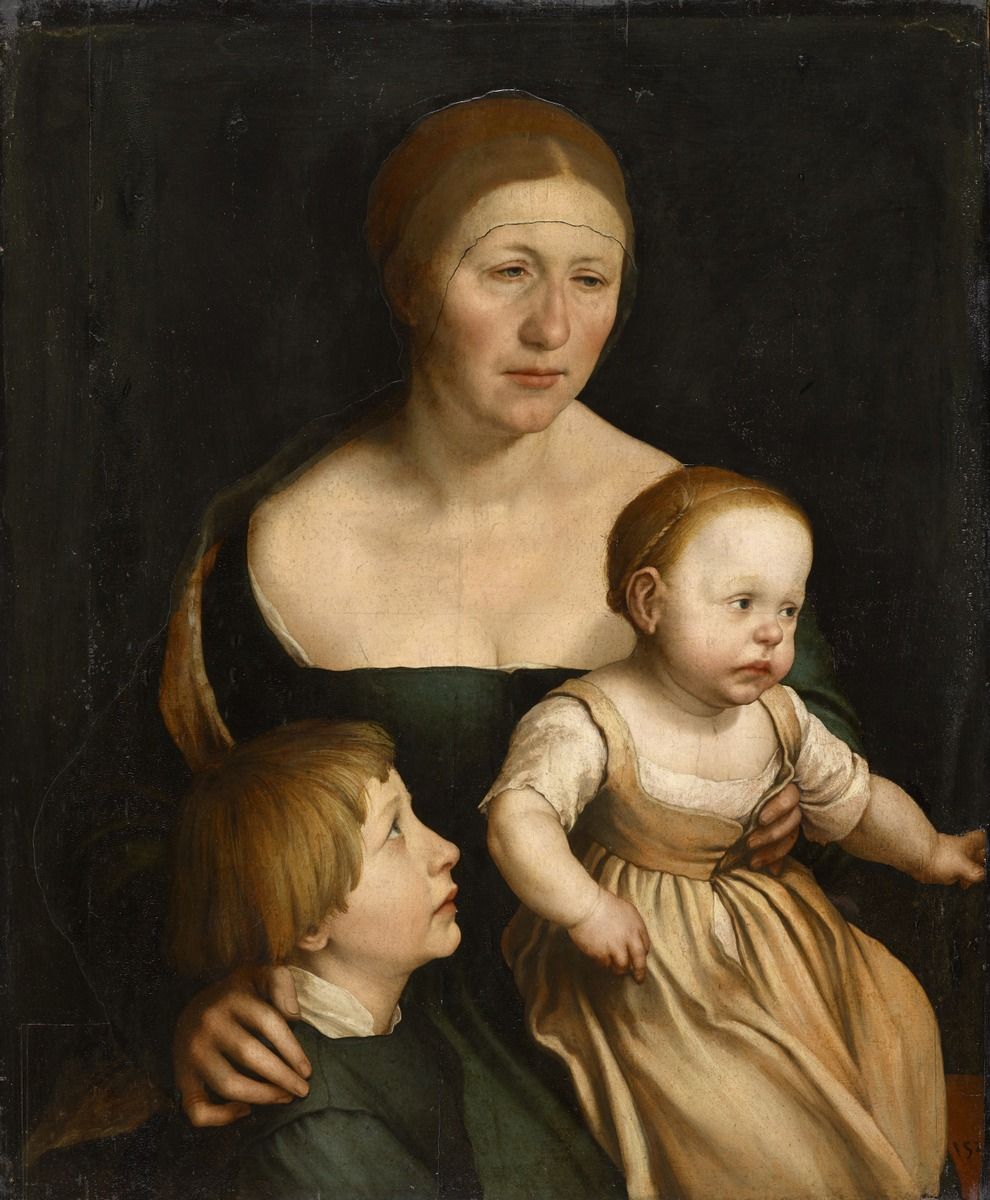
A mother's hand rests on her son's shoulder; her other hand steadies a little girl who reaches beyond the edge of the picture. In The Artist's Family , painted around 1528–29, Hans Holbein brings us close to the household he maintained in Basel. Elsbeth and the children, Philipp and Katharina, occupy a world far removed from the ceremony of his later portraits of Henry VIII. Yet this family group belongs to the same career. Basel gave Holbein a home, a civic identity and an unusually varied field of work before London became his principal place of employment. [1]
He worked in the city in two main periods, 1515–26 and 1528–32, separated by his first English visit. During those years he painted scholars, citizens and sacred figures, designed printed images and helped transform the appearance of buildings. Religious reform changed the purposes pictures could serve and the institutions willing to commission them. To follow Holbein through Basel is to encounter a painter making his way among households, printing presses, churches and the town council. [2] [3]
At a Glance
- Arrival Present in Basel by 1515, alongside his brother Ambrosius. [2]
- Guild membership Admitted to the Zunft zum Himmel in September 1519. [4]
- Citizenship Recorded separately in July 1520. [4]
- Family Married Elsbeth Binzenstock, widow of the tanner Ulrich Schmid, around 1520. [2]
- First English stay 1526–28; Basel again from 1528 to 1532. [2]
- Religious turning point Basel's iconoclasm of February 1529. [4]
- Civic painting Council-chamber commission begun in 1521 and completed in 1530. [2]
- Later connection A return visit in 1538 brought negotiations for a Basel pension and eventual resettlement. [5]
Hans Holbein the Younger in context
Albrecht Dürer
1471–1528 [9]Lucas Cranach the Elder
1472–1553 [10]Dead Christ in the Tomb
1521–22 [13]Sir Thomas More
1527 [14]Georg Giese
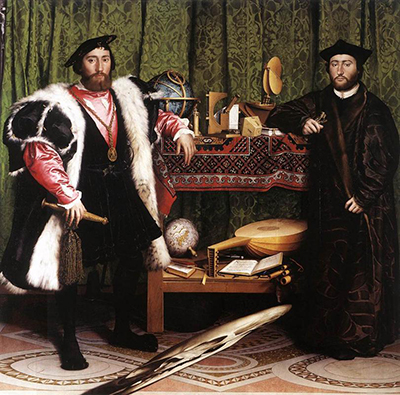
1532 [15]The Ambassadors
1533 [16]Contents
- Becoming a painter of the city
- Pictures made for the printed page
- Scholars who helped shape their own likenesses
- Sacred images for different kinds of attention
- Painting buildings and the business of government
- England and the return to a Basel household
- Reform, destruction and continuing work
- A city that still wanted him back
Becoming a painter of the city
Holbein reached Basel as a young man from Augsburg, where his father, Hans Holbein the Elder, headed a painting workshop. Ambrosius, his elder brother, also pursued an artistic career. The Swiss historical dictionary places the brothers in Basel from 1515 and suggests that Hans initially worked as a journeyman with Hans Herbst. That workshop connection remains probable rather than an invitation to assign every early picture to a single, neatly organised partnership. [2]
A printer might require an ornamental border; a householder might commission a likeness or the decoration of a façade. These needs encouraged a painter to move between small and large surfaces, and between work he executed himself and designs another craftsperson would realise. Holbein's work extended across much of the urban environment.
One substantial early opportunity came in 1516, when he portrayed Jakob Meyer zum Hasen and his wife, Dorothea Kannengiesser. The Kunstmuseum Basel connects their paired portraits with Meyer's election as mayor that June. Their marriage had taken place earlier. The household was being represented at a moment of public advancement. A shared architectural background connects the two panels, while each sitter retains a separate space. [18]
Employment elsewhere briefly interrupted his Basel career. Between 1517 and 1519 Holbein worked on the decoration of Jakob von Hertenstein's house in Lucerne, probably with his father. [2] Such commissions demanded attention to the whole building. A painted figure, doorway or column had to work within an existing structure and meet a viewer approaching from a particular direction. The painter was learning how to organise an encounter in space as well as how to record a face.
On his return to Basel, professional and civic recognition followed through separate acts. The guild entry printed by Arthur B. Chamberlain records Holbein's admission in September 1519, with an oath to keep the guild's rules. The town entry records citizenship in July 1520. [4] These were practical affiliations within a community of trades and obligations. Holbein became someone whom the city could employ, claim as its own and later ask to come home when he worked abroad.
Pictures made for the printed page
Basel's publishing houses gave visual invention a means of travelling. Johannes Froben employed Hans and Ambrosius on book illustration, and his publications connected them with the writings of Erasmus and Thomas More. Froben's 1518 edition of More's Utopia included work by both brothers. The Royal Collection identifies its lively architectural title border as Hans's design. [19] Years before Holbein portrayed More, his work had already appeared around More's words.
A border is easy to pass over when reading a book, but it changes the reader's approach to the text. Architecture can turn the title into an entrance. Figures, foliage and objects can invite inspection before the first argument begins. The designer has to leave sufficient clarity for lettering while making a frame interesting enough to hold the eye. That balance between information and visual ceremony would remain useful in Holbein's portraits, where an inscription, book or piece of clothing helps introduce a person.
The designs also had lives beyond their first uses. The Royal Collection shows a border made for Froben in 1521 surrounding the title of Erasmus's Latin New Testament in 1522. It also identifies the title page of Henry VIII's 1521 defence of the sacraments as a copy of a Holbein design. [19] Images could cross borders independently of the painter, and their reuse could place them beside different arguments. A book's publication date consequently does not always date the invention of its decoration.
The Dance of Death makes the division of labour particularly clear. The Metropolitan Museum distinguishes Holbein’s invention from Hans Lützelburger’s work as printmaker: the designs are dated about 1526, the publication 1538. [20] Drawing, cutting and publishing belong to different moments. The small scenes owe their existence to an exchange between skills, with the blockcutter preserving the designer's distinctions in a surface that could be inked and printed repeatedly.
Their subjects move through a recognisable social world. Death can enter the business of a ruler or interrupt an ordinary task. Rank becomes visible through a few signs of occupation and setting; interruption gives the scene its action. This is a different kind of social observation from a commissioned portrait, but it requires a comparable economy. The viewer must recognise who is present, what they are doing and what has changed.
Scholars who helped shape their own likenesses
The portrait of Bonifacius Amerbach, painted in 1519, offers a particularly close meeting between a painter and the world of books. Amerbach was the son of a Basel printer and a student of law. His portrait includes a substantial Latin epigram which he composed himself. More than twenty drafts survive in Basel University Library, according to the museum's account. Even after Holbein transferred the wording to the picture, a phrase was changed. [12]
The inscription was therefore part of the portrait's making. Amerbach considered how language could explain the painted likeness, while Holbein had to give the tablet a place beside the sitter. Neither contribution disappears into the other. A reader can scrutinise the words and then turn back to the face; someone unable to read the Latin can still register the importance given to writing. The portrait makes learning visible without turning the sitter into an anonymous emblem of scholarship.
The date also needs careful reading. It commemorates Amerbach's birthday, rather than proving the exact day on which Holbein completed the work. [12] An inscription is evidence, but its purpose determines what it can tell us. Here it belongs to the sitter's presentation of himself as much as to the painting's chronology.
Erasmus's portraits extended this relationship across Europe. In the Longford Castle portrait of 1523, now on loan to the National Gallery, the scholar rests his hands on a book. Erasmus sent the picture to William Warham, Archbishop of Canterbury, as a gift. [21] The represented volume and the travelling portrait performed related tasks: each made a learned identity available to people at a distance.
For Holbein, that movement was valuable. A painting could establish confidence in his abilities before he entered the country where it was admired. Scholarly friendships connected publishers, readers, patrons and potential sitters. His advancement depended in part on those connections, while his pictures gave the friendships a durable, portable form.
Sacred images for different kinds of attention
Religious painting formed a substantial part of Holbein's Basel work. The Kunstmuseum's exhibition devoted to 1515–32 brought altarpieces, portraits, drawings and prints together, reminding viewers how much his early practice encompassed. [3] The sacred works themselves are varied. A viewer approaching a great altar encountered a different relationship between body, architecture and image from someone contemplating a small devotional panel.
The Solothurn Madonna , dated 1522, places the Virgin and Child between Saint Martin, dressed as a bishop, and the armoured Saint Ursus. [22] Its standing saints and elevated central group give the gathering a public, monumental character. Human presence is organised through a formal structure, with differences of role and costume helping to distinguish the figures.
The Meyer Madonna , made in 1525–26 and revised in 1528, brings a patron's family under the Virgin's protective mantle. The original belongs to the Würth Collection, inventory 14910. [23] It continues the relationship begun with Jakob Meyer's secular portrait while placing recognisable people within a devotional company. The same painter could serve civic status and religious petition without abandoning the skills of observation through which individuals became distinct.
The Body of the Dead Christ in the Tomb , dated 1521–22, compresses attention into a long, low enclosure occupied by the dead body. [13] Its original purpose remains debated. Christian Müller has proposed that it was intended for an Amerbach family memorial in Basel's Charterhouse, a reconstruction summarised by the museum. The severity of the image should not be converted into a declaration of Holbein's private loss of faith.
The Passion Altarpiece , about 1524–26, belongs to another setting. The current Basel account connects it with the large cloister of the Münster, or cathedral; its surviving panels present eight scenes. [24] The Münster's large cloister and the proposed Charterhouse memorial are distinct places and contexts. Keeping them separate helps preserve the different questions each work raises.
Together, these paintings make any single description of Holbein's religious manner inadequate. He could crowd a narrative with incident, establish a solemn assembly or bring a solitary body close to the spectator. Scale, grouping and the space around a figure determine how slowly or urgently the viewer looks.
Watch: Holbein’s portraits and working methods
Explore museum films on Holbein’s drawings, painted portraits and close-looking details.
Hans Holbein at the court of Henry VIII
A Royal Collection Trust film exploring Holbein’s work at Henry VIII’s court.
Watch on YouTubePainting buildings and the business of government
Much of the Basel that Holbein painted has vanished. The survival of portable panels can make portraiture seem more dominant in his early career than it was. His decorations for the Haus zum Tanz , or House of the Dance, are known through designs and copies. Chamberlain describes a façade transformed by painted architecture and scenes of human activity, including the dancing figures that gave the house its familiar name. [4]
A building presented problems a rectangular panel did not. Windows interrupted the surface, while different storeys and adjoining façades offered competing divisions. Painted columns, balconies and openings could give an irregular frontage an imagined order. People passing in the street encountered the decoration while moving; its effect depended partly on their distance and angle of approach. Such work made the painter's design part of daily civic experience.
Inside the town hall, pictures addressed an audience engaged in governing. Holbein received the council-chamber commission in 1521; the work was completed in 1530. [2] Its chronology stretches across his first English journey and Basel's religious upheaval. Government remained a patron even as the conditions surrounding religious pictures changed.
The later subjects included Rehoboam rejecting wise counsel and the meeting of Samuel and Saul. Chamberlain's account, drawing on surviving designs and records, relates them to the consequences of wrongful rule. [4] Rehoboam's refusal to hear the elders and Saul's encounter with the prophet supplied stories in which authority could be questioned. Placed around councillors, such scenes gave historical and biblical examples a setting in which decisions were actually made.
The paintings cannot be recovered as an intact room. Fragments and preparatory material provide partial evidence, and a design does not preserve every decision taken on the wall. Yet the commission expands our understanding of Holbein's audience. He addressed men exercising collective power as well as individuals commissioning their own likenesses. A council-chamber narrative could hold a course of action up for judgement.
England and the return to a Basel household
By the middle of the 1520s, religious reform had reduced the demand for devotional images in Basel. Holbein travelled to England in 1526 and found support from Thomas More. A letter of recommendation from Erasmus to More is probable, while More's December letter confirming his admiration supplies firmer evidence of the painter's reception. [19] The English commissions of 1526–28 grew from relationships whose beginnings lay partly in Basel's learned and publishing circles.
The journey preceded the decisive iconoclasm of 1529. It was an attempt to find work abroad during a changing situation, rather than a response to an event still in the future. [19] The two-year stay gave Holbein experience with English households and court officials, but he returned to Basel before acquiring the later position of King's Painter.
A property record printed by Chamberlain places Holbein and Elsbeth together at the purchase of a house in August 1528. A further purchase followed in March 1531. [4] These transactions give the return a practical dimension: Basel continued to hold the family's home and property. They also keep Elsbeth within the documentary story, where she is more than the solemn face of a celebrated portrait.
The Artist's Family belongs to this period. The group was painted on paper, subsequently cut around the figures and mounted on limewood. Its dark surrounding field belongs to that altered object. Basel's catalogue proposes that the composition may once have included Holbein himself, in the direction towards which the children turn. The proposal remains uncertain. [1]
The surviving picture establishes a strong physical connection between its three figures. Elsbeth's right arm reaches around Philipp; her other hand supports Katharina. Their attention moves towards the right at different heights, opening the group outwards. The hands give it continuity even where the glances diverge. Elsbeth's unsmiling face can feel deeply affecting without revealing the private history of her marriage. Neither an expression nor the painter's absence abroad proves a story of abandonment.
Reform, destruction and continuing work
In February 1529, iconoclasm changed Basel's churches. Images and altars were attacked, and the city's religious order was transformed. Chamberlain's narrative includes the contemporary testimony of Erasmus as well as the reforming ordinance's rejection of church pictures. [4] The principle concerned the use of images in worship. For painters, it also meant a profound change in the institutions and practices that had sustained commissions.
The loss was material as well as economic. Pictures could be broken, burned or removed; wall decoration could be covered. Surviving religious works consequently tell only part of the story. Their preservation does not show that their earlier setting remained intact, and the disappearance of other works cannot always be reconstructed object by object. The violence disrupted the visual world Holbein had helped create.
It did not eliminate every demand for design. The council employed him to finish the town-hall decoration in 1530. A payment recorded in October 1531 concerned painting the two clock faces at the Rhine Gate. [4] Placing those commissions together gives a more useful sense of a painter's occupation than dividing his tasks into masterpieces and unworthy necessities. Both required a designed surface to work in a public setting.
The changing city also asked religious conformity of its citizens. In 1530 Holbein was called before the council to explain his absence from communion. [2] Chamberlain reports his request for a clearer explanation of the sacrament. [4] The episode allows us to recognise civic pressure without pretending to settle every aspect of his convictions. A commissioned Catholic image, a design associated with reform and a response to the council each arose in a particular encounter.
In 1532 he returned to England. That September, Basel's council sent a request that he come home and offered an annual payment to help support his household. The letter survives in printed transcription and translation. Its mayor, Jakob Meyer zum Hirschen, must be distinguished from Holbein's earlier patron, Jakob Meyer zum Hasen. [5] The city continued to value the painter even after he had sought employment elsewhere. His departure altered the balance between Basel and London, but it did not immediately dissolve his civic ties.
A city that still wanted him back
Holbein visited Basel again in 1538, by then established in royal service. The agreement dated 16 October, reproduced by Chamberlain, offered him fifty gulden annually on his return. It allowed him two further years in England and provided for an annual payment of forty gulden to his wife during that interval. These were terms offered in the document; the text alone does not prove that every projected payment was made. [5]
The council recognised both the value of his skill and the limitations of the local market. Its agreement envisaged him advising on building matters and undertaking painting for suitable payment. It also allowed journeys to sell his work abroad, subject to the council's knowledge and permission. [5] Basel was trying to accommodate an artist whose employment had become international. The arrangement gave mobility a negotiated place within citizenship.
Holbein did not resume a lasting Basel practice before his death in London in 1543. [25] His work, however, acquired a durable local home through the Amerbach collection. The cabinet assembled by Bonifacius and his son Basilius contained paintings, drawings, prints, books and other objects. In 1661, the city and university purchased it; public access followed in 1671 at the Haus zur Mücke. [26]
That history affects what we can see today. Portraits of Basel inhabitants, designs and religious pictures survived within a collection whose interests were wider than any one kind of art. The family group can now stand beside the work Holbein made for scholars, patrons and public institutions. Basel preserves a particularly full view of a painter moving between ways of working, and between the obligations of a household and opportunities that reached far beyond the city.
Artworks directory
Explore paintings, drawings, prints and designs, including works without a separate article. Related studies and versions have their own entries; workshop works and copies are labelled. Print designs and series are grouped rather than repeated for every impression.
Frequently Asked Questions
The records distinguish admission to the painters' guild in September 1519 from citizenship in July 1520. They represent different forms of membership in Basel's working and civic community. [4]
The painting does not establish that interpretation. Its sitters are Elsbeth, Philipp and Katharina, but their expressions cannot supply a documentary account of family relationships. The picture has also been cut down and remounted, leaving its original extent uncertain. [1]
The Amerbach cabinet preserved an important group of his paintings, drawings and prints. Basel's city and university acquired the collection in 1661, providing a foundation for the present public collection. [26]
Discussion
Look again at the images and ideas explored in Hans Holbein's Basel Years. These editorial prompts invite your observations.
Reader Insights
In the family portrait, compare the children's outward attention with Elsbeth's supporting hands. Which gives the group its strongest sense of connection?
Imagine the council-chamber stories around people making political decisions. How might that setting change the way an image of a mistaken ruler is received?
A book border and a gift portrait could reach places before Holbein arrived. Consider the different kinds of introduction each offered its distant audience.
Join the Conversation
Which part of Holbein's Basel practice most changes your understanding of his later portraits: the printer's page, the religious panel, the painted building or the family group?
References
- Kunstmuseum Basel , Bildnis der Frau des Künstlers mit den beiden ältesten Kindern , about 1528–29, inventory 325 (in German). View source .
- Alberto de Andrés and Stefan Hess , Hans Holbein der Jüngere , Historisches Lexikon der Schweiz, version of 2006, revised 3 November 2011 (in German). View source .
- Kunstmuseum Basel , Hans Holbein d.J.: Die Basler Jahre 1515 bis 1532 , 2006 exhibition account (in German). View source .
- Arthur B. Chamberlain , Hans Holbein the Younger , vol. I, 1913, chapters V–VI and XV; published guild, citizenship, property and payment records, with historical discussion. View source .
- Arthur B. Chamberlain , Hans Holbein the Younger , vol. II, 1913, chapter XVII, recall letter of 2 September 1532; chapter XXII, Basel visit and pension agreement of 16 October 1538. View source .
- National Gallery, Early Renaissance, glossary. View source.
- National Gallery of Art, Northern Renaissance. View source.
- National Galleries of Scotland, Mannerism, glossary. View source.
- National Gallery of Art, Albrecht Dürer, artist record. View source.
- National Gallery of Art, Lucas Cranach the Elder, artist record. View source.
- National Gallery, Hans Holbein the Younger, artist record. View source.
- Kunstmuseum Basel , Bildnis des Bonifacius Amerbach , 1519, inventory 314 (in German). View source .
- Kunstmuseum Basel , Der tote Christus im Grab , 1521–22, inventory 318, current object record and account of Christian Müller's proposed Amerbach memorial connection (in German). View source .
- The Frick Collection, Sir Thomas More, 1527, accession 1912.1.77, collection record . View source .
- Gemäldegalerie Berlin, Georg Gisze . View source .
- Susan Foister, The Ambassadors, The German Paintings before 1800 (2024) . View source .
- Susan Foister, Christina of Denmark, Duchess of Milan (2024) . View source .
- Kunstmuseum Basel , Doppelbildnis des Jacob Meyer zum Hasen und seiner Frau Dorothea Kannengiesser , 1516, inventory 312 (in German). View source .
- Royal Collection Trust , Holbein at the Tudor Court , Chambers Gallery large-print labels, “Basel to London, 1526”, Froben portraits and printed books, PDF pp. 26–35. View source .
- Metropolitan Museum of Art , The Dance of Death , Holbein and Hans Lützelburger, about 1526, published 1538, object 19.57.1–.42. View source .
- National Gallery , Erasmus , 1523, L658, on loan from Longford Castle. View source .
- Kunstmuseum Solothurn , Altmeistersammlung , the Solothurner Madonna , 1522, with saints Martin and Ursus (in German). View source .
- Würth Collection , Hans Holbeins Schutzmantelmadonna , original Meyer Madonna, 1525–26 and 1528, inventory 14910 (in German). View source .
- Kunstmuseum Basel , Passion Christi , about 1524–26, inventory 315, current catalogue account of the Münster's large-cloister setting (in German). View source .
- National Galleries of Scotland , Hans Holbein the Younger , artist biography. View source .
- Kunstmuseum Basel , Geschichte der Öffentlichen Kunstsammlung Basel , “Das Amerbach-Kabinett” (in German). View source .
- Royal Collection, Holbein in the Royal Collection . View source .
- Kunstmuseum Basel, Laïs Corinthiaca, 1526, inventory 322 (in German) . View source .
- Royal Collection Trust, Holbein at the Tudor Court, Nash Gallery large-print exhibition labels, 2023 . View source .
- Kunsthistorisches Museum Wien, Next Generation, Jane Seymour, about 1536–37, inventory 881 (in German) . View source .
- Splash image , Hans Holbein the Younger, The Artist's Family, about 1528–29. Elsbeth with Philipp and Katharina; mixed technique on cut paper mounted on limewood. Kunstmuseum Basel, Amerbach-Kabinett, inventory 325. Image source . Public domain .