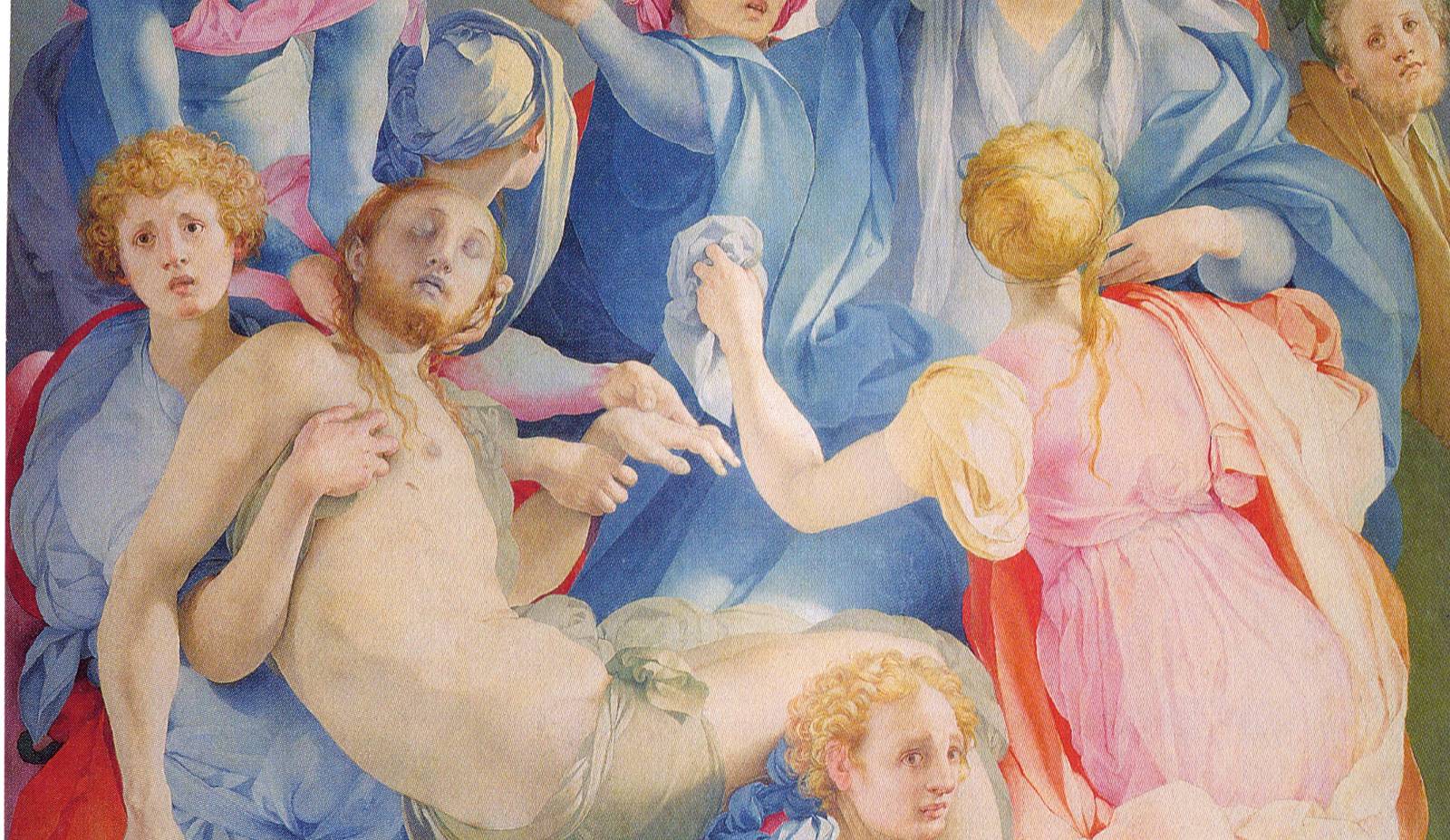
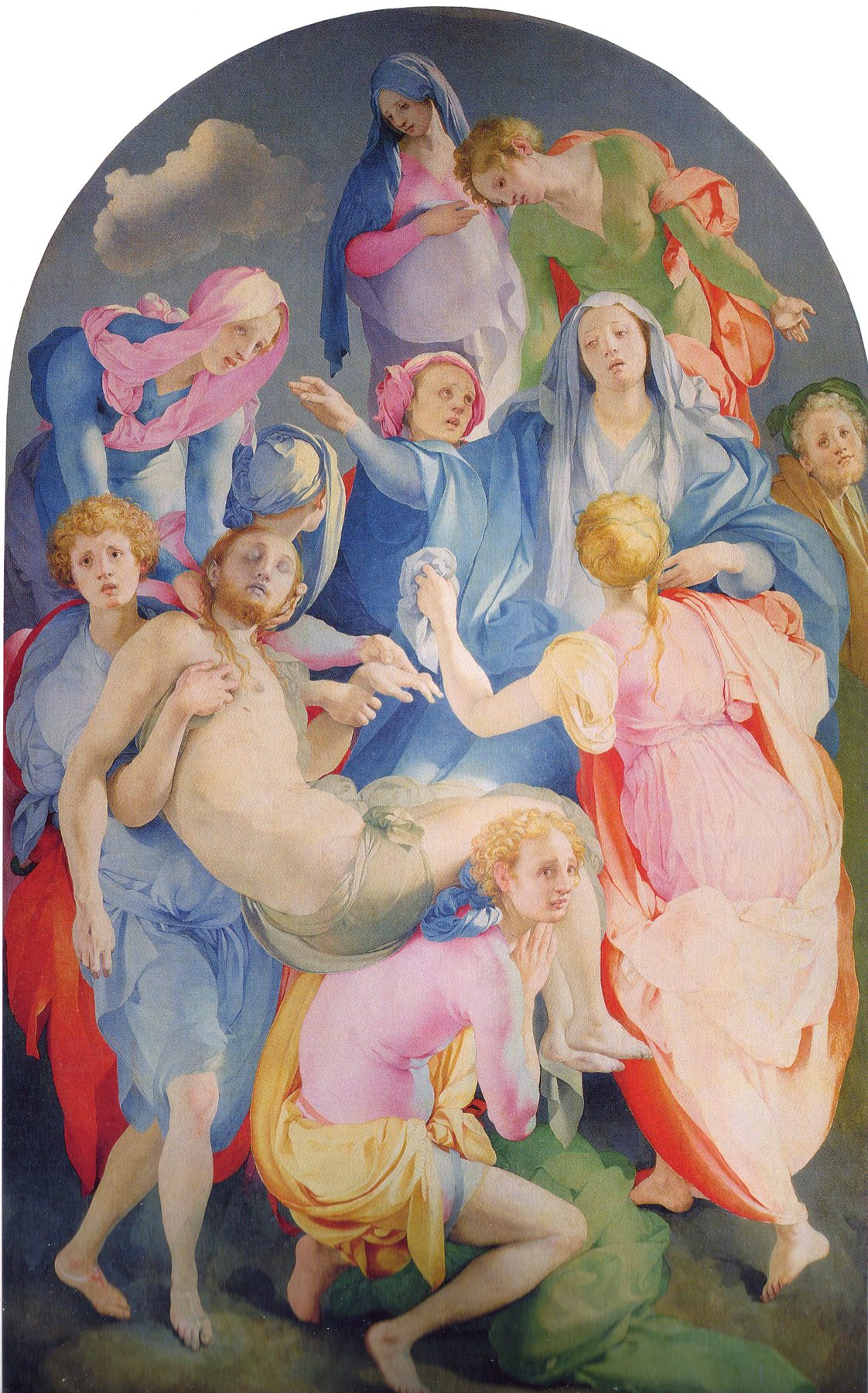
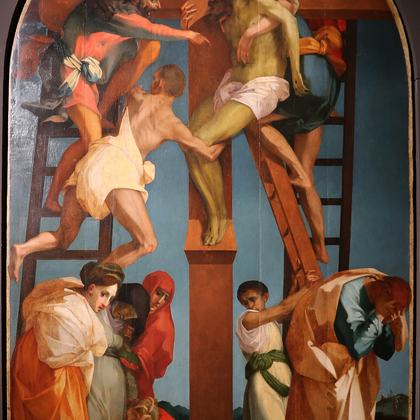
Image reference: Pontormo, Deposition from the Cross.
At a Glance
- Core periodc. 1520–1600
- First centresFlorence · Rome · Mantua · Parma
- Wider centresVenice · Fontainebleau · Prague · Toledo
- Known forartifice · elongated figures · complex poses · unstable space · courtly refinement
- Key ideamaniera: manner, style and cultivated artistic command
Contents
- Mannerism in context
- What does Mannerism mean?
- After perfection
- Pontormo and Rosso Fiorentino
- Parmigianino and impossible grace
- Bronzino and the Medici court
- Architecture, sculpture and virtuoso objects
- Fontainebleau, Prague, Venice and Toledo
- Sacred art and religious reform
- Artists to know
Mannerism in context
Michelangelo
Principal careerCorreggio
Principal careerPontormo
Principal careerParmigianino
Principal careerBronzino
Principal careerBenvenuto Cellini
Principal careerGiorgio Vasari
Principal careerTintoretto
Principal careerEl Greco
Principal careerMannerism is the art of rules understood so thoroughly that they can be bent, stretched or made strange. A body grows longer than anatomy seems to allow. A staircase pours into a vestibule. A bronze figure balances on a breath of wind. A court portrait turns silk, jewels and stillness into authority. A religious scene suspends grief in a space that no ordinary building could contain.
These effects appeared across sixteenth-century Europe after the achievements of Leonardo, Raphael and Michelangelo had made classical balance seem both triumphant and difficult to surpass. The artists now called Mannerists did not form a club or publish a manifesto. They worked in different cities, for different patrons and with sharply different purposes. What joined them was not one look but an intensified awareness of style itself.
Mannerism overlaps rather than cleanly replaces the High Renaissance. Experiments later identified as Mannerist were emerging before Raphael’s death in 1520, while High Renaissance ideals remained active for decades. Michelangelo’s later work belongs to both stories: it became an indispensable model for younger artists, yet his singular career cannot be contained by a label devised later.[1] [6]
The period also overlaps with the Venetian Renaissance, Counter-Reformation art and the beginnings of Baroque. Tintoretto’s accelerated space and El Greco’s elongated sacred figures share Mannerist qualities without becoming Florentine art. By the 1580s the Carracci were criticising rarefied artificiality in Bologna and Caravaggio would soon establish another kind of pictorial immediacy, but sophisticated court art continued in Prague and elsewhere.[30] [45]
A useful sequence begins around 1520 with experiments in Florence and Rome. The Sack of Rome in 1527 dispersed artists and strengthened routes between Italian centres and foreign courts. From the 1530s to the 1560s, Medici Florence, Gonzaga Mantua and Fontainebleau turned style into court culture. In the later sixteenth century, religious reform, academies, international workshops and emerging naturalisms changed the field without ending it at one date.[2] [3]
Follow Mannerism through four stages
–1527
Experiments after Renaissance perfection
Artists in Florence and Rome make inherited balance conspicuously difficult through strained bodies, unstable space and ambitious drawing.
–1540
Dispersal and courtly transformation
The Sack of Rome accelerates mobility as artists carry designs to Parma, Mantua, France and other centres without producing one uniform style.
–1570
Courts, academies and virtuoso objects
Medici Florence and other courts turn polished portraiture, learned allegory, bronze casting and institutional design into forms of authority.
–1610
International manner and religious reform
Prague, Fontainebleau, Venice and Toledo sustain transformed figure styles as religious reform and emerging Baroque naturalisms reshape their purposes.
What does Mannerism mean?
The name creates the first difficulty. The painters, sculptors and architects discussed here did not call themselves Mannerists. The Italian word maniera meant manner, style or way of working. In sixteenth-century writing it could praise an artist’s cultivated command. Giorgio Vasari admired the bella maniera, the “beautiful manner” achieved by artists able to absorb the finest qualities of earlier masters and exercise grace, judgement and invention.[7] [44]
That positive meaning is different from the later English word “mannered”, which can suggest empty affectation. Art historians once used Mannerism to describe a decline after the supposed perfection of the High Renaissance: proportions became distorted, subjects obscure and elegance excessive. This model made the period a corridor between two greater rooms, Renaissance and Baroque.
Modern scholarship has replaced that verdict with harder questions. What happens when naturalistic space and ideal proportion are no longer new achievements but inherited resources? How does an artist show originality after Michelangelo and Raphael? What kind of art suits a court whose viewers value poetry, classical mythology, wit and difficult interpretation? How do religious images respond to theological conflict without abandoning formal ambition? The Städel Museum’s research on Florentine maniera emphasises elegance, cultivation, artifice, caprice and creative independence rather than one symptom or mood.[2]
Several recurring features remain useful. Bodies may be elongated, especially necks, fingers and limbs. Poses turn around an axis. Groups occupy shallow, compressed or strangely discontinuous spaces. Colours can seem cool, acidic or detached from ordinary illumination. Brushwork may disappear into an enamel-like surface, or, in Venice, become rapid and exposed. Scale can change abruptly. A tiny prophet stands in the distance behind a gigantic Virgin; a room collapses around falling giants; a stair behaves like a liquid mass.
Yet none of these features is a test that an object either passes or fails. Bronzino’s portraits are exact in costume and facial description, not simply anti-natural. Giulio Romano can be comic and destabilising. Pontormo can be tender, melancholy or weightless. Rosso Fiorentino can be harsh. Parmigianino makes bodily impossibility look effortless. Mannerism names a field of choices rather than a uniform distortion.[1] [4]
The term is most secure in discussions of central Italian art and courtly networks shaped by it. It becomes less exact when applied to every late-sixteenth-century artist who used an elongated figure. El Greco brought Byzantine icon practice, Venetian colour, Roman figure style and Spanish religious patronage into a highly individual language. Tintoretto was formed by Venetian materials, spaces and institutions. Their work belongs in the conversation, but qualification makes the history stronger.
Mannerism is therefore best used as a question: what does this work do with inherited artistic rules, and for whom does it make that transformation visible?
After perfection
The High Renaissance offered younger artists an intimidating inheritance. Raphael organised large groups with apparent ease. Michelangelo gave bodies monumental force. Leonardo joined observation to elusive expression. To imitate these masters closely risked dependence; to ignore them was impossible. Artistic rivalry turned quotation into a competitive act.
The result was not rejection of classicism but deliberate pressure upon it. A figure derived from Michelangelo might twist more sharply, extend farther into the viewer’s space or be repeated in an unexpectedly delicate form. A Raphaelesque Madonna could be enlarged beyond ordinary scale and surrounded by an imbalance no classical pyramid would resolve. Artists demonstrated that they knew the rule by making its alteration conspicuous.
Drawing was central. Complex bodies had to be invented, revised and transferred. The Getty’s Michelangelo to Vasari project describes the bella maniera as a field in which exaggerated poses, extreme perspectives and muscular forms could shock and delight.[6] The visible difficulty of a design became part of its value. A viewer able to recognise the source could enjoy both memory and departure.
Historical crisis intensified the stakes but should not become a universal explanation. Raphael died in 1520. Imperial troops sacked Rome in 1527, bringing violence, displacement and the temporary collapse of a great centre of patronage. Florence experienced Medici expulsion, siege and ducal consolidation. Protestant reform challenged Catholic images, authority and practice. These events shaped careers and commissions, but Pontormo and Rosso had begun their experiments earlier. Style was not a medical symptom of collective trauma.[3] [13]
Mobility mattered more directly. After the Sack, artists carried drawings and working habits to Bologna, Parma, Mantua, Florence and France. Prints allowed inventions to travel without their makers. Courts recruited foreign talent partly because an international style could signal learning, reach and magnificence. The history is not a single centre radiating influence; it is a network of ambitious people repeatedly translating what they encountered.
Pontormo and Rosso Fiorentino
Pontormo and Rosso Fiorentino were both born in 1494 and trained in the orbit of Andrea del Sarto, yet they became evidence against the idea that early Mannerism was one reaction. A major Palazzo Strozzi exhibition called their careers “diverging paths”. Pontormo remained closely connected to Medici patronage and moved through several visual languages. Rosso pursued a more abrasive independence and eventually remade himself at the French court.[4]
Pontormo’s Supper at Emmaus of 1525 retains recognisable bodies and tableware but makes recognition feel supernatural. Monks gather close to Christ; hands, eyes and circular forms pull attention inward. A triangular divine eye added above Christ intensifies the sacred revelation. The Uffizi describes Pontormo’s mature language through psychological and compositional tension, bright colour and an engagement with northern prints as well as Michelangelo and Andrea del Sarto.[8]
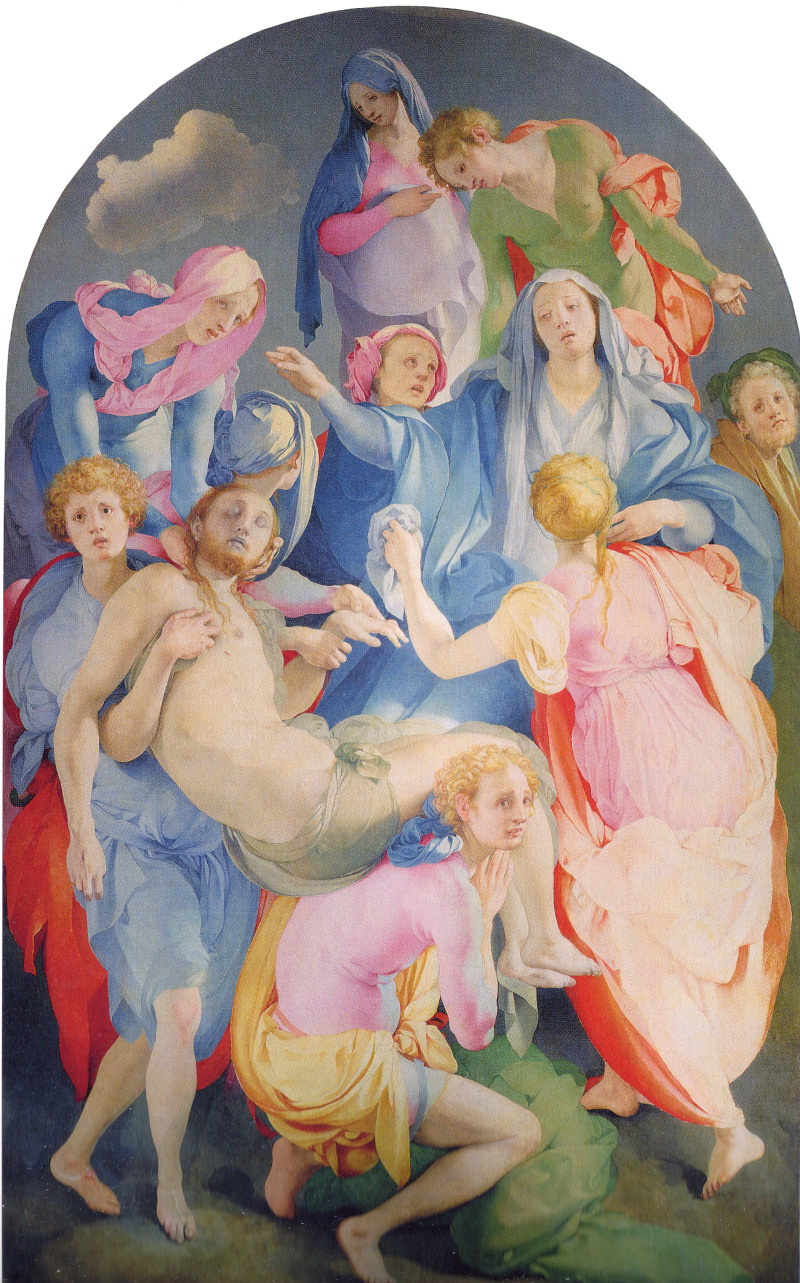
His best-known work is the large altarpiece in the Capponi Chapel at Santa Felicita, usually called the Deposition or Entombment. The uncertain title matches the scene’s suspension. There is no visible cross, tomb or stable ground. Figures carry Christ’s pale body through a compressed field of pink, blue, green and orange. Their feet barely establish weight. Faces turn outward and inward; grief circulates rather than resolving around one actor.
Two bearers seem too slender for their burden, yet the group does not collapse. The effect is less a physical event than a ritual of shared weight. Bright, unnatural colour separates bodies while their contours interlock. Getty scholarship identifies the picture’s elongated simplified forms and vivid hues as exemplary of Pontormo’s compositional complexity.[9]
The work does not prove that Mannerism abandoned religious meaning for formal display. Its instability gives grief a form: the world has lost its normal supports. At the same time, the choreography insists on invention. Viewers feel both emotion and awareness of the artist arranging it.
Pontormo’s drawings reveal how carefully these effects were built. He could draw sleepers, apprentices and bodies from life with immediacy, then transform observed gestures into highly controlled structures. He also studied prints by Albrecht Dürer and Lucas van Leyden, joining northern narrative density to Florentine figure design.[5] “Influence” here is active selection, not passive borrowing.
His Portrait of a Halberdier brings another difficulty. The young sitter’s identity and the painting’s date have long been disputed. Vasari’s reference to a portrait of Francesco Guardi competes with a later tradition identifying Cosimo de’ Medici. Elizabeth Cropper’s study reconstructs how evidence, costume, political history and earlier cataloguing generated the debate.[10] The uncertainty is instructive: a confident pose does not guarantee a secure name.
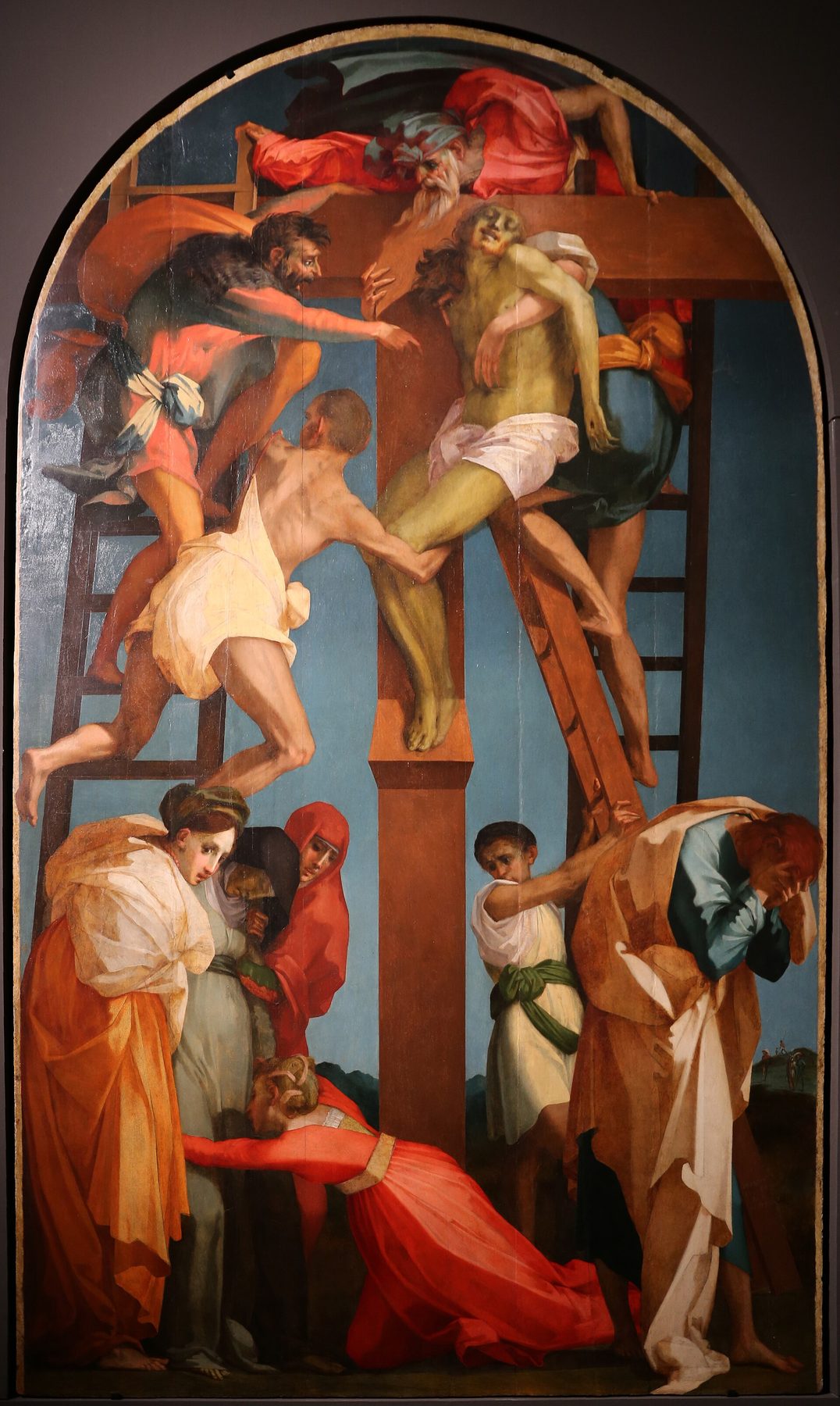
Rosso’s Deposition from the Cross at Volterra, painted in 1521, uses ladders, angular limbs and a hard blue sky to make removal from the cross an exposed mechanical ordeal. Figures at the top bend like hinged tools; mourners below break into separate zones of shock. Where Pontormo suspends, Rosso splinters. Palazzo Strozzi scholarship stresses that both artists could be unconventional without sharing a single vocabulary.[4] [5]
Rosso left Italy after a mobile career and entered the service of Francis I in 1530. At Fontainebleau, his angular bodies and decorative imagination encountered royal architecture, stucco workers, French and Flemish makers, and the later leadership of Primaticcio. The abrasive Florentine altarpiece painter became an architect of courtly splendour. That transformation is one reason movements should be studied through careers, not just visual checklists.
Parmigianino and impossible grace
Parmigianino, born Francesco Mazzola in Parma in 1503, developed another kind of artifice. He learned from Correggio, whose domes dissolved architecture in radiant illusion, then studied Raphael and Michelangelo in Rome. His figures are elongated, but length alone does not explain them. They appear to have been refined beyond ordinary resistance, as if bone and gravity had yielded to drawing.[11] [12]
The Self-Portrait in a Convex Mirror makes virtuosity its subject. Parmigianino painted his image on a curved support, enlarging the hand nearest the mirror and bending the room around the circular field. The picture advertises observation, ingenuity and manual skill while making the artist look youthful and composed. Distortion becomes proof of control.
His Vision of Saint Jerome was the major public painting of his Roman years. Preparatory drawings reveal repeated invention rather than effortless eccentricity. The altarpiece was interrupted amid the upheaval of the Sack of Rome, but its place in his career is more than an anecdote of crisis. It shows an artist using muscular scale, asymmetry and a steep chain of gazes to turn learned design into devotional encounter.[13]
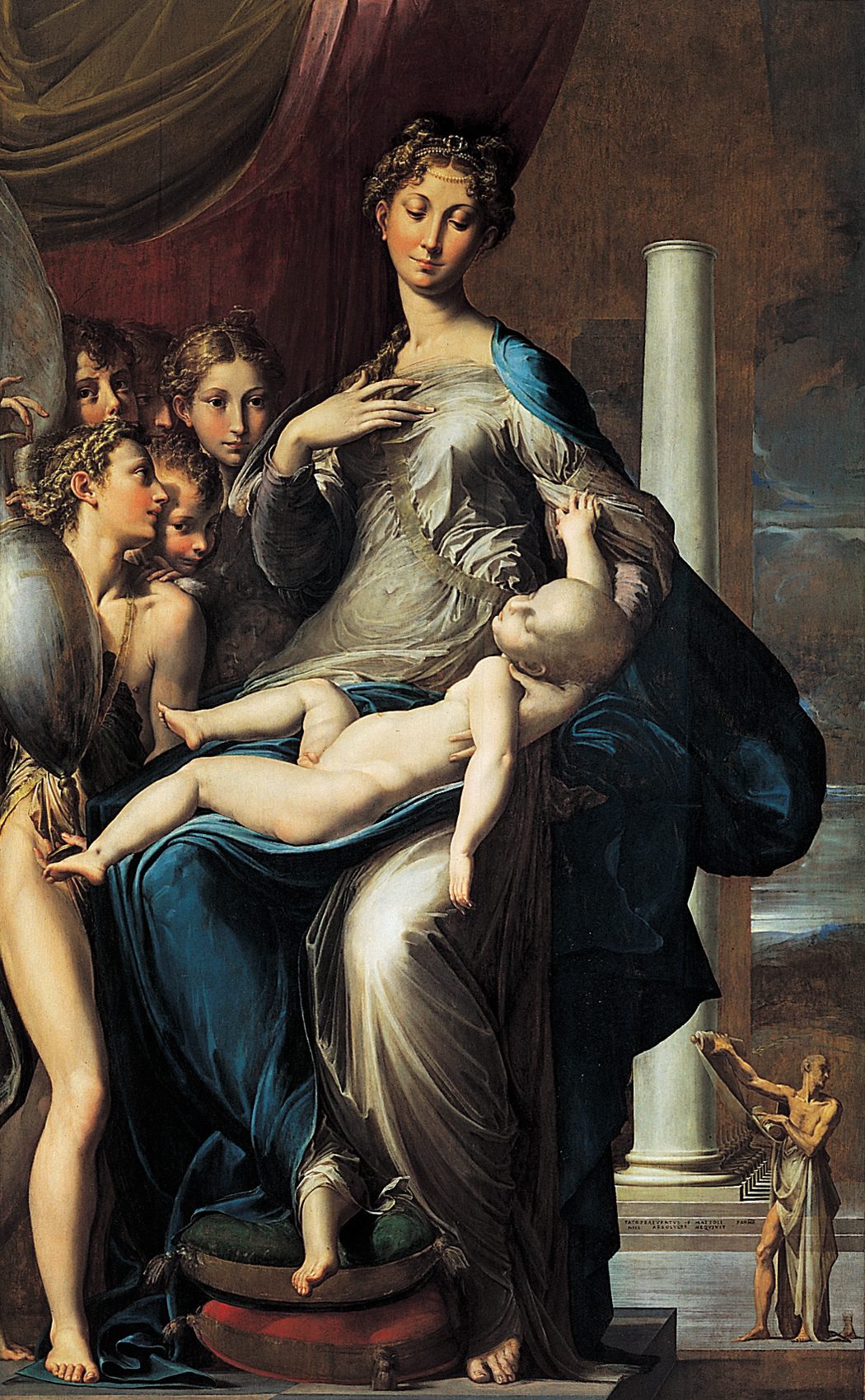
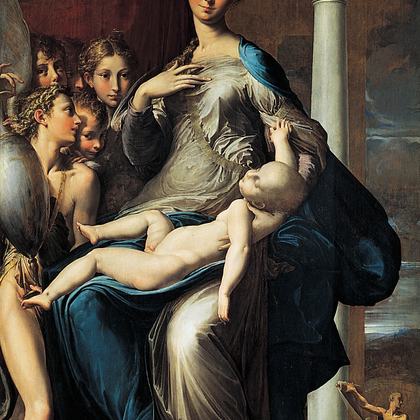
The Madonna of the Long Neck, commissioned in 1534 for Elena Baiardi Tagliaferri’s chapel in Parma, remained unfinished when Parmigianino died in 1540. An inscription later explained that fate had prevented completion. Mary is enormous and elegant, with a column-like neck and long fingers. The child sprawls across her lap in a pose that anticipates the dead Christ. Crowded angels press in from one side, while a tiny Saint Jerome unfolds a scroll beside a row of columns on the other.[11]
Nothing balances conventionally. Scale is discontinuous, the architecture does not describe a coherent room, and the Virgin’s body seems both monumental and boneless. Yet the work is not careless. The column can relate Mary’s neck to Marian poetry, while the child’s sleep carries Passion imagery. Sensual drapery and sacred prefiguration coexist. The painting’s unfinished state makes any complete symbolic scheme harder to secure, so visible evidence should lead interpretation.[11]
Parmigianino’s grace became highly portable. Drawings, prints and followers spread his tapering bodies across Italy and into France. At its weakest, imitation could become a formula of long limbs and decorative ease; at its strongest, it made elegance feel intellectually unstable.
Bronzino and the Medici court
Bronzino trained with Pontormo and collaborated with him, but his mature art exchanged Pontormo’s emotional vibration for polished control. By 1539–40 he had become court painter to Cosimo I de’ Medici. He was also a poet, designer and later member of the Florentine academy. His career shows maniera becoming an official language of dynasty and learned culture.[18] [19]
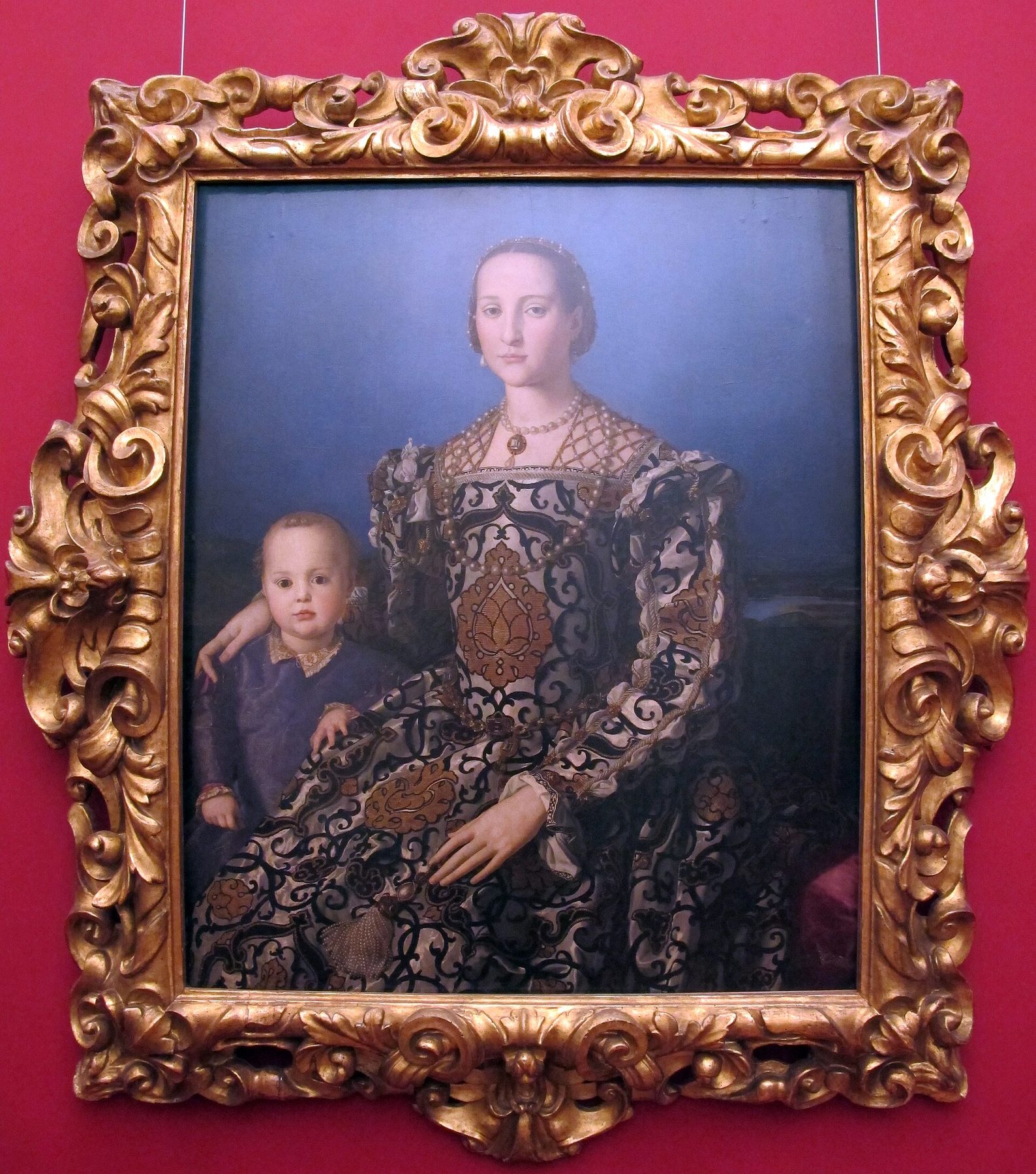
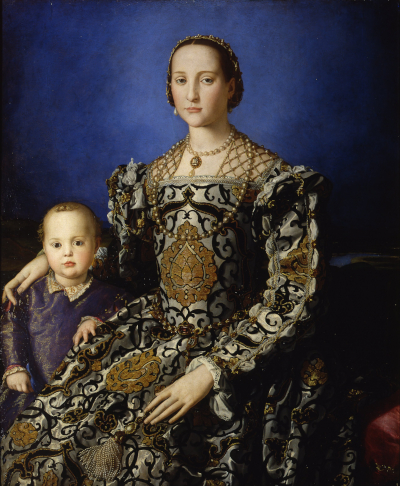
In the Portrait of Eleonora di Toledo with Her Son Giovanni, Eleonora appears against an intense blue field wearing a dress of extraordinary patterned richness. It is tempting to treat the portrait as a fashion document, but the Uffizi emphasises its dynastic purpose. Giovanni embodies succession; expensive pigment and brocade convert material splendour into authority; Eleonora had repeatedly served as head of state during Cosimo’s absences.[16]
Her face is calm rather than psychologically open. The child does not disrupt the design. Skin, pearls, hair and woven pomegranates are differentiated with exactness, while the whole surface remains almost untouched by time or accident. This is naturalism disciplined into a political apparition.
The Portrait of Ugolino Martelli joins another elite identity to studied pose. The young humanist appears with Homer, Virgil and Pietro Bembo, surrounded by architecture and family reference. His body turns across itself in a consciously artificial arrangement. Berlin research connects the design to Pontormo while reading the books and setting as claims to classical and contemporary learning.[17]
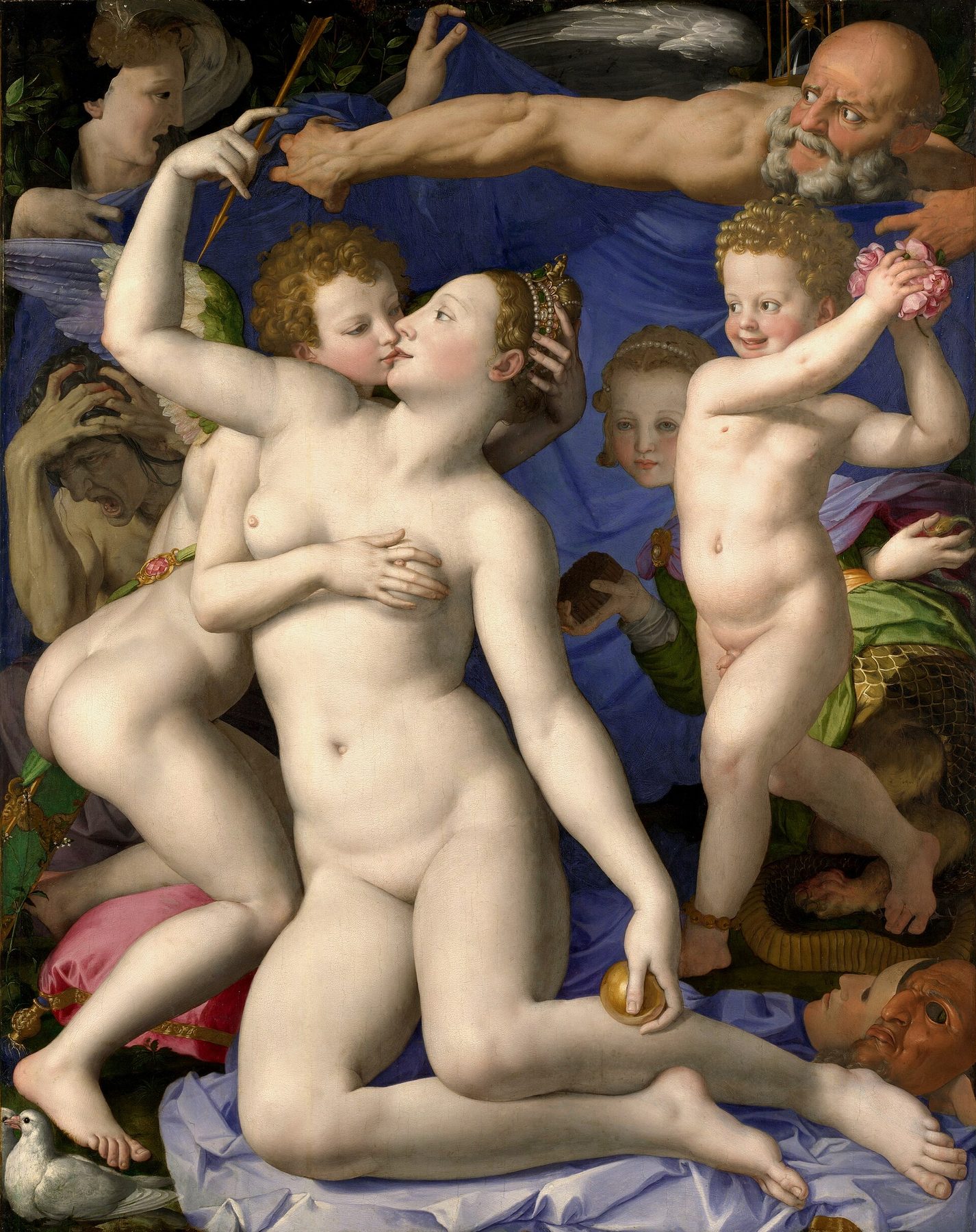
Bronzino’s An Allegory with Venus and Cupid is more openly difficult. Venus and Cupid kiss in a shallow tangle of bodies, masks, roses, honeycomb and hybrid beings. Father Time appears to pull a blue cloth, perhaps revealing or concealing the scene. Figures have been identified as Pleasure, Folly, Fraud, Jealousy, Disease and Oblivion, but the full meaning remains uncertain.[15]
The uncertainty was probably part of the attraction. A sophisticated viewer could test mythological, moral, erotic and political readings. Vasari describes a related painting sent to Francis I, though its documented route is incomplete. The picture’s enamel-like finish, compressed relief space and expensive blue make it resemble a luxury object engineered for eye and intellect.[15]
Courtly complexity extended beyond isolated paintings. The Studiolo of Francesco I in Palazzo Vecchio brought small pictures, rare materials and learned allegories into a private chamber. Vasari’s Forge of Vulcan belonged to a set based on inventions devised with the scholar Vincenzo Borghini. The Uffizi notes that few viewers possessed the knowledge needed to unravel their often obscure symbolism.[21]
This restricted audience complicates the old charge that Mannerist art communicates badly. Some works were not designed for immediate universal clarity. Difficulty could signal intimacy, education and access. To understand that purpose is not to accept every allegorical solution proposed later.
Vasari also helped turn artistic identity into institution. Cosimo I approved the statutes of the Accademia e Compagnia dell’Arte del Disegno in 1563. The academy elevated disegno—both drawing and intellectual design—as a foundation shared by painting, sculpture and architecture. It also joined artistic prestige to Medici government.[20]
Giorgio Vasari shaped the history he inhabited. His Lives, first published in 1550 and enlarged in 1568, organised Italian art as a developmental story culminating in modern excellence and Michelangelo. The book preserves invaluable information and period judgements, but its Florentine loyalties, literary aims and personal relationships must remain visible.[43] [44]
His architecture likewise served ducal order. Cosimo commissioned the Uffizi to gather Florence’s magistracies into one administrative complex, and Vasari began the building in 1560. Its long, controlled perspective towards the Arno differs from the compressed Laurentian vestibule, yet it similarly uses inherited classical forms to organise movement and power. “Uffizi” meant offices before the palace became a gallery. The building reminds us that artistic style operated through government, bureaucracy and urban planning as well as through enigmatic paintings.[22]
Architecture, sculpture and virtuoso objects
Mannerist ideas become especially clear when classical architecture stops behaving predictably. In the vestibule of Michelangelo’s Laurentian Library, paired columns appear embedded in the walls rather than standing freely. Windows are blind or compressed; brackets seem burdened with weight. The great stair advances into the room in three streams, its central oval steps swelling forward.[23]
The vocabulary is classical—columns, pediments, pilasters, scrolls—but syntax has been disturbed. Michelangelo designed the library from 1524, and Bartolomeo Ammannati executed the stone stair in 1559 from his model. The dark vertical vestibule opens into a long, bright, rational reading room. Tension and release are architectural experience, not ornament applied to a neutral shell.[23]
Michelangelo is better understood here as a generative pressure than a member of a movement. His figures and buildings offered younger artists forms that seemed authoritative and open to further transformation. The twisting pose called figura serpentinata—a body spiralling around a central axis—became closely associated with Mannerist art, though it had earlier precedents.[14]
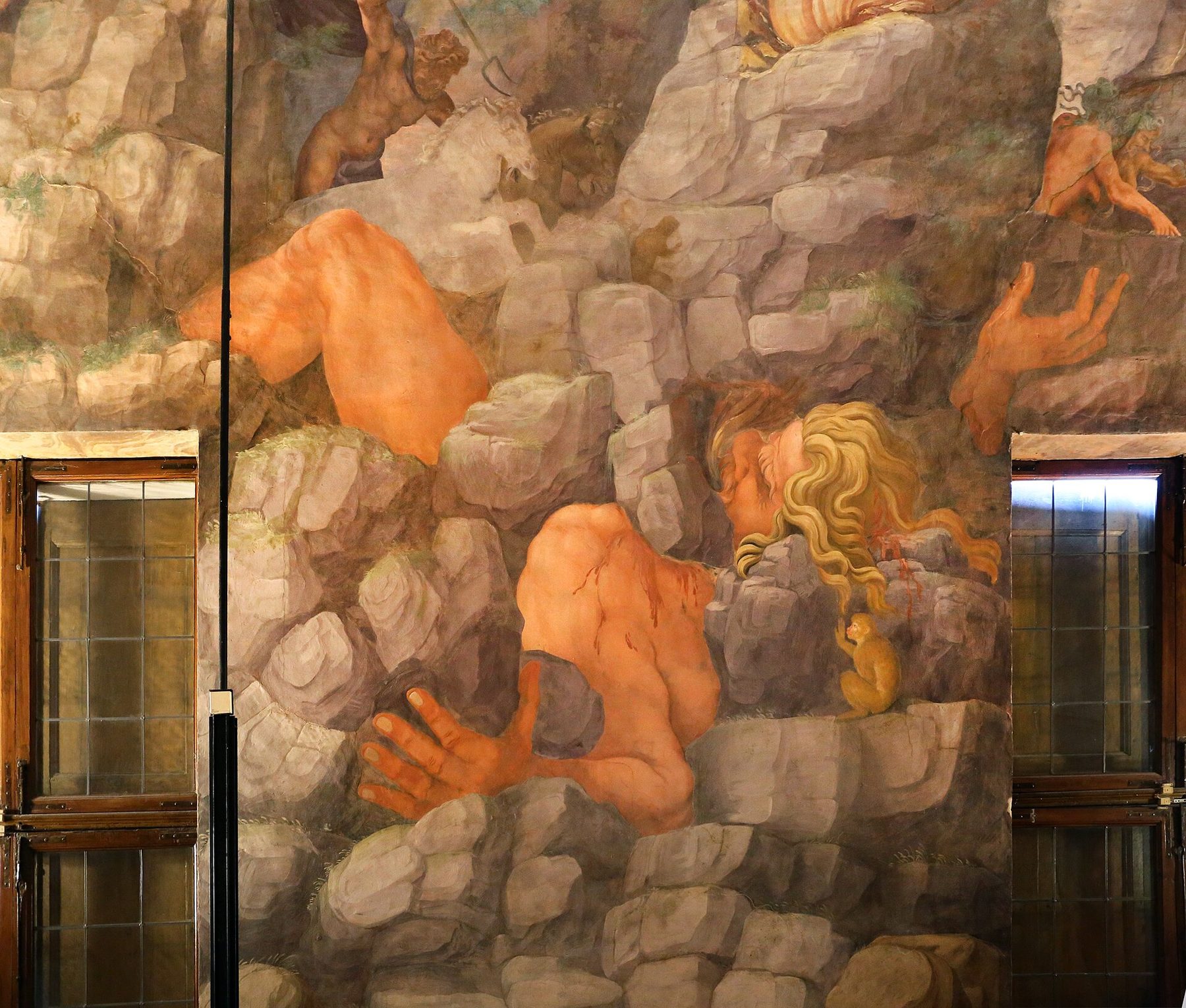
Giulio Romano’s Palazzo Te in Mantua turns disturbance into court entertainment. Designed for Federico II Gonzaga, the suburban palace manipulates classical details across architecture, painting and stucco. In the Sala dei Giganti, the Olympian gods crush rebellious giants while columns and masonry appear to collapse around the viewer. Corners disappear within continuous imagery. The room makes illusion physically enveloping.[24]
The joke is learned and spectacular. Architecture pretends to destroy itself while the building remains carefully engineered. Giulio had worked with Raphael in Rome; at Mantua, inheritance becomes licence. The patron’s guests are invited to recognise both cosmic punishment and technical audacity.
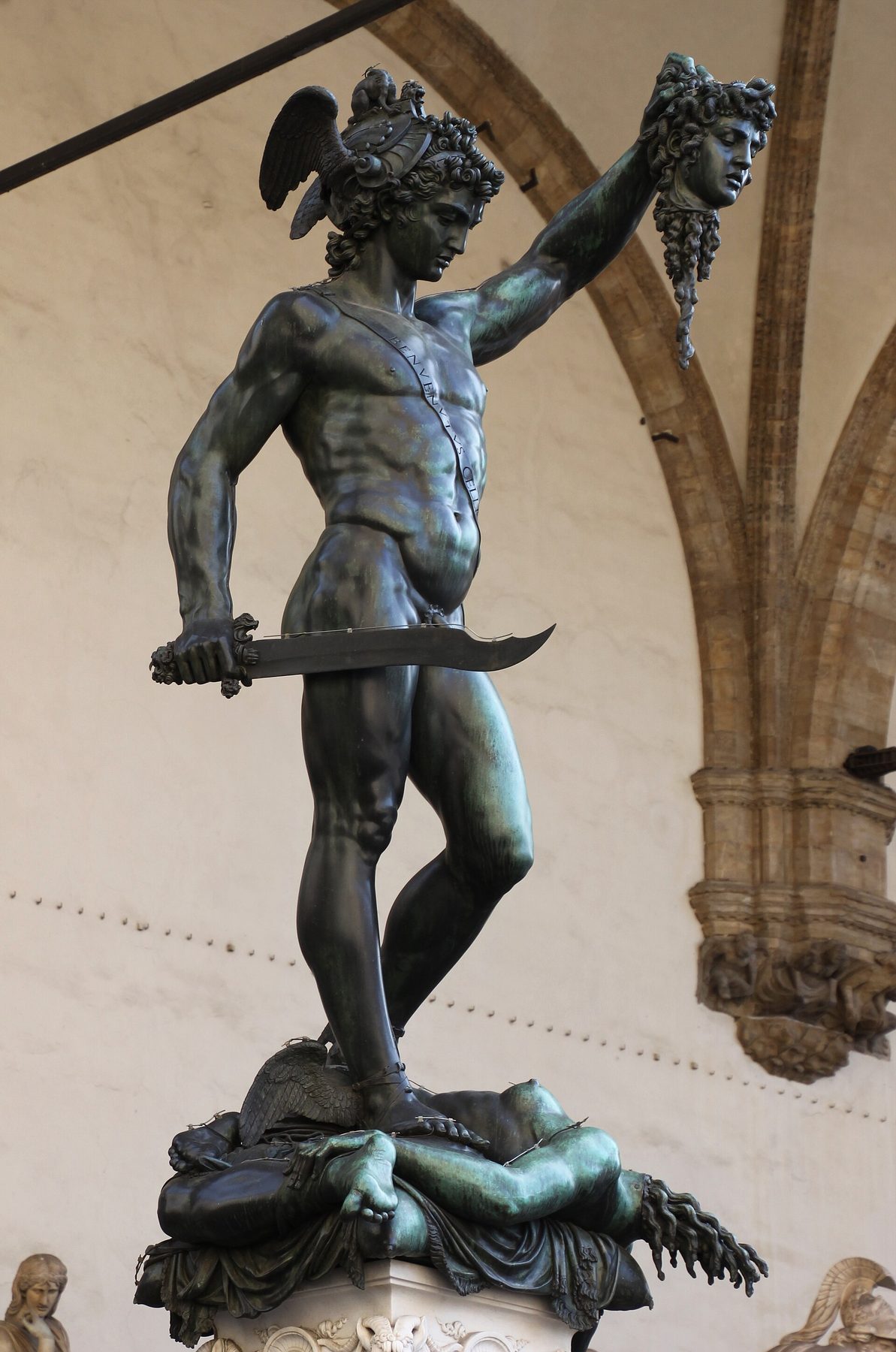
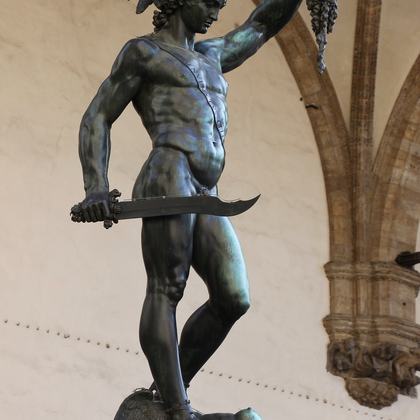
Benvenuto Cellini made virtuosity personal. His bronze Perseus with the Head of Medusa, created for Cosimo I and installed in the Loggia dei Lanzi, joins myth, ducal power, precious detail and a public contest with great Florentine sculpture. Perseus raises Medusa’s severed head above her collapsed body; the elaborate base contains smaller deities and grotesque ornament.[26]
Cellini’s autobiography turns the casting into heroic drama. He describes fire, failing metal, illness, improvisation and personal triumph. It is compelling primary evidence about an artist’s desired identity, not an objective workshop report. His technical treatises provide a different kind of testimony about goldsmithing, bronze and the knowledge behind spectacular objects.[27] [28]
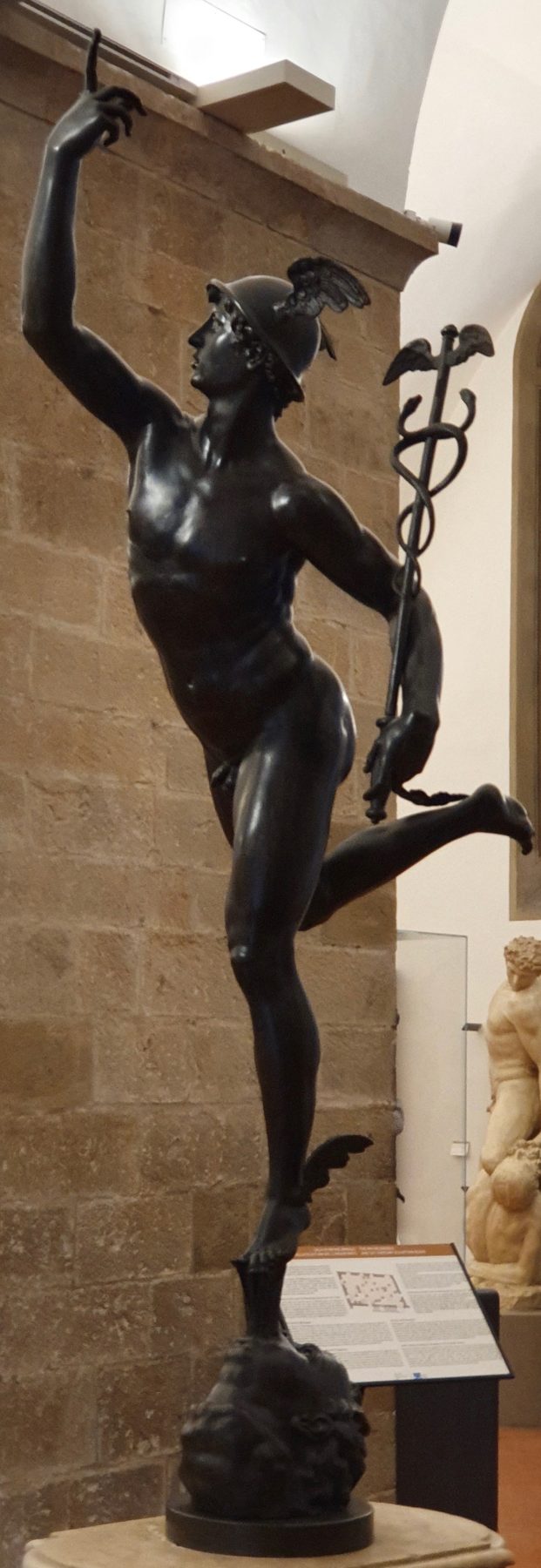
Giambologna, born in Douai and active in Florence, made sculpture demand movement from the viewer. His flying Mercury rises on one foot above a wind god’s breath. The group later called the Abduction of a Sabine Woman binds three bodies into an upward spiral without one privileged frontal view. Its title was attached after the formal invention, a reminder that composition could precede narrative.
Small bronzes carried such inventions between collections. The Met describes Giambologna and his assistants as major entrepreneurs in casting and patination, translating monumental sculpture into repeatable courtly objects. His Florentine workshop attracted northern sculptors such as Adriaen de Vries, who carried spiral form and multiple viewpoints to other European centres.[25] [29]
Sculpture makes the period’s central question tangible. Is a difficult pose merely display, or does bodily movement generate meaning? The strongest works refuse the choice. Technical astonishment changes how violence, flight, desire or victory is experienced.
Essential works
Deposition from the Cross
Pontormo, c. 1525–28
Deposition from the Cross
Rosso Fiorentino, 1521
Madonna of the Long Neck
Parmigianino, 1534–40
Fall of the Giants
Giulio Romano and workshop, 1532–35
Eleonora di Toledo with Her Son Giovanni
Bronzino, c. 1545
Fontainebleau, Prague, Venice and Toledo
Mannerism became European through collaboration, migration and objects. It did not leave Italy as a sealed package. At Fontainebleau, Francis I recruited Rosso Fiorentino in 1530 and later Primaticcio and Niccolò dell’Abate. Italian designs met French architecture, Flemish makers, carved wood, stucco, fresco and royal ceremony.[31] [33]
The Galerie François I combined painted scenes with swags, masks, putti and strapwork that appears like cut and curled leather. The château’s educational resources stress that the gallery was a restricted royal passage and that only the king held its key.[32] Its dense imagery praised rule through a language that made privileged access part of meaning.
It is misleading to call Fontainebleau simply Italian art in France. The Yale University Art Gallery describes a mixed field formed by Italian, French and Flemish artists, with Primaticcio joining Giulio Romano’s Mantuan legacy to the refinement of Correggio and Parmigianino.[34] Prints after the decorations distributed nude types, frames and ornamental devices far beyond the palace.
In the later sixteenth century, the imperial court of Rudolf II at Prague gathered artists and objects from across Europe. Bartholomeus Spranger’s interlaced mythological nudes, Adriaen de Vries’s bronzes and collections of natural and artificial wonders made court culture international. The Met’s Spranger scholarship shows Giambologna as a crucial model while tracing mobile careers through Italy and northern courts.[30]
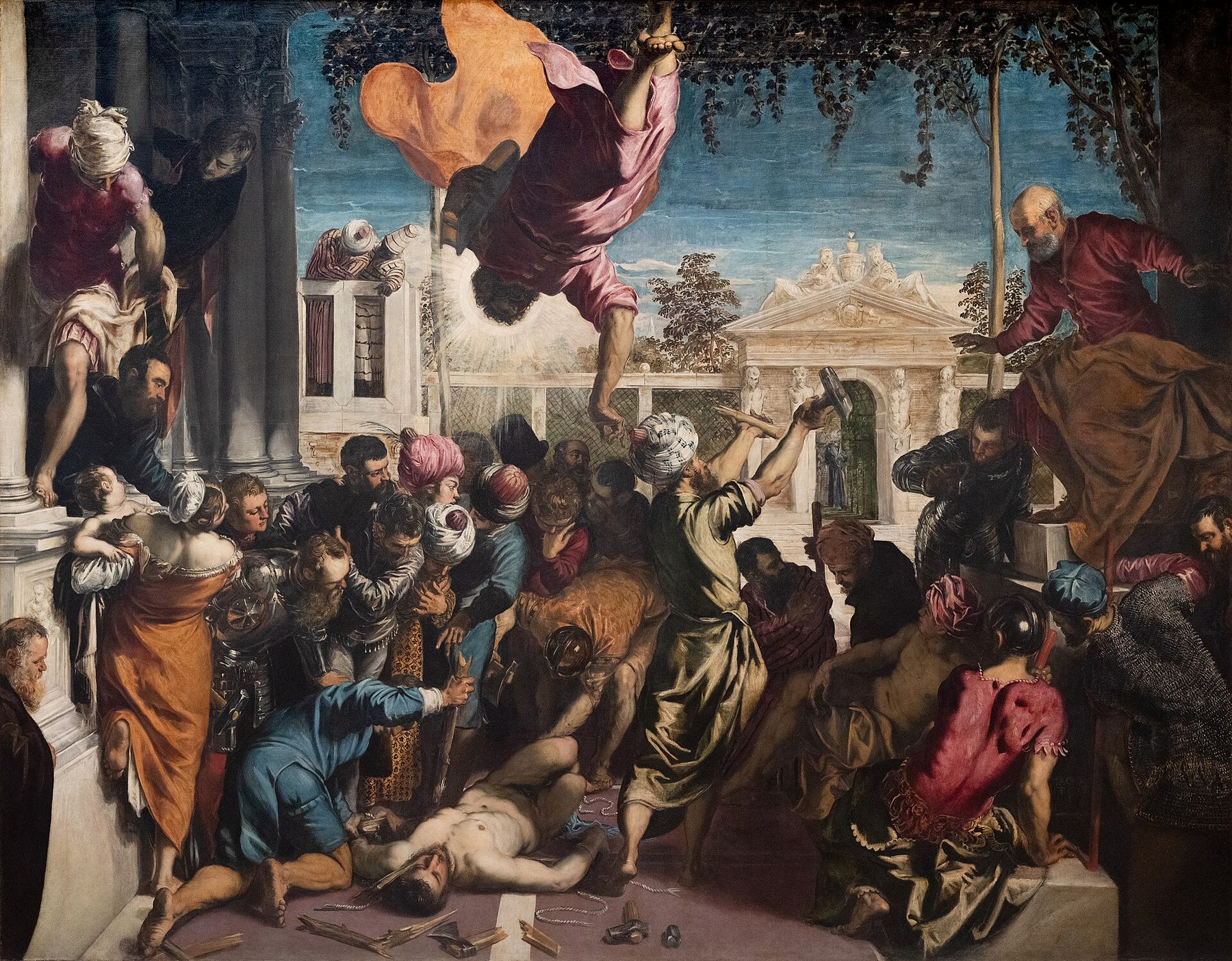
Venice presents a different problem. Central Italian artists including Vasari and Salviati visited, and Venetian painters knew Michelangelo through drawings and prints. Yet Venetian oil practice, colour and institutions generated distinct responses. Tintoretto combined muscular figure design with rapid brushwork, dramatic light and steep spatial acceleration.[35]
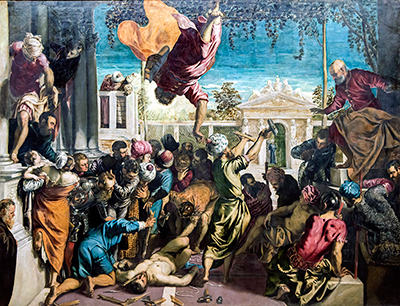
In The Miracle of the Slave, Saint Mark plunges headfirst into a crowded scene, foreshortened bodies and broken instruments spreading around the victim. In Tintoretto’s late Last Supper for San Giorgio Maggiore, the table cuts diagonally into depth while servants, smoke and angels animate a dark interior. These works share Mannerist instability, but their light and paint point strongly towards Baroque experience.
El Greco makes national categories even less adequate. Born in Venetian-ruled Crete, he trained in late Byzantine icon painting, moved to Venice, encountered Titian and Tintoretto, then worked in Rome before settling in Toledo in 1577. He never abandoned all aspects of his earlier practice even as he mastered Western oil painting, perspective and anatomy.[36] [38]
His elongated bodies are sometimes offered as a simple definition of Spanish Mannerism. That misses their layered formation and function. In Toledo, he designed entire altarpiece ensembles, joined painting to sculpture and architectural framing, and adjusted figures for viewing from below. His portraits often remain more restrained than his sacred scenes.[36]
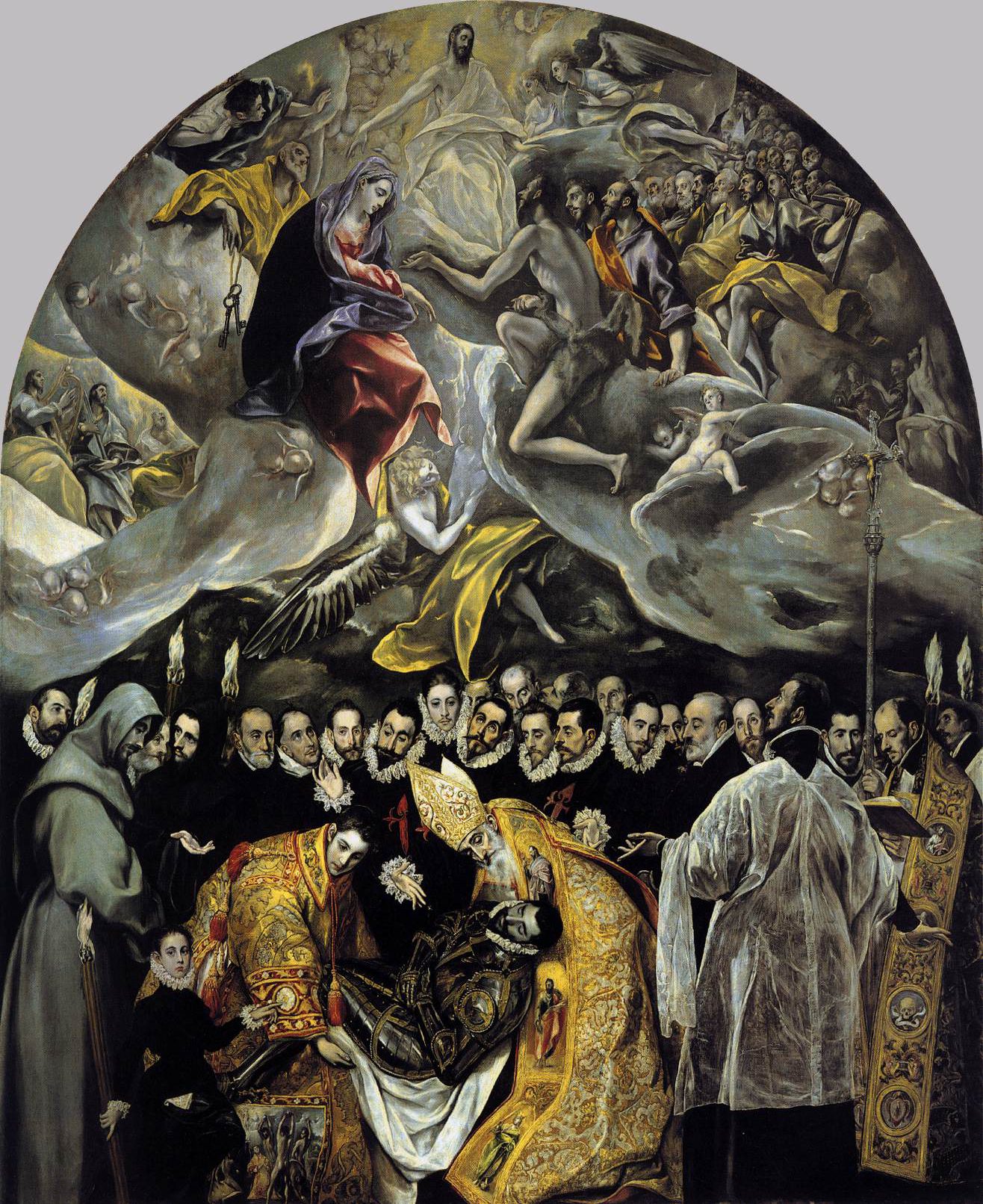
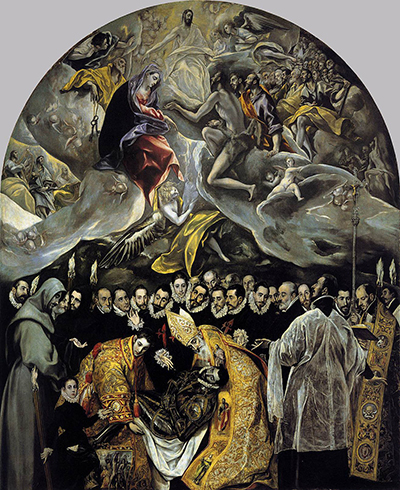
In The Burial of the Count of Orgaz, contemporary Toledo gathers below while a visionary heaven opens above. Earthly portraits, embroidered vestments, stretched saints and swirling cloud belong to different visual registers held in one canvas. Later works push colour and anatomy further from ordinary appearance, not because El Greco could not draw correctly but because he pursued spiritual visibility.
Contemporary religious writers did not universally approve. The Prado records criticism of his formal and iconographic licence, as well as admiration from poets and fellow artists. His later rediscovery by Romantics, modernists and expressionist painters shows how categories change with the needs of viewers.[36] [37]
Sacred art and religious reform
Mannerism unfolded through the Reformation and Catholic reform, but no single “Counter-Reformation style” appeared overnight. The Council of Trent’s final decree on sacred images in 1563 upheld their use while warning against false doctrine, indecency, disorder and confusing novelty. Bishops were given responsibility for unfamiliar or questionable images.[41]
The decree was brief. Later church authorities translated its principles into more detailed instructions. Charles Borromeo’s 1577 guidance addressed church buildings and furnishings and demanded doctrinal care in images.[42] Application differed by place, patron and order, so dates should not be treated as a switch from complex Mannerism to simple Baroque.
Some artists and patrons did favour clearer narratives, more legible emotion and decorous bodies. In Florence, members of the Accademia participated in alterations to major churches after Tridentine reform.[20] In Bologna, the Carracci later criticised what they saw as the artificiality of prevailing practice and combined close study of nature with Raphael, Correggio and Venetian colour.[45]
Yet Bronzino, Vasari, Tintoretto and El Greco all continued to make ambitious religious art in changed circumstances. Clarity concerned theological and devotional function, not a ban on beauty, foreshortening or invention. El Greco’s intense colour and elongation could guide the eye upward; Tintoretto’s diagonals could place viewers inside sacred drama.
Religious interpretation must also resist biographies of anxiety. Pontormo’s strange space does not prove private instability, and Parmigianino’s elegance does not imply weak belief. Commission, location, viewing distance, liturgy and patronage offer firmer starting points than diagnosing an age from its bodies.
Women, professional identity and the limits of the label
Sofonisba Anguissola and Lavinia Fontana worked within the same late-sixteenth-century culture of courts, academies, portraiture and artistic self-consciousness, but they are often positioned at the edge of Mannerism. Their careers show why stylistic categories can conceal access.
Anguissola, born into a minor noble family in Cremona, received an unusual education and built fame through drawings, self-portraits and images of relatives. Her self-portraits functioned as introductions: they presented skill while performing the modesty expected of a learned gentlewoman. She later served at the Spanish court, officially as a lady-in-waiting rather than simply as a salaried painter, and adapted her portraiture to Habsburg reserve.[39] [40]
Lavinia Fontana trained with her father Prospero in Bologna and developed a professional workshop. She painted portraits, altarpieces and mythologies, serving clients in Bologna and Rome. The Prado stresses that mythological painting required access to the nude, a field normally denied to women, and that Fontana turned invention, jewellery and transparent fabrics into claims of artistic authority.[39]
Both artists engaged styles associated with Correggio, Parmigianino, Venetian painting, Spanish court portraiture and late Mannerist eroticism. Neither should be admitted to a canon only by proving she looked like Bronzino. Gender affected training, official title, genre, payment, signature and the public performance of ambition. Those conditions are part of style’s history.
The broader Emilian field confirms this point. Prospero Fontana carried Mannerist practices through a mobile career and trained Lavinia; Bologna then became a centre in which religious reform, learned patronage and new naturalisms coexisted.[45] A movement page should reveal those structures rather than add women as decorative exceptions.
Artists to know
Pontormo
Pontormo makes weight and space emotionally uncertain. Begin with the Deposition, then compare the crowded recognition of the Supper at Emmaus, the slow encounter of the Visitation and the poised vulnerability of the Halberdier. His art changes too much to be reduced to one anxious formula.
Bronzino
Bronzino turned exact finish into social distance. His Medici portraits, drawings, poetry and allegories belong to one learned court culture. Look at how apparently neutral details—book, sleeve, jewel, blue field—organise authority.
Parmigianino
Parmigianino made distortion graceful. The convex self-portrait, Vision of Saint Jerome and Madonna of the Long Neck show invention passing between optical experiment, public altarpiece and unfinished masterpiece.
El Greco
El Greco transformed Cretan, Venetian, Roman and Spanish experience rather than merely exporting Italian Mannerism to Toledo. His stretched sacred figures belong to altarpieces, viewing conditions and devotional aims; his portraits demonstrate a different measure of restraint.
Tintoretto
Tintoretto joined central Italian figure ambition to Venetian colour, light and fast handling. He is most useful at the boundary of categories, where Mannerist instability begins to generate Baroque movement.
Benvenuto Cellini
Cellini was goldsmith, sculptor and author of a spectacular self-image. Perseus turns difficult bronze casting into public political theatre. Read the autobiography critically beside the object.
Giorgio Vasari
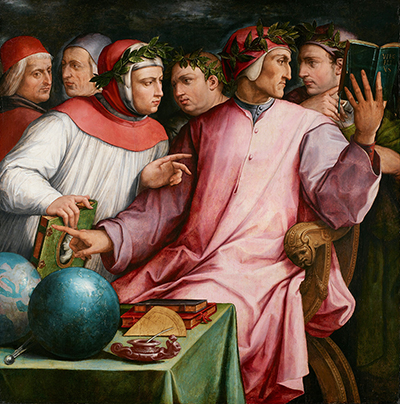
Vasari painted, designed architecture, organised court decoration and wrote the era’s most influential artistic history. His celebration of disegno, Florence and Michelangelo helped determine which achievements later generations saw as central.
Michelangelo
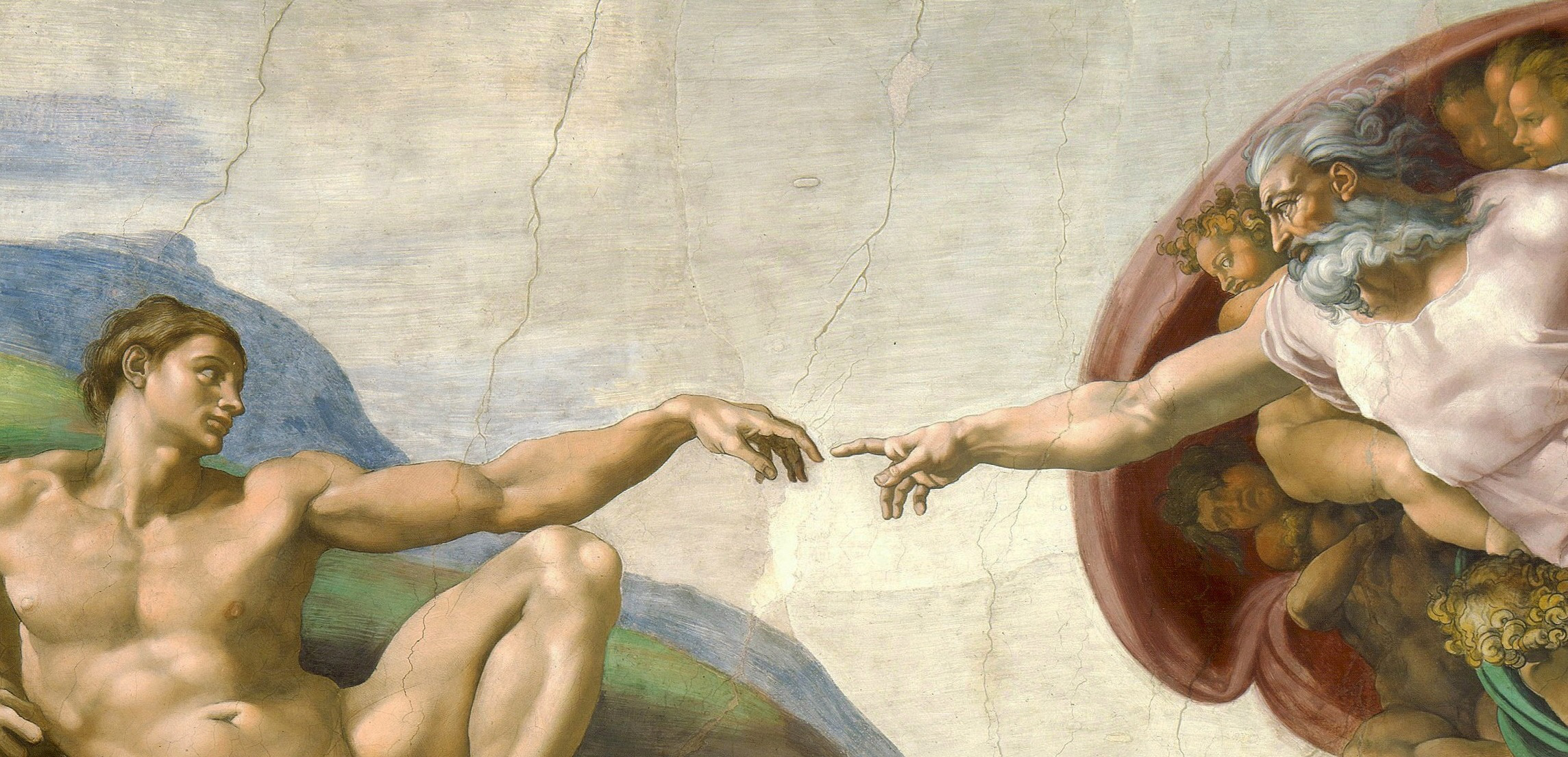
Michelangelo is a model, precursor and destabilising force more than a straightforward Mannerist. The Laurentian Library shows classical language under sculptural pressure; his bodies supplied later artists with a vocabulary they could magnify, refine or contest.
Correggio
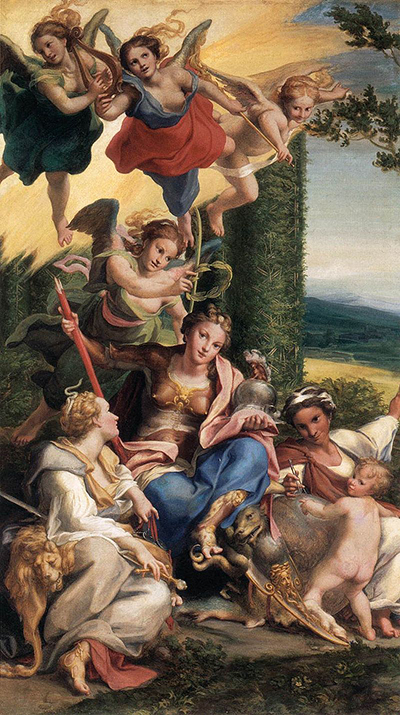
Correggio’s illusionistic domes, tender figures and luminous colour shaped Parmigianino and Emilian painting. His work reminds us that Mannerism did not grow only from Florentine drawing; softness, light and spatial illusion were equally fertile sources.[45]
Rosso Fiorentino, Giulio Romano, Giambologna, Francesco Salviati, Perino del Vaga, Primaticcio, Niccolò dell’Abate, Sofonisba Anguissola, Lavinia Fontana, Bartholomeus Spranger and Adriaen de Vries are also essential to the wider field.
How to look at Mannerist art
Start with the label lightly. Ask where and for whom the work was made before looking for long fingers. A Florentine ducal portrait, a Mantuan pleasure palace, a French royal gallery and a Toledan altarpiece may share sophisticated artifice while serving very different viewers.
Find the inherited rule. Does the work begin from a Raphael Madonna, a Michelangelo nude, a classical column or an ancient myth? Then identify the alteration. Scale may become discontinuous, a pose may spiral, architectural support may look unstable or a familiar story may be paused at an unfamiliar instant.
Trace the line of movement. The figura serpentinata twists around an axis; a Giambologna bronze asks you to walk around it; Tintoretto’s diagonal table pulls you into depth. Follow bodies, gazes, limbs and drapery before deciding that the scene is confused.[14]
Study surface and material. Bronzino hides the brush to create mineral calm. Tintoretto lets strokes and underlayers energise light. Cellini’s bronze converts molten metal and a complex cast into seamless command. The Laurentian stair makes heavy stone appear to flow. Artifice is material intelligence, not just a visual manner.
Separate visible evidence from iconographic proposals. Bronzino’s Allegory contains Time, masks and hybrid beings, but its final moral remains disputed. Parmigianino’s columns and scale invite theological reading without yielding one complete key. Difficulty may have been intended, especially in restricted court settings.
Consider the viewer’s body. Was the object approached from below, walked around, passed through or viewed in a chapel? Elongation can correct or intensify a distant view. A frescoed room can erase its corners. Mannerist works often control spectators through physical placement as much as through subject.
Finally, notice whose learning is assumed. Classical quotation, Petrarchan poetry, mythology and court genealogy rewarded prepared audiences. Ask who was excluded from that preparation and who performed the making. Workshops, assistants, founders, textile workers and models supported the polished appearance of individual genius.
Legacy and afterlife
Mannerism did not end when a new style won a contest. In Bologna, the Carracci promoted reform through natural study and selected models from Raphael, Correggio and Venice. In Rome, Caravaggio’s forceful light and ordinary bodies offered another route. Yet international court styles, bronze workshops and decorative inventions continued into the seventeenth century.
The label itself had a second life. Historians who valued classical balance treated the period as excessive or decadent. Later scholars and museums recovered its formal intelligence, political setting and diversity. The Städel’s Maniera exhibition explicitly framed post-High-Renaissance Florence as a field of major achievement rather than decline.[2]
El Greco’s reception shows how rediscovery can create new ancestors. Romantics, French nineteenth-century painters and twentieth-century modernists admired qualities earlier critics found extravagant. Expressionists saw elongated bodies and heightened colour through their own concerns; the Prado now presents those readings as part of his history rather than timeless proof that he was “modern”.[37]
Pontormo, Parmigianino and Bronzino similarly appeal to artists and audiences alert to unstable identity, artificial beauty and the intelligence of surfaces. The attraction is not that they predicted modern art. It is that they make style visible as a choice under pressure.
Frequently Asked Questions
It is usually dated from around 1520 to about 1600, between the High Renaissance and Baroque. Those dates are guides: experimental tendencies appeared earlier, and international court Mannerism continued after 1600.[1]
No. Mannerist artists studied Renaissance masters, ancient sculpture, perspective and anatomy intensely. Their work often transforms classical rules rather than abandoning them.
Look for conspicuous artifice: elongated or twisting bodies, compressed space, unexpected scale, unusual colour, difficult allegory or technical display. No single feature is decisive, and context matters more than a checklist.
Sofonisba Anguissola and Lavinia Fontana worked within late-sixteenth-century court, portrait and learned artistic cultures often connected to Mannerism. Their careers should be studied on their own terms, including the restrictions and strategies that shaped their access to training, genres and professional status.[39] [40]
Discussion
Mannerist art often makes difficulty pleasurable: a body seems impossible, a space refuses to settle or an allegory withholds its final meaning. Choose one work and decide whether its artifice creates emotional force, intellectual distance or both.
Reader Insights
Identify the classical pose, Renaissance composition or familiar sacred subject before judging the artist’s alteration.
Ask whether difficulty, elegance or technical display addressed a chapel congregation, a court insider or a spectator moving around sculpture.
Notice how polished paint, rapid brushwork, cast bronze or flowing stone makes artifice a physical achievement rather than an abstract label.
Join the Conversation
Have a thought or observation about Mannerism? Share it below. Thoughtful responses may be added to this section.
References
- “Mannerism: Bronzino and his Contemporaries”, Metropolitan Museum of Art, Ross Finocchio. View Source
- “Maniera: Pontormo, Bronzino und das Florenz der Medici”, Städel Museum. View Source
- “Maniera: Pontormo, Bronzino and Medici Florence”, Städel Museum. View Source
- “Pontormo and Rosso Fiorentino: Diverging Paths of Mannerism”, Fondazione Palazzo Strozzi. View Source
- Pontormo and Rosso Fiorentino press kit, Fondazione Palazzo Strozzi. View Source
- “Michelangelo to Vasari”, J. Paul Getty Museum. View Source
- The Medici: Portraits and Politics exhibition galleries, Metropolitan Museum of Art. View Source
- “Supper at Emmaus by Pontormo”, Uffizi Galleries. View Source
- European Drawings 3, J. Paul Getty Museum. View Source
- Pontormo: Portrait of a Halberdier, J. Paul Getty Museum and Elizabeth Cropper. View Source
- “Madonna with the Long Neck by Parmigianino”, Uffizi Galleries. View Source
- “Madonna di San Zaccaria del Parmigianino”, Uffizi Galleries. View Source
- Parmigianino: The Vision of Saint Jerome, Yale University Press and National Gallery Global. View Source
- “Figura serpentinata”, National Gallery, London. View Source
- “Bronzino: An Allegory with Venus and Cupid”, National Gallery, London. View Source
- “Portrait of Eleonora di Toledo with her son Giovanni”, Uffizi Galleries. View Source
- “Ugolino Martelli by Bronzino”, Staatliche Museen zu Berlin. View Source
- “Agnolo Bronzino”, Städel Museum. View Source
- “The Drawings of Bronzino”, Metropolitan Museum of Art. View Source
- “Una storia lunga 450 anni”, Accademia delle Arti del Disegno. View Source
- “La Fucina di Vulcano by Giorgio Vasari”, Uffizi Galleries. View Source
- “Il Palazzo degli Uffizi”, Uffizi Galleries. View Source
- “Monumental Area”, Biblioteca Medicea Laurenziana. View Source
- “Sala dei Giganti di Giulio Romano”, Museo Civico di Palazzo Te. View Source
- “Bronze Sculpture in the Renaissance”, Metropolitan Museum of Art. View Source
- “Michelangelo e il suo tempo”, Musei del Bargello. View Source
- The Autobiography of Benvenuto Cellini, Benvenuto Cellini. View Source
- Treatises on Goldsmithing and Sculpture, Benvenuto Cellini. View Source
- “Dutch and Flemish Artists in Rome, 1500–1600”, Metropolitan Museum of Art. View Source
- Bartholomeus Spranger: Splendor and Eroticism in Imperial Prague, Metropolitan Museum of Art. View Source
- “Galerie François Ier”, Château de Fontainebleau. View Source
- “Guide de la Galerie François Ier”, Château de Fontainebleau. View Source
- “1530: François Ier fait appel à Rosso Fiorentino”, Archives départementales de Seine-et-Marne. View Source
- From Mannerism to Classicism, Yale University Art Gallery. View Source
- “Jacopo Robusti Tintoretto”, Museo Nacional del Prado. View Source
- “El Greco”, Museo Nacional del Prado. View Source
- “La extraordinaria singularidad de El Greco”, Museo Nacional del Prado. View Source
- “El Greco”, National Gallery, London. View Source
- “A Tale of Two Women Painters: Sofonisba Anguissola and Lavinia Fontana”, Museo Nacional del Prado. View Source
- “Historia de dos pintoras”, Museo Nacional del Prado. View Source
- “Decreet over de verering en afbeeldingen van heiligen”, Council of Trent. View Source
- Instructiones fabricae et supellectilis ecclesiasticae, Charles Borromeo. View Source
- Lives of the Most Eminent Painters, Sculptors and Architects, volume X, Giorgio Vasari. View Source
- Le vite, 1568 edition, Giorgio Vasari. View Source
- “Sixteenth-Century Painting in Emilia-Romagna”, Metropolitan Museum of Art. View Source
- Maniera: Pontormo, Bronzino and Medici Florence, Städel Museum and Bastian Eclercy, ed. View Source
- Pontormo: Portrait of a Halberdier, J. Paul Getty Museum and Elizabeth Cropper. View Source
- Parmigianino: The Vision of Saint Jerome, National Gallery Global, Maria Alambritis and Matthias Wivel. View Source
- “Mannerism”, Oxford Bibliographies. View Source
- European Art of the Sixteenth Century, Yale University Press and J. Paul Getty Museum. View Source
- Image references 51–60: open-access reproductions and institutional collection records.
More ART Movements
Counter-Reformation Art
Fontainebleau School