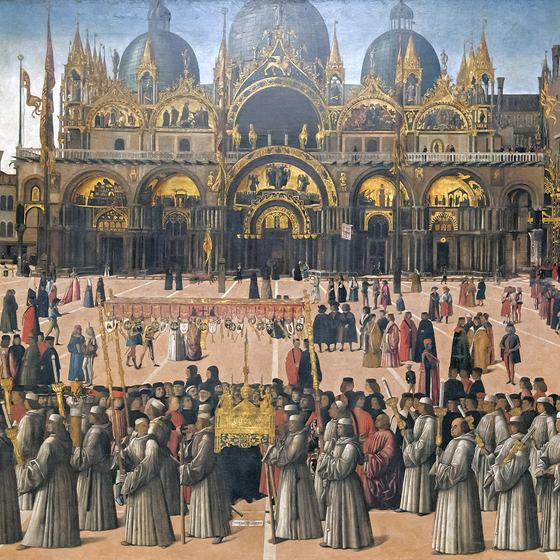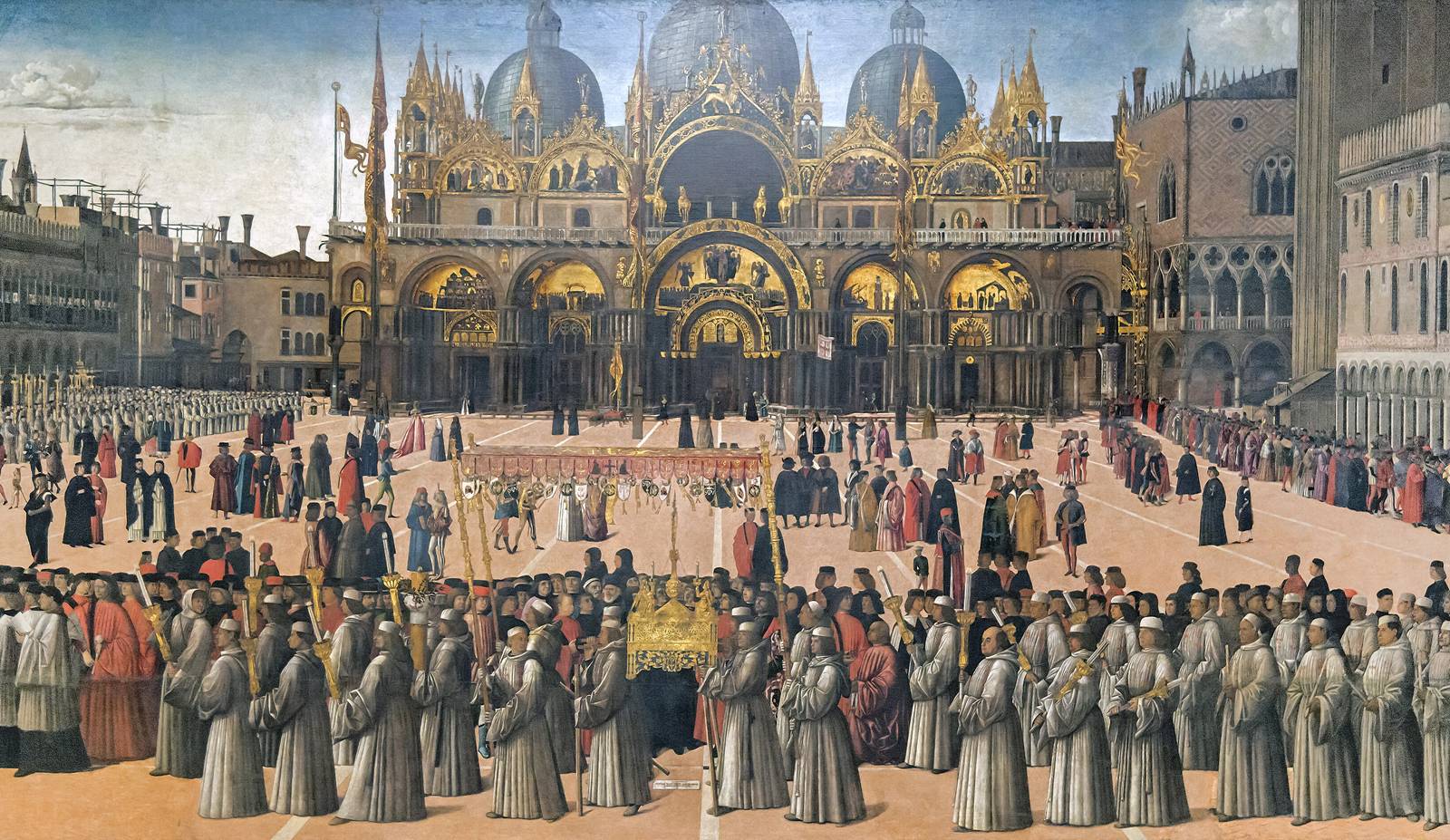
Image reference: Gentile Bellini, Procession in Piazza San Marco.
At a Glance
- Core periodc. 1400–1600, with porous beginnings and endings
- Principal centresVenice · Murano · Padua · Verona · Vicenza · Treviso · Brescia · Bergamo
- Known forcoloured light · oil and canvas · site-responsive altarpieces · civic narrative · portraiture · poetic ambiguity
- Major settingschurch · palace · scuola · domestic house · mainland villa
- Leading namesBellini · Carpaccio · Giorgione · Titian · Lotto · Tintoretto · Veronese · Bassano
- Key contextrepublican patronage · confraternities · Mediterranean exchange · print · plague · fire · workshop families
- Important cautiona regional period category—not one movement, style or birthplace
Contents
- Venetian Renaissance in context
- Republic, lagoon and territory
- Palace, church, scuola and house
- Bellini, Vivarini and the sacred image
- The city as sacred theatre
- Mediterranean exchange
- Giorgione and poetic uncertainty
- Titian and the remaking of scale
- Colour, drawing and material
- Artists to know
Venetian Renaissance in context
Giovanni Bellini
Principal careerGentile Bellini
Principal careerCarpaccio
Principal careerGiorgione
Principal careerTitian
Principal careerLorenzo Lotto
Principal careerJacopo Bassano
Principal careerTintoretto
Principal careerVeronese
Principal careerMarietta Robusti
Principal careerThe Venetian Renaissance describes art made in Venice and the territories connected to its Republic from roughly 1400 to 1600. It includes the devotional light of Giovanni Bellini, Gentile Bellini and Carpaccio's crowded civic stories, Giorgione's enigmatic landscapes, Titian's sensuous and continually revised surfaces, Tintoretto's hurtling visions and Veronese's architectural spectacles. These works do not share one appearance. What connects them is a regional art world shaped by lagoon and mainland, church and state, family workshop and international market, Mediterranean trade and conflict, oil and canvas, printed books and sustained arguments about colour, design, nature and artistic freedom.[1] [2] [3]
Venetian painters are often described as natural colourists whose watery city taught them to see light. The lagoon certainly offered changing reflections, but geography cannot grind a pigment, train an assistant or secure an altarpiece. Venetian colour was a material and intellectual achievement. Specialist sellers supplied expensive and unstable substances from wide trading networks; artists layered, dragged, glazed and revised oil paint; patrons paid for brilliance; theorists made colorito a rival model of pictorial intelligence. Drawing remained fundamental even when line was not the final image's governing effect.[5] [27] [32] [34]
The Republic's splendour rested on oligarchy, dominion, commerce and war. Ottoman diplomacy, Jewish segregation and slavery belong beside its beauty.[6] [8] [9]
Venice did not move from a Byzantine Middle Ages to a classical Renaissance at one decisive moment. Gold grounds, imported icons, Gothic ornament, mosaic, northern European detail, Paduan perspective and Tuscan figures overlapped. The Republic's churches and treasury had long converted Byzantine and eastern Mediterranean objects into signs of sacred and civic identity. Renaissance forms entered an already cosmopolitan visual system rather than awakening an isolated city.
A broad opening around 1400 includes visiting masters such as Gentile da Fabriano and the local workshops that adapted International Gothic elegance. During the fifteenth century Venice expanded onto the Italian mainland. Padua offered humanist study, antiquarian culture and the sculptural example of Donatello. Artists travelling among Padua, Murano, Venice and the Veneto brought stronger bodies, measured space and classical ornament into local painting. The alliance and competition of the Bellini and Vivarini families made these innovations commercially durable.[1] [10]
The first great phase culminates in the long career of Giovanni Bellini, who died in 1516. By then Giorgione and the young Titian had turned landscape, paint and the human body towards new kinds of poetic suggestion. Titian dominated much of the sixteenth century but never worked alone. Lotto, Sebastiano del Piombo, Palma Vecchio, Pordenone, Schiavone and Bassano offered alternatives, while Tintoretto and Veronese reshaped the city's religious and civic spaces.[4] [56]
An ending around 1600 is equally practical. Titian died in 1576, probably during the plague; Veronese in 1588; Jacopo Bassano in 1592; Tintoretto in 1594. Their sons, assistants and followers continued. Palma Giovane completed commissions left by older painters, and family studios carried Venetian approaches into the seventeenth century. The political Republic survived until 1797. Neither style nor institution obeys a neat two-century border.
The adjective “Venetian” is porous. Cima came from Conegliano, Titian from Cadore, Veronese from Verona, Bassano from Bassano del Grappa and Schiavone from the Dalmatian coast. Their careers extend the school through the terraferma and Adriatic.
Republic, lagoon and territory
Venice was a republic governed by a hereditary patriciate. Its doge was elected for life and performed extraordinary ceremonial authority, but councils and law restricted his individual power. Paintings of the doge therefore had to balance person and office. The sitter must appear alive enough to command attention, yet subordinate to the enduring state he temporarily embodied.[19]
The city itself encouraged a powerful myth of exception. Built across islands, apparently protected by water and traditionally said to have been founded under divine favour, Venice represented itself as stable, harmonious and independent. Processions through Piazza San Marco, official histories and allegorical women called Venezia turned political claims into visible ritual. The image of serene continuity was most forceful because the Republic repeatedly confronted instability.
Mainland expansion in the early fifteenth century brought Padua, Verona, Vicenza and other territories under Venetian power. This gave the city agricultural resources, defensive depth and new patrons, but also produced war. The League of Cambrai defeated Venetian forces at Agnadello in 1509, threatening the mainland state. Later conflict with the Ottoman Empire cost Venice Cyprus, even as the naval victory at Lepanto in 1571 became a central subject of public commemoration.[5] [50]
Commerce connected government to material culture. Merchant fleets carried spices, cotton, dyes, glass, metalwork, carpets, silk and ceramics. The Republic's gold ducat circulated widely in the eastern Mediterranean. Such contact changed dress, furnishings and pictures, but “exchange” can sound more equal than the conditions were. Venetians traded with powers they also fought, claimed colonies and depended on controlled privileges abroad.[6]
The city was culturally diverse because different communities made lives within regulated boundaries. German merchants had their own warehouse, the Fondaco dei Tedeschi, and commissioned art for their church. Dalmatian, Albanian and other groups formed confraternities. Jewish people had lived in the territories of the Republic well before 1516, when the government required them to reside in the enclosed Ghetto Nuovo. The famous word “ghetto” thus originates in a policy that permitted an economically useful presence by segregating it.[8]
Black Africans also appear in Venetian records and images as servants, gondoliers, freed people and enslaved individuals within a Mediterranean traffic in human beings. Recovering names where evidence permits prevents dark skin from functioning merely as an exotic accent in a colourful crowd. Cosmopolitanism and coercion were not opposites; they could be conditions of the same commercial city.[9]
Palace, church, scuola and house
Venetian painting was made for places with different kinds of authority. The Doge's Palace held the residence of the doge, courts, council chambers and administrative offices. Its decorations linked government to sacred order, exemplary history, military defence and personifications of justice or peace. A picture's meaning depended on whether patricians debated beneath it, ambassadors waited beside it or judges pronounced sentences before it.[49] [50]
Churches remained the most important public sites for painting. An altarpiece stood within liturgy, architecture, tombs, chapels and votive obligation. A donor might honour a saint, secure family memory and display status at once. Monasteries commissioned vast refectory pictures, allowing sacred meals to address communities while they ate. Private devotional images brought related subjects into homes at an intimate scale.
The scuole formed a distinctively powerful layer of patronage. These were not teaching academies but lay confraternities. Large Scuole Grandi combined devotion, charity, funeral provision, dowries and public ceremony. Numerous Scuole Piccole represented trades, saints and foreign communities. Non-patrician citizens, excluded from the Republic's ruling councils, could gain office and prestige through them. Their halls became alternative civic interiors.[11] [12]
Confraternities commissioned altarpieces and enormous narrative canvases known as teleri. A board of members might select artists, supervise iconography and ask that confratelli appear in a crowd. Painters worked around doors, windows, altars and uneven light. These negotiations do not diminish invention. They explain why Venetian narrative became so attentive to processions, architecture, collective action and viewers who resemble the room's real occupants.[13]
Patrician houses and mainland villas supported different freedoms. Portraits established lineage and public service. Marriage pictures negotiated sexuality, fertility and household alliance. Mythologies could turn classical poetry into sensual display. Small landscapes and ambiguous figure groups invited educated conversation without the public accountability of an altarpiece. The growth of this market around 1500 helped make Giorgione's elusive art possible.
Workshops trained apprentices, bought materials and divided large commissions. A famous signature could cover a master's invention, assistants' execution and later family intervention. “Workshop” describes organised authorship, not automatic inferiority.
Bellini, Vivarini and a transformed sacred image
Jacopo Bellini and Antonio Vivarini established the two leading fifteenth-century dynasties. Their workshops responded to Gothic splendour, Paduan monumentality and imported northern detail in different proportions. The Vivarini became particularly effective makers of multi-panel altarpieces. Repeatable designs and a large shop allowed works to travel through the Veneto, along both Adriatic coasts and into southern Italy. Export helped turn a local sacred format into a regional language.[1] [10]
Jacopo's sons divided and shared reputations. Gentile Bellini became a painter of state ceremony, portraiture and large civic narrative. Giovanni developed sacred figures whose emotional presence is inseparable from landscape, light and oil. Their family relation to Andrea Mantegna, who married their sister Niccolosa, opened a particularly intense exchange. Mantegna's stony figures, antiquarian details and compressed perspective challenged Giovanni; Giovanni softened comparable structures through atmosphere and feeling. Similar compositions reveal dialogue rather than simple copying.[18]
Antonello da Messina's stay in Venice during the 1470s mattered to local portraiture and oil technique, but the old story that he delivered the secret of northern oil painting is too neat. Venetian painters had already encountered oil and imported works. What changed was a long technical exploration of drying oils, mixed media, pale and coloured grounds, transparent layers and the capacity to revise. Giovanni became one of its greatest practitioners.[17]
His San Giobbe Altarpiece places the Virgin and saints within a painted apse whose mosaic-like gold responds to the real church. Music-making angels occupy the foot of the throne. Architecture does not frame separate holy compartments; it creates a single sacred assembly continuous with the viewer's space. The later San Zaccaria Altarpiece develops this calm through luminous colour, subtle landscape openings and an extraordinary stillness that is attentive rather than inert.
Bellini's landscapes do theological work. In the Madonna of the Meadow, the sleeping Child across Mary's lap anticipates death while fields, animals, towers and clouds continue their daily rhythms. Observed nature and sacred foreknowledge occupy one world. In later works, freer touches evoke foliage, dawn and moving air without surrendering structure. A London museum account identifies this ability to make natural setting carry spiritual emotion as one of his defining innovations.[17]
The Doge Leonardo Loredan turns those means towards political portraiture. Loredan wears ceremonial white damask woven with precious metal thread against costly ultramarine blue. The three-quarter pose recalls northern and Antonellesque portraits, while the parapet and armless mass evoke an imperial bust. Oil permits tiny changes in flesh and expression. Yet the doge does not meet the viewer as an equal: his gaze passes aside, preserving the distance of office. Textile, pigment, classical reference and psychological uncertainty construct Republican authority together.[19]
Workshop formulas widened Bellini's reach. Repeated Madonnas changed landscape, gesture and colour while training painters who would transform his language. Dürer called the aged master Venice's best painter; Giorgione and Titian moved beyond him from inside his achievement.
Essential works
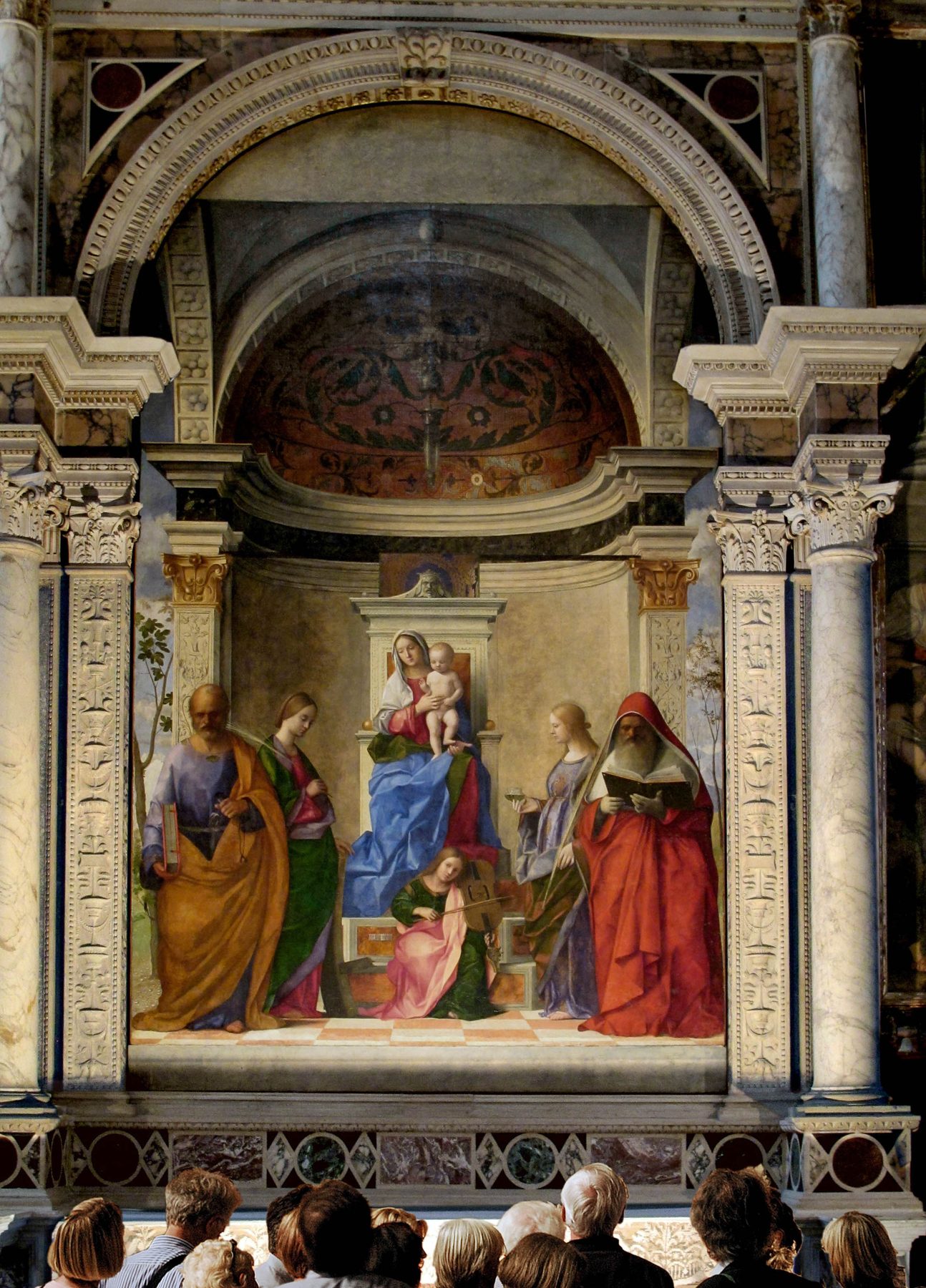
San Zaccaria Altarpiece
Giovanni Bellini, 1505
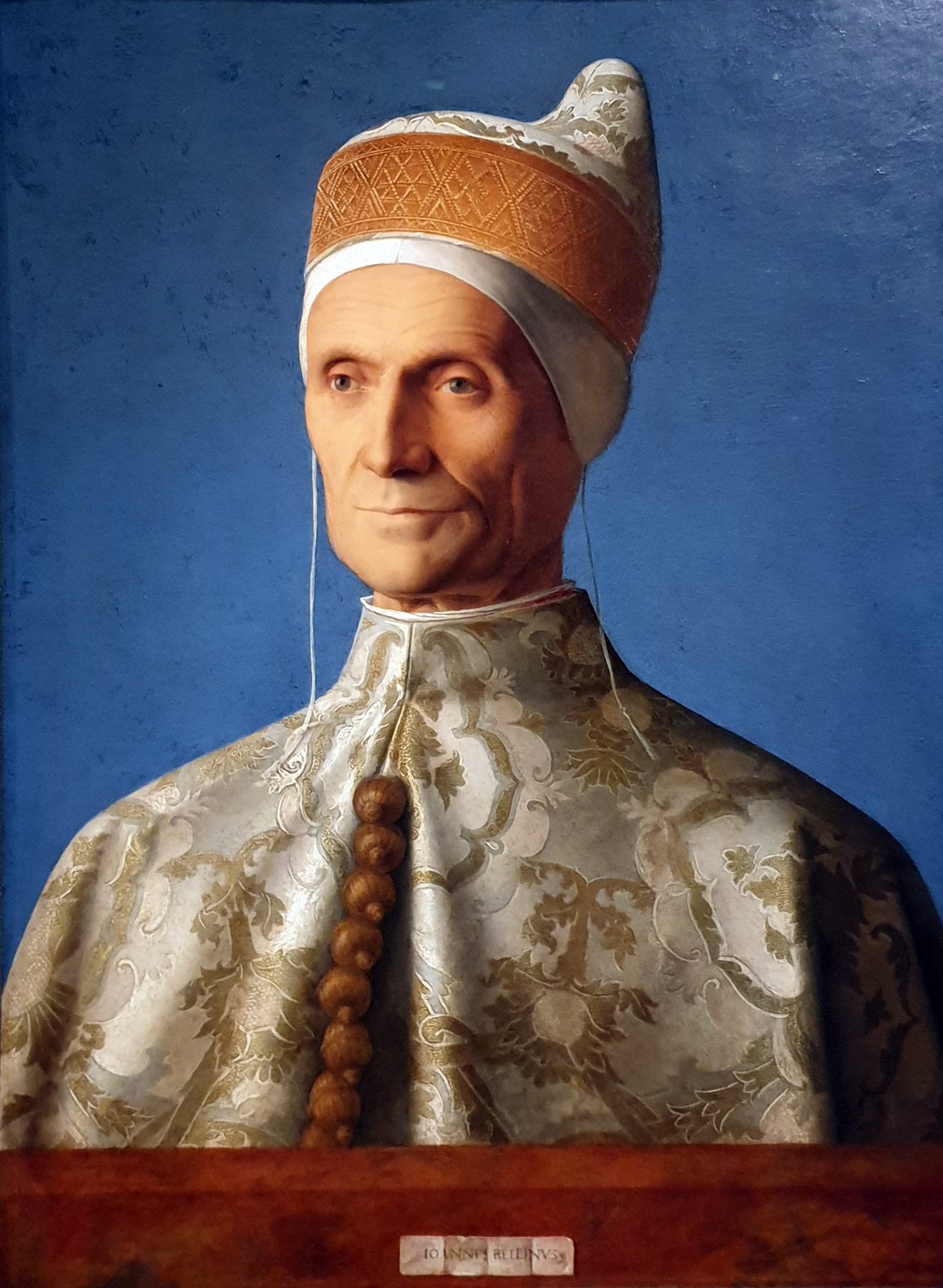
Doge Leonardo Loredan
Giovanni Bellini, c. 1501–04
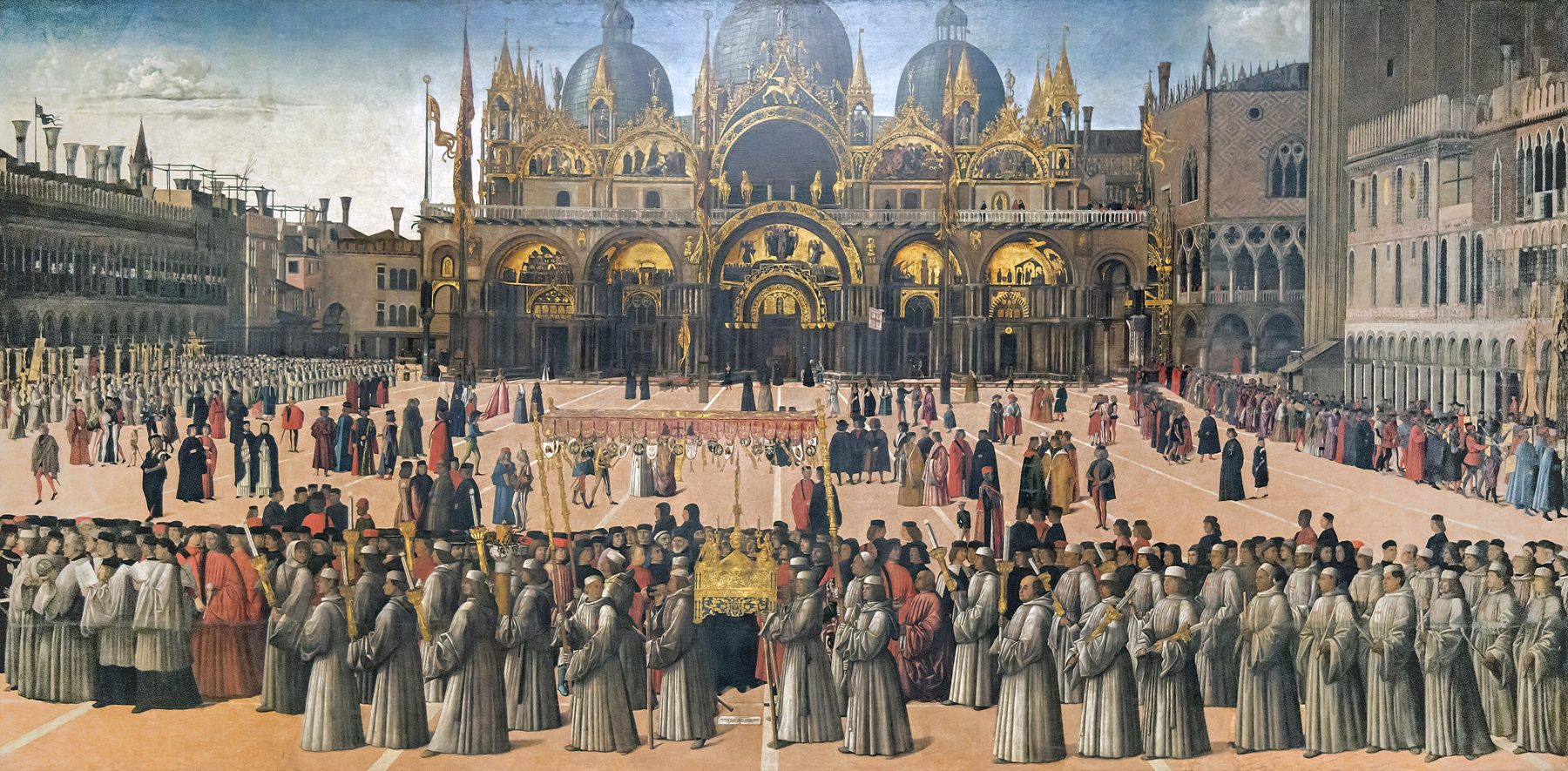
Procession in Piazza San Marco
Gentile Bellini, 1496
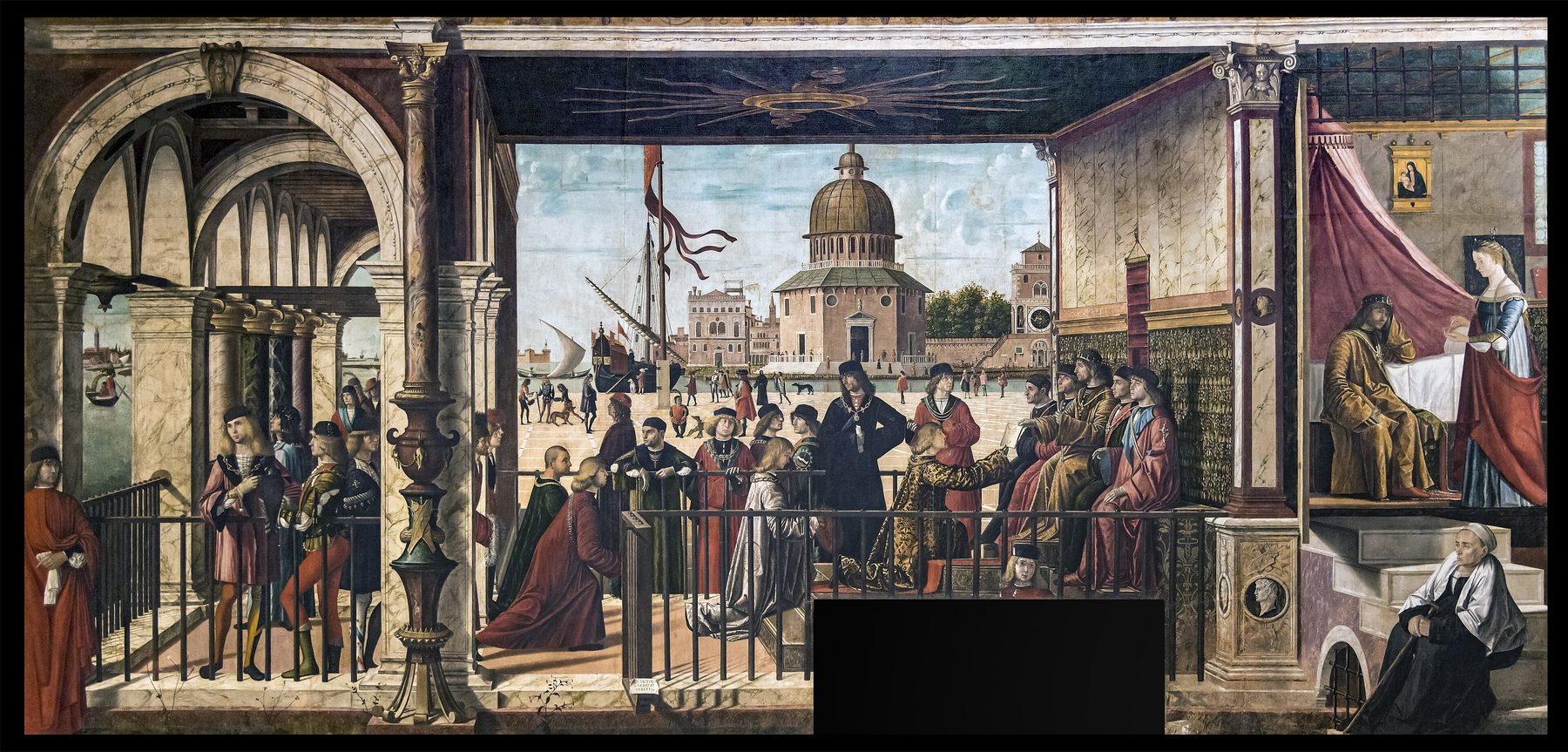
Arrival of the English Ambassadors
Vittore Carpaccio, c. 1495–1500
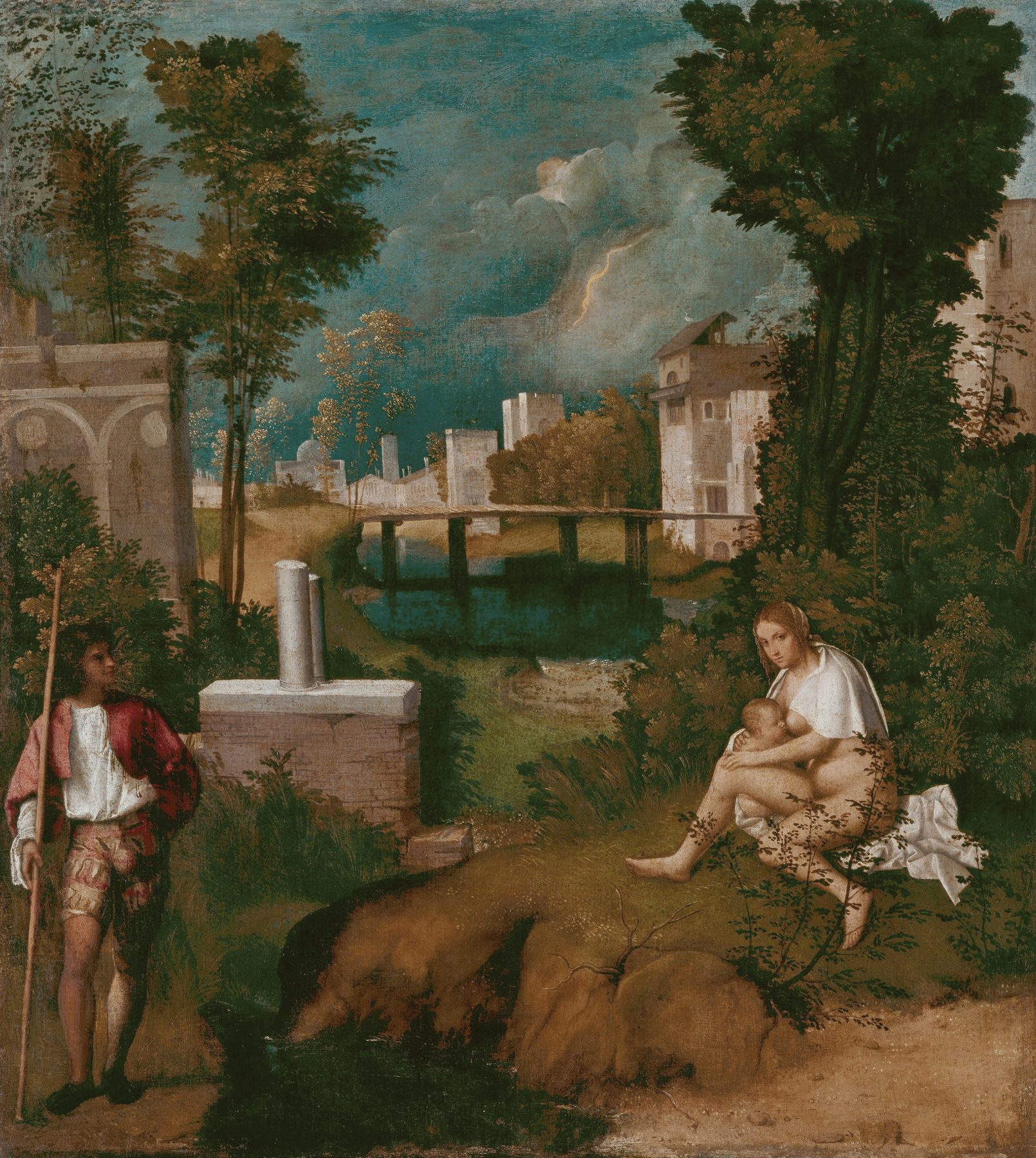
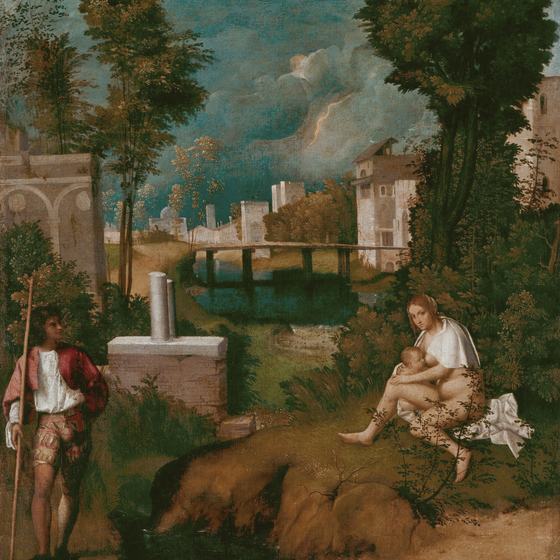
The Tempest
Giorgione, c. 1506–08
The city as sacred theatre
Gentile Bellini and Vittore Carpaccio made the city itself a protagonist. Their large confraternity canvases do not offer neutral views, but they preserve an unmatched density of façades, bridges, fabrics, bodies and ritual movement. Sacred history occurs through the visible organisation of contemporary life.
Gentile's Procession in Piazza San Marco belonged to a cycle devoted to miracles of a relic of the True Cross owned by the Scuola Grande di San Giovanni Evangelista. The relic is almost lost within an immense ceremonial order of confratelli, officials and spectators. Saint Mark's basilica rises across the background in a form close enough to recognition yet adjusted for the picture. A merchant's son kneels because the relic was believed to have healed him. Miracle and civic procession validate one another.[15]
The cycle was collective. Lazzaro Bastiani, Giovanni Mansueti, Carpaccio and Benedetto Diana worked beside Gentile, following recorded episodes and institutional expectations. The present museum arrangement separates canvases from the hall for which they were designed. Napoleonic suppression and later collecting saved important works while changing their relationships to ritual, walls and one another.[14]
Carpaccio's narratives often unfold through several spatial zones. In the Saint Ursula cycle, diplomacy, betrothal, travel, dream and martyrdom become elaborate stages filled with architecture, ships and incident. The settings combine invention with details of Venetian life. A bedchamber can hold a dream messenger, devotional objects and the quiet time before public catastrophe. His art rewards slow lateral reading rather than a single central climax.
At the Scuola di San Giorgio degli Schiavoni, a Dalmatian confraternity, Carpaccio painted stories of Saints George, Tryphon and Jerome. Saint George and the Dragon spreads violence across a terrain of dismembered bodies before the distant city; later scenes show conversion and baptism. Saint Augustine in His Study transforms news of Jerome's death into a burst of light within an ordered room of books, instruments and a small dog. The cycle served a community from across the Adriatic, making “Venetian” art the possession of people whose geographic identity exceeded the city.[16]
Their abundance looks documentary, but each procession is selected and each building adjusted. They show how institutions wanted Venice seen: orderly, devout and magnificent enough to make public space sacred theatre.
Mediterranean exchange and its boundaries
Venetian pictures are full of carpets, silks, metal vessels, ceramics, turbans and pseudo-Arabic ornament. These objects did not arrive as vague eastern “influence”. Merchant routes connected Venice to Mamluk Egypt and Syria, the Ottoman Empire and Safavid Iran. Cargoes carried cotton and industrial materials beside luxury textiles, glass, manuscripts and inlaid metalwork. Painters placed those goods under holy feet, across tables and on elite bodies, converting commercial reach into texture and prestige.[6]
The Republic's relation with the Ottoman world included war, tribute, negotiation and mutual dependence. After peace in 1479, Sultan Mehmet II requested a painter. The Venetian government sent Gentile Bellini, already experienced in dogal portraiture. His surviving portrait of 1480 presents Mehmet beneath a classical arch with an embroidered textile over the parapet and crowns that magnify his imperial territories. The sitter's authority is neither comic nor subordinate; Venetian portrait forms serve an Ottoman claim to universal rule.[7]
Gentile's stay of roughly a year and a half was a diplomatic mission as well as a commission. He produced other images and drawings, and Mehmet honoured him. The portrait itself has been damaged, transferred and repainted, warning against treating every jewel or contour as pristine evidence. Its history nevertheless disproves a model in which Renaissance form travels from an active West to a passive East. Both courts used art to negotiate status.
Foreign communities also commissioned inside Venice. German merchants employed Dürer; Dalmatian and Albanian confraternities shaped sacred cycles; Greek scholars and texts entered after 1453. Aldus Manutius published classics within this multilingual environment.[35]
Yet movement was regulated by the state and market. The Ghetto confined Jewish residents at night even while authorities relied on their lending, medicine and commerce. Slavery brought people from Africa and eastern Europe into households and maritime labour. Ottoman figures could become generic witnesses in Christian scenes. A textile might be admired while its makers remained unnamed. Close looking should ask how an object arrived and whose individuality the picture preserves.
Giorgione and poetic uncertainty
Giorgione changed Venetian painting in a career so short and poorly documented that his historical identity remains unusually unstable. Born in Castelfranco in the Veneto, he worked in Venice, collaborated with Titian at the Fondaco dei Tedeschi and died during the plague of 1510. Only a small group of paintings is securely connected to him. Works once used to define his style have moved between Giorgione, Titian, Sebastiano and other hands.[23]
That uncertainty is not merely a scholarly inconvenience. Giorgione made pictures whose subjects resist the conventional anchors of altarpiece, portrait or known narrative. Landscape, weather, music and the relation between figures create a poetic field in which meaning is felt before it is named. Private patrons could value this cultivated ambiguity as a prompt to memory and conversation.
The Tempest places a standing young man across a stream from a nude woman nursing a child. A city, ruins, vegetation and a flash of lightning occupy the humid distance. The arrangement has generated readings from biblical exile to classical genealogy, allegory and patronal history. An early inventory offered no solution. The Accademia now presents a plausible connection to the Vendramin family and a poem about Aeneas's descendants, while retaining the range of proposed dates and interpretations.[22]
No label can cancel the picture's strangeness. The figures look self-contained, yet the storm joins them. Water crosses foreground and distance; broken columns imply a past without explaining it; lightning makes time momentary. Landscape is not background waiting for a story. It is one of the agents that produces uncertainty.
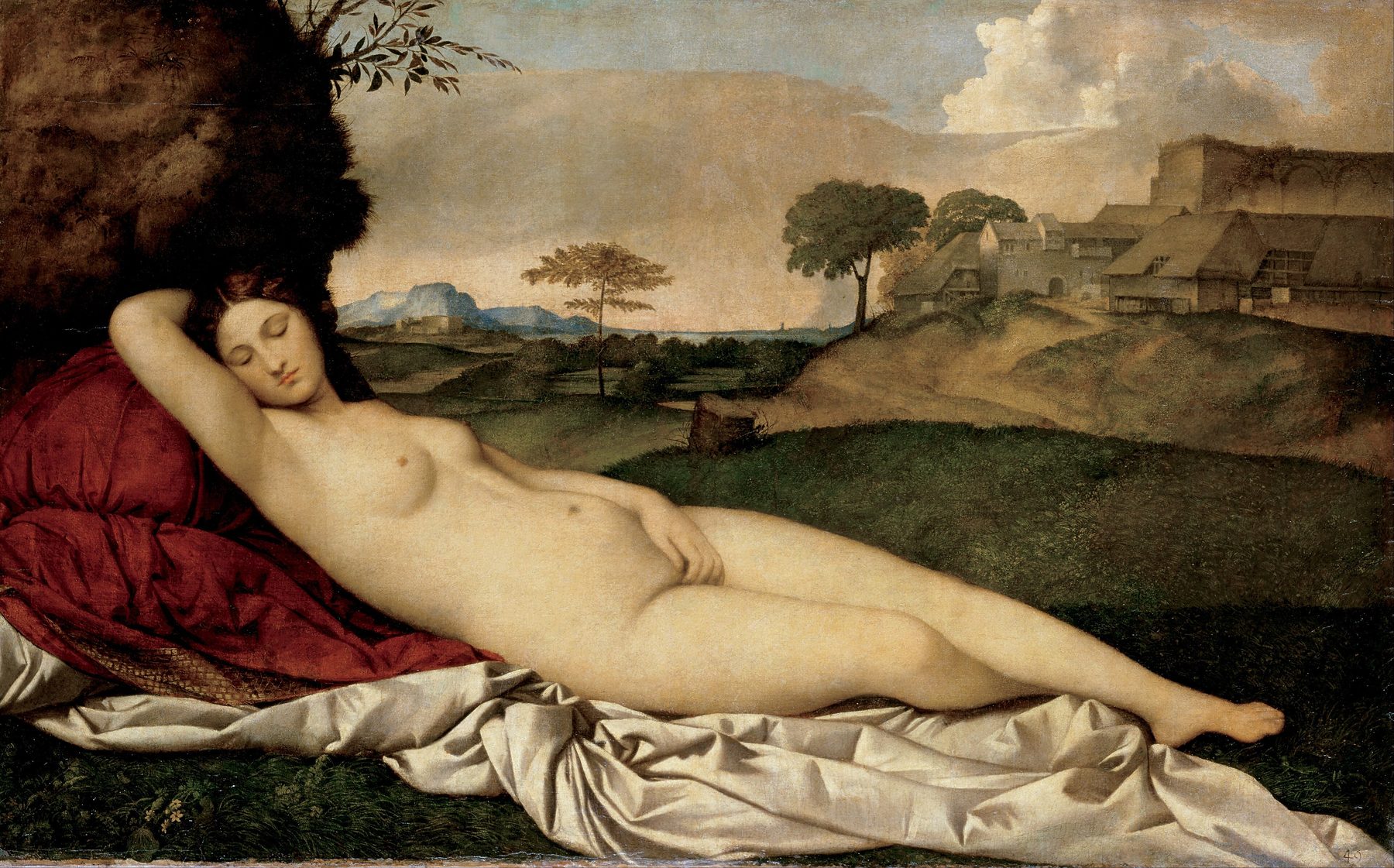
The Sleeping Venus, usually attributed to Giorgione and completed in part by Titian, gives the nude body the long rhythm of hills. Sleep removes direct engagement while exposing the figure to view. Later Venetian nudes inherit this conjunction of landscape, sexuality and poetic distance, but move it into domestic and mythological rooms. Collaboration and completion make the painting itself a bridge between two careers.
Giorgione's influence exceeded his surviving works. Deep colour, softened boundaries, musical gatherings and landscape mood spread widely, but “Giorgionesque” must not become a basket for every uncertain attribution.[21]
Follow the period through four stages
–1480
Lagoon foundations and workshop renewal
Murano and Venice develop new altarpiece, devotional and narrative forms through workshops, imported objects and contact with Padua and the Adriatic.
–1510
Sacred theatre and poetic uncertainty
Bellini, Carpaccio and Giorgione transform sacred presence, civic narrative, landscape and the market for pictures whose meanings remain open.
–1550
Titian and an international visual language
Altarpieces, portraits and mythologies expand in scale and reach as Titian, Lotto and visiting artists connect Venice to courts and print culture.
–1600
Rivalry, spectacle and rebuilt identity
Tintoretto, Veronese and Bassano answer competitive commissions, religious scrutiny, plague and fire through contrasting ideas of speed, splendour and light.
Titian and the remaking of scale
Titian arrived in Venice from Pieve di Cadore, trained within the Bellini orbit and worked closely enough with Giorgione for their early hands still to be disputed. His frescoes at Padua in 1511 show a new physical directness. After Giorgione's death and Sebastiano's departure for Rome, he rapidly gained authority. When Giovanni Bellini died in 1516, Titian became the leading painter available for major Venetian commissions.[24] [25] [26]
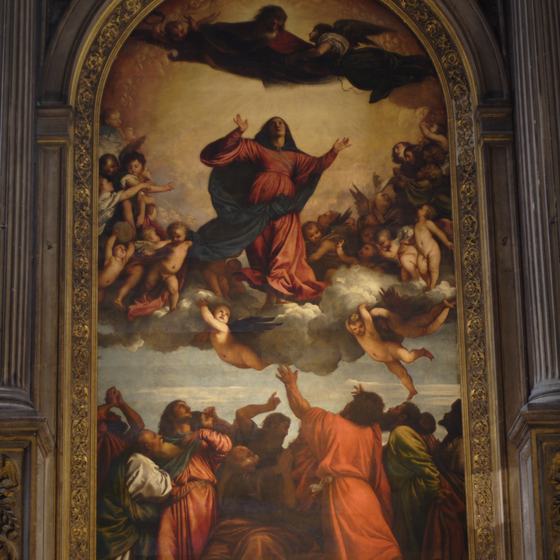
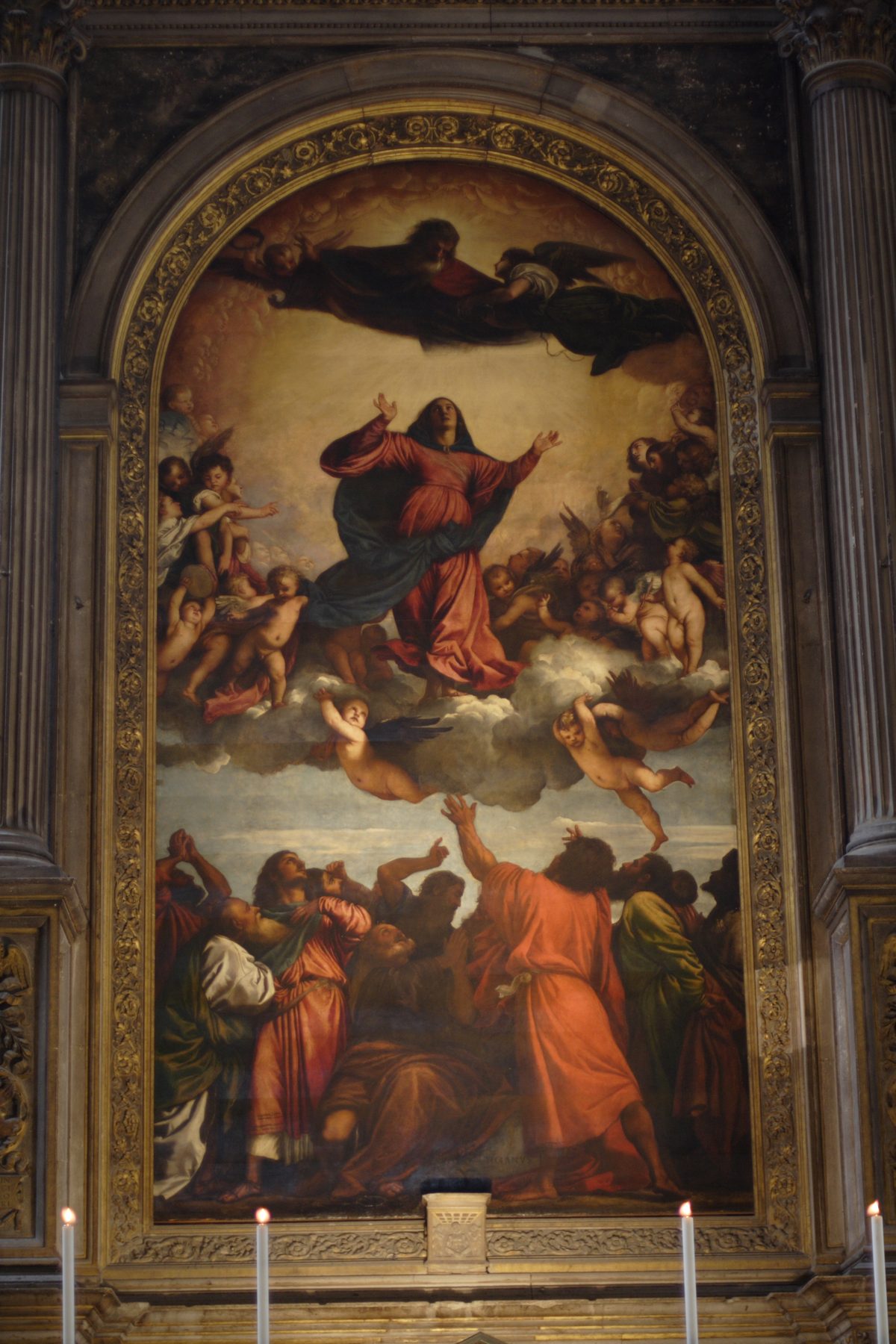
The Assumption of the Virgin, unveiled on the high altar of Santa Maria Gloriosa dei Frari in 1518, transformed the scale of a Venetian altarpiece. Apostles surge below; Mary rises through a field of angels; God receives her above. Red binds the three zones across nearly seven metres of vertical canvas. The composition had to carry through the long Gothic church and compete with coloured windows and carved architecture. Its monumentality is optical, bodily and liturgical, not merely a large version of a private picture.
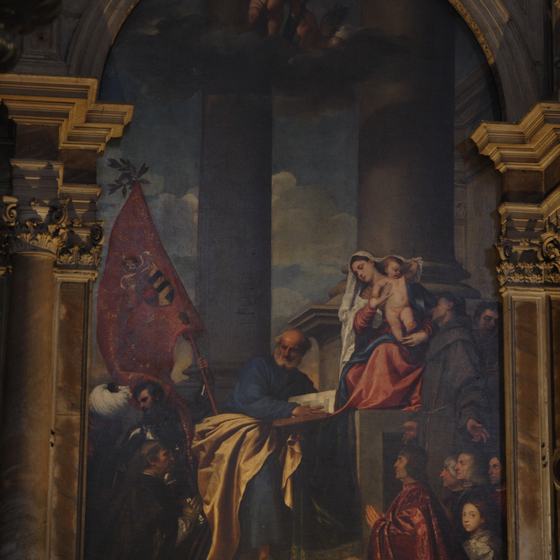
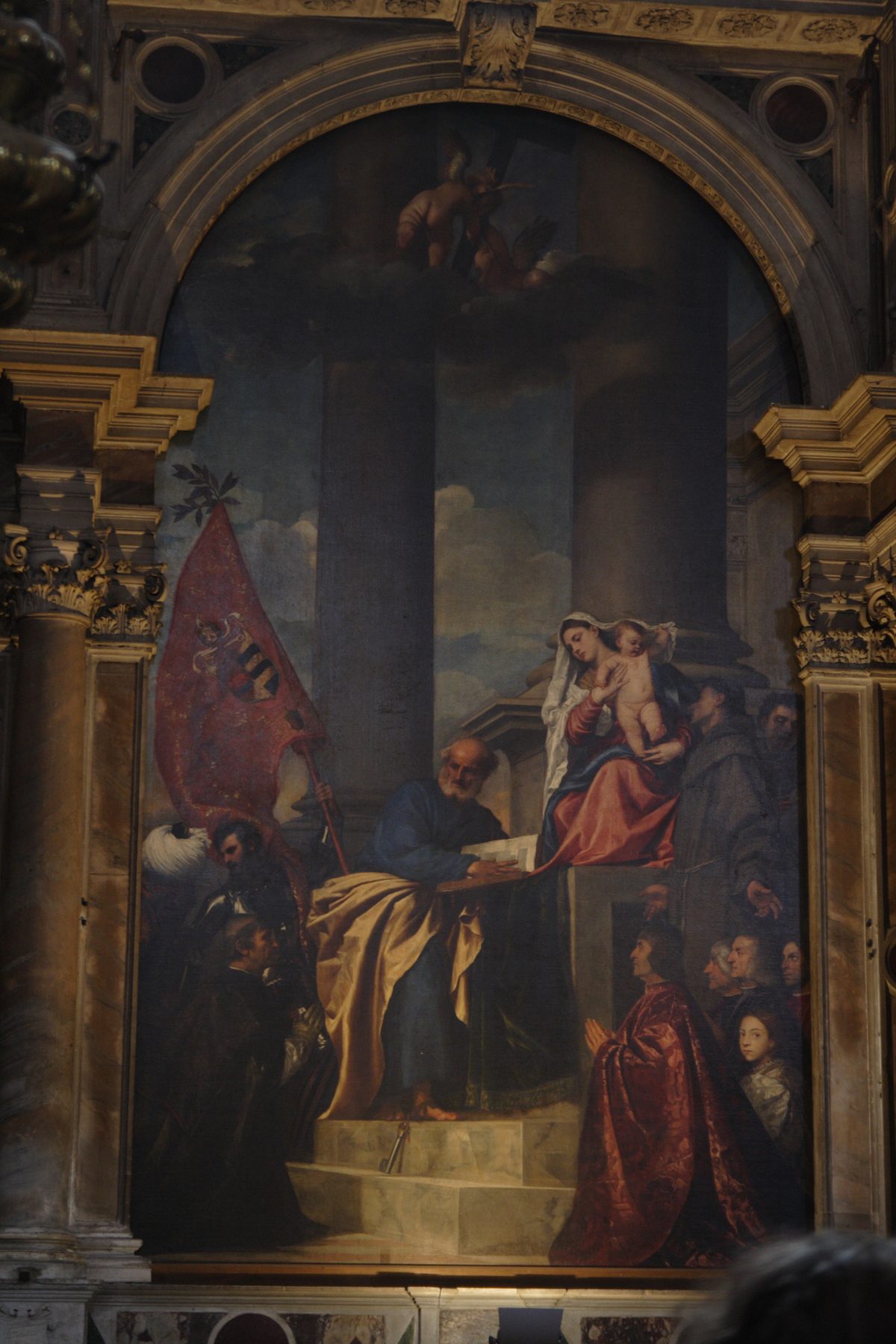
The Pesaro Madonna in the same church reorganises the sacred conversation. The Virgin and Child sit high and to one side, while colossal columns rise beyond the frame. Members of the Pesaro family kneel at different levels; Saint Peter mediates; a bearer displays a papal banner connected to Jacopo Pesaro's naval command. Asymmetry is not a display of novelty for its own sake. It responds to the chapel's side view, family memorial and a history of church, papacy and war.[24]
Titian's altar inventions travelled through workshops, memory and rivals. The lost Death of Saint Peter Martyr drove violent action through a forest; since its destruction by fire in 1867, prints and copies carry much of its design.
Scale also became temporal. Titian might work on a canvas for years, return to it and alter figures or landscape. Technical examination identifies underdrawing, brush sketching, changes in position, varied grounds, opaque passages and transparent glazes. The early myth that he simply placed inspired colour directly on blank canvas cannot survive infrared and X-radiographic evidence.[27]
His later paint increasingly exposes the history of revision. In works such as The Death of Actaeon and The Flaying of Marsyas, bodies emerge from broken touches, scumbles and dark intervals. Some areas look rough at close range but cohere at distance. This does not make Titian an accidental Impressionist or prove every late picture was finished to his satisfaction. It shows a painter using incomplete optical fusion and material variation to carry violence, flesh, weather and grief.[28] [29]
Portrait, myth and the international painter
Titian's Venetian authority became the base of an international career rather than a stage he abandoned. He painted Alfonso d'Este's mythologies, travelled to Mantua, Rome and Augsburg, and served Charles V and Philip II without becoming a permanent court resident. Letters, agents and shipping allowed paintings to move between his Venetian studio and Europe's rulers. Distance increased his prestige while creating delays, payment disputes and opportunities for assistants.[24]
Portraiture joins likeness to social construction. A black garment may absorb light so that face and hand carry intelligence; armour turns reflected highlights into military force; an official's table or curtain builds rank. Titian could make a sitter seem immediately present while withholding private access. His portraits of Charles V joined bodily vulnerability to imperial command, and their circulation helped define the ruler across territories.
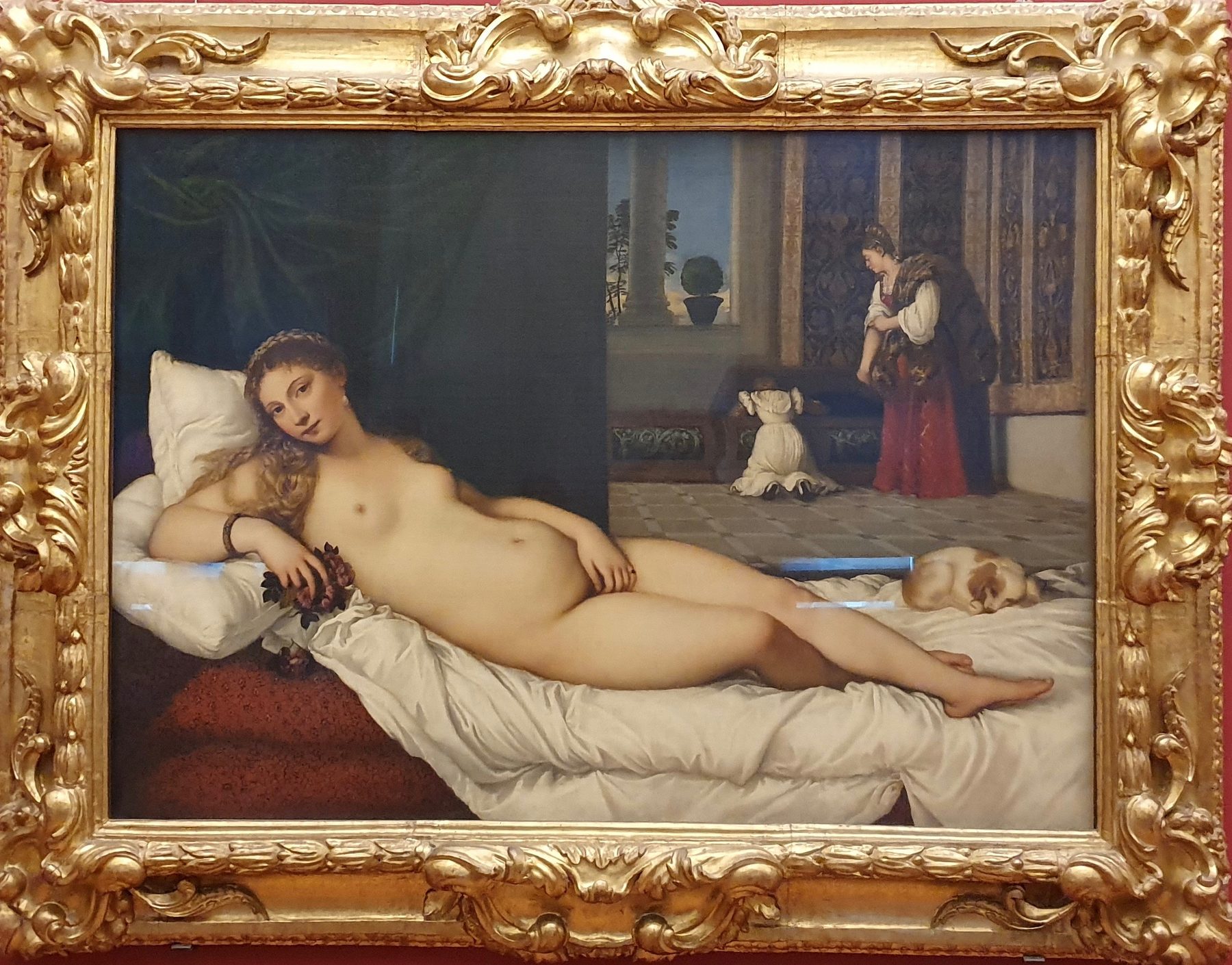
The Venus of Urbino, bought from Titian in 1538 by Guidobaldo della Rovere, relocates a Giorgionesque reclining nude into a patrician bedroom. The woman looks directly outward; servants search a marriage chest; roses, myrtle and a sleeping dog support a nuptial interpretation. The Uffizi associates it with Venetian marriage ritual, although the painting's erotic address cannot be reduced to a handbook of fidelity. Consent, display, household wealth and the viewer's position remain active tensions.[30]
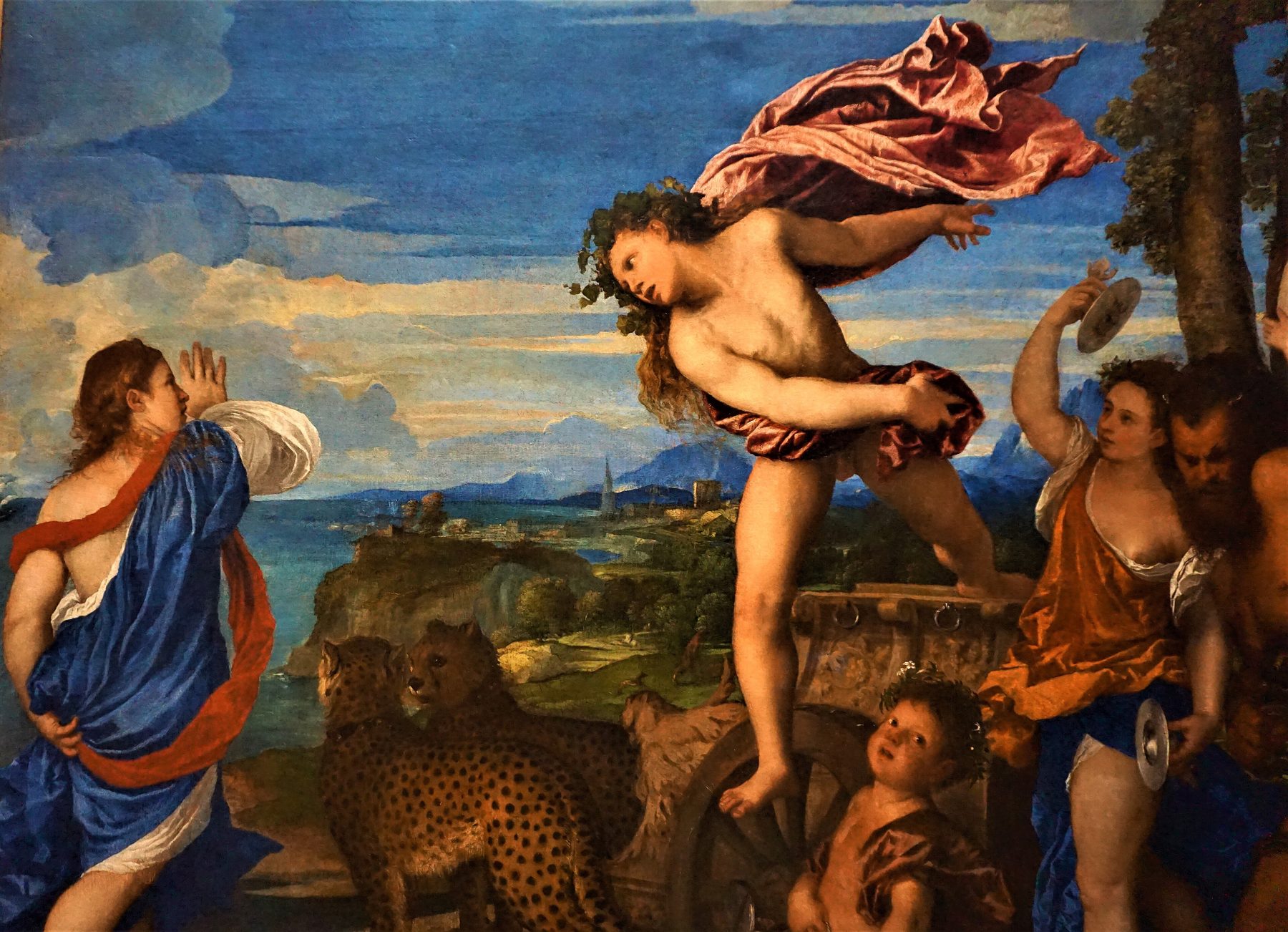
For Philip II, Titian painted a group of mythologies he called poesie. Danaë, Venus and Adonis, Diana and Actaeon, Diana and Callisto, Perseus and Andromeda and The Rape of Europa vary their direction and bodily encounter like visual poems. Ovidian stories allowed sensuous flesh, violent looking, transformation and royal collecting to meet. The canvases do not simply illustrate stable texts; changes between versions reveal Titian adapting invention for different patrons.[31]
International portraits and mythologies never replaced local work. Titian's studio held pictures at many stages and continued them after his death, so attribution often concerns degrees and phases rather than a clean master-copy division.[28] [29]
Colour, drawing and the material picture
Colorito means more than colourful appearance. In sixteenth-century discussion it could include the act of applying paint so that hue, light, texture, edge and atmosphere construct form together. A red robe may organise distance, a translucent shadow make flesh breathe, or a dragged pale stroke turn dark ground into reflected metal. Colour becomes a mode of thinking through the brush.[32] [34]
Venice's commerce supported unusually specialised material knowledge. By around 1500 dedicated colour sellers offered artists substances that had previously been purchased mainly through apothecaries. Inventories and scientific analysis reveal ultramarine, azurite, vermilion, red lakes made from insects or plants, verdigris, orpiment, earth pigments and different oils. Some were local products; others depended on long routes and costly preparation. Access did not automatically create beauty, but it expanded what skilled painters could attempt.[5]
Oil and support mattered. Slow-drying binders permit blending, transparent depth and later revision. Canvas can be woven in sections, transported more easily than a huge panel and stretched across walls or ceilings. Its texture can remain active beneath thin paint. The ready availability of cloth and the needs of teleri encouraged its use. Lagoon humidity may have made fresco and wood more difficult in some settings, but it cannot explain why painters chose canvas for portable portraits, exported mythologies or inland villas.
Venetian artists drew. Carpaccio's surviving full-scale cartoon shows a figure prepared for transfer. Titian used brush underdrawing and altered designs during painting. Veronese's practice could be intensely graphic, and Tintoretto studied sculpture, posed models and made rapid compositional drawings. The real difference is not drawing versus no drawing, but how design remained visible, how much was fixed beforehand and how freely the painted layers could change it.[27] [46]
Giorgio Vasari helped harden a regional opposition. His history made Tuscan disegno—drawing, design and intellectual conception—the foundation of artistic progress, while Venetian colour could appear sensuous but deficient. Lodovico Dolce answered by making Titian's imitation of living nature a model that joined invention, design and colouring. Their debate responded to genuine emphases while serving rival canons.[32] [33]
The terms remain useful for competing ideals and methods, not biological traits: Venetian drawings investigate bodies and light, while Veronese's iridescent passages can be crisply designed.
Surface has also changed through time. Transparent lakes fade, varnish yellows, canvases are lined, panels transferred and damaged passages repainted. The brown-gold unity associated with an old Titian may partly belong to ageing. Looking historically means imagining differences without pretending conservation can return a work to one untouched original moment.
Print, books and visiting artists
Venice was a major European centre of printing. Aldus Manutius published Greek and Latin texts in carefully designed, portable editions, joining humanist scholarship to type cutting, paper, capital and distribution. His achievements depended on editors, compositors, craftsmen and the city's commercial reach. Classical myth and language became more readily available to painters and patrons, while illustrated books supplied portable visual models.[35]
Large prints could make the city or a painter's design travel. Jacopo de' Barbari's immense bird's-eye View of Venice, printed from multiple blocks around 1500, maps roofs, canals, ships and lagoon from an impossible elevated position. Precision supports political imagination: the city appears coherent, protected and commanding. A monumental Crossing of the Red Sea after a Titian design similarly turned many blocks and sheets into a moving sea crowded with figures.[38]
Print privileges reveal an early language of invention and copying. In 1516 Ugo da Carpi asked the Senate to protect his claimed method of printing in light and dark from several blocks. Chiaroscuro woodcuts translated tonal drawings into multiplied colour fields shared by designers, cutters, publishers and printers.[37]
Albrecht Dürer visited Venice twice and carried forms in both directions. During his second stay, German merchants commissioned the Feast of the Rose Garlands for San Bartolomeo. Preparatory studies on blue Venetian paper use the middle tone so dark wash and white heightening build the figures together. The altarpiece combined northern portrait detail, Italian monumentality and the corporate identity of a foreign community. Dürer also admired the aged Giovanni Bellini, disproving any simple story of northern oil passing knowledge to grateful Italians.[36]
Engravings by Dürer, Raimondi and others circulated figures beyond national schools. Pordenone, Schiavone, Bassano and Tintoretto responded to central Italian and northern designs without giving up local materials. Prints did not erase regional difference. They made difference available for selective combination.
Routes away from a single centre
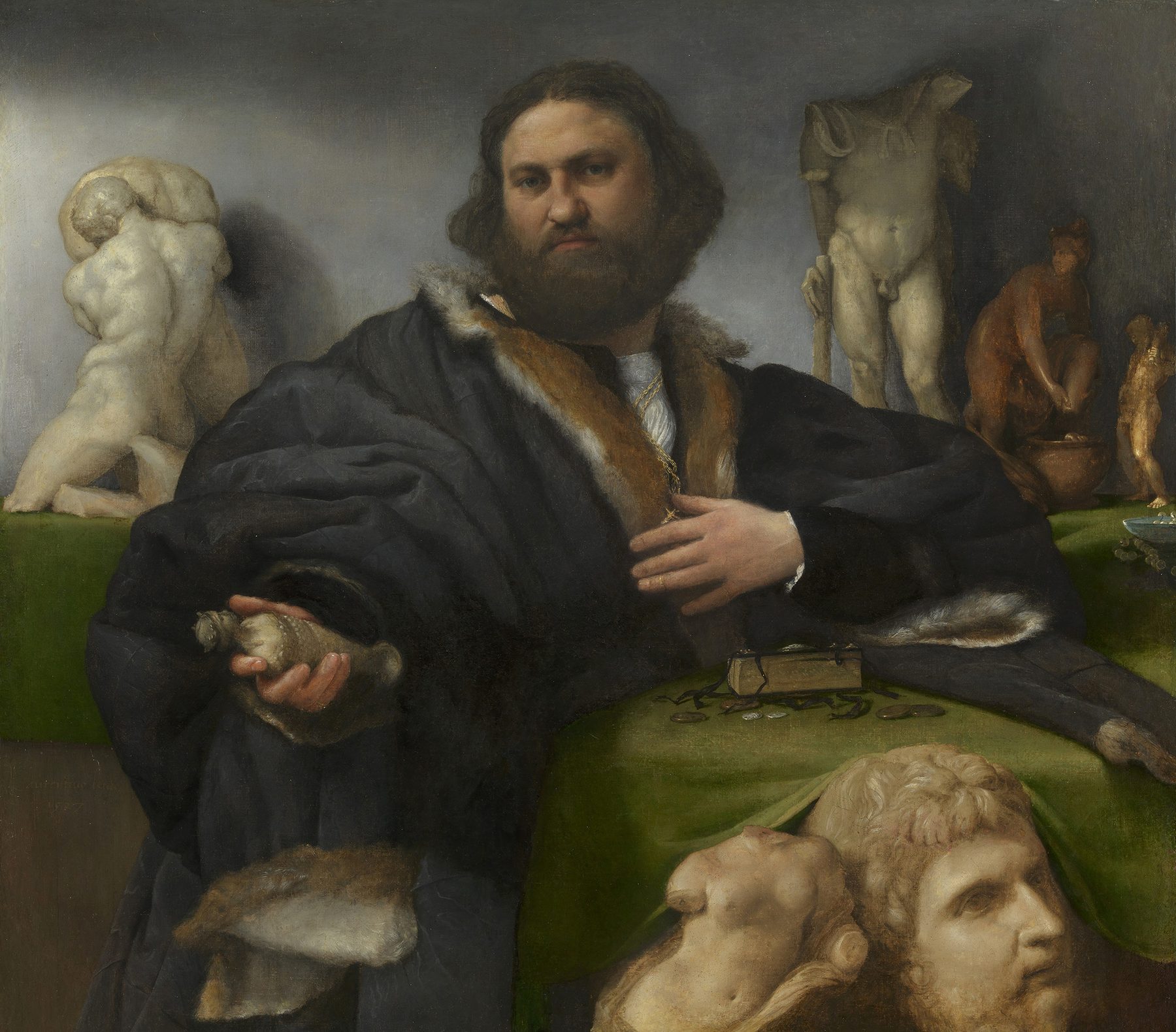
Titian's pre-eminence can make every alternative look like failed competition. Lorenzo Lotto shows the problem. Venetian-born and trained, he worked in Treviso, the Marches, Rome, Bergamo and Venice before retiring at Loreto. Bellini, northern detail, Raphael and Lombard realism entered a language of acidic colour, uneasy gesture and objects that seem to reveal a sitter's private strain.[39] [40]
Lotto's portraits include clerics, merchants, artisans, scholars, women and families rather than only rulers. Rings, letters, books, flowers and broken petals create narratives around identity. His account book provides exceptional evidence about prices, materials, clients and religious concern, but it should not turn every shadow into a diagnosis of the artist. Mobility may reflect opportunity, competition, patronal networks and temperament at once.
Sebastiano del Piombo carried Venetian oil and Giorgionesque atmosphere to Rome, where he collaborated competitively with Michelangelo. His career shows that colour was not confined to the lagoon and that a painter could combine Venetian handling with monumental central Italian design. Movement changed both traditions.
Andrea Schiavone, born in Zara on the Dalmatian coast, absorbed Parmigianino's elongated figures, Venetian colour and printmaking. Pordenone brought muscular, illusionistic energy from Friuli and mainland commissions. Both mattered to the younger Tintoretto. The label “Venetian Mannerism” is useful only if it retains these movements among regions.
Jacopo Bassano remained rooted in a family shop at Bassano del Grappa while working for a broad market. Biblical scenes fill with animals, baskets, tools, peasants and nocturnal light. Northern prints and Venetian colour join the material knowledge of rural Veneto. His sons repeated and adapted successful compositions, making the Bassano name a sustained business rather than one isolated genius.[52]
Innovation could be made in Bergamo or a mainland villa, sent to the Marches, revised in Rome or exported by a family studio. Venice gathered and distributed artists who did not stay within it.
Tintoretto: speed, light and site
Tintoretto built his reputation through speed, daring offers and compositions that seem to wrench sacred stories into the viewer's space. The dyer's son Jacopo Robusti reportedly pursued Michelangelo's design and Titian's colour, but the slogan is too tidy for his varied practice. He studied sculptural models, made drawings, staged figures under artificial light and developed forms directly in paint. Rapid execution could be a method of discovery and competitive pricing, not absence of preparation.[41] [42]
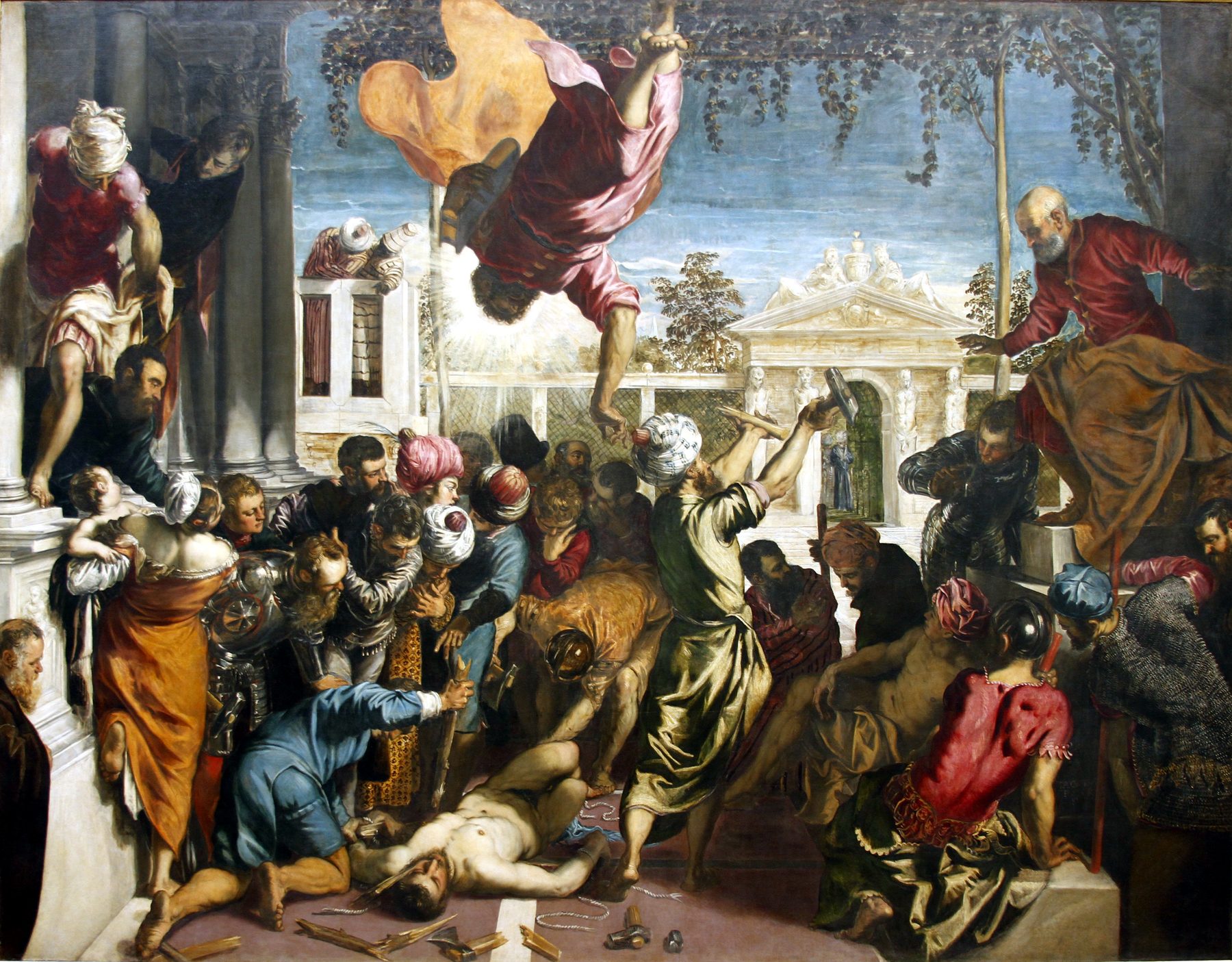
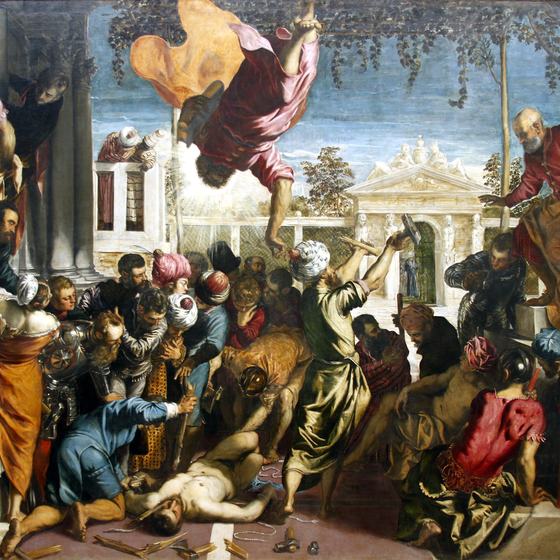
The Miracle of the Slave for the Scuola Grande di San Marco in 1548 made his public breakthrough. Saint Mark plunges from above to save an enslaved Christian whose instruments of torture have broken. Bodies curve around a violent empty centre. Extreme foreshortening and a divided crowd make the miracle arrive as physical interruption. The subject's enslaved protagonist belongs to Christian legend, yet the word “slave” also resonated in a maritime society where enslavement was present.[43]
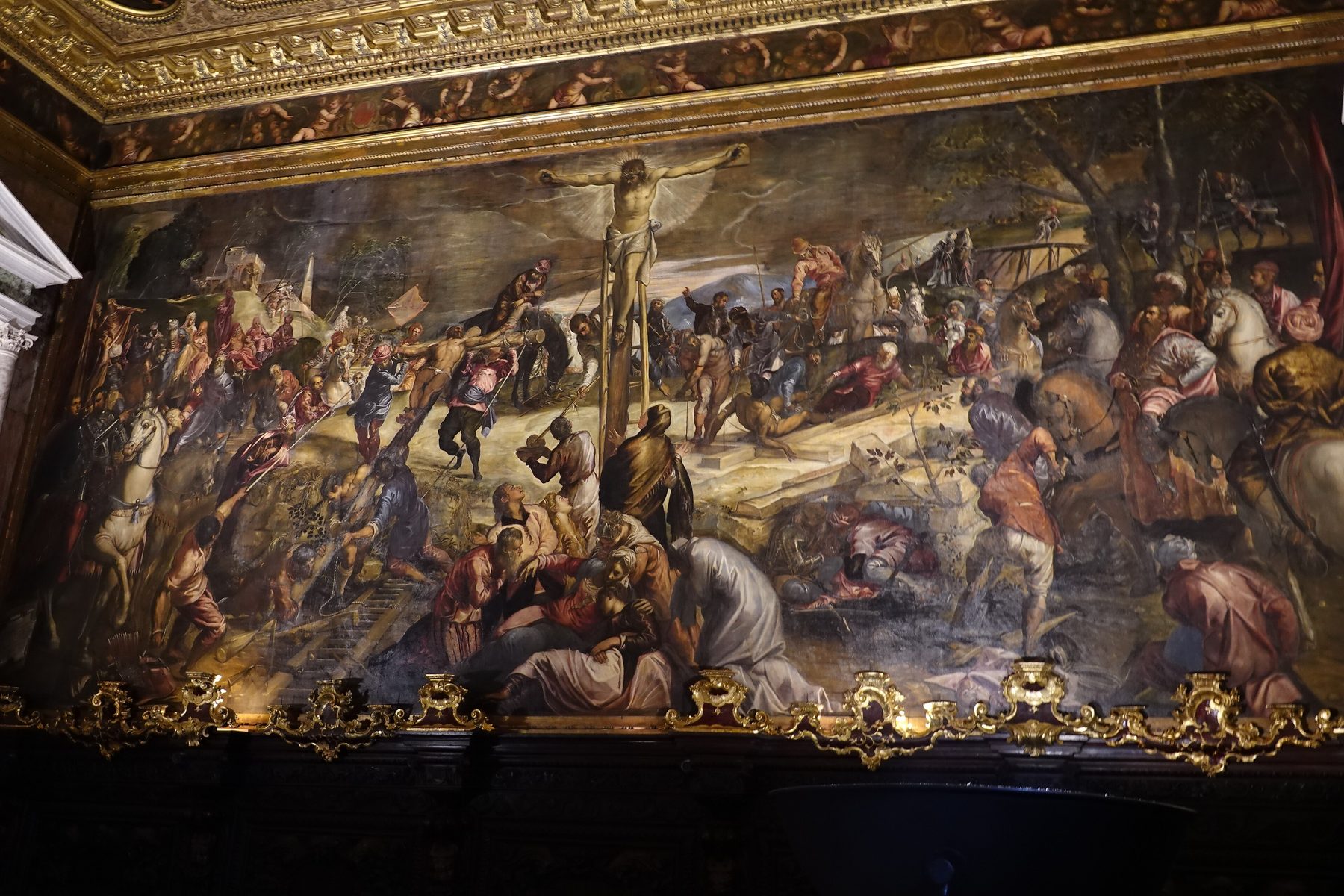
At the Scuola Grande di San Rocco, Tintoretto turned competitive strategy into a relationship lasting more than two decades. He offered a central ceiling painting, then proposed further canvases in exchange for an annual payment while covering material costs. The confraternity gained a celebrated painter on favourable terms; Tintoretto secured income and a vast setting largely free from rival intervention.[45]
The Chapter Room cycle links Old Testament scenes above to New Testament episodes on the walls. Doors, paired windows and uneven natural light become compositional constraints. In the Last Supper, a diagonal table recedes into the room, placing Christ's action at one end rather than enthroning it frontally. Architectural space, sleeping or working bodies and flickering light require the viewer to search. Sacred presence becomes an event within an apparently ordinary meal.
The church's Saint Roch Healing the Plague-Stricken uses torches and an inexplicable lateral beam to cut through a pest house. Diseased bodies, attendants and miraculous action occupy a dark interior. The Scuola identifies it as the first representation of plague in Venetian art. Later alterations and restoration changed its edges, demonstrating how site-specific paintings acquire material biographies of their own.[44]
Tintoretto's scale required a workshop. Assistants prepared and completed passages; landscape specialists could contribute; his sons Domenico and Marco and daughter Marietta participated in the family enterprise. The enormous late Paradise in the Doge's Palace owes much execution to Domenico and others. Recognising those hands does not erase Jacopo's conception. It identifies the collective capacity behind an apparently superhuman output.[42]
Veronese: splendour and decorum
Paolo Veronese came from Verona to Venice in the early 1550s. His formation included architecture, fresco, the iridescent colour of Verona, Giulio Romano, Raphael and Parmigianino as well as Titian. This mixture matters because his bright separations and firm design differ from the tonal unity often called typically Venetian. He became Venetian by working for its churches, patricians, villas and government, not by surrendering his origins.[46] [47]
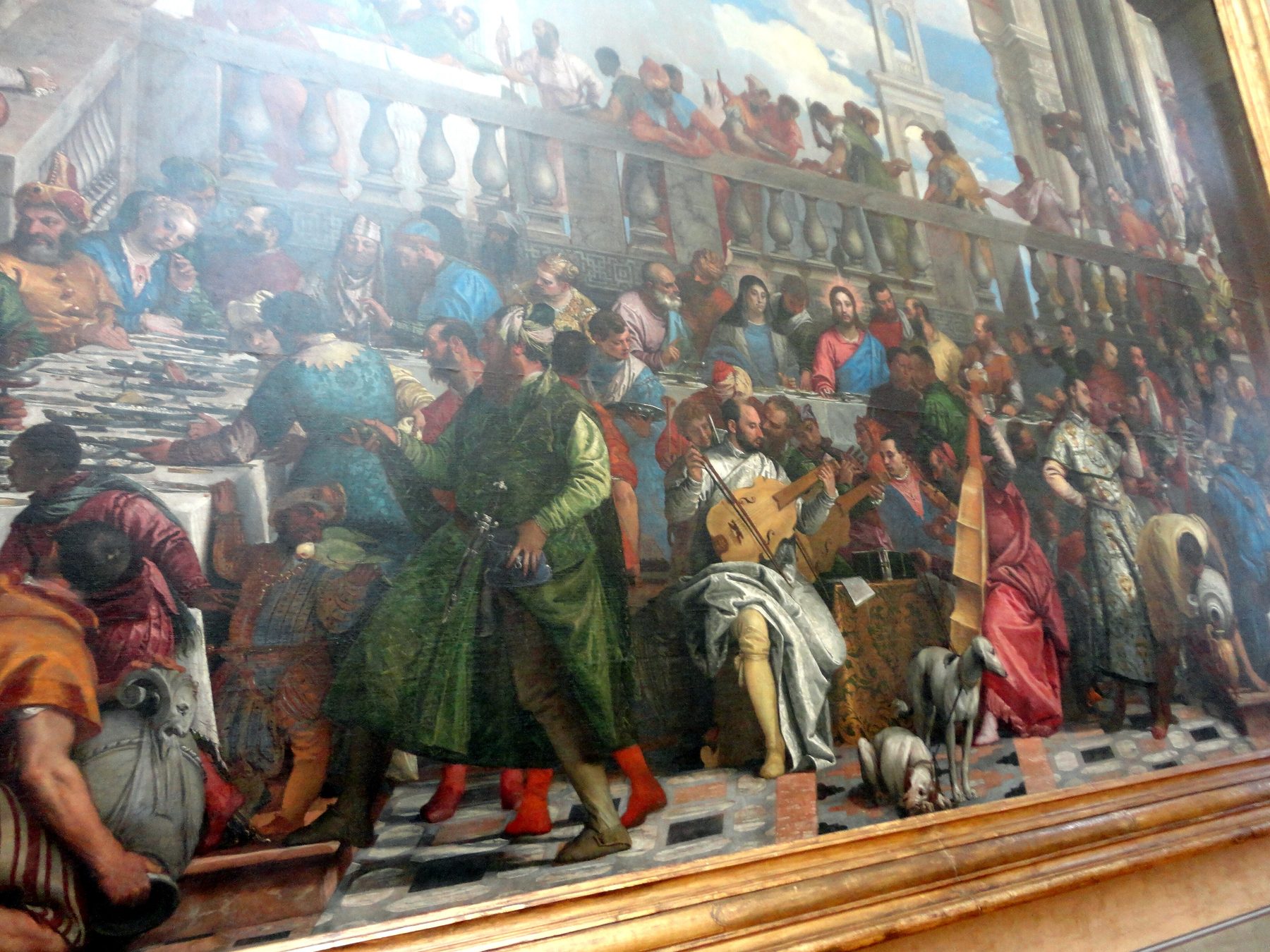
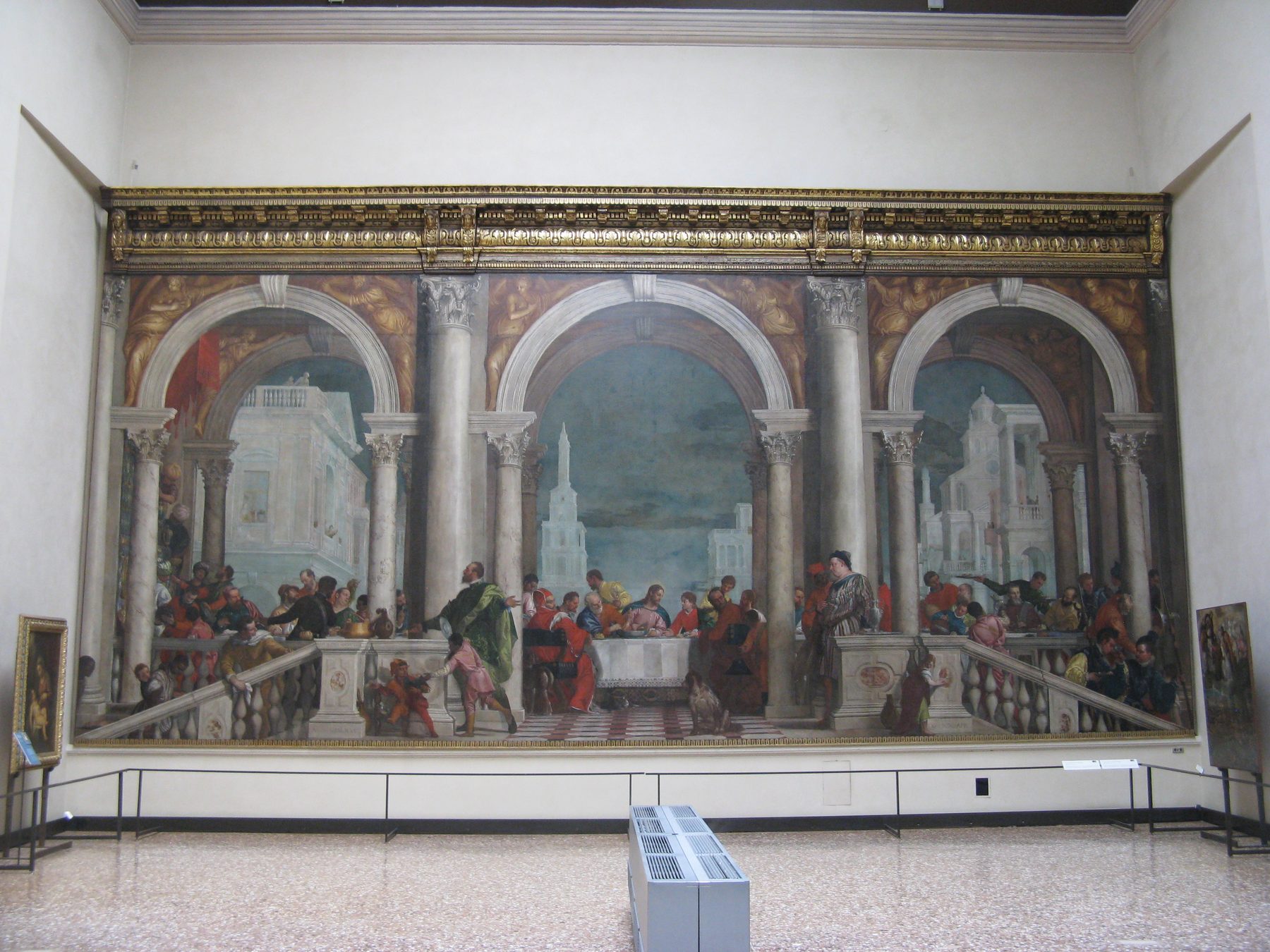
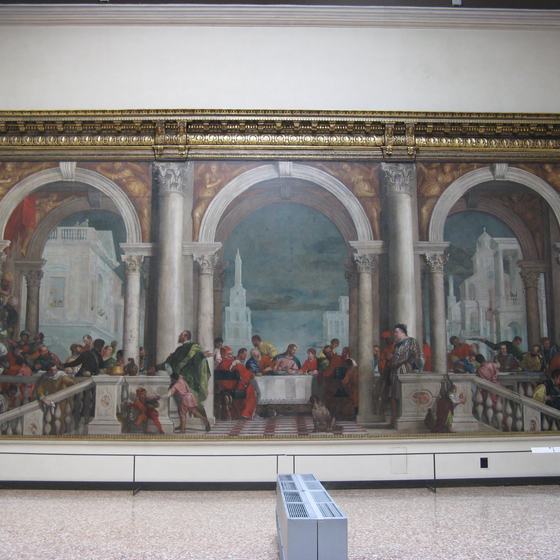
Veronese organised crowded pictures through architecture. Columns, stairs, balustrades and open sky establish zones where servants, nobles, animals and sacred figures can coexist. His great feast scenes transform monastic refectories into palatial stages. Luxury is not extraneous decoration: it tests how biblical events can be made present to wealthy contemporary viewers.
The canvas now called The Feast in the House of Levi was painted in 1573 for the Dominican refectory of Santi Giovanni e Paolo, replacing a work by Titian lost in fire. It was intended as a Last Supper. The Inquisition questioned Veronese about German soldiers, a bleeding servant, a dwarf, a parrot and other figures judged unsuitable around Christ. The surviving inquiry preserves a rare argument about who controls a sacred image.[48]
Veronese defended painters as taking liberties comparable to poets and fools, and pointed out that his invented figures occupied spaces away from Christ. He was ordered to correct the picture. Instead of repainting its architecture and crowd, he changed the title to a Gospel feast where an unruly company was more acceptable. This was neither complete artistic victory nor crushing censorship. It was a practical reframing under institutional pressure.
His decorations at San Sebastiano, the Marciana Library, Villa Barbaro and the Doge's Palace integrate painting with architecture. Ceiling figures must be read from below; frescoed people appear to enter real villa spaces; civic allegories turn good government into luminous bodies. Veronese's large family workshop, including his brother Benedetto and sons, maintained designs and commissions after his death.[47]
At the Doge's Palace, Veronese's personifications make oligarchic rule beautiful, while his Lepanto celebrates victory through sacred approval. Colour and harmony help political claims persuade.[50]
Plague, fire and a rebuilt image
Venice's Renaissance was repeatedly interrupted by epidemic. Giorgione died in 1510. The plague of 1575–77 killed more than 50,000 people in the city according to a Ca' Foscari scholarly account. Authorities initially lifted quarantine after medical advice that the disease was not plague, then restored restrictions as deaths rose. The disaster makes “serenity” look like an aspiration maintained during fear, not an objective condition.[55]
Saint Roch was invoked against plague, and his body made the Scuola di San Rocco a centre of devotion. Charity, welfare, relic and visual drama thus belonged to one institution. Tintoretto's diseased bodies and healing saint were not generic demonstrations of chiaroscuro; they addressed a recurring urban threat.[44]
Titian died in 1576 during the epidemic, although the exact cause cannot be proved from modern medical evidence. His intended burial at the Frari was exceptional under emergency conditions. A promised plague votive painting was left incomplete and later finished by Palma Giovane. Personal death, public devotion and workshop continuation intersect in the object's very incompleteness.
Fire destroyed another visual past. Blazes at the Doge's Palace in 1574 and especially 1577 consumed major paintings by earlier masters, including much of Titian's official work and the great council-hall cycle. The Republic did not reconstruct a neutral interior. It commissioned Tintoretto, Veronese, Palma Giovane, Francesco Bassano and others to restate Venetian history, virtue and authority.[49] [50]
The eastern wall of the Great Council Chamber became the subject of a competition for a new Paradise. Its heavenly hierarchy was meant to align divine order with the doge and assembled patricians below. Veronese and Bassano initially won, but the scheme was not executed before Veronese's death. Tintoretto then received the task and, with major help from Domenico and the studio, completed the enormous canvas by 1592.[51]
The resulting mass of saints and angels frames a radiant centre above the governing tribune. At close range the population can seem nearly unmanageable; across the chamber it becomes a celestial polity. The painting turned fire's rupture into a claim of restored continuity. Its collective making quietly complicates the Republic's equally idealised image of unified order.
Women, bodies and workshop visibility
Venetian painting made bodies central while limiting many people's access to authorship. Male artists studied models, sculpture, anatomy, dress and movement within institutions and workshops largely controlled by men. A recent Accademia exhibition places the Renaissance body within medicine, science, clothing and material culture, reminding us that the “natural” nude is constructed through knowledge and social permission.[54]
Women appear as Virgins, saints, brides, goddesses, beauties and courtesans. The popular half-length belle donne may combine portrait-like specificity with idealisation, poetry and erotic display. It is unsafe to label every uncovered breast a courtesan or every face a named lover. Commission, inscription, attributes, household setting and later provenance must guide interpretation.
Marriage images make gendered viewing especially visible. A bride could be represented through luxurious dress, jewellery and moral emblem, binding personal likeness to family alliance. The reclining nude could allude to marital sexuality while offering her body to a primarily male patron and viewers. Direct gaze may signal agency, invitation, fiction or all three; it does not free the figure from the conditions under which the picture was owned.[30]
Women did work in studios, but documentation and attribution often disappear inside family names. Marietta Robusti, Tintoretto's daughter, was praised during her lifetime as a portraitist and reportedly attracted court interest. She probably assisted in the Robusti shop. The Prado retains a Venetian Lady under her name, while other proposed portraits move between Marietta, her father and followers. The small uncertain body of work is not evidence of small talent. It shows how training, marriage, signature, inheritance and later cataloguing determine survival.[42] [53]
Patrician women also commissioned, inherited and used paintings, although formal government excluded them. Convents shaped sacred settings; brides carried objects between families; widows managed estates; elite women corresponded with artists. Their agency varied with class and legal position. Neither total exclusion nor celebratory exception adequately describes it.
Other bodies were made socially legible through costume and type. Doges wear the corno ducale; confraternity officers occupy ordered ranks; Ottoman figures wear turbans; Black attendants may sharpen the status of a white sitter. The painter's skill at fabric and flesh can make hierarchy look self-evident. A responsible viewer admires the skill while asking whose name, labour and interior life the image withholds.
Artists to know
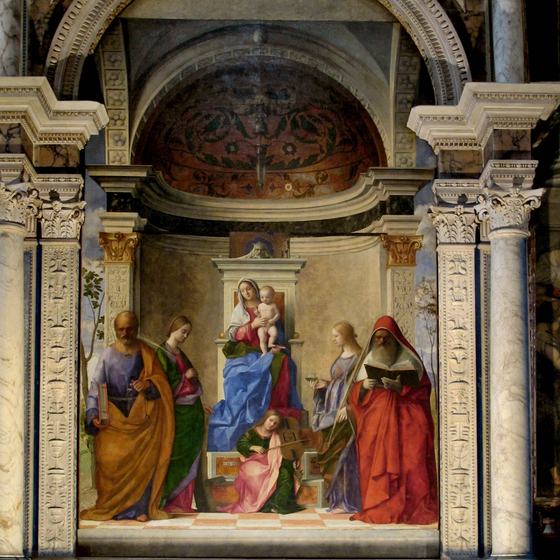
Giovanni Bellini
Bellini made sacred presence emerge through oil, coloured light, landscape and measured stillness. His long career connected Mantegna's sculptural world to Giorgione and Titian, while his workshop established devotional formulas across Venice and the Veneto.[17] [18]
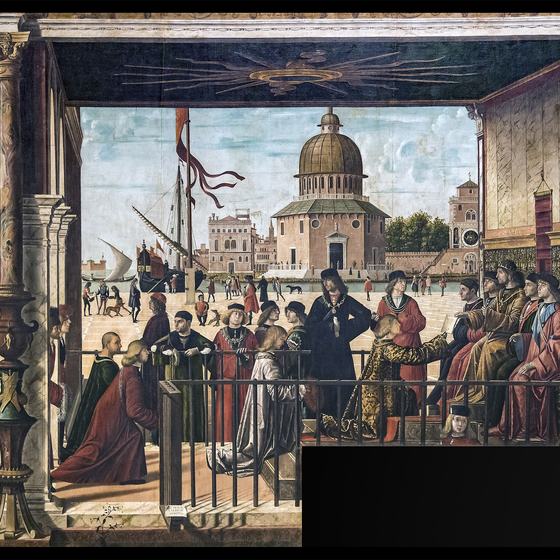
Vittore Carpaccio
Carpaccio organised saints' legends as journeys through architecture, ships, rooms and cities. His cycles reward sequential looking and preserve the role of confraternities from Venice's Adriatic communities.[16]
Jacopo Tintoretto
Tintoretto made narrative arrive through diagonals, abrupt light, crowded recession and rapid brushwork. His vast presence in Venice depended on competitive patronal strategies and a family workshop as well as singular invention.[41] [42] [43]
Paolo Veronese
Veronese combined Veronese and central Italian design with Venetian patronage and colour. His feasts, ceilings and allegories turn architecture into a social stage where splendour, sacred history and political authority negotiate space.[46] [47] [48]
Further artists
Gentile Bellini
Gentile specialised in civic ceremony, portraiture and large narrative canvases. His Ottoman mission and confraternity pictures show Venetian identity being constructed through diplomacy, foreign communities, ritual and meticulous urban staging.[7] [15] [20]
Lorenzo Lotto
Lotto's mobile career carried Venetian training through Treviso, Bergamo, the Marches and Rome. His portraits use gesture, objects and dissonant colour to suggest social identity and unsettled inward life without reducing sitters to rank.[39] [40]
Jacopo Bassano
Bassano brought rural labour, animals, household objects and nocturnal light into biblical narratives. His mainland family studio connected northern prints and Venetian paint to a wide commercial audience.[52]
Marietta Robusti
Marietta was known as a skilled portraitist within and beyond Venice and worked in the Tintoretto family orbit. Uncertain attributions now make her a crucial case for understanding how women's artistic identities were absorbed or lost.[42] [53]
Major artists directory
| Name | Nationality | Key Works |
|---|---|---|
| Gentile Bellini | Italian | Procession in Piazza San Marco |
| Giorgione | Italian | The Tempest, Sleeping Venus |
| Giovanni Bellini | Italian | San Zaccaria Altarpiece, Doge Leonardo Loredan |
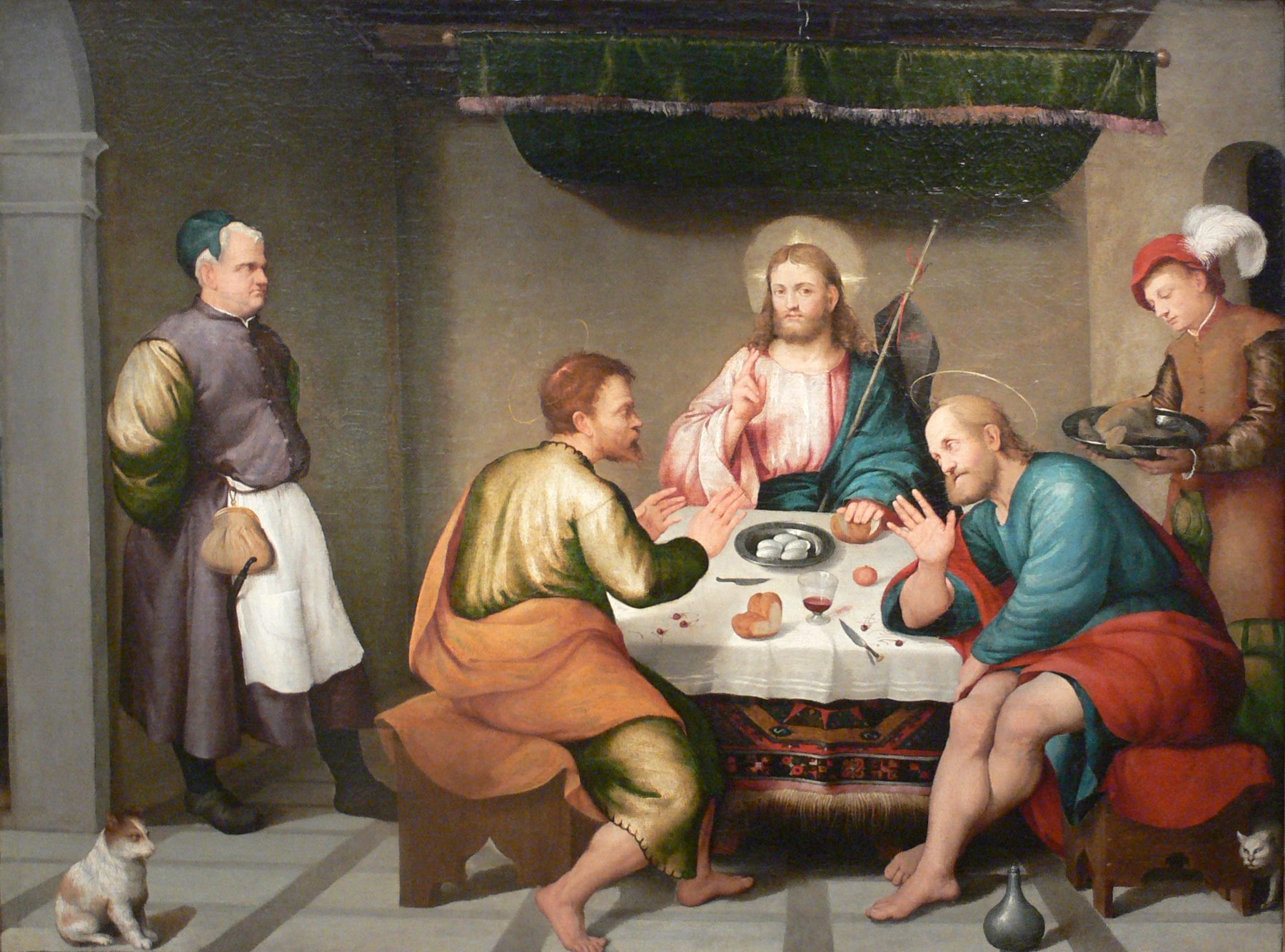
| Jacopo Bassano | Italian | Supper at Emmaus |
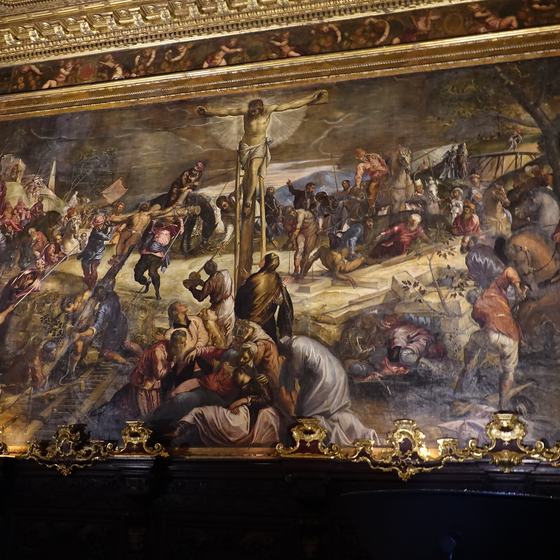
| Jacopo Tintoretto | Italian | Miracle of the Slave, Crucifixion |
| Lorenzo Lotto | Italian | Andrea Odoni |
| Marietta Robusti | Italian | Portraits from the Tintoretto workshop |
| Paolo Veronese | Italian | The Wedding at Cana, Feast in the House of Levi |
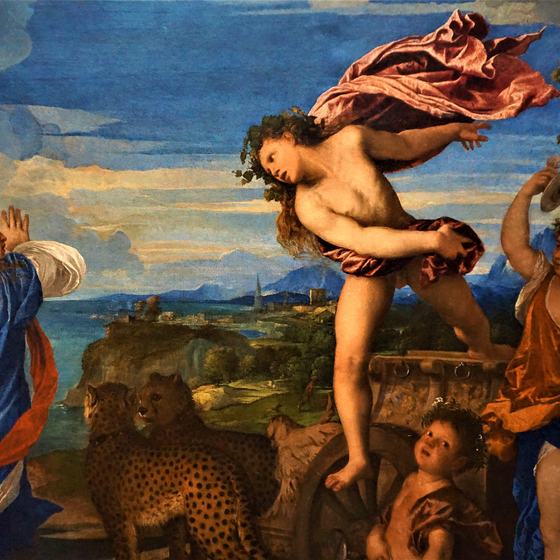
| Titian | Italian | Assumption of the Virgin, Bacchus and Ariadne |
| Vittore Carpaccio | Italian | Arrival of the English Ambassadors |
How to look at Venetian Renaissance art
First establish the intended place. An altarpiece viewed from a side aisle, a ceiling above officials and a domestic nude over furniture solve different problems. Architecture may explain an off-centre Virgin, extreme foreshortening or a crowd distributed around doors. If the work is now in a museum, imagine what separation from its cycle has changed.
Look for colour as structure rather than decoration. Trace where one red repeats, how a blue recedes, whether flesh emerges from a dark ground and which edge dissolves into air. Move closer to see glazes, dragged highlights and canvas weave, then step back until separate marks fuse. The proper distance may change across a single painting.
Search for drawing without demanding a hard outline. A pose can be designed through tonal masses; a figure may have moved during revision; architecture may lock a picture whose fabrics look spontaneous. Infrared evidence is invisible in the gallery, but pentimenti—ghosted hands, shifted contours or altered objects—can sometimes expose thought.[27] [28]
Follow the patron. A doge portrait performs constrained office, a confraternity cycle builds corporate memory and a poesia serves elite private looking. Identify coats of arms, votive donors, institutional clothing and the real room's users. Patronal purpose need not eliminate meanings the patron did not control.
Treat exotic-looking objects precisely. Is a carpet Anatolian, a ceramic Mamluk, a costume invented, or a turban a generic marker? Ask whether the person is named and what trade, diplomacy or coercion brought the object into view. Avoid using “East” as a substitute for several cultures and routes.[6] [7]
Allow ambiguity to remain. Giorgione's storm does not become meaningless because its iconography is uncertain. A Titian nude can be marital, mythic and erotic in the same encounter. Veronese's feast can celebrate painterly liberty while recording religious discipline. Contradiction is often evidence of the picture's social work.
Finally, distinguish ageing from intention. Dark varnish, faded lakes, abrasion, lining and repainting alter colour and touch. A damaged surface may still be profound, but its current harmony cannot automatically be assigned to the Renaissance artist.
Endings and legacy
The Venetian Renaissance did not end with its central masters. The Robusti, Caliari and Bassano workshops continued, while Palma Giovane finished abandoned works. Seventeenth-century painters adapted Venetian brushwork to new religious, courtly and market conditions.
Titian's example became international. Rubens studied his mythologies and copied them; Van Dyck absorbed the union of rank and living flesh; Velázquez encountered Venetian colour within the Spanish royal collection; Poussin learned from the organisation of myth even while defending design. Tintoretto's dramatic recession and Veronese's architecture offered different resources to Baroque painters.[29] [41]
Later colourists valued poetic atmosphere. Delacroix made Venetian and Rubensian colour a Romantic argument; Manet copied Titian and Tintoretto, then adapted the nude and visible paint to modern Paris. Such recoveries could repeat the old opposition between sensual Venice and rational Florence.
Modern conservation and scholarship have changed the story again. Technical imaging restores preparatory decisions beneath “spontaneous” surfaces. Archival work recovers colour sellers, contracts, confraternity boards, women painters and mobile communities. Local institutions reconnect museum canvases to churches, palaces and halls. The result is not a less beautiful Venetian Renaissance. It is a beauty understood as organised matter, labour, belief and power.
Frequently Asked Questions
No. It is a later regional and chronological category. The painters did not join one group or sign a shared doctrine. The term connects artists working within Venice and the Republic's territories while preserving differences of generation, patron, medium and method.
About 1400–1600 is a practical broad range. The mid-fifteenth-century Bellini and Vivarini workshops mark a major transformation, while the deaths of Titian, Veronese, Bassano and Tintoretto make the late sixteenth century a useful ending. Earlier traditions and later workshops cross both boundaries.[1] [3]
Artists used oil, layered paint, varied grounds and rich pigments to make colour organise light, form and atmosphere. Trade and specialist colour sellers supported this practice, while writers defended colorito as a form of pictorial intelligence. It was learned material skill, not an automatic effect of lagoon light.[5] [32] [34]
Yes. Surviving sheets, cartoons, underdrawing and technical images prove extensive design. Some artists fixed less before painting or allowed coloured layers to revise form more visibly than Tuscan practice, but the opposition between Venetian colour and Florentine drawing is a critical construction, not a literal absence.[27] [33]
Canvas could support enormous pictures, travel more easily than large panels, be joined in sections and contribute visible texture. It suited confraternity halls, palace ceilings, private pictures and exported works. Humidity may matter in some settings, but it is not a complete explanation.
No interpretation commands universal agreement. The figures have been linked to biblical, classical and patronal stories, but the early record does not identify a subject. The uncertainty is historically meaningful because weather, landscape and figures were designed to sustain poetic association.[22] [23]
Trade supplied pigments, textiles, carpets, ceramics, books and visual knowledge, and brought Venetian artists into contact with Islamic and northern European cultures. It also depended on colonial claims, regulated foreign communities, war and slavery. Material exchange should be understood with those unequal conditions.[6] [8] [9]
Yes, although workshop and archival structures make their work difficult to reconstruct. Marietta Robusti was praised as a portraitist and probably worked with her father Tintoretto, but few paintings can be assigned to her securely. Women were also patrons, sitters, devotional users and inheritors of art.[42] [53]
Discussion
Which aspect most changes how you see Venetian Renaissance painting: the material construction of colour, the original architectural setting, the workshop behind a famous name, or the trading and political routes carried by a single depicted object?
Reader Insights
Imagine the picture in its church, palace, scuola or domestic room before judging it as an isolated museum object.
Notice how coloured light, texture and atmosphere organise bodies and space rather than treating colour as surface decoration.
Ask what the work reveals about lagoon, mainland and Mediterranean exchange—and what forms of power that movement depended upon.
Join the Conversation
Which Venetian Renaissance work most changes when you imagine its original setting? Share your view below.
References
- Metropolitan Museum of Art, “Art in Renaissance Venice, 1400–1515”, metmuseum.org. View Source
- National Gallery, “Room 29: Venice”, nationalgallery.org.uk. View Source
- Gallerie dell'Accademia di Venezia, “Percorsi di visita”, gallerieaccademia.it. View Source
- Städel Museum, “Titian and the Renaissance in Venice”, staedelmuseum.de. View Source
- Städel Museum, “Tizian und die Renaissance in Venedig”, tizian.staedelmuseum.de. View Source
- Metropolitan Museum of Art, “Venice and the Islamic World, 828–1797”, metmuseum.org. View Source
- National Gallery, “Gentile Bellini: The Sultan Mehmet II”, nationalgallery.org.uk. View Source
- Renata Segre, Preludio al Ghetto di Venezia, edizionicafoscari.unive.it. View Source
- Getty, “The Black Gondoliers of Renaissance Venice”, getty.edu. View Source
- Metropolitan Museum of Art, “Art in Renaissance Venice, 1400–1515: Paintings and Drawings from the Museum's Collections”, metmuseum.org. View Source
- National Gallery, “Scuole”, nationalgallery.org.uk. View Source
- Scuola Grande di San Rocco, “The Venetian Scuole”, scuolagrandesanrocco.org. View Source
- Morgan Library & Museum, “Patronage in Renaissance Venice”, themorgan.org. View Source
- Gallerie dell'Accademia di Venezia, “Storia della collezione”, gallerieaccademia.it. View Source
- Gallerie dell'Accademia di Venezia, “Sala XX: Miracoli della Croce”, gallerieaccademia.it. View Source
- Scuola Dalmata Venezia, “La vita di Vittore Carpaccio”, scuoladalmatavenezia.com. View Source
- National Gallery, “Giovanni Bellini”, nationalgallery.org.uk. View Source
- National Gallery, “Mantegna & Bellini”, nationalgallery.org.uk. View Source
- National Gallery, “Giovanni Bellini: Doge Leonardo Loredan”, nationalgallery.org.uk. View Source
- National Gallery, “Gentile Bellini”, nationalgallery.org.uk. View Source
- National Gallery of Art, “Bellini, Giorgione, Titian, and the Renaissance of Venetian Painting”, nga.gov. View Source
- Gallerie dell'Accademia di Venezia, “La tempesta”, gallerieaccademia.it. View Source
- National Gallery, “Giorgione”, nationalgallery.org.uk. View Source
- Museo Nacional del Prado, “Tiziano Vecellio di Gregorio”, museodelprado.es. View Source
- National Gallery, “Titian”, nationalgallery.org.uk. View Source
- Gallerie dell'Accademia di Venezia, “Tiziano 1508: Agli esordi di una luminosa carriera”, gallerieaccademia.it. View Source
- National Gallery Technical Bulletin, “Titian's Painting Technique to c.1540”, nationalgallery.org.uk. View Source
- National Gallery Technical Bulletin, “Titian's Painting Technique after 1540”, nationalgallery.org.uk. View Source
- National Gallery of Art, “Titian”, nga.gov. View Source
- Gallerie degli Uffizi, “La Venere di Urbino”, uffizi.it. View Source
- Museo Nacional del Prado, “Tiziano”, museodelprado.es. View Source
- Metropolitan Museum of Art, “Venetian Color and Florentine Design”, metmuseum.org. View Source
- Gallerie degli Uffizi, “La rivincita del Colore sulla Linea”, uffizi.it. View Source
- National Gallery, “Colorito”, nationalgallery.org.uk. View Source
- Gallerie dell'Accademia di Venezia, “Aldo Manuzio: Il Rinascimento di Venezia”, gallerieaccademia.it. View Source
- Albertina, “Mantel des Papstes: Studie für das Rosenkranzfest”, sammlungenonline.albertina.at. View Source
- National Gallery of Art, “Italian Renaissance Chiaroscuro Woodcuts”, nga.gov. View Source
- Städel Museum, “Titian and the Renaissance in Venice: Exhibition Research”, newsroom.staedelmuseum.de. View Source
- National Gallery, “Lorenzo Lotto”, nationalgallery.org.uk. View Source
- Museo Nacional del Prado, “Lotto, Lorenzo”, museodelprado.es. View Source
- National Gallery, “Jacopo Tintoretto”, nationalgallery.org.uk. View Source
- National Gallery of Art, “Jacopo Tintoretto”, nga.gov. View Source
- Gallerie dell'Accademia di Venezia, “Il giovane Tintoretto”, gallerieaccademia.it. View Source
- Scuola Grande di San Rocco, “Church: Stories of Saint Roch”, scuolagrandesanrocco.org. View Source
- Scuola Grande di San Rocco, “Chapter Room”, scuolagrandesanrocco.org. View Source
- Museo Nacional del Prado, “Paolo Veronese 1528–1588”, museodelprado.es. View Source
- National Gallery, “Paolo Veronese”, nationalgallery.org.uk. View Source
- Gallerie dell'Accademia di Venezia, “Convito in casa di Levi”, gallerieaccademia.it. View Source
- Palazzo Ducale, “Le Sale Istituzionali del primo piano”, palazzoducale.visitmuve.it. View Source
- Palazzo Ducale, “Le Sale Istituzionali del secondo piano”, palazzoducale.visitmuve.it. View Source
- Palazzo Ducale, “Il Paradiso di Guariento, l'incendio del 1577 e il concorso”, archivio-palazzoducale.visitmuve.it. View Source
- National Gallery, “Jacopo Bassano”, nationalgallery.org.uk. View Source
- Museo Nacional del Prado, “Dama veneciana”, museodelprado.es. View Source
- Gallerie dell'Accademia di Venezia, “Corpi moderni: La costruzione del corpo nella Venezia del Rinascimento”, gallerieaccademia.it. View Source
- Ca' Foscari University of Venice, On Pestilence: A Renaissance Treatise on Plague, iris.unive.it. View Source
- Musée du Louvre, “Titien, Tintoret, Véronèse : Rivalités à Venise — Prologue : La peinture vénitienne au milieu du XVIe siècle”, mini-site.louvre.fr. View Source
- Image references 57–72: open-access reproductions and institutional collection records.
View 16 image sources
01 · commons.wikimedia.org02 · commons.wikimedia.org03 · commons.wikimedia.org04 · commons.wikimedia.org05 · commons.wikimedia.org06 · commons.wikimedia.org07 · commons.wikimedia.org08 · commons.wikimedia.org09 · commons.wikimedia.org10 · commons.wikimedia.org11 · commons.wikimedia.org12 · commons.wikimedia.org13 · commons.wikimedia.org14 · commons.wikimedia.org15 · commons.wikimedia.org16 · commons.wikimedia.org