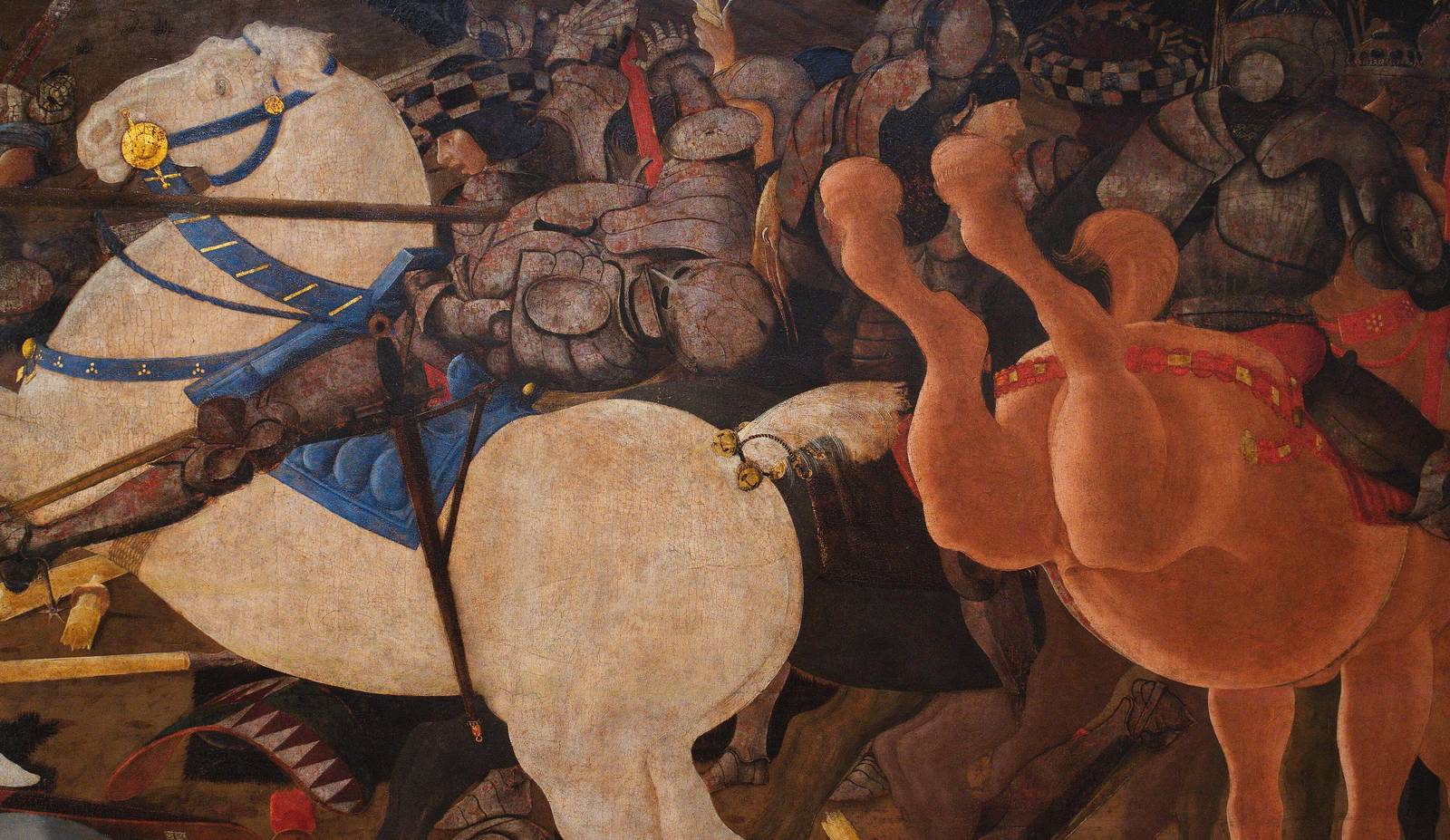
Image reference: Paolo Uccello, The Battle of San Romano.
At a Glance
- Core periodc. 1400–1490s
- Principal regionsFlorence and Tuscany · Urbino · Padua · Mantua · Ferrara · Venice · Rome · Naples
- Known forperspective · substantial figures · classical study · civic monuments · intense religious imagery
- Major mediafresco · panel painting · bronze · marble · architecture · intarsia · illuminated manuscripts
- Key contextChristian devotion · guilds and workshops · humanism · civic rivalry · courts · banking and trade
- Important cautiona later period label—not an organised movement or clean break with medieval art
Contents
- Early Renaissance in context
- What Early Renaissance means
- Why Florence mattered
- Humanism, antiquity and Christianity
- Building space and perspective
- Giving bodies weight
- Devotion and experiment
- Workshops, materials and people
- Beyond Florence
- Artists to know
Early Renaissance in context
Brunelleschi
Principal careerDonatello
Principal careerFra Angelico
Principal careerMasaccio
Principal careerFilippo Lippi
Principal careerPiero della Francesca
Principal careerAndrea Mantegna
Principal careerGiovanni Bellini
Principal careerBotticelli
Principal careerThe Early Renaissance was not a club, a manifesto or a single way of making art. It is the name later historians give to a period of exceptional experiment across fifteenth-century Italy, when painters, sculptors, architects and craftsmen reworked Christian tradition, the remains of antiquity, the observation of nature and the social life of their own cities. Florence was one of its most powerful centres, but no account is complete without Siena, Urbino, Padua, Mantua, Ferrara, Venice, Rome and Naples. Together they created visual languages that made sacred bodies feel physically present, turned walls into measured spaces, revived and transformed ancient forms, and gave patrons new ways to place themselves inside history.[1] [2] [3] [4]
The period sits between the great changes associated with Giotto and fourteenth-century Italy and the generation of Leonardo, Michelangelo and Raphael. That position is useful, but it can also be misleading. It encourages a staircase history in which each artist corrects the defects of the last until the High Renaissance reaches perfection. Giorgio Vasari helped establish that story in the sixteenth century by arranging artists into a sequence of decline, rebirth and fulfilment. The French word Renaissance became a much broader historical label only later. Fifteenth-century artists did not wake each morning believing that they occupied an “early” phase of somebody else's climax.[5]
Several histories overlapped. The spatial and emotional achievements of Giotto remained important. International Gothic elegance, precious surface and courtly display continued to attract patrons. Gold grounds and traditional image types retained devotional force. At the same time, scholars recovered classical texts, artists studied Roman ruins and sculpture, and new methods ordered bodies and architecture within a picture. These were not mutually exclusive camps. A panel might place a monumental, carefully modelled Virgin against gold; a battle scene could use measured recession while glittering like a textile; a sculptor could revive the ancient nude for a work whose subject and setting were unmistakably Christian.[6]
“Early Renaissance” therefore works best as a map, not a boundary wall. A broad range of about 1400 to the 1490s captures many of its defining experiments, but dates change according to place and medium. In sculpture, Donatello's innovations began early and travelled with him. Venetian painting developed on a different rhythm from Florentine painting. In court centres such as Urbino and Mantua, imported artists and local ambitions created particular combinations of learning, ceremony and power. The term Quattrocento—literally the Italian 1400s—can be more neutral, although it too gathers a century of unequal conditions under one name.[3] [4]
The most revealing way to approach the period is not to ask when medieval art ended. Ask instead what a picture, statue, chapel or building was required to do. Who commissioned it? Where did it stand? What skills and materials made it possible? Which older forms did it preserve, and which did it alter? The answers show a culture in which invention often worked through inheritance.
Follow the Early Renaissance through four stages
–1420
Inheritance and civic experiment
Guild commissions, cathedral building and International Gothic display create the institutional setting for new public competition.
–1440
Space and the substantial body
Brunelleschi, Masaccio, Donatello and Fra Angelico make architecture, perspective, light and bodily presence serve civic and devotional meanings.
–1470
Workshops and regional networks
Florentine, Paduan, Umbrian and Venetian experiments travel through artists, drawings, courts, trade and collaborative workshops.
–1490s
Late-century plurality
Myth, portraiture, large chapel cycles, Flemish exchange and multi-art workshops expand the period without resolving it into one style.
What does Early Renaissance mean?
The familiar word “rebirth” carries two related ideas. One is a renewed engagement with the literature, philosophy, architecture and art of Greece and Rome. The other is a later claim that European culture itself had been reborn after a dark interval. The first describes genuine fifteenth-century activity; the second can turn the Middle Ages into a crude foil and Italy into the only active part of Europe. Early Renaissance art becomes clearer when those meanings are separated.[1] [5]
Artists certainly looked at antiquity. Ancient coins, gems, reliefs, sarcophagi, statues and surviving buildings supplied poses, costumes, decorative forms and models of public commemoration. Architects measured Roman structures. Humanists translated and edited texts, compared manuscripts and used rhetoric and history to think about citizenship, conduct and fame. A self-portrait medal by Leon Battista Alberti presents the scholar in a classicising profile, while its emblem of a winged eye turns intellectual vigilance into a memorable sign.[8]
Yet most major visual commissions remained Christian. Cathedrals, parish churches, monasteries, convents and confraternities needed altarpieces, frescoes, choir books, reliquaries, tombs and sculpture. The renewed attention given to Christ's physical humanity could make sacred suffering and tenderness more immediate. Classical columns might frame the Annunciation; mathematically ordered space could lead the eye towards the Trinity; an ancient-looking hero could represent David, the biblical defender of Florence. Humanism and religion were not opposing forces. Both helped patrons imagine how inherited truth might become present to contemporary viewers.[28]
Nor did the period possess one recognisable style. Compare the solemn bodies of Masaccio, the lucid radiance of Fra Angelico, Uccello's geometric armour, Lippi's intimate Madonnas, Piero's stillness, Mantegna's stony archaeology, Bellini's changing light and Botticelli's restless line. All belong within the field, yet no checklist of perspective, naturalism and antiquity describes them equally well. What they share is a sustained testing of how images occupy space, address viewers, carry memory and operate within institutions.
Why Florence mattered
Florence brought several favourable conditions into close contact. Banking, wool and silk manufacture connected the city to European trade. Its guilds regulated professions and participated in public life. Churches, convents and charitable institutions occupied prominent sites. Merchant families used chapels, palaces, tombs and devotional pictures to secure memory and status. Republican political language encouraged comparisons with ancient Rome, even as power became concentrated in fewer hands. Artists could see major works by rivals within a relatively compact urban field.[1] [3]
The competition of 1401 for new bronze doors for the Baptistery is often used as a symbolic beginning. Lorenzo Ghiberti defeated Filippo Brunelleschi with a trial relief of the Sacrifice of Isaac, then spent decades on the doors and became an important designer, writer and administrator. The event mattered, but it did not suddenly create the Renaissance. It reveals an existing culture of public commission, technical judgement and civic prestige in which a biblical subject could become a test of bronze casting, narrative clarity, bodily expression and the study of antiquity.[2]
The Medici family became extraordinarily influential. From the 1430s Cosimo de' Medici exercised power without abolishing republican forms. Family houses, churches, convents and artists benefited from Medici money and association; later, Lorenzo de' Medici's circle became inseparable from the image of late-century Florentine culture. But “Medici art” cannot explain Florence by itself. Rival bankers commissioned major chapels. Guilds owned niches at Orsanmichele. Religious orders and confraternities determined subjects and sites. Nuns negotiated expensive altarpieces. Hospitals received international gifts. A painting later acquired by the Medici may have begun with another patron altogether.[2] [15] [17] [26]
Patronage was rarely a simple purchase of beauty. A contract could specify dimensions, materials, costly pigments, the master's participation, completion dates and penalties. The position of an altar or choir affected scale and viewpoint. Family saints tied sacred history to names and ancestry. Donor portraits placed living or recently dead people near holy figures, but not necessarily on equal terms: scale, gesture and distance could maintain hierarchy. Art expressed devotion, advertised responsibility, claimed honour and sometimes disguised political rivalry. These purposes reinforced one another rather than falling into modern categories of “religious” and “secular”.[25] [26]
Florence also mattered because it attracted and exported people. Craftsmen moved between building sites and workshops. Donatello carried Florentine sculpture to Padua. Netherlandish pictures arrived through merchant networks. Artists trained in one shop before establishing another or entering court service. The city's importance lay not only in what it contained, but in its place within moving systems of labour, credit, objects and information.
Humanism, antiquity and Christianity
Humanism began as an education in language and moral thought rather than a doctrine of unbelief. Its practitioners studied grammar, rhetoric, poetry, history and ethics through ancient texts. They valued persuasive speech, historical example and the active life of citizens. For artists and patrons this learning opened a large store of stories and forms, but it did not dictate one visual scheme. A humanist could serve a pope, a republic or a prince; a classical reference could praise civic liberty, dynastic authority or Christian providence.[3] [5]
Alberti best represents the range of the enterprise. He wrote about painting, sculpture and architecture as well as family, ethics and society. He described painting as an intellectual art and addressed the construction of pictorial space, the proportions and movement of bodies, and the organisation of a compelling narrative. His model of the istoria—a composition whose figures, gestures and emotions make an action intelligible—helped raise the status of design and judgement. But practice did not wait for theory. Masaccio and other painters had already achieved striking spatial and narrative effects by the time Alberti wrote De pictura in Latin in 1435 and Italian in 1436.[6] [7]
Ancient form could be studied with extraordinary seriousness without being copied intact. Donatello's figures respond to Roman sculpture, medieval art, nature and the expressive demands of Christian subjects. Mantegna built imagined antiquities out of inscriptions, ruins, sculpture and contemporary archaeological knowledge. Botticelli's mythological bodies owe something to ancient statues while their linear rhythm remains entirely his own. The Renaissance relationship with antiquity was creative, selective and sometimes mistaken. What mattered was the authority and possibility the past made available.
Christian narrative, meanwhile, was not a static shell around modern form. Religious communities shaped the rhythm of looking. A friar encountering a fresco in a cell did not approach it like a visitor in a gallery. An altarpiece could open and close according to feast days. A predella brought small episodes close to the eye; a monumental central image addressed a congregation from a distance. Images instructed, recalled scripture, focused prayer, embodied institutional identity and made the saints part of daily space. The humanity given to Christ and the Virgin could intensify meditation on incarnation, grief and redemption.[28]
This double attention—to ancient culture and Christian presence—helps explain why the period feels both familiar and strange. Its makers developed tools that later European art would use for centuries, but they did so within beliefs and social structures different from ours.
Building space: Brunelleschi, Alberti and perspective
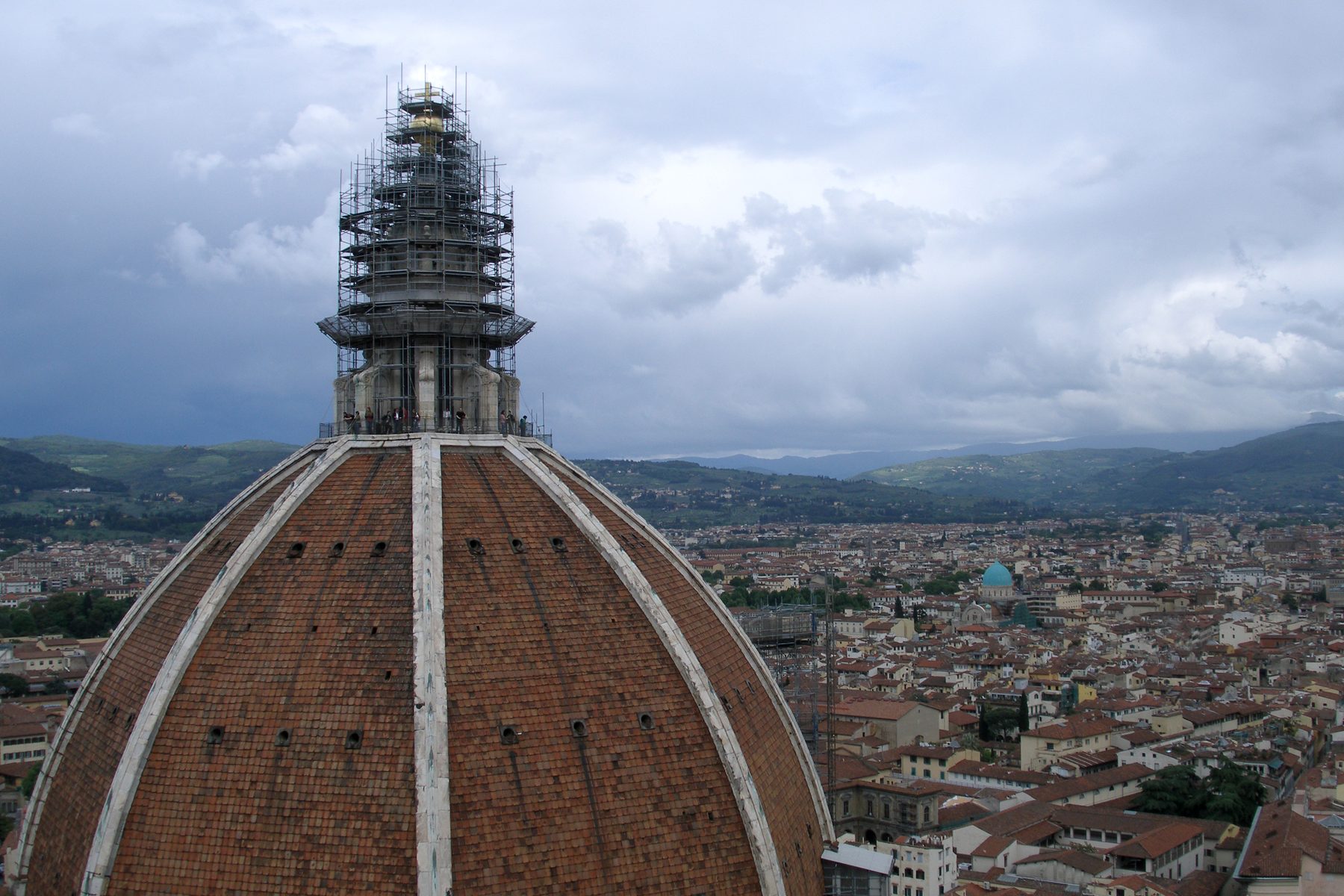
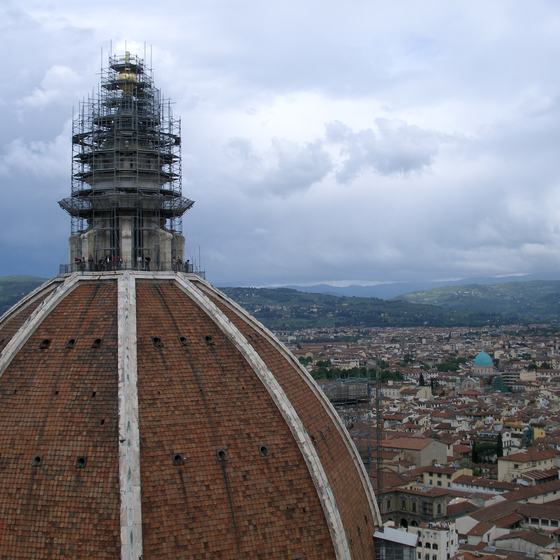
No monument embodies the period's ambitions more completely than the dome of Florence Cathedral. Its scale dominates the city, and its construction between 1420 and 1436 made Filippo Brunelleschi famous. Yet the building itself began in the late thirteenth century, and the enormous octagonal crossing to be covered had been inherited from earlier designers. Brunelleschi did not dream up the problem; he devised a way to solve it.[19] [20]
The dome used inner and outer shells, major ribs and intermediate ribs, carefully arranged masonry and herringbone brickwork. Special hoists and machines raised stone and other materials to unprecedented heights. The project avoided the complete wooden centring that a conventional dome of this span would have demanded. It depended on quarrying, transport, carpentry, brickmaking, metalwork, bookkeeping and disciplined teams of labourers. Lorenzo Ghiberti shared official supervision for much of the construction, even though later stories often cast him only as Brunelleschi's defeated rival.[19] [21]
The result joined engineering to urban meaning. From outside, the vast red-tiled shell completed a cathedral whose Gothic fabric had grown across generations. Classical forms became more explicit in Brunelleschi's later tribunes and the lantern designed for the summit, but continuity and innovation remain visible together. The dome was at once a covering for sacred space, a demonstration of institutional capacity and an emblem of Florence.
Brunelleschi is also associated with lost demonstrations of linear perspective. In the simplest construction, parallel lines running away from the viewer appear to converge at a point on the horizon; objects become smaller according to a consistent geometry. Alberti's treatise offered the earliest surviving coherent written account of this kind of pictorial system. He imagined the picture as an open window and described a grid through which the visible world could be translated onto a plane.[7]
Perspective is often called the discovery of how we really see. That overstates it. It is a convention that relates a flat image to one ideal viewing position. Human vision moves, uses two eyes and attends selectively. Early Renaissance artists could alter or ignore the system when another priority mattered more. Architecture might be internally consistent while figures follow devotional hierarchy. Separate parts of a picture could use different vanishing points. Gold, pattern and surface could compete deliberately with deep recession. Perspective's importance lies not in making every image natural, but in giving artists a controllable way to stage bodies, buildings and viewers in relation to one another.[7] [16]
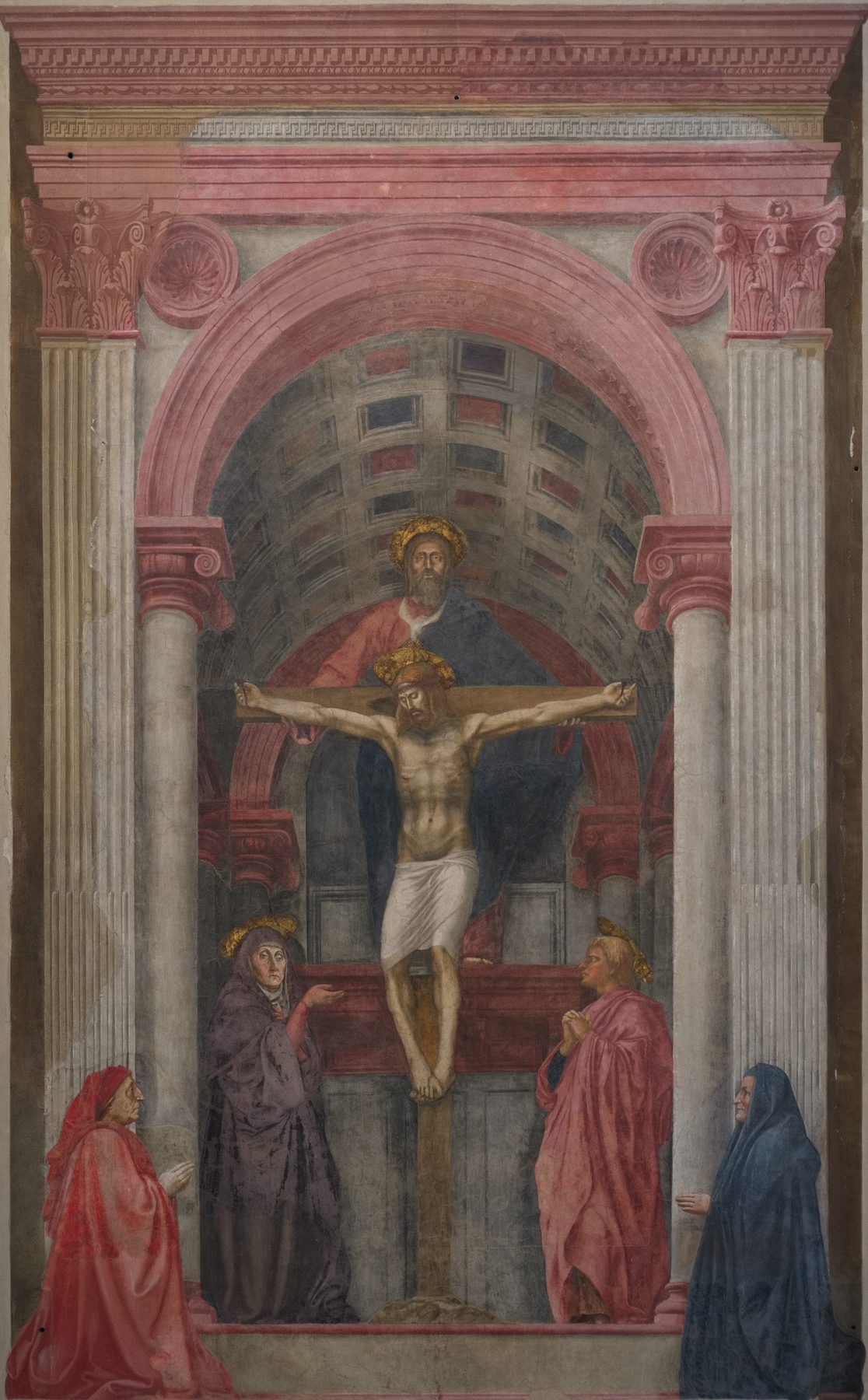
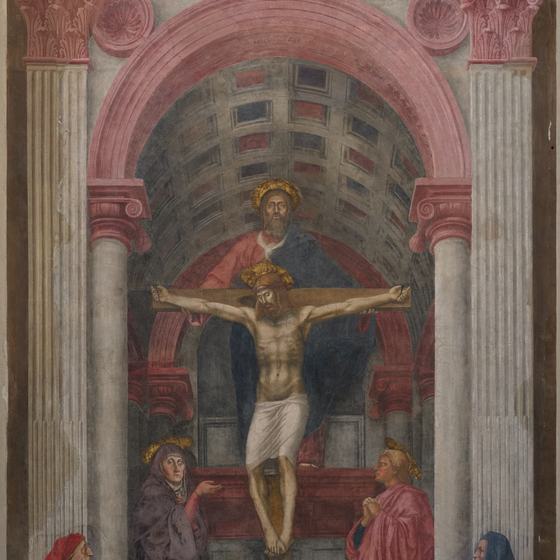
Masaccio's Trinity in Santa Maria Novella demonstrates the social power of that staging. Painted architecture seems to continue the real church wall as a barrel-vaulted chapel. Christ, God the Father, the Virgin, Saint John and kneeling donors occupy a measured order; below them, a skeleton warns the viewer of death. The illusion does not replace doctrine. It gives the theological hierarchy a spatial and bodily presence at the viewer's level, while the painted tomb turns perspective into meditation on mortality.[9]
Essential works
Florence Cathedral Dome
Filippo Brunelleschi, 1420–36
The Trinity
Masaccio, c. 1425–27
David
Donatello, c. 1440s
Equestrian Monument to Gattamelata
Donatello, c. 1445–53
The Annunciation
Fra Angelico, c. 1425–26
Giving bodies weight: Masaccio and Donatello
Masaccio transformed painting in a career cut short before he reached thirty. His figures seem to stand because light describes their volume, drapery responds to bodies and feet make contact with ground. In the Brancacci Chapel, sacred episodes unfold among buildings and landscapes that make action legible. Emotion is concentrated rather than ornamental: expulsion, shame, healing and communal attention register through posture and gesture.
The surviving central panel of his Pisa altarpiece shows the Virgin and Child seated with angels. Its pointed format, gold and expensive materials belong to altarpiece tradition. Yet the throne recedes towards a low viewpoint appropriate to its original position; the Virgin's knees create a powerful volume; the Child eats grapes that anticipate the Eucharist. Physicality does not make the figures less sacred. It makes incarnation—divinity taking bodily form—visually persuasive.[10]
Masaccio's monuments also reveal collaborative authorship. The Brancacci cycle involved Masolino and was completed later by Filippino Lippi. The Pisa ensemble was dispersed, so modern viewers usually encounter separated panels rather than the structure commissioned for a chapel. “Masaccio” names a decisive artistic intelligence, but the surviving object world includes partners, carpenters, gilders, patrons, restorers and later alterations.
Donatello pursued comparable questions in sculpture across a much longer career. For the guild niches of Orsanmichele, a figure had to command a public street while fitting an architectural frame. His marble Saint George stands alert and psychologically charged. Beneath it, a shallow relief creates space with minute variations in depth, making carved stone behave almost like drawing. The viewer's movement past the niche completes the encounter.
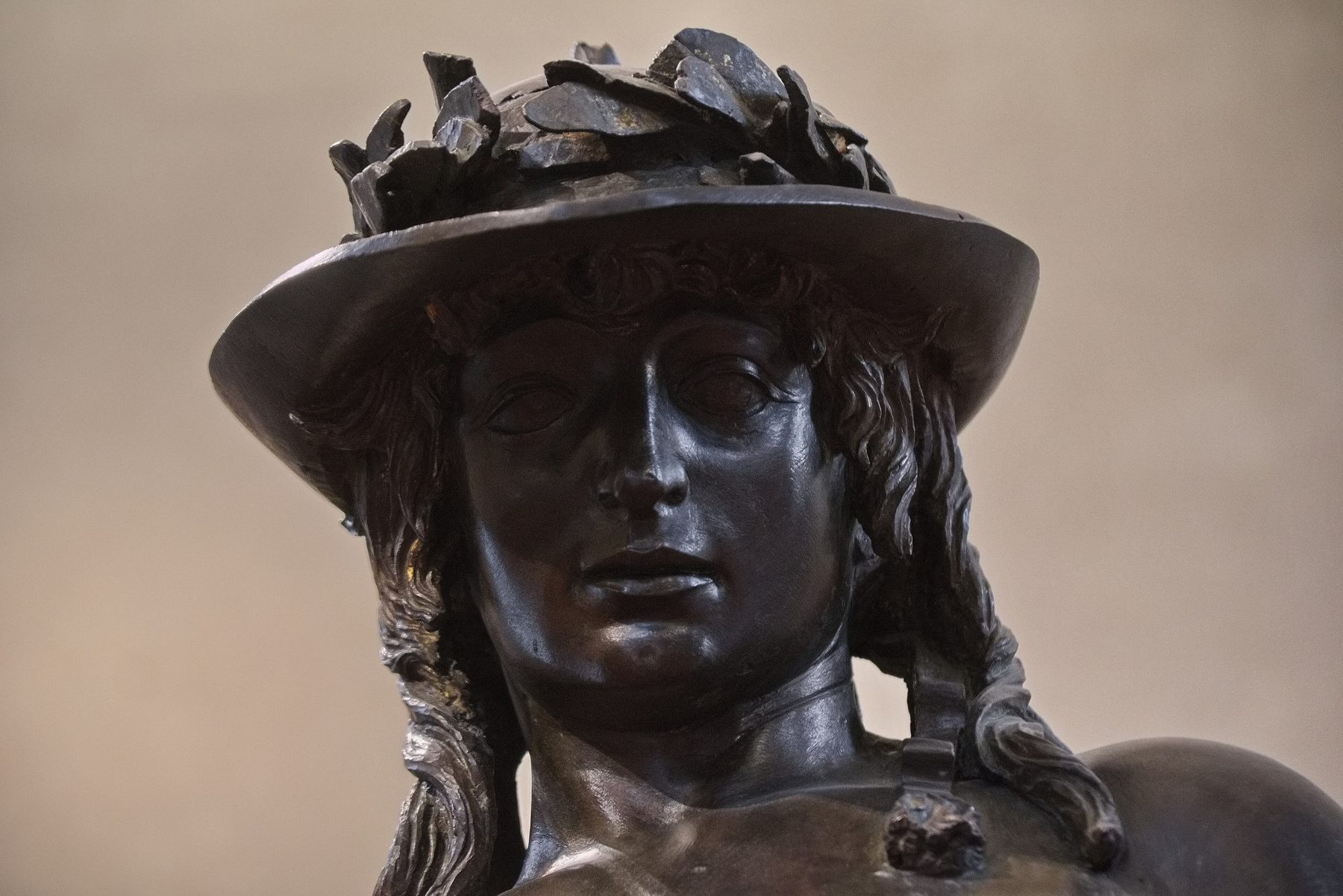
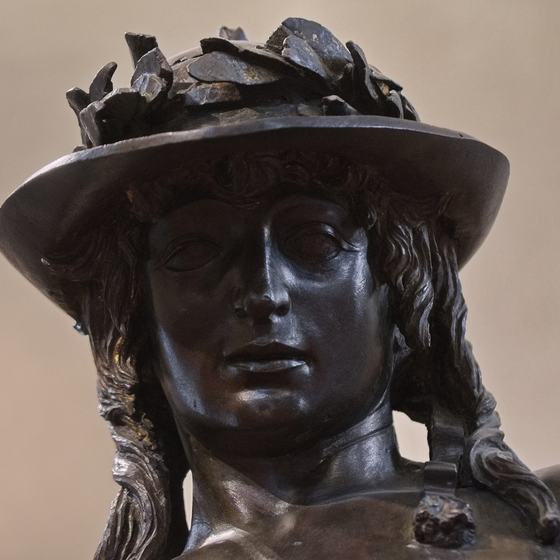
The bronze David changes the terms again. A youthful nude stands over Goliath's head in a pose at once relaxed, unstable, triumphant and enigmatic. It is usually identified as the first freestanding life-sized male nude made since antiquity, probably for a Medici setting. Classical form, biblical victory, Florentine identity and private elite display meet without resolving into one message.[24]
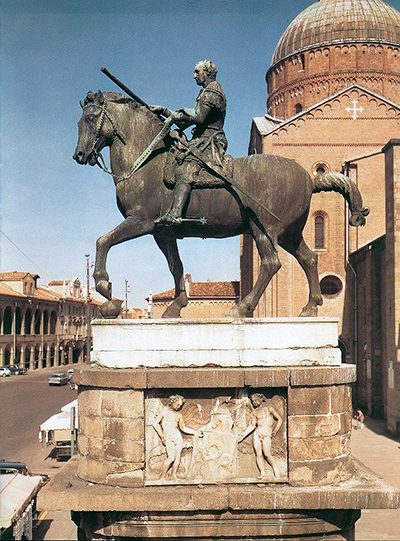
At Padua, the equestrian monument to the mercenary commander Erasmo da Narni, called Gattamelata, revived an ancient type for a contemporary Christian city. Horse and rider dominate the square beside the Basilica of Saint Anthony. The commander does not depend on frantic action; control is expressed through scale, rhythm and contained force. Donatello's decade in Padua carried new approaches to bronze, relief and bodily expression into northern Italy, where artists including Mantegna responded to them.[4] [22]
Donatello could also reject ideal beauty. His wooden Penitent Magdalene turns the body into a record of age, deprivation and spiritual intensity. His late reliefs roughen surfaces and destabilise space. Such works complicate the belief that Renaissance naturalism always moved towards calm classical perfection. His range across marble, bronze, wood, terracotta and stucco shows that materials were active forms of thought. Bronze allowed costly casting, multiplication and gleaming detail, but required assistants, founders and technical knowledge. The “master's hand” was embedded in collective labour.[23] [24]
Devotion and experiment: Fra Angelico, Uccello and Lippi
The phrase “scientific perspective” can make religious painters sound as if they stood outside the period's central innovations. Fra Angelico proves the opposite. A Dominican friar as well as a celebrated painter, he worked for religious houses and powerful patrons in panel, fresco and manuscript. His art uses clear architecture, measured intervals, light and colour to make contemplation possible.[12] [14]
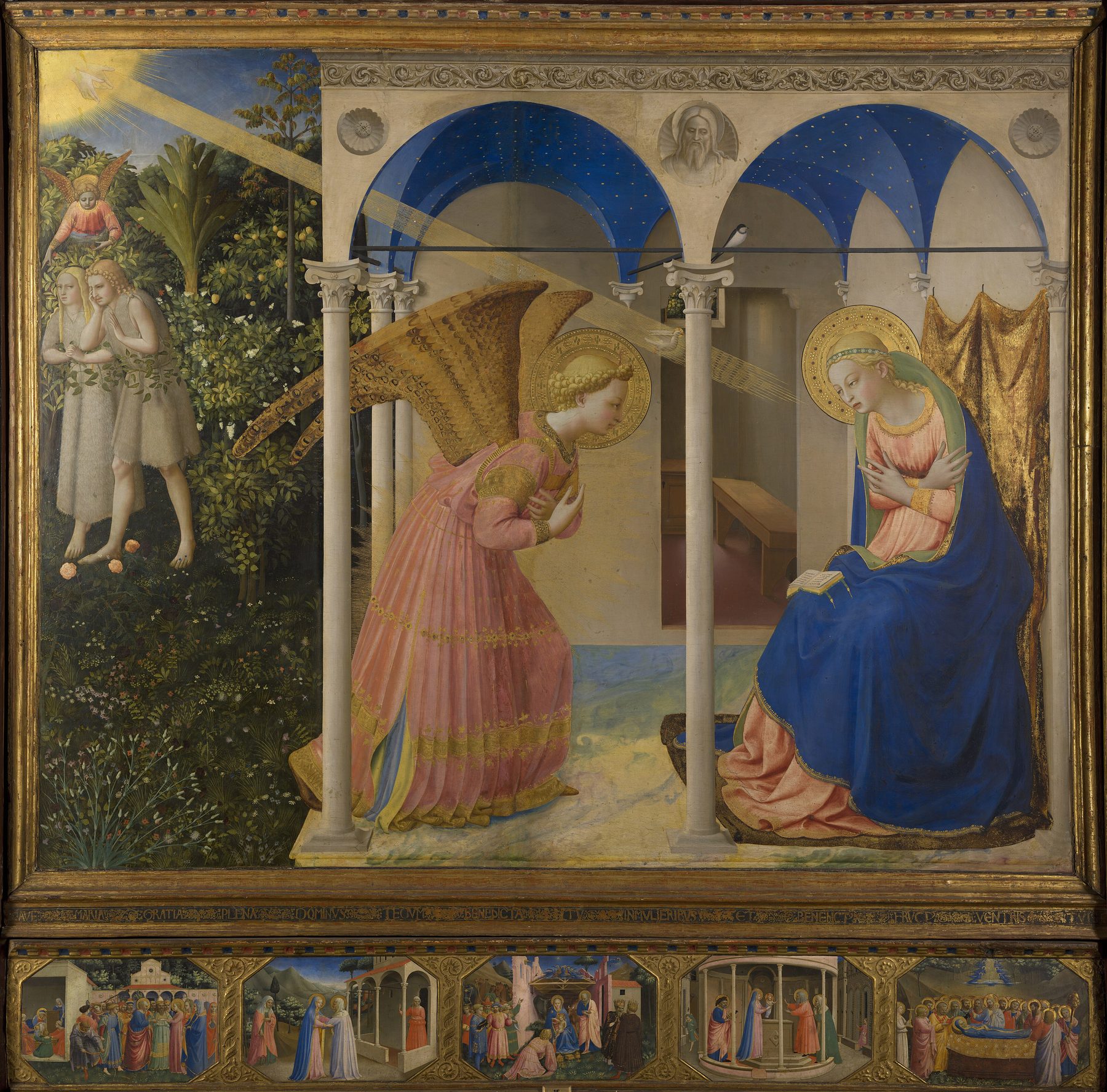
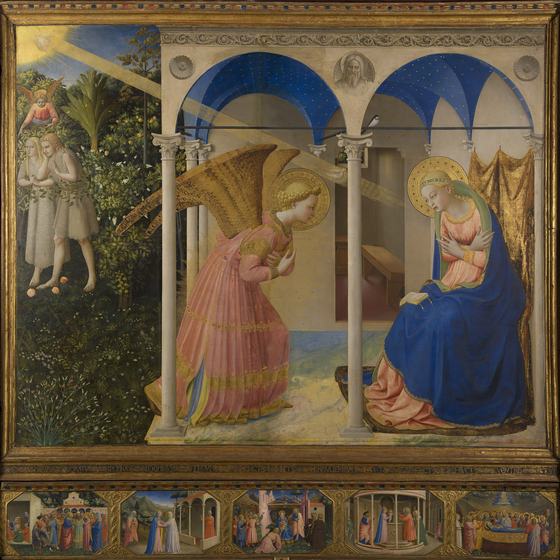
The Prado Annunciation, made in the mid-1420s for the Dominican convent of San Domenico at Fiesole, sets Gabriel and the Virgin beneath a receding arcade. The garden and the distant expulsion of Adam and Eve connect the Incarnation to humanity's fall and salvation. Gold survives within a newly coherent rectangular structure. Restoration has made clearer how precisely the materials and perspective support the work's theological sequence. Innovation and tradition are not competing layers; together they guide reading.[11] [13]
At San Marco in Florence, Fra Angelico and his assistants created frescoes for communal rooms, corridors and friars' cells. Their restraint makes sense within use. A cell image did not need to display all the resources of a public altarpiece. Sparse settings, pauses and gestures allowed prolonged meditation. The modern habit of calling the painter simply sweet or saintly can obscure his intelligence about site and viewers. Equally, treating the frescoes only as exercises in light and space empties them of their Dominican purpose.
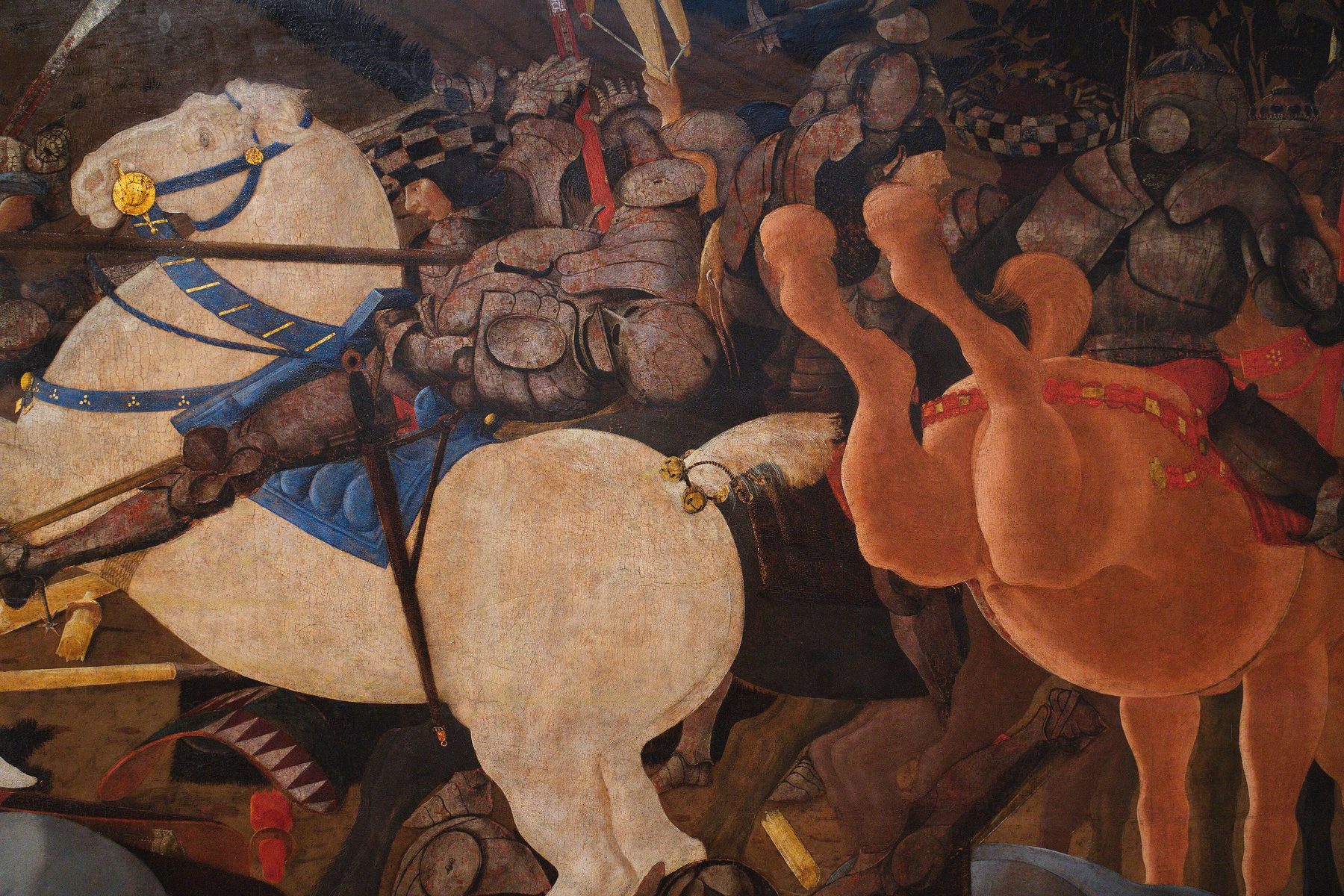
Paolo Uccello offers another kind of complexity. In the London panel from the Battle of San Romano, fallen weapons, lances and bodies organise the foreground while charging horsemen compress the action. The broken lance near the lower edge points towards recession, yet the panel does not behave like a transparent window. Gold and silver once flashed across armour and harness; hedges and distant activity form decorative bands; different spatial cues do not settle into one system. Perspective and splendour work together.[15] [16]
The story of the panels' ownership also corrects a common assumption. They were probably commissioned by the Salimbeni family rather than the Medici. Lorenzo de' Medici later obtained them through pressure and litigation. Their eventual place in a Medici palace helped rewrite them as Medici images. Patronage history can therefore alter interpretation long after an object is made.[15]
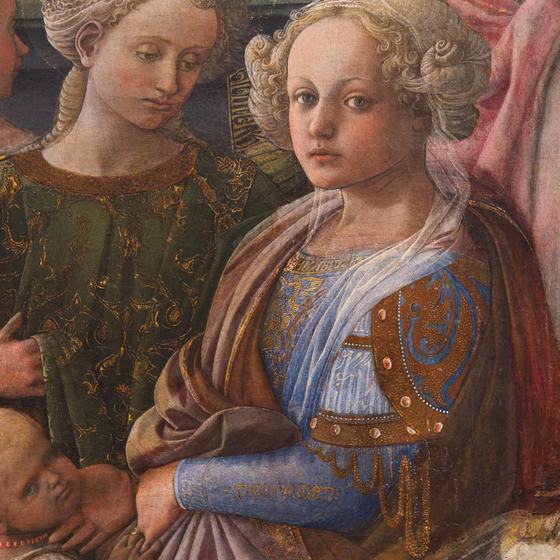
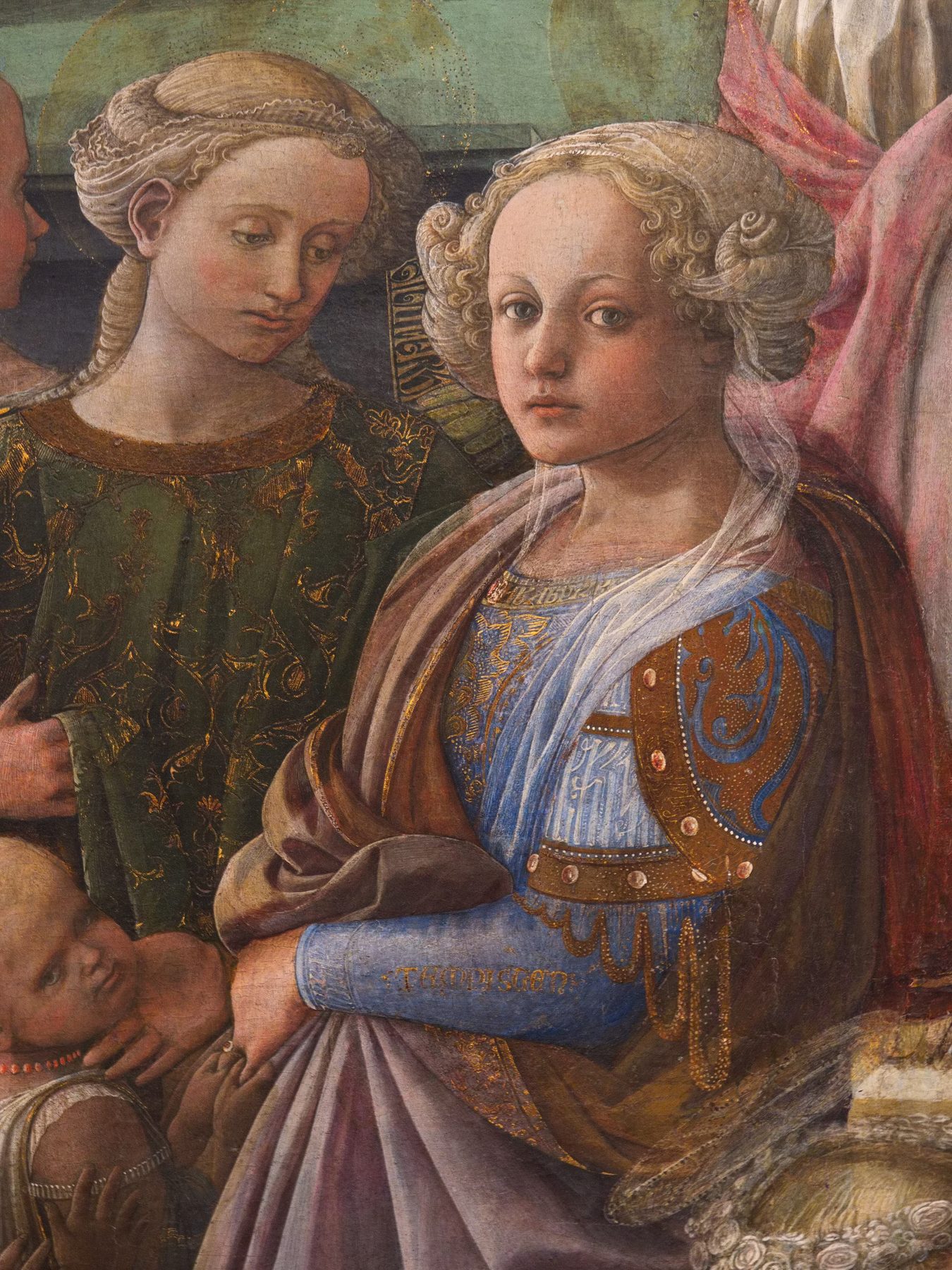
Filippo Lippi brought sacred figures closer to contemporary domestic life. In the Uffizi Madonna and Child with Two Angels, the Virgin appears as an elegantly dressed young woman before a window and landscape. One angel turns outward with a smile, acknowledging the viewer as he lifts the Child. Halos are delicate, bodies overlap convincingly and tenderness is edged by foreknowledge of sacrifice. The work became influential for Lippi's pupil Botticelli.[18]
Lippi's Coronation of the Virgin for the convent of the Murate shows why the commissioning institution must be restored to the story. The Benedictine nuns agreed an expensive contract in 1439, and named assistants participated. The large panel was designed to be seen from the women's elevated choir, which helps explain its tiers, rising structure and concentration of figures. The nuns were neither invisible recipients nor passive subjects: their resources, worship and sightline formed the work.[17]
These three painters resist a single definition of progress. Fra Angelico used measured space to intensify devotion. Uccello made geometry glitter. Lippi turned holy encounter into intimate social presence. Each selected from new and inherited possibilities according to function.
Workshops, materials and the people behind the art
Renaissance fame encourages us to imagine independent personalities signing finished masterpieces. The normal place of artistic formation was the workshop. A boy entered as an apprentice, prepared materials, copied drawings, learned to model, paint or carve, and advanced through repeated tasks. Guild membership shaped legal standing and professional practice. Florentine painters belonged to the guild of doctors and apothecaries because pigments were connected with traded substances; sculptors were associated with guilds governing stone, wood or metal. Workshops negotiated contracts, employed assistants and subcontracted specialists.[25]
A commission associated with a master could contain many hands. The master's responsibility might lie in design, important passages, supervision and delivery rather than every visible mark. Large fresco cycles almost required teams. Bronze casting depended on founders. Panel painting began with carpentry and gesso before drawing, gilding and layers of colour. Architecture required administrators, masons, quarry workers, carpenters, metalworkers and machine operators. Recognising those people does not diminish invention. It explains how invention became physical.
Materials also unsettle a simple chronology. Egg tempera dried quickly and encouraged crisp modelling and layered colour. Gold could create divine radiance, material value or courtly spectacle. Oil paint offered extended working time, transparency and particular effects of light, but Italian painters did not switch from tempera to oil on a single date. Scientific analysis finds egg, oil and mixtures within fifteenth-century works. Medium was a practical and expressive choice, shaped by training, cost, availability and desired effect.[42]
The arrival of Hugo van der Goes's Portinari Triptych in Florence in 1483 made those choices newly visible. Commissioned in Bruges by the Florentine banker Tommaso Portinari for the hospital church of Sant'Egidio, the enormous oil-painted altarpiece joined sharp individual likeness, atmospheric landscape, brilliant surfaces and minute still-life detail. Florentine artists studied it closely. The episode was not Europe receiving Italian innovation; it was Florence learning from a work made in the Netherlands through a merchant who lived between both worlds.[40] [41]
Workshops crossed media more often than modern museum departments suggest. Andrea del Verrocchio trained as a goldsmith and became a sculptor, painter and designer at the centre of a remarkably productive shop. Leonardo, Perugino, Lorenzo di Credi and others passed through or were connected with it. A complex painting might grow from shared drawings and differentiated expertise; a sculptural commission could mobilise modelling, casting and finishing. Verrocchio's importance lies partly in individual works and partly in the workshop as a machine for transmitting problems from one generation and medium to another.[32]
Books belonged to the same visual world. Illuminators developed regional styles in Florence, Ferrara, Lombardy, Rome and elsewhere. Choir books had to be legible at a distance; small devotional books encouraged intimate looking; humanist manuscripts joined ancient texts to carefully designed scripts and borders. Nuns and laywomen could participate in bookmaking even when professional institutions restricted access to other fields. Illumination was not a medieval residue waiting to disappear. It flourished beside fresco and panel painting.[27]
Women as patrons, viewers and makers
Women appear throughout Early Renaissance art, but presence is not the same as power. The Virgin, female saints, classical goddesses, brides and donor wives occupy central images. Their forms were usually produced within male-run workshops and interpreted through religious, familial or erotic expectations. A more complete history asks not only who is represented, but who commissioned, paid, prayed, looked and worked.
Convents were major institutions. Communities of women held property, maintained chapels, commissioned objects and organised worship, though their autonomy varied and was supervised by church and family structures. The Murate commission from Lippi gives unusually concrete evidence: the nuns contracted a leading painter, committed substantial funds and occupied a viewing position for which the altarpiece was designed. Other women ordered domestic images, textiles, books and memorial works through family resources.[17] [26]
Portraiture makes social constraint visible. In Florentine female portraits, clothing, jewellery, hairstyle and pose could communicate marriage, dowry, family honour and ideals of modest beauty. The profile format made a sitter resemble a medal while controlling direct engagement with the viewer. Later three-quarter views increased psychological presence, but no portrait should automatically be read as the discovery of an autonomous modern self. Likeness was shaped by virtue, rank, politics and commemoration.[44] [45]
Women also made art, particularly in religious communities where manuscript illumination and textile work were possible. Evidence is uneven because names were less often recorded and objects were later dispersed or reattributed. It would be false to claim that the Renaissance opened professional equality; guild training, household expectations and legal structures sharply limited careers. It is equally false to describe art as a conversation only among men. Women's institutions, labour and patterns of use were part of the conditions in which objects acquired meaning.[26] [27]
Beyond Florence: Piero, the courts, Padua and Venice
The Italian peninsula was divided among republics, duchies, marquisates, papal territories and the kingdom of Naples. Artists travelled because rulers, churches and cities competed for skill. Regional difference was not a delay in receiving Florentine ideas. It was one of the period's engines.[3] [4]
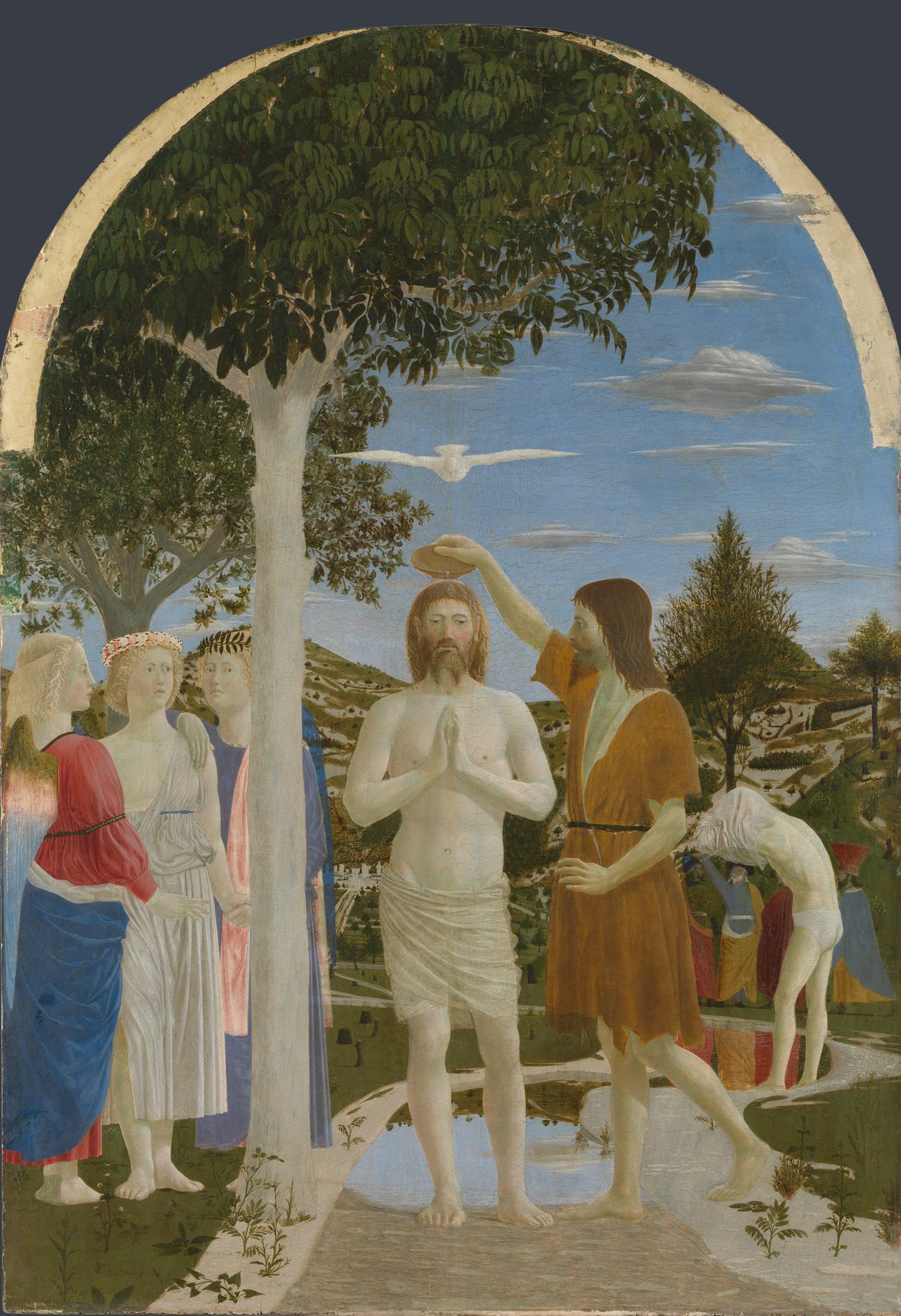
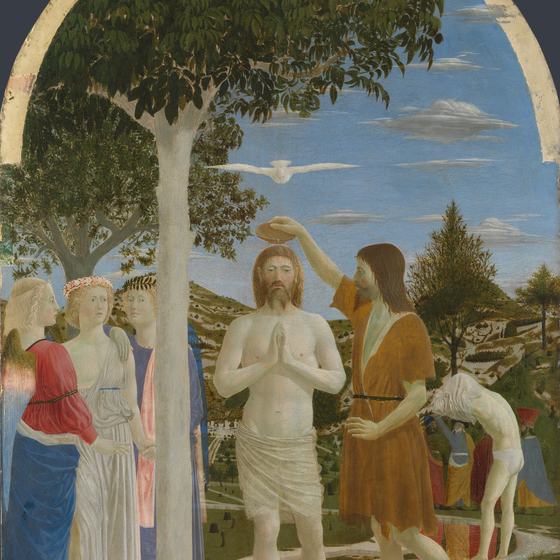
Piero della Francesca was born in Borgo Sansepolcro and worked across central Italy. His Baptism of Christ sets a sacred event within a landscape that evokes the artist's home territory. Figures and trees create a measured calm, reflections and pale colours hold the surface together, and geometry seems inseparable from stillness. Piero later wrote the first known perspective treatise by a practising artist, yet his painting is not a diagram. Mathematical relation supports contemplation, local identity and mystery.[36]
At Urbino, Federico da Montefeltro assembled humanists, architects and artists in a court that fashioned military authority as learned rule. The palace and its studiolo joined books, portraits, illusionistic intarsia and emblems. In the Gubbio studiolo, cupboards, instruments and books appear to project and recede although they are made from fitted pieces of wood. Federico owned Piero's perspective treatise. Geometry here became an image of ordered knowledge and princely self-command, available to a very restricted audience.[37]
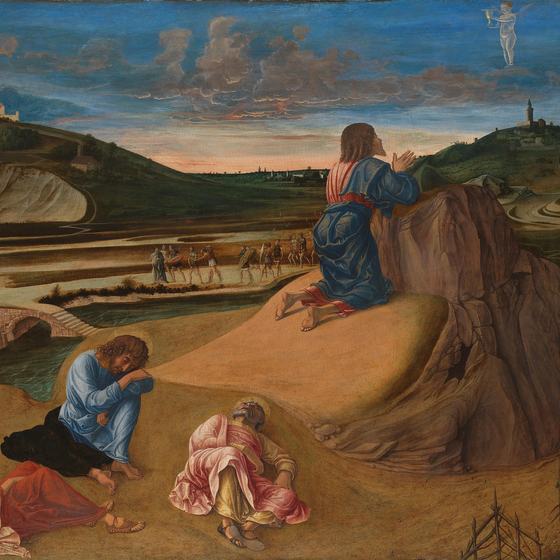
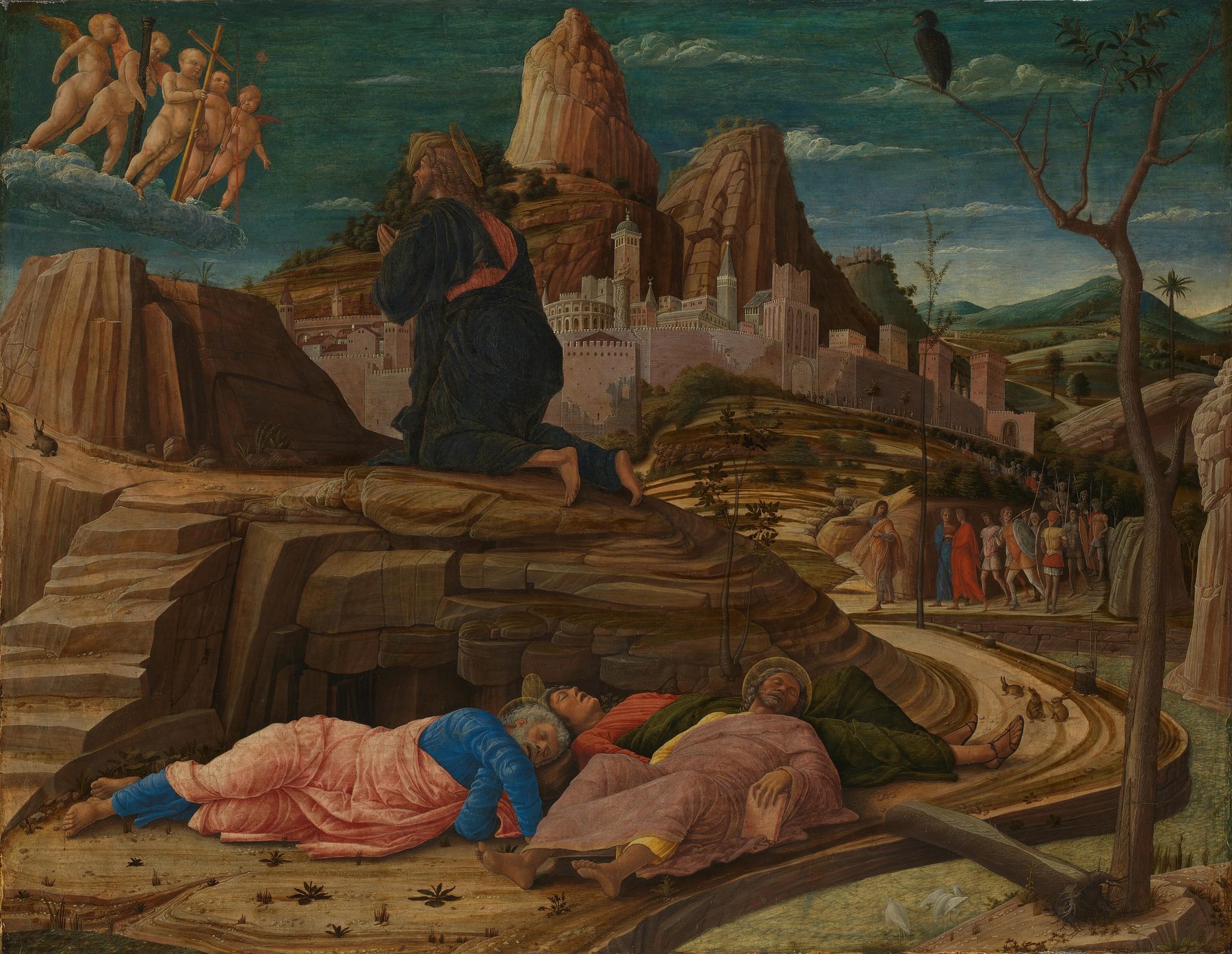
Padua offered another concentration of learning, antiquity and artistic exchange. Donatello worked there for about a decade. Andrea Mantegna studied ancient inscriptions, sculpture and architecture with an intensity that made his painted worlds feel excavated as much as invented. His Agony in the Garden places Christ and the sleeping apostles in a hard, sharply articulated landscape. The disciples' foreshortened bodies, the distant city and a small sculptural horse-and-rider all connect visual experiment with antiquarian knowledge and Donatello's Gattamelata.[38]
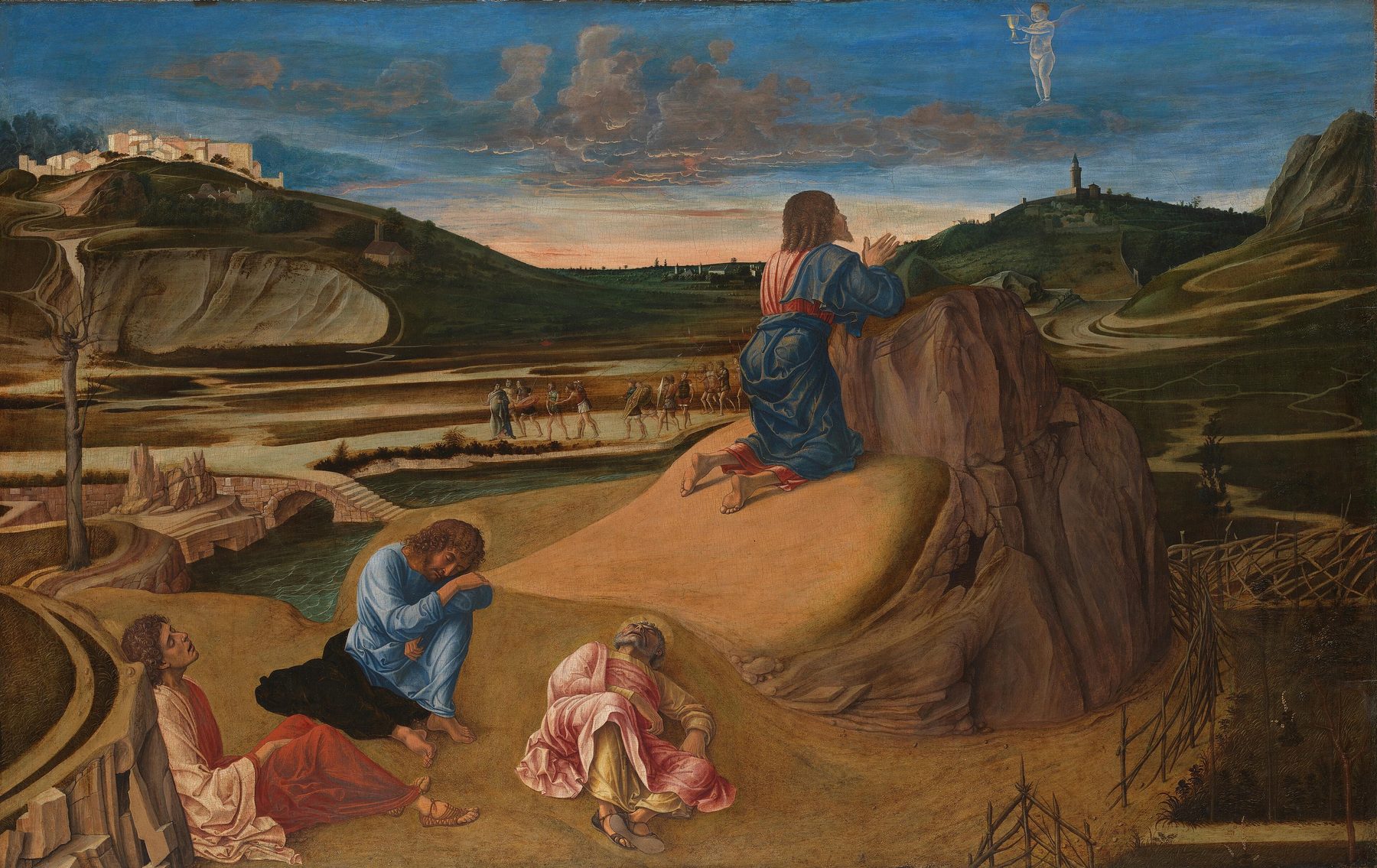
Mantegna married into the Bellini family, making artistic exchange personal as well as professional. Giovanni Bellini developed his own Agony in the Garden from a closely related design. Its atmosphere is transformed by dawn light, distant air and a landscape that seems to carry the emotional transition towards arrest and sacrifice. The comparison shows why regional art cannot be arranged as a league table. Mantegna's sculptural severity and Bellini's light are distinct answers to a shared problem.[38] [39]
Venice's maritime trade, political institutions and ceremonial culture supported a different visual environment. Mosaic, eastern Mediterranean objects and local traditions remained visible while oil painting became increasingly important. Bellini's sacred figures gain presence through luminous colour and atmosphere rather than Florentine disegno alone. Venetian painters did not reject perspective, but space could be organised through light, colour and landscape as much as through drawn architecture.[2] [4]
Ferrara, Mantua, Urbino and Naples likewise used art to shape court identity. Rulers commissioned medals, portraits, palaces, chapels, manuscripts, ephemeral festival designs and images of ancestry. Artists moved among these centres and Rome, carrying techniques while adapting to different ceremonial and political needs. The map of the Early Renaissance is therefore a network of journeys rather than concentric circles around Florence.
Botticelli, Verrocchio and Ghirlandaio
By the later fifteenth century, Florentine art had not converged on one mature solution. The workshops of Botticelli, Verrocchio and Ghirlandaio demonstrate expanding possibilities in myth, sacred intimacy, portraiture, narrative and collaborative practice.
Sandro Botticelli trained with Filippo Lippi and may also have worked in relation to Verrocchio's shop. His early Madonna della Loggia renews an inherited half-length devotional image through delicate contour, landscape and an intimacy learned partly from Lippi. The work already shows how traditions described as Byzantine, Flemish and Florentine could coexist within a small object for private prayer.[31]
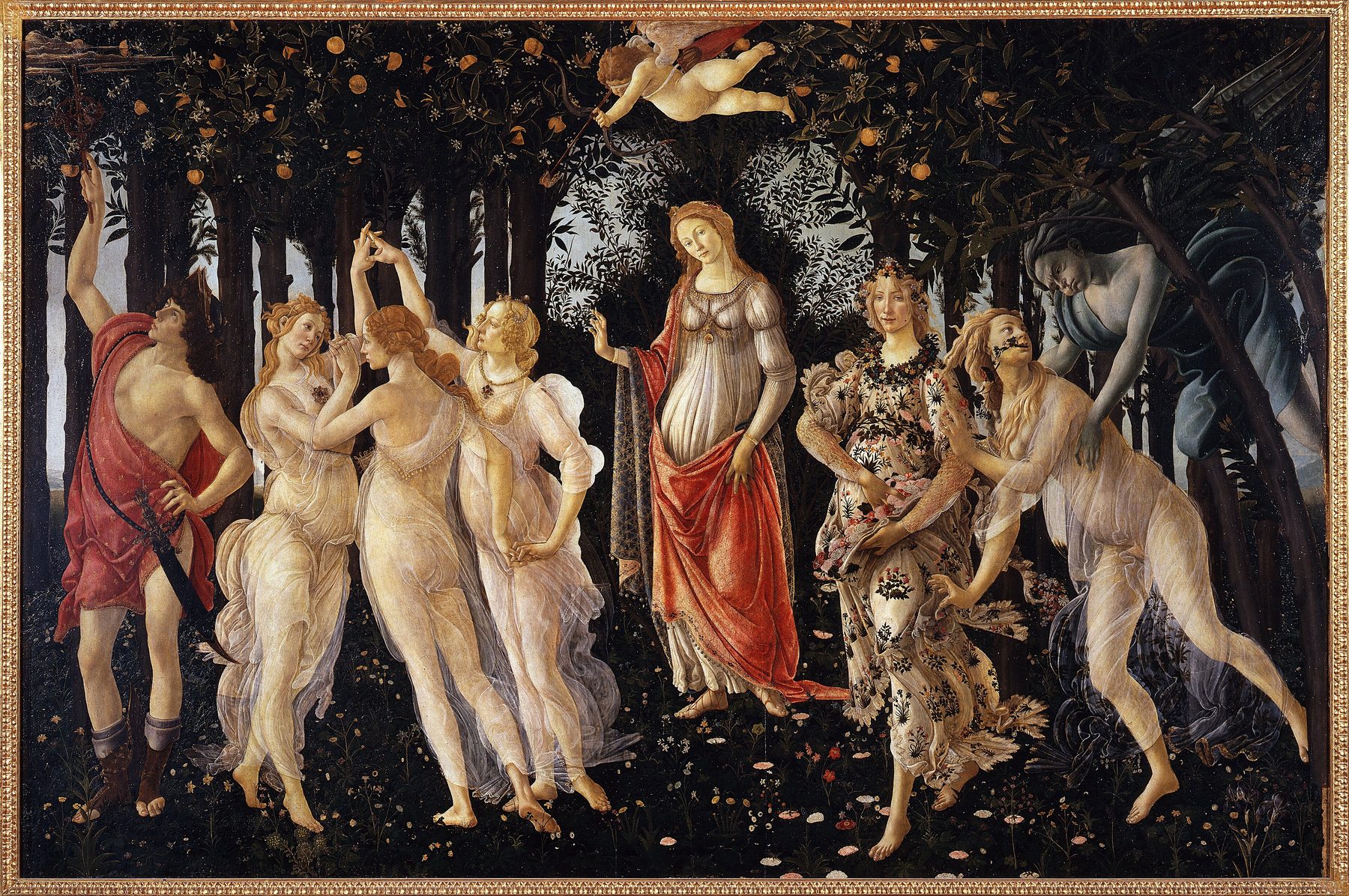
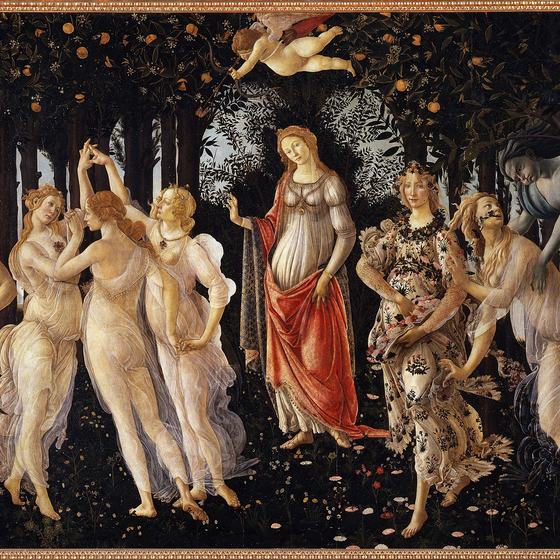
The Primavera, painted about 1480, gathers nine classical figures in an orange grove. Zephyr pursues Chloris, who becomes Flora; Venus occupies the centre; the Three Graces dance while Mercury turns towards the clouds. Poetry, marriage, fertility, philosophy and Medici culture have all been used to interpret the scene. Some connections are persuasive, but no surviving document fixes one complete design. Its meaning also resides in what interpretation cannot flatten: the alternation of pursuit and dance, the almost weightless feet, the dark grove, the abundance of plants and the controlling rhythm of line.[29]
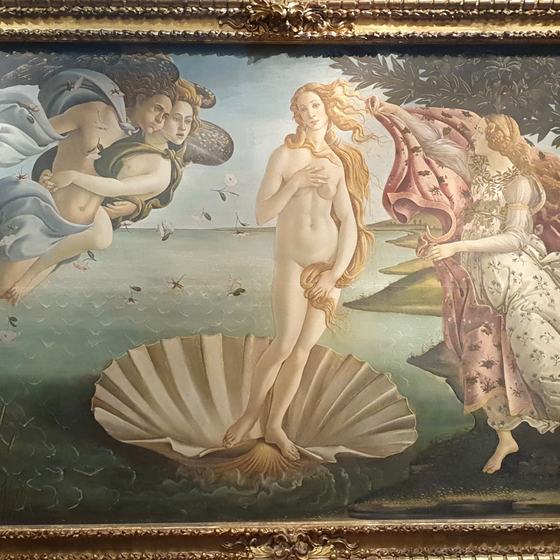
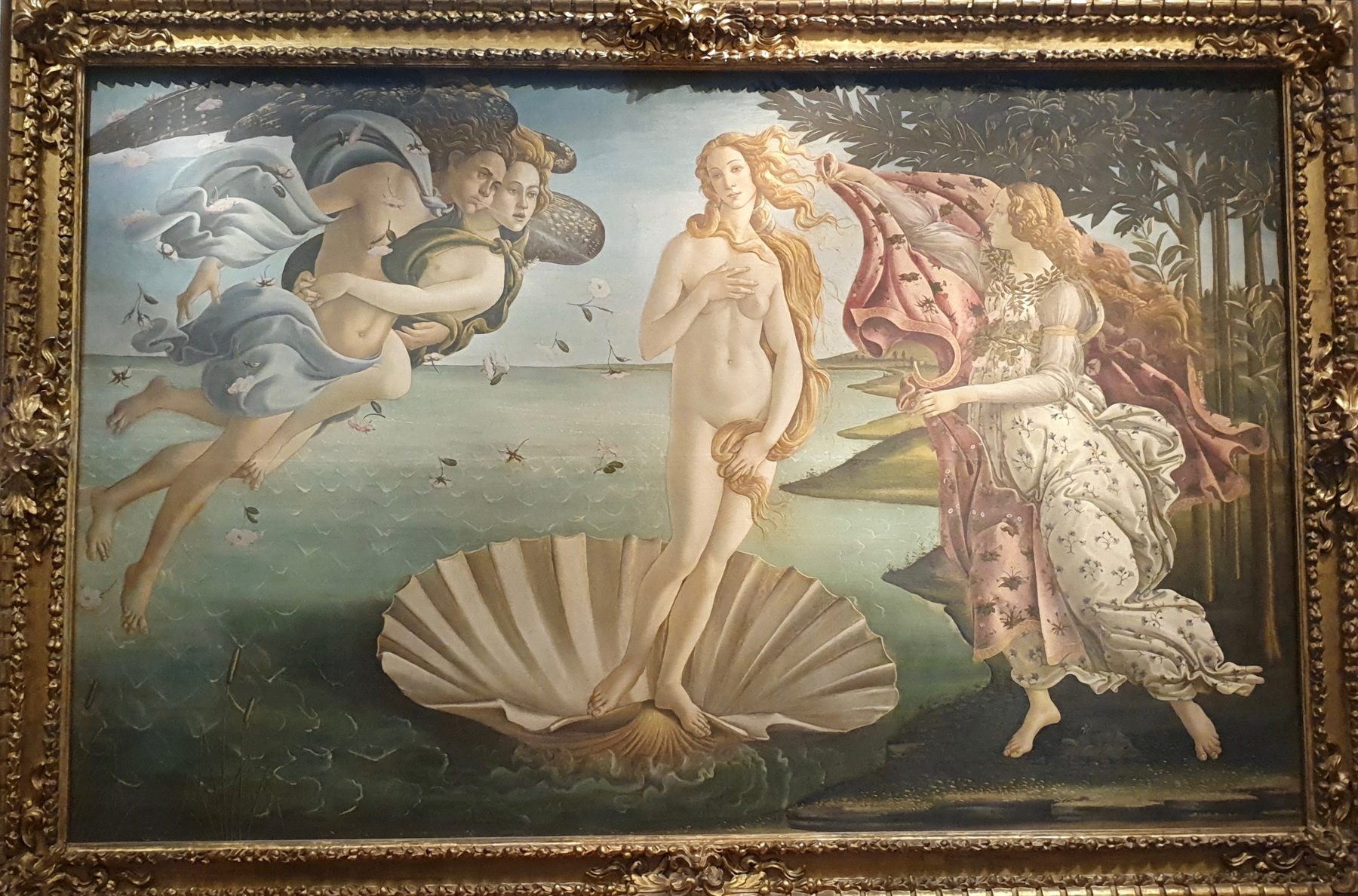
The Birth of Venus, made around 1485, does not actually show the goddess being born. She has arrived offshore and is carried towards land, where a figure waits with a flowered covering. The large canvas was suited to a domestic rather than ecclesiastical setting and permitted a different kind of handling from a panel. Botticelli used gold in hair, foliage and light, combining material preciousness with a dreamlike shore. The Medici association is probable but not fully documented at the moment of commission. Classical sculpture and poetry matter, yet the picture's strangeness should not be reduced to an encrypted philosophy lesson.[30]
Verrocchio's shop stood close to the century's next transformations. His sculptures demonstrate alert surface, movement and technical command, while paintings connected with the workshop show design passing among assistants. Leonardo's early career emerged from this environment. The shop was both a place and a method: drawings, models and shared problems circulated across painting, sculpture and metalwork.[32]
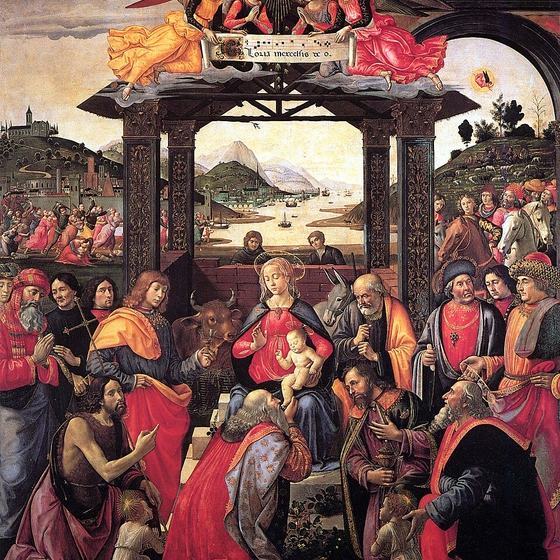
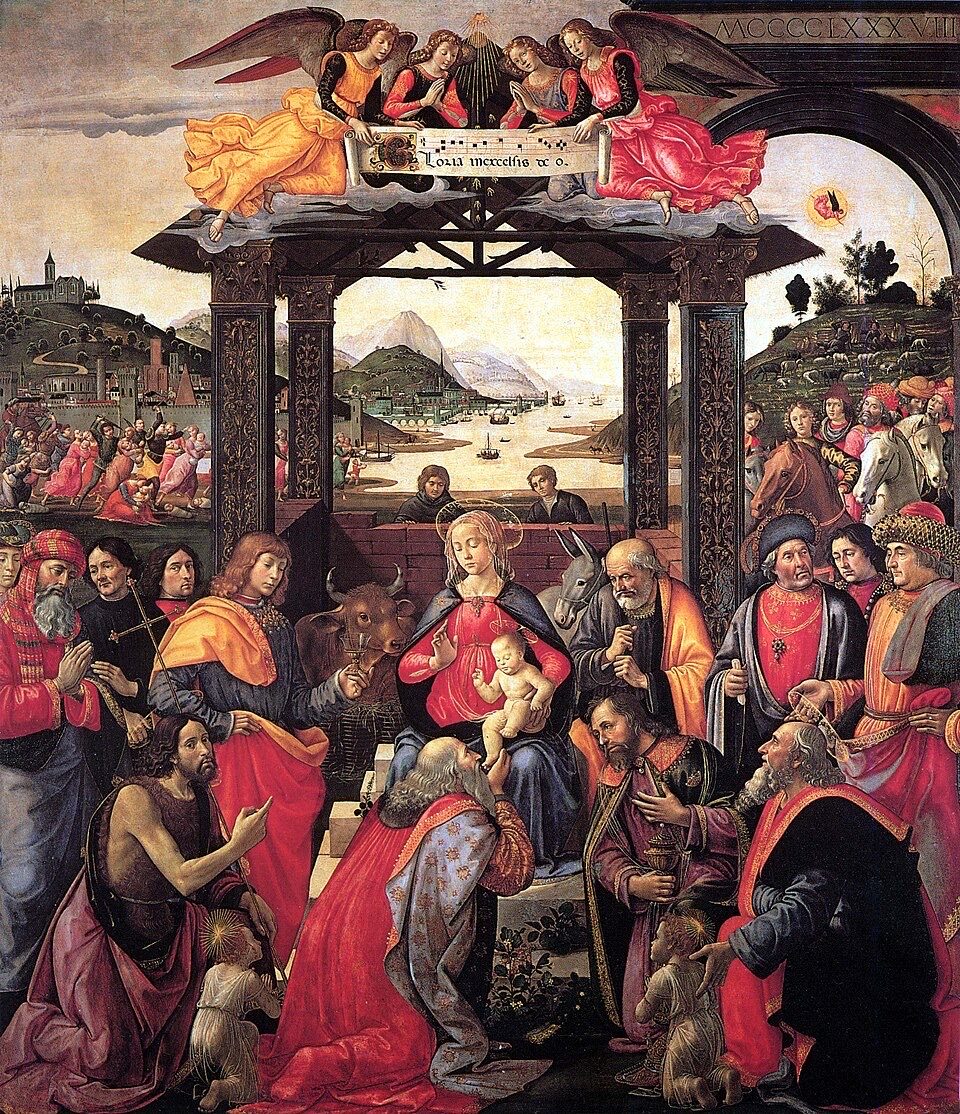
Domenico Ghirlandaio became one of Florence's most successful narrative fresco painters. In 1485 Giovanni Tornabuoni secured patronage of the main chapel at Santa Maria Novella and commissioned a cycle of the lives of the Virgin and Saint John the Baptist. Ghirlandaio's brothers, assistants and the young Michelangelo participated in the extensive work. Sacred events appear within imposing Florentine interiors populated by recognisable members of the social elite. Portraiture makes contemporary status part of salvation history without turning the chapel into a mere society album.[33]
Ghirlandaio's panels likewise join Florentine drawing and perspective to detailed surfaces and northern light. Classical ruins can declare the supersession of the pagan world by Christianity; fashionable fabrics and individual faces bring the event into the patron's world. The influence of Netherlandish painting was not imitation from a distance. Works such as the Portinari Triptych were physically present in Florence, and trade had long carried pictures, pigments, textiles and people between regions.[34] [35] [40]
The 1490s brought political and religious crisis. The Medici were expelled in 1494, the Dominican preacher Girolamo Savonarola attacked luxury and moral corruption, and Florence became a contested republic. Botticelli's later religious pictures have often been explained through a dramatic conversion and the bonfires of vanities. His response to the period deserves serious attention, but the story that he simply destroyed his own art or abandoned beauty is more legend than secure fact. Late Early Renaissance culture did not end at one event; its workshops, objects and arguments continued into a changed world.
Artists to know
Masaccio
Masaccio gave painted bodies unusual gravity and used light and perspective to intensify sacred narrative. The Brancacci Chapel, the Trinity and the Pisa altarpiece made his short career a central reference for later Florentine painters. His works also teach caution: collaboration, dispersal and later completion complicate the image of an isolated founder.[9] [10]
Fra Angelico
Fra Angelico combined Dominican devotion with exact thought about light, colour, architecture and the pace of looking. His public altarpieces and restrained cell frescoes differ because their audiences and functions differed. He shows why spiritual use and formal intelligence should be interpreted together.[11] [12] [14]
Filippo Brunelleschi
Brunelleschi solved the inherited structural challenge of Florence Cathedral's dome and helped establish geometrically ordered pictorial space. His achievements are best understood with the institutions, labour and collaborators that realised them.[19] [20] [21]
Piero della Francesca
Piero made mathematics feel contemplative. His measured figures, lucid landscape and writing on perspective connect local place, court learning and sacred stillness without turning painting into pure calculation.[36] [37]
Sandro Botticelli
Botticelli's contour can animate sacred tenderness, classical desire and late religious urgency. The Primavera and Birth of Venus are icons of the period, but their disputed programmes are reminders that famous paintings do not always surrender one stable explanation.[29] [30] [31]
Further artists
Paolo Uccello
Uccello is celebrated for perspective, but his Battle of San Romano is equally concerned with precious material, pattern and chivalric spectacle. Multiple spatial cues make him more interesting than the later caricature of an eccentric obsessed with geometry.[15] [16]
Filippo Lippi
Lippi brought the Virgin and Child into close, emotionally legible relationships with contemporary faces, dress and landscape. His large institutional commissions reveal assistants and women patrons; his small Madonnas helped form Botticelli's early language.[17] [18]
Andrea del Verrocchio
Verrocchio joined sculpture, painting, metalwork and design in one of Florence's most influential workshops. His legacy includes both powerful objects and a training environment in which Leonardo and other artists learned to think across materials.[32]
Domenico Ghirlandaio
Ghirlandaio organised large narrative cycles whose clarity, portraiture, architecture and surface detail made sacred history socially immediate. The Tornabuoni Chapel is also a monument to workshop labour and patron self-fashioning.[33] [34] [35]
Leon Battista Alberti
Alberti joined humanist writing, architecture and art theory. His treatises gave painting, sculpture and architecture intellectual frameworks that could be studied, debated and transmitted, even though artists' practical discoveries were never reducible to his rules.[6] [7] [8]
Andrea Mantegna
Mantegna used archaeology, inscription, sculpture and audacious foreshortening to make antiquity forcefully present. His career connects Padua, Donatello, the Gonzaga court, print culture and the Bellini family.[4] [38]
Giovanni Bellini
Bellini made colour and natural light structural forces in Venetian painting. His exchanges with Mantegna show shared designs becoming different emotional worlds, while his long career carried Quattrocento experiment towards sixteenth-century Venetian art.[4] [39]
Major artists directory
| Name | Nationality | Key Works |
|---|---|---|
| Andrea del Verrocchio | Italian | David, The Baptism of Christ |
| Andrea Mantegna | Italian | The Agony in the Garden, Camera degli Sposi |
| Domenico Ghirlandaio | Italian | Adoration of the Magi, Tornabuoni Chapel |
| Donatello | Italian | David, Gattamelata |
| Filippo Brunelleschi | Italian | Florence Cathedral Dome, Ospedale degli Innocenti |
| Filippo Lippi | Italian | Coronation of the Virgin, Madonna and Child with Two Angels |
| Fra Angelico | Italian | The Annunciation, San Marco frescoes |
| Giovanni Bellini | Italian | The Agony in the Garden, San Giobbe Altarpiece |
| Leon Battista Alberti | Italian | Palazzo Rucellai, Santa Maria Novella façade |
| Masaccio | Italian | The Trinity, Pisa Altarpiece |
| Paolo Uccello | Italian | The Battle of San Romano, The Hunt in the Forest |
| Piero della Francesca | Italian | The Baptism of Christ, The Flagellation |
| Sandro Botticelli | Italian | Primavera, The Birth of Venus |
How to look at Early Renaissance art
Begin with the original site
Before judging naturalism, imagine where the work stood. Was it high on an altar, inside a private room, on a street, above a tomb or in a friar's cell? A steep viewpoint, strong silhouette or simplified background may answer distance and ritual rather than technical inability. The Murate altarpiece becomes more intelligible when reconstructed for the nuns' elevated choir; Masaccio's throne responds to the height of the Pisa altarpiece.[10] [17]
Notice what is inherited
Look for gold, pointed formats, halos, hierarchies of scale and familiar gestures. Do not classify them automatically as old-fashioned parts. Ask what they contribute: radiance, sacred distinction, material value, memory or legibility. Then observe how they meet receding architecture, cast shadow, bodily volume or landscape. The Early Renaissance often happens inside that meeting.
Test the space
Follow tiled floors, cornices, lances and buildings. Do they converge at one point? Are there several systems? Where would the ideal viewer stand? What refuses to recede? In Uccello, geometry and flat splendour compete. In Masaccio, architecture makes doctrine spatial. In Piero, proportion creates stillness. Perspective is a means, not a score awarded for correctness.[7] [9] [16]
Attend to material
Gold changes as you move; tempera can produce precise layers and sharp edges; oil can suspend colour and light; fresco binds pigment to wall; bronze carries weight, reflection and expense; shallow relief turns shadow into drawing. A reproduction equalises these differences. Ask how surface, scale and fabrication shaped the first encounter.[24] [42]
Find the patron without assuming one patron controls everything
Coats of arms, family saints, portraits, inscriptions and architectural ownership may identify a commissioner. Yet objects can change hands and meanings. The San Romano paintings moved into Medici possession after their making. The Portinari Triptych joined a Florentine hospital to a banker in Bruges. Patronage is a history of relationships, not simply a label.[15] [40]
Look for the workshop
Changes in quality or handling need not be failures. They may record assistants, stages of work, later completion or restoration. Large cycles and bronzes were collective achievements. Consider design separately from execution and ask how knowledge travelled through drawings, models and repeated figures.[25] [32] [33]
Read portraits socially
A face may resemble a person, but clothing, pose and setting also construct virtue, rank, marriage and memory. Compare male and female formats. Notice who looks outward, who is allowed movement and who appears beside a spouse or patron saint. Renaissance individuality was real, but it was formed through social relations.[44] [45]
Let uncertainty remain
The desire to decode Botticelli's mythologies or identify every face can produce false confidence. Distinguish documented patronage from later tradition, and a plausible association from a fixed meaning. A work can be carefully organised and still invite several interpretations.
Legacy
The fifteenth century supplied later artists with an enlarged field of action. Perspective could organise enormous narratives and intimate rooms. Drawing and modelling supported increasingly complex bodies. Workshops transmitted designs across cities and media. Ancient sculpture and architecture became resources for new Christian, civic and courtly statements. Portraits, prints and portable objects extended artistic presence across distance.
Leonardo emerged from Verrocchio's workshop and transformed its habits of observation, modelling and experiment. Michelangelo studied the Florentine monuments of Masaccio, Donatello, Ghirlandaio and others while developing his own account of the heroic body. Raphael absorbed central Italian perspective, court culture and devotional clarity. Their achievements would be impossible without the problems established before them.[22] [32]
But legacy should not turn the Early Renaissance into a rehearsal. Fra Angelico's cell frescoes, Uccello's metallic battles, Lippi's convent altarpiece, Piero's local stillness and Bellini's dawn light answer historical needs that later grandeur does not supersede. The period's value lies in its plurality: old and new, sacred and civic, local and imported, mathematical and material remain visibly in conversation.
Frequently Asked Questions
It is usually placed in the fifteenth century, roughly from about 1400 to the 1490s. The boundaries vary by region and medium. Quattrocento is the Italian term for the 1400s and often overlaps the same field, while some accounts begin from fourteenth-century groundwork or extend individual careers into the early sixteenth century.[1] [3] [4]
No. Florence was exceptionally important because of its institutions, wealth, workshops and public commissions, but Siena, Urbino, Padua, Mantua, Ferrara, Venice, Rome and Naples developed distinct cultures. Artists and objects travelled among them, so the period is best understood as an Italian network with wider European connections.[3] [4] [22]
No. Artists renewed interest in ancient culture, but they continued Christian subjects, inherited image types, Gothic forms, gold and workshop traditions. Many of the period's most original works combine new spatial or bodily effects with older materials and functions. “Rebirth” is useful only if it does not erase that continuity.[5] [28] [43]
Humanism expanded access to classical texts, rhetoric, history and ethical debate. It encouraged new subjects and ways of thinking about fame, civic virtue, the body and the artist's intellectual role. It did not simply make art secular: humanists served religious and political institutions, and classical forms often supported Christian meanings.[3] [5] [8]
He is associated with decisive lost demonstrations, while Alberti supplied the earliest surviving coherent written construction in 1435–36. Artists had already explored convincing space, and mathematical perspective was one convention among several. It did not reproduce vision exactly or become compulsory.[6] [7]
No. The Medici were powerful patrons and political brokers, but guilds, churches, convents, confraternities, hospitals, civic bodies and other families commissioned major works. Uccello's Battle of San Romano panels, for example, probably began with the Salimbeni and entered Medici possession later.[2] [15] [25]
Yes, but within unequal conditions. Women and convents commissioned and used images; nuns could work on illuminated books and other objects; women sat for portraits and shaped domestic devotional culture. Guild access and professional independence were limited, and many makers' names were not recorded.[17] [26] [27] [45]
Look for the interaction of inherited sacred forms with new attention to space, bodily volume, landscape, antiquity and contemporary social presence. These features do not always appear together. A glittering courtly battle, a restrained convent fresco and a luminous Venetian landscape can all belong to the period.[11] [15] [39]
There was no instant change. Leonardo, Michelangelo, Raphael and their patrons inherited workshop training, perspective, classical study, public competition and approaches to the body developed across the fifteenth century. Political change, travel and ambitious commissions then recombined those resources. The later period grows from the earlier one, but does not complete or invalidate it.[22] [32]
Discussion
Does the idea of a “rebirth” help you see what is distinctive about fifteenth-century Italian art, or does it hide too much continuity with medieval culture and too much difference between Florence, Venice and the courts? Choose one work on this page and consider what changes when you begin with its site, patron and material rather than its place in a story of progress.
Reader Insights
Begin with the altar, street, tomb, palace or religious cell for which the object was made.
Notice how gold, Gothic form and devotional types remain active beside perspective and classical study.
Look for the patron, workshop, material specialists and travelling designs behind the named master.
Join the Conversation
Does “rebirth” clarify fifteenth-century Italian art, or hide too much continuity and regional difference? Share your view below.
References
- Italian Renaissance, National Gallery of Art. View Source
- European Renaissance Art teaching packet, National Gallery of Art. View Source
- Florence and Central Italy, 1400–1600 chronology, Metropolitan Museum of Art. View Source
- Venice and Northern Italy, 1400–1600 chronology, Metropolitan Museum of Art. View Source
- Stories of Art 1400–1500, National Gallery. View Source
- Early Renaissance Narrative Painting in Italy, Metropolitan Museum of Art. View Source
- Papers on the Rationalization of Sight, Metropolitan Museum of Art. View Source
- Leon Battista Alberti, Self-Portrait, National Gallery of Art. View Source
- The Magic and Illusion of Masaccio's Trinity, National Gallery of Art. View Source
- Masaccio, The Virgin and Child, National Gallery. View Source
- The restoration of Fra Angelico's Annunciation, Museo Nacional del Prado. View Source
- Fra Angelico and the Rise of the Florentine Renaissance, Museo Nacional del Prado. View Source
- La Anunciación, Fra Angelico, Museo Nacional del Prado. View Source
- Fra Angelico, Metropolitan Museum of Art. View Source
- Paolo Uccello, The Battle of San Romano, National Gallery. View Source
- The Battle of San Romano catalogue entry, National Gallery. View Source
- Filippo Lippi, Coronation of the Virgin, Uffizi Galleries. View Source
- Filippo Lippi, Madonna and Child with Two Angels, Uffizi Galleries. View Source
- Brunelleschi's Dome, Opera di Santa Maria del Fiore. View Source
- The art and architecture of the cathedral, Opera di Santa Maria del Fiore. View Source
- Lorenzo Ghiberti and the Opera del Duomo, Opera di Santa Maria del Fiore. View Source
- Donatello, the Renaissance, Fondazione Palazzo Strozzi. View Source
- Donatello, the Renaissance press kit, Fondazione Palazzo Strozzi. View Source
- Donatello: a master at work, Victoria and Albert Museum. View Source
- The Art of Renaissance Europe: A Resource for Educators, Metropolitan Museum of Art. View Source
- The Renaissance Portrait from Donatello to Bellini, Metropolitan Museum of Art. View Source
- Manuscript Illumination in Italy, 1400–1600, Metropolitan Museum of Art. View Source
- Painting the Life of Christ in Medieval and Renaissance Italy, Metropolitan Museum of Art. View Source
- Botticelli, Spring, Uffizi Galleries. View Source
- Botticelli, Birth of Venus, Uffizi Galleries. View Source
- Botticelli, Madonna della Loggia, Uffizi Galleries. View Source
- Verrocchio, Master of Leonardo, Fondazione Palazzo Strozzi. View Source
- The Tornabuoni Chapel, Santa Maria Novella. View Source
- Ghirlandaio, Adoration of the Magi, Uffizi Galleries. View Source
- Ghirlandaio, Madonna and Saints, Uffizi Galleries. View Source
- Piero della Francesca, The Baptism of Christ, National Gallery. View Source
- The Liberal Arts Studiolo from the Ducal Palace at Gubbio, Metropolitan Museum of Art. View Source
- Andrea Mantegna, The Agony in the Garden, National Gallery. View Source
- Giovanni Bellini, The Agony in the Garden, National Gallery. View Source
- The Portinari Triptych by Hugo van der Goes, Uffizi Galleries. View Source
- Firenze e gli antichi Paesi Bassi, 1430–1530, Uffizi Galleries. View Source
- Analyses of Paint Media, National Gallery. View Source
- The Renaissance collections, Victoria and Albert Museum. View Source
- The Renaissance Portrait, Metropolitan Museum of Art. View Source
- Virtue and Beauty, National Gallery of Art. View Source
- Painting and Experience in Fifteenth-Century Italy, Michael Baxandall. View Source
- Art in Renaissance Italy, 1350–1500, Evelyn S. Welch. View Source
- Giotto to Dürer: Early Renaissance Painting in the National Gallery, Jill Dunkerton and others. View Source
- Donatello: The Renaissance, Francesco Caglioti, editor. View Source
- Image references 50–62: open-access reproductions and institutional collection records.
View 13 image sources
01 · commons.wikimedia.org02 · commons.wikimedia.org03 · commons.wikimedia.org04 · vam.ac.uk05 · commons.wikimedia.org06 · commons.wikimedia.org07 · commons.wikimedia.org08 · commons.wikimedia.org09 · commons.wikimedia.org10 · commons.wikimedia.org11 · commons.wikimedia.org12 · commons.wikimedia.org13 · uffizi.it