 by Tom Gurney
Tom Gurney BSc (Hons) is an art history expert with over 20 years experience
Published on June 19, 2020 / Updated on October 2, 2026
Email: tomgurney1@gmail.com / Phone: +44 7429 011000
Coronation of the Virgin by Fra Filippo Lippi
Fra Filippo Lippi’s Coronation of the Virgin, often known as the Maringhi Coronation, is one of the most ambitious altarpieces of the Florentine Renaissance. Painted between about 1439 and 1447 for the high altar of the Benedictine church of Sant’Ambrogio in Florence, it gathers God the Father, the Virgin, angels, saints, martyrs, donors and the artist himself into an unusually crowded celestial court.
Now in the Uffizi Galleries, the painting measures about two metres high and nearly three metres wide. Its scale, cost, complex workshop history and distinguished original setting make it essential for understanding Lippi’s rise from Carmelite friar-painter to one of Florence’s most sought-after masters.[1] The composition centres on Mary kneeling before God the Father as he places a crown upon her head. Around them, angels hold his stole and carry lilies, while ranks of saints fill the lower and lateral zones.
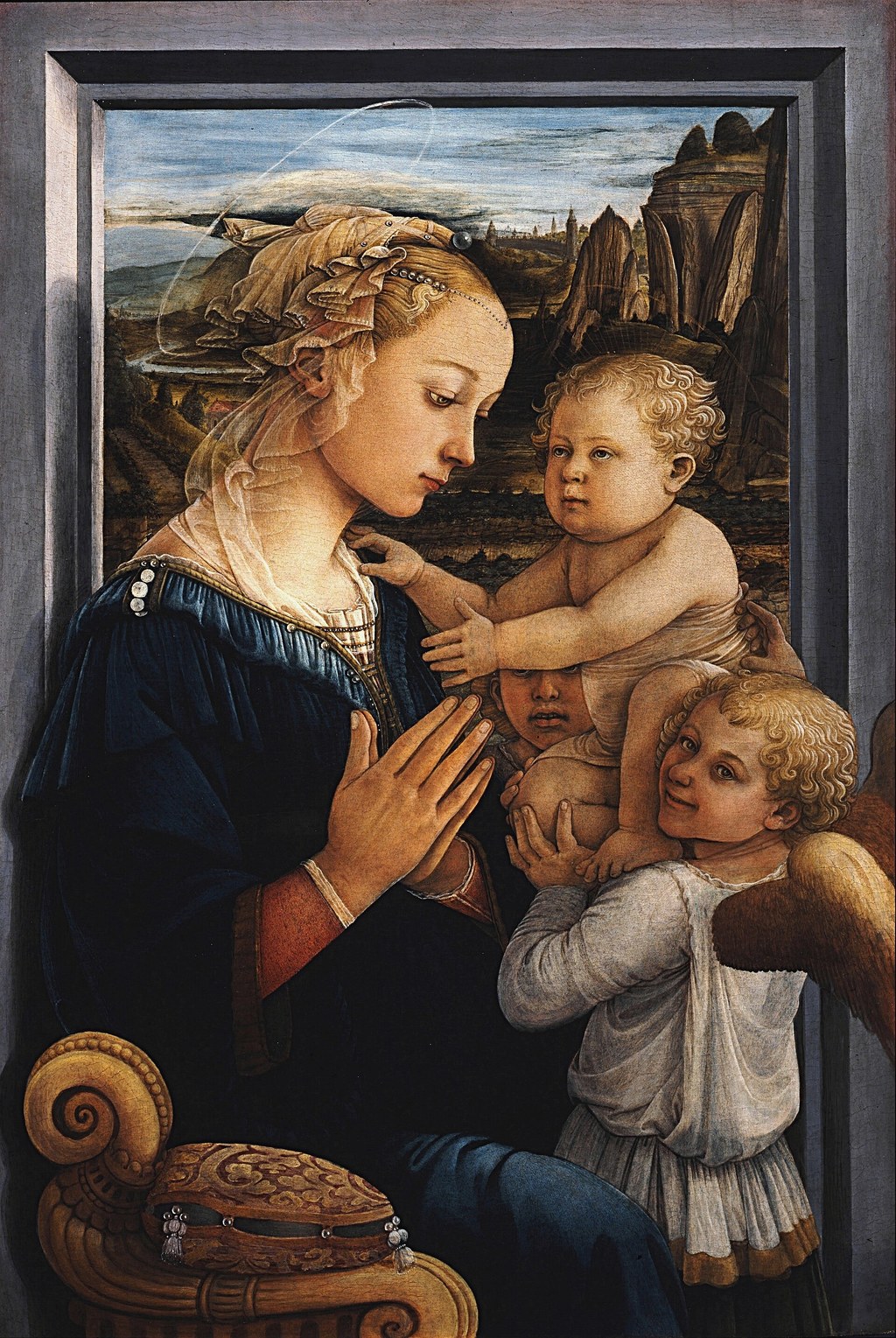
This is not a quiet private devotional image like Lippi’s later Madonna and Child with Two Angels. It was designed for a major ecclesiastical setting, viewed by a community of Benedictine women from their elevated choir as well as by worshippers below. The unusual proportions and compressed appearance of some figures make more sense when that original viewpoint is taken into account. The Uffizi explains that Lippi deliberately adjusted the composition to accommodate the higher position from which the nuns contemplated the image.[1]
The altarpiece is also unusually well documented. Its patron, Francesco di Antonio Maringhi, appears within the painting; surviving records identify collaborators; the Uffizi records a payment of more than 400 gold florins; and the artist signed the work as “FRATER FILIPPUS”.[1] That evidence allows the painting to be studied not simply as an image but as a Renaissance commission involving money, patronage, workshop labour, religious community, architecture and reputation.
At a Glance
- ArtistFra Filippo Lippi
- TitleCoronation of the Virgin
- Alternative nameMaringhi Coronation
- Datec. 1439–1447
- MediumTempera on wood
- Dimensionsapproximately 200 × 287 cm
- Current locationUffizi Galleries, Florence
- Original locationHigh altar of Sant’Ambrogio, Florence
- PatronCanon Francesco di Antonio Maringhi, procurator of Sant’Ambrogio
- CostUffizi records more than 400 gold florins for the altarpiece
- Key assistants documentedFra Diamante, Piero di Lorenzo and Bartolomeo di Giovanni Corradini
- Important figuresGod the Father, Virgin Mary, Saint Ambrose, Saint John the Baptist, Saint Eustace and family, patron Francesco Maringhi, probable self-portrait of Lippi
- Signature“FRATER FILIPPUS”
- Original predellalargely lost or dispersed; one surviving scene associated with Saint Ambrose is in Berlin
- Current framemodern
Contents
- What Does the Painting Show?
- The Coronation of the Virgin as a Subject
- Sant’Ambrogio in Florence
- How Much Did the Altarpiece Cost?
- Lippi’s Self-Portrait
- Saint Ambrose
- The Angels
- The Elevated Viewpoint
- From Masaccio to Lippi
- The Altarpiece as a Complete Renaissance Object
- Patronage, Memory and Salvation
- Looking from the Nuns’ Choir
- Provenance
- Why the Coronation of the Virgin Matters
- FAQs
- References
What Does the Painting Show?
At the centre of the altarpiece, the Virgin Mary kneels before God the Father. He sits enthroned above her and lowers a crown towards her head. Mary folds her hands and accepts the honour with humility. Her gesture reinforces the theological idea that her exaltation is not self-asserted but bestowed. The scene is surrounded by a dense assembly of angels and saints. The heavenly gathering seems to extend beyond the physical limits of the panel.
Angels near the throne hold the long priestly stole worn by God the Father. Others carry white lilies, a conventional attribute of Mary’s purity. Below, saints and holy figures accumulate in closely packed groups. Some turn towards the central event; others engage the viewer through gaze or position. On the far left stands Saint Ambrose, the patron saint of the church for which the altarpiece was made. He is balanced on the opposite side by Saint John the Baptist, patron saint of Florence.
In the foreground is a family group of martyrs: Saint Eustace, his wife Theopista, and their sons Theopisto and Agapius. Their presence expands the iconographic programme beyond the titular saint of Sant’Ambrogio. The patron Francesco Maringhi kneels below Saint John the Baptist. An angel unfurls a scroll beside him bearing the phrase “IS... PERFECIT OPUS”, identifying his role in bringing the commission to completion. Across the composition, Lippi combines individual identities with the effect of a vast spiritual community.
The Coronation of the Virgin as a Subject
The Coronation of the Virgin became an important theme in medieval and Renaissance Christian art. It imagines Mary’s exaltation in heaven, often after her Assumption, as she is crowned Queen of Heaven. The subject is not narrated in a single straightforward biblical passage. It developed through theology, liturgy, devotional tradition and later interpretation. For religious communities devoted to the Virgin, the theme could be especially powerful. It presented Mary as both humble servant and heavenly queen.
The Uffizi notes that the subject frequently appeared in altarpieces made for female convents and monasteries. That context is directly relevant here because Sant’Ambrogio was associated with a Benedictine female community.[1] The painting therefore addressed viewers whose religious lives were structured around prayer, obedience and communal devotion. Mary’s humility and exaltation could function as an ideal within monastic spirituality. At the same time, the enormous gathering of saints creates a vision of the heavenly Church. The painting does not isolate Mary; it situates her within an ordered sacred society.
Sant’Ambrogio in Florence
The original setting of the altarpiece matters enormously. Lippi did not paint it for a museum wall but for the high altar of the church of Sant’Ambrogio in Florence. The church served a Benedictine convent and had its own local devotional identity. Saint Ambrose, its titular saint, appears prominently on the left side of the altarpiece.
The high altar was the liturgical focus of the church. A painting installed there participated in Mass, feast days, prayer and the daily visual experience of the religious community. Its dimensions and composition were therefore responses to architecture as much as to iconography. The Uffizi’s interpretation adds a particularly important detail: the Benedictine nuns viewed the sacred image from a choir positioned at a higher level.[1]
This helps explain why some figures appear squat or seem to emerge upward from below. Lippi adjusted the design for a real spectator occupying an unusual vantage point. Such optical planning reminds us that Renaissance paintings were designed for places. Museum display can detach an altarpiece from the architecture that originally made some of its visual decisions intelligible.
Francesco Maringhi and the Commission. The patron of the work was Francesco di Antonio Maringhi, a canon and procurator connected with Sant’Ambrogio. Documentary evidence identifies him clearly, and Lippi included him within the painted assembly. Maringhi died in 1441, before the altarpiece was finished. His testamentary bequest provided the resources that allowed the commission to continue to completion. The Uffizi dates the work broadly from 1439 to 1447. That long period reflects the scale and complexity of the project.[1]
Maringhi’s portrait is not hidden. He kneels near the Baptist, and the adjacent inscription effectively commemorates him as the man through whom the work was accomplished. Patron portraits inside sacred scenes had a long history. They joined commemoration, devotion and status. For Maringhi, inclusion in the altarpiece ensured an enduring visual presence at the high altar he had helped transform. The image therefore records both heavenly hierarchy and earthly patronage.
How Much Did the Altarpiece Cost?
The Uffizi states that Fra Filippo received more than 400 gold florins for the altarpiece. For a fifteenth-century painting, that was an extremely substantial commission.[1] The figure helps demonstrate the value attached to major painted altarpieces and the status Lippi had achieved. Some secondary accounts cite larger totals in relation to the project. These may incorporate materials, framing, workshop expenditure or broader accounting surrounding the commission rather than the amount paid directly for the painted altarpiece.
Because these figures do not always describe identical categories, they should not simply be treated as competing totals. The safest statement is the one supported directly by the Uffizi: Lippi was paid more than 400 gold florins for the altarpiece.[1] If a larger total is discussed, its accounting basis should be clearly identified. This is a useful example of why Renaissance prices require context. A contract figure, a painter’s fee and the total cost of a completed altar ensemble are not necessarily the same thing.
Workshop Collaboration. The Coronation of the Virgin was too large and complex to understand purely as the work of a solitary hand. The Uffizi records documentary evidence for collaborators including Fra Diamante, Piero di Lorenzo and Bartolomeo di Giovanni Corradini.[1] Their participation does not diminish Lippi’s authorship. Renaissance workshops routinely divided labour under the authority of a master responsible for design, quality and the fulfilment of the commission.
Large altarpieces required preparation of wooden supports, ground, underdrawing, pigments, gilding, repeated figure types and many hours of surface work. The surviving documents are especially valuable because they show that collaboration was not an art-historical guess imposed after the fact. It was part of the historical production process. Different assistants may have contributed to secondary passages while Lippi retained responsibility for the central invention and major figures. The work should therefore be described as a Fra Filippo Lippi altarpiece made with documented workshop assistance.
Lippi’s Self-Portrait
One of the most engaging details in the painting is the kneeling Carmelite friar on the left who looks outward towards the spectator. The Uffizi interprets this figure as an apparent self-portrait of Fra Filippo.[1] If the identification is correct, Lippi inserted himself into the sacred assembly while simultaneously drawing attention to his identity as a religious man and painter.
He does not appear dressed as a wealthy gentleman. His Carmelite habit links him to the order in which he had been raised and professed. Yet the outward gaze also establishes artistic self-awareness. He becomes one of the few figures to acknowledge the viewer directly. This kind of self-inclusion would become increasingly important in Renaissance art. Artists could appear within narrative scenes as witnesses, participants or signatures in human form. In Lippi’s case, the device sits alongside the written “FRATER FILIPPUS”, creating two forms of authorial presence.
“FRATER FILIPPUS”. The inscription beneath the frame names the artist as “FRATER FILIPPUS” — Brother Filippo. The wording is significant because Lippi remained identified through his Carmelite status even as he operated as a professional painter with a workshop and major patrons. His career therefore complicates modern assumptions that religious vocation and artistic commerce were separate worlds.
A friar could negotiate commissions, receive large payments, supervise assistants and cultivate powerful patrons. The inscription also functions as a claim of authorship. In a work involving many hands, the master’s name establishes responsibility for the whole. At the same time, “Frater” preserves his religious identity. The signature is therefore both professional and devotional.
Saint Ambrose
Saint Ambrose stands prominently at the left, appropriate for the church dedicated to him. As the fourth-century bishop of Milan and one of the great Doctors of the Western Church, Ambrose carried enormous theological authority. His inclusion localises the heavenly scene. The Coronation may occur in an eternal celestial realm, but the presence of the church’s patron saint ties that realm directly to Sant’Ambrogio.
Viewers could understand the saint as both a participant in heaven and a protector of their own institution. The visual pairing with John the Baptist reinforces the connection between local and civic identity. Ambrose represents the church; John represents Florence.
Saint John the Baptist. John the Baptist occupies the corresponding position on the right. His importance in Florentine art cannot be overstated. He was patron saint of Florence, and his feast was bound to civic identity, processions and public devotion. Placing him opposite Saint Ambrose allows the altarpiece to unite the specific church with the city that surrounds it. John also has a theological relationship to Christ and salvation history, making him more than a civic emblem. His presence bridges the worldly Florence of the patron and the heavenly court above.
Saint Eustace and His Family. The family of Saint Eustace appears in the foreground. Eustace, his wife Theopista and their two sons were traditionally believed to have suffered martyrdom together. Their inclusion is visually striking because the group introduces familial sanctity into a composition centred on Mary’s heavenly coronation. The family also helps populate the lower foreground with figures on a more immediately human scale.
Lippi uses their coloured robes to create rhythm across the base of the panel. The choice of saints may have reflected devotional associations meaningful to Sant’Ambrogio or its patron, though interpretations should remain tied to documented evidence where possible. What is clear is that Lippi turns a potentially static hierarchy into a varied community of individuals.
The Angels
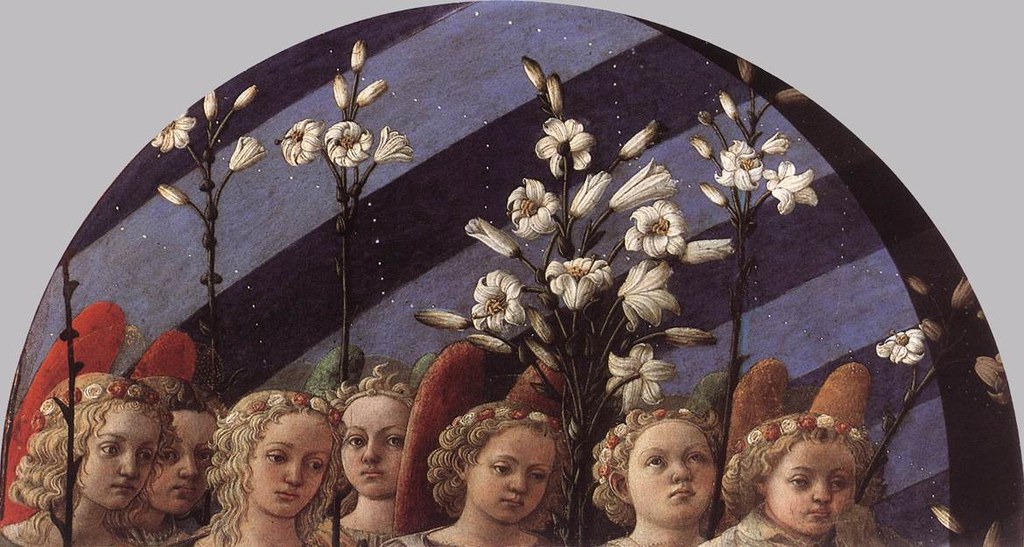
Angels fill the space closest to the throne and help animate the composition. Some support God the Father’s long stole, visually emphasising the ceremonial nature of the coronation. Others carry white lilies. The flower’s association with purity makes it especially appropriate to the Virgin.
Lippi was renowned for youthful angels, and their presence brings movement and softness to a monumental composition. They also mediate between the central divine action and the denser ranks of saints below. Rather than functioning as decorative filler, they articulate levels of sacred space.
The Blue Celestial Background. Behind the central group, Lippi replaces conventional flat gold with bands of blue and light blue. The Uffizi interprets these concentric bands as an evocation of the celestial spheres described by medieval cosmology.[1] This device is important because it shows Lippi balancing old and new visual languages.
The painting is not a fully naturalistic scene located under an ordinary earthly sky. The coronation remains a supernatural event. Yet the heavenly realm has spatial structure. Architecture, throne, layered figures and atmospheric colour combine to give the invisible world a kind of material plausibility. The blue bands therefore perform a theological and compositional function. They distinguish heaven while avoiding the complete abstraction of a gold ground.
Architecture and the Throne. The throne is unusually elaborate. Its articulated stone structure merges into the surrounding architecture and gives the central event physical weight. God the Father does not float in an undefined celestial field. He sits within a constructed environment. This reflects the Renaissance desire to make sacred reality visually coherent through architecture and perspective.
At the same time, the space is not organised with the clean emptiness associated with some early Renaissance experiments. Lippi fills it. Bodies overlap, saints crowd the foreground and the throne rises behind them. The effect is abundance rather than geometric austerity.
The Elevated Viewpoint
One of the most distinctive aspects of the altarpiece is its adaptation to the nuns’ viewpoint. The Uffizi explains that the figures appear somewhat compressed because the image was designed to be seen from the elevated choir of the Benedictine women.[1] This is an essential interpretive point.
Seen straight-on in a museum, proportions devised for another position can appear awkward. Reconstructing the intended viewpoint restores their logic. Renaissance artists frequently adjusted figures for architectural placement. Ceiling paintings, high frescoes and altarpieces all demanded awareness of how bodies would appear from below, above or at an angle. Lippi’s solution at Sant’Ambrogio belongs to that broader history of optical correction.
Mary as Queen and Nun’s Ideal. The Virgin’s role at the centre of a female monastic church gives the subject special resonance. Mary is crowned as Queen of Heaven, yet her posture remains humble. She kneels and folds her hands. The opposition between exaltation and humility lies at the heart of Marian devotion.
For Benedictine women living under religious discipline, that paradox could be especially meaningful. Mary receives the highest honour precisely while embodying obedience. The image therefore offered more than celestial spectacle. It placed a model of sanctified femininity above the church’s principal altar.
Colour. The Coronation is crowded, but colour helps distinguish its figures and clarify the hierarchy. Blue is especially important around the heavenly centre. Warmer colours in robes and mantles pull foreground saints forward. Lippi’s palette gives individual figures presence without fragmenting the entire surface.
The combination of colour, line and modelling reflects his movement beyond the severe monumentality of Masaccio towards a more decorative and graceful language. Yet the bodies remain substantial. This fusion of volume and elegance is one of Lippi’s defining achievements.
From Masaccio to Lippi
Fra Filippo grew up in the environment of Santa Maria del Carmine, where Masaccio and Masolino painted the Brancacci Chapel. Masaccio’s influence is visible across Lippi’s career in his understanding of bodily mass, spatial presence and light. The Coronation demonstrates how Lippi transformed that inheritance.
His figures possess weight, but the composition is far more ornate and rhythmically complex than Masaccio’s most severe works. Line becomes increasingly important. Faces soften, textiles enrich the surface, and emotional accessibility grows. The altarpiece therefore represents one stage in the transition between early fifteenth-century monumentality and the lyrical Florentine style that would later shape Botticelli.
The Lost Frame. The current frame is modern. Originally, the altarpiece would have been integrated into an elaborate wooden structure, probably gilded and designed as part of the high altar ensemble. That loss affects how we perceive the work.
A Renaissance altarpiece was not simply a rectangular image with a neutral border. Painting, carpentry, gilding and architecture could function as a single object. The original frame would have intensified the material splendour of the commission and related it physically to the church interior. Its disappearance leaves the painted panel more exposed and museum-like than it originally appeared.
The Predella. The altarpiece also had a narrative predella below the principal image. Most of that lower component has been lost or dispersed. The Uffizi identifies a surviving compartment with a miracle of Saint Ambrose in the Gemäldegalerie in Berlin.[1] Predellas normally provided smaller narrative scenes beneath the monumental saints or central devotional subject above.
Their scale encouraged close viewing and created a different rhythm from the main panel. The loss means that modern viewers encounter only part of the original programme. Reconstructing the predella is therefore an important part of reconstructing the altarpiece as an object.
The Altarpiece as a Complete Renaissance Object
Modern museum display encourages us to think primarily about the painted surface, but the Coronation of the Virgin originally belonged to a much larger material and devotional ensemble. Its panel, carved and gilded frame, predella, altar and architectural surroundings worked together. This matters because a high-altarpiece was experienced through changing distances. From farther away, the large figures, bright colours and central coronation established the principal devotional message.
Closer to the altar, smaller details and the predella offered more particular stories. Liturgical objects, textiles, candles and the activity of worship would have further altered the visual field. The painting’s present isolation in the Uffizi makes close study much easier, but it also removes the conditions that originally gave the work part of its meaning.[1]
Reconstructing those conditions helps explain why Lippi designed such a dense composition and why expensive framing and secondary scenes mattered. The commission was not simply the purchase of a picture. It was the creation of an altar environment.
Patronage, Memory and Salvation
Maringhi’s presence inside the sacred assembly also reflects the close relationship between Renaissance patronage and hopes for commemoration. Funding an altarpiece for a church was an act of devotion, but it also established a lasting memorial within a community of prayer. Maringhi died before the painting was completed. The fact that his testamentary provision enabled the work to continue gave the finished altarpiece a commemorative dimension from its first installation.
His kneeling figure therefore had particular force. He was represented perpetually in prayer before the sacred figures even after his death. For the Benedictine community, donor and altarpiece became part of the institution’s history. For later viewers, the inscription beside Maringhi preserved knowledge that the object existed because of an identifiable act of patronage.
This does not mean the painting should be reduced to a monument to wealth. Its religious function was real. Rather, Renaissance patronage often united devotion, institutional benefit, family or personal memory and social identity in the same commission.
Looking from the Nuns’ Choir
The elevated viewpoint described by the Uffizi is worth considering in practical terms.[1] A nun in the reserved choir did not stand directly in front of the panel at museum eye level. She looked towards the high altar from a position conditioned by the convent’s architecture and rules of enclosure. Lippi therefore designed for a spectator whose relationship to the main church differed from that of lay worshippers below.
The adjustment of figures to that viewpoint shows that the religious community was not an abstract audience. Their actual bodies and location affected the painting. This also complicates the idea that Renaissance perspective always sought one universal, mathematically ideal beholder. Real commissions could require artists to solve awkward, asymmetric or elevated viewing conditions. In the Coronation, optical accommodation becomes part of pastoral effectiveness. The sacred figures had to read convincingly to the women for whom the subject of Mary’s exaltation carried particular devotional significance.
A Painting Between Institution and Individual Style. The altarpiece is also useful for understanding the limits of purely stylistic art history. Its graceful line and characteristic faces are recognisably Lippi, but many of its most interesting features result from circumstances beyond style: Maringhi’s bequest, Sant’Ambrogio’s dedication, the nuns’ viewpoint, workshop staffing, lost framing and the economics of a large commission.
Those factors do not sit outside the art. They helped determine what Lippi painted and how he painted it. At the same time, institutional requirements did not erase individuality. Lippi’s crowded heavenly court, softly modelled faces and rhythmic arrangement are very different from the solutions another Florentine painter might have offered for the same subject. The Coronation is therefore best understood as a negotiation between artist and commission. That balance is one of the reasons it provides such a useful case study for Renaissance production.
Provenance
The painting remained connected with Sant’Ambrogio for centuries. The Uffizi records that it was later moved to the sacristy and was stolen after 1755.[1] It subsequently entered the collection of the art dealer Angelo Volpini and passed to the Galleria dell’Accademia in Florence in 1813.
The Uffizi states that it has been preserved in the Uffizi since 1913.[1] This history reflects the broader transformation of Renaissance altarpieces from functioning church furnishings into museum works. The Coronation survives, but not in the physical or ritual environment for which it was made.
Contemporary and Later Reputation. The scale and expense of the commission already testify to Lippi’s reputation in the 1440s. The Uffizi notes that he was by this period a famous painter permitted to practise professionally despite his status as a Carmelite friar.[1] The work was admired and copied, contributing to the diffusion of Lippi’s figure types and compositional ideas. Its importance also lies in the evidence it preserves about workshop organisation and patronage. Few paintings allow us to connect visual analysis with surviving names, costs and an identifiable original audience so directly.
Why the Coronation of the Virgin Matters
The Coronation of the Virgin is one of the best works through which to understand Fra Filippo Lippi as a professional Renaissance painter. It is large, expensive, collaborative and site-specific. It shows him working for a major Florentine religious institution, managing assistants, adapting a composition to an elevated viewpoint and inserting both patron and artist into the sacred scene.
Its subject reveals how Marian theology could be tailored to a female monastic audience, while its saints connect the universal Church to local Florentine identity. The painting also marks a crucial moment in Lippi’s stylistic development. Masaccio’s legacy remains visible in the weight of the figures, but Lippi increasingly values rhythmic line, grace, colour and decorative abundance.
Those qualities would become central to later Florentine painting. The Maringhi Coronation therefore stands at the intersection of devotion, optics, patronage, workshop economics and artistic innovation. It is not simply an image of Mary receiving a crown. It is a surviving record of how Renaissance art was commissioned, made, viewed and remembered.
FAQs
Discussion
What stands out to you most about Coronation of the Virgin in relation to Filippo Lippi's wider career?
Reader Insights
Notice how the page connects close visual detail with patronage, workshop practice and the wider Renaissance setting.
Which comparison elsewhere in the cluster helps clarify this work or theme most strongly?
Join the Conversation
Have a thought or observation about Coronation of the Virgin? Share it below. Thoughtful responses may be added to this section.
References
- Uffizi Galleries, “Coronation of the Virgin,” Fra Filippo Lippi, collection entry, text by Daniela Parenti. View Source.
- Jeffrey Ruda, Fra Filippo Lippi: Life and Work with a Complete Catalogue, London, 1993.
- Megan Holmes, Fra Filippo Lippi: The Carmelite Painter, Yale University Press, 1999.
- Jeffrey Ruda, “Style and Patronage in the 1440s: Two Altarpieces of the Coronation of the Virgin by Filippo Lippi,” scholarly study. View Source
- Gallerie degli Uffizi and related collection documentation concerning the surviving predella component and provenance.