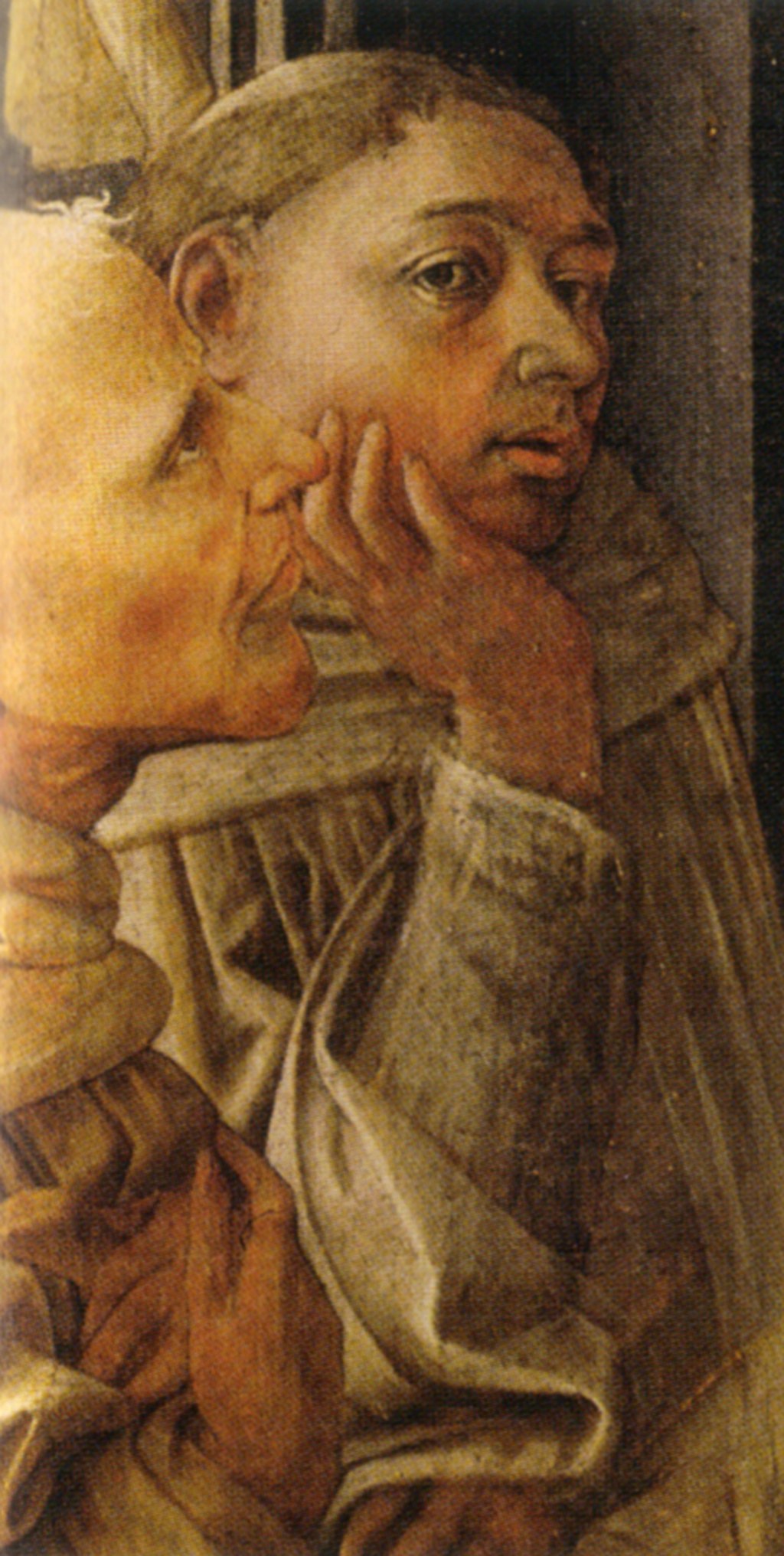
 by Tom Gurney
Tom Gurney BSc (Hons) is an art history expert with over 20 years experience
Published on June 19, 2020 / Updated on October 2, 2026
Email: tomgurney1@gmail.com / Phone: +44 7429 011000
Fra Filippo Lippi: Life, Art and Legacy
Fra Filippo Lippi occupies a distinctive place in the story of the early Renaissance. A Carmelite friar who became one of the most sought-after painters in fifteenth-century Florence, he joined the monumental lessons of Masaccio to a new taste for graceful figures, brilliant surface detail and unusually tender emotion. His paintings can feel at once sacred and immediate: Madonnas lean toward their children with recognisably human affection, angels grin at the viewer, patterned fabrics catch the eye, and religious stories unfold in architectural spaces populated by people who seem to belong to contemporary Tuscany.
His career also resists the neat biographies often imposed on Renaissance artists. Lippi was formed in a religious community, depended on ecclesiastical commissions and retained the title “Fra”, yet his life became entangled with debt, legal disputes, powerful patrons and the nun Lucrezia Buti, with whom he had children. Later writers, above all Giorgio Vasari, turned that irregular life into one of the most colourful artist biographies of the Renaissance. Some of those stories have a documentary basis; others need to be treated as anecdotes rather than facts.
What is secure is Lippi's artistic importance. He was supported by the Medici, worked for churches, convents, confraternities and private patrons, produced large fresco cycles at Prato and Spoleto, and trained or strongly shaped artists of the next generation. Sandro Botticelli's early paintings are particularly difficult to imagine without him. Lippi's son, Filippino Lippi, would carry the family name into the final decades of the quattrocento, but Fra Filippo's own achievement deserves to be understood on its own terms.
At a Glance
- ArtistFra Filippo Lippi
- Bornc. 1406, Florence
- Died1469, Spoleto
- RoleCarmelite friar and Renaissance painter
- Major CentresFlorence, Prato and Spoleto
Contents
- Early life in Florence
- Padua and the formation of a wider style
- Florence, patrons and the Medici
- The Coronation of the Virgin
- Prato: the great turning point
- Lucrezia Buti: history and legend
- The mature Madonna
- Portraiture and private life
- Final years at Spoleto
- Style and technique
- Reputation and legacy
- Chronology: the documented spine of Lippi's life
- Padua and artistic mobility
- The Medici relationship
- Filippino Lippi
- Vasari and the pirate story
- A career across functions
- Why Fra Filippo Lippi matters
- Fra Filippo Lippi in the chronology of the Renaissance
- FAQs
- References
Early life in Florence
Filippo Lippi was born in Florence around 1406. He lost his parents while still young and entered the Carmelite community of Santa Maria del Carmine. Documentary chronologies assembled from the Carmelite records place his profession in the order in the early 1420s and identify him as a painter by about 1430. This environment mattered enormously, because Santa Maria del Carmine contained one of the defining pictorial experiments of the age: the Brancacci Chapel frescoes by Masolino and Masaccio.
It is tempting to describe Lippi simply as a pupil of Masaccio, but the evidence does not support a formal apprenticeship. A more accurate formulation is that Masaccio's art formed part of Lippi's immediate visual environment. The heavy bodies, credible weight, simplified modelling and convincing architectural space of Masaccio's frescoes offered a radical alternative to the more decorative late Gothic tradition. Lippi absorbed those lessons while developing an increasingly personal language.
This distinction matters because Lippi's mature art is not a diluted version of Masaccio. He often preferred more elegant silhouettes, animated drapery, gleaming ornament and emotionally accessible expressions. Where Masaccio can feel severe and architectonic, Lippi frequently brings sacred figures closer to the viewer through gesture, glance and domestic detail. His originality lies partly in the way he reconciled solidity with grace.
Padua and the formation of a wider style
Lippi is documented in Padua in 1434. The work associated with this stay has largely disappeared, which makes the episode frustratingly difficult to reconstruct. Yet Padua was a fertile artistic centre, and the journey reminds us that Lippi's career did not develop inside a closed Florentine system. Northern Italian contacts, sculptural traditions and the circulation of Netherlandish-looking effects all formed part of the broader visual world to which a successful painter could respond.
By the later 1430s Lippi was receiving major commissions in Florence. Two works from 1437 are particularly useful anchors: the Barbadori Altarpiece, commissioned for Santo Spirito, and the Madonna of Tarquinia, dated by inscription. Together they show how rapidly he had developed. The figures retain sculptural mass, yet the settings and surfaces are increasingly elaborate. Architecture, textile, furniture, jewellery and distant landscape begin to carry as much expressive weight as the bodily forms themselves.
The Madonna of Tarquinia is especially revealing because the Virgin and Child inhabit an interior that feels materially specific. The devotional subject is not detached from ordinary life; it is made persuasive through a world of rooms, openings, furnishings and touch. This ability to bring sacred imagery into a recognisable human environment became one of Lippi's most influential achievements.
Florence, patrons and the Medici
Lippi's career depended on patronage networks, and none was more important than the Medici. The National Gallery in London preserves two panels, The Annunciation and Seven Saints, that came from the Palazzo Medici. Their unusual shape has encouraged the view that they functioned as overdoor decorations or related architectural furnishings. They demonstrate that Lippi's work could operate within elite domestic space as well as on church altars.[1]
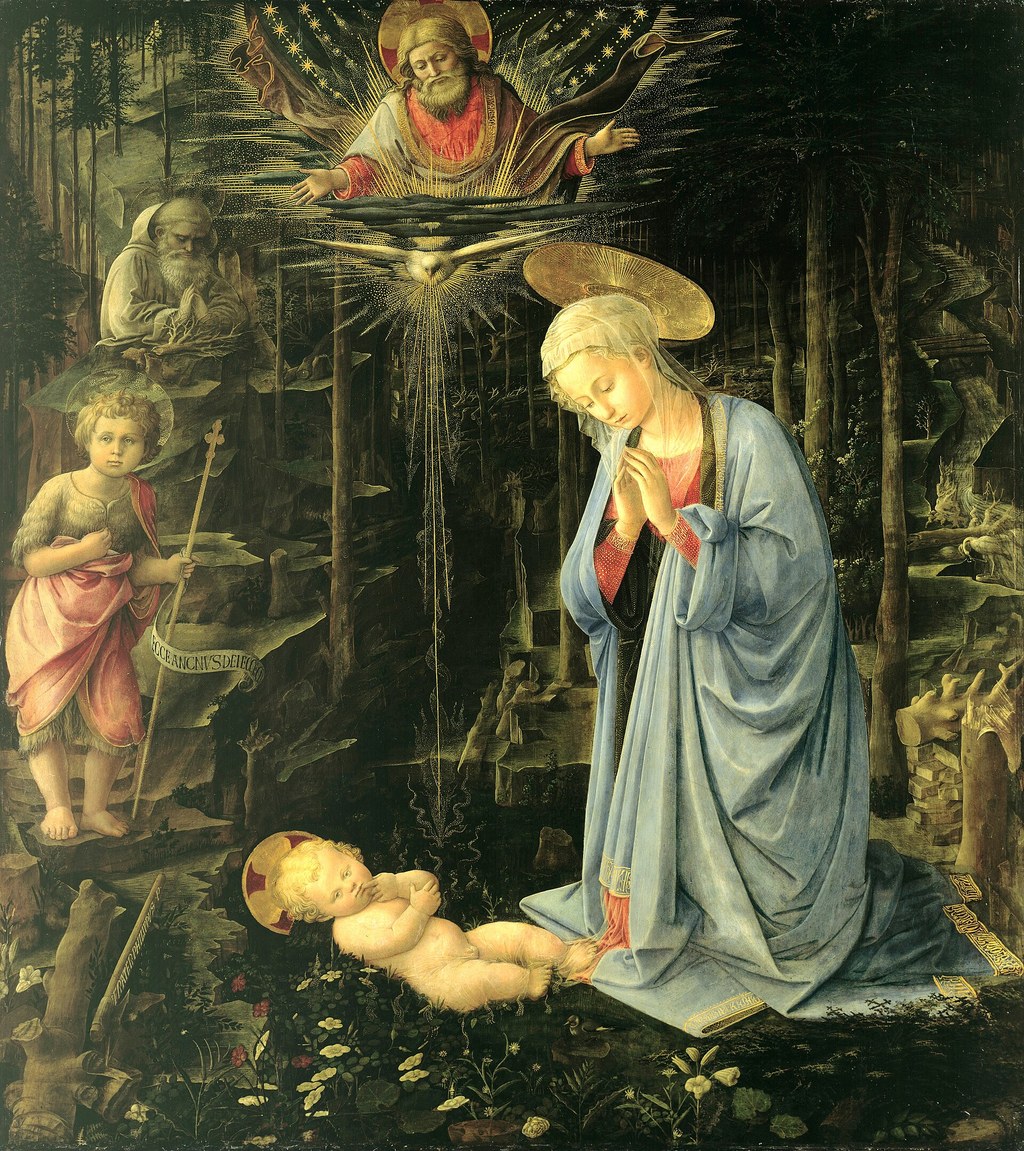
The Medici connection becomes even more vivid in the Adoration in the Forest, painted for the family's private Magi Chapel in the Palazzo Medici. Benozzo Gozzoli's famous fresco procession transformed the walls of that chapel into a lavish dynastic and devotional environment, while Lippi's altarpiece supplied a much quieter centre. Instead of matching the pageantry of the procession, Lippi set the Christ Child and Virgin within a shadowy forest, accompanied by the young John the Baptist and Saint Bernard. The contrast makes the altarpiece one of the most psychologically unusual religious paintings associated with Medici Florence.
The picture is also a reminder that the Medici did not commission a single “house style”. They could patronise public magnificence, private mysticism, portrait-like sacred figures and learned iconography. Lippi was valuable partly because he could adapt. His work could be ceremonially rich or startlingly intimate without ceasing to be recognisably his. Cosimo de' Medici appears repeatedly in accounts of Lippi's life as patron and protector. Later anecdotes sometimes turn that relationship into comedy, depicting the painter as a wayward genius whom Cosimo had to manage. The underlying fact—that Medici support was important—is secure. The picturesque details require more caution. The distinction between documented patronage and Vasarian character story is therefore important.
The Coronation of the Virgin
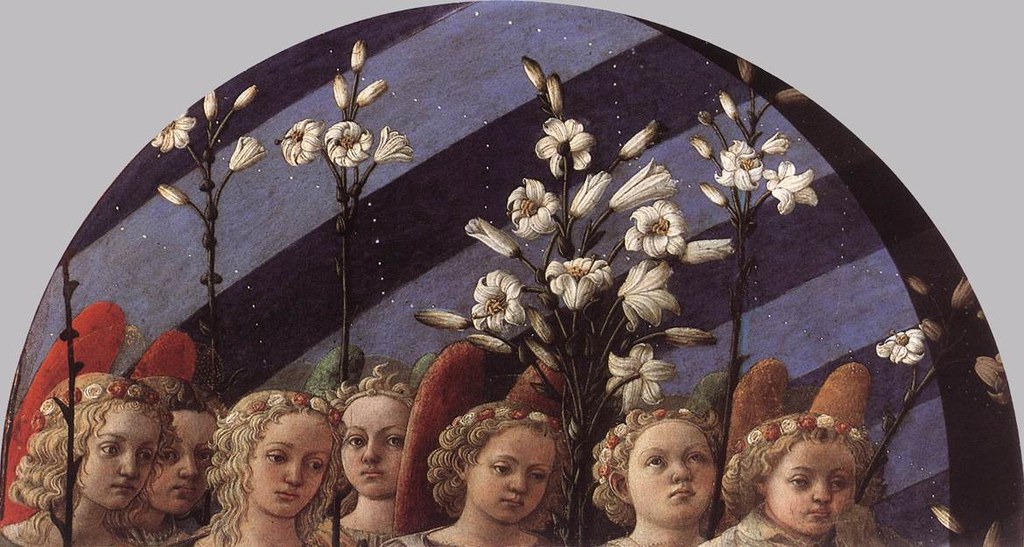
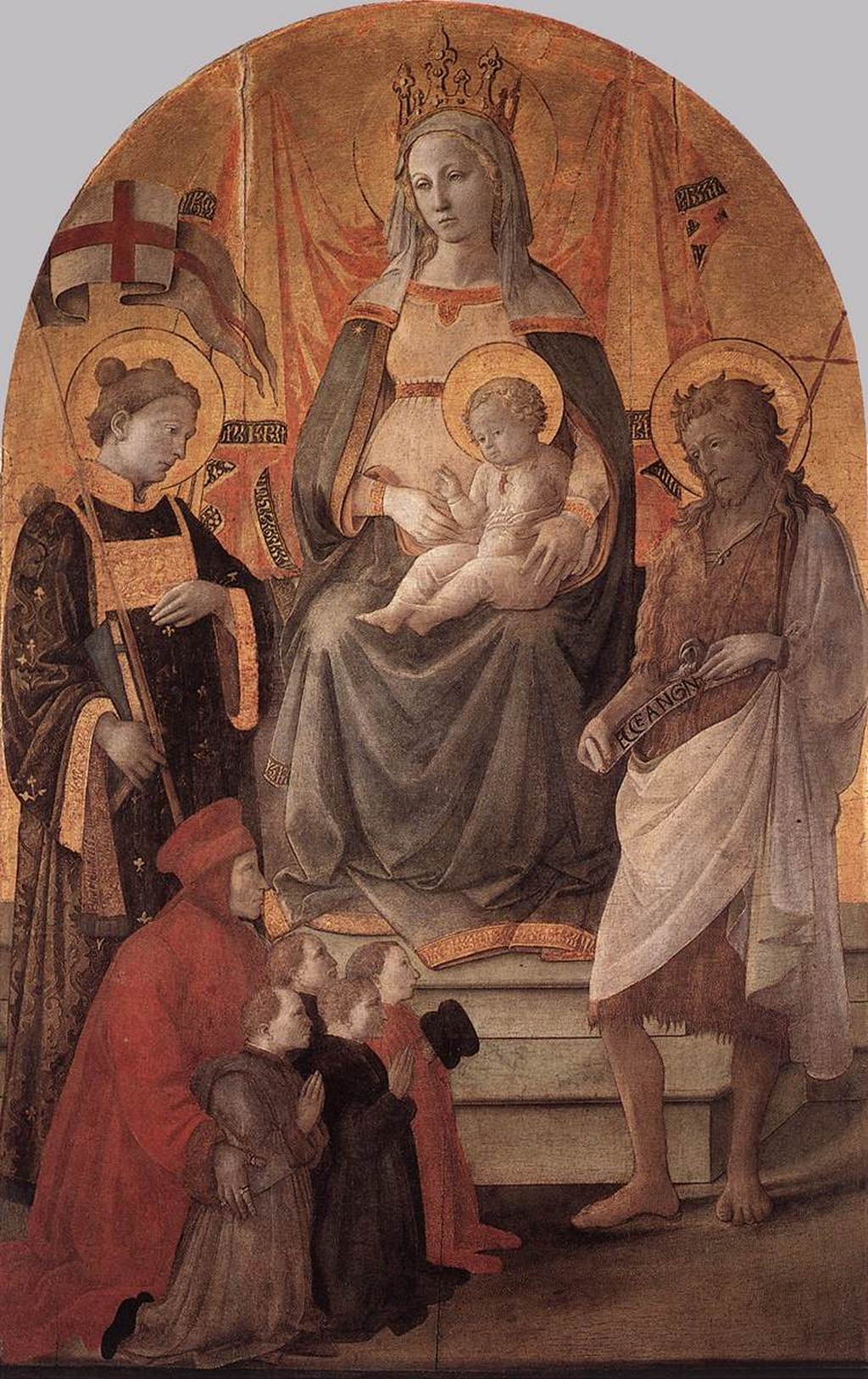
Among Lippi's most ambitious Florentine altarpieces is the Coronation of the Virgin, often called the Maringhi Coronation after its patron. It was created for the high altar of Sant'Ambrogio in Florence and completed in 1447. Surviving documentation makes the work exceptionally useful for understanding Renaissance production because it reveals patronage, payment and workshop participation rather than presenting the altarpiece as the solitary creation of an isolated master.
The vast gathering of saints and angels is organised around the Virgin's coronation, but Lippi fills the sacred assembly with a variety of heads, gestures, textiles and ornamental details. He seems to include himself among the participants, collapsing the distance between maker and holy vision. The result is both ceremonial and crowded, heavenly in subject yet full of individual human presences.
The records also name assistants. This is important for judging Lippi's oeuvre more broadly. A successful fifteenth-century painter was expected to manage a workshop, delegate tasks and deliver complex objects to deadline. “By Fra Filippo Lippi” does not always mean every centimetre was executed by the master's hand. The distinction becomes particularly significant in later collaborative works and in the fresco cycles.
Prato: the great turning point
In 1452 Lippi was invited to decorate the main chapel of the church of Santo Stefano at Prato, now Prato Cathedral, after Fra Angelico had declined the project. The commission would occupy him intermittently for more than a decade and produced the Stories of Saint Stephen and Saint John the Baptist, one of the major fresco cycles of fifteenth-century Tuscany.
The scale of the undertaking changed the rhythm of Lippi's career. Fresco demanded planning across walls rather than panels, the coordination of assistants, scaffolding, plaster and pigments, and a narrative intelligence capable of turning architecture into sequence. Prato's surviving records and modern institutional research make the project unusually legible. Fra Diamante was a significant collaborator, and the workshop's contribution cannot be treated as incidental.
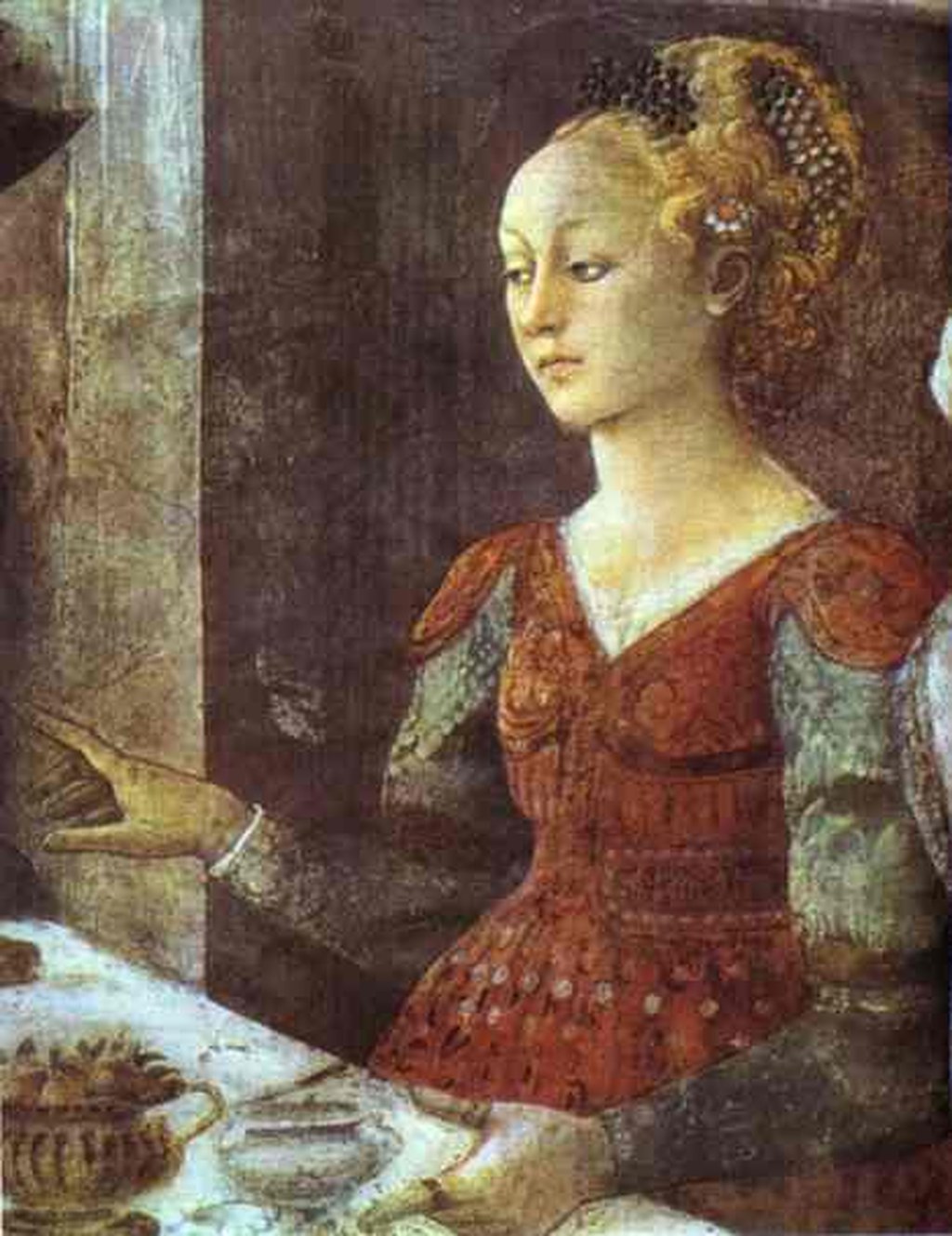
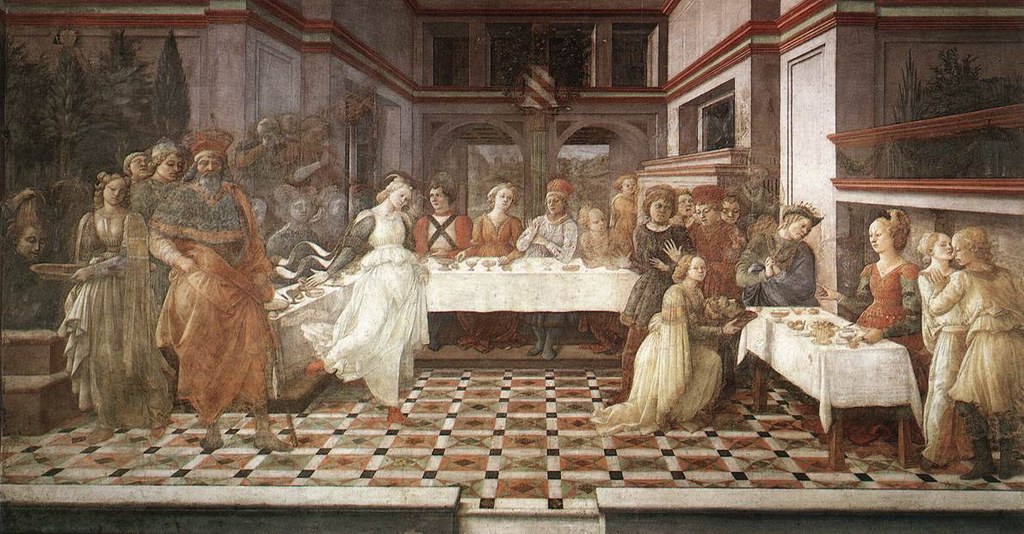
Lippi did not impose a rigid perspective grid on every scene. The paintings adapt space to storytelling. Multiple incidents can appear within one field, and perspective may shift in order to keep important figures visible or make a narrative transition intelligible. This flexibility is especially striking in The Feast of Herod, where Salome's dance, the execution of John the Baptist and the presentation of his head belong to successive moments but coexist within a continuous architectural setting.
Technical evidence also complicates the idea of fresco as a single method. Lippi and his assistants supplemented true fresco with extensive work applied after the plaster had dried. Some of those a-secco passages proved more vulnerable over time. Gold and other surface effects enriched the original appearance, meaning that today's frescoes are in certain respects quieter than the fifteenth-century ensemble would have been.
Lucrezia Buti: history and legend
Prato is also where Lippi's biography becomes inseparable from Lucrezia Buti. Lucrezia was associated with the convent of Santa Margherita, and the relationship between her and the Carmelite friar produced children, including the future painter Filippino Lippi. The basic relationship is not simply a Vasarian invention, but the way it has been narrated over the centuries requires discrimination.
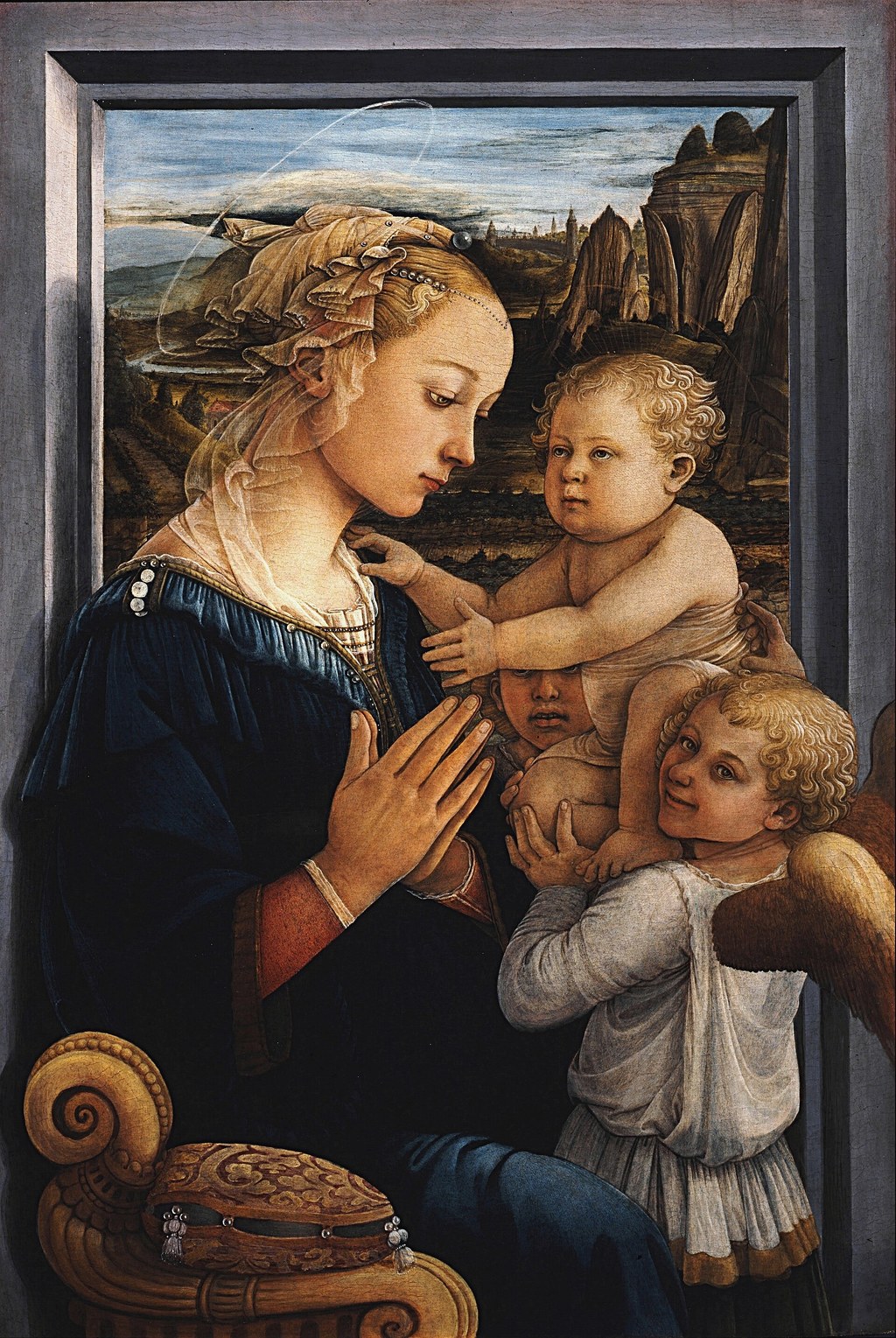
Later versions turn the episode into romantic escape, abduction or scandalous adventure. They also identify Lucrezia as the model for specific Madonnas and, sometimes, for Salome in the Prato frescoes. Such identifications can be attractive because Lippi's women possess enough individuality to invite portrait readings, but resemblance is not documentation. The Uffizi specifically cautions that there is no evidence confirming that Lucrezia is the Virgin in Madonna and Child with Two Angels.[3]
This does not make the tradition irrelevant. On the contrary, the persistence of the Lucrezia identification tells us something about the reception of Lippi's art. Viewers have long felt that his Madonnas are unusually human, personal and emotionally observed. The mistake is to convert that response into certainty about a sitter's name. The relationship also exposes the social realities behind religious institutions. Both Lippi and Lucrezia entered religious communities in circumstances shaped by family and economy, not necessarily by straightforward vocation. The story therefore belongs not only to romantic biography but to the structures of fifteenth-century society.
The Feast of Herod and narrative invention. The Feast of Herod has become the most celebrated scene in the Prato cycle, and it demonstrates why. At one side Salome dances before Herod's court. Elsewhere the consequences of her request unfold. The eye travels through architecture as though through successive stages of a drama, but the boundaries between moments are fluid. Lippi's architecture is not neutral scenery. Arcades, walls, tiled floors and open spaces direct movement and separate actions. Figures form conversational and gestural groups, while costume makes the biblical court look partly like an elite fifteenth-century gathering. Sacred history is translated into contemporary visual experience.
The scene can be compared with earlier representations of the same subject, including works by Giotto and Donatello. Such comparisons reveal that Lippi was not merely illustrating a familiar story. He was exploring how painting could organise time, social behaviour and spatial depth at monumental scale.
The mature Madonna
If Prato reveals Lippi the muralist, Madonna and Child with Two Angels reveals the mature painter of intimate devotion. The painting, now in the Uffizi, is often known affectionately as the Lippina. The Virgin is shown in profile, hands joined, while the Christ Child is lifted toward her by two youthful angels. The foreground angel turns outward with a smile that immediately punctures the formality of the sacred encounter.[3]
The setting seems simultaneously like a window, a frame and an opening onto distant landscape. The Virgin's elaborate hair, translucent veil and pearls belong to contemporary ideals of beauty. Halos are so restrained that the figures can initially register as a Florentine mother, child and attendants before their sacred identities reassert themselves. This controlled ambiguity had an important afterlife. Botticelli, who trained in Lippi's studio, inherited the graceful profile, linear delicacy and emotionally intimate Madonna type. The influence is not a matter of simply copying one composition. Lippi helped establish a vocabulary through which sacred figures could possess elegance, beauty and recognisable feeling without losing devotional purpose.
Portraiture and private life
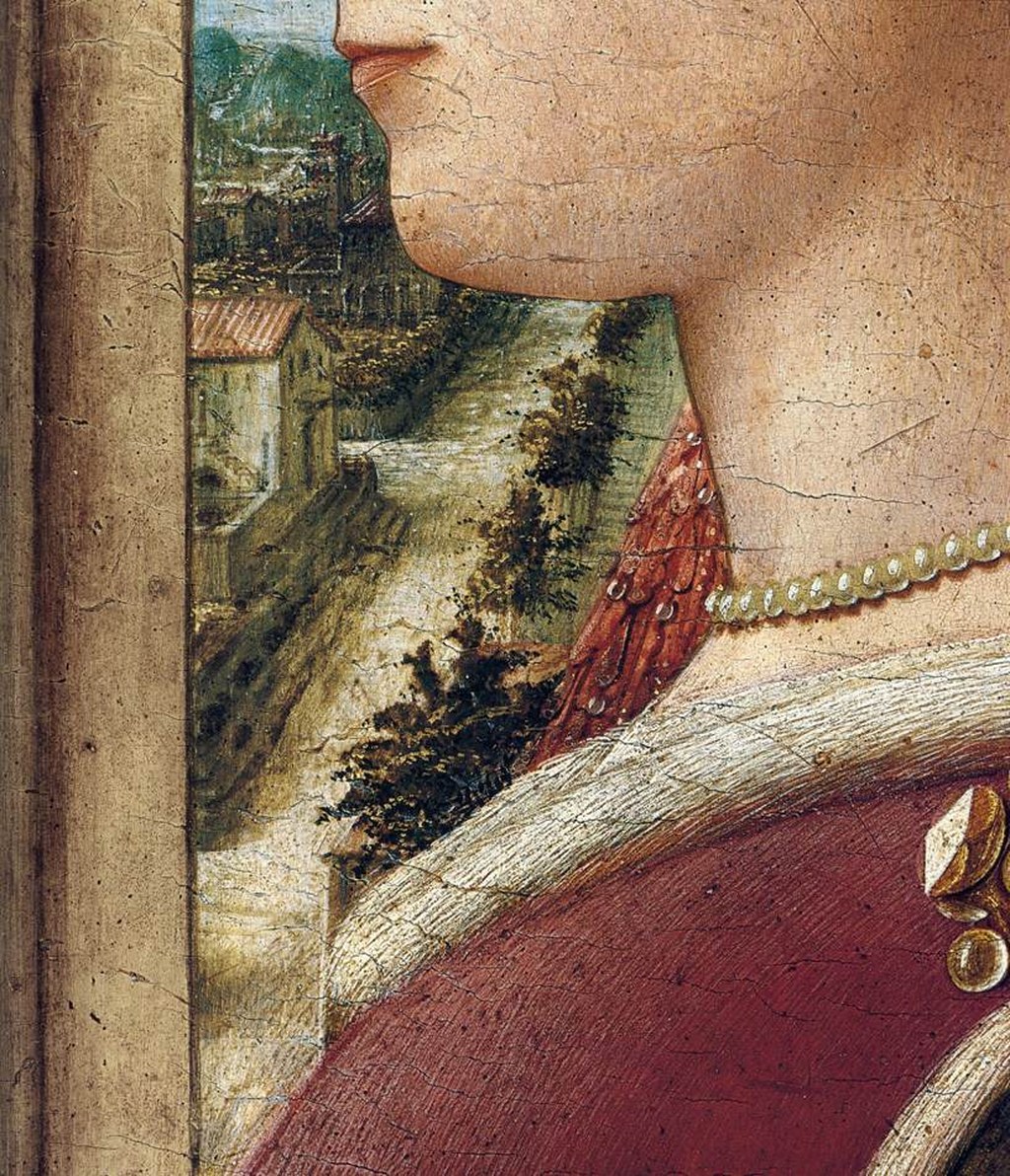
Lippi's Portrait of a Woman with a Man at a Casement, now at the Metropolitan Museum of Art, demonstrates how far his interest in contemporary life could extend. The Met identifies it as the earliest surviving double portrait in Italian painting, the earliest surviving Italian portrait to place its sitters in a domestic setting and the first to include a landscape view.[4]
Those claims make the picture important far beyond Lippi studies. A richly dressed woman appears in profile within an interior while a man looks toward her through an opening. Heraldic evidence associates the man with the Scolari family, and the work has been connected with a marriage involving Lorenzo di Ranieri Scolari and Angiola di Bernardo Sapiti.
The painting turns clothing, jewellery, architecture and heraldry into carriers of social meaning. The profile format recalls medals and dynastic presentation, but the interaction across the casement makes the arrangement feel more complex than two independent likenesses. It is simultaneously portrait, marriage image, interior scene and statement of status.
Workshop, collaboration and the Pistoia altarpiece. One of the best-documented examples of workshop collaboration is the Santa Trinità Altarpiece from Pistoia. It was originally commissioned from Francesco Pesellino in 1455. After Pesellino died in 1457, Lippi and his workshop were contracted to complete it. The surviving confraternity records preserve unusual detail about the patrons' decisions, costs, travel and disputes. The altarpiece therefore resists a simple attribution label. Its importance lies partly in that complexity. Renaissance production could continue across the death of one artist, and contractual responsibility might pass to another workshop. Later dismantling and reassembly added a second history to the object. The National Gallery's reconstruction allows the painting to be studied not just as an image but as the product of institutions, agreements and changing ownership.[1]
Final years at Spoleto
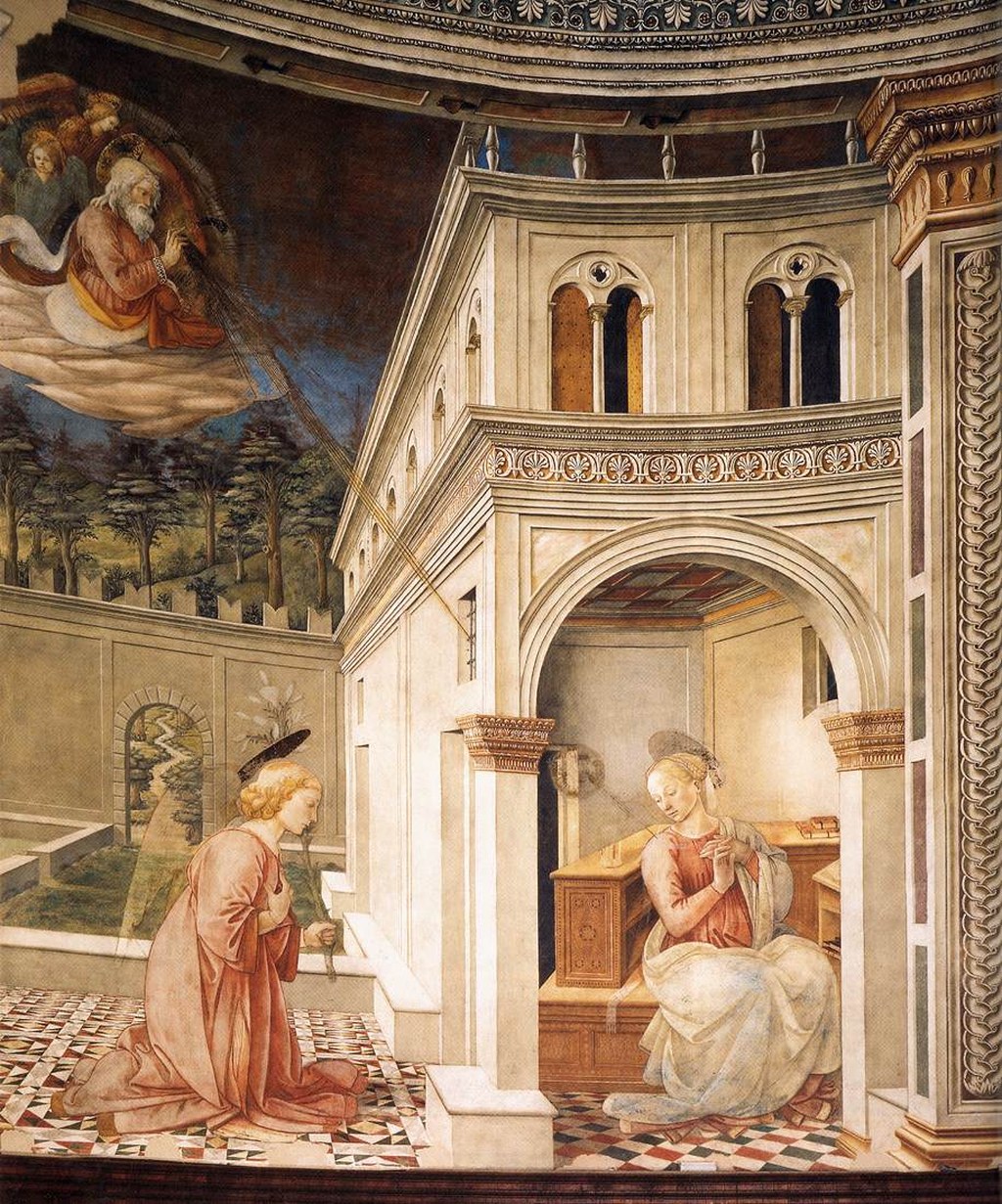
Lippi's last monumental project took him to Spoleto, where he painted the apse of the cathedral with scenes from the life of the Virgin. Institutional sources generally place the execution in the later 1460s, with the surviving cycle including the Annunciation, Nativity, Dormition or Death of the Virgin, and Coronation of the Virgin. The Spoleto frescoes deserve to be considered alongside Prato rather than as an epilogue. They return to themes that had occupied Lippi throughout his career—Mary, birth, death, angels, architecture and ceremonial gathering—but on a monumental scale and at the end of his life. Workshop assistance remained essential.
Fra Filippo died at Spoleto in October 1469 before the entire programme was finished. His assistants completed the project. He was buried in the cathedral, where a later tomb monument links his memory to the building. His son Filippino was involved in the design tradition of the monument, giving the location an unusual connection between biological and artistic succession.
Style and technique
Contemporary Florentine humanist Cristoforo Landino described Lippi in 1480 as graceful, ornate and skilled in composition, variety, colour, relief and ornament. The judgement remains useful because it captures qualities visible across the oeuvre without reducing them to one stylistic formula. Lippi could construct bodies with Masaccio-like weight, but he increasingly favoured sinuous contours and elaborately arranged surfaces. Fabric, pearl, brocade, patterned marble and foliage are rarely afterthoughts. They give sacred images material attraction while also carrying social and symbolic meanings.
His spatial practice was equally flexible. Perspective could establish a believable room, as in the Madonna of Tarquinia, or become a narrative instrument in Prato. Landscapes, sometimes glimpsed through windows and sometimes occupying larger portions of the composition, open Lippi's interiors to a wider world. Technical investigation continues to alter our understanding of these effects. The Gemäldegalerie's 2026–28 conservation campaign on the Adoration in the Forest uses X-radiography, ultraviolet fluorescence, infrared reflectography, microscopy and pigment and binder analysis. Such research can reveal underdrawing, revisions, paint structure and later interventions that the naked eye cannot distinguish.[5]
Lippi and Botticelli. Botticelli is the most famous artist to emerge from Lippi's workshop orbit. The relationship matters because it helps explain how an early Renaissance language of solid bodies and perspectival space could evolve into the elegant linearity associated with later Florentine painting. Early Botticelli Madonnas repeatedly show affinities with Lippi's types: elongated faces, fine contour, translucent veils, tender mother-child interaction and carefully observed ornament. Botticelli would transform these ingredients into a style of his own, but Lippi supplied a crucial foundation.
Influence also ran through workshop habits. Drawings, cartoons, reusable figure types and collaborative execution allowed successful inventions to circulate. A Renaissance workshop was therefore not merely a place where a master issued instructions; it was a mechanism through which visual ideas multiplied.
Reputation and legacy
Lippi's reputation after death was shaped by two competing inheritances. One was artistic: the Madonnas, frescoes and altarpieces admired for grace, colour, invention and feeling. The other was biographical: the entertaining story of the friar whose appetites repeatedly defeated monastic discipline. Vasari helped make the second inheritance irresistible. His account includes dramatic episodes such as Lippi's supposed capture by pirates and liberation after astonishing his captors with his drawing. Such stories have entered popular biography despite their uncertain evidential basis. They should be presented as part of Lippi's legend, not quietly inserted into chronology as verified events.
The artistic legacy is easier to demonstrate. Botticelli absorbed and transformed Lippi's language. Filippino Lippi continued the family tradition while developing a very different late-quattrocento complexity. The Prato and Spoleto frescoes remained visible monuments, while the panel paintings entered some of the world's major collections. Fra Filippo's broader importance lies in the bridge he constructed between monumentality and intimacy. He inherited a Florentine revolution in space and bodily presence, then made it more decorative, emotionally accessible and adaptable to private devotion. In doing so he helped prepare the visual culture in which Botticelli could flourish.
Chronology: the documented spine of Lippi's life
Fra Filippo's biography is strongest when built from dated records and securely documented commissions rather than from Vasari's anecdotes. The surviving chronology is unusually rich for a fifteenth-century painter. He was born in Florence around 1406 and lost his parents young. He entered the Carmelite environment of Santa Maria del Carmine as a child and took religious vows in 1421. The Prato diocesan chronology records him as a painter in Carmelite documentation by 1430.
By the mid-1430s he was working beyond Florence, including a period in Padua. Major Florentine commissions become securely visible from 1437 with the Madonna of Tarquinia and Barbadori Altarpiece. The 1440s brought important church and private works, culminating in the Coronation of the Virgin completed in 1447. The great Prato commission begins in 1452 and dominates the next phase of his life. The cathedral frescoes continued, with interruptions, until 1465. In January 1466 Lippi received the balance of payment for the cycle. Soon afterwards the final Spoleto project took him to Umbria, where he died in 1469. This documented sequence provides the chronology against which later stories can be tested, rather than allowing anecdotes to determine the shape of the life.
Santa Maria del Carmine and the Brancacci Chapel. The Carmine was decisive because Lippi grew up in the same institution that contained the Brancacci Chapel. Masaccio and Masolino's frescoes were being created within his immediate religious environment. It is tempting to turn that proximity into a formal apprenticeship under Masaccio, but the evidence does not support such a simple claim. Prato's institutional research explicitly cautions against assuming a documented workshop training with another master.
The more accurate statement is stronger historically: Lippi had sustained access to one of the most revolutionary visual environments in early Renaissance Florence. He could study monumental bodies, unified light, perspective and emotionally direct sacred narrative from close range. Those lessons became foundational without making him a mere follower.
Padua and artistic mobility
Lippi's documented presence in Padua in the 1430s matters even though much of the work associated with that period is lost. It demonstrates that his early career was not confined to Florence. Padua was an important artistic centre with its own sculptural, pictorial and humanist culture. Travel exposed Lippi to visual traditions and patronage systems beyond his Carmelite upbringing. Claims about exactly which northern or Netherlandish works he saw should remain cautious, but the broader principle is secure: Renaissance painters moved, and their styles developed through contact as well as local inheritance.
The breakthrough year of 1437. The year 1437 is particularly useful because two major works anchor Lippi's emergence as an independent master. The Madonna of Tarquinia carries a secure date, while the Barbadori Altarpiece has a precise commission history. The first reveals his ability to humanise the enthroned Madonna through domestic space, light and tactile detail. The second demonstrates his capacity to handle a major church altarpiece and institutional patronage.
Together they show that by his early thirties Lippi could operate across intimate and public formats. They also establish the coexistence of Masaccio-derived monumentality with the grace and descriptive richness that would become increasingly characteristic.
A friar who became a professional painter. Lippi's religious status should not be treated as a curiosity attached to an otherwise secular career. It shaped his name, social position, commissions and later reputation. He signed the great Sant'Ambrogio Coronation as “Frater Filippus”. At the same time, he functioned as a professional master. He received substantial payments, employed assistants, negotiated commissions and worked for some of the most powerful patrons in Florence.
The apparent contradiction reflects the complexity of Renaissance institutions rather than a simple personal hypocrisy. Religious men could hold economic responsibilities and artistic professions. Lippi's case became exceptional because his family life and personal conduct repeatedly collided with clerical expectations.
The Medici relationship
The Medici connection was sustained rather than incidental. The National Gallery's paired Annunciation and Seven Saints came from Medici family patronage. The Berlin Adoration in the Forest was made for the Magi Chapel in Palazzo Medici. Other works have direct connections with Piero de' Medici and Lucrezia Tornabuoni.[1] Prato institutional accounts also emphasise Cosimo de' Medici's admiration and protection. The precise form of individual interventions should be reported carefully, but the broader pattern is unmistakable: Lippi moved within Medici networks for years. That relationship helped make him one of the central painters of mid-century Florence and placed his workshop in the environment from which Botticelli would emerge.
Prato as a second centre of life. Prato was not simply a place where Lippi happened to receive one enormous job. The city became the setting in which his professional, domestic and workshop lives overlapped most intensely. The cathedral commission required years of work and collaboration. Local institutions commissioned additional panels. The Madonna del Ceppo connects him to the Datini charitable legacy. His relationship with Lucrezia Buti developed there, and Filippino was born during this period. The result is a rare case where one city allows us to study artist, workshop, patronage and household together.
Lucrezia Buti without the romance filter. The relationship with Lucrezia is real; many of the most colourful details attached to it are less secure. Prato records provide evidence for a household and children, including a 1461 denunciation referring to a son living with Lippi. Later biographies turned the relationship into a dramatic story of a friar carrying a beautiful young woman away from a convent. That narrative should be presented as part of Lippi's reception unless individual details can be independently verified.
The same caution applies to painting identifications. Lucrezia may have modelled for Lippi, but the Uffizi explicitly states that nothing confirms her identification as the Virgin in the Lippina.[3] The biography becomes stronger when it distinguishes relationship, legend and portrait hypothesis rather than blending them.
Filippino Lippi
Filippino Lippi was born around 1457 and became one of the outstanding painters of the next generation. His career makes Fra Filippo's personal biography part of a larger artistic lineage. After his father's death, Filippino entered Botticelli's orbit. That creates the remarkable sequence in which Fra Filippo trained Botticelli and Botticelli later helped form Fra Filippo's son. The relationship is historically more interesting than a simple hereditary story. Artistic transmission moved through workshops, not blood alone.
Lippi as workshop master. The surviving commissions show that Fra Filippo increasingly operated through a workshop. Fra Diamante is the best documented collaborator, but other assistants appear in records. The Maringhi Coronation documents several collaborators. The Pistoia Santa Trinita Altarpiece demonstrates Lippi's role as evaluator, designer and workshop head on a project begun by Pesellino. Prato required sustained organisation across a monumental fresco campaign. This matters because authorship cannot always be reduced to identifying where Lippi personally placed a brush. Design, supervision, adaptation and quality control were part of the master's work.
Reputation in his own century. The National Gallery preserves an especially valuable near-contemporary judgement from Cristoforo Landino in 1480. Landino praised Lippi's grace, ornament, composition, variety, colour and relief.[1] That assessment is important because it predates Vasari's colourful sixteenth-century biography. It tells us what an educated Florentine commentator valued close to Lippi's own period. Grace and variety are particularly apt terms. Lippi could move from monumental altarpiece to intimate Madonna, from fresco spectacle to private portraiture without losing a recognisable visual identity.
Vasari and the pirate story
Vasari's life of Fra Filippo contains some of the most memorable anecdotes in Renaissance biography, including the story that Lippi was captured by “Moors” or pirates and won freedom by drawing his captor. The episode has no secure documentary foundation and should not be narrated as established fact. It is valuable instead as evidence of how Lippi's reputation was shaped after death.
The story creates a perfect artist hero: natural talent overcomes language, religion and captivity. Its very perfection should make us cautious. The anecdote belongs to the history of Lippi’s legend and should not be inserted into the chronology as verified fact.
The final move to Spoleto. The Spoleto commission brought Lippi's career to Umbria. The cathedral's Stories of the Virgin form his final monumental project and remained unfinished at his death in 1469, with assistants completing the work. This ending is historically revealing. A successful Renaissance career did not necessarily culminate in a neatly finished final masterpiece. Workshop projects could continue beyond the master's life. Spoleto also became his burial place, and Filippino later had a role in the design of his memorial. The cathedral therefore joins final work, death and family reception in one location.
What Lippi changed in Florentine painting. Fra Filippo's importance lies partly in mediation. He inherited the revolution of Masaccio but made sacred painting more lyrical, socially observant and decoratively refined. He retained bodily presence while giving greater importance to line. He placed Madonnas in contemporary interiors. He made angels smile. He combined perspective with fashionable clothing and intricate surface. He transformed monumental narratives into spaces populated by psychologically varied people. These changes helped prepare the visual culture in which Botticelli could develop.
A career across functions
The range of surviving work is crucial. Lippi painted high-altarpieces, private Madonnas, palace decoration, fresco cycles, portraits, confraternity commissions and monastic images. Each function demanded a different solution. The Munich Annunciation is monumental and monastic; the London Annunciation is domestic and dynastic; the Lippina is intimate; the Feast of Herod is theatrical; the Met double portrait is secular and social.[4] That functional adaptability is one of the strongest reasons to study his career through different kinds of commission rather than through biography alone.
Uncertainty in Lippi's Biography. Fra Filippo is an ideal artist through whom to demonstrate source discipline. His life combines good documentation with irresistible legend. A useful distinction is between four levels of evidence: documented; strongly supported; traditional or later account; and speculative. That method applies to Lucrezia, papal dispensation, supposed marriage, pirate captivity, portrait identifications and specific workshop hands. False certainty would distort the evidence; uncertainty is itself part of the history.
Why Fra Filippo Lippi matters
Fra Filippo Lippi matters because his paintings make the early Renaissance feel inhabited. Architecture is not simply a demonstration of perspective; people move through it. Sacred motherhood is not merely an iconographic type; it becomes touch, glance and anticipation. Rich dress is not superficial decoration; it situates devotion within the material culture of fifteenth-century Florence.
His career also reveals how Renaissance art was actually made. Patrons negotiated commissions. Workshops shared labour. Artists moved between cities. Religious institutions could nurture artistic talent while also constraining personal lives. Paintings were altered, separated, restored and reinterpreted. Attribution itself can remain collaborative rather than absolute. Seen in that fuller context, Lippi is neither simply the scandalous monk of Vasari nor merely Botticelli's teacher. He was one of the central experimenters of fifteenth-century Italian painting: an artist who learned from Masaccio, responded to sculpture and international detail, served Medici and ecclesiastical patrons, mastered both panel and fresco, and gave sacred imagery a new degree of human immediacy.
Fra Filippo Lippi in the chronology of the Renaissance
Lippi's dates place him in a particularly useful generational position. He was young enough to experience Masaccio's revolution first-hand within the Carmine environment, mature enough to become a major painter for Cosimo and Piero de' Medici, and still active when Botticelli entered his studio. He therefore connects phases of Florentine art that are often taught separately. The early Renaissance concern with bodily mass and perspective does not jump directly from Masaccio to later masters. In Lippi it is absorbed, softened and redirected towards grace, contemporary beauty and emotional accessibility.
His career also overlaps the growing importance of private domestic devotion. Large church altarpieces remain central, but tondi, palace panels and household Madonnas become increasingly sophisticated. The Met double portrait shows secular identity developing in parallel.[4] This chronological position helps explain why Lippi's influence is larger than his present popular fame might suggest. He is not merely one successful painter among many. He is one of the artists through whom the visual language of the 1420s and 1430s was transmitted into the later Quattrocento.
Geography of the career. Geography is also essential to understanding the career. Florence supplied childhood, training environment and major patrons. Padua broadened the early career. Prato became the centre of mature fresco work and family life. Spoleto became the final monumental commission and burial place. Florence supplied childhood, training environment and major patrons; Padua broadened the early career; Prato became the centre of mature fresco work and family life; and Spoleto became the site of the final monumental commission and burial. Keeping those places distinct prevents the career from being flattened into a purely Florentine story.
FAQs
Discussion
What stands out to you most about Biography in relation to Filippo Lippi's wider career?
Reader Insights
Notice how the page connects close visual detail with patronage, workshop practice and the wider Renaissance setting.
Which comparison elsewhere in the cluster helps clarify this work or theme most strongly?
Join the Conversation
Have a thought or observation about Biography? Share it below. Thoughtful responses may be added to this section.
References
- National Gallery, London, Fra Filippo Lippi artist biography and collection entries. View Source
- Musei Diocesani di Prato, Filippo Lippi research portal and chronology. View Source
- Uffizi Galleries, collection entries for Madonna and Child with Two Angels, Coronation of the Virgin and related works. View Source
- Metropolitan Museum of Art, Portrait of a Woman with a Man at a Casement. View Source
- Staatliche Museen zu Berlin, Gemäldegalerie, Adoration in the Forest and 2026–28 conservation project. View Source
- National Gallery of Art, Washington, Fra Filippo Lippi collection records. View Source
- Umbria Tourism, “Santa Maria Assunta Cathedral in Spoleto,” institutional account of the cathedral, Lippi frescoes and tomb. View Source.
- Jeffrey Ruda, Fra Filippo Lippi: Life and Work with a Complete Catalogue.
- Megan Holmes, Fra Filippo Lippi: The Carmelite Painter.