 by Tom Gurney
Tom Gurney BSc (Hons) is an art history expert with over 20 years experience
Published on June 19, 2020 / Updated on October 2, 2026
Email: tomgurney1@gmail.com / Phone: +44 7429 011000
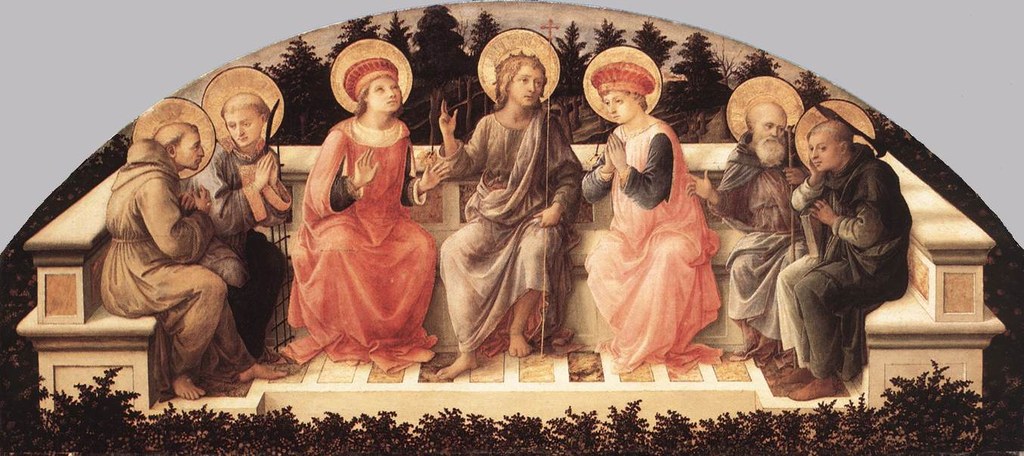
Seven Saints by Fra Filippo Lippi
Fra Filippo Lippi's Seven Saints, painted about 1450-53 and now in the National Gallery in London, is one of the most revealing works in the artist's Medici patronage. At first glance it appears to be an imaginative gathering of seven holy men in a wooded landscape. In fact, every saint has a connection with a member of the Medici family, turning the panel into a subtle form of dynastic devotion.[1]
The painting was almost certainly made as a pendant to Lippi's Annunciation, also in the National Gallery. The two panels are almost identical in size, share a Medici provenance and were probably installed together in one of the family's Florentine residences, perhaps as overdoor paintings.[1] The National Gallery describes the saints as talking and interacting almost as though Lippi were painting an animated group portrait. They did not live at the same time, so the gathering is deliberately ahistorical. Their shared space represents a sacred community rather than a historical event.[1]
That artificial gathering is precisely what makes the picture useful. Lippi translates family names and patron saints into a heavenly genealogy. The Medici do not need to appear as living portraits because their spiritual counterparts stand in for them. The panel therefore connects religious devotion, family identity and palace decoration with unusual economy. It also demonstrates how strongly Renaissance viewers associated personal names with particular saints and how art could turn those associations into a coherent programme.
At a Glance
- ArtistFra Filippo Lippi
- TitleSeven Saints
- Datec. 1450-53
- MediumEgg tempera on wood
- Dimensionsapproximately 68 × 153 cm
- Current locationNational Gallery, London
- Collection numberNG667
- Companion panelThe Annunciation, NG666
- Original patronageMedici family
- Probable functionPendant overdoor or comparable palace decoration
- SettingWooded hillside
- Major themePatron saints of members of the Medici family gathered into one sacred community
- Key compositional pointSaints from different periods appear together as though members of one living group
Contents
- What Does the Painting Show?
- Saint John the Baptist
- Saint Anthony Abbot
- The Companion Annunciation
- Overdoor Painting
- Cosmas and Damian as a Visual Pun
- Style and Interaction
- FAQs
- References
What Does the Painting Show?
Seven saints occupy a long horizontal panel. They are not lined up stiffly. Some turn towards one another, some appear to converse and others direct attention elsewhere.
The National Gallery emphasises this social quality, comparing the effect to an animated group portrait.[1] The landscape helps make the impossible meeting plausible. Rather than placing the saints in separate Gothic niches, Lippi gives them one shared environment. That decision creates the visual equivalent of a heavenly assembly.
Who Are the Seven Saints? The group includes Saint Francis, Saint Peter Martyr, Saints Cosmas and Damian, Saint John the Baptist, Saint Lawrence and Saint Anthony Abbot. Their selection is not random. They were all patron saints or name saints connected with members of the Medici family.
The two physician saints, Cosmas and Damian, are especially important because the family name Medici literally means doctors or physicians. The National Gallery catalogue notes that these two saints are given greater scale and prominence, reinforcing the Medici association.[1] The programme therefore operates through both names and visual emphasis.
Saints Cosmas and Damian. Cosmas and Damian were early Christian martyrs traditionally described as physicians who practised without taking payment. They became especially important to the Medici because of the punning association between their profession and the family name. Cosimo de' Medici had an obvious personal connection with Saint Cosmas.
The brothers could therefore function simultaneously as devotional figures and dynastic emblems. Their elevated importance within Seven Saints makes the painting unmistakably Medicean even without portraits of living family members. This is a sophisticated form of visual identity. The family is present through saints whose names and professions echo it.
Saint John the Baptist
John the Baptist was the patron saint of Florence. His inclusion broadens the panel beyond private family devotion. The Medici were a Florentine dynasty, and John embodied the city itself.
He also had particular devotional importance within the family, as other Medici commissions demonstrate. Lippi later included the young Baptist in Medici-associated Adoration imagery. John therefore connects household identity, civic identity and salvation history.
Saint Lawrence. Saint Lawrence was one of the most widely venerated martyrs of the early Church. For the Medici he also carried the resonance of the name Lorenzo. The family repeatedly used saints as spiritual counterparts to individual members. A Lorenzo could look to Saint Lawrence as patron and heavenly namesake. This structure allowed a family group to be represented symbolically without inserting contemporary likenesses into every sacred work.
Saint Francis. Saint Francis appears at the far left. The National Gallery describes his intense meditation on Christ's suffering and the reception of the stigmata.[1] His inclusion adds another mendicant and devotional strand to the group.
The saint's humility also provides a useful counterweight to the worldly power of the patrons who commissioned the picture. Renaissance elite devotion frequently embraced saints whose lives represented poverty and renunciation. That apparent contradiction was not necessarily felt as hypocrisy by contemporary viewers. Powerful patrons could see holy poverty as an ideal precisely because it exceeded ordinary social life.
Saint Peter Martyr. Peter Martyr was a Dominican preacher and martyr. His presence contributes another religious order and another form of sanctity. Unlike Cosmas and Damian, who heal, or Anthony, who withdraws into ascetic life, Peter represents preaching and violent martyrdom.
The variety matters. Lippi is not assembling seven interchangeable holy men. He creates a group whose members embody different models of Christian life.
Saint Anthony Abbot
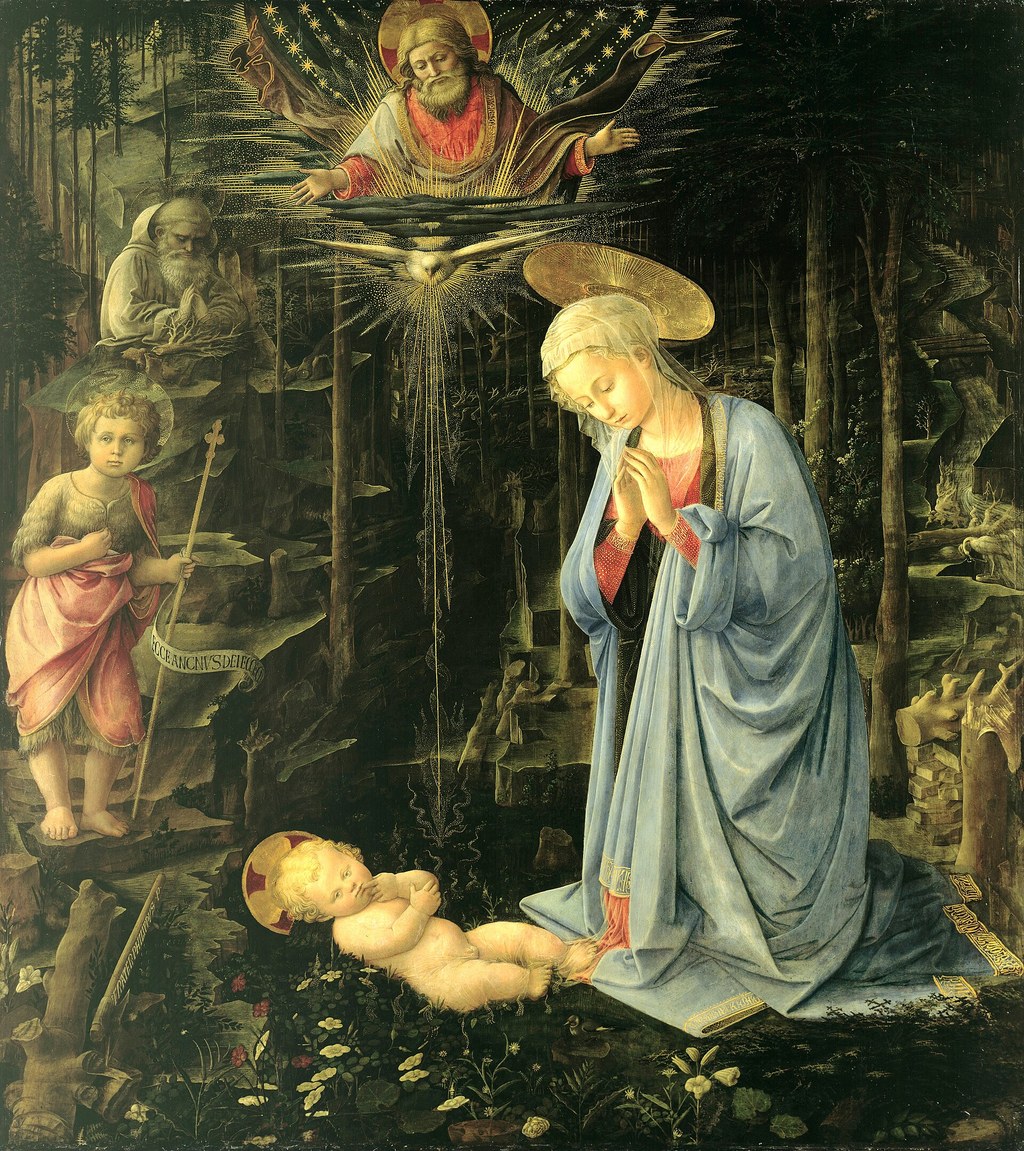
Anthony Abbot represents the ascetic and eremitic tradition. His life was associated with withdrawal into the desert and resistance to temptation. Placed in a wooded setting, he belongs naturally within Lippi's imagined landscape. The saint also links this panel to the artist's repeated interest in contemplative figures placed outside ordinary urban life. That interest later becomes especially powerful in the Berlin Adoration in the Forest.
A Group That Never Existed. The saints lived in different places and centuries. Their meeting is impossible as ordinary history. This is the point.
Renaissance sacred art frequently brought figures from different eras together because heaven operates outside chronological time. The sacra conversazione format uses precisely this logic. A Virgin, ancient martyr, medieval founder and contemporary donor can occupy one coherent space because the image represents spiritual presence rather than an earthly event. In Seven Saints, the same principle becomes dynastic. The saints form a sacred counterpart to the Medici family network.
An Animated Group Portrait. The National Gallery's description of the work as resembling an animated portrait is particularly apt.[1] Lippi avoids the repetitive solemnity that could easily afflict a seven-saint panel. Heads turn.
Figures acknowledge one another. The effect is conversational even though no literal dialogue is recorded. This animation is one of Lippi's great strengths. His religious figures often seem socially alive. The smiling angel in the Lippina provides a famous individual example; Seven Saints extends the principle across a group.
The Companion Annunciation
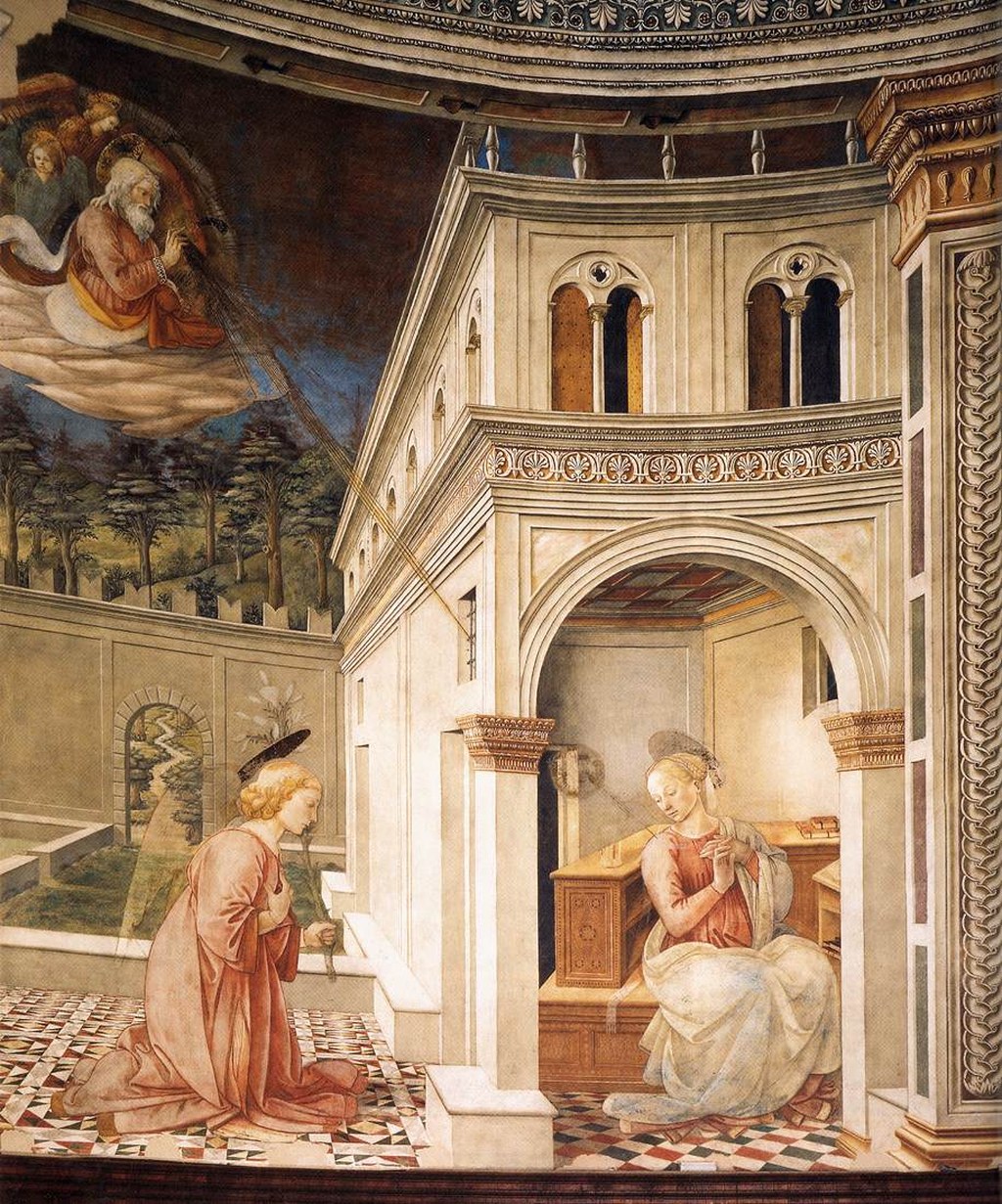
The painting becomes much more intelligible when reunited conceptually with its pendant. The National Gallery catalogue says the Annunciation and Seven Saints were almost certainly painted as a pair and commissioned by a member of the Medici family.[1] Their dimensions are virtually identical.
The Annunciation also contains a Medici device: three feathers within a diamond ring carved into the parapet. Together, the panels combine a universal biblical event with a family-specific sacred network. One panel explains the Incarnation. The other surrounds the household with patron saints.
Why the Pair Matters. Museum display can encourage independent reading because each panel has its own title and catalogue number. Historically, however, the pair formed one programme. That changes interpretation.
The Annunciation is not simply another treatment of Gabriel and Mary. It belonged beside a panel saturated with Medici genealogy. Seven Saints is not merely a line of holy men.
It belonged beside the moment when Mary accepted the Incarnation. The two works reinforce one another. The two panels are best understood together because their probable palace function and Medici iconography are mutually illuminating.
Palazzo Medici and Medici Residences. The exact original installation remains uncertain. The National Gallery catalogue discusses them as Medici overdoor panels and states that they were made for one of the family's Florentine dwellings.[1] That wording should be preserved.
It is safer than inventing one precise doorway without documentary proof. What is secure is the domestic and dynastic context. These were not anonymous church altarpieces. They were embedded in Medici architectural space.
Overdoor Painting
An overdoor has to work differently from a small devotional picture placed at eye level. Its long horizontal format suits an architectural location above a doorway. Figures need strong silhouettes.
The group must remain legible when seen from below or while passing through a room. This helps explain Lippi's clear organisation. The panel can be read quickly as a gathering but rewards closer study of identities and gestures. Architecture therefore shaped composition.
The Wooded Hillside. The landscape is an intriguing choice for a dynastic saint panel. Lippi could have used a palace-like interior or abstract gold ground. Instead, he places the figures outdoors.
The setting softens the formality of the gathering. It also allows the saints to appear as living bodies inhabiting one world. Natural space makes supernatural chronology feel believable. This is a recurring Lippi strategy.
Genealogy Without Portraits. The National Gallery catalogue describes the panel as imbued with genealogical significance.[1] That phrase is important. Genealogy does not require literal family likenesses.
Personal naming in Renaissance Italy created strong links between living people and saints. By assembling the relevant patrons together, the panel can evoke the family as a sacred lineage. The Medici thus appear indirectly. This may be more powerful than conventional donor portraiture because the family is represented through ideal heavenly protectors.
The Medici Device in the Annunciation. The companion Annunciation includes the Medici device of three feathers within a diamond ring. That emblem confirms the dynastic framework of the pair. The combination of impresa and saints is particularly revealing.
One panel identifies the family through emblem. The other identifies it through names. Renaissance patrons possessed several visual languages for identity: heraldry, devices, portraits, saints and inscriptions. Lippi's pair uses more than one.
Cosmas and Damian as a Visual Pun
The special prominence of Cosmas and Damian shows how wordplay could become iconography. Because medici means doctors, the physician saints carried a direct linguistic connection to the family. Their scale makes the pun visual.
They do not need an explanatory inscription for a knowledgeable Florentine viewer. The device demonstrates the cultural sophistication expected of the original audience. The painting could reward viewers who understood names, saints and family history.
Dynasty and Devotion. It would be simplistic to reduce the panel to political propaganda. The Medici were genuine participants in the devotional culture of fifteenth-century Florence. At the same time, religion was inseparable from family identity and social authority.
A palace image could be sincerely sacred and dynastically meaningful at once. The categories do not cancel each other. This is one of the most useful lessons of Medici patronage generally.
Lippi's Relationship with the Medici. Fra Filippo Lippi received important Medici support across his career. The family commissioned or owned works associated with private devotion, palace decoration and the cult of the Magi. Seven Saints belongs to that wider network.
Its existence demonstrates confidence in Lippi's ability to create imagery tailored closely to family identity. That kind of commission required more than technical skill. The painter had to understand patron saints, devices, setting and dynastic meaning.
A Different Kind of Portraiture. Lippi's secular double portrait in the Metropolitan Museum constructs family identity through faces, heraldry, clothing and domestic architecture. Seven Saints constructs it through holy namesakes. Comparing the two reveals how flexible Renaissance identity could be.
A patron could be represented physically or spiritually. Both strategies connected the individual to larger family structures. The Medici panel is therefore a kind of portrait without contemporary faces.
Style and Interaction
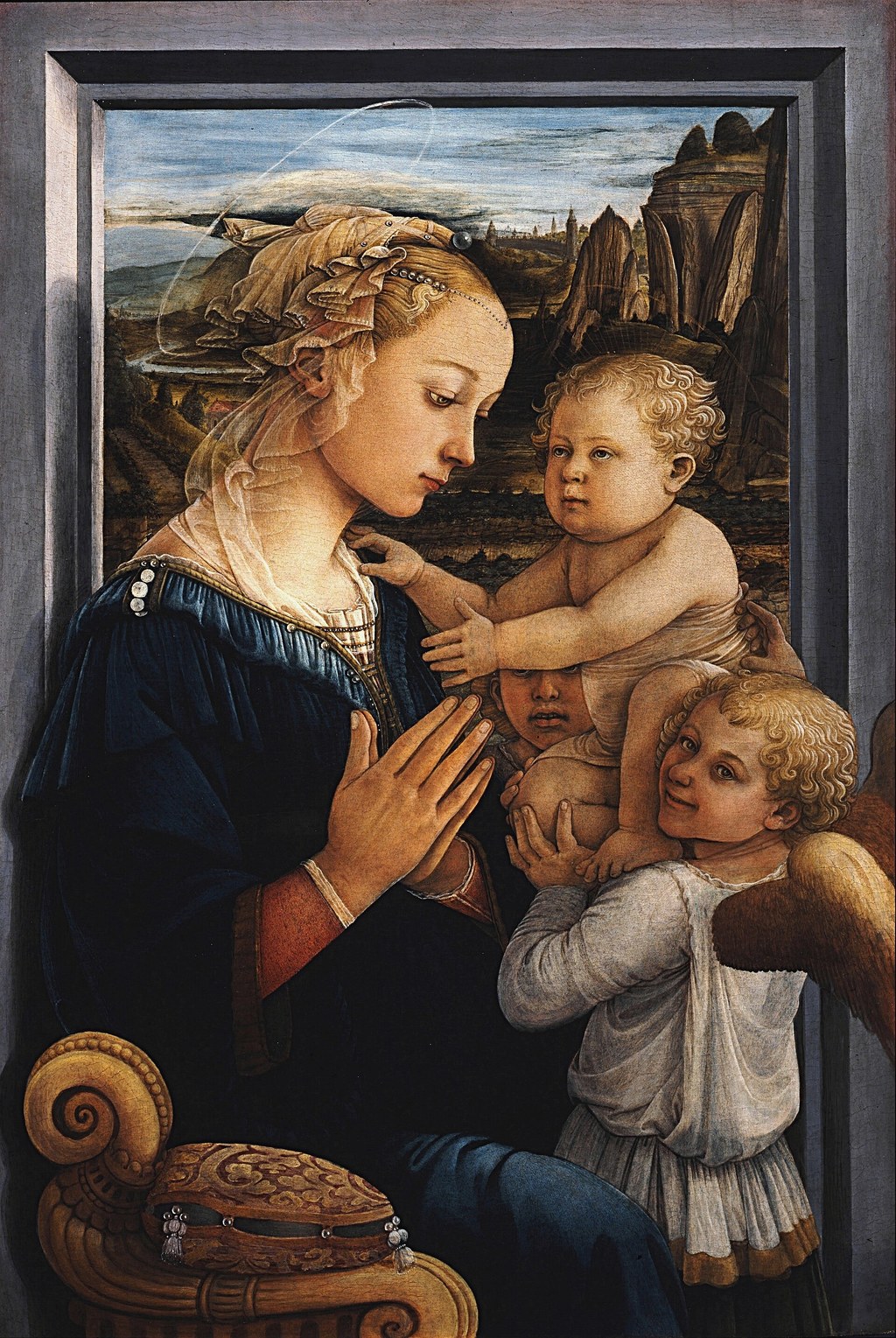
Lippi's mature style is evident in the graceful heads, clear contours and social naturalism of the group. The saints feel less like rigid icons than people capable of attention and reaction. That quality later became important to Botticelli. Lippi showed that sacred dignity did not require immobility. Gesture could humanise without secularising.
Egg Tempera and Surface. The medium is egg tempera on wood. The technique supports crisp contour and controlled detail. For a long architectural panel, that clarity is especially useful. Faces remain differentiated while clothing and landscape create variety. The paint works with the narrow format rather than against it.
Why Seven Saints Matters. Seven Saints matters because it is one of Fra Filippo Lippi's clearest demonstrations of how Renaissance family identity could be translated into sacred imagery. Its seven holy figures form an impossible historical gathering but a coherent heavenly genealogy. Their names and professions connect directly with the Medici.
The companion Annunciation anchors that family programme in the central Christian story of the Incarnation. The probable overdoor function then embeds both paintings within the family's everyday architectural environment. Within Lippi’s oeuvre, the painting adds something genuinely distinctive.
It is not simply another saint painting. It is a study of dynastic devotion, naming, palace display and sacred group portraiture. It also provides one of the best bridges into the broader Fra Filippo Lippi and the Medici feature.
FAQs
Discussion
What stands out to you most about Seven Saints in relation to Filippo Lippi's wider career?
Reader Insights
Notice how the page connects close visual detail with patronage, workshop practice and the wider Renaissance setting.
Which comparison elsewhere in the cluster helps clarify this work or theme most strongly?
Join the Conversation
Have a thought or observation about Seven Saints? Share it below. Thoughtful responses may be added to this section.
References
- National Gallery, London, Fra Filippo Lippi, Seven Saints, NG667. View Source
- Dillian Gordon, The Fifteenth Century Italian Paintings, National Gallery catalogue, “Medici (Overdoor?) Panels,” 2003.
- National Gallery, Fra Filippo Lippi, The Annunciation, NG666. View Source
- Jeffrey Ruda, Fra Filippo Lippi: Life and Work with a Complete Catalogue, 1993.
- Megan Holmes, Fra Filippo Lippi: The Carmelite Painter, Yale University Press, 1999.