 by Tom Gurney
Tom Gurney BSc (Hons) is an art history expert with over 20 years experience
Published on June 19, 2020 / Updated on October 2, 2026
Email: tomgurney1@gmail.com / Phone: +44 7429 011000
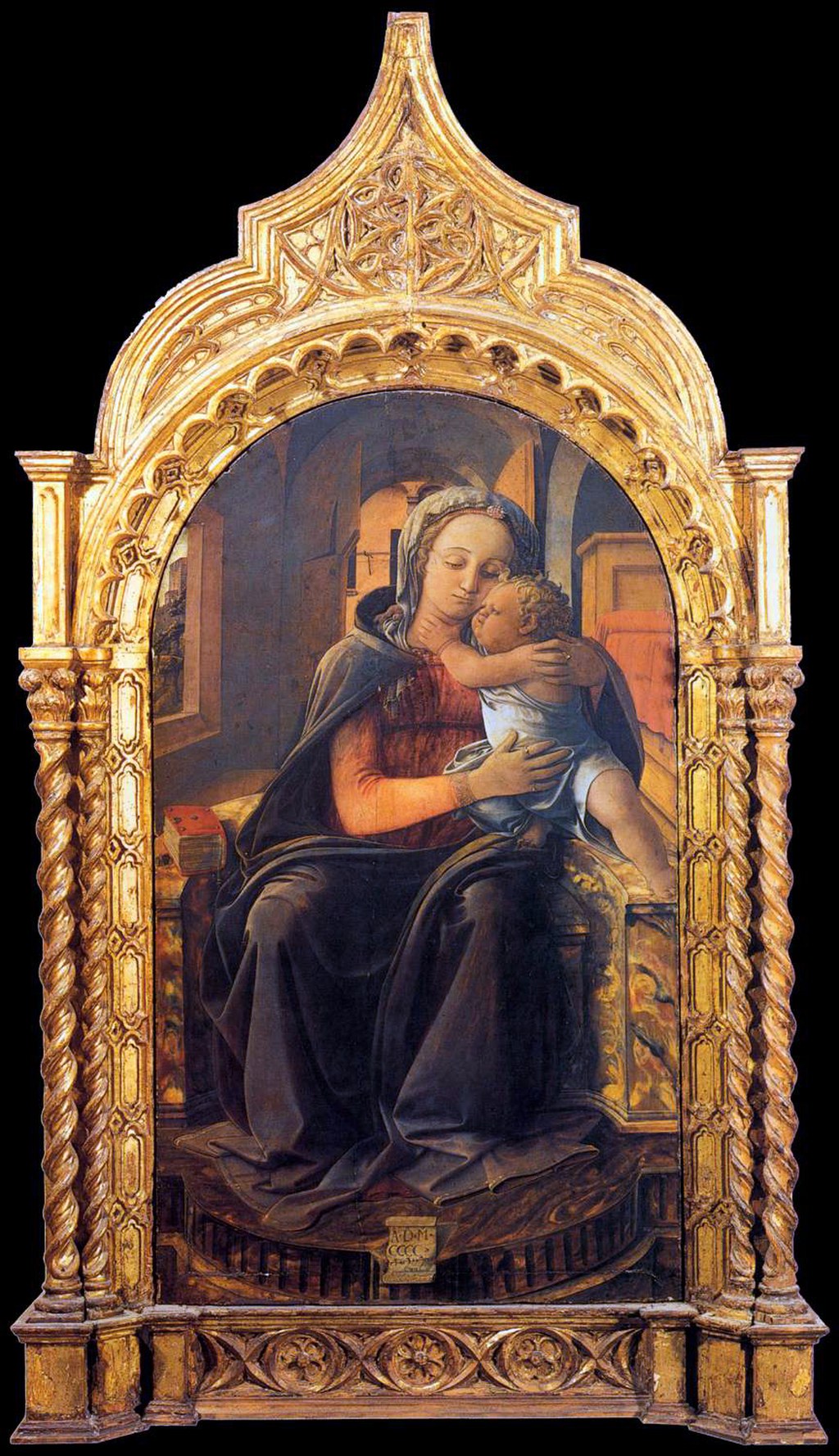
Madonna of Tarquinia by Fra Filippo Lippi
Fra Filippo Lippi’s Madonna of Tarquinia, dated 1437 and now in Palazzo Barberini in Rome, is one of the most important fixed points in the chronology of his career. Unlike many early Renaissance paintings whose dates must be reconstructed from style, this panel announces its year directly in an inscription.[1] That certainty makes it a benchmark. Everything around it in Lippi’s development can be compared with a work we know belongs to 1437.
The painting shows the Virgin enthroned inside a richly furnished interior, holding the Christ Child close to her. A window opens onto a distant landscape, while furniture, textiles, marble and a book turn the sacred image into an unusually tangible domestic environment. The work has long been associated with Giovanni Vitelleschi, the powerful churchman and military commander who was Archbishop of Florence and came from Tarquinia, then known as Corneto. Modern exhibitions have treated Vitelleschi’s patronage as central to understanding why a major Florentine painter produced such an innovative Madonna for a destination beyond Florence.
The painting is also crucial stylistically. The Gallerie Nazionali’s 2017–18 exhibition presented it as the work in which Lippi’s early debt to Masaccio encounters the innovations of Donatello and begins to evolve into a personal language of elegant line, changing colour and graceful ornament. In 1917, art historian Pietro Toesca rediscovered and identified the panel at Santa Maria di Valverde in Tarquinia. A century later, the museum built an exhibition around that act of rediscovery, the patron Vitelleschi and the painting’s place in Lippi’s development.
More recently, the panel returned temporarily to Tarquinia for a 2024–25 exhibition, reconnecting the work with the city and patron for which it was probably made. The Madonna of Tarquinia therefore offers several histories at once: sacred image, dated masterpiece, elite commission, stylistic turning point, rediscovered object and modern cultural homecoming.
At a Glance
- ArtistFra Filippo Lippi
- TitleMadonna of Tarquinia
- SubjectEnthroned Virgin and Child
- Date1437
- MediumOil on panel
- Current collectionGallerie Nazionali di Arte Antica, Palazzo Barberini, Rome
- Probable patronCardinal Giovanni Vitelleschi
- Probable original destinationTarquinia/Corneto, connected with Vitelleschi
- Key significanceSecurely dated work central to reconstructing Lippi’s early career
- Rediscovered1917 by Pietro Toesca at Santa Maria di Valverde, Tarquinia
- Major influences visibleMasaccio, Donatello and northern European/Flemish painting
- Distinctive featuresMonumental figures, domestic interior, perspectival furniture, landscape view, light effects and surviving historical frame
- Recent exhibition historyFocus of major 2017–18 Palazzo Barberini exhibition and returned to Tarquinia in 2024–25
Contents
- What Does the Painting Show?
- Giovanni Vitelleschi
- Masaccio
- The Interior
- Marble
- Tradition and Innovation
- The 2017–18 Exhibition
- Patronage Between Florence and Tarquinia
- From Lost Attribution to Canonical Masterpiece
- Why the Madonna of Tarquinia Matters
- FAQs
- References
What Does the Painting Show?
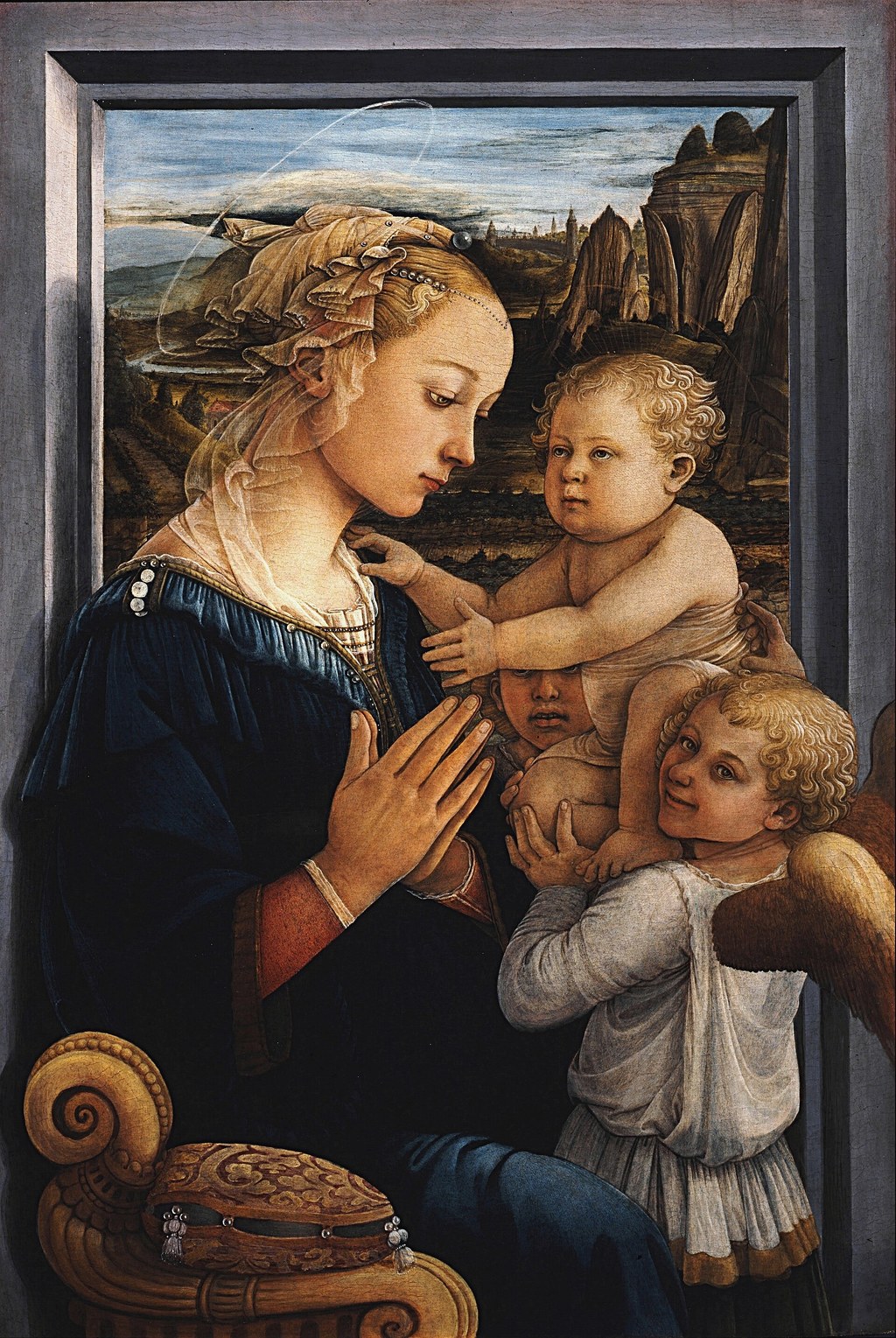
Mary sits on a monumental throne within an interior. She holds Christ with both tenderness and physical solidity. The Child is not arranged as a remote emblem. His body moves actively against his mother, creating a sense of affectionate human contact.
Around them, the room is carefully described. A bed, book, marble surfaces, architecture and textiles turn the interior into a believable inhabited environment. Through a window, the eye moves outward to landscape.
This combination is fundamental to the painting’s character. Lippi joins the hieratic tradition of the enthroned Madonna with the observational detail of domestic life. The Virgin is Queen and mother at the same time.
The Date 1437. The inscription records the year 1437. This makes the Madonna of Tarquinia one of the most useful chronological anchors in Fra Filippo’s oeuvre. Art historians often reconstruct a painter’s development by comparing undated works to the few objects that carry documents or inscriptions.
A fixed date therefore has value far beyond one painting. If another work resembles the Tarquinia Madonna closely in figure type, drapery, architecture or handling, the comparison can help establish its approximate place in Lippi’s career. The date also allows us to connect the painting with contemporary events and commissions. The Barbadori Altarpiece was commissioned in the same year. Together, the two works show Lippi operating at a high level immediately after the period associated with his return from northern Italy.
Giovanni Vitelleschi
The likely patron, Giovanni Vitelleschi, was no ordinary churchman. He was Archbishop of Florence and a powerful papal military figure, often described as a warrior cardinal. Vitelleschi was born in Corneto, the city later renamed Tarquinia.
His connection with both Florence and his native city makes him a convincing intermediary for a commission from Lippi. The 2017 Palazzo Barberini exhibition placed the patron prominently in its interpretation, presenting documentary and contextual material around his role.[1] Patronage helps explain the painting’s combination of Florentine innovation and non-Florentine destination. A powerful cleric could carry metropolitan artistic culture back to his place of origin.
Tarquinia and Corneto. In Lippi’s lifetime the city was commonly known as Corneto. The modern title Madonna of Tarquinia reflects the later name. This is worth explaining because historical documents may refer to Corneto while modern museum and tourism material uses Tarquinia.
The panel’s relationship with the city is unusually strong. It was rediscovered there in the twentieth century, probably had an earlier connection there, and has repeatedly returned as a focus of local cultural identity. The 2024–25 exhibition in Palazzo Vitelleschi gave the painting another temporary homecoming. That return was not simply a travelling-loan convenience. It reunited the panel with the architectural and historical world of its likely patron.
A Turning Point in Lippi’s Style. Palazzo Barberini’s centenary exhibition described the painting as fundamental to Lippi’s development.[1] The key transition is from an early style formed under the imposing example of Masaccio towards a more personal manner. Masaccio remains visible in the weight of the figures.
Mary and Christ occupy space as solid bodies rather than decorative silhouettes. At the same time, Lippi becomes increasingly interested in elegant contour, luminous colour and surface detail. The result does not reject Masaccio.
It transforms him. This is one of the most important patterns in early Renaissance art: innovation rarely means starting from nothing. Lippi takes existing advances in volume and perspective and reshapes them around his own sensibility.
Masaccio
Fra Filippo grew up within the Carmelite environment of Santa Maria del Carmine in Florence. There he encountered Masaccio’s Brancacci Chapel frescoes. Those paintings demonstrated a new power of light, weight and spatial coherence.
The Madonna of Tarquinia retains that inheritance. The Child in particular has a substantial body. His limbs occupy space convincingly, and his mass feels closer to sculpture than to the weightless infants of some earlier Gothic painting. Mary is equally solid. Her throne becomes an architectural structure supporting a physical body.
Donatello. The 2017 exhibition also emphasised Donatello as a crucial comparison. Donatello’s sculpture offered Lippi another language of bodily movement and expressive naturalism. The Christ Child’s lively pose has often encouraged comparison with the vigorous children in contemporary Florentine sculpture.
The connection is not merely that painted bodies resemble statues. Donatello demonstrated how gesture could make sacred figures psychologically immediate. Lippi adapts that lesson to painting. Christ becomes a child in motion rather than a miniature adult placed ceremonially on Mary’s lap.
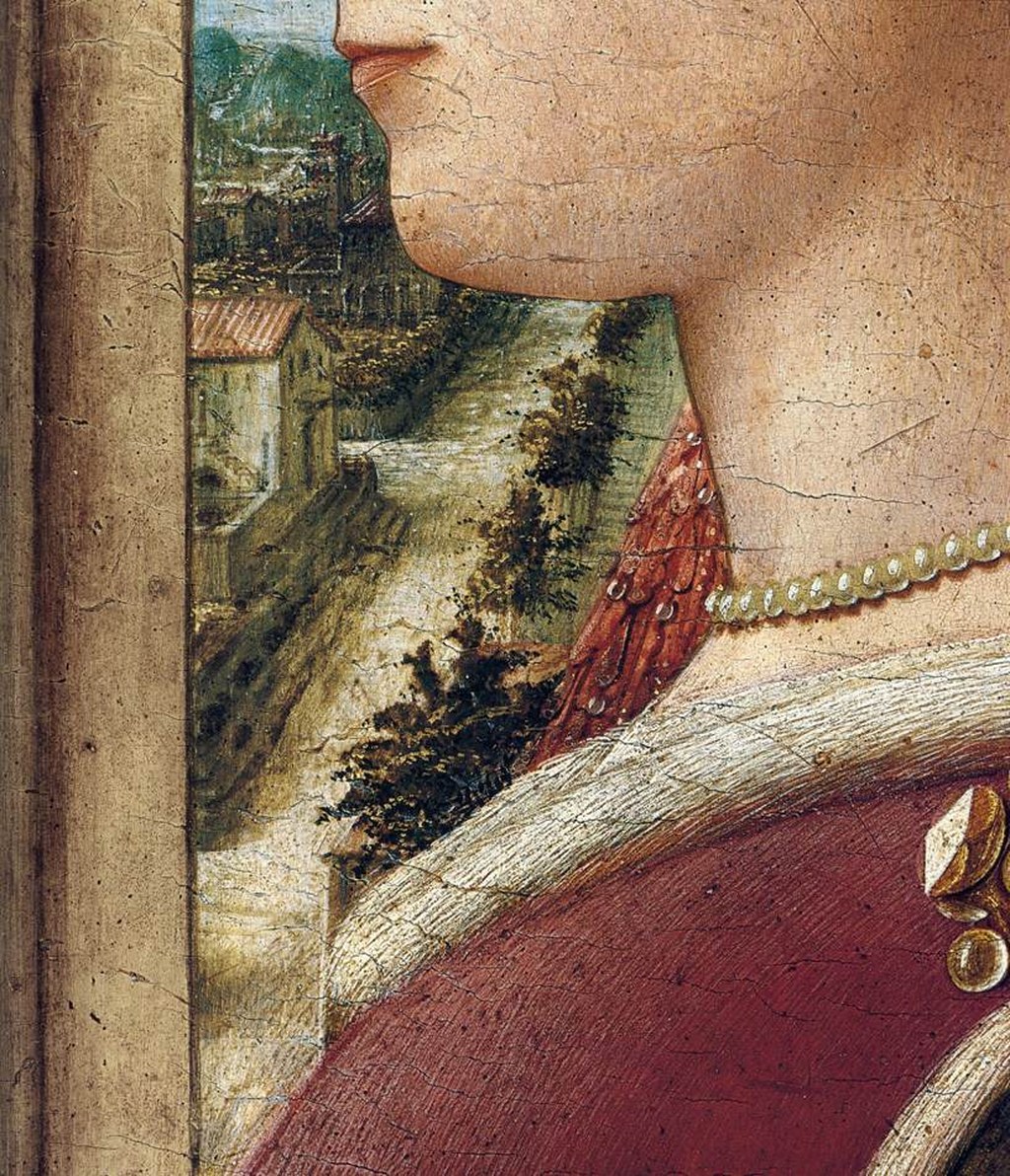
Northern European Influence. The painting also contains details often associated with northern European art. The open window and distant landscape broaden the space beyond the room. Light behaves as though Lippi is studying how it passes through an interior and reflects from surfaces.
Objects receive close attention. The marble, book, furniture and textiles have a descriptive intensity less central to Masaccio’s monumental language. Florence had access to imported northern works and luxury goods through international trade.
Lippi’s period outside Florence may also have widened his visual experience. Claims that he personally travelled to Flanders remain speculative and should not be treated as established biography. Direct travel is unnecessary to explain influence. Images and ideas circulated.
The Interior
The room is one of the painting’s great innovations. Religious figures had long been placed in architectural settings, but Lippi makes this one feel domestic. The bed is particularly important.
It suggests a private chamber rather than a church-like throne room. This domesticity brings Mary close to the experience of elite Renaissance women. She is enthroned, yet she also inhabits a household. The sacred and ordinary overlap. That strategy would become increasingly important in Renaissance devotional art.
The Bed. The bed creates depth through strong foreshortening. Its receding form helps construct the room around Mary. It also adds a note of intimacy.
Beds were major pieces of furniture in elite households and could be among their most visible and valuable possessions. In a Marian image, a bed can evoke motherhood and domestic life without needing to become a fixed symbol. Its presence simply makes the Virgin’s space recognisable as lived. The object also gives Lippi an opportunity to demonstrate perspective.
The Book. A substantial book rests within the composition. Books commonly appear with the Virgin in Renaissance painting because Mary could be represented as a reader of scripture or devotional text. Here the book contributes to both iconography and material realism.
Its binding, thickness and placement make it a specific object. As with the bed, Lippi’s achievement lies in allowing symbolic potential and observational detail to coexist. The room contains things one could imagine touching. That tactile quality strengthens the Incarnational theme. Christian divinity enters the material world.
Marble
The throne and architectural surfaces allow Lippi to display different textures. Marble is solid, cool and prestigious. Its veining and polished character contrast with cloth and flesh.
This interest in materials again suggests a painter looking beyond purely structural perspective. Lippi wants space to be convincing because its surfaces differ. A room is made not only from lines but from substances.
Light. Light is one of the most sophisticated elements of the panel. The landscape opening and interior architecture provide plausible sources and transitions. Illumination helps separate Mary from the surrounding room.
Her face becomes a visual centre. Rather than modelling the figures with the stark sculptural force associated with Masaccio, Lippi increasingly lets light wrap forms more softly. This shift contributes to the grace of his mature style.
The Landscape. The window offers a view beyond the interior. Landscape creates distance while preventing Mary’s throne from becoming visually claustrophobic. It also joins domestic space to a larger world.
The device has northern parallels, but Lippi integrates it into a distinctly Florentine concern with perspective and spatial continuity. The landscape is small relative to the figures. Its purpose is not to become an independent landscape painting. It expands the sacred interior.
The Frame. Research conducted for the 2017 exhibition strengthened the understanding of the painting’s frame. Palazzo Barberini reported evidence supporting the originality of the current frame and suggested it may have been designed by Lippi himself.[1] If so, this is extremely important.
Frames are often treated as secondary accessories, yet Renaissance painters worked within structures that shaped the visual transition between image and architecture. An original frame preserves part of the object that is lost in many museum paintings. Its more traditional Gothic form also creates an instructive contrast with the innovative naturalism inside. The painting can therefore be modern in pictorial space while retaining inherited forms at its edge.
Tradition and Innovation
This combination is typical of transitional Renaissance art. Historical narratives sometimes imply that artists suddenly abandoned Gothic tradition when perspective arrived. The Madonna of Tarquinia shows otherwise.
Old and new coexist. A traditional devotional format can contain innovative perspective. A Gothic-inflected frame can surround a modern interior.
An enthroned Madonna can behave like a tender mother. Lippi’s originality lies partly in refusing to choose between these systems. He makes them work together.
Pietro Toesca and the 1917 Rediscovery. The modern history of the painting changed dramatically in 1917. Art historian Pietro Toesca identified the panel at Santa Maria di Valverde in Tarquinia as a work by Fra Filippo Lippi. The rediscovery illustrates how attribution shapes cultural value.
A painting can exist physically for centuries while knowledge of its authorship fades. Once connected securely to a major artist, it enters a different scholarly and museum history. The 2017–18 Palazzo Barberini exhibition marked one hundred years since Toesca’s identification.[1] Importantly, it did not merely celebrate the attribution. It revisited documentation, patronage, frame and early style.
Why Rediscovery Matters. The term “rediscovery” can sound romantic, but it refers to a serious scholarly process. Toesca had to recognise characteristics of Lippi’s style and place the work within a developing historical framework. Subsequent scholars then tested, refined and contextualised the attribution.
The fact that the painting is securely dated made it especially consequential. Once accepted as Lippi, it became evidence for dating other works. In this way, attribution can reorganise an entire artist’s chronology. The Tarquinia panel is a textbook example.
The 2017–18 Exhibition
Palazzo Barberini organised Altro Rinascimento. Il giovane Filippo Lippi e la Madonna di Tarquinia from November 2017 to February 2018.[1] The exhibition compared the painting with a tightly selected group of works connected with young Lippi, Masaccio and Donatello. This curatorial structure is revealing.
Rather than treating the Madonna as an isolated masterpiece, the exhibition used it as a lens through which to examine artistic formation. The title’s idea of an “other Renaissance” encouraged attention to experimentation beyond a simple canonical sequence. Lippi appears not as an artist mechanically following Masaccio but as someone combining multiple visual cultures.
Return to Tarquinia, 2024–25. The painting returned temporarily to Tarquinia from December 2024 to March 2025. It was shown in Palazzo Vitelleschi, now home to the archaeological museum and historically connected with the patronal story. Such returns can be powerful because they reintroduce geographic meaning lost in a permanent museum collection.
A work labelled “Madonna of Tarquinia” becomes physically present in Tarquinia again. Visitors can understand why the name matters. The event also generated fresh public and scholarly attention, renewing interest in the painting’s history and patronage.
Why a Secure Date Changes an Artist’s Catalogue. A dated Renaissance painting can function almost like a calibration point. Suppose an undated Madonna shares the Tarquinia panel’s handling of drapery, facial type, throne construction and light. Scholars can ask whether those similarities place it near 1437 or whether differences indicate an earlier or later stage. The process is not mechanical.
Artists can return to older ideas, assistants can imitate a master, and restoration can alter appearance. Nevertheless, a secure date sharply reduces uncertainty. The Tarquinia panel is therefore important even for paintings that have nothing to do with Tarquinia. It helps organise them. This is why exhibition curators repeatedly use it as a central comparison when discussing the young Lippi.
Patronage Between Florence and Tarquinia
Vitelleschi’s biography also helps explain why the commission is historically revealing. As Archbishop of Florence, he occupied a position within the city where Lippi was building his career. As a native of Corneto, he retained a strong connection with a place outside Florence.
A commission could therefore carry Florentine artistic innovation across regional networks through the mobility of a patron. This is an important corrective to histories of the Renaissance that treat Florence as a sealed artistic laboratory. Florentine painters worked for patrons whose careers connected cities, courts and church offices. Objects travelled with those networks. The Madonna of Tarquinia is a particularly vivid example because its style is deeply Florentine while its identity became inseparable from another city.
A Sacred Interior for an Elite Patron. The domestic richness of the room may also be understood in relation to elite private devotion. The panel is not enormous like a high-altarpiece. Its intimate vertical format makes sustained close viewing plausible.
For an elite patron, a sacred image could occupy a palace or private devotional environment in which luxurious surroundings were not inconsistent with prayer. Lippi mirrors that world inside the painting. Mary inhabits a refined chamber.
Yet the Child’s physicality prevents the scene from becoming a display of furniture. The theological focus remains Incarnation. Sacred presence enters the same material world as books, cloth, marble and beds. That is one reason Lippi’s domesticity feels so consequential rather than merely decorative.
From Lost Attribution to Canonical Masterpiece
The twentieth-century history of the panel also shows that museum canons are constructed through research. Before Toesca’s identification, the painting existed but did not occupy its modern place in Lippi’s career. After 1917, the dated inscription made the attribution especially powerful.
Once accepted, the panel could be used to reassess related works. Exhibitions, catalogues and museum display then reinforced its status. By the time Palazzo Barberini marked the centenary of rediscovery in 2017, the Madonna was no longer a newly found curiosity.[1]
It had become one of the works through which scholars explain Lippi’s development. That transformation is itself an important part of the painting’s modern history. A masterpiece is not only painted. It is also rediscovered, attributed, researched, exhibited and repeatedly reinterpreted.
Comparison with the Barbadori Altarpiece. The Madonna of Tarquinia and Barbadori Altarpiece both belong to 1437. That makes comparison especially valuable. The Barbadori work is a large church altarpiece with saints and angels.
The Tarquinia Madonna is narrower and more intimate. Yet both demonstrate Lippi’s concern with unified space and monumental bodies. The difference shows his adaptability. He could use the same developing artistic language for distinct patrons and functions.
Comparison with Madonna and Child with Two Angels. Comparing the 1437 panel with the Lippina of around 1465 reveals nearly three decades of development. The Tarquinia Madonna is more architectonic. The throne and interior structure the image heavily.
In the later Uffizi painting, architecture recedes and emotional intimacy becomes even more dominant. Line grows more elegant. Halos become extremely discreet. The comparison gives an unusually clear view of Lippi’s development from 1437 to his later mature style.
Why the Madonna of Tarquinia Matters
The Madonna of Tarquinia matters because it gives art historians something precious: certainty. The date 1437 anchors Lippi’s chronology. From that anchor, we can see an artist absorbing Masaccio, responding to Donatello, exploring northern European detail and already moving towards the grace that would define his mature work.
The painting also opens a rich patronage story through Giovanni Vitelleschi. Its domestic interior expands understanding of how sacred figures could enter contemporary life. Its original frame preserves evidence often lost.
Its twentieth-century rediscovery demonstrates how scholarship changes the status of objects. And its recent return to Tarquinia reconnects the painting with the place embedded in its modern name. Few works combine stylistic, documentary and modern reception history so neatly. It deserves to be counted among the core paintings through which Lippi’s development is understood.
FAQs
Discussion
What stands out to you most about Madonna of Tarquinia in relation to Filippo Lippi's wider career?
Reader Insights
Notice how the page connects close visual detail with patronage, workshop practice and the wider Renaissance setting.
Which comparison elsewhere in the cluster helps clarify this work or theme most strongly?
Join the Conversation
Have a thought or observation about Madonna of Tarquinia? Share it below. Thoughtful responses may be added to this section.
References
- Gallerie Nazionali di Arte Antica, Palazzo Barberini, “Madonna di Tarquinia,” collection record and institutional object history. View Source.
- Gallerie Nazionali di Arte Antica, Palazzo Barberini, Altro Rinascimento. Il giovane Filippo Lippi e la Madonna di Tarquinia, exhibition documentation, 2017–18. View Source
- Exhibition press dossier, Gallerie Nazionali Barberini Corsini, 2017. View Source
- Exhibition catalogue and institutional materials for 1437. La Madonna di Filippo Lippi, Tarquinia e il cardinale Vitelleschi, 2024–25.
- Jeffrey Ruda, Fra Filippo Lippi: Life and Work with a Complete Catalogue, London, 1993.
- Megan Holmes, Fra Filippo Lippi: The Carmelite Painter, Yale University Press, 1999.