 by Tom Gurney
Tom Gurney BSc (Hons) is an art history expert with over 20 years experience
Published on June 19, 2020 / Updated on October 14, 2023
Email: tomgurney1@gmail.com / Phone: +44 7429 011000
Introduction
The Brancacci Chapel in the church of Santa Maria del Carmine is one of the defining monuments of the Early Renaissance. Begun in the 1420s by Masolino da Panicale and Masaccio and completed decades later by Filippino Lippi, the chapel preserves a layered cycle centred on the life of Saint Peter, but its importance reaches far beyond iconography because it became one of the principal places where later Florentine artists studied bodies, perspective, gesture and narrative.
Official Florentine sources describe Masaccio’s contribution as an extraordinary pictorial revolution, contrasting the solidity, profound humanity and rigorous spatial construction of his figures with Masolino’s more elegant late-Gothic language. Filippino Lippi, working roughly sixty years later, then had to adapt his own figures and architecture to the severe visual world already established on the walls.
The chapel therefore contains more than one artistic moment. It is simultaneously a Brancacci family foundation, a Carmelite devotional space, a collaborative experiment between two painters of different generations, an unfinished commission reshaped by politics, a later Filippino completion, a site damaged by fire and architectural alteration, and a laboratory through which generations of Renaissance artists learned to see. Its modern appearance is also the result of survival rather than untouched continuity.
Parts of the original upper programme were destroyed in the eighteenth century, the church suffered a devastating fire in 1771, major conservation campaigns altered how the frescoes could be understood, and the most recent diagnostic and restoration programme, begun in 2022, continued the long process of studying and protecting the cycle. To understand the Brancacci Chapel properly, it is therefore necessary to move between patronage, theology, painting, architecture and conservation. Masaccio’s frescoes are central, but they gain much of their significance from the larger system around them.
At a Glance
- LocationSanta Maria del Carmine, Florence
- ChapelBrancacci Chapel, right transept
- Original family patronFelice Brancacci
- Main subjectLife of Saint Peter and the early Church
- Initial campaignc. 1423 onward
- Principal early artistsMasolino da Panicale and Masaccio
- Later completionFilippino Lippi, around 1480s–1485
- Major Masaccio scenesThe Tribute Money, Expulsion from the Garden of Eden, Baptism of the Neophytes, Saint Peter Healing the Sick with His Shadow, Distribution of Alms and Death of Ananias, and portions of Raising of the Son of Theophilus and Saint Peter Enthroned
- Major Masolino sceneTemptation of Adam and Eve, with other surviving and lost contributions
- Major Filippino rolecompletion of unfinished scenes and substantial work on the right wall
- Lost materialvault and upper lunettes destroyed in eighteenth-century remodelling
- Firemajor church fire in 1771
- Major modern restoration1981–90
- Recent conservation campaign2022–24, with subsequent reopening
- Later reputationmajor training ground for Florentine artists, including Leonardo and Michelangelo
Contents
- Santa Maria del Carmine
- Why Saint Peter?
- The Beginning of the Fresco Campaign
- The Chapel as One Environment
- Continuous Narrative
- A Possible Tax Interpretation
- Baptism of the Neophytes
- Poverty and Dignity
- Masaccio’s Grouping
- Landscape
- Masaccio and Brunelleschi
- Felice Brancacci’s Political Fall
- A Chapel of Three Artists
- The 1981–90 Restoration
- Seeing Fresco up Close
- Fra Filippo Lippi
- The Chapel and the History of the Body
- A Monument of Collaboration
- Why the Brancacci Chapel Matters
- Frequently Asked Questions
- References and Research Sources
Santa Maria del Carmine
Santa Maria del Carmine was founded by Carmelites in Florence in 1268, and construction continued over a long period before the church was consecrated in 1422. The building developed through the support of the commune and wealthy Florentine families, placing private family chapels inside a broader institutional and urban religious environment. The Brancacci Chapel occupied the right arm of the transept and had existed before the fresco campaign began. FeelFlorence notes that the chapel itself had been built before 1386, which means Masaccio and Masolino were decorating an established family space rather than creating an entirely new architectural setting.
Felice Brancacci. The fresco cycle was commissioned by the merchant Felice Brancacci, whose family had long associations with the chapel. MUS.E identifies him directly as the patron who engaged Masolino and Masaccio in the 1420s, while Florentine institutional material places the beginning of the painted programme around 1423. Brancacci’s patronage combined family commemoration with public religious display. Like many elite Florentine chapels, the space was devotional but also social, because it embedded the family name within one of the city’s important churches and secured ongoing liturgical attention for the patronal household.
A Merchant Patron and the Oltrarno. Felice Brancacci belonged to the mercantile world that made Florentine art possible. His chapel was not a private domestic room but a semi-public sacred space within a working Carmelite church in the Oltrarno, an area whose social texture included artisans, labourers and poorer residents as well as wealthy families. This context matters when reading scenes concerned with charity, money and the early Christian community. Images of almsgiving, healing and economic obligation would have been encountered within a district where material inequality and collective religious life were visible realities rather than abstract themes.
Why Saint Peter?
The cycle focuses principally on Saint Peter, one of Christ’s apostles and traditionally regarded as the first pope. His life offered a sequence of episodes involving authority, preaching, healing, baptism, charity, punishment and martyrdom, making him an especially useful figure for a chapel interested in the institutional identity of the Church. The Carmelite context strengthened that choice because Peter could embody the active Church in the world. His miracles and acts of charity present sacred authority through practical action rather than through remote hierarchy alone.
The Early Church as a Model. Several scenes concentrate on the communal life described in Acts. Peter heals the sick, distributes resources, baptises converts and confronts dishonesty within the Christian community, presenting apostolic authority as inseparable from care, discipline and social organisation. This gives the fresco cycle a moral structure extending beyond biography. The chapel is not simply “the life of Saint Peter” illustrated scene by scene; it presents the creation of Christian community after the Fall and through Christ’s redemptive mission.
Adam and Eve within a Peter Cycle. Masolino’s Temptation of Adam and Eve and Masaccio’s Expulsion from the Garden of Eden initially seem anomalous in a chapel devoted largely to Peter. Smarthistory explains the theological connection through salvation history: humanity’s Fall creates the need for Christ’s sacrifice, while Peter represents the Church through which salvation is transmitted historically. The Genesis scenes therefore provide the beginning of the larger Christian story. Peter’s ministry gains meaning because it belongs to the response to humanity’s original separation from God.
The Beginning of the Fresco Campaign
FeelFlorence states that decoration began around 1423 with Masolino and Masaccio, while recent restoration evidence has helped clarify Masolino’s role in the early upper campaign. The chronology remains complex because much of the earliest material was later destroyed. It is safer to imagine the project developing in stages during the middle of the 1420s rather than assigning every surviving wall to one perfectly documented sequence.
Masolino’s Initial Role. Masolino was older than Masaccio and already an established painter. Evidence from surviving sinopie and the lost upper register supports an important role for him in launching the programme rather than treating him as an assistant to a younger genius. This matters because the chapel’s artistic revolution emerges through collaboration. Masaccio enters a project in which another painter is already active, then produces frescoes whose bodily and spatial language becomes the dominant reference point for later generations.
Masaccio’s Arrival. Masaccio’s contribution changed the visual character of the chapel dramatically. FeelFlorence highlights the solidity, profound humanity and rigorous perspective of his figures, qualities that distinguish his scenes from Masolino’s greater elegance and late-Gothic refinement. The difference is visible without reducing either painter to caricature. Masolino remains sophisticated, but Masaccio gives bodies and spaces a gravity that later artists recognised as something fundamentally new.
Fresco as a Medium. Fresco requires pigment to be applied to wet plaster, binding colour chemically with the wall as the surface dries. Large cycles are therefore planned in sections, or giornate, and the artist must work decisively within the time allowed by each prepared area. Masaccio’s broad modelling and strong forms suit the medium exceptionally well. His figures retain clarity at architectural scale, while large masses of light and shadow make bodies legible from across the chapel.
The Chapel as One Environment
The frescoes should not be understood as independent museum pictures. They occupy opposing walls, respond to real architectural boundaries and form sequences encountered as the viewer turns within the chapel. This environmental character is central to Masaccio’s achievement. Perspective and light make painted spaces seem related to one another and to the actual room, giving the cycle a degree of unity that reproduction on separate pages inevitably weakens.
The Original Upper Register. The chapel originally contained more painted material than survives. Upper lunettes and vault decoration were destroyed during eighteenth-century remodelling, removing important parts of the original narrative and particularly diminishing our knowledge of Masolino’s contribution. Surviving sinopie preserve traces of some lost compositions. These preparatory drawings are crucial because they allow modern researchers to reconstruct elements of a programme that no longer exists in paint.
Lost Evangelists and Peter Scenes. The vault included Evangelists, while the upper lunettes contained additional narratives connected with Peter. Their destruction means the modern chapel begins visually lower than the fifteenth-century ensemble did. This loss alters interpretation. What now appears as a relatively compact sequence was once part of a taller and more enveloping sacred environment.
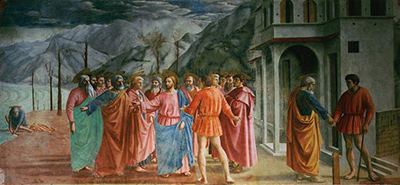
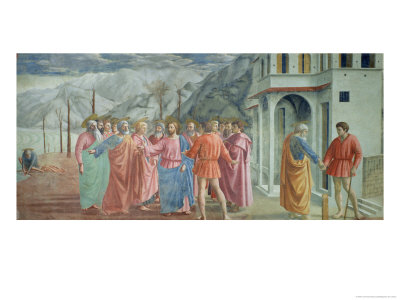
The Tribute Money. The Tribute Money is perhaps the most famous fresco in the chapel and one of Masaccio’s clearest demonstrations of continuous narrative. Peter appears three times and the tax collector twice as the story moves from demand, to miraculous retrieval of the coin, to payment, all within one continuous landscape and architectural field. The central group around Christ controls the scene despite the chronological complexity. Smarthistory notes that the apostles form a semicircle around him and that the perspectival construction draws attention towards Christ’s face, making theology and geometry reinforce one another.
Continuous Narrative
The technique of showing several moments in one image had ancient and medieval precedents. Masaccio’s achievement lies in making those temporal stages inhabit one physically convincing world rather than separating them into unrelated zones. Perspective therefore supports storytelling. The spectator understands that one Peter acts at different moments even though all versions remain visible simultaneously.
The Tax Collector. The tax collector stands with his back partly towards the viewer and occupies the foreground assertively. His pose contributes to depth because the body turns in space rather than remaining parallel to the picture plane. Smarthistory also connects his stance with contrapposto and the new Renaissance interest in bodily balance. Such figures make the biblical scene feel populated by people who stand according to gravity rather than according to decorative convention.
Cast Shadows. One of the most revolutionary aspects of The Tribute Money is its consistent directional light. Figures cast shadows across the ground, making them appear subject to the same environmental conditions rather than individually illuminated sacred icons. The effect produces something close to weather. Light seems to cross the entire scene from one direction, connecting mountains, architecture and human bodies within a common atmosphere.
Perspective and Christ. The perspective draws the eye towards Christ without turning the fresco into a rigid diagram. Architectural recession and bodily grouping work together, allowing the sacred centre to emerge naturally from the visual structure. This is characteristic of Masaccio at his best. Mathematical organisation is present, but viewers experience it as clarity rather than calculation.
A Possible Tax Interpretation
Smarthistory notes that the biblical tax story could resonate with contemporary Florentine disputes over taxation, particularly during expensive conflict with Milan and debates involving ecclesiastical exemption. Such parallels should not be turned into a single definitive key to the fresco. They demonstrate instead how a biblical narrative could acquire additional urgency in a city where questions of civic finance and religious authority were current.
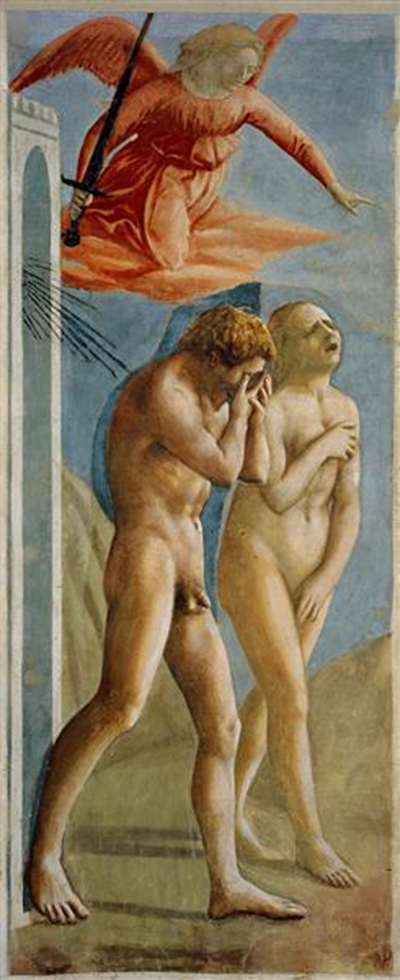
The Expulsion from the Garden of Eden. Masaccio’s Expulsion occupies a narrow field beside The Tribute Money but has an emotional force disproportionate to its scale. Adam covers his face while Eve cries out and attempts to cover her naked body, allowing shame, guilt and grief to be carried through the whole figure rather than through facial expression alone. The scene has little decorative distraction. Masaccio concentrates on bodies moving forward beneath divine judgement, making the expulsion feel immediate and irreversible.
The Angel. The angel above Adam and Eve is strongly foreshortened, projecting into the spectator’s space as the couple move outward from Eden. This creates a directional force that pushes the figures physically towards the viewer’s world. The movement is therefore theological and spatial at once. Humanity leaves paradise and enters the fallen condition shared by the chapel’s spectators.
Masolino’s Temptation. Across the chapel, Masolino’s Temptation of Adam and Eve offers a famous contrast. His figures are elegant, calm and idealised, inhabiting a more refined vision of Eden. The pairing is historically powerful because Masaccio’s Expulsion seems brutally physical beside it. Yet both images belong to one salvation narrative, and their stylistic difference became one of the great visual lessons available to later artists.
Baptism of the Neophytes
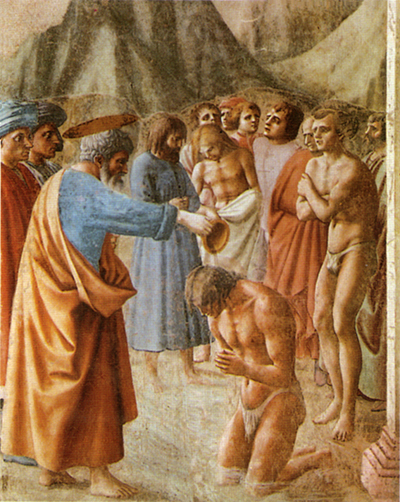
In Baptism of the Neophytes, Masaccio turns sacramental history into an observation of bodily experience. One convert kneels while another figure waits and visibly shivers, giving the scene a naturalistic detail whose importance lies precisely in its ordinariness. The cold body makes the sacrament believable. Masaccio does not trivialise baptism; he intensifies it by showing that sacred transformation happens to flesh exposed to water and temperature.
Saint Peter Healing the Sick with His Shadow. This fresco places Peter in an urban street where the sick wait to be healed by the passing of his shadow. The architecture gives the miracle a recognisable civic setting, drawing apostolic history closer to the streets of Renaissance Florence. The marginal and disabled figures are treated with unusual seriousness. Their bodies occupy the foreground as forcefully as Peter himself, making charity and suffering central parts of the visual narrative.
Miracle in the City. The urban setting is crucial because holiness appears through movement among ordinary people. Peter’s power is not isolated within a church interior; it travels through public space. This makes the scene particularly appropriate to the social theology of the cycle. Apostolic authority is demonstrated through service and healing.
Distribution of Alms and Death of Ananias. Distribution of Alms and Death of Ananias combines two morally linked events. Peter distributes money to those in need while Ananias lies dead after dishonestly withholding property that had supposedly been dedicated to the Christian community. Masaccio therefore turns economic behaviour into sacred narrative. Charity, ownership and moral obligation become visible through bodies arranged within a communal space.
Poverty and Dignity
The poor are not decorative accessories. Masaccio gives them physical presence and individual gravity, allowing need itself to become a serious subject. This is one of the fresco cycle’s most socially compelling qualities. Sacred history includes people whose significance lies in vulnerability rather than authority.
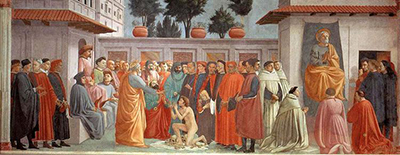
Raising of the Son of Theophilus and Saint Peter Enthroned. This large scene became one of the clearest examples of the chapel’s interrupted history. Masaccio began the composition, but Filippino Lippi completed significant areas decades later. The narrative combines the miraculous raising of Theophilus’s son with Peter enthroned as a figure of ecclesiastical authority. Miracle and institution therefore occupy one extended composition.
Two Generations on One Wall. The fresco is particularly valuable because Masaccio and Filippino can be studied within the same pictorial field. Filippino had to respect the earlier scale, architecture and visual gravity while finishing a scene for a later Florentine audience. The result is not seamless in the sense of erasing difference. Its importance lies in making continuity visible.
Peter Enthroned. Peter’s enthronement provides a visual statement about the authority of the Church. The apostle is no longer shown only acting among the poor or performing miracles but occupying a formal institutional role. This broadens the cycle’s theology. Peter embodies both charitable action and ecclesiastical continuity.
Masaccio’s Grouping
Masaccio’s figures are repeatedly organised as social bodies rather than isolated individuals. Apostles cluster around Christ, converts gather around baptism, the poor form communities of need and urban spectators create believable civic environments. This grouping is one reason the chapel became so influential. Later painters could study how to coordinate many bodies without sacrificing clarity.
Facial Individuality. The figures often possess distinct physiognomies, but Masaccio avoids turning sacred narrative into a gallery of distracting portraits. Individual heads enrich the group while remaining subordinate to the action. This balance became fundamental to Renaissance narrative painting. Humanity increases without dissolving compositional order.
Gesture. Gesture carries much of the storytelling. Christ points, Peter responds, tax collectors demand, sufferers reach and mourners recoil, allowing actions to remain intelligible across architectural distance. Masaccio’s gestures are generally economical. One arm or turned head can organise an entire relationship, which contributes to the solemnity of the cycle.
Architecture. Architecture in the Brancacci Chapel is functional rather than ornamental. Buildings establish urban context, perspectival recession and narrative zones, but rarely overwhelm the people who inhabit them. This restraint distinguishes Masaccio’s spatial intelligence. Architecture serves human action rather than becoming a display of technical virtuosity.
Landscape
The mountainous backgrounds of scenes such as The Tribute Money use atmospheric recession to extend space beyond the central human group. Distant forms lose clarity, creating a convincing depth that complements linear perspective. Landscape therefore participates in the same naturalistic system as bodies and buildings. The world appears continuous from foreground figure to distant mountain.
Halos in Perspective. Even halos are treated as objects seen in space rather than as flat symbolic discs pasted against the surface. Smarthistory notes their elliptical appearance in The Tribute Money, reinforcing the sense that sacred attributes obey viewpoint. This is a small but revealing innovation. Symbolic form yields to optical experience without losing its religious function.
Feet and Grounding. Masaccio pays unusual attention to feet. Foreshortened feet and cast shadows convince viewers that bodies stand on a ground plane rather than hover before it. Such details are easy to overlook, but they are fundamental to the revolution in bodily credibility. Monumentality begins at the point where a figure actually meets the earth.
Masaccio and Donatello. The sculptural quality of these figures naturally invites comparison with Donatello. Bodies possess weight, turn in space and respond to gravity in ways that make them feel almost carved despite being painted on flat plaster. Masaccio’s broader Florentine network helps explain this cross-media language. Painting, sculpture and architecture were all redefining what it meant for a human figure to occupy space.
Masaccio and Brunelleschi
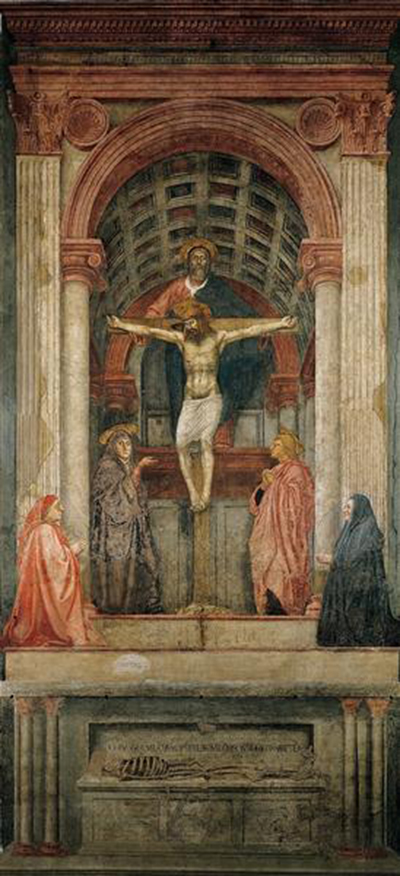
Brunelleschi’s perspective experiments form the other obvious comparison. The chapel does not display geometry as spectacularly as the later Holy Trinity, but perspectival thinking allows streets, groups and architecture to belong to one coherent environment. Masaccio therefore converts an architectural way of thinking into narrative fresco. Space becomes the stage upon which human and sacred action can appear natural.
Masolino’s Contribution. Masolino remains essential to the cycle even though Masaccio became the more influential figure historically. His elegant forms establish a visual counterpoint and preserve evidence of how refined late-Gothic language continued to operate alongside emerging Renaissance naturalism. His role in the initial campaign also means that the chapel should never be described as a Masaccio project subsequently decorated by others. It began collaboratively from the outset.
The Difference between Masolino and Masaccio. FeelFlorence describes the contrast directly: Masolino’s figures retain late-Gothic elegance, while Masaccio’s possess solidity, deep humanity and rigorous perspective. That institutional formulation is useful because it identifies a real stylistic shift without dismissing Masolino. The chapel preserves transition rather than simple replacement.
Why the First Campaign Stopped. The original decoration remained incomplete. Masolino left for other work, Masaccio eventually travelled to Rome and died young, while Felice Brancacci’s later political difficulties further complicated the patronal history. The result was a major unfinished sacred interior. Its incompletion became one of the conditions that made Filippino Lippi’s later contribution necessary.
Felice Brancacci’s Political Fall
Brancacci’s position became increasingly difficult as Medici power grew. His exile altered the status of the family chapel and helped sever the original patronal framework that had supported the fresco cycle. Political history therefore entered the physical history of the paintings. Artistic incompletion cannot be explained solely through painters’ schedules.
Rededication to the Madonna del Popolo. FeelFlorence records that in the middle of the fifteenth century the chapel was rededicated to the Madonna del Popolo and received a thirteenth-century Madonna and Child altarpiece. This changed the devotional identity of the space while the Peter frescoes remained on the walls. The chapel thus accumulated new meanings rather than preserving one fixed fifteenth-century programme unchanged.
Filippino Lippi. Filippino Lippi eventually completed the cycle around the 1480s, with FeelFlorence giving approximately 1485 for the conclusion. His task was extraordinarily demanding. He had to work in a chapel whose earlier paintings had already acquired enormous authority, and his contribution needed to function beside both Masolino and Masaccio without appearing disconnected.
Filippino’s Adaptation. FeelFlorence notes that Filippino adapted figures and architectural elements to the severity of Masaccio’s frescoes. This is one reason his Brancacci paintings differ from some of his more decorative mature work elsewhere. The earlier environment imposed a discipline on the later painter.
A Chapel of Three Artists
The completed Brancacci Chapel therefore contains three distinct hands working across roughly six decades. Masolino represents one sophisticated late-Gothic route, Masaccio introduces a new monumentality and Filippino demonstrates how a later Renaissance painter could negotiate an already historical style. Few monuments allow artistic development to be observed so directly within one room.
The Eighteenth-Century Remodelling. The chapel underwent major changes in the eighteenth century. Upper frescoes were destroyed when the architecture was remodelled, permanently reducing the original programme. The loss is especially serious because modern viewers cannot reconstruct every relationship between upper and lower scenes. What survives is a partial Renaissance system.
The Fire of 1771. Santa Maria del Carmine suffered a devastating fire in 1771, after which much of the church interior was rebuilt. FeelFlorence records the major renewal of the church following the disaster, while the Brancacci Chapel survived with its principal frescoes intact despite damage and later intervention. That survival is extraordinary. The chapel now functions partly as a Renaissance island within a substantially later church interior.
Nineteenth- and Twentieth-Century Condition. Centuries of smoke, dirt, overpainting, protective coatings and changing restoration practice gradually altered the surfaces. Some details became difficult to read, colours shifted and the distinction between original and later intervention could be obscured. This history matters because Masaccio’s reputation depends strongly on light and modelling. Anything that darkens or flattens the surface directly affects interpretation.
The 1981–90 Restoration
The major restoration campaign of 1981–90 became a landmark in modern understanding of the chapel. Cleaning and technical study revealed colours, modelling and details that had been obscured, while also clarifying aspects of attribution and working method. The restoration transformed reproductions of Masaccio for an entire generation. The frescoes appeared lighter, more chromatically varied and more spatially coherent than many earlier photographs had suggested.
Removal of Later Additions. One of the most famous consequences involved the Expulsion, where later coverings over the nudity of Adam and Eve were removed. Restoring the original bodies returned an essential part of Masaccio’s conception of vulnerability and shame. The intervention demonstrated how moral censorship can change formal meaning. The nakedness is not incidental; it is central to the theology of the Fall.
The 2022–24 Diagnostic Campaign. The City of Florence established scaffolding and a new conservation campaign beginning in January 2022 to study the frescoes at close range and address local deterioration. Officials reported issues including small plaster detachments, scratches, lifting and losses in the paint layer, while describing the overall cycle as being in good condition. The project made conservation itself temporarily part of the visitor experience because the public could access the scaffolding and view the frescoes at unusually close range. This created a rare moment in which technical study and public interpretation occurred simultaneously.
The Chapel after Restoration. By 2026 Florence’s official tourism material described the Brancacci Chapel as regularly accessible again after the long restoration programme. Its modern status is therefore not simply that of an old masterpiece preserved passively. The monument continues to be inspected, conserved, reinterpreted and mediated through new technologies.
Seeing Fresco up Close
Close access changes how Masaccio’s technique can be understood. Brushwork, giornata boundaries, corrections and surface abrasion become visible in ways impossible from floor level. This technical intimacy reinforces an important point: the monumental illusion was created through rapid physical labour on plaster. Renaissance innovation was intellectual and manual at once.
The Chapel as an Academy before Academies. The Brancacci Chapel became famous as a place where artists studied. Later Florentine tradition repeatedly describes painters drawing from Masaccio’s figures, using the walls as practical lessons in anatomy, drapery, grouping and spatial construction. This role made the chapel function almost like an informal academy. The paintings transmitted knowledge directly across generations.
Leonardo da Vinci. Florentine institutional material includes Leonardo among the later artists associated with study of the chapel. The connection is plausible within a culture in which ambitious painters learned by drawing major local works repeatedly. What Leonardo could encounter there was not one formula but a system: bodies with weight, coherent light, controlled gesture and narrative groups organised in space.
Michelangelo. Michelangelo’s relationship with Masaccio became even more famous. Smarthistory explicitly notes that he came to the Brancacci Chapel to sketch Masaccio’s work, while Florentine institutional accounts likewise place him among the artists formed by study of the frescoes. The connection helps explain why Masaccio’s bodily gravity remained powerful long after perspective itself had become standard practice. Michelangelo could transform that monumentality into an even more muscular language.
Fra Filippo Lippi
Fra Filippo Lippi had especially close ties to Santa Maria del Carmine because he entered the Carmelite community there as a young man. The Brancacci frescoes therefore formed part of the environment in which his artistic identity developed. His later painting is more lyrical than Masaccio’s, but bodily weight and spatial coherence show how the chapel’s innovations could be absorbed without literal imitation.
Filippino Lippi as Heir. Filippino’s later completion makes this transmission almost familial. As Fra Filippo’s son, he entered a chapel deeply connected with both his father’s formation and Masaccio’s historical prestige. His work there therefore represents inheritance on several levels at once: artistic, institutional and personal.
Why Artists Kept Returning. The chapel remained useful because its lessons were concrete. A student could examine how feet meet the ground, how drapery reveals knees, how a figure turns away from the viewer, how cast shadows establish light and how a group can occupy space without confusion. These are practical problems every figure painter must solve. Masaccio’s answers remained relevant even when style changed dramatically.
The Chapel and the History of Perspective. The Brancacci Chapel occupies a crucial position between the San Giovenale Triptych and the Holy Trinity. It demonstrates Masaccio using perspective in large-scale narrative before pushing the system into a more spectacular architectural illusion at Santa Maria Novella. The chapel therefore shows perspective becoming flexible. Geometry is absorbed into storytelling rather than displayed as an isolated innovation.
The Chapel and the History of the Body
Its importance to the Renaissance body may be even greater. Adam, Eve, apostles, beggars, converts and tax collectors all possess physical mass and individual response. Masaccio extends dignity beyond ideal sacred figures. The human body becomes capable of carrying sin, cold, illness, authority and charity with equal seriousness.
The Chapel and Social History. The Peter cycle repeatedly returns to economic and communal themes. Taxation, almsgiving, shared property, deceit, poverty and healing turn abstract doctrine into questions about how a community should function. This social content makes the frescoes especially resonant within the urban environment of Florence. Christianity appears as a system of relationships between bodies, money and authority.
The Chapel and Salvation History. At the same time, the cycle remains theological. Adam and Eve establish the Fall, Christ appears as the source of salvation, Peter carries apostolic authority forward and the early Church converts that authority into ritual and communal practice. The chapel therefore moves from humanity’s loss towards institutional redemption. Individual scenes gain meaning through that larger arc.
The Chapel and Patronage. Felice Brancacci’s family commission also reminds us that such theological programmes depended upon wealth. A merchant could fund an image of Christian poverty and charity as part of his own family commemoration. This is not necessarily hypocrisy. Renaissance patronage often joined sincere devotion, social status, memorial ambition and concern for salvation within the same act.
A Monument of Collaboration
Masaccio’s fame can make the chapel seem like his personal masterpiece, but its history resists that simplification. Masolino helped launch the programme, Masaccio transformed its visual language and Filippino later completed the surviving cycle. Patrons, friars, plasterers, assistants and restorers also shaped what we see. The monument is collaborative across centuries.
A Monument of Loss. The chapel is equally a monument of absence. Lost lunettes, destroyed vault frescoes, damaged surfaces and incomplete documentary evidence mean that modern interpretation begins from a fragment. That incompleteness should not be hidden. It explains why attribution and chronology remain subjects of research rather than settled lists.
Why the Brancacci Chapel Matters
The Brancacci Chapel matters because it makes the Early Renaissance visible as a lived transformation. Within one small architectural space, Masolino’s elegance, Masaccio’s monumental naturalism and Filippino Lippi’s later adaptation coexist across several generations. Masaccio’s contribution is revolutionary because body, light and perspective operate together with unusual consistency. Figures cast shadows, feet meet the ground, architecture recedes logically and emotional states become bodily experiences rather than decorative gestures.
The cycle also expands the social possibilities of sacred painting. Poor people, sick bodies, tax collectors and converts share the walls with Christ and apostles, turning the history of Saint Peter into a meditation on how Christian community acts in the world. Its later influence magnifies that achievement. Leonardo, Michelangelo and generations of Florentine artists could study the frescoes directly, making the chapel one of the principal mechanisms through which Masaccio’s innovations entered the wider Renaissance. Finally, the monument’s survival is itself remarkable. Political change, rededication, eighteenth-century destruction, the 1771 fire and centuries of restoration altered the chapel profoundly, yet enough remains for the original revolution to be experienced with extraordinary force.
Frequently Asked Questions
Discussion
Use this space to discuss Brancacci Chapel | Masaccio, its source evidence and how it fits into Masaccio's wider cluster.
Keep comments focused on close looking, attribution language, object evidence and page-specific caveats.
Reader Insights
Which detail on this page most changes how you read the work?
How does this page connect to Masaccio's paintings, fresco technique or Florentine setting?
Where should the wording stay cautious because the source evidence is qualified?
Join the Conversation
Share your reading of Brancacci Chapel | Masaccio below.
References and Research Sources
- Comune di Firenze, Cappella Brancacci – L’ultimo restauro, for church history, conservation history and the 2022–24 campaign. View Source
- FeelFlorence, Brancacci Chapel, for chronology, artist distinctions and Filippino Lippi’s completion. View Source
- MUS.E Firenze, The Brancacci Chapel, for Felice Brancacci’s commission and current institutional interpretation. View Source
- Smarthistory, Masaccio, The Tribute Money and Expulsion in the Brancacci Chapel, for continuous narrative, perspective, cast shadows, iconography and later study by Michelangelo. View Source
- Smarthistory, Masaccio, Expulsion of Adam and Eve from Eden in the Brancacci Chapel, for the theological role of the Genesis scene within the Saint Peter cycle. View Source
- FeelFlorence, Santa Maria del Carmine, for the 1771 fire and later reconstruction of the church interior. View Source
- FeelFlorence, 2026 museum updates, for current post-restoration public access. View Source