 by Tom Gurney
Tom Gurney BSc (Hons) is an art history expert with over 20 years experience
Published on June 19, 2020 / Updated on October 14, 2023
Email: tomgurney1@gmail.com / Phone: +44 7429 011000
Introduction
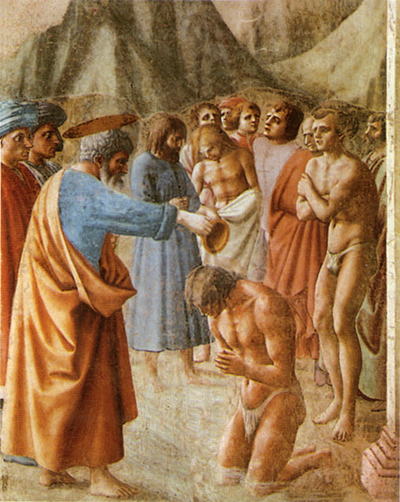
Masaccio’s Baptism of the Neophytes is one of the most celebrated frescoes in the Brancacci Chapel because it transforms a sacramental subject into a scene of immediate bodily experience. Saint Peter baptises new converts while other men wait nearby, and among them one figure shivers so visibly from the cold that a small physical reaction has become one of the defining images of Early Renaissance naturalism.
The fresco belongs to the larger Saint Peter cycle in Santa Maria del Carmine, where apostolic authority is repeatedly shown through action. Peter preaches, heals, distributes resources and baptises, so the chapel presents the early Church not as an abstract institution but as a community formed through ritual, charity and embodied participation. Masaccio’s great achievement is to make baptism feel both sacred and physically real.
Water touches bodies, men wait, one convert kneels, another trembles, and the surrounding group reacts with a degree of natural observation that gives the sacrament unusual immediacy. The famous shivering figure is therefore not merely an anecdotal detail. He demonstrates Masaccio’s broader conviction that sacred history becomes more compelling when human bodies behave according to ordinary physical conditions.
At a Glance
- ArtistMasaccio
- TitleBaptism of the Neophytes
- Datec. 1425–27
- MediumFresco
- LocationBrancacci Chapel, Santa Maria del Carmine, Florence
- SubjectSaint Peter baptising converts
- Biblical contextActs of the Apostles
- Central actionbaptism by Saint Peter
- Famous detaila waiting convert shivering from cold
- Key themesconversion, sacrament, bodily vulnerability and formation of the early Church
- Key formal qualitiesgrouped figures, physical observation, modelling through light and coherent spatial organisation
- Wider chapel relationshipcomplements Peter’s healing, charity and institutional scenes
- Historical importancelandmark in the naturalistic representation of the human body within sacred narrative
Contents
- The Biblical Context
- Water
- Vulnerability
- Conversion as Process
- Cold and Light
- Drapery and Nakedness
- Relationship to Almsgiving
- Sacrament and Incarnation
- Observation
- Donatello
- Michelangelo
- Why the Shivering Figure Is So Important
- Why Baptism of the Neophytes Matters
- Frequently Asked Questions
- References and Research Sources
The Biblical Context
The fresco belongs to the early chapters of Acts, where Peter preaches publicly and large numbers of people join the Christian community. Baptism becomes the visible rite through which conversion is formalised and the new believer enters the Church. Masaccio does not illustrate one verse mechanically. Instead, he represents the broader apostolic activity of baptism as a communal event, allowing the sacrament to function as both theological act and human gathering.
Why Baptism Matters in the Peter Cycle. Peter’s role in baptism is central to the chapel’s broader theology. He is not merely the recipient of Christ’s authority but the apostle through whom that authority becomes institutional practice. The scene therefore complements miracles and acts of charity elsewhere in the chapel. Healing restores bodies, almsgiving addresses poverty and baptism incorporates people into the Christian community itself.
The Kneeling Convert. At the centre of the sacramental action, a convert kneels before Peter. His lowered body establishes humility and submission while also making the physical act of baptism legible from a distance. The posture gives the scene structural clarity. Peter remains upright and authoritative, while the candidate’s lowered position makes the hierarchy of priestly action immediately understandable.
Saint Peter. Peter stands with monumental gravity as he administers the sacrament. His authority is calm rather than theatrical, consistent with Masaccio’s broader treatment of apostolic leadership in the chapel. The importance of the action comes through gesture and physical relation rather than dramatic expression. Peter’s body provides stability around which the rest of the group is organised.
Water
Water is the central material of the sacrament, and Masaccio treats it as a physical substance acting upon bodies. The kneeling figure receives it directly, while the waiting converts remain visibly conscious of temperature and exposure. This physicality reinforces the theology of baptism. Spiritual transformation occurs through a material element touching the human body.
The Shivering Figure. The most famous figure stands among the waiting converts and visibly shivers from cold. His body contracts, his arms draw inward and his posture communicates discomfort without requiring explanatory text. This detail became famous because it feels observed rather than invented symbolically. Masaccio appears to have looked at how a cold body behaves and then used that observation inside a sacred scene.
Why the Shiver Matters. The shivering figure is not necessary to identify the subject. A more conventional painter could have shown baptism perfectly clearly without including any sign of temperature. Masaccio includes it because bodies respond to environment. That choice turns the sacrament from an abstract rite into an event taking place in real physical conditions.
Naturalism and Theology. The detail also demonstrates that naturalism does not compete with religion. By making the convert more physically believable, Masaccio makes the sacrament more immediate. The viewer can imagine cold water, waiting and exposure. Sacred experience therefore becomes embodied rather than remote.
Vulnerability
The neophytes are partially or fully unclothed, which makes them physically vulnerable. Their bodies are exposed not for ideal beauty but because baptism requires direct contact with water. This vulnerability gives the scene emotional force. Entering the Christian community is represented as an experience involving humility and bodily openness.
The Nude Body. Masaccio’s treatment of the nude differs from the heroic classical tradition that later Renaissance artists would develop more fully. His converts are ordinary male bodies participating in a ritual rather than idealised displays of anatomy. This makes the fresco especially important. The nude becomes a carrier of lived religious experience rather than only beauty or heroism.
Group Structure. The waiting converts form a compact group around the central baptism. Their bodies overlap and turn in different directions, creating depth while preserving a clear focus on Peter and the kneeling candidate. Masaccio therefore solves a difficult compositional problem. A crowd remains legible because bodily variation is organised rather than random.
Standing, Kneeling and Waiting. Different postures correspond to different stages of participation. One man is actively receiving baptism, others wait, and Peter performs the sacrament. The composition therefore makes time visible through bodily position. Ritual unfolds as sequence without requiring several separate scenes.
Conversion as Process
The scene suggests that conversion is not only a moment but a process. Candidates wait, approach, receive baptism and enter the Christian community. Masaccio’s grouping makes this progression humanly believable. The sacrament belongs to a social rhythm rather than to one isolated miracle.
Faces and Individuality. The neophytes possess distinct faces and responses. Some watch closely, others wait with concentration and the shivering man is absorbed in physical discomfort. This variation prevents the group from becoming a generic crowd. Conversion is communal, but each person remains an individual body.
Masculine Bodies. The scene is populated mainly by adult male converts, consistent with the apostolic narrative and the ritual context represented. Masaccio uses differences in age, build and posture to prevent repetition. These varied bodies contribute to the fresco’s humanism. Sacred community is constructed from recognisably different people rather than identical types.
Light. Directional light models shoulders, torsos and faces with remarkable clarity. This gives the partially nude bodies sculptural volume and makes their physical condition more immediate. As elsewhere in the Brancacci Chapel, light is a structural device. It binds separate figures into one environment.
Cold and Light
The shivering figure becomes especially effective because the body is exposed to the same environmental conditions as everyone else. Light defines the flesh while the implied cold reminds us that bodies are sensitive to atmosphere. Masaccio therefore creates a fuller sense of environment than perspective alone could provide. Space has temperature as well as depth.
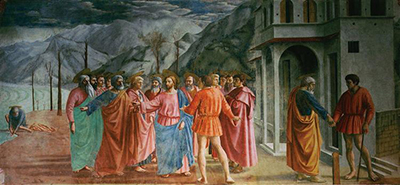
Architecture and Landscape. The setting is relatively restrained compared with The Tribute Money. Masaccio gives enough landscape and spatial structure to locate the group without allowing architecture to overwhelm the sacramental action. This economy keeps attention on bodies. The environment supports rather than competes with the rite.
Foreshortening. Several bodies turn or project into depth, demonstrating Masaccio’s control of foreshortening. Shoulders, arms and torsos change shape according to viewpoint rather than remaining parallel to the wall. This makes the group feel spatially dense. Figures appear to occupy real positions around the central baptism.
Feet and Ground. Masaccio pays careful attention to how figures stand. Feet connect the bodies to the ground plane and help distinguish nearer from farther positions. This grounding is one of the quiet foundations of his naturalism. A body becomes believable when it seems capable of bearing weight.
Drapery and Nakedness
Peter’s heavy robes contrast with the exposed bodies of the converts. The difference reinforces role as well as physical condition. Peter is already part of the institutional Church, while the candidates are in the vulnerable process of entering it. Clothing becomes a subtle marker of spiritual and social status.
The Baptismal Gesture. Peter’s gesture is controlled and economical. He does not perform the sacrament theatrically; the act appears routine enough to suggest repeated apostolic practice. This normality is important. Christianity is becoming institution through repeated ritual rather than one exceptional event.
The Early Church as Community. Acts presents baptism as one of the means through which the early Church grows rapidly. Masaccio turns that expansion into a visible gathering of bodies. The fresco therefore depicts institutional formation at human scale. The Church is literally made of people standing together.
Relationship to Healing. Saint Peter Healing the Sick with His Shadow presents Peter as a figure whose sacred authority changes bodies through miracle. Baptism of the Neophytes presents a more formal sacramental action. Together the scenes show two different channels of grace. One is miraculous and spontaneous, the other ritualised and institutional.
Relationship to Almsgiving
Distribution of Alms and Death of Ananias shows what happens after people belong to the Christian community. Resources must be shared, trust maintained and the vulnerable supported. Baptism therefore becomes the entrance to a social order. Conversion has practical consequences.
Relationship to Peter Enthroned. Later in the cycle, Peter appears enthroned as a formal leader. The baptism scene helps establish the legitimacy of that authority through service. He earns institutional centrality not merely through title but through repeated action within the community.
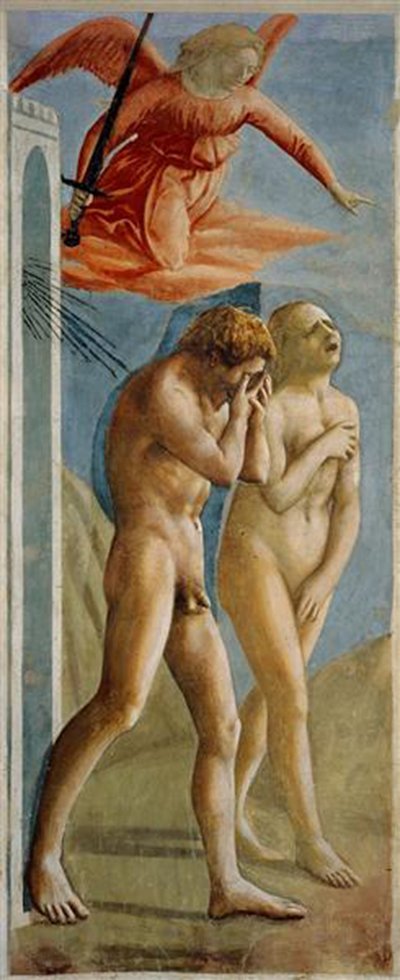
Relationship to the Expulsion. The Expulsion from the Garden of Eden establishes humanity’s fallen vulnerability. Baptism represents one of Christianity’s central rites of restoration and entry into redeemed community. The juxtaposition strengthens the larger theological arc of the chapel. Fallen bodies become baptised bodies.
Water and Rebirth. Christian baptism traditionally signifies washing, death to the old life and rebirth into a new one. Masaccio’s physical treatment of water makes that symbolism tangible. The candidate does not merely receive an abstract sign. His body undergoes an action.
Sacrament and Incarnation
Masaccio’s naturalism also fits a broader Christian emphasis on materiality. Christianity is a religion in which flesh, water, bread and wine can carry sacred meaning. The fresco’s bodily realism therefore serves rather than contradicts theology. Matter becomes a vehicle of grace.
The Carmelite Setting. Within Santa Maria del Carmine, the baptism scene reinforced the Church’s sacramental identity. The fresco was encountered by viewers already familiar with baptism as part of Christian life. The biblical past therefore reflected the institutional present. Peter’s action became a model for the continuing sacramental Church.
The Oltrarno Audience. The church’s urban audience would have included people of different social backgrounds. Baptism was one of the experiences that theoretically united them within the same Christian community. Masaccio’s varied group of bodies therefore carries social resonance. Entry into the Church crosses distinctions of appearance and status.
Humanism. The fresco is often admired as an example of Renaissance humanism because Masaccio treats ordinary bodily experience as worthy of attention. The shivering man is perhaps the clearest example. This humanism is profoundly religious. Physical observation becomes a means of making sacramental life more convincing.
Observation
Masaccio’s figures suggest sustained observation of people rather than reliance on inherited formulas alone. The shiver, weight shifts and varied waiting postures all feel drawn from ordinary human behaviour. This observational intelligence gives the scene its freshness. The sacred event is populated by people who behave like people.
Emotion without Drama. No one reacts with exaggerated ecstasy. The emotional register is restrained, ranging from concentration to discomfort. This moderation makes the scene credible. Conversion is important enough not to require theatrical excess.
The Shivering Man and Renaissance Reputation. Later writers and viewers repeatedly singled out the shivering convert as evidence of Masaccio’s extraordinary naturalism. The figure became almost emblematic of the painter’s ability to make a body communicate through posture alone. Its fame is revealing. A tiny observation could carry as much historical weight as a complex perspectival construction.
Giotto’s Legacy. Giotto had already demonstrated that sacred narratives gain force when figures possess weight and emotional clarity. Masaccio extends that tradition by adding more systematic light, space and bodily observation. The baptism scene is a good example of that continuity. Monumentality and human detail coexist without cancelling one another.
Donatello
The sculptural gravity of the neophytes also recalls Donatello’s contemporary figures. Bodies turn, bear weight and occupy space with unusual physical authority. Masaccio’s fresco therefore belongs to a broader Florentine culture in which sculpture and painting were redefining the human figure simultaneously.
Fra Angelico. Fra Angelico’s early Renaissance paintings likewise incorporate increasing bodily weight and spatial coherence, though in a more contemplative visual language. The Brancacci Chapel provided one of the environments through which Masaccio’s innovations entered Florentine painting generally. The baptism scene demonstrates how adaptable those innovations were. Physical realism could serve quiet sacrament as effectively as dramatic narrative.
Fra Filippo Lippi. Fra Filippo Lippi’s close association with Santa Maria del Carmine made the Brancacci frescoes particularly relevant to his formation. His later figures often combine Masaccian bodily credibility with greater lyrical softness. The chapel therefore acts as a bridge between generations. Masaccio’s neophytes became part of the visual education of later Florentine painters.
Filippino Lippi. Filippino Lippi eventually completed unfinished sections of the chapel decades after Masaccio’s death. His presence turned the cycle into a multi-generational monument. The baptism fresco remained one of the earlier masterpieces he had to work beside. Its gravity helped determine the visual discipline of the later completion.
Michelangelo
Michelangelo’s later study of the Brancacci Chapel reinforces the importance of Masaccio’s bodies. Although his own nudes became far more muscular and anatomically elaborate, the principle that bodily form can carry psychological and theological meaning remained fundamental. The shivering convert offers a particularly clear lesson. Anatomy matters because it expresses experience.
Restoration. The fresco benefited from the major Brancacci Chapel restoration of the 1980s, which clarified colour and modelling after centuries of grime and alteration. Later diagnostic work beginning in 2022 continued to examine plaster and painted surface. These conservation campaigns matter because subtle modelling defines the bodies. Loss of tonal range can flatten exactly the physical effects that made the fresco famous.
Surface and Fresco Technique. Fresco is painted into wet plaster, meaning that the artist must complete each section before it dries. Large bodies are therefore built through carefully planned working areas and decisive brushwork. The apparent naturalism of the scene depends on disciplined technique. Spontaneous human observation had to be translated rapidly into durable wall painting.
Close Viewing. Recent conservation access has allowed the frescoes to be examined from scaffolding at close range. Brushwork, plaster joins and corrections become visible in ways impossible from the chapel floor. This technical evidence reminds viewers that Masaccio’s monumental bodies are physical constructions made by hand. Renaissance innovation was practical craft as much as intellectual theory.
Why the Shivering Figure Is So Important
The shivering man is important because he condenses Masaccio’s artistic revolution into one ordinary bodily fact. He is cold. That observation would be insignificant in a purely symbolic system, but Masaccio turns it into evidence that sacred history happens in the same physical world as the viewer.
Why Peter Matters. Peter’s role gives the scene institutional meaning. He is not only one apostle among many but the administrator of a sacrament that brings people into the Christian community. His calm authority contrasts with the exposed vulnerability of the converts. The relationship between them defines the rite.
Why the Group Matters. The group shows conversion as communal rather than private. Several people wait, observe and participate around one central sacramental action. This is important to the chapel’s larger theology. The Church is formed through gathered bodies.
Why Baptism of the Neophytes Matters
Masaccio’s Baptism of the Neophytes matters because it makes a central Christian sacrament feel physically immediate. Water, cold, nakedness, waiting and bodily posture transform an institutional rite into an event the viewer can imagine experiencing. The famous shivering figure embodies this achievement perfectly. He adds no new iconographic information, yet his reaction makes the entire scene more believable because it acknowledges that human bodies remain sensitive even during sacred transformation.
Masaccio’s naturalism therefore deepens theology rather than distracting from it. Baptism is more convincing because it occurs through flesh and water, and the early Church becomes more real because its members appear as individual human beings. Within the Brancacci Chapel, the fresco also strengthens the wider portrayal of Peter. Healing, charity, baptism and governance become connected aspects of apostolic authority, showing how belief develops into organised communal life. The result is one of the clearest examples of why Masaccio became so influential. He demonstrated that the smallest observation of physical reality could give monumental religious painting greater emotional and intellectual force.
Frequently Asked Questions
Discussion
Use this space to discuss Baptism of the Neophytes by Masaccio, its source evidence and how it fits into Masaccio's wider cluster.
Keep comments focused on close looking, attribution language, object evidence and page-specific caveats.
Reader Insights
Which detail on this page most changes how you read the work?
How does this page connect to Masaccio's paintings, fresco technique or Florentine setting?
Where should the wording stay cautious because the source evidence is qualified?
Join the Conversation
Share your reading of Baptism of the Neophytes by Masaccio below.
References and Research Sources
- Comune di Firenze / Musei Civici Fiorentini, Brancacci Chapel history and conservation documentation. View Source
- FeelFlorence, Brancacci Chapel, for chronology, attribution and institutional interpretation. View Source
- MUS.E Firenze, Brancacci Chapel resources, for Saint Peter, Carmelite context and the early Christian community. View Source
- Acts of the Apostles, especially the early chapters describing Peter’s preaching, baptism and growth of the Church.
- National Gallery, London, Masaccio artist biography, for his role in developing monumental bodies, coherent light and Early Renaissance naturalism. View Source