 by Tom Gurney
Tom Gurney BSc (Hons) is an art history expert with over 20 years experience
Published on June 19, 2020 / Updated on October 14, 2023
Email: tomgurney1@gmail.com / Phone: +44 7429 011000
Introduction
Masaccio and Masolino da Panicale are often presented as opposites: the younger Masaccio as the revolutionary founder of Renaissance painting and the older Masolino as the elegant survivor of an International Gothic world. The contrast is useful up to a point, but it becomes misleading when it obscures the fact that the two painters repeatedly worked together and remained professionally connected from Florence to Rome.
Their collaboration matters precisely because their differences are visible. In Sant’Anna Metterza, the Brancacci Chapel and the later Santa Maria Maggiore altarpiece, the two artists bring distinct approaches to body, line, space and emotion into the same commissions, allowing viewers to see artistic change unfolding inside shared objects rather than across separate generations. The Uffizi describes Sant’Anna Metterza as a true “manifesto” of the first Florentine Renaissance, created through the collaboration of artists different in age and style. That formulation is especially valuable because it avoids reducing Masolino to a foil: the historical significance lies in the meeting of two visual languages. Masaccio’s style increasingly favours bodily mass, directional light, perspectival coherence and emotional directness.
Masolino tends towards more elegant contour, refined surface and a lighter, more courtly presence, yet he was also capable of sophisticated spatial construction and should not be treated as technically naïve. Their partnership therefore offers one of the clearest windows onto the Early Renaissance as a period of overlap rather than sudden replacement. New painting emerges through conversation with older forms, and collaboration becomes one of the mechanisms through which that change becomes visible.
At a Glance
- Masaccio1401–1428/29
- Masolino da Panicalec. 1383/84–documented until 1435
- Age differenceroughly 17–18 years
- Relationshipprofessional collaboration; formal master-pupil status is unproven
- Major shared worksSant’Anna Metterza, Brancacci Chapel, Santa Maria Maggiore altarpiece
- Key contrastMasaccio’s mass and unified light versus Masolino’s elegance and linear refinement
- Important cautionMasolino was not simply “medieval” or technically backward
- Florentine collaborationearly to mid-1420s
- Roman collaborationfinal phase of Masaccio’s career
- Core significanceartistic transition visible within shared commissions
Contents
- Who Was Masolino?
- Why the Relationship Matters
- The Christ Child
- Masolino Begins the Campaign
- Masaccio’s Expulsion
- Tribute Money
- Departure from the Chapel
- Saints Jerome and John the Baptist
- Masolino Was Not “Behind”
- Shared Sacred Purpose
- Why Sant’Anna Metterza Matters So Much
- Frequently Asked Questions
- References and Research Sources
Who Was Masolino?
Masolino da Panicale was born around 1383 or 1384 and was therefore significantly older than Masaccio. He was already a mature painter when Masaccio entered the Florentine guild in 1422, giving him greater professional experience and wider exposure to the refined courtly traditions that had dominated painting around 1400. His style is often described through grace, fine contour, ornamental beauty and relatively light bodily modelling. These qualities made him highly successful, and his later career in Rome, Hungary and northern Italy demonstrates that he was far more than a fading representative of an obsolete style.
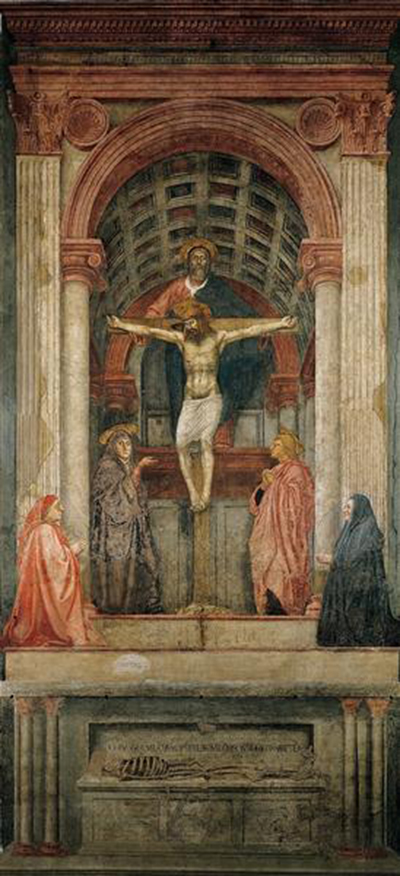
Who Was Masaccio? Masaccio was born in 1401 and entered professional life with extraordinary speed. His earliest securely known work, the San Giovenale Triptych of 1422, already demonstrates an interest in central perspective, bodily monumentality and a unified ground plane. By the middle of the decade, those qualities had become more radical. In the Brancacci Chapel and the Holy Trinity, he developed figures whose weight, shadow and spatial coherence helped redefine the possibilities of painting.
Was Masolino Masaccio’s Teacher? A formal master-pupil relationship has often been proposed because Masolino was older and because the two painters worked together early in Masaccio’s career. No surviving apprenticeship contract proves the arrangement, however, and Masaccio’s earliest known work already shows a strong artistic independence. The safer description is collaboration within an unequal age relationship. Masolino may well have helped Masaccio professionally, but the available evidence does not justify turning him automatically into the younger painter’s documented master.
Why the Relationship Matters
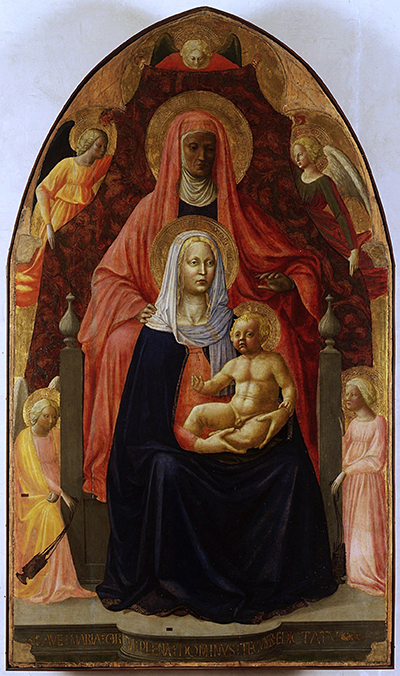
The temptation to rank the painters can obscure the real historical value of their partnership. Artistic change is easier to understand when two approaches appear within the same commission because differences in body, light and space become concrete rather than theoretical. This is exactly what happens in Sant’Anna Metterza. The painting allows the viewer to compare Masolino’s Saint Anne with Masaccio’s Virgin and Child without changing museum, subject or scale.
Sant’Anna Metterza. The Uffizi dates Sant’Anna Metterza to about 1424–25 and records that it was commissioned by Nofri Del Brutto Buonamici for Sant’Ambrogio in Florence. The subject places Saint Anne behind the Virgin and Child, creating a three-generation sacred hierarchy reinforced by angels. Modern attribution generally assigns Saint Anne largely to Masolino and the Virgin and Child to Masaccio. The Uffizi describes Anne as severe and monastic while emphasising the solid, full volumes of Mary and Christ painted by the younger artist.
Masolino’s Saint Anne. Masolino’s Saint Anne occupies the rear of the sacred group and creates a protective structure around Mary and Christ. Her body is substantial enough to dominate the composition, but the treatment remains more linear and hieratic than Masaccio’s figures below. The distinction is subtle rather than crude. Anne is not flat, yet her presence depends more upon contour and formal dignity, while Masaccio builds the Virgin and Child through stronger volume and light.
Masaccio’s Virgin. Masaccio’s Virgin appears almost sculptural. Her knees project beneath the drapery, her torso has measurable depth and the Christ Child sits with a convincing physical relationship to her body. This bodily construction changes the emotional tone of the image. Mary is not only Queen of Heaven but a physically present mother supporting the weight of a child.
The Christ Child
Masaccio’s Christ is famously robust. The Uffizi characterises him as powerfully built, and that physicality becomes a crucial part of the painting’s Renaissance character. The child’s body is not decorative. It occupies space with enough force to make incarnation visible as a physical reality.
Five Angels. Five angels complete the composition, and their attribution has generated discussion because the panel is collaborative at several levels. Their varying treatment reinforces the sense that the work emerged through a shared workshop process rather than from one hand acting in isolation. This complexity is historically valuable. Renaissance painting often involved collaboration, and attempts to divide every square centimetre between named masters can sometimes exaggerate modern expectations of individual authorship.
A “Manifesto” of the Early Renaissance. The Uffizi describes the painting as a manifesto of the first Florentine Renaissance because two different artistic languages meet so clearly within it. That description captures why the panel matters beyond attribution. The work does not show one style replacing another after a clean break. It shows coexistence, negotiation and transition happening inside one sacred image.
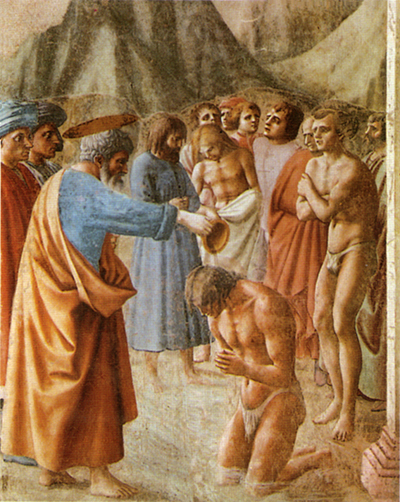
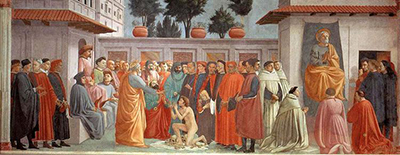
The Brancacci Chapel. The Brancacci Chapel expands the collaboration from panel painting to monumental fresco. Felice Brancacci commissioned the programme after returning from Egypt in 1423, and Masolino appears to have begun elements of the upper register before Masaccio became deeply involved. The chapel was dedicated principally to Saint Peter and the early Church. Its surviving frescoes make the contrast between the two painters unusually visible because their scenes occupy the same architectural environment.
Masolino Begins the Campaign
Recent Florentine restoration material assigns surviving sinopie from the lost upper register to Masolino and dates this phase around 1424. This supports the view that Masolino had an important initiating role rather than entering a project already defined by Masaccio. The chronology matters because it complicates the heroic narrative of the younger painter taking over. Masaccio’s revolution develops within a project that Masolino helped establish.
The Lost Upper Register. The original chapel contained more decoration than survives today. Lunettes and vault paintings were destroyed during later remodelling, leaving the current walls as fragments of a larger programme. This loss particularly affects our understanding of Masolino because some of his early contribution disappeared. The surviving comparison between the painters is therefore incomplete from the start.
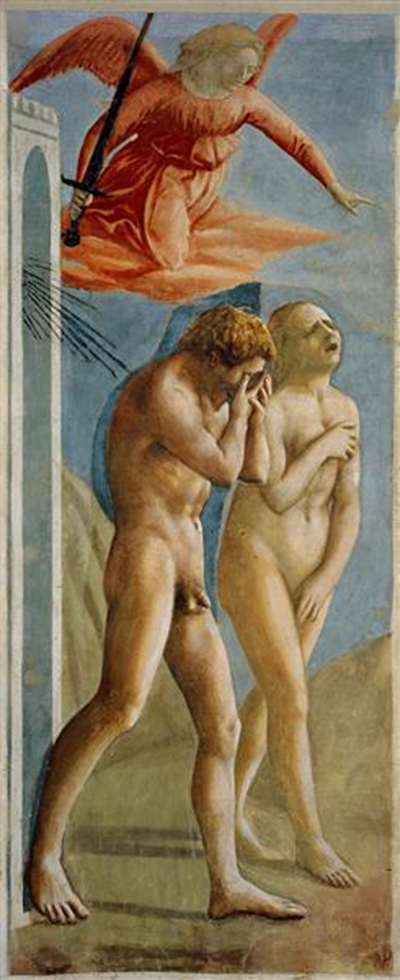
Temptation and Expulsion. The most famous direct contrast is between Masolino’s Temptation of Adam and Eve and Masaccio’s Expulsion from the Garden of Eden. The two frescoes occupy corresponding positions and deal with the fall of humanity from radically different emotional perspectives. Masolino’s figures are elegant, smooth and poised within a graceful Eden. Masaccio’s Adam and Eve are expelled into pain, with bodily shame and grief overwhelming ideal beauty.
Masolino’s Eden. Masolino’s Adam and Eve possess refined surfaces and controlled gestures. Their bodies feel idealised and their relationship with the surrounding setting remains calm, producing an image of temptation that is visually seductive rather than psychologically violent. This refinement is not evidence of incompetence. It reflects a different artistic priority in which elegance and beauty remain central carriers of meaning.
Masaccio’s Expulsion
Masaccio strips away almost everything except bodily suffering. Adam covers his face, Eve cries out and both figures move forward under divine judgement. The contrast with Masolino is therefore not simply realistic versus unrealistic. It is a difference in what the body is being asked to communicate.
Body versus Contour. Masaccio builds bodies through mass and shadow, while Masolino often relies more strongly on outline and surface refinement. This distinction becomes one of the easiest ways to recognise their separate contributions within collaborative projects. Neither method is neutral. Masolino’s contour can produce elegance and serenity, while Masaccio’s modelling produces physical gravity and emotional immediacy.
Light. The painters also differ in their handling of light. Masaccio increasingly uses a consistent directional source to model bodies and unify groups, especially in the Brancacci Chapel. Masolino’s illumination is generally softer and less structurally dominant. His figures can appear luminous and graceful without being bound as strongly to one common atmospheric condition.
Perspective. It would be wrong to claim that Masolino did not understand perspective. His later works demonstrate considerable spatial sophistication, and the Brancacci environment itself required both painters to operate within increasingly coherent architectural systems. Masaccio nevertheless uses perspective more aggressively as an organising principle. Space becomes a framework that determines bodies, narrative and the viewer’s relation to the scene.
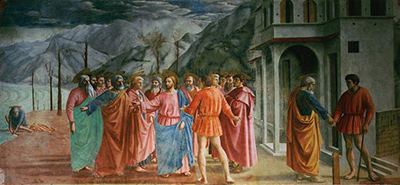
Tribute Money
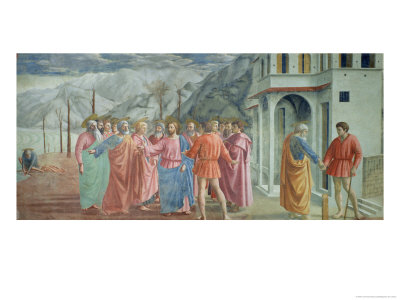
The Tribute Money is one of the clearest demonstrations of Masaccio’s mature difference. The apostles occupy a shared landscape under unified light, and multiple narrative moments unfold across one coherent spatial field. Nothing in Masolino’s surviving Brancacci contribution has quite the same combination of bodily gravity and atmospheric unity. The contrast helps explain why later artists treated Masaccio’s sections as particularly revolutionary.
Healing and Charity. Masaccio’s Saint Peter Healing the Sick with His Shadow and Distribution of Alms and Death of Ananias also reveal a distinctive social realism. Poor, sick and ordinary figures possess the same bodily seriousness as apostles. This is one of the places where Masaccio’s art becomes more than formal innovation. His weighty naturalism allows sacred charity to unfold among recognisable human bodies.
Masolino’s Narrative Grace. Masolino, by contrast, often excels at elegant narrative flow. His figures can move through scenes with clarity and refinement, and his surface treatment retains a decorative sophistication that remained highly valued by patrons. This helps explain why his career continued successfully after Masaccio’s death. Renaissance painting did not immediately abandon the qualities Masolino represented.
Collaboration Rather than Competition. The Brancacci Chapel is often taught through comparison, but the artists were not necessarily painting as rivals. They were fulfilling one commission with a shared iconographic purpose. Differences in style could coexist because the patron and church required a complete sacred programme rather than an art-historical demonstration of progress.
Departure from the Chapel
Both painters eventually left the Brancacci project unfinished. Their movements and commitments diverged, and the chapel remained incomplete for decades. This interruption is one of the reasons the surviving cycle became so historically layered. Filippino Lippi later entered the same environment and had to complete what Masolino and Masaccio had begun.
Masolino beyond Florence. Masolino’s career took him beyond Florence, including work in Hungary and Rome. These international movements are important because they show that his style remained adaptable and desirable across different patronage environments. The older painter therefore cannot be understood only through his proximity to Masaccio. He had an independent career with its own artistic logic.
Rome. Masaccio and Masolino were reunited professionally in Rome near the end of Masaccio’s life. The most important surviving evidence is the dispersed altarpiece associated with Santa Maria Maggiore. The National Gallery identifies surviving panels from a large double-sided ensemble on which both artists collaborated. Masolino completed the work after Masaccio’s death, making the commission a final chapter in their partnership.
Santa Maria Maggiore Altarpiece. The surviving panels include works assigned separately to Masaccio and Masolino, but the original ensemble is now dismantled. Reconstruction therefore depends upon physical evidence, iconography, framing logic and comparison between hands. The project demonstrates that collaboration between the two painters persisted well beyond Sant’Anna Metterza. Their professional relationship remained active until Masaccio’s final Roman phase.
Saints Jerome and John the Baptist
The National Gallery’s panel of Saints Jerome and John the Baptist is attributed to Masaccio and comes from the Santa Maria Maggiore altarpiece. The figures retain his characteristic bodily seriousness even within a format shared with Masolino. This panel is especially valuable because it places Masaccio’s mature style within the collaborative Roman context. His final works were not produced in isolation from the older painter.
Masolino Completes the Altarpiece. National Gallery research states that Masolino completed the Santa Maria Maggiore ensemble after Masaccio died in Rome in 1428/29. This makes the object a rare case in which collaboration turns into posthumous completion. The circumstance echoes the Brancacci Chapel in reverse. There, Filippino completed Masaccio’s unfinished work decades later; in Rome, Masolino appears to have continued almost immediately after the younger painter’s death.
Death and Diverging Reputations. Masaccio’s early death transformed the historical balance between the two artists. Masolino continued working, but later Renaissance art history increasingly positioned Masaccio as the decisive revolutionary figure. Vasari’s progressive narrative reinforced this hierarchy. Masaccio became the painter who advanced art towards greater naturalism, while Masolino was increasingly interpreted as the older style against which that progress could be measured.
The Problem with Vasari’s Model. Vasari’s account is enormously influential but can make collaboration look like a competition in historical progress. Modern study benefits from restoring Masolino’s own sophistication and recognising that the two painters shared projects because their work could coexist productively. The contrast remains real. What changes is the assumption that stylistic difference must equal artistic failure on one side.
Masolino Was Not “Behind”
Masolino’s paintings continued to develop after his work with Masaccio. His later frescoes demonstrate perspective, architectural complexity and an ability to adapt to changing Renaissance expectations. Calling him simply backward therefore distorts the evidence. He represents another route through the early fifteenth century, one that retained elegance while absorbing new spatial ideas.
Masaccio Was Not Isolated. The opposite myth is equally misleading. Masaccio did not invent his style in solitary opposition to everyone around him. His collaborations with Masolino, contacts with Donatello and proximity to Brunelleschi demonstrate how deeply embedded he was in artistic exchange. Innovation emerged from networks.
What Masaccio May Have Learned from Masolino. Masolino’s greater professional experience may have offered Masaccio access to commission structures, workshop practice and sophisticated decorative programmes. The surviving record does not allow these contributions to be measured precisely, but collaboration itself suggests practical exchange. Masaccio may also have learned from Masolino’s handling of graceful narrative and complex ensembles even while moving towards a heavier visual language. Influence need not be visible as imitation.
What Masolino May Have Learned from Masaccio. The relationship may also have altered Masolino. His later work shows increasing engagement with perspective and spatial organisation, although it would be too simple to attribute every change directly to Masaccio. Working beside a younger painter using radical mass and light must nevertheless have provided a powerful visual stimulus. Collaboration creates opportunities for influence in both directions.
Shared Sacred Purpose
The artists also worked within common theological programmes. Whether their styles differed or not, both had to make Saint Anne, the Virgin, Christ or Saint Peter intelligible within devotional settings. This shared purpose helps explain why their differences do not destroy unity. Iconography and architecture can hold distinct hands together.
Collaboration in Renaissance Workshops. Modern audiences often expect a masterpiece to express one individual personality, but Renaissance production was frequently collective. Altarpieces, fresco cycles and architectural decorations could involve masters, assistants, craftsmen and later completion by other artists. Masaccio and Masolino therefore belong to a normal workshop culture even though their individual reputations became exceptional. Collaboration should be understood as part of authorship rather than as contamination of it.
The Brancacci Chapel as a Comparative Laboratory. Few sites make this clearer than the Brancacci Chapel. Because Masolino, Masaccio and later Filippino Lippi all worked there, the walls allow viewers to compare several decades of Florentine painting within one programme. The chapel became influential partly because artists could study those differences directly. History was visible in paint.
Later Artists and Masaccio’s Advantage. Later Florentine painters tended to respond most strongly to Masaccio’s monumental bodies and coherent space. This retrospective preference helped widen the historical distance between his reputation and Masolino’s. Yet the comparison itself depends on Masolino’s presence. Without the older painter beside him, Masaccio’s innovations would be less immediately legible.
Why Sant’Anna Metterza Matters So Much
The Uffizi’s description of the altarpiece as a manifesto of the early Renaissance captures this paradox perfectly. The work matters because two languages coexist. Masaccio’s solidity appears new precisely because Masolino’s elegance remains beside it. Transition becomes visible without requiring one artist to disappear.
Why the Brancacci Chapel Matters. The chapel expands that principle to architectural scale. Masolino helps establish the programme, Masaccio radicalises bodily and spatial presence, and Filippino later completes the surviving ensemble. The result is not one artist’s sealed masterpiece but a layered history of Florentine painting. That complexity is one reason the chapel became such an extraordinary teaching site.
Why the Roman Collaboration Matters. The Santa Maria Maggiore altarpiece proves that the partnership was not merely an early episode. Masaccio and Masolino were still linked professionally at the end of the younger artist’s life. This continuity changes the story significantly. Masaccio did not “outgrow” Masolino so completely that collaboration became impossible; their different approaches continued to coexist within important commissions.
Why Masaccio and Masolino Matter Together. Masaccio and Masolino matter together because their partnership makes the birth of Renaissance painting visible as a process rather than a single revolutionary moment. The younger painter’s monumentality, light and spatial logic appear beside an older language of elegance and refinement, allowing viewers to see how artistic priorities were shifting in real time. The collaboration also reminds us that innovation depends upon networks. Masaccio’s extraordinary individuality developed through contact with older painters, sculptors, architects, patrons and workshop systems rather than through isolation. Masolino, meanwhile, emerges as more than the convenient “before” image in a textbook comparison.
He was an accomplished painter whose own work could incorporate new spatial ideas while preserving qualities that remained valuable to patrons. Together, the two artists demonstrate that Renaissance change was not a clean break. It was negotiation, overlap and exchange, and some of its most important evidence survives precisely because different hands worked on the same objects.
Frequently Asked Questions
Discussion
Use this space to discuss Masaccio and Masolino | Masaccio, its source evidence and how it fits into Masaccio's wider cluster.
Keep comments focused on close looking, attribution language, object evidence and page-specific caveats.
Reader Insights
Which detail on this page most changes how you read the work?
How does this page connect to Masaccio's paintings, fresco technique or Florentine setting?
Where should the wording stay cautious because the source evidence is qualified?
Join the Conversation
Share your reading of Masaccio and Masolino | Masaccio below.
References and Research Sources
- Uffizi Galleries, Saint Anne, Madonna and Child, five angels (Sant’Anna Metterza). View Source
- Uffizi Galleries, video and interpretive material on Masaccio and Masolino, Sant’Anna Metterza. View Source
- Comune di Firenze / Musei Civici Fiorentini, Brancacci Chapel history and restoration research. View Source
- MUS.E Firenze, Brancacci Chapel historical and iconographic resources. View Source
- National Gallery, London, Saints Jerome and John the Baptist. View Source
- National Gallery, London, A Pope (Saint Gregory?) and Saint Matthias. View Source
- National Gallery, London, scholarly reconstruction of the Santa Maria Maggiore altarpiece. View Source
- National Gallery, London, Masaccio and Masolino artist records. View Source