 by Tom Gurney
Tom Gurney BSc (Hons) is an art history expert with over 20 years experience
Published on June 19, 2020 / Updated on October 14, 2023
Email: tomgurney1@gmail.com / Phone: +44 7429 011000
Introduction
Masaccio and Donatello were among the most important artists working in Florence during the 1420s, and the relationship between their art helps explain why the Early Renaissance transformed bodies so decisively. The National Gallery describes Donatello as Masaccio’s friend and a major influence, while also emphasising that both artists shared an interest in setting convincing human figures within believable space. The strongest evidence for their connection does not come from one documented joint commission.
Instead, it emerges through repeated visual and technical parallels: monumental bodies, drapery that reveals rather than disguises structure, concern with viewpoint, and a willingness to treat sacred figures as physically present rather than as decorative signs. The Pisa Polyptych provides the clearest documentary bridge between them. Donatello was working in Pisa in 1426, and National Gallery records show that he was physically present with Masaccio when one payment was collected and later witnessed another payment connected with the altarpiece.
This proximity has encouraged scholars to ask whether Donatello’s role was more direct than general influence. Some have proposed that Masaccio based the Pisa Madonna on Donatellesque sculptural models, while others have suggested that artistic exchange may have travelled in both directions. The most responsible interpretation is therefore neither “Donatello taught Masaccio” nor “they simply happened to know each other.” They belonged to the same experimental Florentine culture and confronted many of the same problems through different media.
At a Glance
- Donatelloc. 1386–1466
- Masaccio1401–1428/29
- Shared centreFlorence
- Documented Pisa overlap1426
- National Gallery descriptionDonatello as Masaccio’s friend and major sculptural influence
- Key shared concernsbodily mass, drapery, viewpoint, perspective, emotional gravity
- Important Masaccio workPisa Polyptych
- Possible Donatello connectionsculptural models for the Pisa Madonna and elevated figures
- Important cautionno securely documented joint artwork survives
- Scholarly possibilityinfluence may have been reciprocal
Contents
- Donatello’s Florence
- The Body as Structure
- The Pisa Madonna
- The Getty Study
- Schiacciato
- Donatello and Social Bodies
- Shared Experiment, Different Careers
- Drawing and Modelling
- Why Donatello Matters to Masaccio
- Frequently Asked Questions
- References and Research Sources
Donatello’s Florence
Donatello was already one of Florence’s leading sculptors when Masaccio entered professional life. His marble and bronze figures had helped change expectations around the human body by giving saints and biblical heroes unprecedented mass, psychological intensity and relation to architectural space. This mattered for painters because sculpture posed the problem of physical presence in the most literal possible way. A sculpted figure exists in real space, casts real shadows and changes according to the spectator’s position, so painters looking at Donatello encountered solutions that could not be reduced to surface design alone.
Masaccio’s Different Medium. Masaccio worked primarily in fresco and panel painting, yet many of his figures appear almost sculptural in conception. Bodies are built through light and shadow, drapery describes mass, and figures seem capable of occupying space rather than resting upon a flat surface. This does not mean he tried to imitate stone in paint. The more important connection is conceptual: both artists treated the body as a three-dimensional structure whose physical credibility carries emotional and sacred meaning.
The National Gallery’s “Friend Donatello”. The National Gallery goes beyond vague stylistic comparison and describes Masaccio as influenced by the sculptural advances of his friend Donatello. This wording gives the relationship a stronger historical basis than many generic “influence” claims, although the surviving documents still do not reconstruct the full nature of their friendship. The term should therefore be used with appropriate confidence but not embellished with invented anecdotes. What survives securely is artistic proximity, documented overlap in Pisa and strong formal relationships between their works.
The Body as Structure
Donatello’s saints often stand with a convincing sense of skeleton, weight and balance beneath their clothing. Masaccio achieves a similar effect in paint by allowing folds to respond to knees, torsos, hips and shoulders rather than operating as independent decorative patterns. This structural drapery is one of the clearest signs of their shared visual world. Cloth becomes evidence of the body rather than a substitute for it.
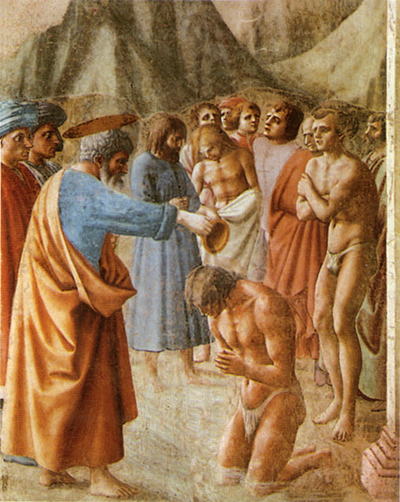
Contrapposto and Weight. Donatello helped revive a classical understanding of contrapposto in which the body shifts weight across hips and legs. Even where Masaccio’s figures are more static, his bodies similarly possess an internal logic of support. A standing apostle in the Brancacci Chapel does not appear simply upright because the outline is vertical. The figure seems to carry weight through feet and legs, which gives the whole group a sculptural gravity.
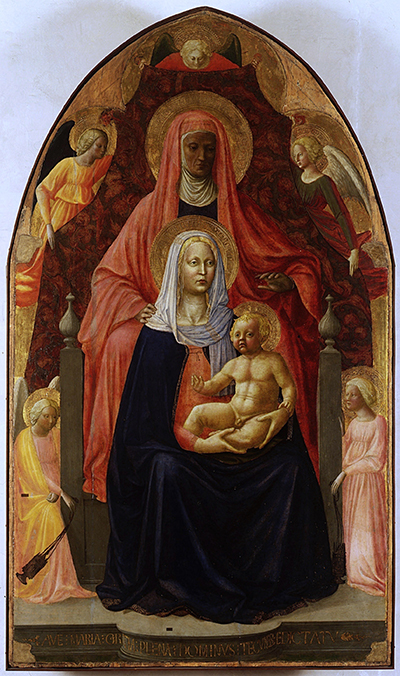
San Giovenale before Pisa. The San Giovenale Triptych already demonstrates this concern before the documented Pisa overlap. Mary’s body has real bulk beneath her robes, while saints stand heavily enough to feel physically present despite the gold ground. This chronology matters because Donatello cannot be used as a simplistic explanation for every Masaccio innovation. Masaccio had already developed a powerful interest in bodily mass, and the relationship with Donatello should be understood as reinforcement and dialogue rather than one-way invention.
The Virgin and Child as Shared Problem. Both artists repeatedly confronted the Virgin and Child as a central devotional subject. Sculpture and painting had to solve similar problems: how should Mary support Christ physically, how should the child’s weight relate to her lap, and how can sacred intimacy remain believable without becoming ordinary domestic anecdote? Masaccio’s Madonnas answer these questions with increasing physical directness. The result is close enough to Donatello’s sculptural language that scholars have proposed specific relationships.
The Pisa Madonna
The central panel of the Pisa Polyptych is particularly important. The National Gallery notes that Masaccio may have based the image on Donatellesque sculptural models and identifies a relief now in the Victoria and Albert Museum as one possible comparison. Mary’s throne, broad knees and heavy body create the sense of a sculpture occupying architectural space. Christ’s small but fleshy body likewise appears supported by real physical contact rather than by symbolic placement.
Donatello in Pisa. The documentary context makes the comparison especially compelling because Donatello was in Pisa while Masaccio was producing the polyptych. The National Gallery records that Donatello was working there on the monument to Cardinal Rinaldo Brancacci and was present when Masaccio collected one payment on 24 July 1426. Donatello later witnessed another payment due to Masaccio in December. These records do not prove that he designed any element of the polyptych, but they establish direct professional proximity during the commission.
What Did Donatello Actually Do? Some scholars have interpreted the payment context as evidence that Donatello may have supplied models or advice for the Pisa Madonna. John Pope-Hennessy proposed direct sculptural involvement, while other scholars have treated the similarities as influence without a formal role. The evidence remains open enough that the strongest phrasing should distinguish fact from interpretation. Donatello was present and professionally connected; specific design participation is plausible but unproven.
Saint Andrew and the Problem of Height. The Getty’s Saint Andrew, originally part of the Pisa ensemble, provides another important comparison. The figure was designed for an elevated position and appears optically adjusted for a spectator looking upward. Sculptors had to solve this problem routinely because statues were placed on façades, niches and monuments. Masaccio’s handling of foreshortening therefore belongs naturally to a visual world Donatello knew intimately.
The Getty Study
Getty research on the Pisa altarpiece emphasises the importance of viewing conditions in understanding Saint Andrew. When detached and placed at ordinary museum height, the proportions can appear strange, but reconstruction makes them more intelligible. This is exactly the kind of problem sculpture teaches painters to consider. A body does not exist independently of its viewing position.
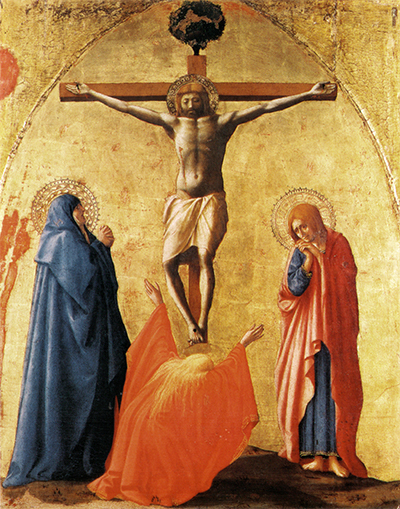
The Pisa Crucifixion. The Crucifixion from the Pisa Polyptych pushes this principle even further. Christ’s body is dramatically shortened because the panel occupied a high position and had to look convincing from below. Masaccio therefore adjusts anatomy according to optical experience rather than according to an abstract frontal ideal. This is one of the clearest moments where pictorial perspective and sculptural viewing logic converge.
Donatello’s Elevated Figures. Donatello had extensive experience designing figures for elevated architectural settings. Saints placed high on church façades or bell towers had to be made legible from street level, and proportions could be altered to compensate for viewing distance and angle. Masaccio’s Pisa adjustments belong to the same practical intelligence. The painted panel becomes almost architectural sculpture translated into tempera.
Perspective in Relief Sculpture. Donatello also pioneered the use of single-point perspective in relief sculpture. The National Gallery identifies works such as The Feast of Herod as important examples of his perspectival innovation. This creates another direct field of overlap with Masaccio. Both artists explored how depth could be represented convincingly within shallow or flat surfaces.
Schiacciato
Donatello’s extremely shallow relief technique, often called schiacciato, uses minute changes in depth to create the illusion of large spatial recession. Although Masaccio works through paint rather than carved planes, the shared principle is important. Both artists understand that the eye can be persuaded to read a small physical depth as a much larger visual space. Perspective becomes an optical construction rather than a literal copy of three-dimensional reality.
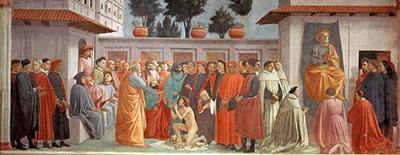
Masaccio’s Fresco Space. The Brancacci Chapel translates this concern into monumental wall painting. Streets and architectural settings recede convincingly, while figures possess enough mass to feel as though they could be sculptural objects standing within those spaces. This fusion of spatial illusion and bodily volume is where Donatello’s relevance becomes strongest. Masaccio’s figures do not merely occupy perspective; they have the physical authority required to make the perspective believable.
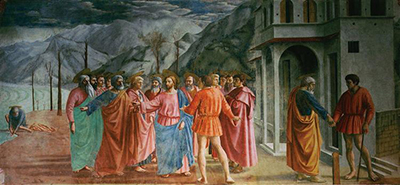
The Tribute Money. In The Tribute Money, the apostles form a dense semicircular group around Christ. Their robes define bodies with enough weight that the group feels almost like a sculptural ensemble arranged within landscape. The effect is very different from relief because the figures are painted, yet the concern with grouped mass is similar. Masaccio repeatedly thinks about figures as volumes interacting with one another rather than as outlines sharing a surface.
Saint Peter Healing the Sick with His Shadow. The urban fresco of Saint Peter provides another example of sculptural bodily presence. Sick and poor figures sit or stand with convincing physical burden, while Peter moves through the street as a monumental vertical form. Masaccio gives humble figures the same structural seriousness as saints. This democratic physicality is one of the reasons his art feels so radically human.
Donatello and Social Bodies
Donatello likewise gave psychological force to figures beyond idealised courtly beauty. Prophets, saints and penitential figures could appear weathered, tense or physically individual. Both artists therefore helped widen the emotional vocabulary of the Renaissance body. Human dignity did not require smooth perfection.
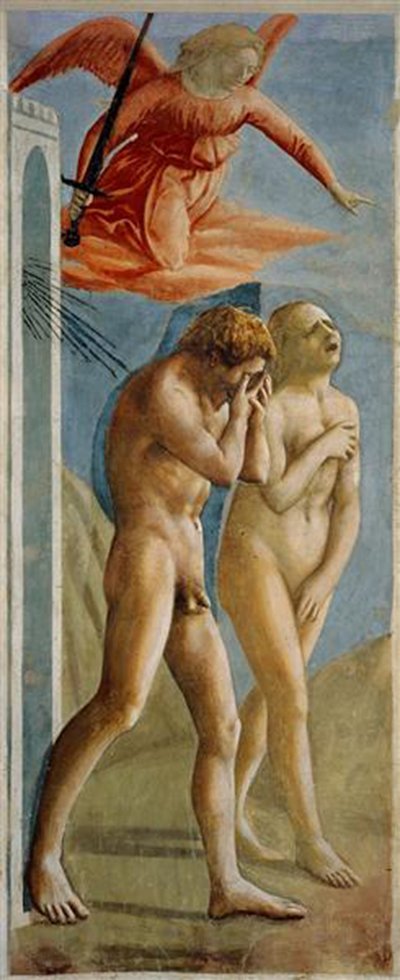
Emotional Force. The relationship becomes especially clear in Masaccio’s Expulsion from the Garden of Eden. Adam and Eve are not beautiful in a conventional decorative sense; their bodies are distorted by grief and shame. Donatello’s willingness to let bodily form communicate psychological intensity provides a strong sculptural parallel. In both media, emotion reshapes physical appearance.
The Classical Body. Donatello’s engagement with ancient sculpture gave Renaissance artists a renewed language of bodily structure and contrapposto. Masaccio’s figures are less overtly archaeological, but they share the conviction that the body can be organised according to internal anatomical logic. This classical recovery therefore enters painting through practical observation rather than through imitation of antique poses alone. Masaccio’s apostles feel Renaissance because they possess structure, not because they dress like Romans.
Donatello and the Nude. Donatello’s later bronze David would become a landmark in the revival of the free-standing nude. Masaccio died before that work was made, so it cannot have influenced him directly. The chronology is important because it prevents later Donatello masterpieces from being projected backwards. The relationship must be built from works and ideas available during Masaccio’s lifetime.
Shared Experiment, Different Careers
Donatello lived until 1466, allowing his art to develop across several more decades in Florence and Padua. Masaccio died before thirty, so the relationship captures only the beginning of what could have become a much longer artistic dialogue. This imbalance makes comparison poignant. Donatello had time to transform Renaissance sculpture repeatedly, while Masaccio’s painting revolution was compressed into only a few years.
Possible Two-Way Influence. National Gallery scholarship notes that Luciano Berti proposed influence moving in both directions. This possibility is historically important because artistic relationships between major contemporaries are rarely simple hierarchies. Masaccio’s painted solutions could have interested Donatello just as sculptural solutions interested Masaccio. Both were active experimenters rather than teacher and passive recipient.
The Brancacci Name. An intriguing coincidence also connects Donatello’s Pisa work with the Brancacci family. Donatello was preparing the tomb of Cardinal Rinaldo Brancacci while Masaccio was completing the Pisa Polyptych, although this cardinal should not be confused simplistically with the Florentine Brancacci Chapel patronal history. The overlap does, however, show how tightly linked elite patronage networks could be. Artists moved through families, cities and commissions rather than working within isolated disciplines.
Workshop Networks. Masaccio and Donatello also operated within workshop systems. Assistants, craftsmen, patrons and architects all contributed to large projects, even when later history celebrates one individual genius. This matters when assessing influence. Ideas could travel through drawings, models, conversations, shared craftsmen and direct observation without leaving one neat contract.
Drawing and Modelling
Sculptors often produced clay or wax models before final execution. Painters likewise relied on preparatory drawings and cartoons, making model-based exchange entirely plausible within Renaissance practice. The Pisa Madonna hypothesis becomes more understandable in this context. A painted figure could derive from sculptural thinking even if no finished Donatello sculpture served as a literal copy.
Light as Virtual Sculpture. Masaccio’s directional light can be understood as a way of sculpting with paint. Highlights and shadows establish projecting and receding surfaces, turning a flat wall into the illusion of bodily mass. This is where his debt to sculpture becomes technical rather than iconographic. Donatello carves mass physically; Masaccio constructs it optically.
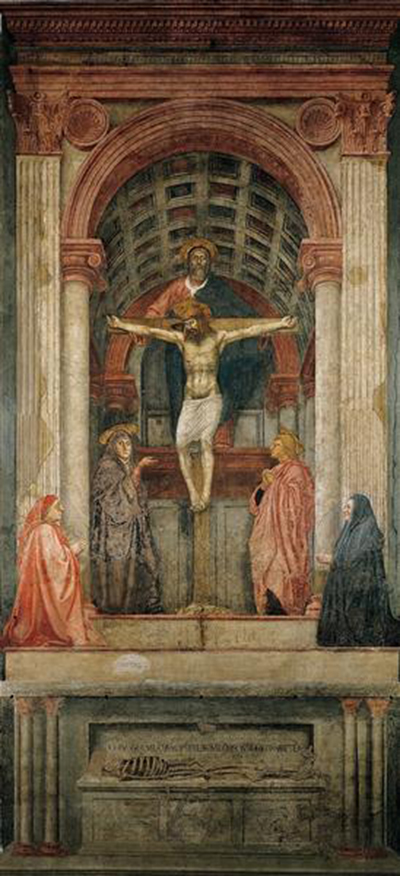
The Holy Trinity. The Holy Trinity provides another form of sculptural thinking. The sacred figures occupy a fictive architectural niche that appears cut into the wall, creating the illusion that painted bodies exist inside a real three-dimensional structure. Perspective is usually emphasised here, but bodily monumentality is equally necessary. Without weighty figures, the architecture would feel like an empty geometric exercise.
Architecture, Sculpture and Painting Together. Early Renaissance Florence repeatedly dissolves modern boundaries between disciplines. Brunelleschi’s architecture, Donatello’s sculpture and Masaccio’s painting all address proportion, viewpoint, space and the human body. The same ideas migrate between media. Masaccio’s importance lies partly in recognising how sculptural and architectural discoveries could be converted into pictorial form.
Why Donatello Matters to Masaccio
Donatello matters because sculpture gave Masaccio an extraordinarily powerful model for thinking about physical presence. A body must occupy space, respond to gravity, be seen from particular viewpoints and communicate character through stance as much as through facial expression. Masaccio translates those principles into paint. His figures become weightier, his drapery more structural and his elevated Pisa panels more responsive to real viewing conditions. Yet the relationship should not be reduced to dependency.
Masaccio had already demonstrated strong bodily monumentality by 1422, and scholars have proposed reciprocal influence between the two artists. The best interpretation is therefore one of artistic dialogue. Donatello and Masaccio belonged to the same experimental culture, and each helped make the human figure newly central to Renaissance visual experience.
Why Masaccio and Donatello Matter Together. Masaccio and Donatello matter together because they reveal how the Early Renaissance developed across media rather than within isolated artistic categories. Sculpture teaches painting about mass and viewpoint, while painting explores light and illusion in ways sculpture can observe and adapt. Their documented proximity in Pisa makes that exchange especially concrete. Donatello was not an abstract influence known only through works elsewhere; he was physically present during Masaccio’s 1426 commission and connected with its payment history. The resulting Pisa Polyptych demonstrates how deeply Masaccio had absorbed sculptural thinking.
Virgin, saints and crucified Christ are designed as bodies seen in architectural space, with proportions adjusted according to where viewers would stand. This is one of the defining achievements of Renaissance art. The body becomes not simply depicted but situated.
Frequently Asked Questions
Discussion
Use this space to discuss Masaccio and Donatello | Masaccio, its source evidence and how it fits into Masaccio's wider cluster.
Keep comments focused on close looking, attribution language, object evidence and page-specific caveats.
Reader Insights
Which detail on this page most changes how you read the work?
How does this page connect to Masaccio's paintings, fresco technique or Florentine setting?
Where should the wording stay cautious because the source evidence is qualified?
Join the Conversation
Share your reading of Masaccio and Donatello | Masaccio below.
References and Research Sources
- National Gallery, London, Masaccio artist biography. View Source
- National Gallery, London, Masaccio, The Virgin and Child from the Pisa Polyptych. View Source
- National Gallery, London, scholarly catalogue for the Pisa Polyptych. View Source
- National Gallery, London, Donatello artist biography and glossary. View Source
- J. Paul Getty Museum, Masaccio: Saint Andrew and the Pisa Altarpiece. View Source
- J. Paul Getty Museum, technical and reconstruction research on the Pisa Polyptych. View Source