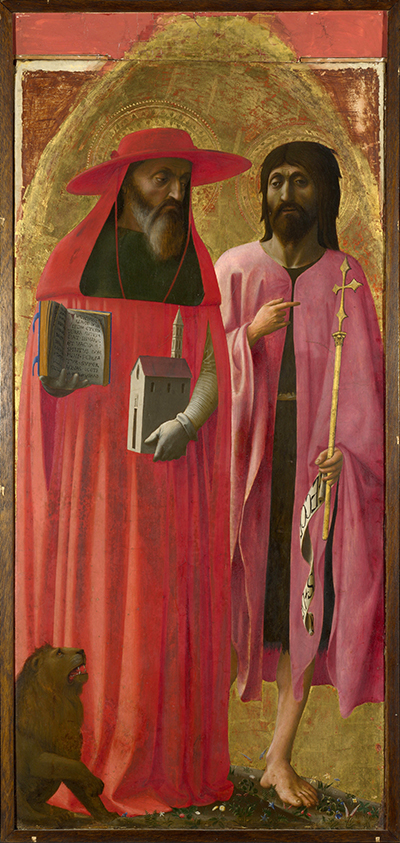
 by Tom Gurney
Tom Gurney BSc (Hons) is an art history expert with over 20 years experience
Published on June 19, 2020 / Updated on October 14, 2023
Email: tomgurney1@gmail.com / Phone: +44 7429 011000
Introduction
Masaccio’s Pisa Polyptych was one of the largest and most ambitious panel-painting commissions of his short career. Made in 1426 for a family chapel in the Carmelite church of Santa Maria del Carmine in Pisa, the altarpiece was later dismantled, leaving its surviving panels scattered between London, Naples, Pisa, Los Angeles, Berlin and other collections.
The loss of the original structure makes the work difficult to imagine today. Museum visitors encounter individual fragments—most famously the Virgin and Child in the National Gallery, the Crucifixion in Naples and Saint Andrew at the Getty—without the architectural frame, missing saints and vertical hierarchy that originally bound them together. What makes the Pisa Polyptych unusually valuable is the quality of the documentary record.
The Pisan notary Giuliano di Colino degli Scarsi da San Giusto, who commissioned the altarpiece for his family funerary chapel, kept detailed payment records that allow Masaccio’s work to be followed from February through December 1426. The National Gallery catalogue records the first payment on 20 February, only a day after Masaccio began, and a final payment on 26 December completing the agreed total of 80 florins. Those documents also reveal the collaborative environment behind the commission.
Masaccio’s brother Giovanni, known as Lo Scheggia, collected one payment, the assistant Andrea di Giusto appears in the records, and Donatello was physically present with Masaccio during one payment and later witnessed another. The Pisa Polyptych therefore provides much more than a set of masterpieces. It offers an unusually concrete picture of Masaccio as a professional painter working within contracts, workshops, patronage, architecture and a network of fellow artists.
At a Glance
- ArtistMasaccio
- TitlePisa Polyptych / Pisa Altarpiece
- Date1426
- Original locationSanta Maria del Carmine, Pisa
- PatronGiuliano di Colino degli Scarsi da San Giusto
- Functionfamily funerary chapel altarpiece
- Agreed payment80 florins
- Work begun19 February 1426
- First payment20 February 1426
- Final payment26 December 1426
- Central surviving panelVirgin and Child, National Gallery, London
- Upper surviving panelCrucifixion, Capodimonte, Naples
- Surviving saint panelsincluding Saint Paul in Pisa and Saint Andrew at the Getty
- Surviving predellapanels in the Gemäldegalerie, Berlin
- Lost principal saintsPeter, John the Baptist, Julian and Nicholas
- Workshop figuresAndrea di Giusto and possibly Lo Scheggia
- Documented artistic contactDonatello present during the commission
- Historical importanceone of the great reconstructed polyptychs of the Early Renaissance
Contents
- Giuliano degli Scarsi
- The First Payment
- Lo Scheggia
- Where Was It Painted?
- Mary’s Monumentality
- Pietra Serena
- Saint Paul
- The Crucifixion
- Light in the Crucifixion
- Local Artistic Memory
- Workshop Collaboration
- Light as Sculpture in Paint
- Light from the Left
- Why the Altarpiece Was Dismantled
- Digital and Scholarly Reconstruction
- Why the Payment Record Matters
- Why the Pisa Polyptych Matters
- Frequently Asked Questions
- References and Research Sources
Giuliano degli Scarsi
The patron, Giuliano di Colino degli Scarsi da San Giusto, was a Pisan notary born in 1369. The National Gallery identifies him as the commissioner who ordered the altarpiece for his family funerary chapel in Santa Maria del Carmine. His detailed records are fundamental because no original contract survives. Instead, the surviving account book provides a sequence of payments and practical details that allows the commission to be reconstructed unusually closely.
A Family Funerary Chapel. The altarpiece was connected with Giuliano’s family burial arrangements. His records also document the movement of a sepulchral monument into relation with the chapel, reinforcing the connection between painting, burial and family memorial. This context is essential because Renaissance altarpieces were not merely decorative images. They operated within spaces of prayer, commemoration and liturgy, often ensuring that wealthy patrons and their families remained embedded visibly within sacred institutions.
Santa Maria del Carmine in Pisa. The Carmelite setting created an institutional link with the Brancacci Chapel in Florence, although the two commissions were distinct. Masaccio was therefore working for Carmelite environments in two cities within a very compressed period. This parallel reinforces the importance of the order to his career. The Pisa commission gave him a major panel-painting project while the Florentine Carmine exposed him to monumental fresco.
Beginning the Commission. According to Giuliano’s records, Masaccio began the altarpiece on 19 February 1426 and received the first payment the following day. The precision is remarkable. Few fifteenth-century masterpieces can be located so securely within the artist’s working calendar.
The First Payment
The first payment amounted to 10 florins and was made in Pisa in the presence of the Carmelite prior, with Masaccio himself present. A second payment of 15 florins followed on 23 March. These records show an active relationship between painter, patron and religious institution. The commission was supervised materially rather than existing only as a private agreement.
Donatello in July. On 24 July 1426 Masaccio received another payment of 10 florins while Donatello was with him. This documented proximity is one of the strongest pieces of evidence connecting the two artists. Donatello was working in Pisa at the same time on the monument to Cardinal Rinaldo Brancacci, placing painter and sculptor within the same professional environment.
Donatello as Witness. The National Gallery catalogue also records Donatello witnessing another payment to Masaccio in December. The repeated connection makes direct artistic exchange entirely plausible, although it does not prove that Donatello formally designed any part of the altarpiece.
October and Exclusive Work. On 15 October Masaccio received a substantial payment of 25 florins and promised not to undertake other work until the commission was complete. This clause indicates the patron’s urgency and the scale of the project. It also hints that Masaccio may have been balancing Pisa with other commitments, possibly including work connected with the Brancacci Chapel.
Lo Scheggia
The October payment was received by Masaccio’s brother Giovanni, known as Lo Scheggia, together with the mason Maestro Leonardo. Lo Scheggia’s presence is important because it places family collaboration inside the commission. He later developed an independent career but here appears within Masaccio’s working network.
Andrea di Giusto. The documents also name Masaccio’s garzone, Andrea di Giusto da Firenze, who collected a payment on Masaccio’s behalf on 24 December. National Gallery scholarship has associated some lower-quality predella execution with Andrea. This makes the polyptych a useful reminder that even masterpieces by canonical artists could include differentiated workshop labour.
The Final Payment. On 26 December 1426 Masaccio received 16 florins and 15 soldi, completing the agreed 80-florin payment. The transaction took place in the Carmine chapter house in the presence of the prior, and the delivery remained subject to the work being judged satisfactory. This formal conclusion shows how closely artistic production was tied to approval and institutional oversight. Reputation did not eliminate contractual accountability.
Was the Altarpiece Finished in 1426? The payment record suggests completion by the end of 1426 under modern dating, but the wider chapel may not have been fully ready for installation immediately. National Gallery scholarship notes that the chapel itself appears to have continued undergoing work afterwards. The distinction between painting completion and final installation is important. Large altarpieces depended on carpentry, masonry and chapel preparation as well as painted panels.
Where Was It Painted?
Scholars have debated whether Masaccio painted the altarpiece mainly in Pisa or in Florence. The payment records place him repeatedly in Pisa, yet the National Gallery notes that the portable wooden construction would theoretically have allowed work in Florence. The question remains open. What matters securely is that Masaccio was deeply engaged with Pisa throughout the commission and that local carpentry and chapel arrangements were significant.
The Lost Original Structure. The Pisa Polyptych was a complex multi-tiered altarpiece rather than one rectangular picture. A central Virgin and Child was surrounded by standing saints, upper panels, a Crucifixion and a narrative predella. The original frame has disappeared, making reconstruction dependent on surviving panels, old descriptions, dimensions and documentary evidence.
Why “Polyptych”? A polyptych is an altarpiece made of multiple panels arranged within an architectural frame. Such structures could combine large iconic figures above with smaller narrative scenes below. Masaccio’s Pisa commission belongs to this tradition but transforms it through perspective, light and physical monumentality. Traditional format and Renaissance naturalism coexist.
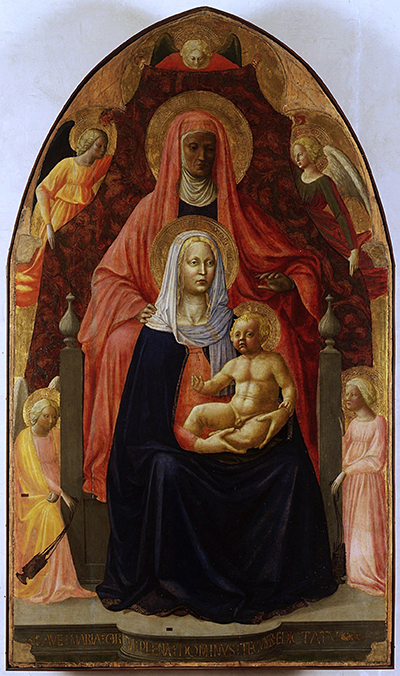
The Central Virgin and Child. The National Gallery’s Virgin and Child was the centre of the altarpiece. The museum emphasises Mary’s sturdy sculptural form, Christ’s fleshy body and the use of single-point perspective within the throne. This central panel would have anchored the entire structure visually and theologically. Everything around it depended upon the authority of the Virgin and Christ at the core.
Mary’s Monumentality
Mary is broad, heavy and physically convincing. Her body casts a shadow against the throne, reinforcing the illusion that she exists as a solid form rather than as a decorative outline. The treatment demonstrates Masaccio’s close engagement with sculpture. Holy figures become credible because they occupy space with the same seriousness as carved bodies.
Christ and the Grapes. Christ eats grapes, an ordinary bodily action carrying Eucharistic meaning. The National Gallery explicitly links the fruit with the wine of the Eucharist and Christ’s future sacrifice. The symbolism would have resonated strongly because a Crucifixion originally stood above the central panel. Christ’s childhood action therefore anticipates the sacrificial image higher in the altarpiece.
Eucharistic Verticality. This vertical relationship is crucial. The child who eats grapes below becomes the crucified Christ above, allowing the physical structure of the polyptych to connect incarnation and sacrifice. The altarpiece therefore organised theology architecturally. Placement itself carried meaning.
The Throne. The throne uses single-point perspective to create depth, and the National Gallery points to the V-shaped recession created by the angels’ lutes as part of the spatial construction. This makes the central sacred group inhabit measurable space. Perspective is therefore integrated into a traditional gold-ground altarpiece rather than requiring the abandonment of older sacred materials.
Pietra Serena
The pale grey architectural forms have often been compared with the pietra serena used in contemporary Florentine architecture. This visual language would have made the throne feel strikingly modern. Brunelleschian architectural culture therefore enters panel painting. The Virgin inhabits a space resonant with the new Florence.
The Angels. Small music-making angels occupy the foot of the throne. Their instruments and positioning help establish recession while also giving the sacred court a liturgical and celestial character. The figures are decorative without being spatially irrelevant. Masaccio integrates ornament into perspective.
The Four Lost Flanking Saints. Vasari identified the four full-length saints flanking the central Virgin as Peter, John the Baptist, Julian and Nicholas. The National Gallery notes that all four are now lost. Their disappearance is one of the largest gaps in reconstruction. The modern central panel now looks isolated where it once belonged to a dense sacred hierarchy.
Why Those Saints? The selection reflected chapel dedication, patronal identity and Carmelite context. Saint Peter and John the Baptist had broad ecclesiastical importance, while Julian and Nicholas likely carried more specific devotional or patronal associations. The exact original relationships become harder to read because the panels are gone. Reconstruction must therefore remain partly hypothetical.
Saint Paul
A surviving Saint Paul associated with the polyptych remains in Pisa. The narrow panel shows how Masaccio adapted monumental bodily presence to a vertical saint format. Its survival helps define the style and scale of the upper or lateral components. Even isolated saints were conceived as substantial bodies rather than flat icons.
Saint Andrew. The Getty’s Saint Andrew dates to 1426 and originally belonged to the upper right tier of the altarpiece. Getty records identify him through the cross of martyrdom and the book he carries. The panel has become central to reconstructing how Masaccio designed figures for elevated viewing. Its current museum height differs radically from the original installation.
Elevated Viewing. A figure placed high above the spectator is seen from below. If painted according to ordinary eye-level proportions, the body can appear distorted when installed. Masaccio adjusts for this problem. The Getty study makes Saint Andrew a key example of how viewing position shaped the artist’s decisions.
Donatello and Viewing from Below. This concern parallels problems faced by sculptors such as Donatello. Statues designed for façades or monuments had to be adjusted according to their intended viewing height. Masaccio therefore applies a sculptural intelligence to painting. The body is designed for architecture rather than for detached contemplation.
The Crucifixion
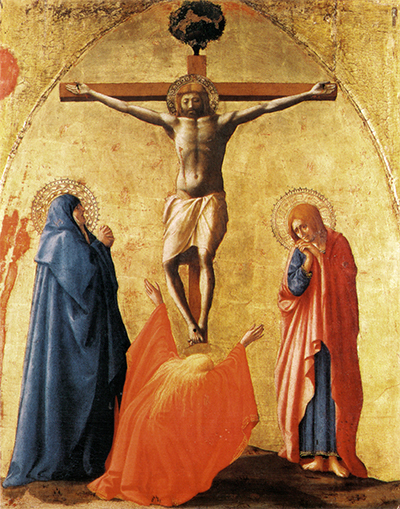
The Crucifixion, now in Naples, originally occupied an elevated position in the polyptych. Christ’s body appears dramatically shortened when seen straight on, but this foreshortening makes sense when reconstructed for a viewer below. The panel is one of the clearest demonstrations that museum viewing can distort our understanding of Renaissance design. What looks strange at eye level may have been optically convincing in situ.
Christ’s Body. Masaccio sacrifices ideal frontal anatomy in order to achieve visual truth from the intended viewpoint. This is an advanced use of perspective because the painter is considering not just internal space but the physical position of the spectator. The body therefore belongs to two spaces at once: the painted scene and the actual chapel.
Mary Magdalene. Mary Magdalene is shown from behind at the foot of the Cross, her raised arms creating one of the most emotionally forceful gestures in the panel. The pose gives grief a bodily direction. Rather than relying upon facial expression, Masaccio makes the whole figure become lament.
Mary and Saint John. The Virgin and Saint John flank Christ with restrained grief. Their composure contrasts with Magdalene’s dramatic gesture, creating emotional variation within a small field. Masaccio therefore controls intensity carefully. Different bodies mourn differently.
Light in the Crucifixion
National Gallery scholarship highlights the especially high quality of the Crucifixion and the central predella, noting dramatic illumination from the left. This consistency with the central Madonna reinforces the unity of the original altarpiece. Light helped bind physically separate panels into one visual environment.
The Predella. The predella formed the low horizontal zone beneath the principal panels. Surviving sections are now in Berlin and include the Adoration of the Magi as well as narrative episodes connected with saints from the main tier. Predellas allowed large iconic figures above to be supplemented by small-scale storytelling below. Masaccio demonstrates that his monumentality could survive even within reduced figures.
Adoration of the Magi. The Adoration of the Magi is one of the finest surviving predella sections. National Gallery scholarship singles it out with the Crucifixion as especially high-quality work by Masaccio himself. The scene coordinates architecture, horses, procession and kneeling figures within a shallow horizontal field. Narrative density increases, but spatial clarity remains.
Nicola Pisano and Pisa. The National Gallery notes that Masaccio may have drawn details from Nicola Pisano’s celebrated pulpit sculpture in the Pisa Baptistery when designing predella scenes. This local artistic dialogue is important because Masaccio did not arrive in Pisa with only Florentine references. The city’s medieval sculpture offered another source for crowded narrative composition.
Local Artistic Memory
Pisa possessed a major sculptural tradition through Nicola and Giovanni Pisano. Their works demonstrated how sacred narratives could combine dramatic bodies and dense grouping. Masaccio’s encounter with this environment complicates a purely Florentine account of his development. The Pisa Polyptych is also a Pisan object responding to local culture.
Predella of Saint Peter and Saint John the Baptist. Some predella scenes narrate episodes from the lives of the saints associated with the lost flanking panels. This allowed the altarpiece to connect iconic presence above with biographical action below. The structure teaches viewers who the saints are through narrative. Stable sacred identity and temporal story coexist vertically.
Scenes from Saints Julian and Nicholas. National Gallery scholarship notes that some lower-quality execution in scenes from the lives of Julian and Nicholas has been attributed to Andrea di Giusto. This variation offers valuable evidence for workshop practice. Masaccio designed the ensemble, but assistants may have carried out some subsidiary passages.
Masaccio as Designer. The National Gallery concludes that Masaccio must have designed the whole altarpiece even where execution varies. This distinction between design and execution is fundamental to Renaissance workshop practice. Authorship can include conceptual control without requiring the master’s hand on every centimetre.
Workshop Collaboration
The Pisa records make this unusually concrete. Andrea di Giusto appears as a garzone, Lo Scheggia is involved in payments and other craftsmen participated in chapel and frame production. The masterpiece therefore emerges from a network. Individual genius operates through collaboration rather than outside it.
Donatello’s Possible Role. Because Donatello was with Masaccio during one payment and witnessed another, scholars have proposed several forms of artistic involvement. Pope-Hennessy even suggested that Donatello may have supplied sculptural models for the central Madonna. This remains a hypothesis, not documented fact. The secure point is that the two artists were in direct professional proximity during the commission.
Two-Way Influence. Luciano Berti proposed that influence may have travelled in both directions between Masaccio and Donatello. This is historically persuasive because major contemporaries rarely relate as simple teacher and follower. Shared problems can generate reciprocal experimentation.
The Central Madonna and Donatello. The National Gallery identifies Donatello as an important sculptural source for the Madonna and Child, comparing the panel with a relief now in the Victoria and Albert Museum. The comparison rests on physical conception rather than copying details alone. Mary’s mass and Christ’s bodily weight make the painted figures behave almost sculpturally.
Light as Sculpture in Paint
Masaccio uses light to carve bodies optically. Highlights and shadow give volume to flesh and drapery, producing a three-dimensional effect on a flat panel. The Getty describes this use of light as one of Masaccio’s great historical contributions.
Gold Ground and Renaissance Space. The altarpiece retained extensive gold, demonstrating again that Renaissance naturalism did not require the immediate elimination of medieval materials. Sacred brilliance and measurable perspective coexist. Masaccio’s revolution occurs within inherited form. The format remains traditional while the bodies and spaces change profoundly.
Frame and Architecture. The lost frame would have been essential to the original experience. It divided panels physically while also joining them into one architectural object. Modern reconstructions attempt to recover this relationship, but no museum installation can recreate the lost object with total certainty. The polyptych survives as scholarship as much as material.
The Original Location. The precise position of Giuliano’s chapel within Santa Maria del Carmine has been debated. National Gallery scholarship discusses evidence that may place the altar in relation to the nave and tramezzo rather than simply assuming a modern chapel configuration. This matters because original lighting and viewing angle affect how the panels were designed. Location is part of formal interpretation.
Light from the Left
The National Gallery notes that the altarpiece’s painted light emphatically comes from the left and uses this fact in discussing the original location. Masaccio therefore appears to coordinate fictive illumination with architectural conditions. The painted object was designed to belong to the church rather than ignore it.
Altarpiece and Sepulchral Monument. Giuliano’s records describe moving his funerary monument in relation to the altar. The ensemble therefore joined image and burial physically. Worshippers encountered the Virgin, saints and Christ’s Passion within a space also marked by the patron’s mortality.
Death and Salvation. This funerary context deepens the altarpiece’s theology. The Eucharistic grapes, Crucifixion and saintly intercession all acquire particular force beside a family tomb. The polyptych was therefore not merely an image of sacred hierarchy. It formed part of a ritual environment concerned with death, memory and salvation.
The Carmelites. The Carmelite friars played an active role in the commission. The prior appears repeatedly in the payment documentation and retained the right to approve the completed altarpiece. Institutional oversight reminds us that sacred art had multiple stakeholders. Patronal wishes had to coexist with the needs and authority of the religious community.
Why the Altarpiece Was Dismantled
Like many medieval and Renaissance polyptychs, the Pisa altarpiece was eventually dismantled as church interiors and tastes changed. Individual panels entered separate collections over time. This dispersal destroyed the original visual hierarchy. Modern scholarship has had to reverse that history through reconstruction.
Rediscovering the Central Panel. The National Gallery notes that Bernard Berenson published the London Virgin and Child in 1907 as the central panel of the altarpiece Vasari had seen in the Carmine, an identification subsequently accepted by nearly all scholars. This modern recognition became a foundation for reconstructing the larger ensemble. One panel helped call the lost object back into existence conceptually.
The Getty Saint Andrew and Reconstruction. The Getty’s acquisition and study of Saint Andrew added another crucial piece. The museum’s monograph examines the commission, patronage, original location and later dispersal in detail. The panel demonstrates how individual museum objects can function as gateways into lost architectural ensembles. Its significance lies partly in what once surrounded it.
Scattered Geography. The surviving fragments are now dispersed widely. London, Naples, Pisa, Los Angeles and Berlin each preserve pieces of one original sacred object. This dispersal creates an unusual modern experience. To “see” the Pisa Polyptych now requires travel or reconstruction.
Digital and Scholarly Reconstruction
Modern diagrams, technical imaging and digital visualisation help reunite the panels conceptually. The National Gallery catalogue includes reconstructed arrangements of the predella and wider ensemble. Such reconstructions remain hypotheses rather than replacements for the lost original. Their value lies in restoring relationships of scale, height and iconography.
Why Scale Matters. A panel viewed alone can seem complete, but its original scale depended upon neighbouring saints and the frame. The central Madonna’s monumentality becomes even greater when imagined within a large multi-tiered structure. Similarly, small predella scenes gain meaning when restored beneath the saints whose lives they narrate.
Why Height Matters. Height changes perception dramatically. The Crucifixion and Saint Andrew were designed for upward viewing, meaning modern museum placement can make their proportions appear unusual. Reconstruction therefore corrects interpretation. Apparent distortion becomes deliberate optical adjustment.
Why Workshop Evidence Matters. The documents prevent us from imagining Masaccio as a solitary genius painting every panel in isolation. His brother, assistant, patron, prior, carpenter, mason and fellow artists all appear around the commission. This richer picture makes the masterpiece more historically convincing. Renaissance art was produced through systems of labour.
Why the Payment Record Matters
The payment sequence gives unusual insight into the rhythm of work. February establishes the beginning, March confirms progress, July places Donatello beside Masaccio, October produces an exclusivity demand and December records the rush towards completion. The altarpiece therefore acquires a calendar. We can follow the project almost as a working commission rather than as a timeless masterpiece.
Why the Pisa Polyptych Matters in Masaccio’s Career. The polyptych proves that Masaccio’s revolution was not limited to fresco. He could translate bodily mass, perspective and coherent light into egg tempera and gold while working within a highly traditional altarpiece format. The project also demonstrates professional maturity. At twenty-four or twenty-five, he was managing a large, expensive commission with assistants and institutional scrutiny.
Relationship to the Brancacci Chapel. National Gallery scholarship explicitly connects the monumentality and compositional discipline of the Pisa Madonna with Masaccio’s experience as a fresco painter in the Brancacci Chapel. This cross-media relationship is crucial. Lessons learned on plaster inform panel painting, while the controlled altarpiece environment gives Masaccio new problems of hierarchy and viewing height.
Relationship to the Holy Trinity. The Pisa Polyptych also anticipates the spectator-conscious perspective of the Holy Trinity. Elevated panels are designed for viewers below, while the central throne uses coherent recession. Masaccio’s interest in viewpoint therefore extends across media. He repeatedly asks where the spectator will stand.
Why the Pisa Polyptych Matters
The Pisa Polyptych matters because it reveals Masaccio at the height of his powers inside one of the most thoroughly documented commissions of the Early Renaissance. The payment record allows us to watch the project unfold through 1426, while surviving panels reveal how he coordinated perspective, light, bodily mass and sacred hierarchy across a complex architectural object.
Its fragmented condition is tragic but intellectually productive. The London Madonna, Naples Crucifixion, Pisa saints, Getty Saint Andrew and Berlin predella fragments each preserve part of a lost whole, forcing modern viewers to reconstruct the relationships between them. That reconstruction changes how the paintings look. Foreshortened bodies designed for elevated viewing become intelligible, Eucharistic grapes beneath the Crucifixion recover their vertical meaning and small predella narratives reconnect with the saints they once explained. The documents also humanise production.
Lo Scheggia, Andrea di Giusto, the Carmelite prior, Giuliano degli Scarsi and Donatello all appear in the working history, showing that Masaccio’s achievement emerged through a professional network rather than solitary inspiration. Above all, the polyptych demonstrates the breadth of Masaccio’s revolution. Traditional gold, multi-panel structure and saintly hierarchy remain, but within them bodies become sculptural, architecture becomes measurable and the viewer’s real position becomes part of the design.
Frequently Asked Questions
Discussion
Use this space to discuss Pisa Polyptych | Masaccio, its source evidence and how it fits into Masaccio's wider cluster.
Keep comments focused on close looking, attribution language, object evidence and page-specific caveats.
Reader Insights
Which detail on this page most changes how you read the work?
How does this page connect to Masaccio's paintings, fresco technique or Florentine setting?
Where should the wording stay cautious because the source evidence is qualified?
Join the Conversation
Share your reading of Pisa Polyptych | Masaccio below.
References and Research Sources
- National Gallery, London, scholarly catalogue for Masaccio’s Virgin and Child, for the commission, payment records, reconstruction, assistants, Donatello contact, lost saints, predella and original-location debate. View Source
- National Gallery, London, Masaccio: The Virgin and Child, for the central panel, Eucharistic grapes, perspective, sculptural modelling and Donatello comparison. View Source
- J. Paul Getty Museum, Eliot W. Rowlands, Masaccio: Saint Andrew and the Pisa Altarpiece, for the commission, programme, original location and later history. View Source
- Getty CONA, Saint Andrew, for the panel’s date, subject, medium and position in the upper right tier. View Source
- National Gallery, London, Masaccio artist biography, for the Pisa Polyptych’s central place in his career and his treatment of monumental figures through light and perspective. View Source