 by Tom Gurney
Tom Gurney BSc (Hons) is an art history expert with over 20 years experience
Published on June 19, 2020 / Updated on October 2, 2026
Email: tomgurney1@gmail.com / Phone: +44 7429 011000
Madonna del Ceppo by Fra Filippo Lippi
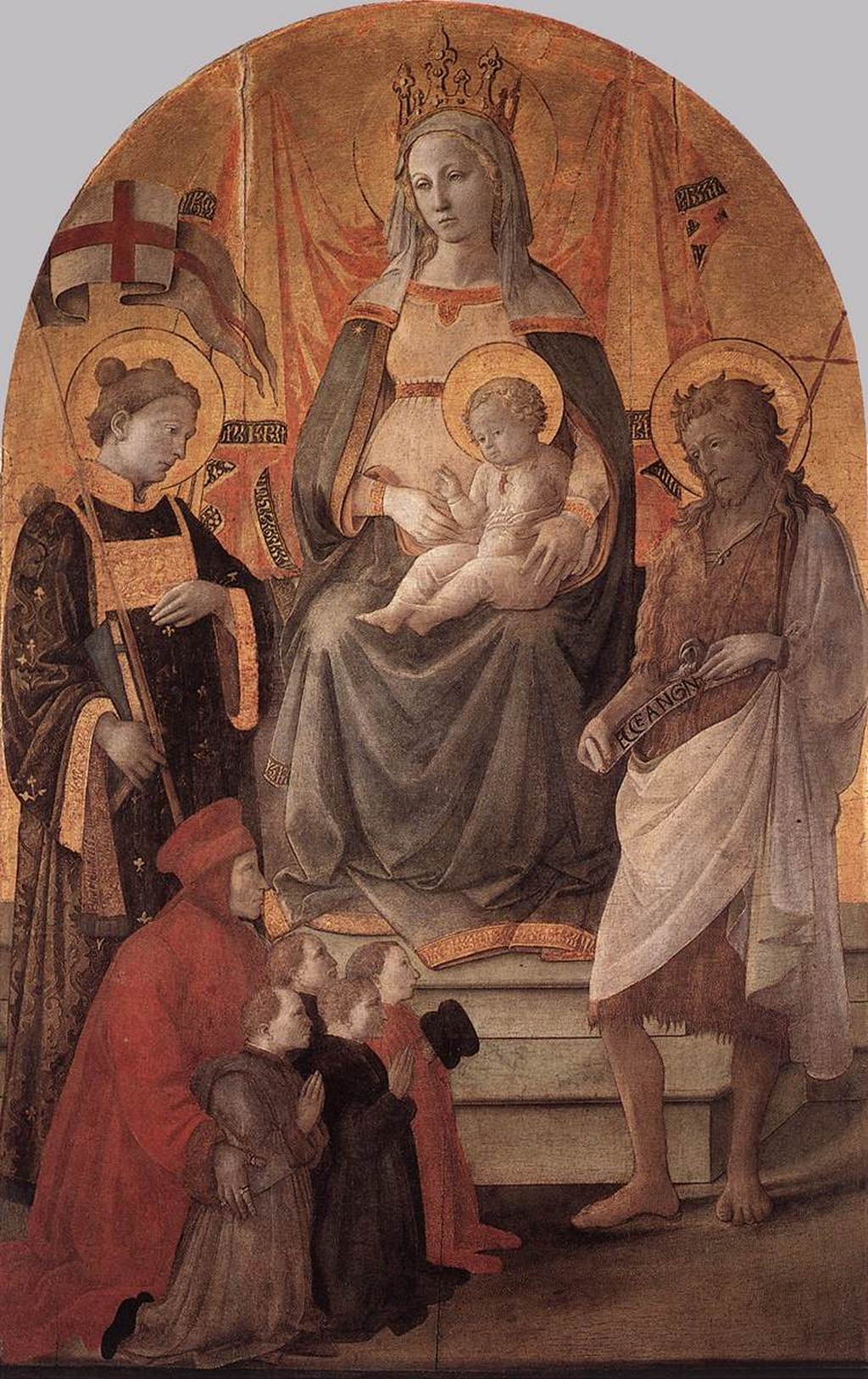
Fra Filippo Lippi’s Madonna del Ceppo, painted about 1452–53 and now in the Museo di Palazzo Pretorio in Prato, is one of the clearest examples of how Renaissance painting could unite religion, charity, civic identity and institutional memory.[1] The painting was commissioned by the charitable foundation known as the Ceppo pe’ poveri di Cristo, an institution founded by the celebrated Prato merchant Francesco di Marco Datini. The foundation played an important role in financing Lippi’s major work in the city and requested this large commemorative tabernacle for the courtyard of Palazzo Datini.
That context immediately distinguishes the work from a private Madonna. It was made to represent an institution whose purpose was care for the poor. Mary sits elevated with the Christ Child while Saints Stephen and John the Baptist stand beside her. Below, Francesco Datini and institutional officials appear as donors at a much smaller scale.
The changing sizes create a precise hierarchy. Sacred figures dominate; earthly benefactors are present but subordinate. The painting therefore commemorates charitable patronage without allowing donors to compete with holy figures. It is one of the strongest surviving links between Lippi’s art, Prato’s social history, the Datini legacy, the cathedral frescoes and the economics of Renaissance charity.
At a Glance
- ArtistFra Filippo Lippi
- TitleMadonna del Ceppo
- Date1452–53
- MediumTempera and gold on panel
- Dimensionsabout 189 × 120 cm
- Current locationMuseo di Palazzo Pretorio, Prato
- CommissionerCeppo pe’ poveri di Cristo
- Institutional founderFrancesco di Marco Datini
- Original settingCourtyard of Palazzo Datini
- Principal saintsSaint Stephen and Saint John the Baptist
- Donor figuresFrancesco Datini and representatives of the charitable institution
- Key themesCharity, civic identity, donor portraiture, hierarchical scale, Prato patronage and institutional memory
- Condition historyLong exposure in a sheltered outdoor location caused significant deterioration before later restoration
Contents
- What Does the Painting Show?
- Saint Stephen
- Palazzo Datini
- Patronage Networks
- Mary
- Comparison with the Prato Frescoes
- Hierarchy as Institutional Design
- Outdoor Display and the Meaning of Durability
- Prato and Florence in One Image
- The Courtyard as Public-Facing Space
- FAQs
- References
What Does the Painting Show?
Mary sits high in the composition with Christ. Saint Stephen and Saint John the Baptist flank her. Below are smaller human figures associated with the charitable foundation.
This vertical arrangement makes status immediately legible. The sacred world occupies the dominant scale. The earthly world approaches humbly. The composition therefore communicates institutional prestige without confusing donors with saints.
The Meaning of “Ceppo”. The painting’s common name comes from the charitable organisation that commissioned it. A ceppo in Tuscan institutional history became associated with charitable foundations and their funds. The Ceppo pe’ poveri di Cristo was founded through the legacy of Francesco di Marco Datini. Its purpose linked wealth with care for the poor. The altarpiece therefore belongs to a social system in which successful merchants could transform private fortunes into enduring public charity.
Francesco di Marco Datini. Datini is one of the most famous merchants of medieval and Renaissance Tuscany. His surviving archive has made him extraordinarily important to historians of commerce, household life and business. His charitable legacy also shaped Prato after his death.
The Ceppo transformed his wealth into institutional continuity. Lippi’s painting helped make that continuity visible. Datini appears not simply because he was rich. He appears because the institution traced its identity to him.
Charity and Commemoration. Renaissance charity often combined spiritual, civic and memorial aims. Giving to the poor fulfilled Christian obligations. Endowing an institution benefited a city.
It could also preserve the donor’s name. The Madonna del Ceppo holds those functions together. Datini remains visibly present.
Yet he kneels beneath sacred figures. His commemoration is framed as service rather than self-glorification. That balance is central to the work.
Saint Stephen
Saint Stephen was deeply important to Prato and to its cathedral. He was the first Christian martyr and one of the principal saints represented in Lippi’s cathedral fresco cycle. His presence therefore connects this panel with the city’s religious identity. For a local audience, Stephen was not a generic saint selected from a catalogue. He anchored the image in Prato.
Saint John the Baptist. John the Baptist was patron saint of Florence. His presence beside Stephen creates a meaningful pairing. Stephen represents Prato.
John represents Florence. Fra Filippo himself moved between these civic worlds. The painting therefore visually connects the city in which he was working with the larger Florentine culture from which his career emerged.
The Donor Figures. The earthly donors are represented at reduced scale. This is sometimes called hierarchical scale. Size reflects spiritual status rather than simply physical distance.
By the mid-fifteenth century, Renaissance artists were increasingly committed to coherent perspective and naturalistic space. Lippi nevertheless retains hierarchy where it serves devotional meaning. This is important. Renaissance naturalism did not eliminate symbolic convention overnight. Artists selected which rules mattered in particular contexts.
Why the Donors Are Smaller. If the donors were painted at the same scale as Mary and the saints, they might appear to belong to the sacred gathering as equals. Reduced scale prevents that misunderstanding. It communicates humility.
At the same time, inclusion itself is honour. The officials and founder are permanently represented in proximity to holy protectors. The painting therefore negotiates between prestige and submission.
Palazzo Datini
The original location in Palazzo Datini gives the work additional force. The building was connected directly with the merchant whose legacy founded the charity. Installing the tabernacle there transformed architecture, institutional memory and sacred image into one ensemble. Visitors encountered charity not as an abstract account book but as a visible religious identity. The painting told them who stood behind the institution and under whose sacred protection it operated.
A Courtyard Image. The work’s courtyard location affected its physical history. Although sheltered, it remained exposed to environmental changes in ways a church interior panel might not. Palazzo Pretorio records substantial deterioration.[1]
That condition history is important because it explains why some areas may appear less intact than viewers expect from a museum painting. A work’s present appearance reflects where it lived. Provenance is therefore material as well as documentary.
Restoration. Later restoration recovered important passages. Conservation cannot simply return an object to an imagined “original” state. It stabilises what survives and may remove or reduce later damage where ethically possible.
For the Madonna del Ceppo, treatment helps modern viewers recover the hierarchy, textiles and figures after centuries of difficult display conditions. Conservation history therefore has to be considered before every weak passage is judged as an artistic decision.
Prato in 1452–53. The date coincides with the beginning of Lippi’s enormous commission in Prato Cathedral. This makes the Madonna del Ceppo part of a decisive career moment. Lippi was becoming embedded in the city.
Major institutional patrons required his work. The Ceppo itself had a financial connection to the cathedral project. The panel and frescoes should therefore be studied together as products of one Prato network.
Patronage Networks
The artist did not move through Prato as an isolated genius. Institutions, clergy, merchants, charitable officials and workshop assistants formed the network that made his work possible. The Madonna del Ceppo reveals that network with unusual clarity.
Its patron is not one prince. It is an organisation created from a merchant’s legacy. That institutional model offers a valuable contrast with Lippi’s Medici commissions.
Merchant Wealth and Sacred Art. Datini’s story illustrates the relationship between commerce and religious culture. Merchant wealth could finance buildings, charity and painting. Modern narratives sometimes treat money and spirituality as opposites.
Renaissance institutions frequently joined them. The moral question was not whether wealth existed but how it was used. A charitable foundation transformed accumulated capital into almsgiving and civic benefit. The altarpiece visualises that transformation.
Textiles and Surface Detail. Palazzo Pretorio draws attention to rich surface elements and the influence of northern painting in textile description.[1] Lippi had a strong interest in fabrics throughout his career. Here the detail serves more than decoration.
Expensive textiles distinguish sacred dignity and institutional prestige. They also demonstrate the painter’s ability to render materially different surfaces. The viewer encounters cloth, gold, skin and architecture as distinct things.
Flemish Influence. Northern European painting was admired for close observation of materials, jewels and textiles. Lippi’s interest in such detail belongs to a wider Florentine engagement with northern visual culture. The Madonna del Ceppo can therefore support discussion of artistic exchange without requiring unsupported claims that Lippi travelled personally to Flanders. Influence could occur through imported works and circulating objects. Visual relationship should be distinguished from biographical speculation.
Mary
The museum describes Mary as melancholy. That mood appears elsewhere in Lippi’s mature Madonnas. The theological reason is familiar.
A Virgin holding Christ can also be understood as a mother with foreknowledge of his future Passion. Her sadness therefore belongs to a devotional structure. It creates emotional depth without turning the image into overt tragedy.
Christ. The Child occupies the sacred centre with Mary. His presence transforms the painting from a civic memorial into a Christian image. The donors’ charity is meaningful because it is placed under Christ. The painting thus connects institutional action with religious salvation.
Saintly Protection and Civic Geography. The pairing of Stephen and John creates a miniature sacred map. Prato and Florence meet around Mary and Christ. Lippi’s own career also connects those places.
He was Florentine by formation but produced some of his greatest work in Prato. The saints make that relationship visible. This is one reason the image belongs so naturally within the wider history of Lippi’s Prato period.
Hierarchical Scale and Renaissance Perspective. It is tempting to describe Renaissance art as a straightforward march towards mathematically consistent space. The Madonna del Ceppo complicates that story. Lippi knew perspective.
His Prato frescoes prove it. Yet he deliberately gives donors a reduced scale. Symbolic hierarchy remains useful. The Renaissance artist could be naturalistic when naturalism served meaning and conventional when convention served meaning better.
Comparison with the Prato Frescoes
The panel and cathedral cycle share patrons, place and chronology. Their scales and functions differ dramatically. The frescoes tell expansive saintly histories across monumental walls.
The Madonna del Ceppo condenses institutional identity into one vertical devotional image. This comparison reveals Lippi’s flexibility. He could design narrative architecture for a cathedral and a commemorative tabernacle for a charitable courtyard at the same time.
Comparison with Medici Patronage. The Ceppo commission is a useful counterweight to the Medici pages. In Florence, Lippi worked for a powerful family whose private palace became a major artistic environment. In Prato, he worked for a charitable institution rooted in a merchant’s legacy.
Both patrons used sacred art to express identity. But the identities differ. The Medici emphasise dynasty and elite devotion. The Ceppo emphasises charity and civic benefaction.
Datini as a Renaissance Afterlife. Datini died before Lippi painted the panel. His appearance is therefore commemorative rather than a live portrait sitting. This is significant.
A Renaissance person could remain socially active through institutions founded after death. Money, buildings, archives and images extended a name across generations. The Madonna del Ceppo is part of Datini’s afterlife. It shows how patronage can outlast the patron.
The Ceppo as a Corporate Patron. The commission is particularly valuable because the word “patron” refers here to a corporate body rather than a single living individual. Officials changed over time. The institution survived them.
That continuity affected how the painting represented identity. A private patron might request a personal saint, coat of arms or family portrait. The Ceppo needed an image that could outlast particular officeholders.
Lippi solves the problem by placing the foundation’s founder and representatives beneath enduring sacred protectors. The painting therefore works almost like a visual charter. It explains where the institution came from, whom it served and under whose heavenly protection it imagined itself operating.
Hierarchy as Institutional Design
The scale differences can be read almost as an organisational chart. Mary and Christ occupy the summit. Stephen and John stand beneath or beside them as intercessory patrons.
Datini and the Ceppo officials occupy the lowest human register. This hierarchy is not humiliation. It is order.
The benefactors derive dignity from proximity to sanctity while accepting their subordinate place. For an institution devoted to charity, such visual humility was especially appropriate. The painting could commemorate wealth only by showing wealth placed in service.
Datini's Archive and the Value of Context. Francesco Datini is exceptional because enormous quantities of documentary material connected with his commercial life survive. That archive allows historians to reconstruct business practices, correspondence, household management and economic networks with unusual detail. Lippi’s painting belongs to the cultural afterlife of that documented merchant world.
The contrast is productive. Letters and ledgers show how wealth was made and managed. The Madonna del Ceppo shows how part of that wealth was transformed into religious and charitable memory. The painting therefore links art history with economic history without forcing an artificial connection.
Charity in a Commercial City. Prato prospered through manufacture and trade. Commercial activity created wealth but also social inequality and vulnerability. Charitable institutions occupied an important position within that urban environment.
They could distribute aid, manage bequests and create durable structures for benefaction. A sacred painting commissioned by such an organisation did not merely beautify its headquarters. It visualised the moral identity of the institution.
Mary and Christ provided the religious centre. The saints provided civic protection. The donors represented human responsibility.
Outdoor Display and the Meaning of Durability
The courtyard installation also reminds us that Renaissance patrons sometimes expected panel paintings to function in conditions far less protected than modern museums. Shelter could reduce direct rain while still exposing wood and paint to humidity, temperature variation, dust and changing air. The object’s deterioration is therefore evidence of use.
It spent centuries where its commissioners expected people to encounter it. Removing it into museum conditions protects the surviving material but ends that original relationship between image and place. The loss of context is the price of preservation.
Gold in a Charitable Image. The medium includes gold. At first glance, precious-looking materials might seem contradictory in an image made for a charity helping the poor. Renaissance viewers would not necessarily have understood the contradiction in modern terms.
Honouring sacred figures with valuable material could itself be considered appropriate devotion. The splendour of the image represented the dignity of the institution’s religious mission. The key issue was hierarchy. Gold does not glorify the donors as saints. It helps construct a sacred environment above them.
Institutional Portraiture. The donor figures deserve to be understood as more than miniature likenesses. Together they create a portrait of an organisation. Modern corporate identity uses logos, staff photographs and mission statements.
A Renaissance charitable body used founders, officeholders, saints and sacred narratives. The Madonna del Ceppo is therefore a portrait without a single protagonist. Its subject is collective continuity. That makes it especially unusual within Lippi’s oeuvre.
Prato and Florence in One Image
Saint Stephen and Saint John the Baptist create a civic pairing that would have been legible to local viewers. Stephen belonged centrally to Prato Cathedral. John the Baptist embodied Florentine identity.
Their juxtaposition can be read alongside Lippi’s own movement between the two cities. Prato was not merely a provincial stop. It became the location of a long, ambitious period in which his work was supported by institutions with connections reaching back towards Florence. The painting makes that network visible through saints.
Why the Madonna del Ceppo Matters. The Madonna del Ceppo matters because it turns charity into an image. Fra Filippo Lippi represents not only Mary, Christ and saints but an institution. Through size, placement and donor portraiture, he creates a clear hierarchy between sacred protection and earthly benefaction.
The work also embeds his art firmly in Prato. Its patronage links to Datini. Its saints link Prato and Florence.
Its date links directly to the cathedral frescoes. Its damaged and restored surface records centuries in a courtyard connected with the institution itself. It opens subjects often neglected in artist biographies: charitable finance, merchant legacy, institutional patronage and the material consequences of original display. That makes it one of the most distinctive paintings through which to understand Lippi’s Prato career.
A Painting About the Use of Wealth. The work invites a broader question that reaches beyond art history: what was wealth for? Datini’s mercantile success had produced resources far beyond immediate household consumption. The charitable foundation converted those resources into an enduring social purpose.
Lippi’s altarpiece then converted that purpose into visual memory. The sequence matters. Commercial profit becomes charitable capital; charitable capital supports institutional action; institutional action commissions sacred art.
The painting therefore sits at the end of an economic chain. This does not mean every viewer consciously reconstructed the chain. Its visible donor hierarchy was enough to communicate the principle that earthly resources should ultimately serve higher obligations. For a modern reader, explaining this process can make patronage feel much less abstract than simply saying that a wealthy merchant “supported the arts”.
The Courtyard as Public-Facing Space
A courtyard attached to an institution sits between private interior and open civic street. People entering on business could encounter the image. Officials working there could see it repeatedly.
Beneficiaries of charity might also pass through the space. The painting therefore had a broader practical audience than an intimate bedroom Madonna. Its vertical clarity suits that semi-public function.
Mary and the saints remain legible quickly. The smaller donor figures reward closer attention. Lippi again adapts design to how an object is likely to be encountered.
Why Restoration Changes the Emotional Reading. Damage can affect mood. If flesh tones lose modelling or bright textiles become dull, Mary may appear more severe or melancholy than originally intended. If gold and surface detail deteriorate, the institutional splendour can seem restrained.
The emotional impression of the surviving object should therefore be distinguished from claims about its original appearance. Palazzo Pretorio’s restoration history gives us permission to make that distinction explicitly.[1] The painting has an original history and a survival history. Both belong in the painting’s history.
FAQs
Discussion
What stands out to you most about Madonna del Ceppo in relation to Filippo Lippi's wider career?
Reader Insights
Notice how the page connects close visual detail with patronage, workshop practice and the wider Renaissance setting.
Which comparison elsewhere in the cluster helps clarify this work or theme most strongly?
Join the Conversation
Have a thought or observation about Madonna del Ceppo? Share it below. Thoughtful responses may be added to this section.
References
- Museo di Palazzo Pretorio, Prato, “Madonna del Ceppo,” collection entry. View Source.
- Museo di Palazzo Pretorio, “Filippo Lippi and the Prato Workshop.”. View Source
- Musei Diocesani di Prato, institutional research on Lippi and the cathedral fresco commission. View Source
- Jeffrey Ruda, Fra Filippo Lippi: Life and Work with a Complete Catalogue, 1993.
- Megan Holmes, Fra Filippo Lippi: The Carmelite Painter, 1999.