 by Tom Gurney
Tom Gurney BSc (Hons) is an art history expert with over 20 years experience
Published on June 19, 2020 / Updated on October 2, 2026
Email: tomgurney1@gmail.com / Phone: +44 7429 011000
Fra Filippo Lippi's Spoleto Cathedral Frescoes
The apse frescoes in Spoleto Cathedral form the final monumental chapter of Fra Filippo Lippi's career. Painted in the later 1460s and left to be completed by assistants after Lippi's death in October 1469, the Stories of the Virgin bring together subjects that had occupied him for decades: Annunciation, Nativity, death, coronation, angels, architecture and the figure of Mary herself. The cycle is sometimes overshadowed by the better-known Prato frescoes, yet Spoleto deserves equal attention as the culminating public work of a painter who had spent much of his life making sacred stories feel immediate and human.
The site adds unusual biographical force. Lippi died in Spoleto and was buried in the cathedral. The building therefore preserves both his final monumental imagery and his posthumous memory. To move from the painted apse to his tomb is to encounter the end of the artist's career within a single architectural space.
Contents
- The commission and chronology
- The Annunciation
- The Death of the Virgin
- Workshop participation
- Marian imagery across Lippi's career
- Place within the Renaissance
- Annunciation: Beginning the Marian Arc
- Coronation: The Apse Opens into Heaven
- Workshop Completion
- The Tomb
- Influence in Umbria
- The Apse as a Narrative Machine
- Workshop Continuity After the Master's Death
- The Tomb as a Second Artwork
- References
The commission and chronology
Umbria's official tourism authority dates the surviving Stories of the Virgin frescoes broadly to 1463–69.[1] This range accommodates the extended commission and execution rather than reducing the project to only its final painting campaign. Different publications sometimes emphasise the contract, preparatory phase, active fresco execution or final completion, which can produce apparently competing starting years. The broad date 1463–69 accommodates the overall project, while 1469 marks Lippi's death before assistants completed the remaining work.
By this point Lippi was an experienced mural painter. The long Prato Cathedral project had taught him how to organise large surfaces, coordinate assistants and adapt narrative to architecture. Spoleto therefore represents neither a first experiment nor an isolated late commission. It is the work of a painter bringing decades of experience to another cathedral-scale programme.
The commission also required displacement. Lippi's career had been rooted in Florence and Prato, but Spoleto drew him into Umbria. Artistic geography mattered in the Renaissance: large commissions moved painters, workshops and visual ideas between cities.
The apse as a narrative space. The cycle covers the cathedral apse with episodes from the Virgin's life. Institutional descriptions identify major scenes including the Annunciation, Nativity, Death or Dormition of the Virgin, and the Coronation of the Virgin above. These episodes form a theological arc. The Annunciation initiates the Incarnation; the Nativity presents Christ's entry into the world; Mary's death marks the close of her earthly life; the Coronation transforms that death into heavenly triumph. Lippi therefore works not with a random anthology of Marian scenes but with a sequence extending from divine promise to celestial fulfilment. The architecture of the apse gives the programme a natural vertical logic. Earthly episodes occupy lower zones, while the Coronation rises above. Physical height becomes theological hierarchy.
The Annunciation
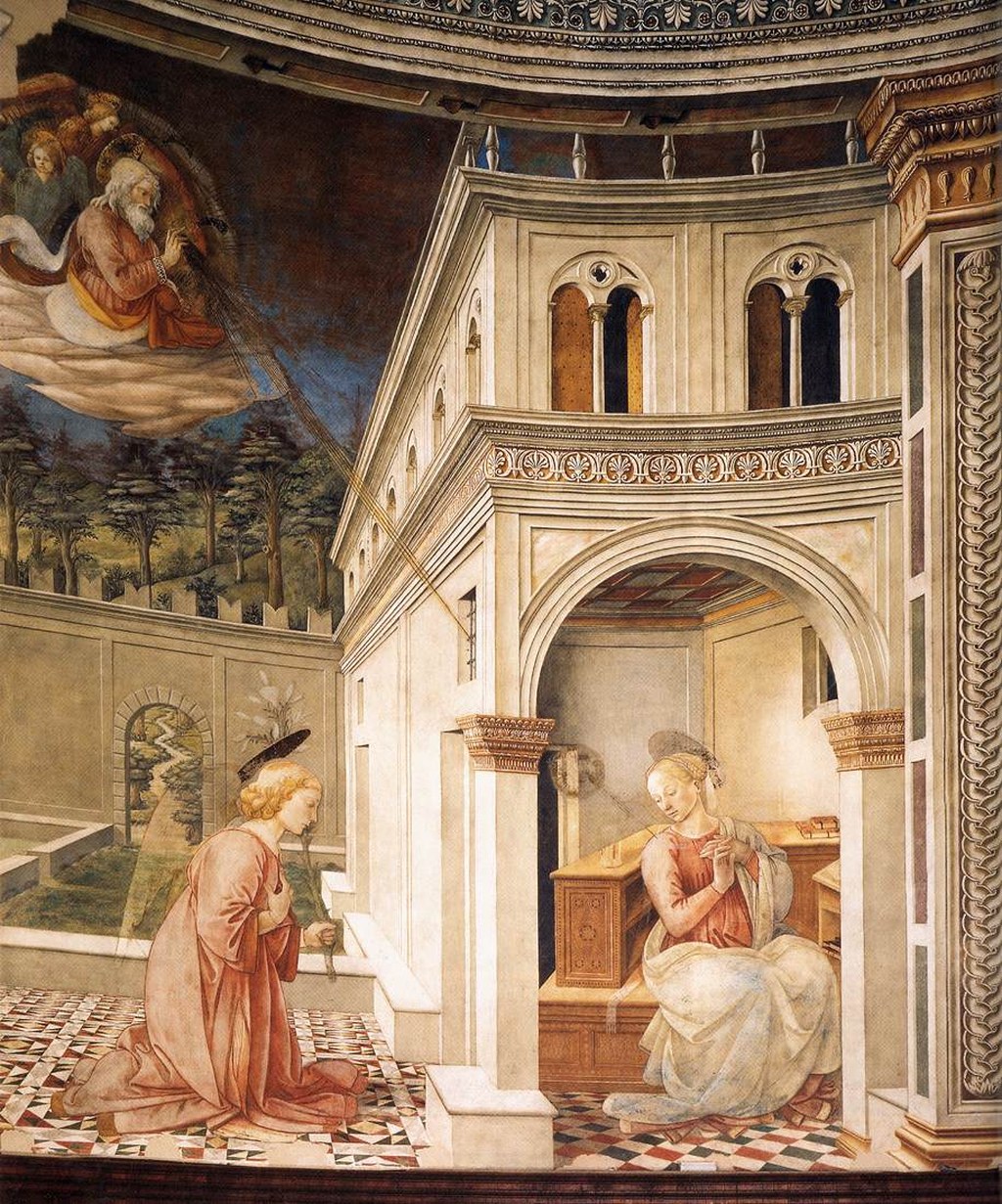
The Annunciation was one of Lippi's recurring subjects. Earlier panel versions show how adaptable the theme could be. In Spoleto the encounter between Gabriel and Mary belongs to a monumental public cycle rather than a private or semi-private panel. Lippi's Annunciations typically depend on controlled gestures and clear spatial separation. Gabriel approaches; Mary receives, pauses or turns; architecture creates both distance and connection. The theological mystery is expressed through an event that is visually comprehensible as an encounter between two bodies. At Spoleto the subject also serves as the first movement in the larger Marian biography. The scene should therefore be read in relation to what follows rather than isolated as an independent composition.
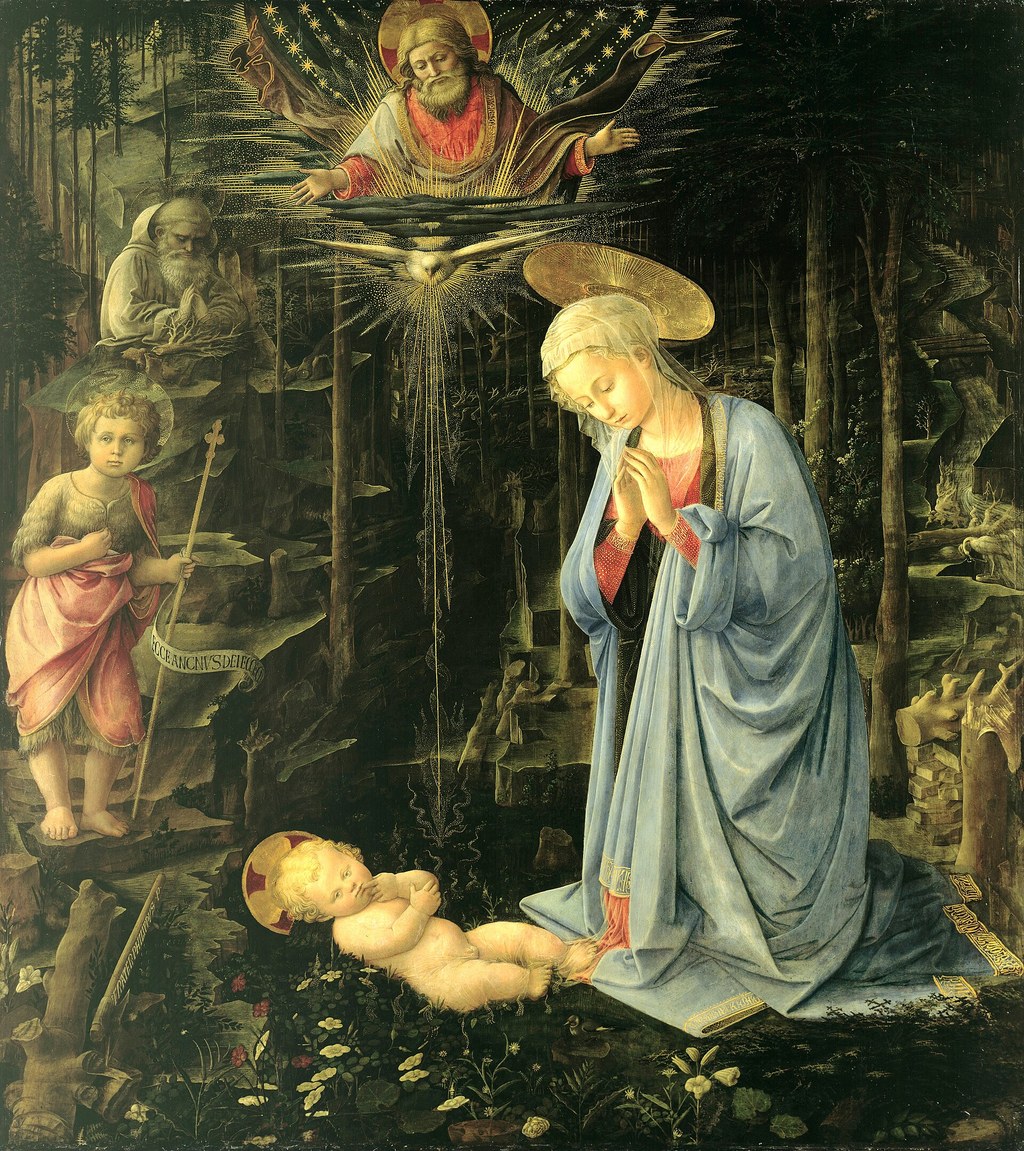
The Nativity. The Nativity allowed Lippi to explore another theme central to his art: the sacred made physically vulnerable. His mature Madonnas repeatedly emphasise touch, bodily closeness and the smallness of the Christ Child. On a cathedral wall, the same emotional logic operates at far larger scale. Nativity imagery in fifteenth-century Italy could combine biblical tradition with visionary elements drawn from later devotional literature. Lippi had already explored a particularly mystical form of Christ's birth in the Berlin Adoration in the Forest. At Spoleto, the episode belongs instead to a structured life of the Virgin. The comparison between Berlin and Spoleto is valuable precisely because it shows that “Nativity” was not one fixed pictorial formula for Lippi. Destination and programme altered the emphasis.
The Death of the Virgin
The Death of the Virgin or Dormition changes the emotional register of the cycle. Instead of promise or birth, the apostles gather around Mary's deathbed. The scene gave Renaissance painters opportunities to explore grief, ritual, communal witness and the transition from earthly body to heavenly destiny. For Lippi, who excelled at varied groups, the subject was especially fertile. Different figures can respond with different degrees of attention and emotion. The deathbed creates a horizontal centre around which the community is organised. The scene also prepares the Coronation above. Mary's death is not the terminal image of the programme. It is a passage between earthly narrative and heavenly elevation.
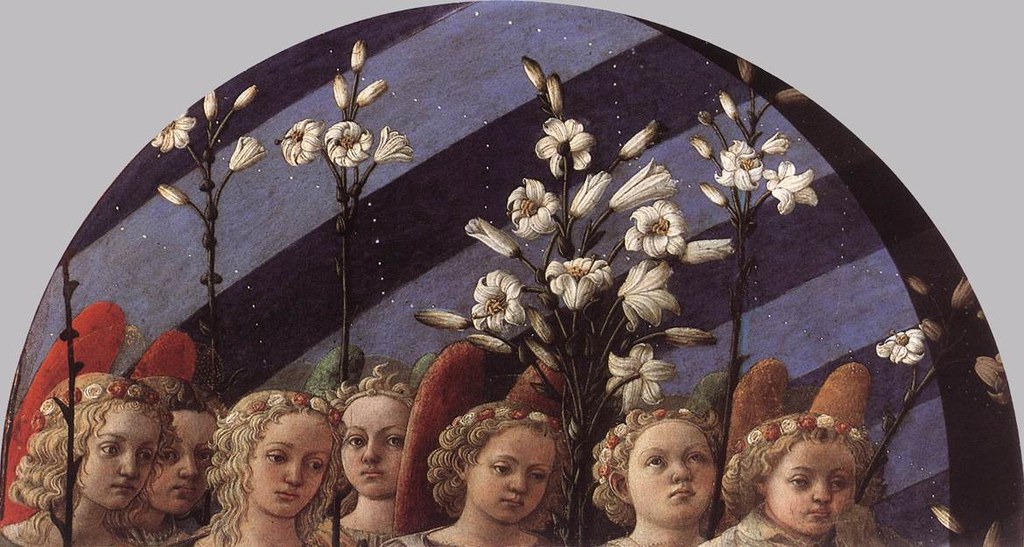
Coronation of the Virgin. The Coronation occupies the culminating position in the apse. Lippi had treated this subject on a grand scale decades earlier in the Sant'Ambrogio altarpiece now in the Uffizi. The comparison allows us to see both continuity and change. The earlier panel fills a large rectangular field with an abundant celestial assembly. In Spoleto, the architecture itself shapes the heavenly vision. Monumental wall painting allows the coronation to become part of the cathedral rather than an object placed within it. The subject also closes Lippi's career with an image closely associated with his artistic identity: Mary surrounded by angels and sacred figures, transformed through colour, gesture and ornament into an accessible vision.
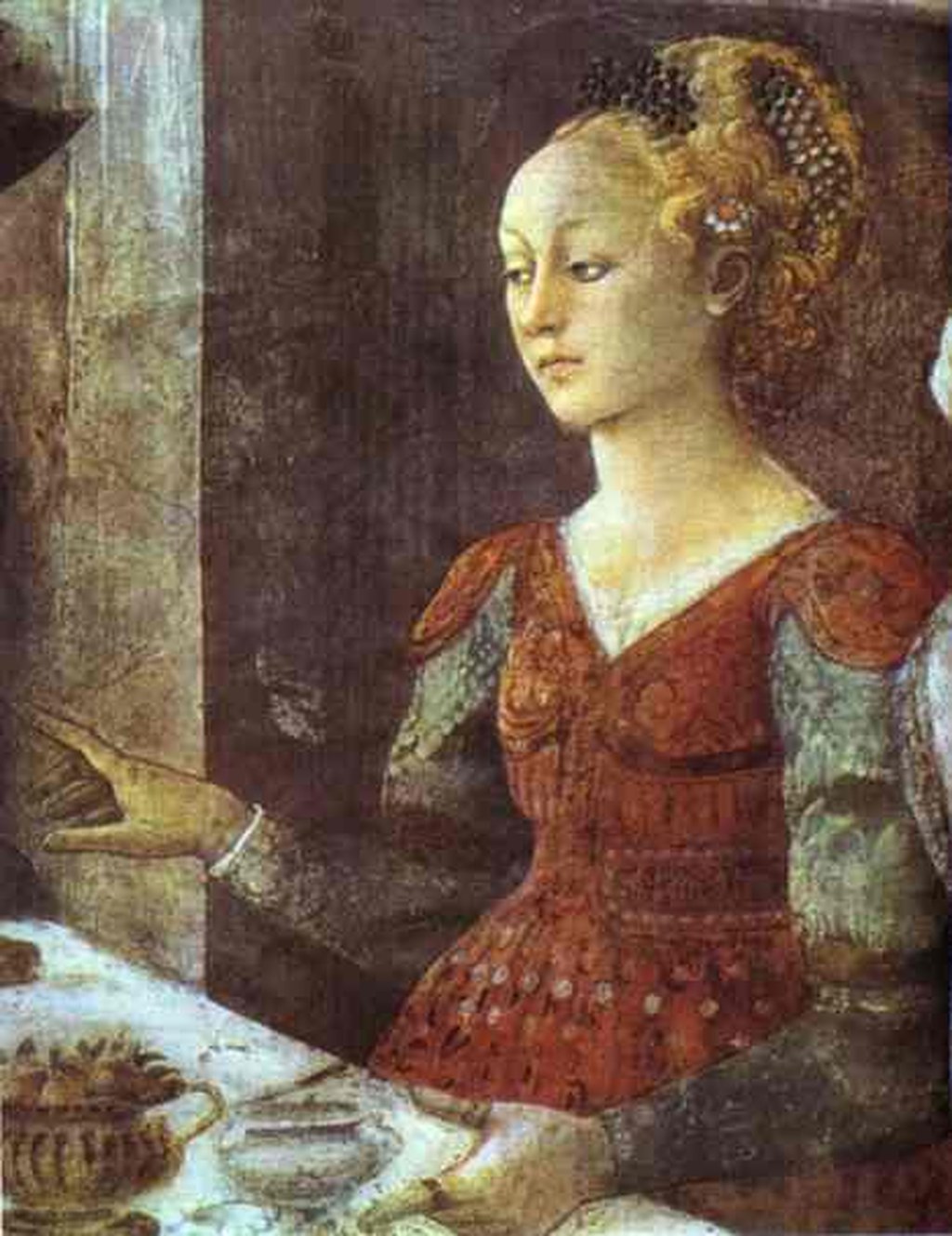
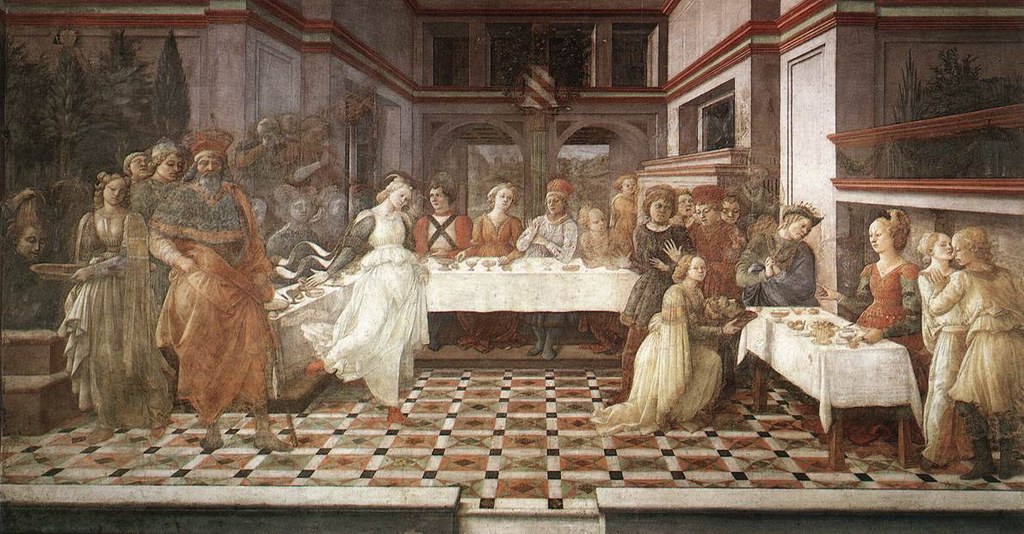
From Prato to Spoleto. Comparison with Prato is unavoidable but should not turn Spoleto into a lesser sequel. Prato is organised around two saintly biographies and includes complex episodes of public action such as The Feast of Herod. Spoleto is more concentrated. Its subject is Marian and its sequence more explicitly teleological, moving toward heavenly coronation. The difference affects narrative rhythm. Prato can be dramatic, episodic and social. Spoleto tends toward the ceremonial and devotional. Lippi's experience of organising large groups remains visible, but the programme asks for a different emotional trajectory. The two cycles together demonstrate the range of Lippi's mural practice. He could handle murder, dance, civic ceremony, domestic birth, mourning and celestial triumph.
Workshop participation
As at Prato, the Spoleto frescoes were workshop productions. This became unavoidable when Lippi died before the project was fully complete. His assistants continued the work, which raises important questions about invention, execution and continuity. A late Renaissance-style biography might be tempted to imagine the master's death as the abrupt end of artistic creation, but a functioning workshop was designed precisely to continue projects. Drawings, compositional plans, established figure types and the practical knowledge of assistants could carry an unfinished programme forward.
The cycle therefore offers a particularly clear example of why attribution must sometimes operate at several levels. Fra Filippo designed and led the project; assistants executed substantial portions; completion after his death belongs to the workshop's history rather than being an embarrassing footnote.
Lippi's death in Spoleto. Fra Filippo died in Spoleto in October 1469. Later legend, encouraged by the colourful tone of early biographies, generated sensational explanations of his death, including poisoning connected with romantic intrigue.[4] Such claims should not be repeated as established history without evidence. The secure fact is that his life ended while he was associated with the cathedral project. His death makes the frescoes chronologically final, but their significance is not dependent on romanticising them as a painter's conscious farewell. Assistants completed the cycle after his death, preserving the workshop's connection with the commission.
The tomb. Lippi's burial in Spoleto Cathedral gives the site a second layer of importance. Institutional heritage sources identify his tomb in the cathedral and connect its design tradition with his son Filippino Lippi. That association is symbolically powerful. Filippino was still young when his father died and would become a major Florentine painter in his own right, eventually working in a more complex late-quattrocento language. The tomb therefore binds two generations without implying that their styles were identical. For a modern visitor, Spoleto becomes one of the rare places where an artist's final monumental work and memorial coexist.
Marian imagery across Lippi's career
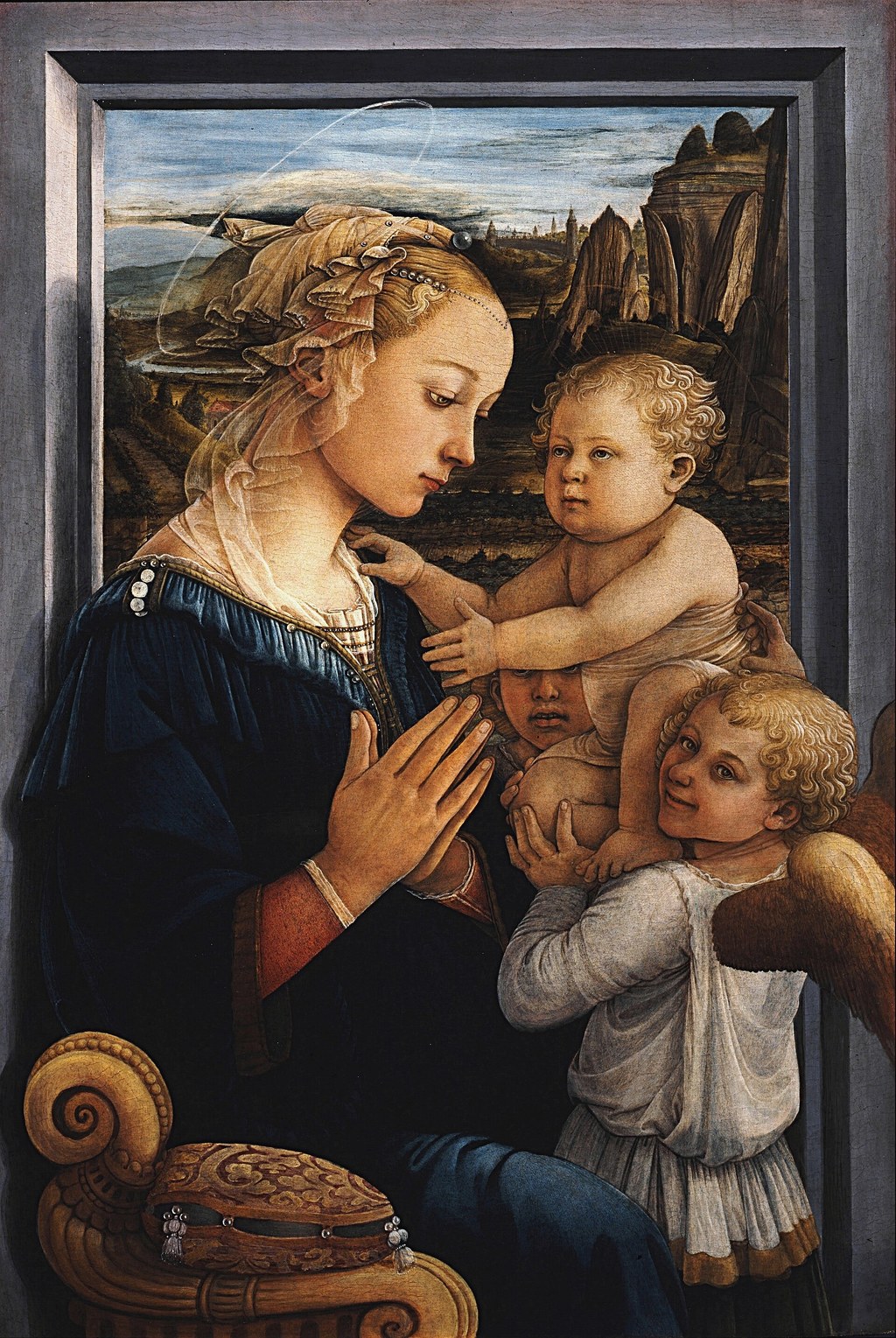
The Spoleto cycle is especially meaningful when placed against Lippi's long engagement with images of the Virgin. From the Madonna of Tarquinia to the Lippina, Mary had allowed him to explore the relationship between sacred status and recognisable humanity. In small or medium-sized panels, intimacy often depends on physical closeness: the Child reaches toward his mother; Mary lowers her gaze; angels enter the viewer's space. In the cathedral apse, that intimacy has to be translated into monumental forms visible at distance. The cycle therefore demonstrates that Lippi's Marian art was not tied to one scale or function. The same theological figure could inhabit domestic devotion, altar imagery and cathedral architecture.
Grace and monumentality. Cristoforo Landino's near-contemporary praise of Lippi's grace, ornament, composition, colour and relief is particularly apt at Spoleto. Monumental scale did not force Lippi to abandon elegance. Instead, graceful contour and ceremonial grouping become structural tools. This distinguishes his mural language from Masaccio's earlier monumentality. Lippi had absorbed the lesson that figures should possess bodily presence, but he increasingly clothed that presence in flowing line, ornament and varied expression. The Spoleto frescoes can thus be understood as a late synthesis rather than a radical stylistic break.
Condition and historical change. Like all mural cycles of this age, the Spoleto frescoes have a material history extending beyond their execution. Changes to the cathedral, environmental conditions, cleaning and restoration affect what survives. Every visible colour or detail cannot be assumed to have reached us untouched from 1469. Wall paintings are layered historical objects, and condition can alter contrast, surface finish and the legibility of details. This is especially important when comparing Spoleto with better-studied or more recently technically examined panel paintings. Differences in appearance may reflect medium and preservation as much as artistic intention.
Place within the Renaissance
Spoleto expands the geography of Lippi's influence beyond Florence and Prato. The presence of a major Florentine master in Umbria demonstrates the mobility of Renaissance artists and the prestige attached to importing established talent. The frescoes also contributed to a regional visual memory. Later works in Umbria could look back to Lippi's sacred iconography, showing that the commission had an afterlife beyond the immediate cathedral audience. At the same time, the cycle remained connected with Florence through the artist's workshop, family and stylistic legacy. It is better understood as a node in a network than as a provincial detour.
Spoleto as Lippi's Final Artistic Geography. The move to Spoleto matters because Renaissance careers were shaped by geography. Fra Filippo had been formed in Florence, established major patronage relationships there and then spent a long period working in Prato. Spoleto placed him in a different regional environment.
A prestigious cathedral commission carried Florentine visual culture into Umbria while also forcing Lippi and his workshop to adapt to a new building, audience and local devotional programme. The project therefore represents artistic transmission in both directions. Lippi arrived with decades of experience. The resulting apse then became a model visible to later Umbrian painters, and regional sources note that subsequent church decoration could draw inspiration from his Marian programme.
The Cathedral Setting. Santa Maria Assunta is not a neutral container. The apse occupies the liturgical focus of the cathedral. Covering it with the life and glorification of Mary transformed architecture into narrative.
A visitor standing in the nave looks towards a painted sequence integrated with worship rather than towards an independent framed object. Scale changes accordingly. Individual figures needed to remain legible at distance.
Colour and large compositional divisions mattered more than tiny domestic detail. The architecture also gives the cycle its culminating hierarchy. Lower narrative events belong to Mary's earthly life. The Coronation above lifts her physically and theologically into heaven.
Annunciation: Beginning the Marian Arc
The Annunciation initiates the sequence with promise. Gabriel's message begins the Incarnation, making Mary's acceptance the first decisive step in the story that leads towards Christ's birth. Within a cycle that ends in Mary's heavenly coronation, the scene also establishes a larger trajectory of humility and exaltation.
The young woman who accepts God's will will eventually be represented as Queen of Heaven. That beginning-and-end relationship matters more here than it does in a standalone Annunciation panel. The entire apse encourages retrospective reading. The Coronation changes how the viewer understands the Annunciation below.
Nativity: Incarnation in Monumental Form. The Nativity gives visual consequence to Gabriel's message. Christ enters the world physically. Lippi had spent much of his career humanising sacred bodies, especially through Madonnas and infant Christ figures.
In Spoleto, that intimacy has to operate at cathedral scale. The challenge is different from the Lippina. There, a viewer can approach a panel closely and respond to faces, veils and a smiling angel. Here, the fundamental relationships have to survive distance. Gesture, silhouette and broad grouping become more important.
Dormition: The Emotional Centre. The Dormition or Death of the Virgin is arguably the emotional hinge of the programme. Promise and birth lie behind. Coronation lies ahead.
Between them is death. A gathered community surrounds Mary's body, turning private loss into collective witness. For Lippi, who had shown such skill at differentiated crowds in Prato, this was a subject particularly suited to his strengths.
Apostles can mourn, pray, bend, look and respond differently. The variety keeps the scene human. At the same time, its position beneath the Coronation prevents grief from becoming final. The architecture itself tells the viewer what comes next.
Coronation: The Apse Opens into Heaven
The upper Coronation converts architectural height into sacred hierarchy. Lippi had painted the subject before in the great Sant'Ambrogio altarpiece. Spoleto allows comparison across medium and career.
In the Uffizi panel, a transportable wooden object contains heaven. In Spoleto, heaven occupies the building itself. The curve of the apse and its elevated surface help dissolve the distinction between painted celestial space and cathedral architecture.
This is a fundamentally different kind of viewing. The worshipper looks upward. The bodily act of looking reinforces the theological meaning.
A Marian Career in Four Scenes. The four principal episodes also condense many themes that had occupied Lippi for decades. Annunciation recalls his repeated experiments with Gabriel and Mary. Nativity recalls his intimate devotional paintings.
Dormition gives him another opportunity to organise varied groups. Coronation returns to one of his grandest early altarpiece subjects. The cycle therefore feels retrospective without needing to be interpreted as a conscious autobiography. Its programme naturally gathers themes already central to his work. That makes it a fitting final major commission even if Lippi never intended it as a farewell.
Fresco at the End of a Career. By Spoleto, Lippi was no novice in wall painting. Prato had required him to manage plaster campaigns, assistants, perspective and monumental storytelling over many years. That accumulated practical knowledge mattered.
Large fresco decoration is organisational art. The master must coordinate designs, wall preparation, daily plaster sections and workshop labour. Spoleto therefore represents experience institutionalised through a workshop. Its completion after Lippi's death demonstrates that the process was larger than one pair of hands.
Workshop Completion
The phrase “and helpers” in institutional descriptions should be taken seriously. It does not mean the cycle is somehow less authentically Lippi. Renaissance authorship often included invention by a master and execution distributed through assistants.
The issue becomes particularly visible after 1469 because Lippi could no longer supervise the final work. Assistants had to rely on established designs, drawings and workshop habits. Some passages may therefore be closer to the master's own hand than others. This layered authorship is more accurate than pretending the cycle was executed uniformly by a single hand.
Fra Diamante and the Workshop Question. Fra Diamante was Lippi's most important long-term collaborator and is repeatedly associated with his major mural practice. Any attempt to discuss Spoleto must therefore acknowledge the broader workshop system in which the final project was produced. The precise division of hands remains a specialist problem and should not be stated more confidently than current scholarship allows. What is secure is that Lippi led a functioning workshop capable of continuing monumental work after his death. That capability was itself part of his professional success.
Lippi's Death in 1469. Fra Filippo died in Spoleto in 1469 while the cathedral project remained associated with his workshop. This chronological fact is enough to give the cycle special poignancy. Later biography added sensational stories, including claims of poisoning linked to romantic intrigue.
Those stories should be attributed to later tradition rather than narrated as documented cause of death. The stronger history is simpler. An ageing artist died away from Florence while engaged on a major commission. His assistants completed the work. The cathedral then became both workplace and burial place.
The Tomb
Lippi's tomb remains in Spoleto Cathedral.[1] Umbria's institutional account records that the sepulchre was designed by his son Filippino Lippi and executed by an unknown Florentine sculptor in the sixteenth century. That gives the building an extraordinary father-son connection.
Fra Filippo's final painted cycle rises in the apse. His memorial stands elsewhere in the cathedral. Filippino's role in the tomb makes the site part of his story too. Spoleto therefore belongs to both Fra Filippo’s final years and Filippino’s later memorialisation of his father.
Lorenzo de' Medici and the Burial Tradition. Later accounts connect the memorialisation of Lippi with Florentine interest in recovering or honouring the painter after his death. Such stories need careful sourcing because details vary. The secure visual fact is the tomb itself and Filippino's design connection. The surviving monument deserves more weight than colourful anecdote. Legend can illuminate later reception, but it should be identified clearly as legend rather than treated as contemporary evidence.
Prato versus Spoleto. The two cathedral cycles should be compared structurally. Prato is expansive and biographical. It narrates the lives of John the Baptist and Saint Stephen through numerous public episodes.
Spoleto is concentrated and Marian. It moves from Annunciation to birth, death and coronation. Prato's Feast of Herod is filled with courtly spectacle. Spoleto's programme culminates in devotional triumph. The difference prevents the later cycle from feeling like repetition.
Spoleto and the Lippina. The late Madonna and Child with Two Angels dates close to the period leading into Spoleto. Both show Lippi's mature Marian language, but scale changes everything. The Lippina is intensely close.
Spoleto is monumental. One makes sacred intimacy resemble domestic experience. The other expands Marian biography across cathedral architecture. Together they show the same artist operating from the scale of a face to the scale of a building.
Influence in Umbria
Regional institutional sources note that later church decoration in Umbria drew upon the sacred iconography established by Lippi's Spoleto apse. That afterlife matters. The cycle did not simply receive Florentine style.
It became a local source. This is how Renaissance artistic geography works in practice. A travelling master imports ideas.
A major public commission fixes those ideas in a prominent site. Later artists encounter and reinterpret them. Spoleto therefore extends Lippi's influence beyond the Florentine line leading to Botticelli.
Seeing the Cycle Today. The frescoes remain in the cathedral for which they were made. That continuity is invaluable. Unlike the Barbadori Altarpiece or many dispersed panels, the Spoleto paintings can still be understood through original architecture.
The viewer can look up into the apse, perceive the vertical hierarchy and move physically through the building towards the tomb. This gives the site a form of evidence that museums cannot recreate. The location is part of the artwork’s meaning, not merely its address.
Why Spoleto Deserves Pillar Status. Spoleto should not be reduced to a short “final years” section in the biography. It has enough distinct material to stand as a major part of Lippi’s late career. The cycle completes the chronological arc of Lippi's career.
It offers a second monumental comparison with Prato. It contains four major Marian themes. It demonstrates workshop continuation after the master's death.
It preserves his tomb and a connection with Filippino. It also records the transmission of Florentine painting into Umbria. Those functions make Spoleto a structural part of Lippi’s career, not a secondary add-on.
The Apse as a Narrative Machine
The apse does more than supply wall space for four episodes. Its curved architecture creates a hierarchy that a rectangular panel could not reproduce in the same way. Narrative scenes occupy the lower field where human history unfolds. The Coronation occupies the elevated zone above, turning physical height into theological completion. The viewer therefore reads the building vertically as well as chronologically. Annunciation and Nativity establish promise and Incarnation; Dormition marks the end of Mary's earthly life; Coronation resolves the sequence in heaven. This vertical movement is one of the strongest reasons to understand the cycle as a single programme rather than as four isolated scenes. The architecture is part of the argument.
Seeing Fresco at Cathedral Scale. Digital images flatten differences of size. A fresco cycle can look like a group of ordinary pictures reproduced side by side. In the cathedral, however, the distance between spectator and painted figures changes how every detail works. Large gestures must read clearly from below. Faces require sufficient contrast to remain expressive. Colour blocks help organise scenes before individual details become visible.
Lippi's late mural practice therefore cannot be judged by the same standards as a small domestic panel. The Lippina rewards proximity; Spoleto has to survive distance. The distinction shows that style is partly a response to scale and function. The same painter may appear more intimate in tempera and more declarative in fresco without having changed artistic identity.
Workshop Continuity After the Master's Death
The unfinished state of the project at Lippi's death makes Spoleto especially valuable for understanding Renaissance workshop continuity. A monumental commission depended on accumulated design decisions: cartoons or drawings, colour plans, architectural divisions, prepared plaster zones and habits of execution shared among assistants. When the master died, assistants were not starting from nothing. They inherited a structured project.
This helps explain how a cycle can remain recognisably Lippi's even where the final brushwork belongs partly to others. Authorship in such a case is architectural and conceptual as well as manual. Two extremes are equally misleading: claiming every surviving stroke as Fra Filippo's own hand, or treating assistant participation as proof that the cycle is merely workshop production.
Spoleto and the End of the Florentine Story. Fra Filippo's death in Spoleto creates a geographical ending that differs from the location of his artistic beginnings. He had grown up around Santa Maria del Carmine in Florence and the Brancacci Chapel. He ended his life working in Umbria. Between those points lie Medici commissions, Prato's cathedral cycle, private Madonnas, portraiture and major altarpieces.
Spoleto therefore gives the biography a natural final destination. It is not simply where he happened to die; it is where the last major surviving chapter of his career remains visible. That makes the cathedral unusually valuable for visitors interested in the artist. One can encounter both his final monumental project and his memorial within the same building.
The Tomb as a Second Artwork
The tomb should be treated as more than biographical furniture. It is a later artwork produced in response to Lippi's reputation. Filippino Lippi's involvement in its design gives it an intimate dynastic dimension. A son who became one of Florence's major painters helped shape the memorial of the father whose workshop world had formed him.
The monument therefore belongs simultaneously to Fra Filippo's reception and Filippino's biography. Spoleto forms a natural historical hinge: Fra Filippo's frescoes lead to his tomb; the tomb leads to Filippino; Filippino then connects back to Botticelli, who had trained under Fra Filippo and later taught the son. That network is unusually strong because it corresponds to real historical relationships rather than modern categorisation.
Why the Cycle Should Stay Together in V1. The Annunciation, Nativity, Dormition and Coronation are most meaningful when first understood as parts of the same apse programme rather than as isolated images. The scenes share patronage, location, chronology, medium and a unified Marian programme. Splitting them too early would force repeated explanation of the same commission and cathedral. Keeping them together preserves the sequence and architectural meaning of the cycle. The cycle is strongest when expanded where evidence and distinctiveness justify it, not by treating every identifiable scene as an isolated masterpiece.
Why the Spoleto frescoes matter. The Spoleto frescoes matter first because they are major surviving works by Fra Filippo Lippi. They matter second because they complete the story of his mural practice. Prato demonstrates his ability to organise complex saintly narratives; Spoleto shows him constructing a concentrated Marian programme on another monumental scale. They also matter biographically without needing legend. Lippi spent his final period working in Spoleto, died there and was buried in the cathedral. Assistants completed the cycle, making the site an unusually clear record of how a Renaissance workshop outlived its master.
Most of all, the apse allows us to see the continuity of Lippi's central artistic problem. Throughout his career he sought ways of making sacred figures both elevated and human. At Spoleto that balance is no longer confined to a panel that can be approached closely. It fills the architecture of a cathedral.
Discussion
What stands out to you most about Spoleto Cathedral Frescoes in relation to Filippo Lippi's wider career?
Reader Insights
Notice how the page connects close visual detail with patronage, workshop practice and the wider Renaissance setting.
Which comparison elsewhere in the cluster helps clarify this work or theme most strongly?
Join the Conversation
Have a thought or observation about Spoleto Cathedral Frescoes? Share it below. Thoughtful responses may be added to this section.
References
- Umbria Tourism, “Santa Maria Assunta Cathedral in Spoleto,” institutional account of the cathedral, Fra Filippo Lippi’s Stories of the Virgin (1463–69), and his tomb. View Source.
- Jeffrey Ruda, Fra Filippo Lippi: Life and Work with a Complete Catalogue, 1993.
- Megan Holmes, Fra Filippo Lippi: The Carmelite Painter, Yale University Press, 1999.
- Giorgio Vasari, Lives of the Artists, used for later reception and anecdotal tradition rather than as contemporary documentation.