 by Tom Gurney
Tom Gurney BSc (Hons) is an art history expert with over 20 years experience
Published on June 19, 2020 / Updated on October 2, 2026
Email: tomgurney1@gmail.com / Phone: +44 7429 011000
The Feast of Herod by Fra Filippo Lippi
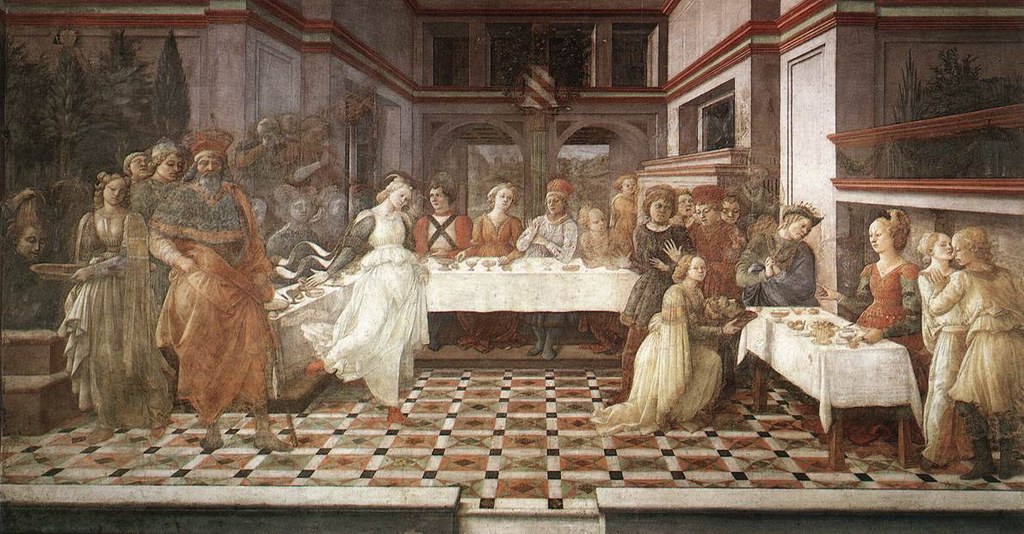
Fra Filippo Lippi’s Feast of Herod is one of the great narrative frescoes of the Italian Renaissance. Painted in the main chapel of Prato Cathedral as part of Lippi’s cycle devoted to Saint Stephen and Saint John the Baptist, it transforms a violent biblical story into an expansive theatrical spectacle of architecture, movement, courtly dress and psychological reaction.
The fresco occupies a broad wall of the Cappella Maggiore and belongs to the final phase of Lippi’s long Prato project, which stretched from the early 1450s into the mid-1460s. Modern scholarship has identified the Feast of Herod as one of the last scenes completed in the cycle, probably in 1465, shortly before the painter finally left Prato for Spoleto.
Its subject comes from the Gospel accounts of the death of Saint John the Baptist. Herod Antipas had imprisoned John after the prophet condemned his relationship with Herodias. During a feast, Herodias’s daughter danced before Herod and his guests, and the ruler rashly promised to grant her request. Prompted by her mother, she demanded John the Baptist’s head.
Lippi does not reduce this story to a single dramatic instant. Instead, he uses continuous narrative, showing several moments within the same architectural space. Salome appears more than once, moving through the unfolding story as if across a stage. This makes the fresco especially important for understanding how Renaissance artists organised time inside a static image. The viewer does not simply look at one event; the eye travels across a sequence.
The fresco is equally remarkable for its architecture. A modern geometric study has reconstructed Lippi’s painted space and demonstrated that the painter used perspective with considerable sophistication while also deviating from strict geometrical consistency when narrative clarity or visual harmony demanded it. The Feast of Herod therefore offers an unusually rich meeting point between biblical narrative, Renaissance theatre, perspective, fresco technique and courtly culture. It is not simply an illustration of Salome’s dance; it is a carefully staged experiment in how painting can make time, space and emotion unfold before a viewer.
At a Glance
- ArtistFra Filippo Lippi, with workshop collaboration within the wider Prato cycle
- TitleThe Feast of Herod
- Dateprobably 1465 within a fresco campaign lasting c. 1452–65
- MediumFresco with important a-secco additions
- LocationCappella Maggiore, Prato Cathedral, Prato, Italy
- CycleStories of Saint Stephen and Saint John the Baptist
- Approximate sizeabout 450 × 880 cm
- SubjectSalome’s dance, the beheading of John the Baptist and presentation of his head
- Narrative methodcontinuous narrative, with different moments shown in the same setting
- Key visual featurea vast Renaissance banquet hall organised through perspective
- Technical significancenumerous secondary figures were added a secco rather than into fresh plaster
- Research significancemodern perspective reconstruction has shown deliberate deviations from strict geometry in favour of visual and narrative effect
Contents
- The Biblical Story
- Where Is the Fresco?
- The Long Prato Commission
- What Does the Feast of Herod Show?
- Salome as a Moving Figure
- Was Salome Lucrezia Buti?
- A Renaissance Stage
- Perspective
- Courtly Architecture and Contemporary Dress
- Herod, Herodias and Moral Responsibility
- Fresco and A-Secco Technique
- Gold and Surface Effects
- Comparisons with Earlier Feasts of Herod
- Was the Feast of Herod Lippi’s Masterpiece?
- FAQs
- References
The Biblical Story
The story represented by Lippi is drawn principally from the Gospels of Matthew and Mark. John the Baptist, preacher and forerunner of Christ, had criticised Herod Antipas for his relationship with Herodias, who had previously been married to Herod’s brother. John was imprisoned. During a banquet held by Herod, Herodias’s daughter danced before the ruler and his guests.
The Gospels do not name the young woman, although later tradition identified her as Salome. Herod, pleased by the dance, promised to give her whatever she requested. After consulting her mother, she asked for the head of John the Baptist. Herod was distressed but, because of the oath he had made publicly before his guests, ordered John’s execution.
The prophet’s head was brought on a platter and given to the girl, who in turn carried it to her mother. The story offered Renaissance artists a remarkable range of subjects: dance, court ceremony, temptation, oath, martyrdom, horror and moral failure. Lippi chooses not to isolate the moment of execution. He is interested in the social and psychological drama generated around it. The banquet therefore becomes the central setting. Violence takes place within a world of elegance, decorum and entertainment, making the horror of John’s death feel all the more disruptive.
Where Is the Fresco?
The Feast of Herod forms part of the fresco decoration of the Cappella Maggiore, the main chapel of Prato Cathedral. Fra Filippo Lippi was commissioned to decorate the chapel with stories devoted to Saint Stephen and Saint John the Baptist, saints closely connected with the religious identity of Prato and its cathedral. The overall project became one of the defining commissions of Lippi’s career. It occupied him, with interruptions, for more than a decade.
The cycle extends across the chapel walls and culminates in large narrative scenes. Rather than viewing the Feast of Herod as an isolated masterpiece, it is important to understand it as the conclusion of a much larger programme. The story of John the Baptist develops across one side of the chapel. Events from the saint’s life lead towards his martyrdom, so the banquet carries the accumulated weight of the preceding episodes.
Its position within an actual cathedral also shaped how it was seen. The fresco was part of a liturgical and architectural environment rather than a transportable picture intended for an art collection. The viewer’s angle, distance from the wall and movement through the chapel were therefore integral to Lippi’s planning.
The Long Prato Commission
Fra Filippo began work on the Prato Cathedral frescoes in the early 1450s. Institutional research in Prato places the main campaign from 1452 to 1465, although the work was interrupted repeatedly by other commissions, travel and complications in the artist’s personal life. The project involved assistants, most importantly Fra Diamante. Large fresco cycles required organised workshop labour because plaster had to be applied and painted in sections while still workable.
The commission also generated substantial documentary evidence. Payments, materials, scaffolding and completion can be followed more closely than is possible for many fifteenth-century paintings. This evidence makes the Prato cycle especially valuable for studying Lippi not merely as an inspired individual but as the head of a working Renaissance enterprise. The Feast of Herod appears to belong to the end of the campaign. Barbara Ansaldi’s 2020 study, drawing on restoration scholarship, identifies it as the last scene painted and places its completion between the summer and winter of 1465.[1]
If so, it represents the culmination of more than a decade of experience in the chapel. Lippi had already solved many of the problems of scale, narration and perspective elsewhere in the cycle. In the Feast, those solutions become unusually ambitious.
What Does the Feast of Herod Show?
Lippi stages the episode inside an enormous Renaissance palace. The setting consists of a deep central hall with patterned floor, walls, openings and architectural divisions that organise the action. The ancient court of Herod has effectively been translated into the world of fifteenth-century Italy. Guests wear fashionable contemporary clothing, and the building resembles the idealised architecture of Renaissance elite culture.
Salome appears at multiple points within this continuous narrative. Her movement links successive moments in the story. In one area she dances before the assembled court. Elsewhere the fatal consequences of the request become clear, and the severed head of Saint John enters the banquet. On the right, the narrative reaches the presentation of the head in the company of Herodias and the guests. Reactions range from attention and curiosity to visible shock.
The death itself is not allowed to dominate the centre. Lippi pushes parts of the violent narrative towards the edges and lets the luxurious banquet architecture occupy much of the viewer’s first impression. This choice is psychologically effective. Courtly beauty becomes the environment in which a terrible moral failure unfolds.
Salome as a Moving Figure
Salome is the key to reading the fresco. Rather than appearing once, she functions as a recurring figure who guides the eye through time. Continuous narrative had a long history in Italian art. A painter could represent a single protagonist several times within one unified field, trusting the viewer to understand that the repeated figure indicated different moments rather than multiple simultaneous versions of the same person.
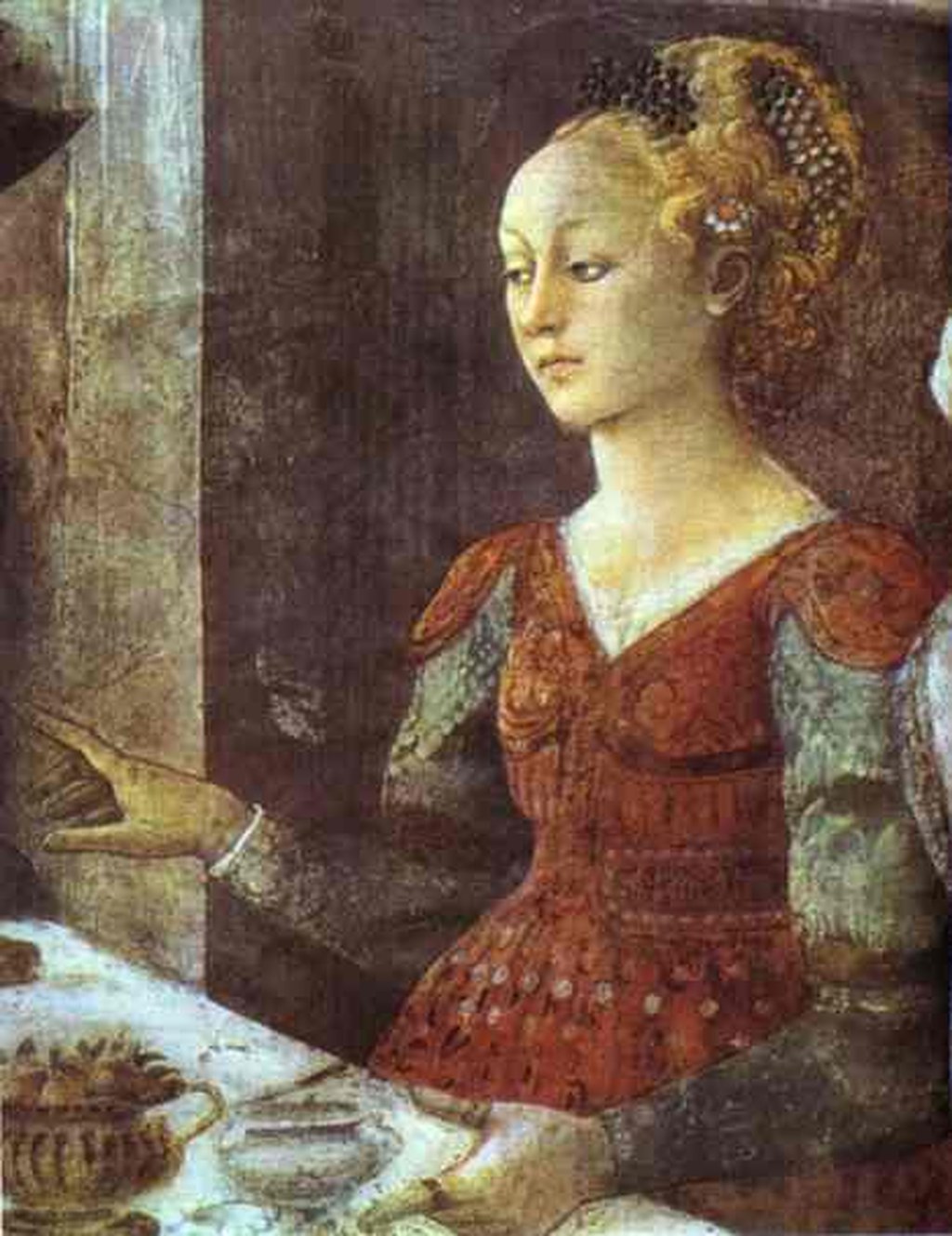
Lippi uses this system with exceptional elegance. Salome’s changing position effectively maps the chronology of the story onto the architecture. Her dance is the most visually seductive moment. She appears light, graceful and fluid, her clothing contributing to the sense of motion. Later appearances carry the narrative towards its grim conclusion. The same youthful figure who animated the feast becomes the intermediary through which John’s death is displayed.
This contrast matters. Salome is not represented simply as a monstrous villain. Lippi seems more interested in the tension between beauty and consequence. Her elegance belongs to the courtly world that has produced the catastrophe. The result is morally uneasy rather than straightforwardly didactic.
Was Salome Lucrezia Buti?
A popular tradition identifies Salome with Lucrezia Buti, the woman with whom Fra Filippo formed a relationship during his years in Prato and who became the mother of Filippino Lippi. This identification is attractive for obvious reasons. Lippi was working in Prato during the relationship, and later biographies encouraged readers to connect his paintings of beautiful women with Lucrezia.
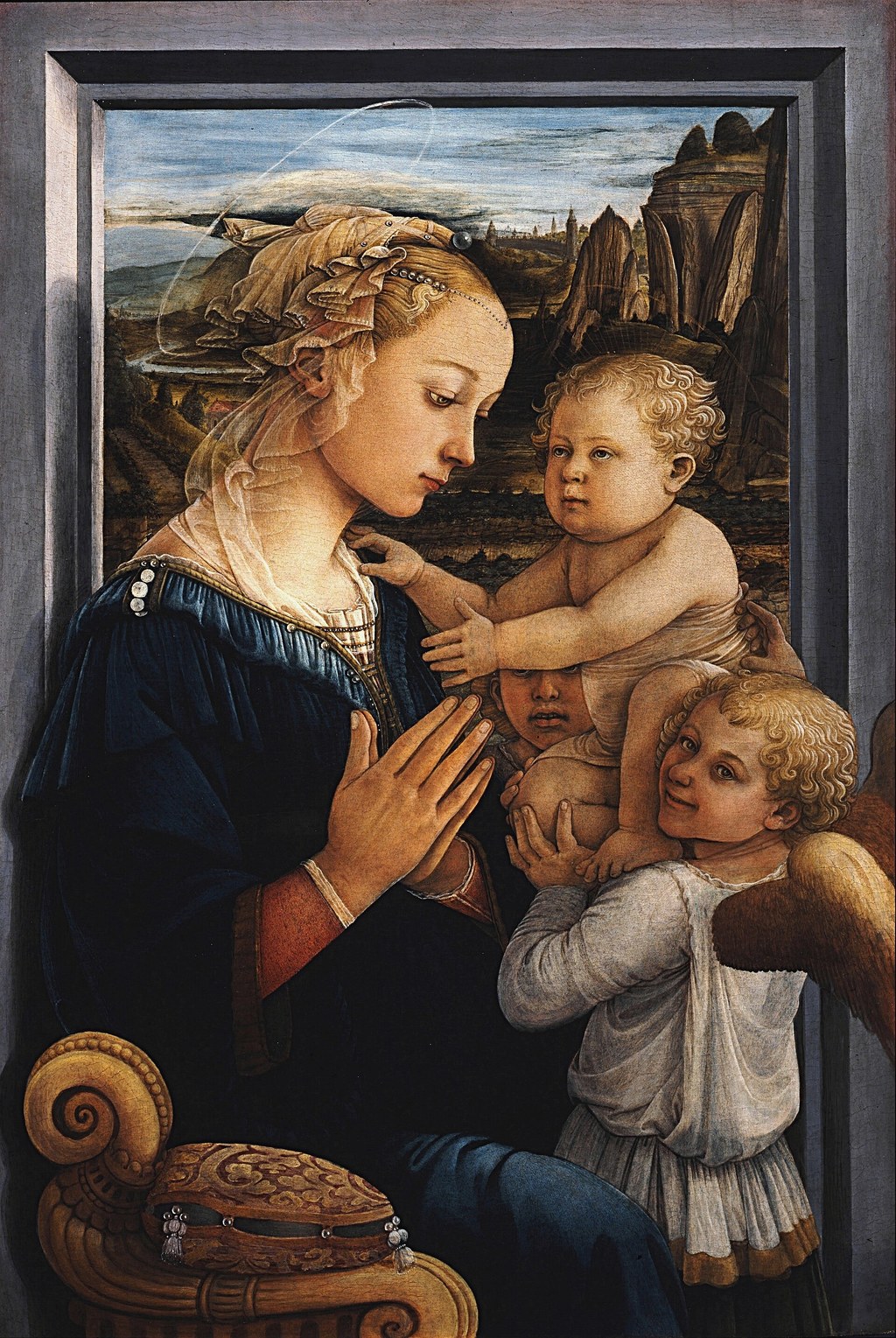
However, the same caution required for the Uffizi Madonna and Child with Two Angels applies here. A tradition of identification is not the same as documentary proof. Modern literature sometimes repeats the idea that Lucrezia was the model for Salome, but secure evidence establishing a specific sitting has not survived. The safest formulation is therefore that Lucrezia has sometimes been proposed or traditionally identified as the model. It should not be stated simply that the fresco “portrays Lucrezia Buti.” This is especially important because Lippi’s women often share an idealised type. Similar facial features can reflect workshop style and contemporary concepts of beauty rather than repeated portraiture of one individual.
A Renaissance Stage
One of the strongest interpretations of the Feast of Herod treats it as a kind of painted theatrical performance. The architecture acts like a stage set, and the figures behave as performers conscious of a watching audience. Megan Holmes has connected Lippi’s narrative art with the culture of religious performance. In fifteenth-century Florence and Tuscany, sacred stories could be enacted dramatically as well as preached, painted and read.[3]
Barbara Ansaldi’s study develops this theatrical aspect in relation to the Feast. The events unfold in distinct zones of a single constructed environment, allowing the spectator to follow them almost as scenes within a performance.[1] Architecture does not merely house the figures. It tells the viewer where one episode ends and another begins.
Pilasters, walls, openings and changes of plane establish narrative compartments without breaking the overall unity of the hall. This is one reason the fresco can contain multiple moments without becoming visually chaotic. The setting is simultaneously unified and divided. The spectator is encouraged to scan it.
Perspective
Perspective was one of the defining technical and intellectual achievements of fifteenth-century Florentine art. By using geometrical systems of convergence, painters could suggest coherent three-dimensional architecture on a flat wall. Lippi knew this language well, but the Feast of Herod is important because it shows that Renaissance perspective was not always a rigid mathematical cage.
Barbara Ansaldi’s geometric reconstruction identified the basic structure of the painted space and used it to generate plans and sections of Lippi’s imagined architecture.[1] The analysis found substantial regularity. The setting is not casual; it is organised around a coherent perspectival conception. At the same time, Lippi departs from strict consistency in several places. Architectural elements and proportions are adjusted when a mathematically exact solution would be less effective visually.
This is a crucial insight into Renaissance practice. The goal was not necessarily to demonstrate perfect geometry for its own sake. Perspective served the painting. When narrative emphasis, legibility or compositional harmony required modification, the artist could bend the rule. Ansaldi concludes that the Feast balances rule and deviation. That balance helps explain why the space feels convincing even when reconstruction reveals inconsistencies.[1]
The Ideal Viewer. Perspective assumes a viewer. In theory, a one-point system is most coherent from a specific position in front of the image. A monumental chapel fresco complicates this because visitors see the wall from different places and heights. Lippi therefore had to think not only about geometry but about practical viewing. The fresco’s scale is enormous compared with a portable panel. Figures and architectural divisions need to remain intelligible from the chapel floor.
Some of Lippi’s adjustments can be understood as responses to this situation. A form that is technically correct in projection may not look right from where the human spectator actually stands. The painted space is consequently designed for perception rather than for abstract demonstration. This distinction is one of the most useful lessons of the modern perspective study. Lippi understood the system well enough to depart from it intelligently.
Courtly Architecture and Contemporary Dress
Although the story takes place in the ancient world, almost nothing about Lippi’s banquet attempts archaeological reconstruction. The figures and setting instead belong to an idealised version of the painter’s own age. This was normal in Renaissance religious art. Contemporary costume made sacred history legible to viewers by translating it into familiar social categories.
The luxurious hall also establishes status. Herod’s court is wealthy, ordered and ceremonially sophisticated. That external order makes its moral failure sharper. John the Baptist, the prophetic outsider, is destroyed by people who appear refined and civilised. The guests’ clothing contributes to the visual richness of the fresco. Fabrics, headwear and changing silhouettes allow Lippi to vary the crowd while showing his skill as an observer of contemporary fashion. These details are not merely decorative. They tell us what kind of world Herod rules. It is a world of spectacle.
The Reactions of the Guests. One of Lippi’s great narrative strengths is his ability to distribute emotion across a group rather than concentrating everything in a single protagonist. When John’s head enters the banquet, the guests do not respond uniformly. Their faces and gestures produce a spectrum of attention, surprise and revulsion. This variety helps the viewer interpret the event. The horror of the object is measured partly through the people who see it.
Renaissance narrative painting often used bystanders in this way. Their reactions operate almost like prompts for the spectator. Some figures may look where we should look; others enact an emotional response we might share. The crowd also prevents the scene from becoming schematic. Herod’s feast feels socially inhabited. The tragedy takes place before witnesses, reinforcing the public nature of Herod’s oath and the social pressure that contributes to his decision.
Herod, Herodias and Moral Responsibility
The biblical story is structurally complicated because responsibility is dispersed. Herodias desires John’s death, Salome delivers the request, Herod gives the order, and the court witnesses the result. Lippi’s broad composition suits that moral complexity. No single figure monopolises the painting. Herodias is traditionally treated as the instigator. Her calmness can appear chilling when contrasted with the stronger reactions around her.
Herod’s role is equally important because his promise and concern for public reputation trap him within his own performance of power. The execution is therefore the product not just of personal cruelty but of courtly structures: oath, spectacle, honour and hierarchy. The feast becomes a setting in which moral judgement is corrupted by social pressure. That theme would have been readily understandable to a Renaissance audience accustomed to reading biblical history as a source of lessons for contemporary conduct.
Fresco and A-Secco Technique
The Feast of Herod is usually described as a fresco, but modern conservation scholarship has demonstrated that its execution was technically more complex. True fresco, or buon fresco, requires pigment to be applied onto fresh wet plaster. The colour becomes bound into the wall as the plaster carbonates. Artists normally work in manageable daily sections known as giornate. The boundaries of these sections can help conservators reconstruct the order of execution.
Lippi also used a-secco painting, applying colour onto dry plaster. This allowed greater freedom for details and later changes but was generally less durable. Research cited in Ansaldi’s study is especially revealing. In the middle area of the Feast, additional groups of guests were painted a secco rather than incorporated into new fresh plaster.[1]
Thirteen such figures have been identified in the restoration literature as additions, several of which are now extremely faint. This changes how we understand Lippi’s process. The composition was not necessarily fixed in every detail before execution began. He could assess the visual balance of the enormous scene and add figures after the fresco plaster had dried. The wall becomes evidence of decision-making.
What Has Been Lost? The heavy use of a-secco detail helps explain why parts of the fresco no longer look as Lippi intended. Paint applied to dry plaster is more vulnerable than pigment locked into fresh plaster. Over centuries, cleaning, moisture, abrasion and environmental change can remove or weaken these surface additions. Some figures documented by restoration research are now almost ghostlike.
The loss affects more than colour. It can alter the apparent density and balance of the composition. A modern viewer might interpret an empty-looking area as Lippi’s deliberate design when it was once populated by figures that have largely disappeared. This is why conservation evidence matters for art-historical interpretation. We are not looking at an untouched fifteenth-century surface. The surviving fresco is the result of original technique plus five and a half centuries of material history.
Gold and Surface Effects
The Prato restoration research has also shown that some dark lines visible in hems, ornaments and halos relate to wax applications that originally supported gold leaf. What appears today as a restrained fresco may therefore once have caught real light from gilded details. This would have changed the chapel’s visual effect substantially. Gold could shimmer as viewers moved or as daylight and candles altered the illumination.
The combination of fresco, a-secco colour and applied gilding demonstrates how misleading it is to imagine Renaissance wall painting as simply pigment brushed onto plaster. Lippi’s surface was materially varied. That variation helped sacred history inhabit the actual architectural space of the cathedral.
Comparisons with Earlier Feasts of Herod
The subject had a distinguished artistic history before Lippi. Giotto, Andrea Pisano, Donatello and Masolino all treated episodes associated with Herod’s feast and the death of John the Baptist. Donatello’s bronze Feast of Herod for the Siena Baptistery is an especially important comparison because it uses linear perspective to create a deep architectural setting while distributing narrative information across several spatial zones.
Lippi’s fresco is much larger and more courtly, but it addresses a related problem: how can architecture organise violent action without reducing the scene to confusion? Masolino’s treatment at Castiglione Olona also demonstrates the attraction of banquet architecture as a framework for the subject. Lippi builds upon these precedents but creates a distinctive emphasis on Salome’s movement and the social spectacle of the feast. Later artists, including Ghirlandaio, would continue to explore the same story. The subject therefore provides an excellent cross-section through the development of Renaissance narrative painting.
The Feast and the Rest of the Prato Cycle. The Feast of Herod should also be compared with Lippi’s scenes from the life of Saint Stephen on the opposite side of the chapel. Across the cycle, Lippi repeatedly uses architecture to accommodate large groups and separate successive moments. Funerals, preaching, miracles and martyrdom are staged with an eye to the spectator’s movement through space.
This repetition creates thematic unity while allowing different emotional registers. The Feast is among the most secular-looking scenes because of its dance, luxury and fashionable crowd, yet its place within the chapel gives it unmistakable religious purpose. John’s martyrdom corresponds to Stephen’s. Both saints become witnesses whose deaths complete the narrative arcs devoted to them. The chapel is therefore structured around sanctity tested by worldly power.
Was the Feast of Herod Lippi’s Masterpiece?
Calling any single work an artist’s definitive masterpiece is subjective, but the Prato fresco cycle has an unusually strong historical claim within Lippi’s career. Giorgio Vasari regarded the Prato work as among the painter’s greatest achievements, and modern Prato institutions continue to present the cycle as central to his reputation. The Feast of Herod is often singled out because it concentrates so many of Lippi’s strengths: graceful line, lively observation, sophisticated narrative, perspectival architecture, fashionable detail and emotional variety.
It also arrives at the end of the project, allowing it to be read as a culmination. Yet its quality cannot be separated completely from the surrounding cycle. The fresco gains meaning from the stories that precede it and from its location in the cathedral. It is both an independent masterpiece and a chapter within a larger work.
Why the Feast of Herod Matters. The Feast of Herod matters because it demonstrates that Renaissance narrative painting was not simply an exercise in illustrating texts. Lippi redesigns the biblical story for the visual experience of a fifteenth-century spectator. He transforms time into movement across a wall. He transforms Herod’s ancient palace into recognisable Renaissance architecture. He uses perspective not mechanically but flexibly, changing geometry when visual logic demands it. He combines durable fresco with vulnerable a-secco additions, leaving material traces of revision and improvisation.
Above all, he turns the viewer into an active reader. We must find Salome, follow her, recognise that she appears more than once, connect separated episodes and observe the court’s changing reactions. The eye effectively performs the narrative. That is why the fresco remains so compelling. Its beauty is not separate from its intelligence. The architecture, figures and decorative detail are all parts of a system designed to make a story unfold in space.
FAQs
Discussion
What stands out to you most about The Feast of Herod in relation to Filippo Lippi's wider career?
Reader Insights
Notice how the page connects close visual detail with patronage, workshop practice and the wider Renaissance setting.
Which comparison elsewhere in the cluster helps clarify this work or theme most strongly?
Join the Conversation
Have a thought or observation about The Feast of Herod? Share it below. Thoughtful responses may be added to this section.
References
- Barbara Ansaldi, “Inside The Feast of Herod by Filippo Lippi: Geometric Analysis and Perspective Restitution of the Painted Space,” in Connecting: Drawing for Weaving Relationships, proceedings of the 42nd International Conference of Representation Disciplines Teachers, 2020, pp. 2907–2930. DOI: 10.3280/oa-548.160.
- Eve Borsook, “Fra Filippo Lippi and the Murals for Prato Cathedral,” Mitteilungen des Kunsthistorischen Institutes in Florenz 19 (1975), pp. 1–148.
- Megan Holmes, Fra Filippo Lippi: The Carmelite Painter, Yale University Press, 1999.
- Isabella Lapi Ballerini, “Il restauro degli affreschi di Filippo Lippi a Prato fra metodo e riflessione critica,” in Officina Pratese: tecnica, stile, storia, 2014.
- Mark Gittins and Sabrina Vedovello, “Problemi operativi e risultati del recente restauro,” in Officina Pratese: tecnica, stile, storia, 2014.
- Jeffrey Ruda, Fra Filippo Lippi: Life and Work with a Complete Catalogue, London, 1993.
- Musei Diocesani di Prato, institutional materials on Fra Filippo Lippi and the Cappella Maggiore frescoes. View Source