 by Tom Gurney
Tom Gurney BSc (Hons) is an art history expert with over 20 years experience
Published on June 19, 2020 / Updated on October 2, 2026
Email: tomgurney1@gmail.com / Phone: +44 7429 011000
Portrait of a Woman with a Man at a Casement by Fra Filippo Lippi
Fra Filippo Lippi’s Portrait of a Woman with a Man at a Casement, painted around 1440 and now in the Metropolitan Museum of Art in New York, is one of the most innovative portraits of the Italian Renaissance. At first glance it seems restrained: a richly dressed woman is shown in profile inside a domestic interior, while a man appears through an opening before her.[1]
The apparent simplicity conceals a series of firsts. The Metropolitan Museum describes the painting as the earliest surviving double portrait in Italian painting, the first surviving Italian portrait to place its sitters in a domestic setting, and the first to include a view onto a landscape.[1] Those distinctions make the work much more than an attractive record of two Florentines. It marks a crucial stage in the development of portraiture as painters began to connect individual identity with marriage, property, domestic architecture, clothing, heraldry and social status.
The sitters are usually associated with the Scolari family. The man rests his hands above the family coat of arms, while the woman’s sleeve bears the word “lealta”, meaning “faithful”. The Met suggests that the couple may be Lorenzo di Ranieri Scolari and Angiola di Bernardo Sapiti, who married around 1436. The identification is plausible but not absolute, and specialist scholarship on the heraldry has shown that the Scolari arms do not by themselves uniquely identify one man.[1]
The painting is especially valuable because the woman dominates the composition. She is larger, closer and more elaborately dressed, while the man is reduced to a head and hands framed by the architectural opening. Yet this visual prominence should not be mistaken for uncomplicated social power. Renaissance marriage joined families, property and status, and the objects surrounding the woman—her clothing, jewels and domestic environment—belong to that economic and dynastic world. Lippi therefore gives us a portrait that is simultaneously intimate and institutional. It shows two people, but it also shows the structure of a marriage.
At a Glance
- ArtistFra Filippo Lippi
- TitlePortrait of a Woman with a Man at a Casement
- Datec. 1440
- MediumTempera on wood
- Dimensions64.1 × 41.9 cm
- Current locationMetropolitan Museum of Art, New York
- Credit lineMarquand Collection, Gift of Henry G. Marquand, 1889
- SignificanceEarliest surviving Italian double portrait according to the Met
- Additional firstsFirst surviving Italian portrait with sitters in a domestic setting and first with a landscape view
- Probable contextMarriage or engagement
- Possible sittersLorenzo di Ranieri Scolari and Angiola di Bernardo Sapiti
- Key inscription“lealta” (“faithful”) embroidered on the woman’s sleeve
- HeraldryScolari family coat of arms shown beneath the man’s hands
- Major themesRenaissance marriage, female portraiture, clothing, jewellery, property, family identity and domestic space
Contents
- What Does the Portrait Show?
- Marriage or Engagement?
- The Scolari Coat of Arms
- Renaissance Ideals of Female Beauty
- The Domestic Interior
- Architecture as a Portrait Device
- Could the Portrait Be Posthumous?
- Tempera and Detail
- What the Heraldry Can and Cannot Tell Us
- Bride, Household and Display
- Portraiture as Material History
- Why the Portrait Matters
- FAQs
- References
What Does the Portrait Show?
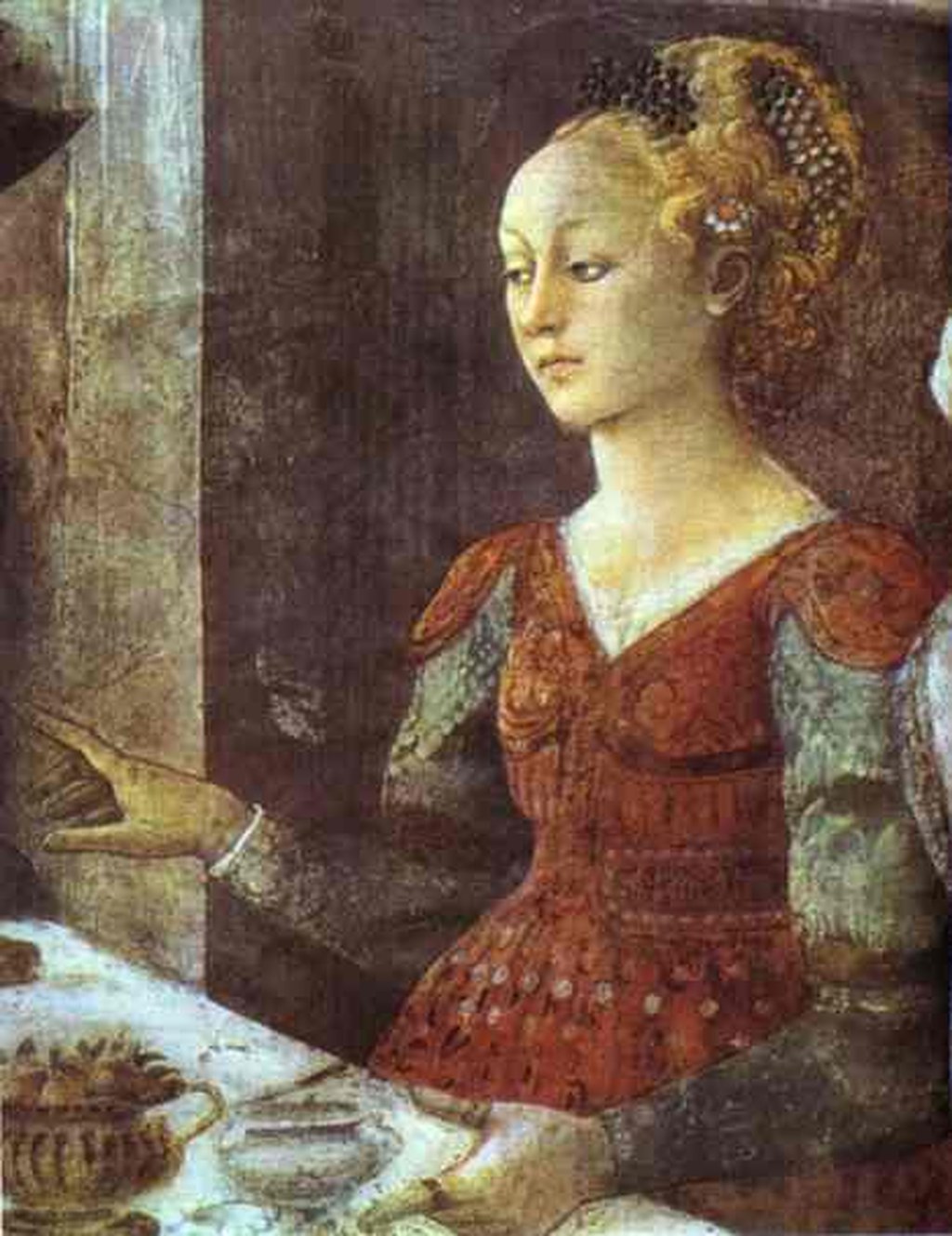
The woman occupies most of the vertical panel. She stands or sits in strict profile, facing right towards an opening in the architecture. Her forehead is high, her nose sharply outlined and her expression controlled. Her gaze does not turn towards the viewer. She wears an elaborate dress, rich fabrics, pearls and jewellery. Her hair is carefully arranged beneath a complex headdress.
In front of her, the man appears through a rectangular casement. Only his upper body and hands are visible. He seems both present and separated from her. The architectural frame keeps the two sitters within the same painting while preventing the easy intimacy of a conventional paired portrait. Behind the woman, another opening reveals a landscape.
The painting therefore contains several nested spaces: the viewer’s world, the woman’s room, the man’s casement and the landscape beyond. That spatial complexity is one reason the work feels so advanced for its date.
The Earliest Surviving Italian Double Portrait. The Met’s description of the painting as the earliest surviving double portrait in Italian painting gives it exceptional historical importance.[1] Portraits of individuals already existed, and donors had long appeared inside religious paintings. What is unusual here is the combination of two secular sitters within one independent portrait. The form allowed Lippi to represent identity as relational.
The woman is not simply “a woman” and the man not simply “a man”. Their meaning depends upon their connection. That relationship is reinforced by heraldry, clothing and the word “lealta”. The painting therefore moves beyond physical likeness into social definition. It asks not only who these people are, but what binds them.
Marriage or Engagement?
The Met suggests that the work probably celebrated an engagement, and marriage has long been central to its interpretation.[1] Several details support that reading. The woman’s sleeve spells “lealta”, or fidelity. Jewels and expensive clothing were closely connected with marriage negotiations, gifts and family display.
The Scolari arms identify the world into which the couple were being joined. The painting may therefore have commemorated a betrothal, wedding or marital union rather than functioning as a neutral record of appearance. The exact moment matters because Renaissance marriage was a process rather than a single modern-style ceremony.
Families negotiated alliances, dowries and property. Gifts changed hands. Legal, religious and domestic stages could unfold over time. A portrait might participate in that process by making the new relationship visible and memorable.
Who Are the Sitters? The figures have often been identified as Lorenzo di Ranieri Scolari and Angiola di Bernardo Sapiti. The Met retains this possibility and notes that the two married around 1436.[1] The man’s association with the Scolari is strongly supported by the heraldic device beneath his hands.
Identifying the woman is more complicated. If the portrait commemorates Lorenzo’s marriage, Angiola becomes a logical candidate. Yet heraldic evidence does not uniquely prove that particular pairing. Katalin Prajda’s specialist study of the coat of arms investigated the wider Scolari family and showed why earlier identifications require careful genealogical scrutiny.[3]
The most reliable approach is therefore neither to discard the traditional identification nor to overstate it. The sitters *may be* Lorenzo and Angiola. That wording preserves both the strength and the limits of the evidence.
The Scolari Coat of Arms
The coat of arms beneath the man’s hands is one of the painting’s most important clues. Heraldry allowed Renaissance viewers to identify families quickly. In a society where lineage mattered deeply, a coat of arms could operate almost like a visual surname. The man’s physical placement strengthens the association. His hands appear directly above the heraldic field.
He therefore presents himself in relation to the family identity. If the portrait marks a marriage, the device also announces the woman’s incorporation into a new dynastic network. She dominates the visible space, but the family emblem supplies the institutional framework. The portrait combines individual bodies with collective lineage.
“Lealta”: The Meaning of Faithfulness. The embroidered letters on the woman’s sleeve spell “lealta”, meaning loyalty or faithfulness. In a marriage portrait, the word has an obvious relevance. It can be read as a virtue expected within the union.
Yet the inscription does more than label the woman as faithful. It turns clothing into language. Her garment literally carries a moral quality. This fusion of material luxury and virtue is characteristic of Renaissance representation. Rich textiles and jewels could advertise wealth while also being interpreted through ideals of chastity, fidelity or status. The clothing therefore speaks socially and morally at the same time.
The Woman in Profile. The strict profile was common in fifteenth-century Italian female portraiture. It offered a clear outline of forehead, nose, lips and chin and could evoke ancient medals and coins. The format also encouraged decorum.
A woman looking directly at the viewer could imply an interpersonal exchange that was not always considered appropriate in elite female representation. The profile keeps her visually available for inspection while withholding reciprocal gaze. This may feel restrictive to modern viewers, but it also gives the woman extraordinary formal strength.
Her silhouette becomes the dominant shape of the painting. The man, by contrast, is fragmented by architecture. Lippi thus creates a paradox: the woman may occupy a constrained social role, yet she commands the picture.
Renaissance Ideals of Female Beauty
The woman’s appearance reflects Florentine ideals rather than modern expectations of naturalistic portraiture. Her forehead is extremely high, her complexion pale and her features refined. Hair could be arranged or removed to enlarge the forehead, which was associated with fashionable beauty.
Jewellery frames rather than overwhelms the face. The profile makes these features legible as a sequence. Portraiture in this period often balanced likeness with idealisation. The sitter needed to be recognisable enough to carry identity but also presented according to social ideals. Lippi’s sacred women and secular female sitters share some stylistic qualities, reminding us that “portrait likeness” was mediated by the artist’s preferred visual type.
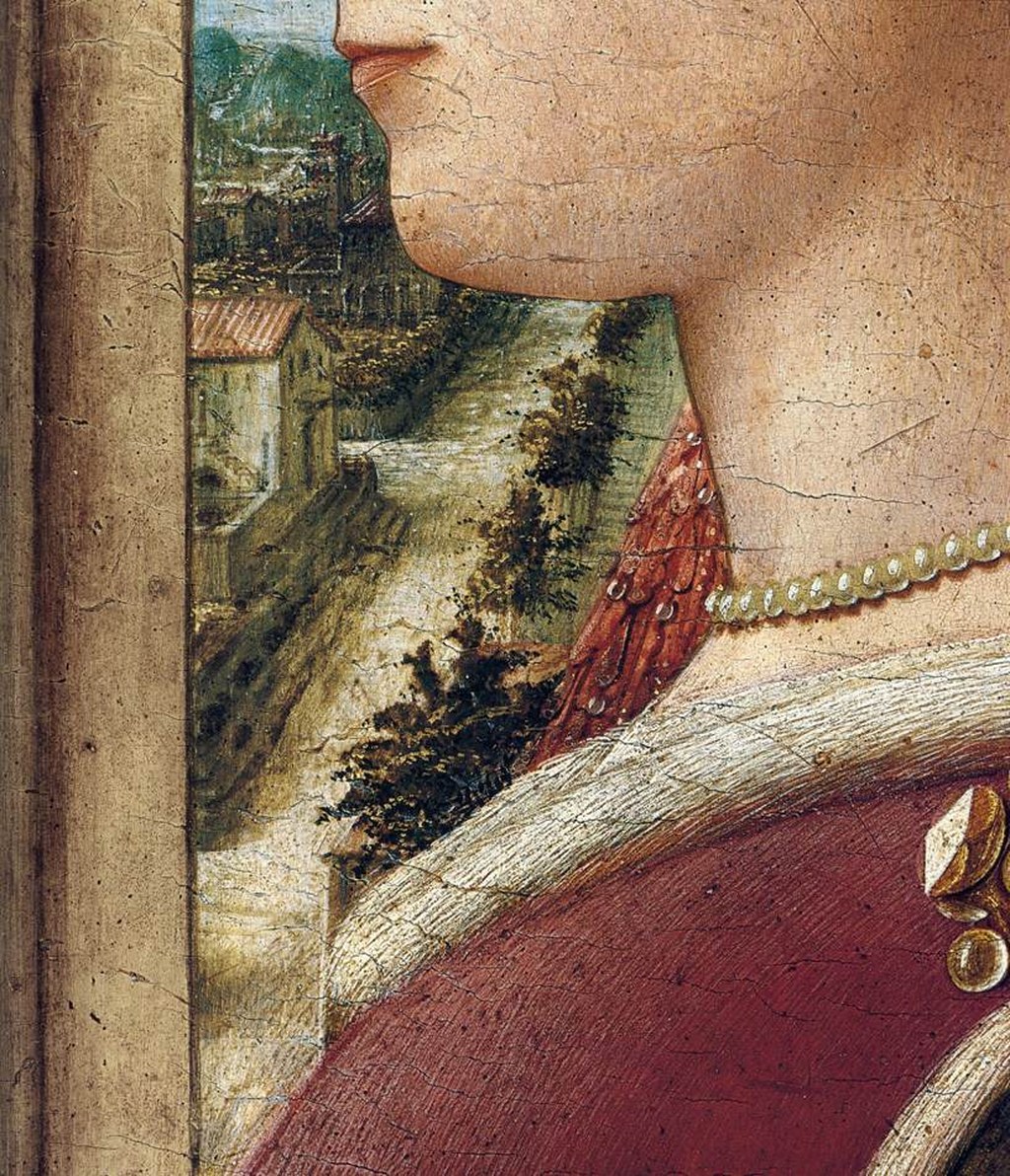
Clothing as Evidence. The clothing is among the richest areas of the painting. The woman wears luxurious fabrics and fur, and the Met draws attention to jewellery such as the head brooch and shoulder brooch.[1] These were not incidental accessories.
Curator Stephan Wolohojian notes in the Met’s interpretation that such jewels could be expensive gifts exchanged in connection with marriage.[1] Their presence therefore carries economic history into the portrait. The woman’s body becomes the surface upon which family wealth is displayed.
This is one reason modern interpretations should be cautious about treating her visual splendour as straightforward personal ownership. In elite Renaissance households, clothes and jewels could participate in dowry, gift and family-property systems. The portrait represents wealth, but not necessarily financial independence.
Jewellery. The Met’s audio discussion identifies a brocchetta di testa, or head brooch, and a brocchetta di spalla, a shoulder brooch.[1] Their placement directs attention to the woman’s hair and dress. Pearls were especially prominent in Renaissance ideals of elite femininity and could carry associations of purity and chastity.
Jewellery also had measurable financial value. A brooch could be both symbol and asset. Portraits preserve these objects even when the originals have disappeared, making paintings useful evidence for material culture. In Lippi’s hands, the jewellery participates in compositional rhythm as well. Small highlights interrupt the broad masses of fabric and draw the eye around the sitter.
The Domestic Interior
According to the Met, this is the first surviving Italian portrait to place sitters inside a domestic setting.[1] That development changes the meaning of portraiture. A neutral background isolates a face. A room connects a person to property, household and way of life.
Architecture tells us that identity extends beyond the body. The woman appears inside an ordered, affluent environment. Walls and openings structure her space. The man’s position at the casement complicates that order. He belongs to the same domestic system but occupies a different spatial zone. Their separation may be artistic rather than symbolic, yet it creates a striking visual metaphor for two people joined through architecture.
The Landscape View. The Met also identifies the painting as the first surviving Italian portrait with a view onto a landscape.[1] Through the opening behind the woman, Lippi lets the eye travel beyond the interior. This expansion performs several functions.
It creates depth. It also implies property, geography and an external world attached to domestic identity. Some interpretations have read the landscape as part of the wealth represented by the portrait, though we should be cautious about assuming that every visible piece of land literally belonged to the sitter. More securely, the view connects the household to a broader environment. The portrait becomes spatially ambitious rather than merely descriptive.
Northern European Influence. The combination of interior, window and distant landscape has often encouraged comparison with northern European painting. Netherlandish artists were particularly admired for their detailed interiors, reflective surfaces, textiles and landscape glimpses. Florence was not culturally isolated. International trade moved objects and images as well as money.
Lippi’s interest in minute surface description elsewhere in his work makes the comparison persuasive. Yet the portrait remains fundamentally Florentine in its profile format, linear clarity and social language. It is better understood as an example of selective exchange than as imitation of one northern model. Lippi combines different visual possibilities into something new.
Architecture as a Portrait Device
The casement is not merely background. It is the mechanism through which the double portrait works. Without it, the man might compete awkwardly with the larger woman. With it, Lippi can include him at a smaller scale while making the difference feel spatially plausible.
The opening acts almost like a picture within the picture. His face becomes framed. This creates a hierarchy of attention: first the woman, then the man, then the coat of arms and landscape. The architecture choreographs looking.
Why Is the Woman Larger? Modern viewers often notice that the woman seems more important because she occupies so much more space. That impression is visually valid. She is undoubtedly the principal figure.
The Met’s interpretive material even invites consideration of her as the centre of the future household.[1] Yet physical prominence should not automatically be converted into a claim about gender power. Marriage portraits could focus on the bride because her appearance, dowry and transfer between families were central to the event being commemorated. The woman may be the subject because the marriage is the subject. Her prominence tells us something important, but it needs to be read inside the social system that produced the painting.
Marriage, Money and Power. Elite Florentine marriages were rarely private affairs based only on personal affection. They joined families. Dowries affected household finances and political networks.
Jewels and clothing could communicate the value and status attached to the alliance. The Met’s discussion is deliberately direct about this economic dimension.[1] The painting therefore resists a sentimental reading in which two lovers simply pose together.
Their union belongs to a world where marriage organised property and kinship. That does not prove the couple lacked affection. It means affection was only one part of what marriage did.
Could the Portrait Be Posthumous?
Some recent scholarship has considered whether the female sitter could have been represented posthumously. That possibility emerges from uncertainties about identification, chronology and the unusual construction of the double portrait. A posthumous interpretation would change the meaning of the architecture and the woman’s visual centrality.
However, this remains a scholarly proposal rather than a museum consensus. It is therefore best discussed as a scholarly possibility rather than as an established conclusion. A productive hypothesis should not be turned into a headline fact.
Lippi as Portrait Painter. Fra Filippo is much better known today for Madonnas, altarpieces and frescoes than for portraiture. That makes this painting particularly revealing. His ability to define a face through line, render costly fabrics and establish psychological distance transfers naturally from sacred painting into secular portraiture.
At the same time, portraiture demanded a different kind of social intelligence. Lippi had to represent status without saints, halos or biblical narrative. Heraldry, architecture and clothing take over some of the functions that iconographic attributes perform in religious works. The portrait shows how adaptable his visual language could be.
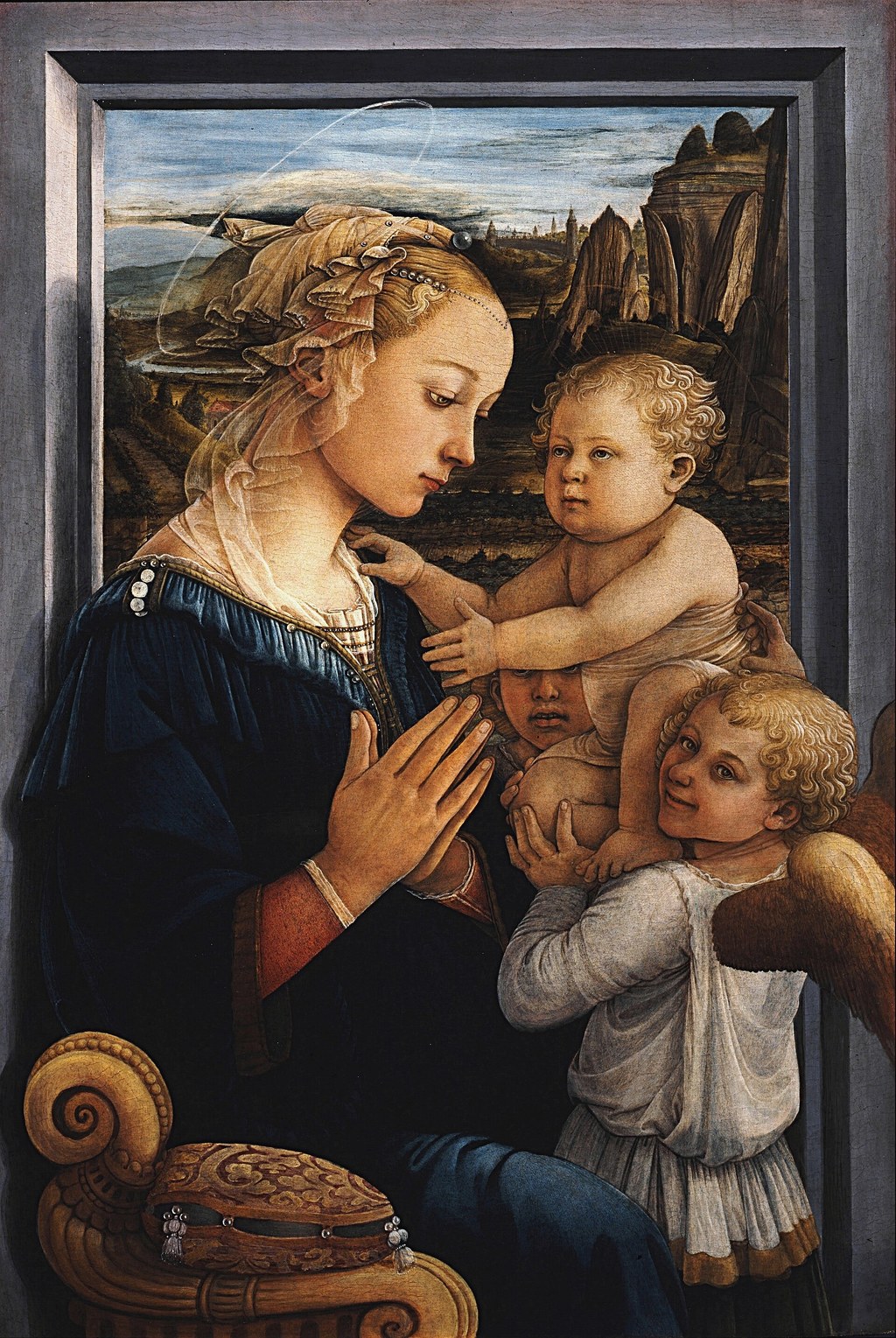
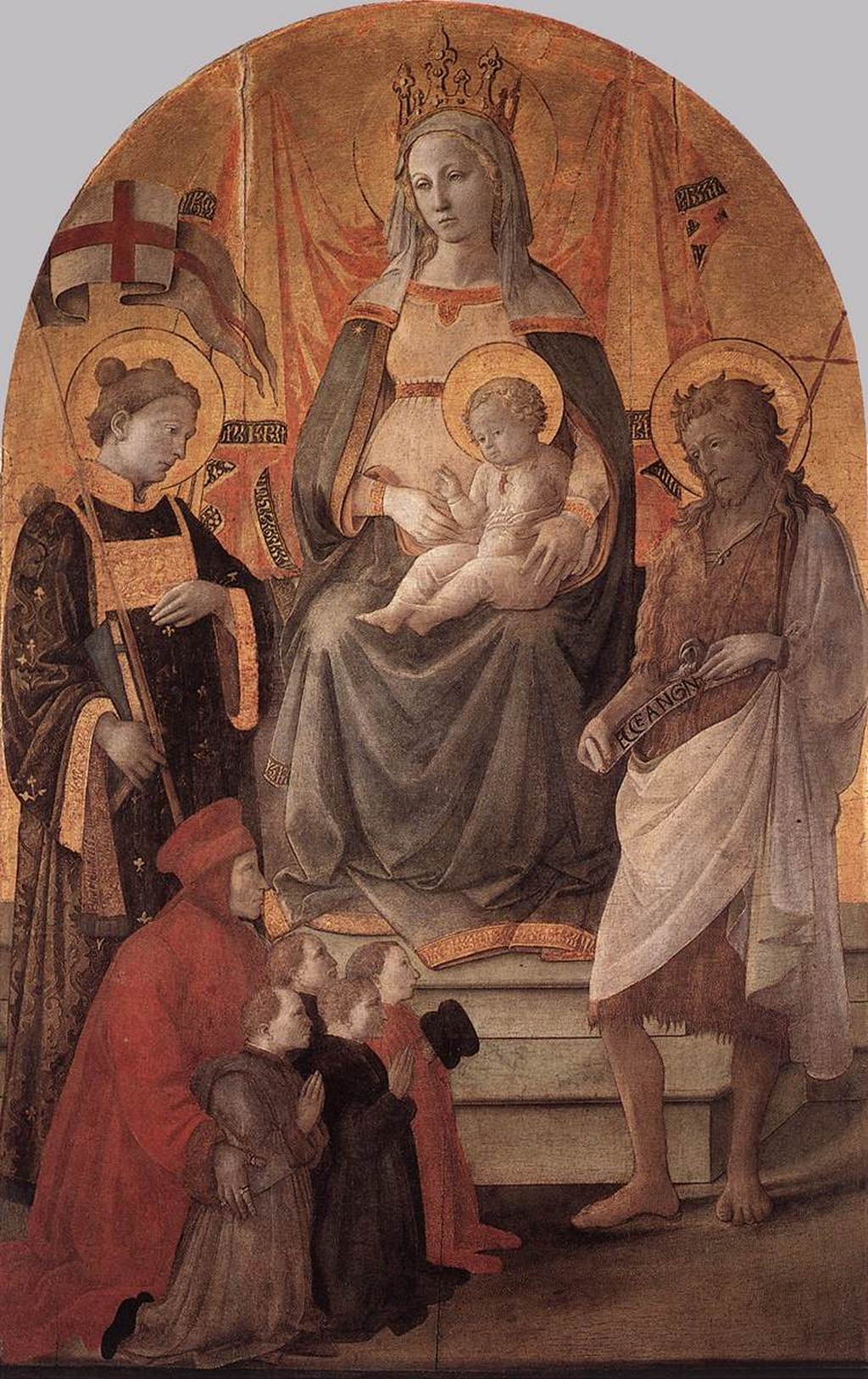
Comparison with Lippi’s Madonnas. The woman’s profile can be compared productively with Lippi’s later Virgin in the Madonna and Child with Two Angels. Both share a high forehead, delicate features and carefully arranged hair. Yet their roles change the meaning of those similarities.
The Madonna embodies sacred beauty and purity. The secular woman embodies lineage, marriage and social status. The comparison is useful because it also warns against identifying idealised female types too quickly as portraits of specific women. Lippi had a repertoire of beauty that crossed sacred and secular contexts.
Tempera and Detail
The painting is executed in tempera on wood. Tempera allowed Lippi to build crisp contours and fine details suited to jewellery, embroidery and profile features. The controlled surface complements the social restraint of the sitters.
Nothing is loose or accidental. The profile, letters, arms and architectural edges all depend upon precision. This makes the painting a particularly good example of how technique and subject can reinforce one another.
A Portrait Built from Boundaries. One of the most sophisticated features of the painting is its repeated use of boundaries. The outer edge of the panel separates the painted world from ours. Within that painted world, walls and openings divide the woman from the landscape and the man from the woman. Each person is therefore framed twice: first by the panel and then by architecture.
This makes the portrait unusually self-conscious about the act of looking. We look at the woman. She looks towards the man.
The man looks into the interior. Behind them, another opening invites the eye outward towards the landscape. Lippi creates a chain of views rather than a single static confrontation.
That structure may help explain why the portrait feels psychologically charged even though the sitters do not touch. Their relationship is expressed through spatial alignment. The architecture joins them precisely by separating them.
What the Heraldry Can and Cannot Tell Us
The Scolari coat of arms is firmer evidence than the names usually attached to the faces. This distinction is important. A family emblem can identify the dynastic group associated with a commission without telling us exactly which individual member is represented.
The Scolari were an extended family, and specialist archival work has examined several possible branches and marriage arrangements. Earlier interpretations often moved too quickly from “Scolari arms” to one specific Scolari man. Prajda’s study is useful because it shows how heraldic evidence must be combined with chronology, genealogy and marriage records.[3]
This is precisely the type of issue where careful source criticism improves upon simplified retellings without contradicting the museum. It can be said securely that the coat of arms is Scolari. It can then say that Lorenzo di Ranieri Scolari and Angiola di Bernardo Sapiti are plausible sitters. Those are two different levels of certainty. Keeping those levels of certainty separate makes the identification more reliable.
A Marriage Portrait Without Physical Affection. Modern wedding photography encourages viewers to expect touch, smiles and reciprocal gaze. Lippi’s couple behaves very differently. Their faces are controlled, their bodies separated and their relationship encoded through objects and architecture rather than affection.
That does not mean the painting records an unhappy marriage. It reflects a different conception of what a marriage image needed to communicate. The priorities are status, legitimacy, fidelity, household and family connection.
The woman’s clothing and jewels make her marriageable social identity visible. The man’s heraldry anchors the union in lineage. Their physical reserve may therefore be appropriate to the seriousness of the alliance. The portrait preserves a social contract in visual form.
Bride, Household and Display
The woman’s apparent centrality also makes sense if the portrait commemorated her entry into a household. Marriage involved movement. A bride could leave the social and domestic sphere of her birth family and become part of another family’s household.
Clothes, jewels and dowry goods accompanied that transition and were publicly meaningful. Lippi places the woman precisely inside an architectural environment. Whether or not the room represents a literal Scolari interior, the setting makes household identity part of her portrait.
The landscape expands that idea further. Her new social position belongs not just to a face but to a system of rooms, property, family signs and territory. The portrait’s innovation therefore lies partly in redefining what counts as a likeness. Identity is environmental.
The Viewer's Role. The viewer occupies a curious position. We see the woman more clearly than the man does. Her profile is presented to us at close range, while he is positioned farther away through the casement.
This creates an asymmetry between painted relationship and spectator access. We are outsiders, but the composition gives us privileged visual information. The heraldry and embroidered word function almost like clues placed for us to decode.
The painting becomes a social puzzle. Who are these people? Why are they joined?
What do the clothes, jewels and arms tell us? This interpretive demand is one reason the work remains so compelling. It was probably legible in more specific ways to its original family audience, who already knew the names and circumstances. For modern viewers, the loss of that knowledge turns the painting into historical investigation.
Portraiture as Material History
The panel is also valuable because it preserves categories of evidence that written documents often describe only abstractly. Marriage contracts can list dowry values. Inventories can list jewels.
Genealogies can record alliances. But a portrait shows how these things could be assembled around a body to produce status visually. We see scale, placement and colour.
We see how a brooch relates to hair and how embroidery sits on a sleeve. We see how heraldry can be built into architecture rather than floating separately. This is why portraits matter far beyond biography. They are records of objects, spaces and social expectations. Lippi’s double portrait is particularly powerful because so many of those categories survive in one compact panel.
From Florence to the Met. The early provenance is not as well documented as the work’s likely marriage context. By the nineteenth century, the painting had entered collecting networks that carried Italian Renaissance art into British and American collections. It ultimately became part of the Marquand Collection.
Henry G. Marquand gave it to the Metropolitan Museum in 1889.[1] Its presence in New York has contributed greatly to its modern prominence. The Met also makes a public-domain image available, allowing unusually close educational study of the painting.[1]
Why the Portrait Matters
Portrait of a Woman with a Man at a Casement matters because it expands the history of Renaissance portraiture in several directions at once. It joins two sitters in one independent image. It places them inside domestic architecture.
It opens that interior onto landscape. It integrates heraldry, written language, jewellery and fashion into the construction of identity. And it makes marriage visible as both a personal and institutional relationship.
The painting is especially important within Lippi’s oeuvre because it does not repeat the themes of his Madonnas. It reveals an artist responding to the social machinery of Florence. The woman’s extraordinary visual presence also makes the work a valuable starting point for discussions of gender.
She dominates the panel, but the Scolari arms and marriage economy complicate what that dominance means. The result is more interesting than either a purely celebratory or purely restrictive reading. Lippi gives us a woman who is at once individual, ideal, bride, bearer of family status and commanding pictorial presence. That complexity is why the portrait remains one of the most important secular images of the early Florentine Renaissance.
FAQs
Discussion
What stands out to you most about Portrait of a Woman with a Man at a Casement in relation to Filippo Lippi's wider career?
Reader Insights
Notice how the page connects close visual detail with patronage, workshop practice and the wider Renaissance setting.
Which comparison elsewhere in the cluster helps clarify this work or theme most strongly?
Join the Conversation
Have a thought or observation about Portrait of a Woman with a Man at a Casement? Share it below. Thoughtful responses may be added to this section.
References
- Metropolitan Museum of Art, Portrait of a Woman with a Man at a Casement, Fra Filippo Lippi, collection record. View Source.
- Metropolitan Museum of Art, “A Renaissance Marriage,” interpretive essay, 2012. View Source
- Katalin Prajda, “The Coat of Arms in Fra Filippo Lippi’s Portrait of a Woman with a Man at a Casement,” Metropolitan Museum Journal 48 (2013). View Source
- J. Russell Sale, “Protecting Fertility in Fra Filippo Lippi’s Portrait of a Woman with a Man at a Casement,” Metropolitan Museum Journal 51 (2016). View Source
- Jeffrey Ruda, Fra Filippo Lippi: Life and Work with a Complete Catalogue, London, 1993.
- Megan Holmes, Fra Filippo Lippi: The Carmelite Painter, Yale University Press, 1999.