


 by Tom Gurney
Tom Gurney BSc (Hons) is an art history expert with over 20 years experience
Published on June 19, 2020 / Updated on October 2, 2026
Email: tomgurney1@gmail.com / Phone: +44 7429 011000
Selected Filippo Lippi Paintings
Browse the main artwork pages in this cluster through the legacy image-and-link layout used across approved medium pages.
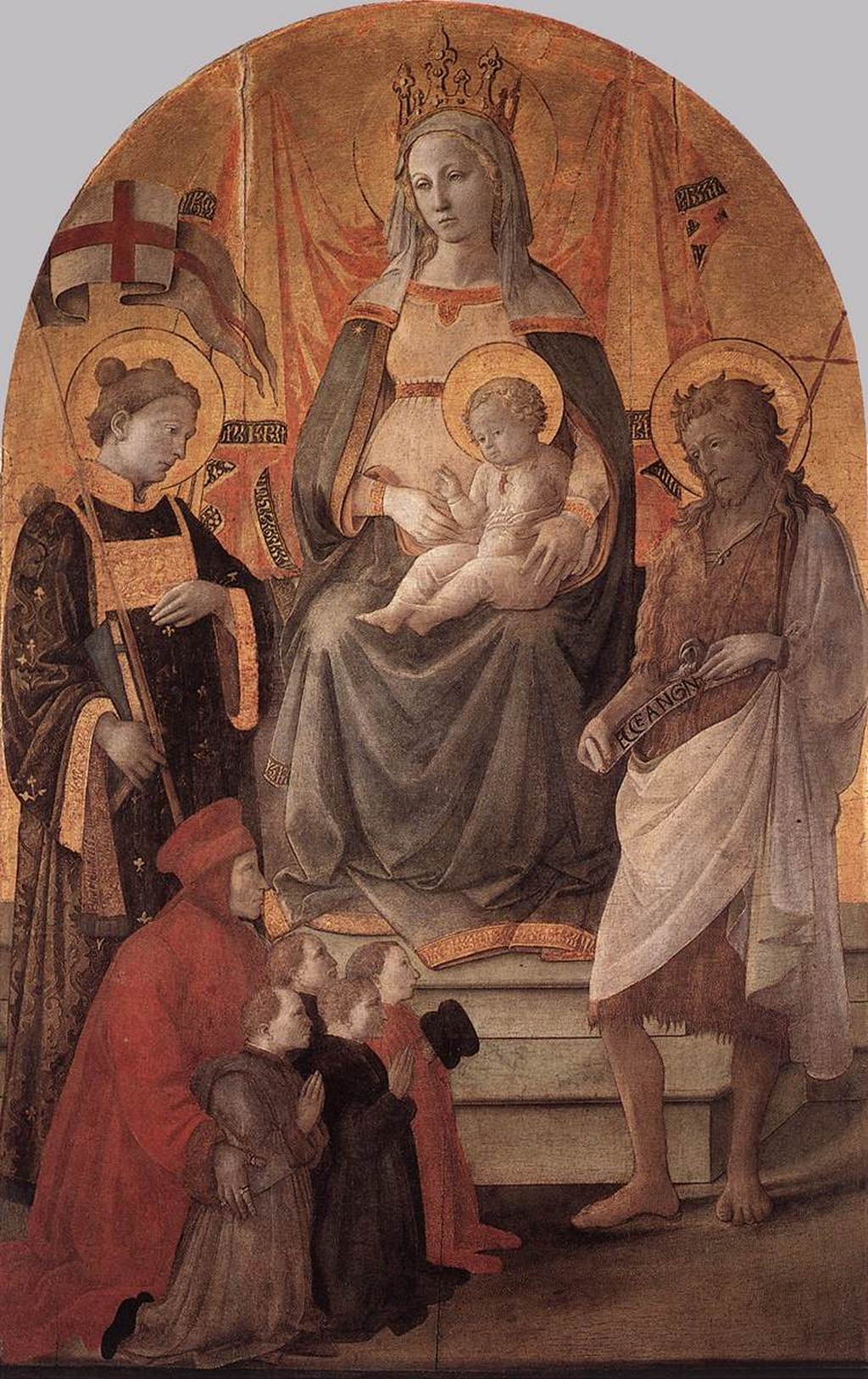
Fra Filippo Lippi Paintings: A Guide to His Major Works
Fra Filippo Lippi's surviving paintings trace one of the most revealing careers of the Florentine early Renaissance. His art ranges from intimate Madonna panels to enormous fresco cycles, from Medici palace decoration to an exceptional double portrait, and from large public altarpieces to images intended for private contemplation. Seen chronologically, the works show an artist who began under the overwhelming influence of Masaccio but gradually developed a more graceful, decorative and emotionally direct language.
A useful way to approach Lippi is not to treat every Madonna as a variation on the same subject. His pictures were made for very different audiences and spaces. A convent high altar demanded something different from a bedroom or palace chapel; a civic cathedral fresco required another kind of storytelling again. Patronage, location and function therefore help explain why his style changes from work to work. This guide concentrates on paintings that are both important within Lippi's development and well supported by surviving documentation or modern museum research.
Contents
- Early development and the legacy of Masaccio
- Portrait of a Woman with a Man at a Casement, c. 1440
- Coronation of the Virgin, completed 1447
- Madonna and Child with Scenes from the Life of Saint Anne, c. 1452–53
- The Feast of Herod
- Adoration of the Magi, Washington
- Pistoia Santa Trinità Altarpiece
- Legacy
- References
Early development and the legacy of Masaccio
Lippi grew up within the Carmelite world of Santa Maria del Carmine in Florence, where Masaccio and Masolino painted the Brancacci Chapel. No documentary evidence establishes a formal apprenticeship under Masaccio, but the impact of those frescoes on Lippi's early art is unmistakable. Figures have physical weight, architectural space matters, and sacred scenes are presented with a new concern for bodily presence. Yet even the earlier Lippi tends to soften Masaccio's severity. He is increasingly interested in graceful line, patterned surfaces and the expression of feeling. These characteristics become clearer as his career develops.
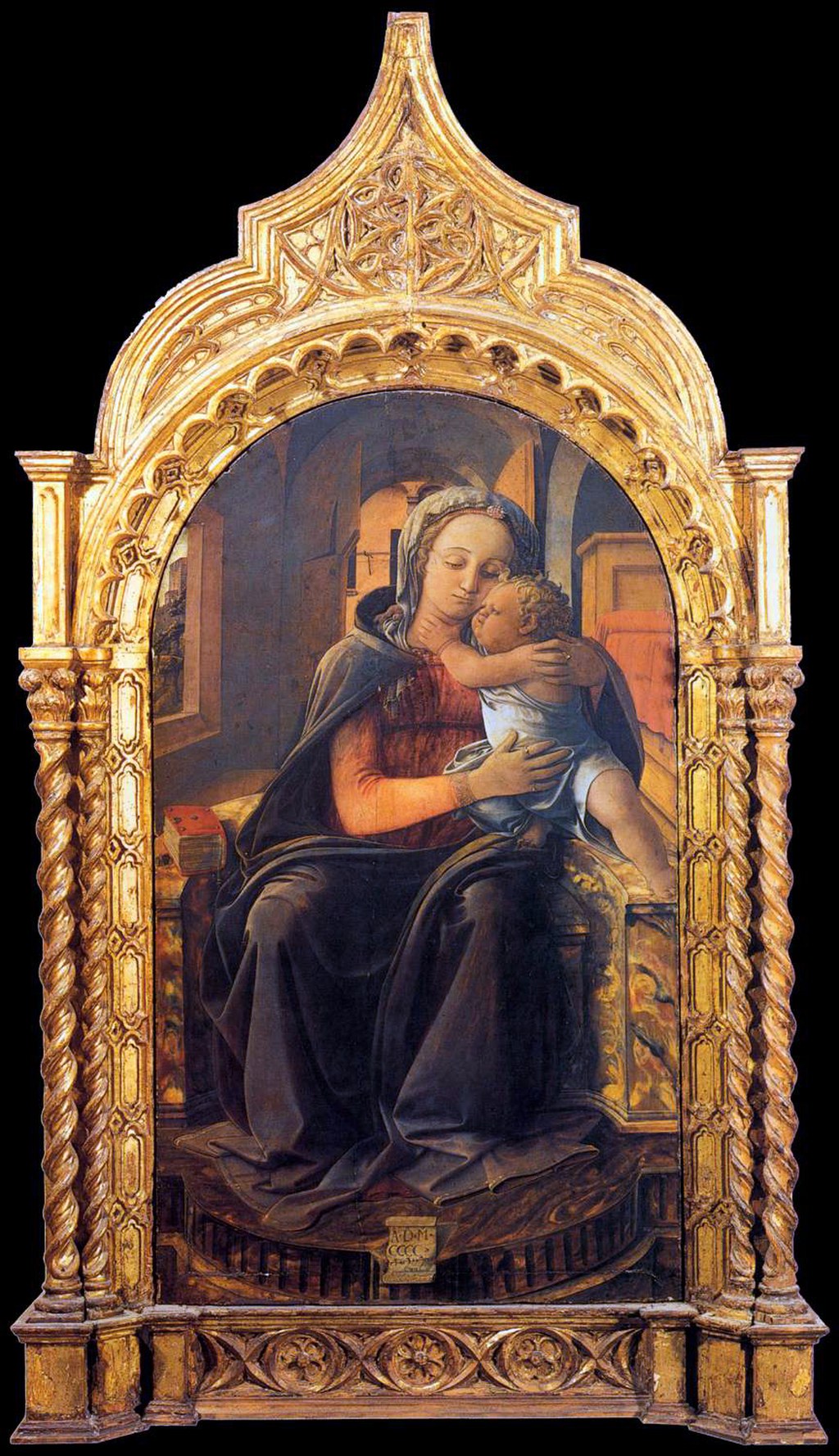
Madonna of Tarquinia, 1437. The Madonna of Tarquinia is one of the most important dated works in Lippi's career. Now in Palazzo Barberini in Rome, the panel bears the date 1437 and is probably connected with Giovanni Vitelleschi, Archbishop of Florence and a native of Tarquinia. The Virgin and Child possess the solid physicality associated with the new Florentine style, but they occupy an unusually detailed interior. Furniture, architecture, fabrics and an opening toward landscape transform the devotional image into a plausible domestic world. The emotional exchange between mother and child is equally important. Rather than presenting Mary as a remote icon, Lippi makes the encounter intimate without stripping it of sacred meaning. The painting therefore stands at a productive intersection: Masaccio's solidity, Donatello-like sculptural presence, Gothic elegance and an increasing fascination with material detail.
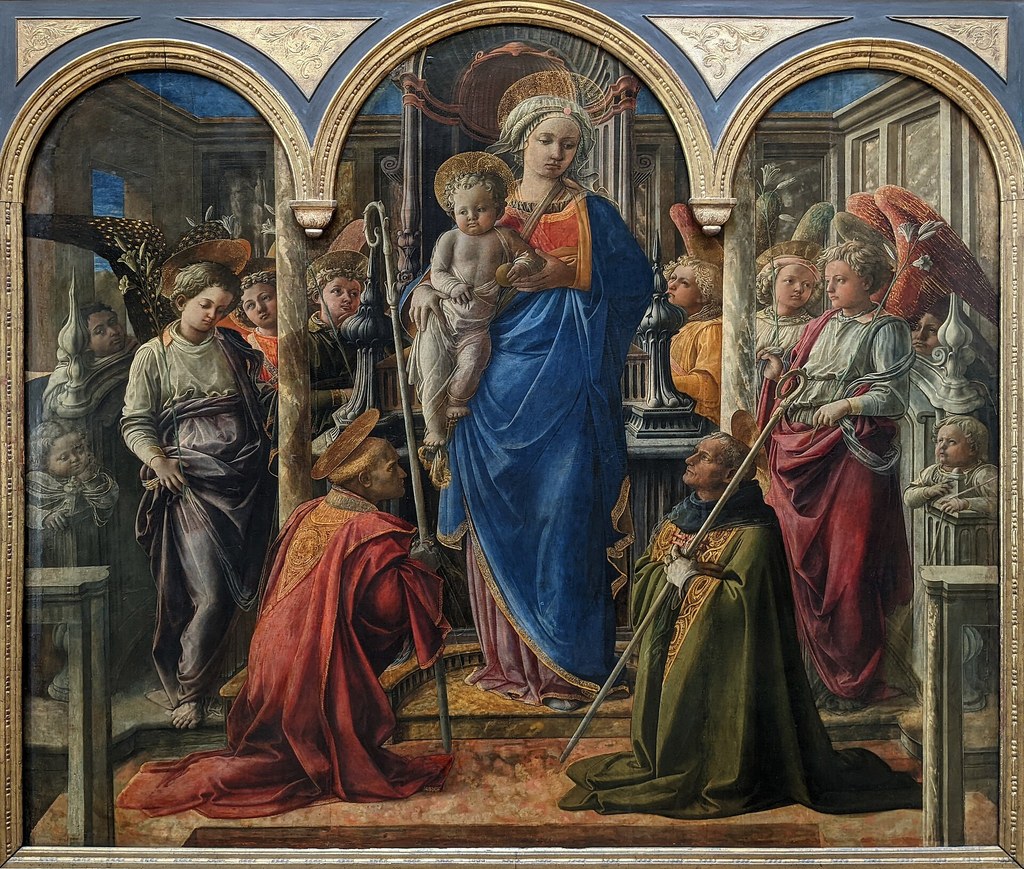
Barbadori Altarpiece, 1437. The Barbadori Altarpiece, now in the Louvre, was commissioned in March 1437 for the Barbadori chapel in Santo Spirito, Florence. Its surviving documentation gives it an unusually firm place in Lippi's chronology. The Virgin and Child appear with angels and Saints Fredianus and Augustine within a unified architectural setting. The work belongs to a period in which Florentine painters were moving beyond the compartmentalised appearance of traditional polyptychs. Lippi's architecture helps bring the sacred figures into a single shared world.
The altarpiece's later dispersal is part of its history. The main panel is in Paris while predella components survive elsewhere, including Florence. Any modern discussion therefore has to reconstruct an object whose original visual programme is no longer encountered in one place.
Portrait of a Woman with a Man at a Casement, c. 1440
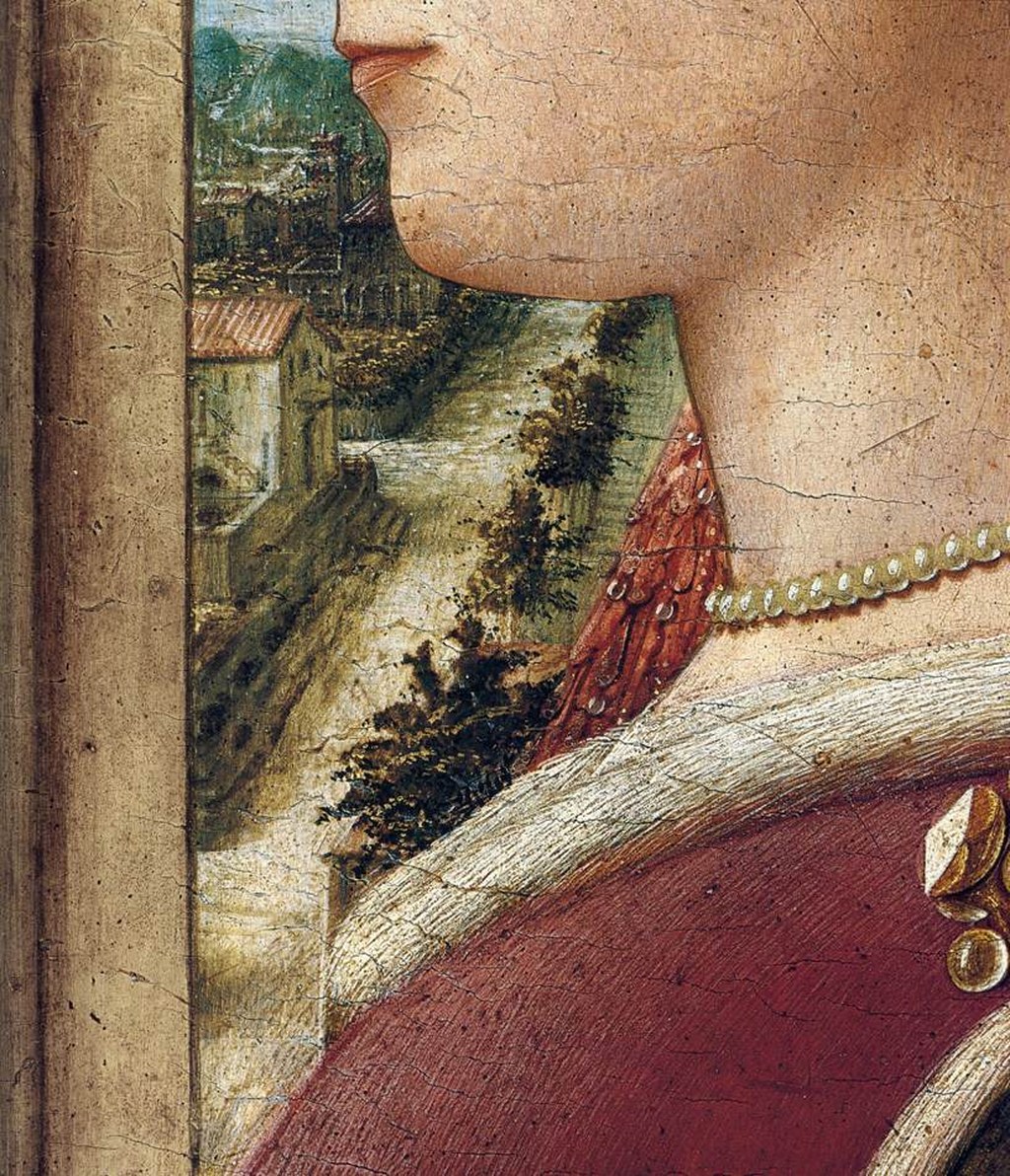
The Metropolitan Museum's double portrait is unique within Lippi's oeuvre and unusually important to the history of Italian portraiture. The Met describes it as the earliest surviving double portrait in Italian painting, the earliest surviving Italian portrait with its sitters placed in a domestic interior, and the first with a landscape view.[3] A richly dressed woman appears in profile while a man is framed by an architectural opening. Heraldic evidence associates him with the Scolari family, and the picture has been connected with a marriage between Lorenzo di Ranieri Scolari and Angiola di Bernardo Sapiti.
The painting demonstrates that Lippi's interest in material life was not limited to religious images. Clothing, jewellery, architecture, inscriptions and heraldry all communicate status and social identity. It is one of the best works through which to explore marriage, gender and domestic display in Renaissance Florence.
Murate Annunciation, c. 1443–45. The large Annunciation now in Munich's Alte Pinakothek was made for the Benedictine Suore Murate in Florence and commissioned by Giovanni de' Benci, whose wealth was tied to the Medici banking world. The picture is particularly useful for understanding Lippi's stylistic mixture. The figures retain a courtly elegance associated with International Gothic art, yet they inhabit a carefully constructed perspectival setting. Grace and mathematical order are not opposites here; Lippi makes them cooperate. This work also provides a valuable comparison with the later National Gallery Annunciation. The same biblical episode could be reformulated according to destination, scale and patron.[1]
Coronation of the Virgin, completed 1447
The Uffizi's monumental Coronation of the Virgin was made for the high altar of Sant'Ambrogio in Florence and completed in 1447. It is among the richest documented commissions in Lippi's career.[2] The subject allows Lippi to assemble an enormous sacred community around the crowning of Mary. Angels, saints and worshippers form a dense ceremonial gathering enlivened by individual faces, gestures and textiles. The artist probably represented himself among the figures, bringing the maker symbolically into the sacred event. Surviving records also identify assistants, reminding us that large Renaissance altarpieces were workshop enterprises. The Coronation is therefore as important for understanding artistic labour as for studying iconography.
Saint Bernard's Vision of the Virgin, 1447. The National Gallery's Saint Bernard's Vision of the Virgin is one of Lippi's more unusual devotional subjects. Saint Bernard encounters the Virgin in a rocky, contemplative landscape. The painting was probably associated with the Palazzo Vecchio and may have functioned as an overdoor image.[1] Its subject creates an especially useful comparison with Filippino Lippi's celebrated later treatment of Saint Bernard's vision. Father and son use the same miraculous encounter to very different effect. The surface is worn, which also makes the painting a case study in the physical history of Renaissance panels. What survives is not identical to what fifteenth-century viewers saw.
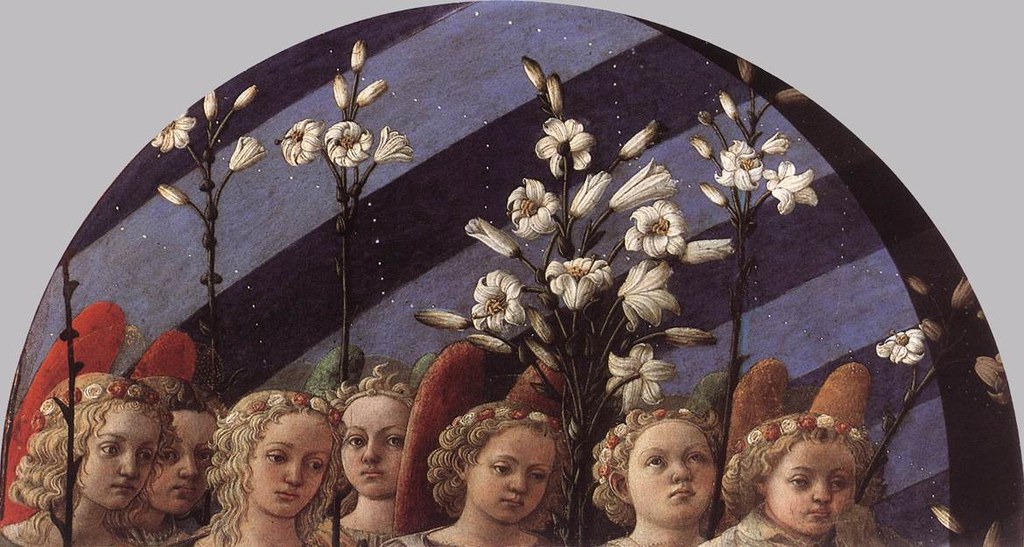
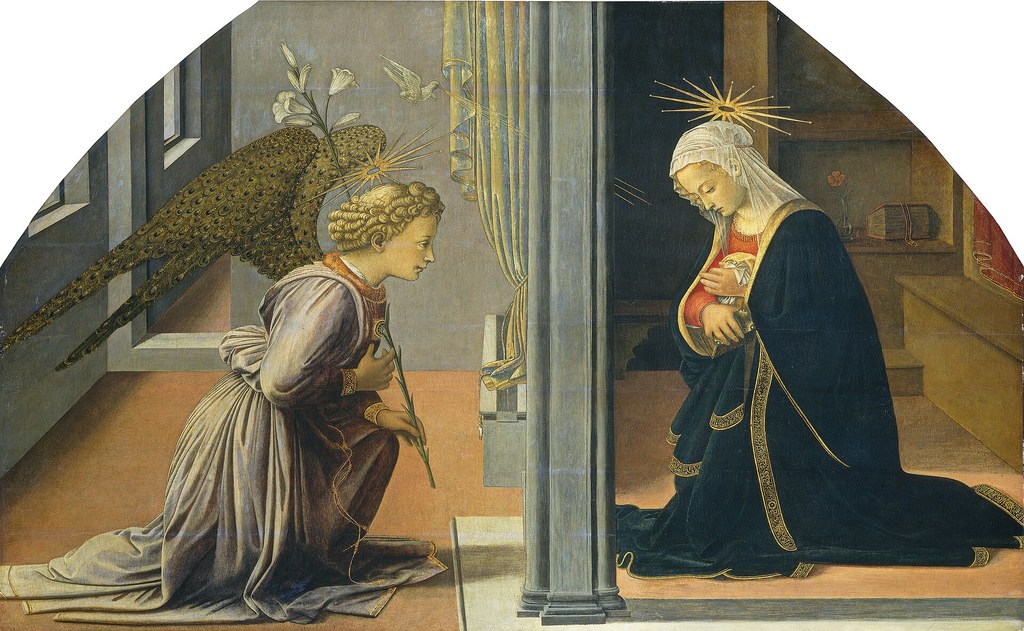
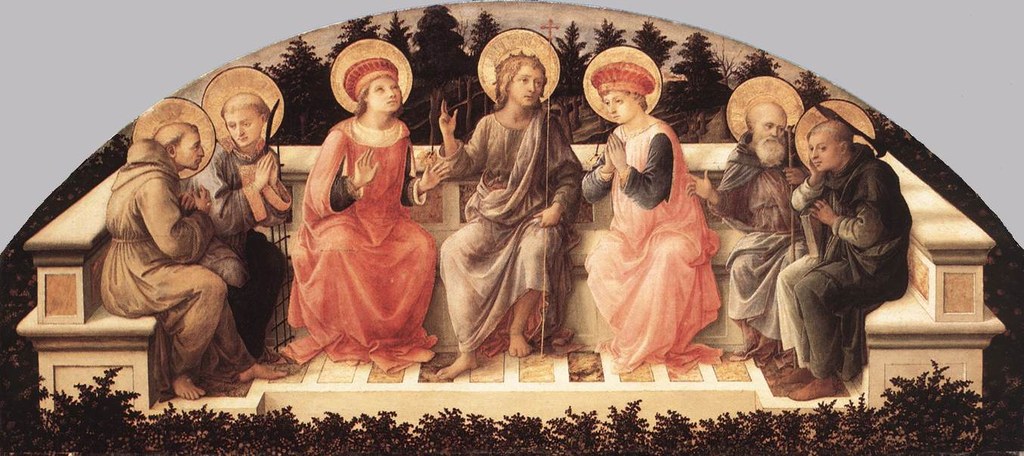
The Medici panels: Annunciation and Seven Saints, c. 1450–53. Two National Gallery panels, The Annunciation and Seven Saints, once belonged to the Palazzo Medici. Their semicircular or otherwise architecture-responsive formats support the idea that they formed part of palace decoration, probably positioned above doors or within an architectural scheme.[1] The Annunciation rewards close looking. Gabriel's elaborate wings, the lilies, enclosed garden imagery and the descent of the Holy Spirit turn a familiar subject into a collection of finely calibrated details. The figures' grace is balanced by the clarity of the setting.
Seven Saints is historically valuable because the saints correspond to names and patrons associated with members of the Medici family. It therefore converts a devotional group into a dynastic image. Seen together, the panels show how sacred painting could serve private faith, family identity and palace display simultaneously.
Madonna and Child with Scenes from the Life of Saint Anne, c. 1452–53
This large circular painting, now in the Pitti Palace, is one of Lippi's most inventive approaches to narrative. The Madonna and Child dominate the foreground while episodes from Saint Anne's life occupy the background, including the meeting of Anne and Joachim and the birth of the Virgin. Scale distinguishes both space and time. Background figures are smaller not simply because they are farther away but because they belong to earlier moments in the sacred history. Lippi compresses several generations of Marian narrative into one domestic devotional object. The richly furnished interiors are especially valuable evidence for how contemporary viewers might imagine holy history through the material culture of fifteenth-century elite life.
Prato and the great fresco cycle. In 1452 Lippi began work on the main chapel of Prato Cathedral. The resulting Stories of Saint Stephen and Saint John the Baptist became the largest sustained project of his career and one of the masterpieces of Tuscan fresco painting. The cycle matters because panel-painting habits had to be transformed for monumental walls. Lippi coordinated assistants, designed broad narrative sequences and adapted perspective to the changing architecture of the chapel. Surviving records identify Fra Diamante as a major collaborator.
The frescoes also preserve technical evidence of a complex finishing process. Details were added a secco, and some ornament originally included gold leaf attached over wax-like applications. The brighter, more materially varied fifteenth-century appearance has therefore been reduced by time and historic cleaning.
The Feast of Herod
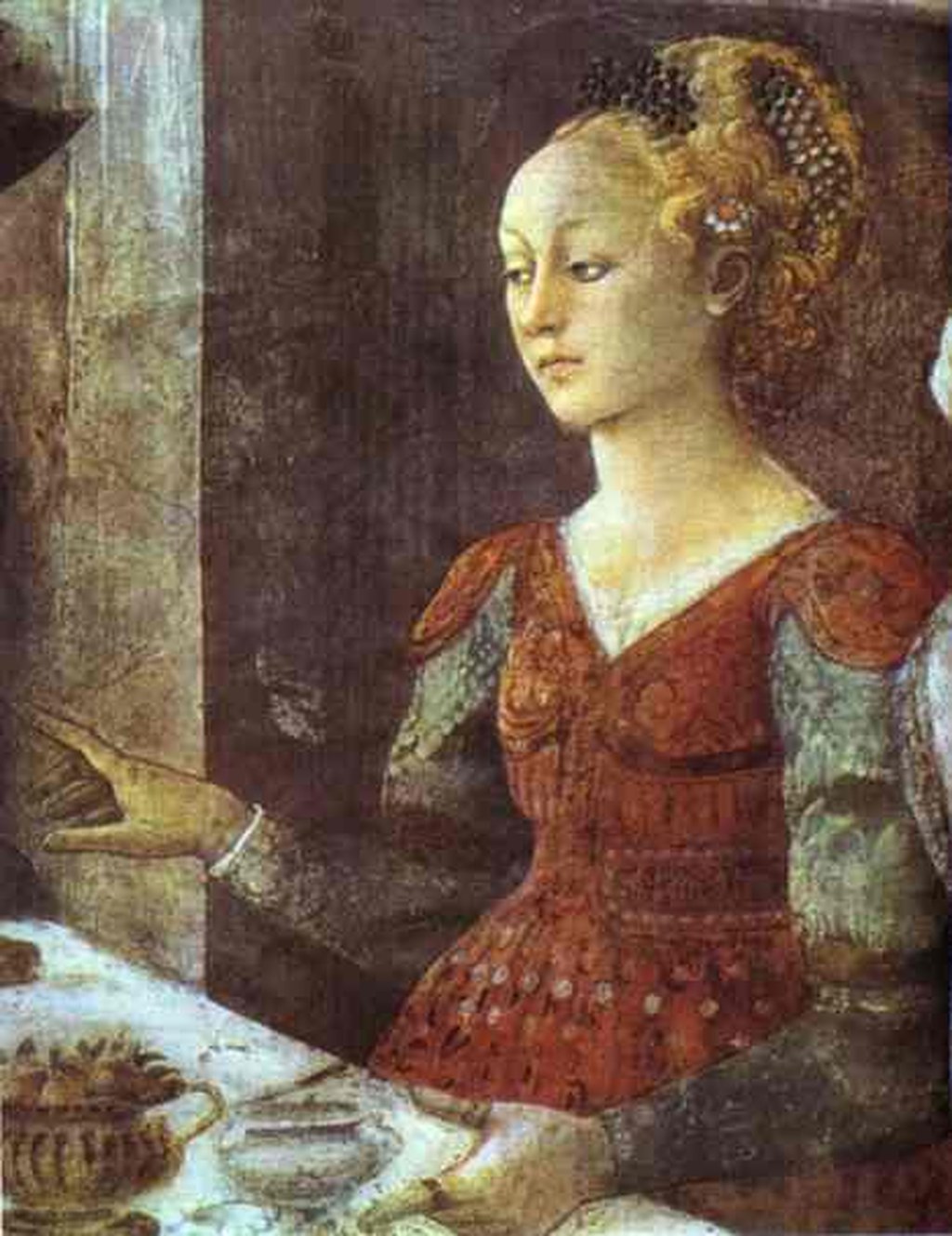
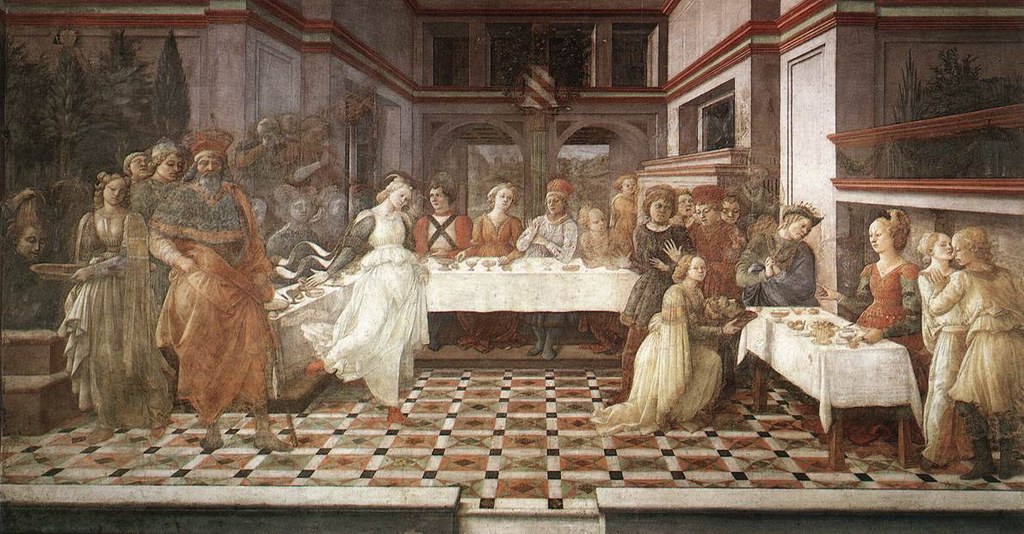
The Feast of Herod is the best-known scene in the Prato cycle. Its fame rests partly on its sophisticated treatment of narrative time. Salome dances in one area while the beheading of John the Baptist and the presentation of his head unfold elsewhere within the same architectural environment. The eye reads the wall almost cinematically, moving from performance to consequence. Yet Lippi avoids turning the composition into a simple strip of episodes. Perspective, walls, groups of figures and gesture make the transitions feel spatially coherent. The scene also demonstrates Lippi's ability to transpose biblical history into the visual language of contemporary elite society. Costume, behaviour and architecture make Herod's court simultaneously ancient and Florentine.
Madonna del Ceppo, 1452–53. The Madonna del Ceppo in Prato connects Lippi's sacred art with civic charity. It was commissioned by the charitable institution founded by merchant Francesco di Marco Datini and includes donor figures alongside patron saints. The work is valuable because it makes patronage visible. Scale distinguishes heavenly figures from earthly donors, while textiles, emblems and saintly identities connect religious devotion to the social institutions of Prato. Its conservation history is equally important. Long exposure in a sheltered but outdoor context damaged the panel, and restoration has had to recover an image whose surface suffered significantly over time.
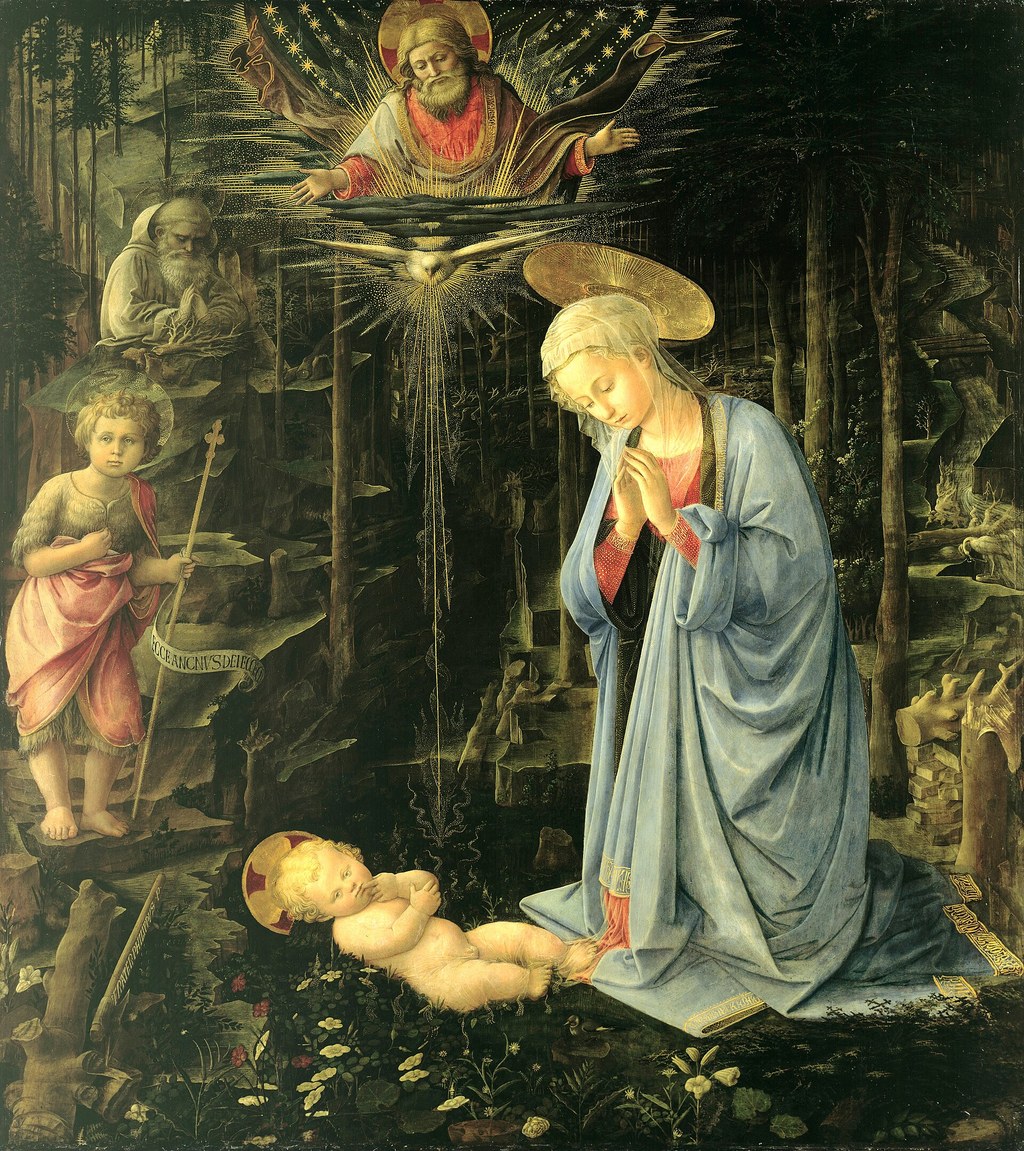
Adoration in the Forest, c. 1459. The Adoration in the Forest, now in Berlin, was painted for the Medici family's private Magi Chapel in Florence. It is among Lippi's most atmospheric works. The Virgin kneels before the Christ Child in a densely wooded landscape, joined by the young John the Baptist and Saint Bernard. The forest is more than a picturesque setting. Its darkness, vegetation, running water and symbolic details encourage a contemplative reading. The picture deliberately contrasts with the pageantry of Benozzo Gozzoli's Magi procession covering the chapel walls.
The work has acquired new importance through the Gemäldegalerie's 2026–28 technical examination and conservation project. Infrared reflectography, X-radiography, ultraviolet examination, microscopy and material analysis promise to clarify Lippi's working methods and the painting's later restoration history.
Adoration of the Magi, Washington
The National Gallery of Art's large circular Adoration of the Magi is currently attributed jointly to Fra Angelico and Fra Filippo Lippi. Its collaborative authorship and likely Medici patronage make it one of the richest research objects connected with Lippi.[4] The crowded procession, exotic animals, ruins and winding landscape create an effect very different from the Berlin forest picture. The tondo also opens onto the Medici family's special identification with the Magi and the civic culture surrounding Magi processions in Florence. Its attribution has changed over time, making the painting a useful demonstration that authorship is a scholarly argument rather than a permanent label.
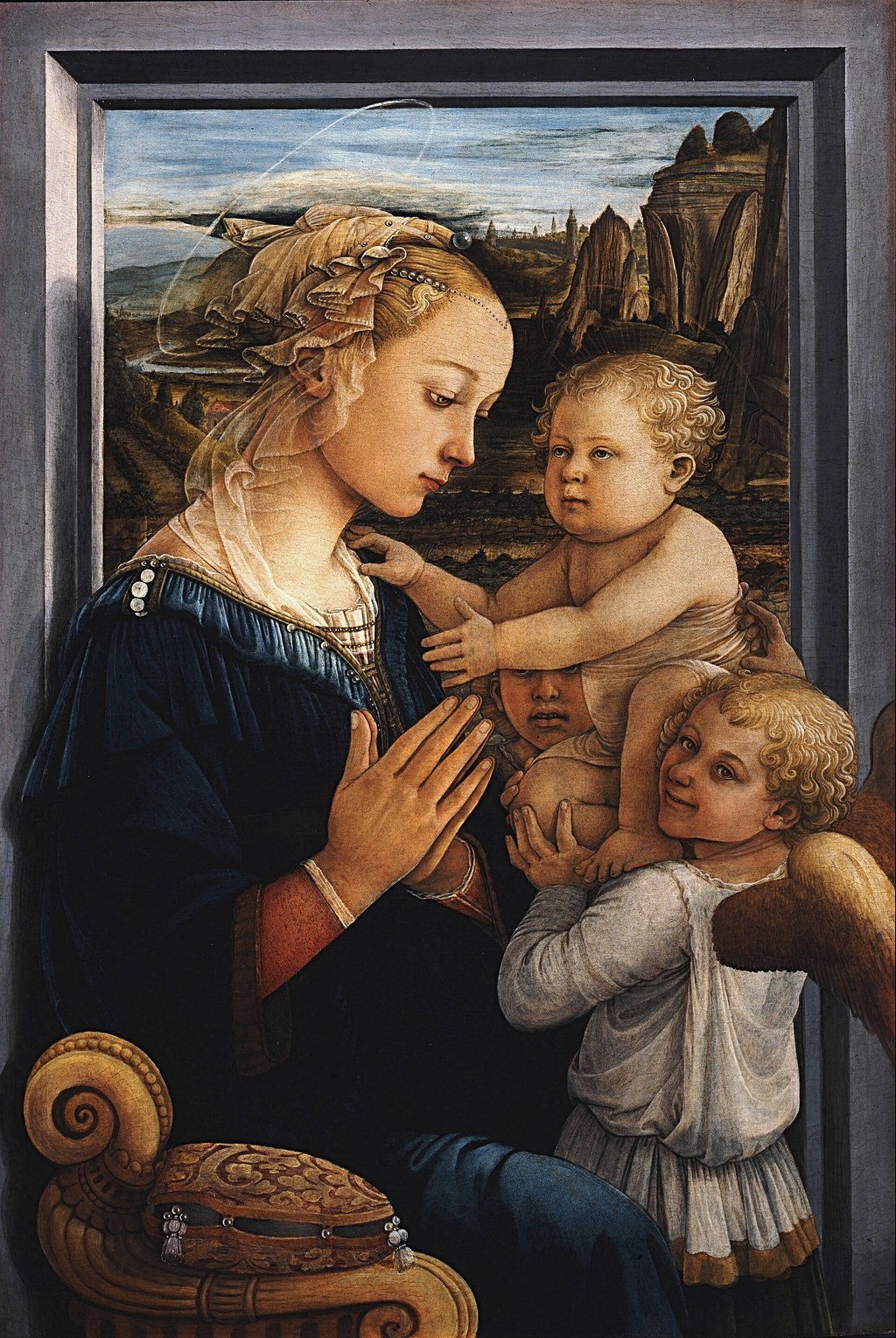
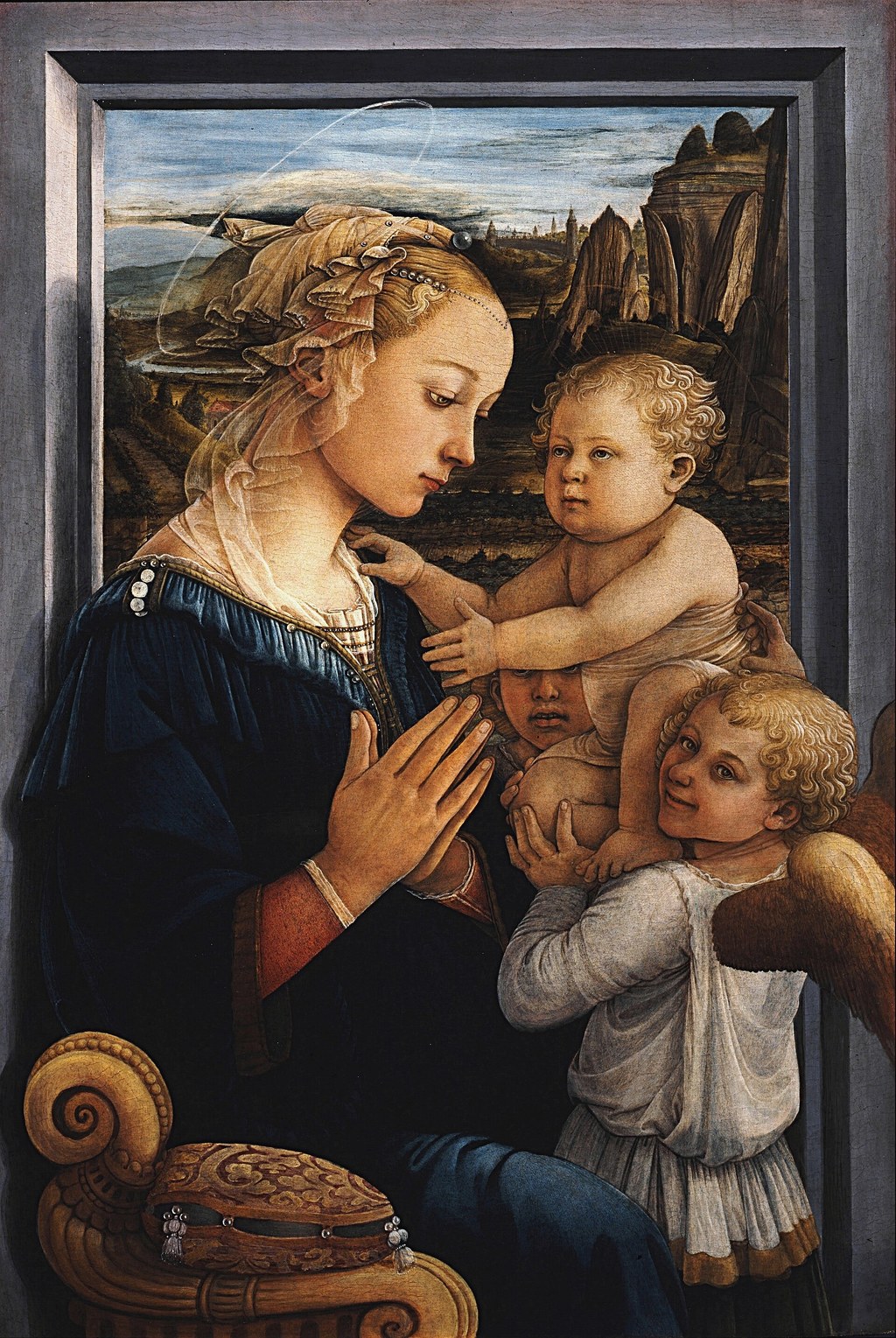
Madonna and Child with Two Angels, c. 1465. The Uffizi's Madonna and Child with Two Angels is probably Lippi's most recognisable panel. Mary prays while two angels lift the Christ Child toward her. The nearest angel turns toward the viewer with an unforgettable smile.[2] The painting brings together several mature characteristics: graceful contour, translucent veil, contemporary beauty, tender interaction and distant landscape. Halos are restrained almost to disappearance, intensifying the sense that sacred figures have entered an ordinary human world.
The traditional claim that the Virgin depicts Lucrezia Buti should be handled carefully. The Uffizi notes that no evidence confirms the identification. The story remains part of the painting's reception, but it is not secure portrait documentation.[2] Its influence on Botticelli is much easier to support. Botticelli's early Madonnas repeatedly develop the kinds of profile, line, veil and emotional intimacy found in Lippi's mature sacred imagery.
Pistoia Santa Trinità Altarpiece
The Pistoia Santa Trinità Altarpiece has one of the most revealing documentary histories of any work associated with Lippi. It was commissioned from Francesco Pesellino in 1455. After Pesellino died, Lippi and his workshop were contracted to finish it. Confraternity records preserve negotiations over design, saints, costs and completion. The work therefore shows how Renaissance authorship could be shared across workshops and even across the death of the original contractor. Later dismantling complicated the object further. Its modern reassembly at the National Gallery makes reconstruction itself part of the painting's story.[1]
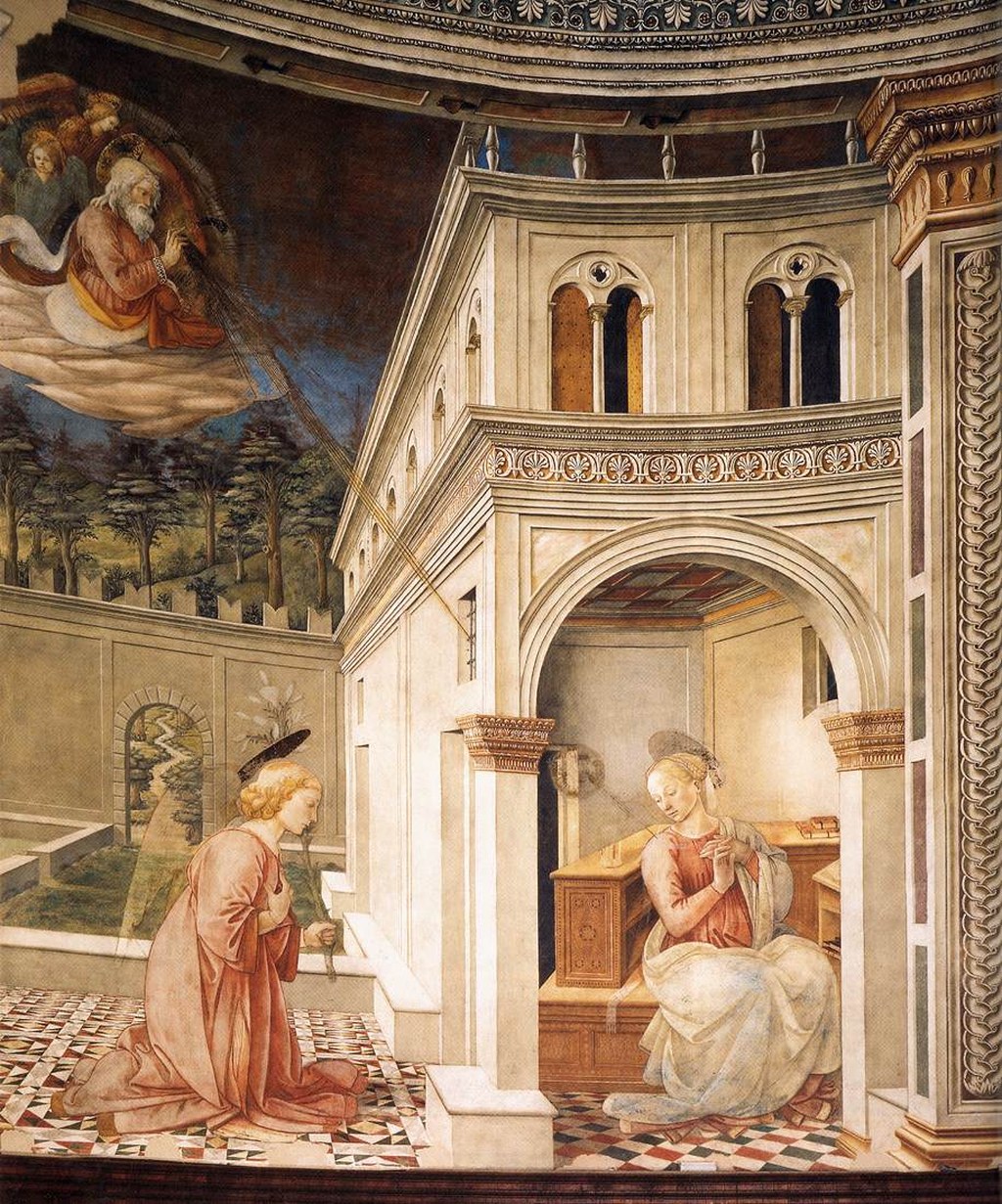
Spoleto: the final frescoes. Fra Filippo's final monumental commission was the Stories of the Virgin in the apse of Spoleto Cathedral. The surviving programme includes the Annunciation, Nativity, Death of the Virgin and Coronation of the Virgin. The cycle returns to subjects Lippi had painted throughout his life, but now on the scale of cathedral architecture. It also brings his career to a literal conclusion: Lippi died in Spoleto in October 1469 before completion, and assistants finished the work.
His burial in the cathedral gives the cycle an unusual biographical resonance. Spoleto is not simply the site of his last surviving frescoes; it became the place where his life, workshop and posthumous memory converged.
How Lippi's paintings changed. Across these works, Lippi's development is not a straightforward march away from Masaccio. Early monumentality remains available to him, but he adds other priorities: delicacy, ornament, emotional accessibility, contemporary domestic detail and a more flexible use of perspective. His Madonnas become increasingly intimate, but he can still handle ceremonial scale. His fresco narratives turn architecture into a mechanism for organising time. His portrait demonstrates attention to secular identity, while Medici commissions show his ability to design for highly specific private spaces.
The result is a body of work broad enough to challenge the stereotype of Lippi as merely a painter of pretty Madonnas. His paintings document almost every major function of fifteenth-century Florentine art: altar, convent, palace, household, confraternity, civic cathedral, family devotion and dynastic display.
Legacy
Lippi's most visible artistic heir was Botticelli. The younger artist absorbed his master's graceful contours, delicate facial types and intimate sacred relationships, then extended them into a more linear and poetic language. Filippino Lippi inherited the name and some of the workshop tradition but developed under different conditions, including close contact with Botticelli. The comparison between father and son is therefore not a simple family succession. It is a network in which workshop, patronage and stylistic inheritance intersect.
For modern viewers, Fra Filippo's major works offer an unusually rich introduction to Renaissance painting because they combine formal innovation with social history. To look closely at them is to encounter not only colour and composition but marriage, charity, monastic life, Medici power, workshop economics, conservation and the changing idea of artistic authorship.
Discussion
What stands out to you most about Paintings in relation to Filippo Lippi's wider career?
Reader Insights
Notice how the page connects close visual detail with patronage, workshop practice and the wider Renaissance setting.
Which comparison elsewhere in the cluster helps clarify this work or theme most strongly?
Join the Conversation
Have a thought or observation about Paintings? Share it below. Thoughtful responses may be added to this section.
References
- National Gallery, London, Fra Filippo Lippi artist biography and collection entries. View Source.
- Uffizi Galleries, Fra Filippo Lippi collection entries, including Madonna and Child with Two Angels and Coronation of the Virgin. View Source.
- Metropolitan Museum of Art, Fra Filippo Lippi collection records.
- National Gallery of Art, Washington, Fra Filippo Lippi artist and object records. View Source.
- Musei Diocesani di Prato, institutional research portal on Fra Filippo Lippi and the Prato Cathedral frescoes. View Source.
- Jeffrey Ruda, Fra Filippo Lippi: Life and Work with a Complete Catalogue, 1993.
- Megan Holmes, Fra Filippo Lippi: The Carmelite Painter, Yale University Press, 1999.